
Last updated: 03-11-2023
Sun Wukong’s magic staff is famed in popular culture for its ability to grow and shrink but less so for its great weight. The latter quality is best demonstrated in Journey to the West (Xiyouji, 西遊記, 1592; “JTTW” hereafter) chapter 56 when human bandits attempt and fail to pick up the 8.8 ton weapon:
Sticking the rod into the ground, Pilgrim said to them, “If any of you can pick it up, it’s yours.” The two bandit chiefs at once went forward to try to grab it, but alas, it was as if dragonflies were attempting to shake a stone pillar. They could not even budge it half a whit! This rod, you see, happened to be the “As-You-Will” Gold-Banded Staff, which tipped the scale in Heaven at thirteen thousand, five hundred catties [yiwan sanqian wubai jin, 一萬三千五百斤; 17,559.81 lbs. / 7,965 kg]. [1] How could those bandits have knowledge of this? The Great Sage walked forward and picked up the rod with no effort at all. Assuming the style of the Python Rearing its Body, he pointed at the bandits and said, “Your luck’s running out, for you have met old Monkey!” (Wu & Yu, 2012, vol. 3, p. 81).
I suggested in one of my earliest articles that the weight of Monkey’s staff had a connection to Chinese numerology:
Thirteen thousand five hundred is divisible by nine, which Chinese numerology considers to represent “infinity.” So it’s possible the number (infinity multiplied) was meant to convey that the staff was heavy beyond comprehension, something that only a divine hero such as Monkey would be able to wield.
While I still agree that the great weight cements his position as a superior hero, I no longer believe that the number is directly connected to numerology.
Table of Contents
1. Connection to the Water Margin
I now suggest that the weapon’s weight was directly influenced by a scene in chapter 28 of the Water Margin (Shuihu zhuan, 水滸傳, c. 1400). It involves the bandit Wu Song lifting a heavy stone block:
[Wu Song:] “You mean I haven’t got my strength back? All right. How heavy is the stone block [shi dun, 石墩] I saw in front of the Heavenly King Temple yesterday?” [2]
[Shi En, a young admirer] “Probably four to five hundred catties [si wu bai jin, 四五百斤; 520.29 to 650.36 lbs. / 236 to 295 kg].”
“Let’s take a look. I wonder whether I can move it.”
“Please have some food and wine first.”
“There’ll be time enough for that when we come back.”
The two men walked to the Heavenly King Temple. The prisoners on the grounds bowed and hailed them respectfully. Wu Song shook the stone slightly. He laughed.
“This soft life is spoiling me. I’ll never be able to pick it up!”
“You shouldn’t scoff,” said Shi En. “That stone weighs three to five hundred catties [san wu bai jin, 三五百斤; 390.21 to 650.36 lbs. / 177 to 295 kg]!”
Wu Song grinned. “You really think I can’t lift it? Get back, you men, and watch this.”
He slipped off his tunic and tied the sleeves around his waist. Embracing the stone, he raised it easily [fig. 1], then tossed it away with both hands. It dropped with a thud, sinking a chi [尺; 12.3 in / 31.8 cm] into the earth. The watching prisoners were astonished.
Wu Song grasped the stone with his right hand and lifted. With a sudden twist, he flung it upwards. It sailed one zhang [丈; 10.25 ft / 3.18 m] into the air. He caught it in both hands as it came down and lightly put it back in its original place. He turned and looked at Shi En and the prisoners. His face wasn’t flushed, he wasn’t even breathing hard, his heart beat calmly (based on Shi & Luo, 1993/2001, vol. 2, pp. 590-591).
武松道: “只是道我沒氣力了! 既是如此說時, 我昨日看見天王堂前那個石墩, 約有多少斤重?” 施恩道: “敢怕有四五百斤重。” 武松道: “我且和你去看一看, 武松不知拔得動也不。” 施恩道: “請吃罷酒了同去。” 武松道:“且去了回來吃未遲。” 兩個來到天王堂前, 眾囚徒見武松和小管營同來, 都躬身唱喏。武松把石墩略搖一搖, 大笑道: “小人真箇嬌惰了, 那裡拔得動!” 施恩道:“三五百斤石頭, 如何輕視得他。” 武松笑道: “小管營也信真箇拿不起? 你眾人且躲開, 看武松拿一拿。” 武松便把上半截衣裳脫下來, 拴在腰裡, 把那個石墩只一把, 輕輕地把將起來, 雙手把石墩只一撇, 撲地打下地里一尺來深。眾囚徒見了, 盡皆駭然。武松再把右手去地里一提, 提將起來, 望空只一擲, 擲起去離地一丈來高。武松雙手只一接, 接來輕輕地放在原舊安處, 回過身來, 看着施恩並眾囚徒。武松面上不紅, 心頭不跳, 口裡不喘。(Shi & Luo, 1975/2021a, vol. 1, p. 391)

Fig. 1 – Wu Song lifts the stone block (larger version). Image found here.

Now compare it to the scene in JTTW chapter three where Monkey first procures his magic staff:
“Take it [the staff] out and let me see it,” said Wukong. Waving his hands, the Dragon King said, “We can’t move it! We can’t even lift it! The high immortal must go there himself to take a look.” “Where is it?” asked Wukong. “Take me there.”
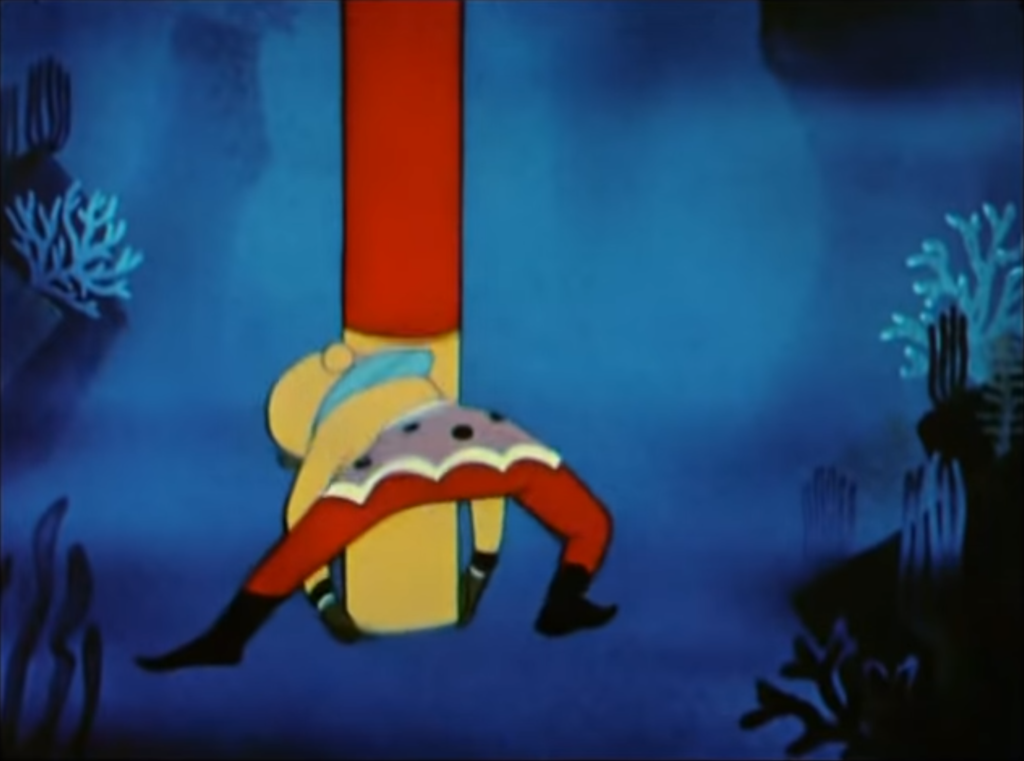
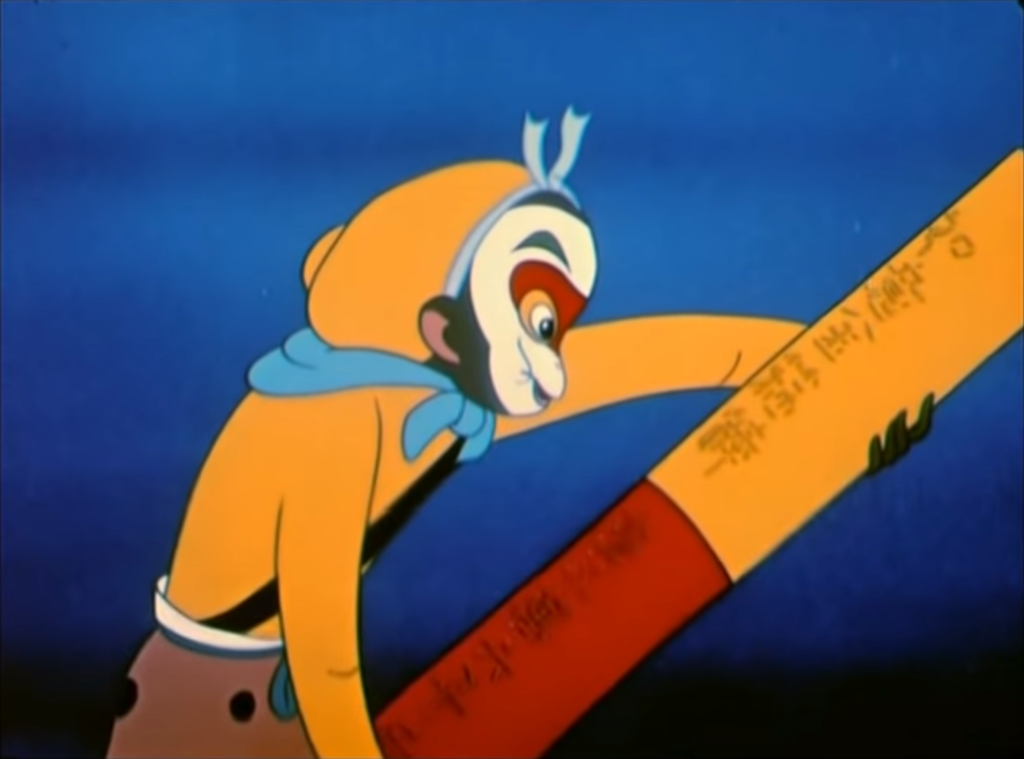
The Dragon King accordingly led him to the center of the ocean treasury, where all at once they saw a thousand shafts of golden light. Pointing to the spot, the Dragon King said, “That’s it—the thing that is glowing.” Wukong girded up his clothes and went forward to touch it: it was an iron rod [tie zhuzi, 鐵柱子] more than two zhang [丈; 20.5 ft / 6.36 m] long and as thick as a barrel. Using all his might, he lifted it with both hands [fig. 2], saying, “It’s a little too long and too thick. It would be more serviceable if it were somewhat shorter and thinner.” Hardly had he finished speaking when the treasure shrunk a few chi [尺; 1 = 12.3 in / 31.8 cm] in length and became a layer thinner. “Smaller still would be even better,” said Wukong, giving it another bounce in his hands. Again the treasure became smaller. Highly pleased, Wukong took it out of the ocean treasury to examine it. He found a golden hoop at each end, with solid black iron in between. Immediately adjacent to one of the hoops was the inscription, “‘As-You-Will’ Gold-Banded Staff. Weight: thirteen thousand five hundred catties [Ruyi jingu bang zhong yiwan sanqian wubai jin, 如意金箍棒,重一萬三千五百斤] [fig. 3].” He thought to himself in secret delight, “This treasure, I suppose, must be most compliant with one’s wishes.” As he walked, he was deliberating in his mind and murmuring to himself, bouncing the rod in his hands, “Shorter and thinner still would be marvelous!” By the time he took it outside, the rod was no more than twelve chi in length and had the thickness of a rice bowl (Wu & Yu, 2012, vol. 1, p. 135). [3]

Fig. 2 – Monkey lifts the iron pillar (larger version). Fig. 3 – Sun looks at the inscription, including the weight (larger version). Screenshots from the 1960s classic Havoc in Heaven.
2. Comparison
Both scenes involve a hero (Wu Song vs. Sun Wukong) asking someone (Shi En vs. Ao Guang) to show them a heavy object that cannot be moved (stone block vs. iron pillar). Both heroes then adjust their clothing before easily lifting the object with both hands. Most importantly, the Chinese characters for the weight of each object (三五百斤 vs. 一萬三千五百斤) are similar. The only difference is the addition of 一萬 and 千, respectively (fig. 4). [4] Now, someone might say the numbers are meaningless as “three to five hundred” is a common estimate for lengths, distances, and people used throughout the Water Margin (some examples). But the proposed connection is strengthened when you take into account the many similarities shared by Monkey and Wu. I show in this article that both are reformed supernatural spirits previously trapped under the weight of magic mountains, slayers of tigers, Buddhist monks nicknamed “Pilgrim,” monastic masters of martial arts, wearers of moralistic golden headbands, and wielders of bin steel weapons. Therefore, given the close historical and cultural ties between the two characters, I believe that the JTTW author-compiler embellished the Water Margin episode to portray Sun as a hero like no other, a divine immortal that can lift weights far beyond even Wu Song himself.

Fig. 4 – The weight of Monkey’s staff where the red characters represent additions to the weight of Wu Song’s stone in black.
3. Updates
Update: 03-11-23
My friend and contributor Saie Surendra (his website) was recently sent a video similar to this one suggesting another possible origin for the weight of Monkey’s staff. [5] The speaker, Lan Yanling (兰彦岭), states, “The Golden-Hooped Staff weighs 13,500 catties, and everyday a person breathes 13,500 times” (金箍棒重13,500斤,人一天呼吸13,500次). The specific number of breaths is drawn from ancient medical treatises, some of which were absorbed into the Daoist canon.
For example, the first scroll of The Yellow Emperor’s Canon of Eighty-One Difficult Issues (Huangdi bashiyi nanjing, 黃帝八十一難經) reads:
A person, in the course of one day and one night, breathes altogether 13,500 times (Unschuld, 1986, p. 65).
This second possibility is interesting as Sun achieves immortality through a series of breathing and energy circulation exercises. This means that, if the number did influence the weapon’s weight, one could speculate that the staff is a physical manifestation of the methods by which he gained his powers.
I’m not quite sure how I feel about this new possibility. On one hand, it doesn’t require adding characters (i.e. 一萬 and 千) to come up with the figure 13,500 (refer back to section 2). But on the other, it lacks the literary context laid out in the main article. I’ll have to look into this more.
Notes:
1) I have changed Yu’s (Wu & Yu, 2012) dry rendering “Compliant Golden-Hooped Rod” to a more pleasant one based on W.J.F. Jenner (Wu & Jenner, 1993/2001, vol. 1, p. 56). Also, Yu’s (Wu & Yu, 2012) original translation says “thirteen thousand five hundred pounds” (vol. 1, p. 135). However, the Chinese version uses jin (斤), known in English as “catty.” The catty and pound are two different measures of weight, the former being heavier than the latter. Therefore, the English text has been altered to show this. The catty during the Ming Dynasty when the novel was compiled equaled 590 grams (Elvin, 2004, p. 491 n. 133; Jiang, 2005, p. xxxi), so 13,500 catties would be roughly 17,560 lbs.
2) I’ve updated the English translation because it didn’t mention the specific temple name appearing in the original Chinese version.
3) Both the original Chinese and the translation say that the staff shrank to “no more than two zhang in length” (zhiyou er zhang changduan, 只有二丈長短) (based on Wu & Yu, 2012, vol. 1, p. 135), but it was close to two zhang (20.5 ft / 6.36 m) from the start. Irwen Wong of the Journey to the West Library blog has suggested to me that this is a likely error for “one zhang two (chi)” (丈二; 12.3 ft / 3.74 m). I’ve, therefore, modified the translation.
4) These mean “10,000” (yiwan, 一萬) and “1,000” (qian, 千), respectively. When combined with the character for three, the latter becomes “3,000” (sanqian, 三千).
5) The video was sent to him by an acquaintance named Afeng.
Sources:
Elvin, M. (2004). The Retreat of the Elephants: An Environmental History of China. New Haven (Conn.): Yale university press.
Jiang, Y. (2005). The Great Ming Code / Da Ming Lu. Vancouver, Wa: University of Washington Press.
Shi, N., & Luo, G. (2021a). Shuihu zhuan (shang, zhong, xia) [Tale of the Water Margin (Vols. 1-3)]. Beijing: Renmin wenxue chubanshe. (Original work published 1975)
Shi, N., Luo, G., & Shapiro, S. (2001b). Outlaws of the Marsh (Vols. 1-4) (S. Shapiro, Trans.). Beijing, China: Foreign Languages Press. (Original work published 1993)
Unschuld, P. (1986). Nan-Ching: The Classic of Difficult Issues; With Commentaries by Chinese and Japanese Authors from the Third through the Twentieth Century. Berkeley, CA: University of California Press.
Wu, C., & Jenner, W. J. F. (2000). Journey to the West (Vols. 1-4). Beijing, China: Foreign Languages Press. (Original work published 1993)
Wu, C., & Yu, A. C. (2012). The Journey to the West (Vols. 1-4) (Rev. ed.). Chicago, Illinois: University of Chicago Press.