
Last updated: 01-25-2025
Anyone who has read Journey to the West (Xiyouji, 西遊記, 1592) will know that the Tang monk Tripitaka (Tang Sanzang, 唐三藏; a.k.a. Xuanzang) is said to be an incarnation of Master Golden Cicada (Jinchan zi, 金蟬子), the Buddha’s fictional second disciple. The full picture of his past can be pieced together from verse and character dialogue throughout the narrative. This culminates with the Tathagata‘s explanation in chapter 100:
Because you failed to listen to my exposition of the law and slighted my great teaching, your true spirit was banished to find another incarnation in the Land of the East [i.e. China]. Happily you submitted and, by remaining faithful to our teaching, succeeded in acquiring the true scriptures (Wu & Yu, 2012, vol. 4, p. 381).
In the course of my research, I’ve come across two other examples of Buddhist deities from Ming-Qing Chinese vernacular literature that are exiled from the Western Heaven. In this article, I would like to highlight these stories, as well as analyze them alongside Master Golden Cicada’s tale to record parallels. It’s important to note that all examples are connected to the Journey to the West story cycle. Finally, I will show that the presented examples share similarities with Greek philosophy.
I wrote this to better understand how the story of Master Golden Cicada’s exile may have come about.
Table of Contents
- 1. Master Golden Cicada
- 2. Miao Jixiang
- 3. The Great Peng
- 4. Analysis
- 5. Similarities to Western Philosophy
- 6. Updates
1. Master Golden Cicada
For the record, the fullest account of Tripitaka’s past is described by Sun Wukong in chapter 81:
“You don’t realize that Master was the second disciple of our Buddha Tathagata, and originally he was called Elder Gold Cicada. Because he slighted the Law, he was fated to experience this great ordeal.”
“Elder Brother,” said Eight Rules, “even if Master did slight the Law, he had already been banished back to the Land of the East where he took on human form in the field of slander and the sea of strife. After he made his vow to worship Buddha and seek scriptures in the Western Heaven, he was bound whenever he ran into monster-spirits and he was hung high whenever he met up with demons. Hasn’t he suffered enough? “Why must he endure sickness as well?”
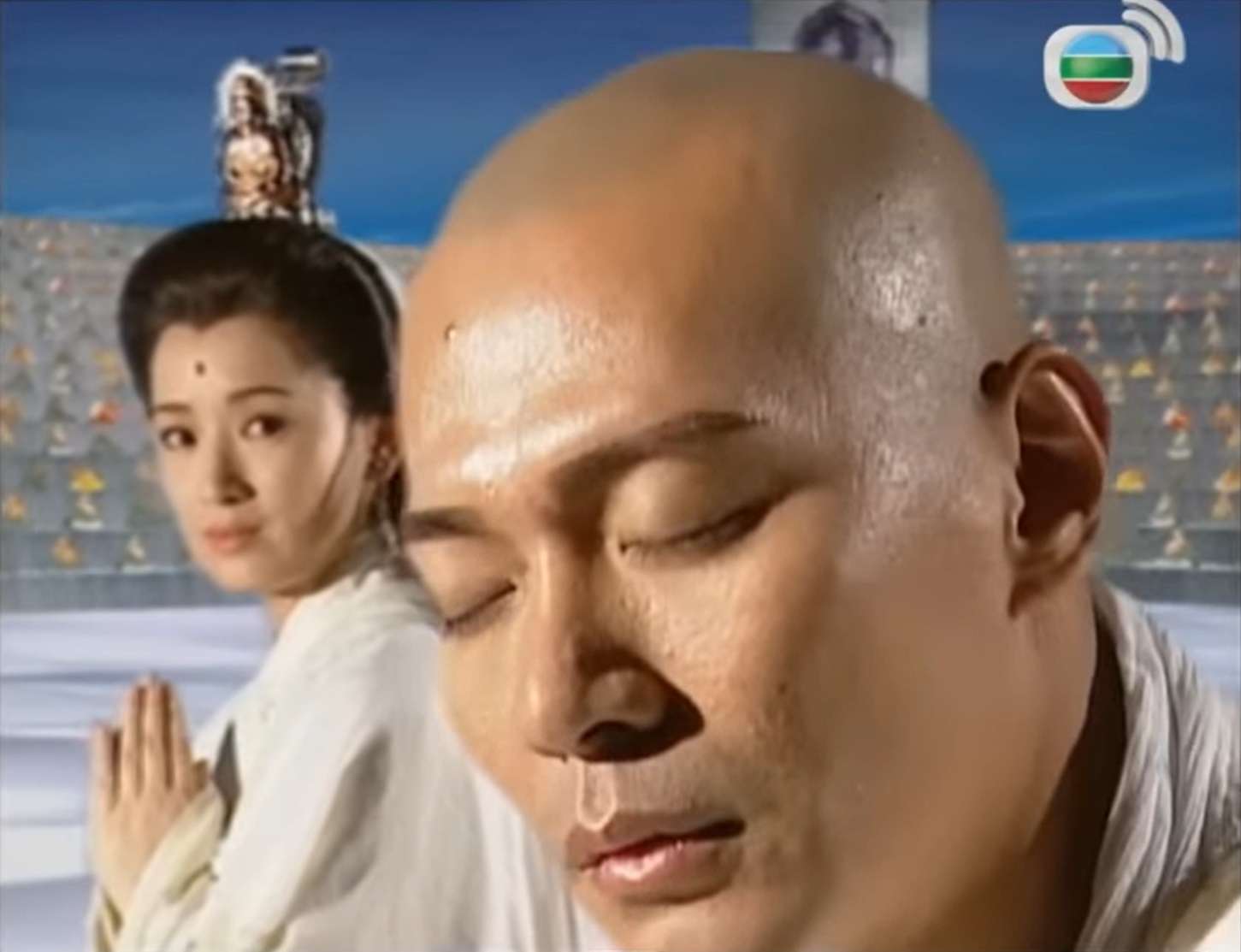
“You wouldn’t know about this,” replied Pilgrim. “Our old master fell asleep while listening to Buddha expounding the Law [fig. 1]. As he slumped to one side, his left foot kicked down one grain of rice. That is why he is fated to suffer three days’ illness after he has arrived at the Region Below.” [1]
Horrified, Eight Rules said, “The way old Hog sprays and splatters things all over when he eats, I wonder how many years of illness I’d have to go through!”
“Brother,” said Pilgrim, “you have no idea either that the Buddha is not that concerned with you and other creatures. But as people say:
Rice stalks planted in noonday sun
Take root as perspiration runs.
Who knows of this food from the soil
Each grain requires most bitter toil?Master still has one more day to go, but he’ll be better by tomorrow” (Wu & Yu, 2012, vol. 4, p. 82).

Fig. 1 – Master Golden Cicada falls asleep during the Buddha’s sermon (larger version). Screenshot from episode one of the 1996 Journey to the West TV show.
2. Miao Jixiang
Miao Jixiang (妙吉祥) is a former oil lamp-turned-humanoid Buddhist disciple who briefly appears in chapter one of Journey to the South (Nanyouji, 南遊記, c. 1570s-1580s). He is exiled from the Western Heaven for using his holy flame to kill a belligerent sage. But Miao escapes underworld punishment thanks to the intervention of the Bodhisattva Guanyin. He is later reborn in China as a number of figures, most famously the popular martial deity Huaguang dadi (華光大帝; variously translated as “Great Emperor of Flowery/Resplendent/Magnificent/Majestic Light”):
That Great King of the Single Flame [Duhuo dawang, 独火大王] … wanted to incinerate Spirit Mountain. Fortunately, the Tathagata foresaw this with his all-seeing eyes, and so he recited a mantra, summoning five hundred dragons that brought forth dew and fog to cover the mountain.
Unable to unleash his fire, this Single-Flame demon became angry, rampaging to the left and right of the temple and hurling insults.
Miao Jixiang [2] offered a word of advice, “You are not the same caliber of wisdom as we Buddhist disciples. You can leave if you want; it makes no difference.”
“If you enrage my heart-mind, I will burn your dog bones to death!” replied the Great King of the Single Flame.
Miao Jixiang laughed, “You can only burn others. You can never burn me. If you can burn me, I will acknowledge you as superior.”
Anger racing through him, the Great King set loose his Fire of the Five Dippers, but Miao Jixiang remained perfectly still.
He laughed, “You monster, how could your fire burn me? I used to be the oil lamp before the Tathagata’s Dharma Hall, burning brilliantly day and night, listening to the sutras, and inquiring about the Dharma. I have accumulated many candle wicks during this time. But one day, Tathagata recited a spell and bestowed onto me a human body. With my appearance, spirit, hearing, and origins all arising from fire, how could you burn me? You monster, if you continue to harass our Spirit Mountain and cause us unease, I will inevitably bring forth my Perfected Fire of Samadhi to burn you monster to death, so as to avoid any future troubles.”
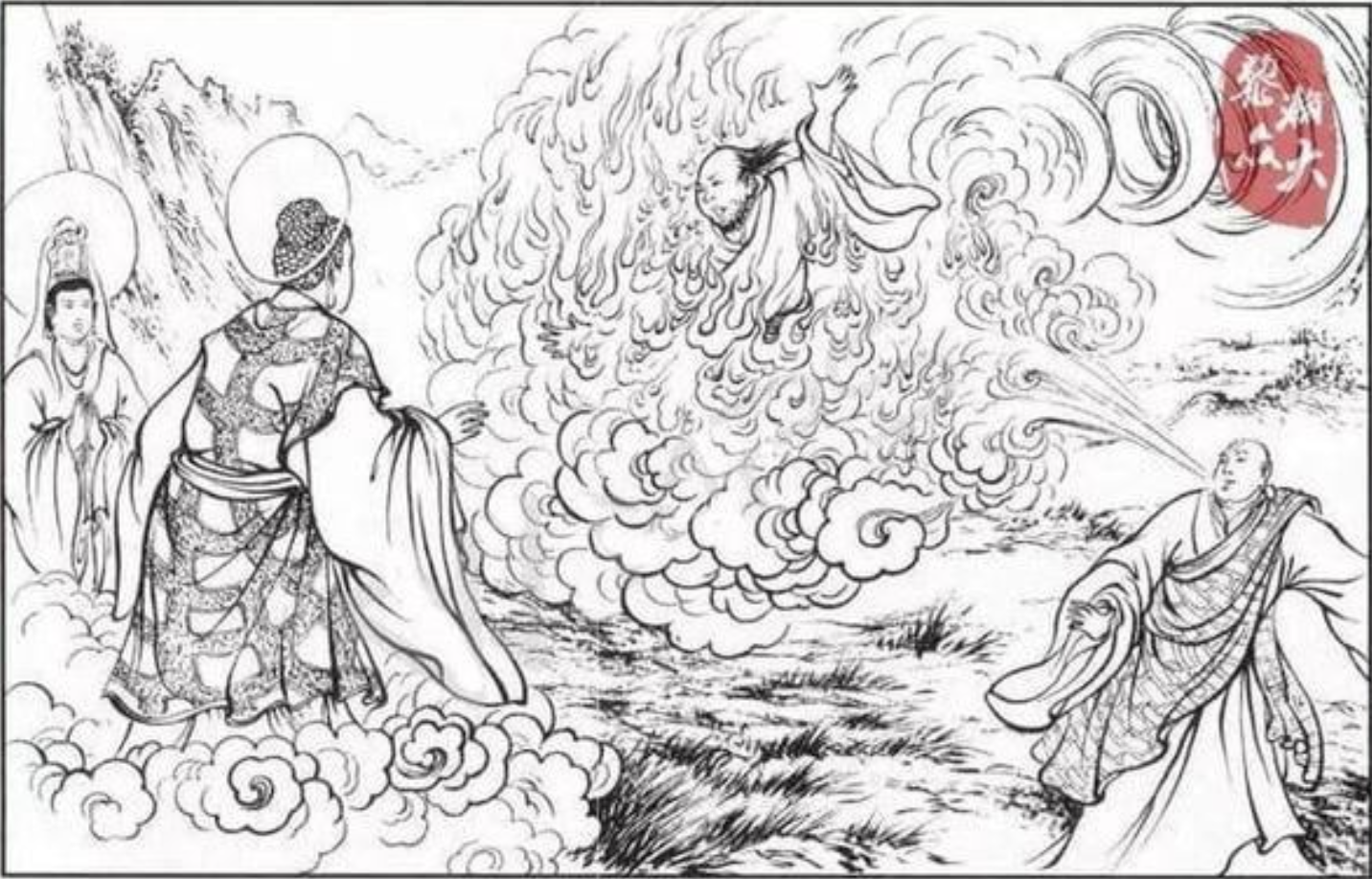
Watching this with his all-seeing eyes, the Tathagata was about to stop Miao Jixiang, but the latter had already unleashed his fire and burned that damnable Single Flame to death [fig. 2].
Furious, the Tathagata summoned heavenly generals to arrest Miao Jixiang, “You beast, how dare you break my precepts?” Tathagata scolded. “Although he is wrong, you and I are Buddhists (chujia zhi ren, 出家之人, lit: “people who have left their families”); we’re supposed to be infinitely merciful. Why did you burn him to death? Such an act is intolerable by the Buddhist Dharma. I shall banish you to the underworld (yinshan, 陰山; lit: “mountain of yin/darkness”) to suffer.”
Miao Jixiang begged for forgiveness.
The Reverend Mother Guanyin came forward from one said to defend him by saying, “Although he is guilty, Miao Jixiang is a disciple of Spirit Mountain. He should not be banished to the underworld. When he was still alive, the Great King of Horse-Ear Mountain approached our Spirit Mountain to pray for a son. Now that his wife is pregnant, why not send Miao Jixiang to be reincarnated as her son? After Miao Jixiang goes through this catastrophe, he shall be allowed to return to Spirit Mountain and serve the Master. Why not do this?”
Nodding, Tathagata was about to send Miao Jixiang away.
“My master, you order me to reincarnate,” Miao Jixiang said in tears, “but if I am deprived of the Divine Way, I am afraid that I will be bullied.”
Sitting atop his treasured throne, Tathagata recited a spell, “I shall now bestow you with the five supernatural powers: the heaven power, with which you can travel freely to heaven; the earth power, with which the earth will crack by itself if you want to get inside; the wind power, with which you are shadowless in the wind; the water power, with which you can travel without any obstacle in water; the fire power, with which you feel ease in the fire.”
Tathagata pointed his dharma finger at Miao Jixiang’s forehead, saying, “I will also bestow you with a heavenly eye, with which you can see all across the three realms.”
Tathagata ordered the Reverend Mother Guanyin to deliver Miao Jixiang to his reincarnation (adapted from pp. 10-11 of this PDF).

Fig. 2 – Miao Jixiang kills the Great King of the Single Flame (larger version). From a modern lianhuanhua comic. Image found here.
3. The Great Peng
The Complete Vernacular Biography of Yue Fei (Shuo Yue quanzhuan, 說岳全傳, 1684) depicts the Great Peng, the Golden-Winged King of Illumination (Dapeng jinchi mingwang, 大鵬金翅明王), [3] as a hot-tempered avian dharma protector stationed above the Tathagata’s head (fig. 3). He is exiled from the Western Heaven for killing a bat-spirit who farts during the Buddha’s sermon, and the bird is later reborn in China as the famed Song-era General Yue Fei (岳飛, 1103–1142):
Let’s talk about the Buddha Tathagata at the Great Thunderclap Monastery in the Western Paradise. One day, he sat on a nine-level lotus throne, and the Four Great Bodhisattvas, the Eight Great Vajra Warriors, the five hundred Arhats, the three thousand Heavenly Kings, nuns and monks, male and female attendants, all of the heavenly sages who protect the Dharma, gathered to listen to his lecture on the Lotus Sutra. His words were like flowers and precious jewels raining from the heavens. But, at that time, a star-spirit, the Maiden Earth Bat, who had been listening to the lecture from beneath the lotus throne, couldn’t bear it any longer and unexpectedly let out a stinky fart.
The Buddha was a great, merciful lord, so he didn’t mind even the slightest bit. But don’t console the Dharma protector above his head, [4] the “Great Peng, the Golden-Winged King of Illumination,” whose eyes shone with golden light and whose back was a scene of auspiciousness. He became angry when he saw the nasty, filthy Maiden Earth Bat, and so he unfurled both his wings and dropped down to kill the spirit by pecking her on the head. The light-point of her soul shot out of the Great Thunderclap Monastery and went to the Lands of the East (China) in the world below to find a mother and reincarnate. She was reborn as a daughter of the Wang clan. She would later marry the Song Prime minister Qin Hui (1091–1155) and come to cruelly kill the righteous (Yue Fei) as a means to get revenge against today’s enemy. We will talk about this later.
Let’s return to the Buddha, who saw what happened with his all-seeing eyes and exclaimed, “Good! Good! It turns out that this is an episode of karma (cause and effect).” Then he called the Great Peng bird to come closer and shouted, “You evil creature! You already took refuge in my teachings. How can you not follow the five precepts by daring to commit such a horrible crime? I don’t need you here; you will descend to the mortal world to pay off your (karmic) debt and wait until you have fulfilled your work. Once that is completed, only then will I allow you to return to the mountain to achieve the right fruit (Buddhist merit).” The Great Peng complied with the decree, flying out of the Great Thunderclap Monastery directly to the Lands of the East to be reincarnated. We will stop here (translated by the author).

Fig. 3 – Detail of an altar to the Great Peng, the Golden-Winged King of Illumination (larger version). Full image found here.


4. Analysis
There are four parallels shared between these stories. First, each character is exiled for disrespecting the Buddha. Master Golden Cicada falls asleep during the Tathagata’s sermon. Miao Jixiang kills a belligerent sage on the grounds of the Thunderclap Monastery. And the Great Peng kills the Maiden Earth Bat in the same hallowed place during the Buddha’s lecture. The latter two examples are similar in that both characters are admonished by the Tathagata for breaking the precept against killing. For the former, the Buddha exclaims, “You beast, how dare you break my precepts? … Such an act is intolerable by the Buddhist Dharma” (你這畜生如何敢破我戒?… 佛法難容). And for the latter, he screams, “You evil creature! You already took refuge in my teachings. How can you not follow the five precepts by daring to commit such a horrible crime?” (你這孽畜!既歸我教,怎不皈依五戒,輒敢如此行兇?). Admittedly, these acts make Master Golden Cicada’s sleeping far less serious in comparison.
Second, each is exiled from the Western Heaven in India to be reborn as a hero in China. Master Golden Cicada lives out a number of pious incarnations before his final life as Tripitaka, a learned monk who procures scriptures needed to release untold numbers of orphaned souls from the underworld. Miao Jixiang experiences several adventurous incarnations before his final life as Huaguang dadi, a martial deity who rids the world of evil spirits. And the Great Peng is reborn as Song Dynasty General Yue Fei, a patriot who fights against invading Jurchen forces which threaten the Middle Kingdom.
Third, all are exiled with the understanding that they will return once they have accumulated enough Buddhist merit and/or paid off a karmic debt. This is more implied in Master Golden Cicada/Tripitaka’s case when the Buddha reveals his past transgression and then grants him an elevation in spiritual rank to an enlightened being, thereby allowing him to return to the Western Heaven at the end of his story arc (Wu & Yu, 2012, vol. 4, p. 381). Whereas with Miao Jixiang, this is openly suggested by Guanyin: “After [he] goes through this catastrophe, he shall be allowed to return to Spirit Mountain and serve the Master. Why not do this?” (等他大难满日,取回灵山,伏侍师父,何不可也。) The Tathagata agrees to this arrangement. As for the Great Peng, the Buddha states,
[Y]ou will descend to the mortal world to pay off your (karmic) debt and wait until you have fulfilled your work. Once that is completed, only then will I allow you to return to the mountain to achieve the right fruit (Buddhist merit).
And fourth, all are connected to the Journey to the West story cycle. For instance, in chapter one of Journey to the South (c. 1570s-1580s), “Pilgrim Sun” (Sun xingzhe, 孫行者; i.e. Sun Wukong) wins first place in a competition between the gods of the Buddho-Daoist pantheon to see who owns the greatest celestial treasure (see pp. 6-7 of this PDF). And in chapter 17, Monkey fights Miao Jixiang’s reincarnation, Huaguang dadi, because the latter framed the former for the theft of immortal peaches. The Great Sage initially wins the encounter, but he is unexpectantly burned at the last minute, leaving his non-canonical daughter to finish the fight (see pp. 107-110 of this PDF). And the Great Peng originally appears as a demon king named the “Peng of Ten Thousand Cloudy Miles” (Yuncheng wanli peng, 雲程萬里鵬) in chapters 74 to 77 of Journey to the West (1592). At the end of his arc, he is trapped above the Buddha’s head (fig. 4):
Perceiving the Peng’s intentions, Tathagata produced a golden light and, facing the wind, and gave his head (which had once supported the nests of magpies) a shake. The head changed at once into a piece of meat dripping with fresh blood. Stretching out his claws, the monster-spirit drew near and tried to clutch at the piece of meat. Our Father Buddha pointed at him with his finger and immediately the monster-spirit felt such cramps throughout his huge wings that he could not fly away. He was trapped above the Buddha’s head in his true form: the Great Peng, a golden-winged eagle [fig. 4] (based on Wu & Yu, 2012, vol. 4, p. 31).
如來情知此意,即閃金光,把那鵲巢貫頂之頭迎風一幌,變做鮮紅的一塊血肉。妖精掄利爪叼他一下。被佛爺把手往上一指,那妖翅膊上就了筋,飛不去,只在佛頂上不能遠遁,現了本相,乃是一個大鵬金翅鵰。
The Great Peng later begrudgingly agrees to submit to Buddhism (Wu & Yu, 2012, vol. 4, p. 31). Therefore, this explains his lofty position in The Complete Vernacular Biography of Yue Fei (1684).

Fig. 4 – The Great Peng trapped above the Buddha’s head (larger version). From Chen Huiguan’s Newly Illustrated and Complete Journey to the West (Chen Huiguan Xinhui Quanben Xiyouji, 陈惠冠新绘全本西游记, 2001).

5. Similarities to Western Philosophy
McEvilley (2002) comments that the Greek philosopher Empedocles (5th c. BCE) wrote of gods being exiled for ten thousand years for the crime of murder or lying under oath. The fallen deity was believed to reincarnate into every creature of land, air, and sea, and when their long punishment was over, they were reborn in their last life as a person of high culture, such as royalty, religious leaders, and scholars. They then returned to their former heavenly station upon death (McEvilley, 2002, pp. 106-107). These beliefs mirror the misdeeds (sleeping and murder), exile from heaven, experience of reincarnation, and then eventual return to heaven of Master Golden Cicada, Miao Jixiang, and the Great Peng. These similarities likely point to a broader concept in Greco-Indian philosophy that made its way into Chinese vernacular fiction.
6. Updates
Update: 01-25-25
I have suggested that a historical disciple of the Buddha influenced the episode of Master Golden Cicada falling asleep. See 01-25-25 update here:
Notes:
1) Tripitaka’s additional punishment points to the supreme importance of rice in an agrarian society like ancient China.
2) Miao Jixiang should not be confused with the Bodhisattva Manjushri, who has the same Chinese name in some older Buddhist literature (Von Glahn, 2004, p. 214).
3) The mingwang (明王, “illumination king”) of the Great Peng’s Buddhist title could also mean “wisdom king,” which refers to spiritual knowledge.
4) My previous article traces the religious motif of a bird (Garuda) hovering above the heads of Buddhist personages to Hindo-Buddhist architecture in ancient India.
Sources:
McEvilley, T. (2002). The Shape of Ancient Thought: Comparative Studies in Greek and Indian Philosophies. New York: Allworth.
Von Glahn, R. (2004). The Sinister Way: The Divine and the Demonic in Chinese Religious Culture. United Kingdom: University of California Press.
Wu, C., & Yu, A. C. (2012). The Journey to the West (Vols. 1-4) (Rev. ed.). Chicago, Illinois: University of Chicago Press.