
Last updated: 01-09-2023
At the end of Journey to the West (Xiyouji, 西遊記, 1592) chapter seven, Sun Wukong is crushed under Five Elements Mountain for 600-plus-years as punishment for attempting to usurp the throne of heaven. I’ve previously described how this sentence is based on Tang and Song-era tales of the Sage-King Yu the Great imprisoning an aquatic simian demon beneath a mountain. Monkey’s time pinned by the landmass has been portrayed numerous times in movies and television, but modern media often forgets that this was only part of his punishment. The other half was a hellish diet:
Moved by compassion, he [the Buddha] recited a divine spell and called together a local spirit and the Fearless Guards of Five Quarters to stand watch over the Five-Phases Mountain [fig. 1]. They were told to feed the prisoner with iron pellets [tie wanzi, 鐵丸子] when he was hungry and to give him melted copper [ronghua de tong zhi, 溶化的銅汁] to drink when he was thirsty. When the time of his chastisement was fulfilled, they were told, someone would be coming to deliver him (Wu & Yu, 2012, vol. 1, p. 199).
又發一個慈悲心,念動真言咒語,將五行山召一尊土地神祇,會同五方揭諦,居住此山監押。但他饑時,與他鐵丸子吃;渴時,與他溶化的銅汁飲。待他災愆滿日,自有人救他。

Fig. 1 – One of the guards charged with watching over Monkey (larger version). From the children’s book Son Goku (1939).
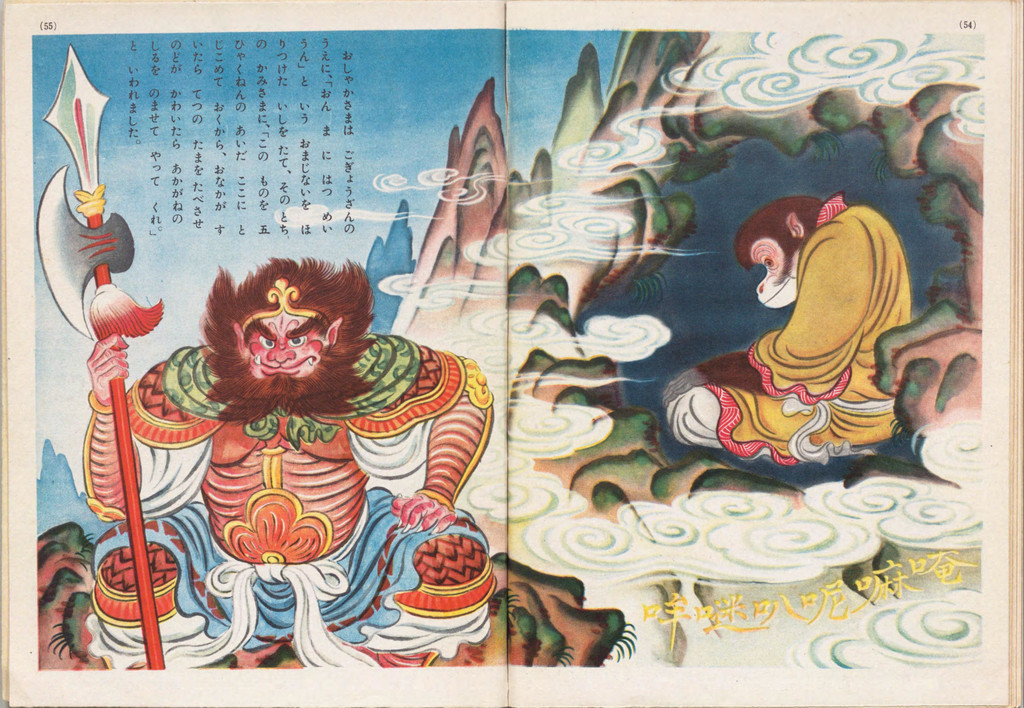
Table of Contents
- 1. The Origin
- 1.1. Additional Info
- 2. Other Damned Celestials
- 3. Updates
1. The Origin
This punishment comes directly from Buddhist doctrine describing the torture of sinners in hell (Sk: Naraka; Ch: Diyu, 地獄). For example, the Dīrghāgama (Sk: दीर्घागम; Ch: Chang Ahun Jing, 長阿含經, or “The Collection of Long Scriptures”) [1] describes two realms in hell in which the damned are fed such a horrific diet:
[…] Terrified they [a damned soul] run out, seeking safety and refuge, but they arrive at the Hell of Hunger [Ji’e diyu, 飢餓地獄].
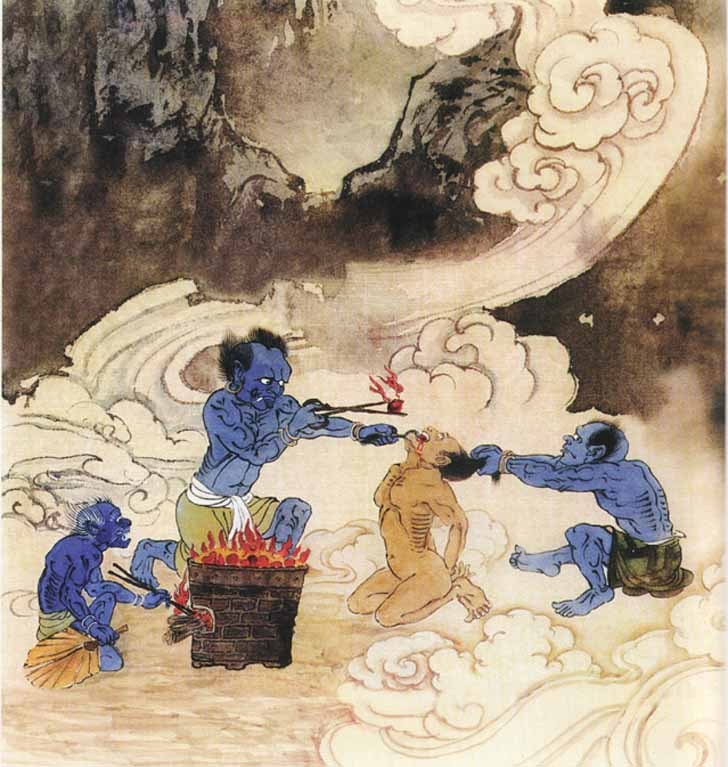
The wardens come to ask them: “Since you came here, what do you want?” They answer: “We are hungry”. The wardens then seize them and throw them on burning iron. They are caused to stretch and spread out their bodies; with iron hooks the wardens hook the sinners’ mouths and force them open; they put [hot] iron pellets into them [fig. 2]. The pellets burn their lips and tongues, from the throats down to their stomachs. The pellets penetrate through the sinners; there is nothing but burning. The horrible, fatal, and bitter suffering makes the sinners shriek and moan. Since their punishment is not yet completed, the sinners do not perish. After having suffered for a long time, they leave the Hell of Hunger. Frightened they run away, looking for relief and safety, until they arrive to the Hell of Thirst [Ke diyu, 渴地獄].
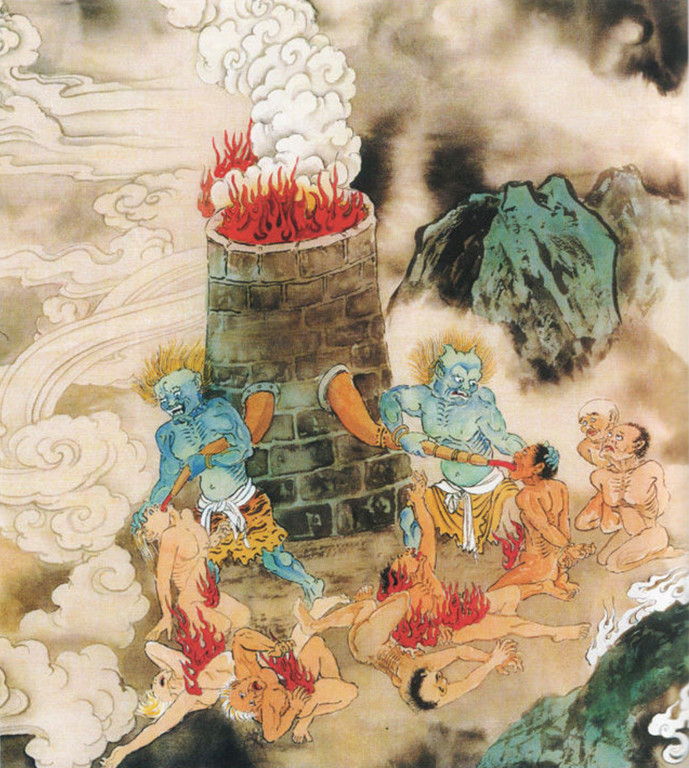
The wardens come to them and ask: “Since you came here, what do you want?” They answer: “We are thirsty.” The wardens thereupon seize the sinners and throw them on burning iron. They are caused to stretch and spread out their bodies; with hot iron hooks, the wardens hook the sinners’ mouths and force them open. They pour down molten copper [fig. 3]. It burns their mouth, lips and tongue; from their throats it reaches their stomachs. It penetrates down and goes through them; there is nothing but burning. The terrible, fatal, and bitter suffering makes the sinners shriek and moan. Since the remaining transgressions have not yet been atoned, they do not perish. After having been subjected to this punishment for a long time, they leave the Hell of Thirst (Howard, 1986, p. 131).

Fig. 2 – A damned soul being force-fed red hot iron pellets (larger version). Fig. 3 – Souls being forced to drink molten copper (larger version).
1.1. Additional Info
The same source explains that the hells of hunger and thirst are the respective fourth and fifth of sixteen minor hells (shiliu xiaoyu, 十六小獄) making up one of the eight greater purgatories (ba da diyu, 八大地獄) called the hell of consciousness (xiang, 想). Sinners reborn into this labyrinth of pain are full of anger and lash out at each other with scythe-like claws, as well as swords and daggers. They remain conscious through endless rounds of dismemberment and resurrection via a cold, magical wind (lengfeng, 冷風). They then wander into each successive minor hell, enduring everything from grinding by hot millstones to their flesh and bones being shattered by blistering cold. Again, each sinner remains conscious and resurrects between each purgatory (Howard, 1986, pp. 129-134).
Another name for the greater hell of consciousness is the Sanskrit term Samjiva (Ch: Denghuo, 等活), meaning “revival” or “repetition.” These might refer to the cyclical resurrection of the sinner, or to their karmic punishment mirroring what they did to others in life (Buswell & Lopez, 2014, p. 754).
It should be noted that unlike the Judeo-Christian tradition, rebirth in the Buddhist hell is not forever. For some it may last eons, but the torture serves to cleanse the spirit of past sins gained in life. Once the karmic debt has been repaid, the soul will be reborn into one of the other six realms of existence: hell, hungry ghost, animal, human, asura, or deva. Sometimes souls have to work their way back up to human status if they have particularly heavy karmic baggage.
Monkey’s punishment is essentially hell on earth. The Five Elements Mountain pins him down so that the chosen guards can torture him with hot iron pellets and molten copper just like those in the subterranean hells of hunger and thirst. He is not capable of dying, so his immortality serves a similar function to the magic wind that continually resurrects the damned. The finite length of his sentence (600-plus-years) is similar to the way a soul will only stay in the hell realm until they have repaid their karmic debt. And Tripitaka delivering him from his torments is like a soul being reborn into a new life. After all, Monkey’s life drastically changes after his release; he goes from being a rebellious, power-hungry demon, to a Buddhist monk devoted to the protection of his master.
2. Other Damned Celestials
Sun Wukong is not the only celestial to be damned to drink molten copper. Readers may be surprised to learn that King Yama (Yanluo Wang, 閻羅王), fifth of the Ten Judges of Hell, also suffers from this affliction. The aforementioned Dīrghāgama reads:
Buddha said to the bhiksus: “South of Jambudvipa, in the interior of the great Diamond Mountain, lies the palace of King Yama. The realm he governs extends for six thousand yojanas in both directions. His city has seven rows of ramparts, with seven nets and seven rows of trees … Day and night, three times a day, a huge copper cauldron automatically places itself in front of him. If the huge cauldron emerges in the interior of the palace, the king, upon seeing it, rushes out of the palace stricken by horror and fright. But then, if the cauldron emerges outside the palace, the king, upon seeing it, reenters the palace stricken by horror and fright. Giant hell wardens grab King Yama and have him lie down on hot irons. With iron hooks, they split his mouth open and force molten copper down. It burns his lips and tongue; from the throat, it reaches his stomach. It spreads down below and passes through [his body] so that no place is left unburnt. The punishment continues [in this fashion] until its completion. Afterwards, King Yama returns to seek amusement with all his ladies. Many great state[s]men, who possessed riches, are also punished in this way” (Howard, 1986, p. 141).
So Yama inhabits an odd position where he is both a member of the heavenly hierarchy working to judge the fate of the dead and a damned soul repaying a karmic debt through torture.
3. Updates
Update: 01-09-23
Chapter four of Shao (1997) explains that the term “Five Elements/Phases” (Wuxing, 五行) is used in JTTW and Buddho-Daoist doctrine to represent mortality. For example, Monkey complains to the judges of hell in chapter three that he’s no longer subject to death since he has achieved the Daoist elixir, thereby breaking free of the five elements. His imprisonment beneath Five Elements Mountain and hellish diet are, therefore, clues that the Buddha is punishing Sun to a symbolic death and afterlife. His subsequent release in chapter 14 can then be viewed as a symbolic reincarnation, which completes the cycle of death, karmic punishment, and rebirth.
Recall how the novel states time and time again that Monkey was under the mountain for 500 years. Although internal story details suggest it was actually over 600 years, it’s important to remember that 500 is used in Buddhist doctrine to denote a large number (Zhao, 2021, p. 126). So, maybe the novel was just implying that Monkey was punished for a really long time.
Note:
1) The Dīrghāgama has only survived thanks to a Chinese translation from the original Sanskrit in 413 CE (Buswell & Lopez, 2014, p. 246).
Sources:
Buswell, R. E., & Lopez, D. S. (2014). The Princeton Dictionary of Buddhism. Princeton University Press.
Howard, A. F. (1986). The Imagery of the Cosmological Buddha. Leiden: E.J. Brill.
Wu, C., & Yu, A. C. (2012). The Journey to the West (Vols. 1-4) (Rev. ed.). Chicago, Illinois: University of Chicago Press.
Zhao, P. (2021). The Essentials of Buddhism: Questions and Answers (H. Fang, trans.). Beijing: American Academic Press.