Archive #45 – Tripitaka Seeks the Scriptures: A Rare Journey to the West Puppet Play from Quanzhou, Fujian

Last updated: 07-21-2025

The Journey to the West Research blog is proud to host a guest post by the very knowledgeable @ryin-silverfish of Tumblr. They managed to track down a digital copy of the script for Tripitaka Seeks the Scriptures (Sanzang Qujing, 三藏取经), an extremely rare Journey to the West (Xiyouji, 西遊記; “JTTW” hereafter) puppet play from Quanzhou, Fujian province, China (fig. 1). This prompt book was first transcribed during the Qing Dynasty (1644-1911), but internal characteristics date it to sometime after the late-13th-century JTTW and before or concurrent with the early-Ming JTTW zaju play. Needless to say, this is a super important addition to JTTW studies as it likely serves as a “missing link” between the northern and southern traditions of the story cycle (Hu, 2017a; 2017b). The strange thing is that I’ve never read anything about the play in any English sources on JTTW. This fact demonstrates just how rare and precious the play is.

The work contains familiar episodes, like Monkey’s havoc and punishment, Tripitaka‘s tumultuous childhood and vow to retrieve scriptures from India; Sun Wukong and Zhu Bajie becoming his disciples, etc. (This and other parallels presented below perhaps point to the play’s influence on the later 1592 edition of the novel. Or, at the very least, this points to them drawing upon the same source.) But the play also has some very interesting differences: Tripitaka is adopted by Tang Emperor Taizong, thus becoming a prince; Monkey is imprisoned in a crystal well for his past misdeeds; Sha Wujing is the one transformed into a white horse; and Erlang becomes the Tang Monk’s disciple after being punished for flirting with a heavenly maiden. Read on for a full Chinese script and English synopsis below.

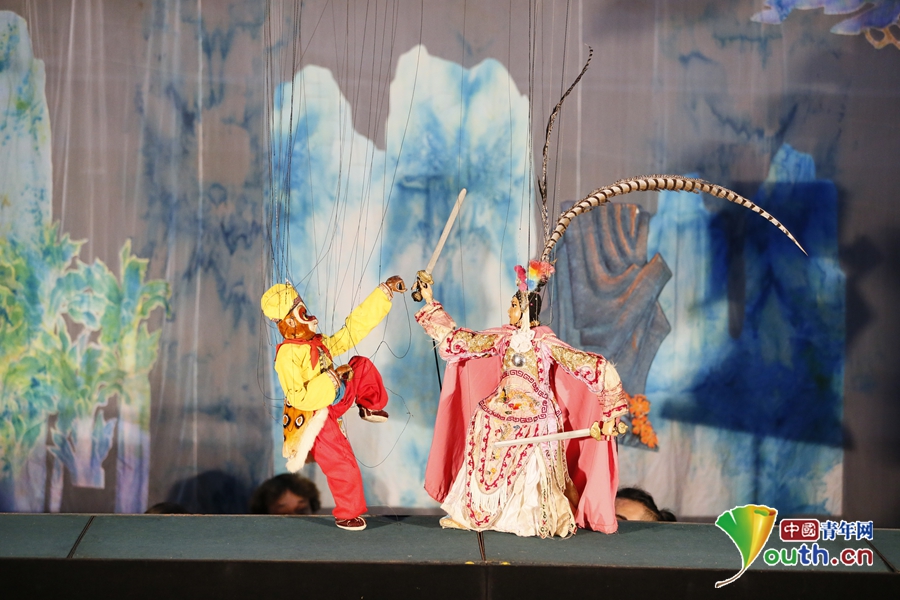
Fig. 1 – An example of modern Quanzhou string puppetry depicting a battle between Sun Wukong and Princess Iron Fan (larger version). Image found here.

I. The Chinese Script

The source of this text is quite obscure, only featured in a 1999 Chinese collection of puppet theater plays published by the Quanzhou Regional Opera Research Society.

Name of the book: 泉州地方戲曲研究社編,《泉州傳統戲曲叢書》第十卷《傀儡戲•目連全簿》(北京:中國戲劇出版社,1999)。

Unsurprisingly, I have no way of getting my hands on an actual copy of the book, so the Chinese text here came from a Tieba user who did, and then someone helpfully uploaded it onto Baidu Cloud Drive.

Just something to keep in mind.

PDF File:

https://docs.google.com/document/d/10XhOpvLFrdcSaqyrhY_4MmiXylSGNhWutcgv6Ngen3M/edit

Jim: Here is a backup just in case.

Click to access Quanzhou-Puppet-Theatre-JTTW.pdf

[Note: See also the 07-21-25 update below for a PDF of the original book!]

II. English Summary

Disclaimer – This is a very rough chapter-by-chapter summary of the play, which was first transcribed in the Qing dynasty and appeared to be written in the local dialect. As I do not speak Hokkien, nuances are likely lost and errors made.

Jim: I have added italicized explanatory notes to @ryin-silverfish’s summary below. I formatted the section as such so that readers will have more context at hand. This way, you won’t have to constantly scroll down to the footnotes. Also, I have added links, as well as more hanzi and pinyin. I don’t (yet) know Hokkien either, so I apologize for not adding the corresponding romanization.

Chapter 1: Meeting the Buddha (Jian Fozu, 见佛祖)

Tripitaka (Sanzang, 三藏; a.k.a. Xuanzang, 玄奘) sings his backstory, which is pretty much the same as the JTTW novel version, minus the revenge part, and with a few more details: he was found by Li Gong (李公) and raised under the name “River Float” (Jiang Liu’er, 江流儿) in the Golden Mountain Temple (Jinshan Si, 金山寺). [A] As an adult, he later traveled to become a monk at the Immortal Peach Temple (Pantao Si, 蟠桃寺). Tang Emperor Taizong came there one day to sponsor a mass and present incense, and being impressed by the monk’s arhat-like aura, made him his adopted son, “Prince Tripitaka” (Sanzang Taizi, 三藏太子). [B]

The royal monk is praying to the “Buddha of the Southern Seas” (Nanhai Fozu, 南海佛祖, a.k.a. Guanyin), when the goddess arrives to ask what is bothering him. He worries that the monks who travel outside the temple might be tempted by worldly things, so he vows that day to retrieve scriptures from India in order to save them from negative karmic fate. [C] In response, Guanyin first tells him that the journey will be perilous, with untold dangers along the way. Then, she tells Tripitaka of the “Great Sage Equaling Heaven” (Qitian Dasheng, 齐天大圣), who had been imprisoned in a well for stealing the Jade Emperor’s wine in the past. Next, she recommends recruiting the Great Sage to protect the monk on the trip, and to that end gives him a “Precious Sash of Infinity” (Wujin Baodi, 无尽宝绦) and a golden headband, two heavenly treasures needed to respectively free and submit the spirit. Finally, Guanyin gives him a ringed staff, an alms bowl, and straw slippers before sending him on his way.

A) Tripitaka is found as a baby by the monk Faming (Faming Heshang, 法明和尚), the holy abbot of the Golden Mountain Temple, in JTTW chapter nine. He gives the baby the same name, “River Float” (Jiang Liu/er, 江流/儿) (Wu & Yu, 2012, vol. 1, p. 222).

B) The monk becomes Tang Emperor Taizong’s bond brother (xiongdi, 兄弟) in JTTW chapter 12 (Wu & Yu, 2012, vol. 1, p. 290). The monarch even refers to him as his “Royal Brother” (yudi, 御弟) (Wu & Yu, 2012, vol. 1, p. 291, for example).

C) The Tang Monk’s reason for the trip is different in the novel: he is chosen to procure scriptures of the “Great Vehicle” (Dacheng, 大乘; i.e. Mahayana texts) in order to perform a “Grand Mass of Land and Water (Shuilu Dahui, 水陆大会), which will free untold numbers of abandoned souls from the underworld (Wu & Y, 2012, vol. 1, pp. 275 and 286-290). This is more in line with Tang Taizong’s mass in the play.

Chapter 2: Monkey in a Well (Zuojing Hou, 坐井猴)

Sun Wukong sings his backstory inside the well: he was as old as heaven and earth and had eleven brothers, a.k.a. the “Eleven Luminaries” (Shiyi Yao Xingjun, 十一曜星君). [D-F] Turning into a mosquito and flying into the celestial realm, he ate twelve peaches of immortality and three, multi-ton alms bowls full of Laozi’s golden elixir pills and drank 3,000 jars of heavenly wine. [G]

In a drunken haze, Monkey drank so much water from the Eastern Sea that the Dragon King’s palace was exposed, causing the monarch, together with every other deity he had pissed off, to complain to the Jade Emperor.

After he was captured by the combined forces of Erlang, Nezha, Devaraja Li Jing, the Curtain-Raising General Deng Hua (Juanlian Denghua, 卷帘邓化), and celestial soldiers, the plot, again, proceeds the same as in the JTTW novel. This includes his failed execution, sentence to the eight trigrams furnace, wager with the Buddha, and his defeat under “Five-Fingers Mountain” (Wuzhi Shan, 五指山; a.k.a. “Five Elements Mountain“). The only thing different is his place of imprisonment: the power-nullifying, 10,000-zhang-deep “Dazzling Crystal Well” under the Wild Horse Bridge of Youzhou (Youzhou Yema Qiao xia wanzhang Huashan Liuli Jing, 幽州野马桥下万丈花闪琉璃井). [H-J]

Monkey is told that only when “flowers bloom on iron trees” (tieshu kaihua, 铁树开花) will he be released. Shortly thereafter, Guanyin shows up in his dreams and mentions Tripitaka, and the chapter ends with him crying out the monk’s name, hoping he might be heard.

D) Monkey formally introduces himself as Sun Wukong (xing Sun ming Wukong, 姓孙名悟空). But this name only appears twice in the entire play. He is primarily called “Equaling Heaven” (Qitian, 齐天). It appears a total of 286 times, including only two uses of “Great Sage Equaling Heaven” (Qitian Dasheng, 齐天大圣) (ch. 2 & 4). He is twice referred to in chapter four as the “Monkey Whose Greatness Equals Heaven” (Yuansun Qitian, 猿孙大齐天) (refer to the PDF). The present summary primarily uses Sun Wukong and Monkey out of tradition. 

E) Monkey’s stated age, “the same as Heaven and Earth” (yu tiandi tonggeng, 与天地同庚) (refer to the PDF), is different from the novel. Calculations based on internal story details suggest that he was born around the year 500 BCE during the late-Zhou Dynasty (c. 1046-256 BCE). 

F) The “Eleven Luminaries” (Shiyi Yao Xingjun, 十一曜星君) are a combination of nine sinicized Hindu astrological deities and two East Asian astrological deities. They include the Sun (Taiyang xing, 太陽星), Moon (Taiyin xing, 太阴星), Mars (Huoxing, 火星), Mercury (Shuixing, 水星), Jupiter (Muxing, 木星), Venus (Jinxing, 金星), Saturn (Tuxing, 土星), Rahu (Luohou, 罗睺), Ketu (Jidu, 奇都), and two shadowy planets called Yuebei xing (月孛星) and Ziqi (紫气). See figure one here for a circa 13th-century image of these gods. I don’t know if these are supposed to be his biological siblings or just bond brothers. But Wukong does take the “Nine Luminaries” (Jiu Yaoxing, 九曜星), the aforementioned sinified stellar gods, as his bond brothers in JTTW chapter five (Wu & Yu, 2012, vol. 1, p. 160). He later fights and singlehandedly defeats them all during his rebellion (Wu & Yu, 2012, vol. 1, p. 171).

Monkey does have biological brothers and sisters in two YuanMing stage plays (see the 12-20-23 update here). One is a sister called the “Iron-Colored Macaque” (Tiese Mihou, 铁色狝猴) (refer to this PDF). In the puppet play, Laozi refers to Monkey as an “iron bone-colored macaque” (Tiegu Se Mihou, 铁骨色猕猴) because his body is immune to harm. I’m not sure where these terms come from. They might be connected to the tiese (铁色), a kind of fruit-bearing tree in Asia. Perhaps macaques were associated with eating its fruit. Also, I should note that Monkey is called the “Great Sage Steel Muscles and Iron Bones” (Gangjin Tiegu Dasheng, 钢筋铁骨大圣) at the end of the late-13th-century JTTW.

G) Monkey is punished in JTTW chapter five for a host of crimes, including eating countless immortal peaches, ruining a celestial banquet, drinking copious amounts of heavenly wine, and eating all of Laozi’s elixir pills (Wu & Yu, 2012, vol. 1, pp. 162 and 165-166).

H) One zhang () comprises ten chi (, a.k.a. “Chinese feet”), and one chi is roughly 31.8 cm (12.3 in). This makes one zhang 3.18 m (10.43 ft) (Jiang, 2005, p. xxxi). Ten-thousand zhang (wanzhang, 万丈) would therefore be 31,800 m (104,300 ft). That’s one deep well!

The Water Margin (Shuihu Zhuan, 水浒传, c. 1400), another famous Chinese vernacular novel, also contains a 10,000 zhang deep pit (wanzhang shenqian dixue, 万丈深浅地穴) used to imprison 108 stellar spirits (Shi & Luo, 1975/2021a, vol. 1, p. 15). Shapiro translates this as “a pit 100,000 feet deep” (Shi & Luo, 1993/2021b, vol. 1, p.15). But the use of 10,000 zhang is likely referring to an infinitely deep, inescapable abyss.

This idea can be traced to a Song-era Daoist ritual in which an exorcist draws the character for “well” (jing, 井/丼) on the ground. This divides the ritual space into nine sections, representing the Nine Palaces (Jiugong, 九宮) (stellar groupings comprising the cosmos), thereby creating an earth prison to incarcerate evil spirits. The Compilation of Rituals of the Way (Daofa huiyuan, 道法会元) reads:

[U]se the Sword mudrā to draw the character for “well” on the ground. Transform it into a black prison, ten-thousand zhang deep, and ten thousand li wide. Black vapors burst out of it. Inside the prison, visualize how cangues and locks, as well as tools and machinery are laid out. Then recite the Spell for Fast Arrest.

右用劍訣,就地劃一井字。化為黑獄,深萬丈,闊萬里。黑炁衝騰。存獄中枷鎖、噐械備列;就念「促捉咒」(Meulenbeld, 2007, p. 142).

Therefore, Monkey’s imprisonment was likely influenced by this Daoist rite.

I) It’s important to note that liuli (琉璃), the material comprising his prison, has a connection to Buddhism. For example, it is mentioned in Indian Buddhist sources under it’s Pali/Sanskrit equivalent, vaiḍūrya (वैडूर्य), as one of the seven precious substances, along with gold, silver, pearls, etc. Modern translators of said sources associate vaiḍūrya with shiny, translucent beryl and cat’s eye gemstones. But the Chinese originally associated vaiḍūrya/liuli with opaque, dark blue, and sometimes golden-speckled lapis lazuli (Winder, 1990). This is why the Chinese name of the Medicine Buddha, Yaoshi Liuli Guangwang Rulai (藥師琉璃光如來), is translated as the “Medicine Master [of] Lapis Lazuli Light Tathāgata” (for example).

This would suggest that Wukong’s prison is not crystal but lapis lazuli, perhaps with golden speckles, which would explain the “dazzle” (huashan, 花闪) part of the well’s name. And since he is held fast there by the Buddha’s seal (see chapter 4 below), the medium of his jail is likely influenced by Buddhism. This would make his prison a joint Buddho-Daoist punishment.

J) Youzhou (幽州) was an ancient prefecture in what is now Heibei province, China.

Chapter 3: Farewell Banquet (Paishu, 派数)

Zhangsun Wuji, historically Taizong’s minister, is preparing a farewell banquet for Prince Tripitaka. It’s mostly a list of dishes; not much to see here.

Chapter 4: Monkey Joins (Shou Hou, 收猴)

Tripitaka attends Zhangsun Wuji’s farewell banquet, and then begins his journey to the west. The Buddha Maitreya sees him about to reach a wide river, uncrossable by boats, and sends Shancai to assist him by covering the river in lotus flowers.

Tripitaka steps over the lotuses and crosses the “Nine-Rank, No Boats River” (Jiupin Wuchuan Jiang, 九品无船江). Keep on keeping on, he hears someone calling out his name, but doesn’t see the caller. The local god of the soil shows up to inform him that it is the Great Sage Equaling Heaven, yelling from inside his well.

The monk removes the Buddha’s seal on the well cover by reciting the “Three-Jewels Mantra” (Sanbao zhenyan, 三宝真言), and then he uses the Precious Sash to lift Sun Wukong out of the well, thereby breaking the iron locks holding him down.

Tripitaka asks Monkey to escort him to the Western Heaven, but the spirit only wants to go back to Flower-Fruit Mountain. Sun Wukong agrees to have his head shaved just so he can bail out after a few li. [K] Unfortunately for him, he also agrees to wear the golden headband, and right after he speeds away, Tripitaka recites the tightening sutra and forces him to return.

Monkey finally relents and agrees to protect Tripitaka on the journey to India. He takes this as an opportunity to bring out the “luggage” from his ear: the 30,000 cattyAs-You-Wish Staff” (Qianjun Ruyi Bang, 千钧如意棒; a.k.a. the “Golden-Hooped As-You-Wish Staff,” Jingu Ruyi Bang, 金箍如意棒), forged by the sage-king Yu the Great. [L & M]

K) Wukong also sports a shaven head in the novel. For instance, in JTTW chapter 27, he states:

But ever since Nirvana delivered me from my sins, when with my hair shorn I took the vow of complete poverty and followed you as your disciple, I had this gold fillet clamped on my head… (Wu & Yu, 2012, vol. 2, p. 24).

自从涅槃罪度,削发秉正沙门,跟你做了徒弟,把这个金箍儿勒在我头上 …

L) The staff’s weight is based on a thousand multiples of 30 catties (jun, ). One catty (jin, ) is 590 grams (Elvin, 2004, p. 491 n. 133). Therefore, 30,000 catties would be roughly 17,700 kg or 39,021.82 lbs. But 30,000 is likely used here to refer to an unimaginably large number (i.e. Wukong’s staff is REALLY heavy). 

The novel staff weighs 13,500 catties (cf. Wu & Yu, 2012, vol. 1, p. 135). This equals 7,965 kg or 17,559.81 lbs.

M) The literary weapon also has a slightly different name: the “As-You-Wish Gold-Banded staff” (Ruyi Jingu Bang, 如意金箍棒). (Notice how ruyi (如意) and jingu (金箍) are switched around from the play’s staff name.) In addition, it is said to have been used by Yu the Great in the past to conquer the world flood (Wu & Yu, 2012, vol. 1, p. 135). But the staff’s creation is attributed to both Laozi (ch. 75) and Yu (ch. 88) (Wu & Yu, 2012, vol. 3, pp. 375; vol. 4, 201).

Chapter 5: The Horse Joins (Shou Ma, 收马)

The “Deep Sand God” of Black Sand Cave (Heisha Dong Shensha Shen, 黑沙洞深沙神, i.e. Sha Wujing) sits in his abode, [N] looking to grab some travelers to eat, and soon, he comes across Tripitaka and Sun Wukong. He seizes the monk first, then tries to grab the monkey but seemingly fails.

Sun Wukong, using his magic “Fiery Eyes and Golden Irises” (Huoyan Jinjing, 火眼金睛), figures out it was the Deep Sand God, and then goes into his cave for a rescue mission. They banter and proceed to fight. Knowing that the old monkey spirit is vulnerable to 1) flames and 2) water, [O] the Deep Sand God sets a fire inside his cave, forcing Sun Wukong to flee to the South Sea for help.

Guanyin decides to come along and asks Sun Wukong to bring her alms bowl, too. When they confront the Deep Sand God again, Guanyin presents a wager to him: if he can lift her alms bowl (boyu, 钵盂), both she and Tripitaka will be his food.

The monster tries but is unable to lift it. [P] Sun Wukong then lifts the bowl, tosses it onto his head, and attempts to slay the Deep Sand God. But Guanyin spares him on the condition that he will turn into a white horse and become Tripitaka’s steed. [Q]

N) The “Deep Sand God” (Shensha Shen, 深沙神) appears as a desert demon in (the incomplete) chapter eight of the late-13th-century JTTW. He claims to have eaten Tripitaka’s two previous incarnations on their journey to India. The monster only helps the pilgrims cross the “Deep Sands” (Shensha, 深沙) via a magical golden bridge once he is threatened with heavily retribution. Memorial poems note that Tripitaka releases the Spirit from a 500-year-long curse, and Monkey promises to speak highly of him when they meet the Buddha (Wivell, 1994, pp. 1190-1191).

O) Monkey is shown to be weak to “True Samadhi Fire” (Sanmei zhenhuo, 三昧真火), an intense flame born from spiritual cultivation, in JTTW chapter 41 (Wu & Yu, 2012, vol. 2, pp. 230-23). And he is shown throughout the novel to be a less proficient fighter in water (ch. 21, for example) (Wu & Yu, 2012, vol. 1, pp. 423-424).

P) This is reminiscent of JTTW chapter 42, when Guanyin challenges Wukong to pick up her porcelain vase, which contains an ocean full of water. He is unsuccessful (see the 07-03-22 update here). The Deep Sand God’s inability to raise the alms bowl is likely related to monk Faxian‘s story about the immovable quality of Buddha’s almsbowl (Faxian & Legge, 1886/1965, pp. 34-35).

Q) In the novel, the white horse is a transformed dragon prince. He is forced to become Tripitaka’s steed after eating the original horse in chapter 15 (Wu & Yu, 2012, vol. 1, p. 328).

Chapter 6: Erlang Joins (Shou Erlang, 收二郎)

Erlang sings his backstory. The previous year, he harassed a Jade Maiden messenger (Chuanyan Yunu, 传言玉女) on a bridge in Tianjin (Tianjin Qiaotou, 天津桥头), provoking the Jade Emperor’s wrath and causing him to cut off sacrifices and worship to Erlang. After the intervention of Guanyin, he was sent to Mt. Guankou (灌口山) (in Sichuan) as a guardian deity, but often preyed on passing mortals and ate their flesh. [R]

The POV switches to Tripitaka and Wukong; the latter sees a black cloud blocking his way, and suspecting it to be a demon, he asks his master to hide while he checks. Erlang reveals his identity and suggests that he will catch the monk and share his flesh with “Elder Brother Qi” (Qige, 齐哥) (i.e. Monkey).

Wukong promptly chews him out and reveals that Tripitaka is the reincarnation of the Golden Chan Arhat (Jinchan Luohan, 金禅罗汉), [S] who attended a lantern fruit festival without notifying his fellow monks and was punished by the Buddha to experience 36 perils (sanshiliu jie, 三十六劫) on his journey to the west. [T]

After getting a monk makeover, Erlang becomes Tripitaka’s disciple.

R) This is reminiscent of Zhu Bajie’s backstory from JTTW chapter 18. After being stripped of his divine post and exiled to earth for forcing himself on a moon maiden, Pigsy becomes a meat-eating spirit (Wu & Yu, 2012, vol. 1, p. 212).

S) Tripitaka’s past divine title, the “Golden Chan Arhat” (Jinchan Luohan,金禅罗汉), is similar to that from JTTW, “Master Golden Cicada” (Jinchan Zi, 金蝉子). Chan (as in Chan Buddhism) and chan (蝉, “cicada”) look and sound similar.

T) Master Golden Cicada is exiled from heaven for sleeping during the Buddha’s lecture. The fullest explanation for this appears in chapter 81 (Wu & Yu, 2012, vol. 4, p. 82). Another part of his punishment is experiencing 81 perils, which happen throughout the novel. Eighty of these are listed, with the final one happening shortly thereafter, in chapter 99 (Wu & Yu, 2012, vol. 4, pp. 358-363).

Chapter 7: Pigsy Joins (Shou Zhu, 收猪)

Zhu Bajie (猪八戒), the pig demon of Mt. Song (嵩山; later called “Pig Excrement Mountain,” Zhushi Shan, 猪屎山), is hungry for human flesh, and so he decides to whip up some smoke and seize some unaware travelers under its cover. Just like the two villains before him, he picks the pilgrims as his target.

Wukong fights him, subdues him, and he joins the party.

Chapter 8: Spiderly Woe (Zhizhu Men, 蜘蛛闷)

Lady Earth-Raised (Diyang Furen, 地养夫人), the spider demoness of Mt. Hua (Hua Shan, 华山), has a problem. She might be the youngest sister of the “Three Saints of Mt. Song” (Song Shan Sansheng Langjun, 嵩山三圣郎君), [U] living on her silk webs, but she is still single and unmarried. As such, she commands her imps to patrol the mountains daily, so as to kidnap a fine man as her future husband.

The imps soon spot a group of people under the mountain: a monkey, a horse, a pig, and a monk (Erlang isn’t mentioned for some reason). She asks one of her imp minions, the “Big-headed Demon” (Datou Gui, 大头鬼), which one seems like a good choice, and after comically dismissing the first three, she settles on the monk.

The Big-headed Demon eagerly grabs a sack and chopper and, when she asks why, he tells her he is going to cut the monk in half and bring the body to her. But since a dead person does not a good husband make, she decides to kidnap the monk herself.

U) Lady Earth-Raised is similar to the seven Spider Spirits (Zhizhu Jing, 蜘蛛精) from JTTW chapters 72 to 73, and her lofty brothers, the Three Saints, are reminiscent of the Demon Lord of a Hundred Eyes (Baiyan Mojun, 百眼魔君), the spider spirits’ senior from chapter 73.

Her name and at least one of her deceptions is also very similar to a demoness in JTTW chapter 80 (see below).

Chapter 9: Subduing the Spider (Shou Zhizhu, 收蜘蛛)

The demoness disguises herself as a young woman with her lower half buried in the earth (the same trick Lady Earth Flow uses in JTTW chapter 80 (Wu & Yu, 2012, vol. 4, p. 67) and calls out for help. Tripitaka orders Wukong to investigate, but he refuses because he doesn’t want trouble. However, the monk forces him into it via the headband tightening spell.

She says she was buried there by her husband for doing something wrong, and then asks the monk for help. When Tripitaka tries to pry her free with a monk’s knife (jiedao, 戒刀), she grabs him and returns to her cave.

Sun Wukong spots some spider silk with his fiery eyes and plans to turn into a jiaoming fly (jiaoming chong, 蟭螟虫) [V] and follow it back to her cave. However, the horse says she probably raises hens inside, and a fly would quickly be eaten, so he should transform into a Scops owl (Lao Chi, 老鸱), a bird of prey. That way Wukong can deal with the chickens when he sneaks inside.

He soon finds the spider demoness and orders her to let his master go or die. She replies that if he dares, her brothers, the “Three Saints of Mt. Wo” (Wo Shan Sanshen Langjun, 窝山三圣郎君) (again, a mountain’s name does not stay consistent) will deal with him. [W] Wukong beats her to death with the staff anyways and rescues Tripitaka.

V) The jiaoming fly (jiaoming chong, 蟭/焦螟虫) is an aquatic insect from Daoist literature said to be so small that it can congregate in the eyebrows of a mosquito (Wang, 2012, p. 28 n. 44).

W) The “Three Saints of Mt. Song/Wo” (Song/Wo Shan Sansheng Langjun, 嵩/窝山三圣郎君) are part of a pattern in JTTW in which the pilgrims face a trio of baddies. Examples include the three bogus animal immortals (ch. 46), the three demon kings of Lion-Camel Cave (ch. 74-77), and the three rhino demons (ch. 91-92). The three incarnations of the White Bone Spirit (ch. 27) could also count. This reoccurring number is perhaps meant to mirror Tripitaka’s three disciples.

Chapter 10: Bad News (Bao Xiongxun, 报凶讯)

Luo Tuo, Luo Du, and Luo Hou (罗托,罗独,罗候)—the Three Saints of Mt. Wo—are having a party in celebration of their eldest brother, Luo Tuo’s birthday. They wonder why their sister has not arrived yet, when suddenly, the Big-Headed Demon enters and delivers the bad news.

Furious, the trio swear revenge and set out to capture Tripitaka and kill Wukong. [X]

X) The Saints’ anger over the murder of their spider sister is also similar to the rage of the Demon Lord of a Hundred Eyes over the killing of his seven spider sisters (ch. 73) (Wu & Yu, 2012, vol. 3, pp. 340-341). All eight are done in by Monkey.

Chapter 11: Subduing the Three Saints (Shou Sansheng, 收三圣)

The pilgrims are passing through a mountain, when Luo Tuo swoops down and grabs Tripitaka but fails to capture Wukong. Monkey informs the rest of the gang about the Three Saints. Erlang suggests that since Wukong is the one who started it, he alone should deal with them.

The whole gang goes after the trio anyways but fails to beat them. Wukong tells Erlang and Sandy to keep watch on the Three Saints so that they do not harm Tripitaka, and he flies to the South Sea to seek Guanyin’s help.

Guanyin agrees, but the chapter ends here because the rest of the pages are missing from the original manuscript.

Chapter 12: Ascending the Immortal Pavilion (Dengxian Ge, 登仙阁)

The chapter begins with the head of the pavilion’s local shrine asking an attendant about sacrifices, for the birthday of a certain “Great Immortal” (Daxian, 大仙) is near. He demands a young boy, as well as food and fruits, as gifts.

The shrine attendant goes to inform the families responsible for supplying each of the sacrifices; this year, it is Old Huang’s (Huang Gong, 黄公) turn to give up his only grandson. [Y] He begs them to delay the sacrifices until his family can … sire another grandkid!

In response, the shrine attendants tie him up and start beating him, stating that if the Great Immortal does not get his sacrifice, the whole village will suffer. Unable to withstand the beating, Old Huang yields and agrees to their demand.

Y) This plot is similar to the Great King of Numinous Power (Linggan Dawang, 灵感大王) episode from JTTW chapters 47 to 48. He demands a yearly sacrifice of children from families that shoulder the horrible burden on a rotating basis. This shares shocking similarities with Hindu literature (see section 2.2 here).

Chapter 13: Meeting the Grandfather and Grandson (Yu Gongsun, 遇公孙)

The pilgrims hear the commotions of the sacrificial ceremony, and upon investigating, come across Old Huang, dragging his grandson along and sobbing. After questioning him, Tripitaka decides to go to Ascending Immortal Pavilion himself and talk the Great Immortal out of this whole “human sacrifice” thing.

Chapter 14: Subduing the Great Serpent (Shou Dashe, 收大蛇)

The sacrificial ceremony begins. But the shrine attendants wonder if the Great Immortal has not yet arrived because the young boy hasn’t been offered up. Tripitaka arrives just in time to call out the Great Immortal for demanding human sacrifices.

Enraged, the Great Immortal orders his imps to snatch Tripitaka, but Wukong smashes his way in and demands the release of his master. The Great Immortal dares Wukong to allow the spirit three free strikes; Wukong agrees.

After three hits and no effect, the Great Immortal tries to bash him over the head with a stone incense burner, which only annoys Wukong. [Z] He whips out his staff and kills the Great Immortal in one strike, revealing his true form—a huge serpent. [AA]

The pilgrims continue their journey. Wukong asks Erlang to get their master some water, while he travels on his cloud to get some food from the Immortal Peach Monastery (蟠桃寺). As the two leave, Tripitaka hears the sound of people chopping firewood and goes to investigate.

Z) Monkey is famous for his invulnerability in JTTW. For instance, in chapter 75, Wukong willingly blocks a sword strike with his adamantine head:

Arousing his spirit, the old demon stood firmly with one foot placed in front of the other. He lifted up his scimitar with both hands and brought it down hard on the head of the Great Sage. Our Great Sage, however, jerked his head upward to meet the blow. All they heard was a loud crack, but the skin on the head did not even redden (Wu & Yu, 2012, vol. 3, p. 373).

那老魔抖擻威風,丁字步站定,雙手舉刀,望大聖劈頂就砍。這大聖把頭往上一迎,只聞扢扠一聲響,頭皮兒紅也不紅。

AA) A massive, red-scaled python spirit (honglin damang, 紅鳞大蟒) appears in JTTW chapter 67.

Chapter 15: Firewood Crossing (隔柴渡)

Two firewood choppers turn out to be Hanshan and Shide (寒山,拾得), two famous historical monks of Mt. Tiantai, who are also worshiped in folk religion. Tripitaka asks them if there is a temple nearby. They say yes but that it’s on the other side of the river.

There aren’t any boats either, so they use their firewood to create a bridge for Tripitaka. Halfway across, the bridge collapses; he falls into the river, only to be rescued by the local Dragon King, who escorts him to the “Correctness and Broadness Temple” (Fangguang Si, 方广寺), [AB] where the Buddha is secretly staying.

After the monk greets Buddha, an immortal lad brings Tripitaka a message: Devaraja Li (Li Tianwang, 李天王) of the Bisha-men Palace (Pisha Gong, 毗沙宫) is inviting him to a party in celebration of his own birthday, as well as Prince Nezha’s (Nezha Taizi, 哪吒太子) “return to the world/rebirth” (zai chushi, 在出世). Tripitaka agrees and heads for the celestial realm on a white crane.

AB) This may be a reference to the Buddhāvataṃsaka Sūtra (Dafangguang fo huayan jing, 大方广佛华严经; a.k.a. “Flower Garland Sutra,” Huayan jing, 华严经). The Chinese believed that this was the Buddha’s first teaching shortly after achieving enlightenment (Buswell & Lopez, 2014, p. 84). This might then explain why the Buddha is residing in a random temple along the journey.

Chapter 16: Party in the Celestial Realm (Tiangong Hui, 天宫会)

Devaraja Li is organizing the party, sending out invitations for the 500 Arhats (Wubai Luohan, 五百罗汉). The immortal lad reports that all five hundred handkerchiefs (shoupa, 手帕) were given out, save for one—which turned out to be Tripitaka’s, missing because of the whole reincarnation thing. [AC]

Luckily, he soon arrives. Devaraja Li gifts him three cups of immortal wine, and Tripitaka, being a lightweight, becomes totally wasted and is taken into the backrooms of the palace to rest.

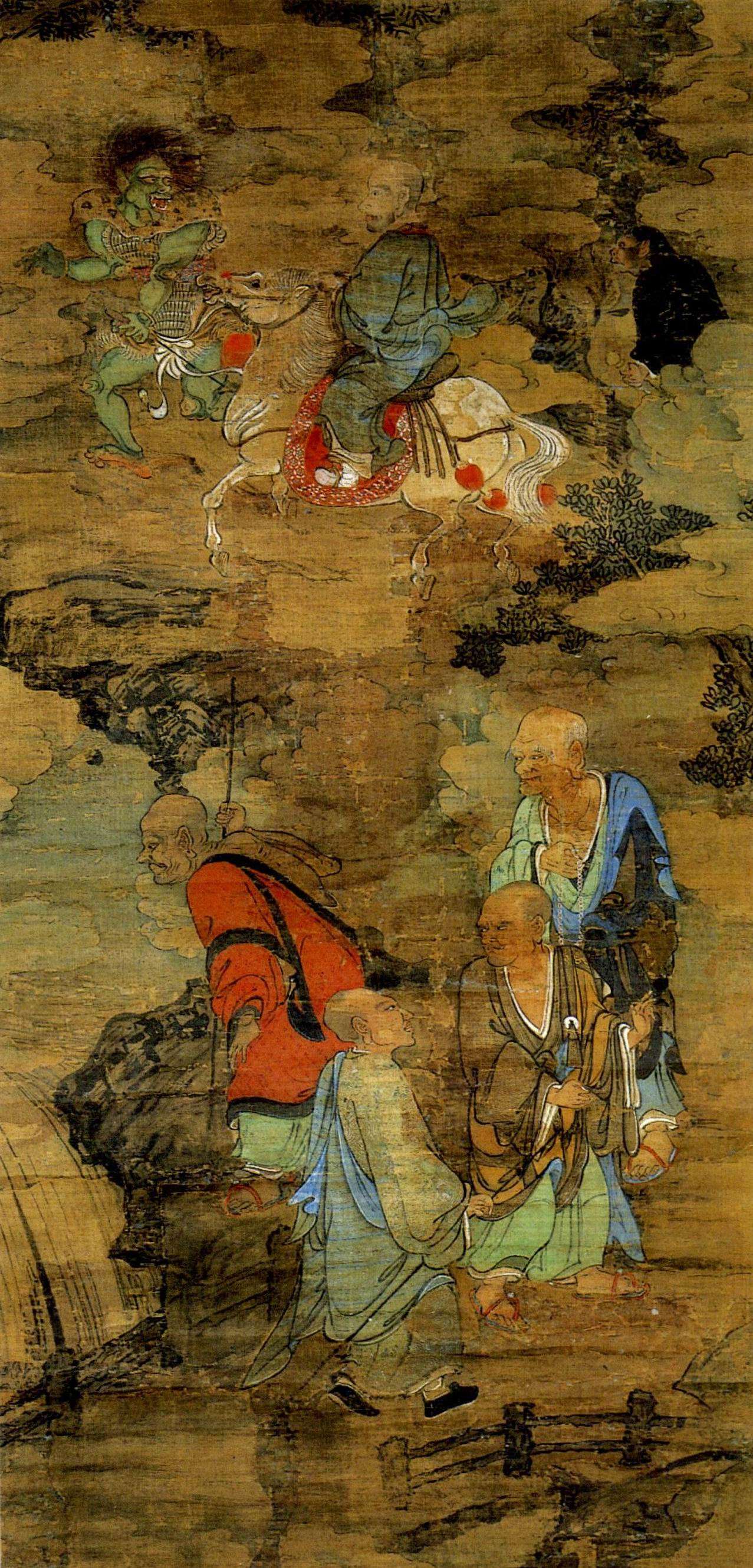
AC) Tripitaka was historically venerated as an arhat as early as the Song dynasty (960-1279) (Liu, 2019). For example, he is included in a series of late-12th-century religious paintings focusing on the 500 Arhats. A black-robed Sun Wukong can be seen walking in the clouds behind him (fig. 2) (see the 06-04-23 update here).

Fig. 2 – Lin Tinggui and Zhou Jichang, The Tang Monk Procures the Scriptures (Tangseng qujing, 唐僧取經), no. 77 of 100 scrolls from Images of the 500 Arhats (Wubai Luohan tu, 五百羅漢圖, 1178-1188 CE) (larger version). Hanging scroll, ink and color on silk. Image from Nara kuniritsu hakubutsukan, Tōkyō bunkazai kenkyūjo, 2014, p. 86. Courtesy of Dr. Liu Shufen, a research fellow at the Institute of History and Philology, Academia Sinica. See the 06-04-23 update here for close ups of Monkey.

Chapter 17: Where did the monk go? (Tao Heshang, 讨和尚)

Meanwhile, Wukong and Erlang return, only to find their master missing. They bash on the gate of the Correctness and Broadness Temple to demand his whereabouts; the Buddha replies that Tripitaka is drunk and sleeping in Devaraja Li’s palace, then slams the door shut in their faces.

Erlang asks Wukong to go to the celestial realm and bring their master back. Wukong declines, citing the whole “Havoc in Heaven” business, then asks Erlang to go. He also declines because of the Jade Maiden incident in the past.

Finally, they summon the local Jiedi (揭帝) with a mantra and send the guardian deity to pick up Tripitaka.

Chapter 18: Subduing the Red-faced Demon (Shou Chimian, 收赤面)

Elder Li De (Laofu Li De, 老夫李德) of Mt. Song has an 18-year-old daughter, Jinyu (金玉, “Golden Jade”), who has been charmed by a demon, and none of the exorcisms by Daoist priests seem to work. The pilgrims happen to pass by and stay at his place for the night, so naturally, Tripitaka signs his monkey disciple up to banish the demon.

Wukong hides in her bedroom, ready to ambush the demon. However, when spooked, it spews out fire and forces Wukong to retreat. Elder Li laments that the demon will surely give them even more trouble after this fiasco; in response, Wukong transforms into the man’s daughter and summons the local god of the soil for questioning. The deity reveals the monster’s identity as the “Red-Faced Demon King” (Chimian Guiwang, 赤面鬼王).

A transformed Wukong marches to the demon’s cave and tells him their relationship might not work out now that her father has seen the demon flee, deeming him a weakling. The Red-Faced Demon then reveals his backstory: he used to be a woodcutter until he saw the “Lamp-Lamp Buddha” (Dengdeng Fo, 灯灯佛) meditating on a rock, [AD] with a precious pearl (zhu, 珠) by his side. He stole the pearl and swallowed it, which allowed him to turn into a fireball and take flight.

Wukong cajoles him into giving up the pearl, immediately swallows it, and uses the True Samadhi Fire to eliminate the demon. [AE]

AD) This is a likely reference to Dīpaṃkara (Sk: दीपंकर), the Buddha preceding Śākyamuni. His Chinese name appears in countless sutras as Dengdeng Fo (燃灯佛), or the “Lamp Buddha.” This is appropriate given the magic pearl’s connection to spiritual fire. Also, this implies that the Red-Faced Demon has lived for countless eons if he was alive during the time of the previous Buddha.

Dīpaṃkara is referenced in JTTW chapter 5, and he briefly appears in chapter 98 (Wu & Yu, 2012, vol. 1, p. 166; vol. 4, p. 352). In addition, his name is listed first (even above Śākyamuni) in a roster of Buddhas and Bodhisattvas saluted at the end of the novel (Wu & Yu, 2012, vol. 4, p. 384). Journey to the West calls him Dendeng Gufo (燃灯古佛; a.k.a. Gufo, 古佛, here and here), or the “Ancient Buddha of the Lamp.”

AE) This chapter shares similarities with a number of JTTW episodes. First, Monkey hiding in the daughter’s room and later transforming into her likeness is reminiscent of Sun and Zhu’s first meeting in chapter 18 (Wu & Yu, 2012, vol. 1, pp. 374-375). Second, Wukong, once again disguised as a woman, tricks a spirit into spitting up a magic pearl and then swallows it himself in chapter 31 (Wu & Yu, 2012, vol. 2, pp. 80-81). And third, the emphasis on a red demon’s command of True Samadhi Fire is similar to Red Boy from chapter 40-42.

Chapter 19: Eight Wheels (Balun Tan, 八轮叹)

The “Holy Mothers of the Eight Wheels” (Balun Shengmu, 八轮圣母) sing their backstory: They were eight sisters—Gold Wheel, Silver Wheel, Copper Wheel, Iron Wheel, Tin Wheel, Wind Wheel, Fire Wheel, and Cart Wheel (Jinlun, Yinlun, Tonglun, Tielun, Xilun, Fenglun, Huolun, Chelun, 金轮, 银轮, 铜轮, 铁轮, 锡轮, 风轮, 火轮, 车轮), who were famous for their might but had remained single for 24,000 years.

As such, they planned to kidnap a husband to share between themselves.

Chapter 20: Subduing the Eight Wheels (Shou Balun, 收八轮)

Tripitaka is very close to his destination, when he is kidnapped by Gold Wheel. A very amusing sequence ensues, where each sister tries to snatch him away for their own wedding but are interrupted by Wukong bashing his way in and threatening to kill all eight of them.

The sisters beg for mercy; Wukong accepts their surrender, and then orders them to turn into eight immortal maidens (Feixian, 飞仙), fly to the Thunderclap Monastery (Leiyin Si, 雷音寺), and notify the Buddha of the pilgrims’ forthcoming arrival.

Chapter 21: Meeting the Great Buddha (Jian Dafo, 见大佛)

The pilgrims greet the Buddha and receive the Three Baskets of scriptures, consisting of sutras, texts and monastic codes. Afterwards, these are taken back to Immortal Peach Temple by the Four Bodhisattvas and Eight Vajrapanis (Ba Jingang, Si Pusa, 八金刚,四菩萨). [AF]

AF) The Eight Vajrapanis are ordered by Buddha to escort the pilgrims and sutras back to China in JTTW chapter 98 (Wu & Yu, 2012, vol. 4, p. 357). However, the guardians are later directed to land after only half way so that Tripitaka can experience the last of the 81 perils: the sutras are nearly lost in chapter 99 when a giant white turtle carrying the group to the other side of a river gets annoyed and dives into the water (this might be based on a historical event) (Wu & Yu, 2012, vol. 4, pp. 363). Thankfully, the Vajrapanis pick them back up and finish the trip to China in chapter 100 (Wu & Yu, 2012, vol. 4, pp. 370).

Chapter 22 to 23: Descending with the Buddha’s Decree (Jiang Fozhi, 降佛旨) and Conferring of Titles (Fengci, 封赐)

After the pilgrims descend to the Tang capital on colorful clouds, their Vajrapani escort suddenly remembers that he forgot to ask for the Buddha’s decree. He then flies back to Thunderclap Monastery after telling them to first start reading the scriptures to the masses.

That minor incident aside, the decree soon arrives without problem: Tripitaka is appointed the “Venerable Pindola Arhat” (Bintou Luohan Zunzhe, 宾头罗汉尊者), Wukong the “Great Sage of the Void” (Xukong Dasheng, 虚空大圣), Erlang the “Great Emperor of Miraculous Knowledge” (Lingtong Dadi, 灵通大帝), [AG] while Zhu Bajie and the Deep Sand God are made Buddhas. [AH]

Taizong then welcomes Prince Tripitaka back and gives him the royal title of “The Great Chan Master of the Great Law and True Scriptures” (Dafa Zhenjing Dachan Shi, 大法真经大禅师).

AG) This section of the manuscript contains an out of place passage not mentioned in the summary. It reads: “The Tree-born Prince and Sinful Dragon, Tathagata, and Erlang were each granted the title of Great Emperor of Marvelous Knowledge” (树生太子业龙,如来,灌口二郎各封灵通大帝) (refer to the PDF). This previously unmentioned princely dragon Buddha character is likely a transcription error (Hu, 2017a; 2017b).

AH) This is radically different than JTTW chapter 100. Only Sun Wukong and Tripitaka become Buddhas. Sha is made an arhat, while Zhu is made an altar custodian (Wu & Yu, 2012, vol. 4, pp. 381-382). Would the play’s ending then suggest that Buddhahood is considered lesser to the heavenly titles given to Monkey and Erlang?

–THE END–

III. Thanks

Jim: I would like to express my utmost thanks to @ryin-silverfish for alerting me to this play, providing the Chinese script, summarizing it, and directing me to an intricate paper about the play’s history. This article would not have been possible without their generous contributions.


Update: 07-21-2025

I’m excited to archive a PDF of the original book (fig. 3) containing the JTTW puppet play.

泉州地方戲曲研究社編,《泉州傳統戲曲叢書》第十卷《傀儡戲•目連全簿》(北京:中國戲劇出版社,1999)。

Quanzhou Local Opera Research Society. (1999). Quanzhou Traditional Opera Series (Vol. 10): Puppet Opera – The Complete Book of Mulian. Beijing: China Drama Publishing House.

All thanks goes to @ryin-silverfish for providing the PDF.

Archive link:

Click to access 泉州传统戏曲丛书-第10卷-傀儡戏·《目连》全簿-Pdg2Pic-郑国权主编;泉州地方戏曲研究社编-Z-Library.pdf

Fig. 3 – Quanzhou Traditional Opera Series (Vol. 10): Puppet Opera – The Complete Book of Mulian (《泉州傳統戲曲叢書》第十卷《傀儡戲•目連全簿》) (larger version).

Sources:

Buswell, R. E., & Lopez, D. S. (2014). The Princeton Dictionary of Buddhism. Princeton University Press.

Elvin, M. (2004). The Retreat of the Elephants: An Environmental History of China. New Haven (Conn.): Yale University Press.

Faxian, & Legge, J. (1965). A Record of Buddhistic Kingdoms: Being an Account by the Chinese Monk Fâ-Hien of his Travels in India and Ceylon (A.D. 399-414) in Search of the Buddhist Books of Discipline. New York: Dover Publications. (Original work published 1886)

Hu, S. (2017a, December 26). Chonggu “Nanxi” Xiyouji: Yi Quanzhou Kuileixi Sanzang Qujing Wei Qieru dian [A Re-evaluation of the Southern Story System of The Journey to the West: Based on Quanzhou Puppet Drama Monk Xuanzang on a Pilgrimage for Buddhist Scriptures]. Weixin Gongzhong Pintai. Retrieved from https://www.yidianzixun.com/article/0HzCWYnd.

Hu, S. (2017b). Chonggu “Nanxi” Xiyouji: Yi Quanzhou Kuileixi Sanzang Qujing Wei Qieru dian [A Re-evaluation of the Southern Story System of The Journey to the West: Based on Quanzhou Puppet Drama Monk Xuanzang on a Pilgrimage for Buddhist Scriptures], Fudan Xuebao (Shehui Kexue Ban), 59(6), 65-74.

Jiang, Y. (2005). The Great Ming Code / Da Ming Lu. Vancouver, Wa: University of Washington Press.

Liu, S. (2019). Songdai Xuanzang de shenghua: Tuxiang, wenwu he yiji [The Sanctification of Xuanzang in the Song Dynasty: Images, Artifacts and Remains]. Zhonghua wenshi luncong, 133, 161-219.

Meulenbeld, M. R. E. (2007). Civilized Demons: Ming Thunder Gods from Ritual to Literature (Publication No. 3247802) [Doctoral dissertation, Princeton University]. ProQuest Dissertations & Theses Global.

Nara kuniritsu hakubutsukan, Tōkyō bunkazai kenkyūjo henshū [Nara University Tōkyō Research Institute for Cultural Properties (Ed.)]. (2014). Daitokuji denrai gohyaku rakan zu [Daitoku Temple’s Tradition of the 500 Arhats Paintings]. Kyōto: Shitau bungaku.

Shi, N., & Luo, G. (2021a). Shuihu Zhuan (Shang, Zhong, Xia) [Tale of the Water Margin (Vols. 1-3)]. Beijing: Renmin Wenxue Chubanshe. (Original work published 1975)

Shi, N, & Luo, G. (2021b). Outlaws of the Marsh (vols. 1-4) (Trans. S. Shapiro). Beijing: Foreign Language Press. (Original work published 1993)

Wang, y. (2004). Sun Wukong De Yuanji Keneng Zai Fujian Baoshan [Sun Wukong’s Origin Could be In Baoshan, Fujian]Yuncheng Xueyan Bao, 22(3), 30-34.

Wang, P. (2012). The Age of Courtly Writing: Wen Xuan Compiler Xiao Tong (501-531) and His Circle. Netherlands: Brill.

Winder, M. (1990). Vaiḍūrya. Bulletin of Tibetology, 26(1-3), 31-37.

Wivell, C.S. (1994). The Story of How the Monk Tripitaka of the Great Country of T’ang Brought Back the Sūtras. In V. Mair (Ed.), The Columbia Anthology of Traditional Chinese Literature (pp. 1181-1207). New York: Columbia University Press.

Wu, C., & Yu, A. C. (2012). The Journey to the West (Vols. 1-4) (Rev. ed.). Chicago, Illinois: University of Chicago Press.

The Weight of the Monkey King’s Staff: A Literary Origin

Last updated: 03-11-2023

Sun Wukong’s magic staff is famed in popular culture for its ability to grow and shrink but less so for its great weight. The latter quality is best demonstrated in chapter 56 when human bandits attempt and fail to pick up the 8.8 ton weapon:

Sticking the rod into the ground, Pilgrim said to them, “If any of you can pick it up, it’s yours.” The two bandit chiefs at once went forward to try to grab it, but alas, it was as if dragonflies were attempting to shake a stone pillar. They could not even budge it half a whit! This rod, you see, happened to be the “As-you-will” gold-banded cudgel, which tipped the scale in Heaven at thirteen thousand, five hundred catties [yiwan sanqian wubai jin, 一萬三千五百斤; 17,560 lbs. / 7,965 kg]. [1] How could those bandits have knowledge of this? The Great Sage walked forward and picked up the rod with no effort at all. Assuming the style of the Python Rearing its Body, he pointed at the bandits and said, “Your luck’s running out, for you have met old Monkey!” (Wu & Yu, 2012, vol. 3, p. 81).

I suggested in one of my earliest articles that the weight of Monkey’s staff had a connection to Chinese numerology:

Thirteen thousand five hundred is divisible by nine, which Chinese numerology considers to represent “infinity”. So it’s possible the number (infinity multiplied) was meant to convey that the staff was heavy beyond comprehension, something that only a divine hero such as Monkey would be able to wield.

While I still agree the great weight cements his position as a superior hero, I no longer believe the number is connected to numerology.

1. Connection to the Water Margin

I now suggest the weight of the weapon was directly influenced by a scene in chapter 27 of the Water Margin (Shuihu zhuan, 水滸傳, c. 1400). [2] It involves the bandit Wu Song lifting a heavy stone block:

“You mean I haven’t got my strength back? All right. How heavy is the stone block [shi dun, 石墩] I saw in front of the Heavenly King Temple yesterday?” [3]

[Shi En, a young admirer] “Probably three to five hundred catties [san wu bai jin, 三五百斤; 390-650 lbs./177-295 kg].” [4]

“Let’s take a look. I wonder whether I can move it.”

“Please have some food and wine first.”

“There’ll be time enough for that when we come back.”

The two men walked to the Heavenly King Temple. The prisoners on the grounds bowed and hailed them respectfully. Wu Song shook the stone slightly. He laughed.

“This soft life is spoiling me. I’ll never be able to pick it up!”

“You shouldn’t scoff,” said Shi En. “That stone weighs three to five hundred catties!”

Wu Song grinned. “You really think I can’t lift it? Get back, you men, and watch this.”

He slipped off his tunic and tied the sleeves around his waist. Embracing the stone, he raised it easily [fig. 1], then tossed it away with both hands. It dropped with a thud, sinking a foot into the earth. The watching prisoners were astonished.

Wu Song grasped the stone with his right hand and lifted. With a sudden twist, he flung it upwards. It sailed ten feet into the air. He caught it in both hands as it came down and lightly put it back in its original place. He turned and looked at Shi En and the prisoners. His face wasn’t flushed, he wasn’t even breathing hard, his heart beat calmly (Shi, Luo, & Shapiro, 1999, pp. 845-847).

Fig. 1 – Wu Song lifts the stone block (larger version). Image found here.

Now compare it to the scene in chapter three of Journey to the West where Monkey procures his magic staff:

“Take it [the staff] out and let me see it,” said Wukong. Waving his hands, the Dragon King said, “We can’t move it! We can’t even lift it! The high immortal must go there himself to take a look.” “Where is it?” asked Wukong. “Take me there.”

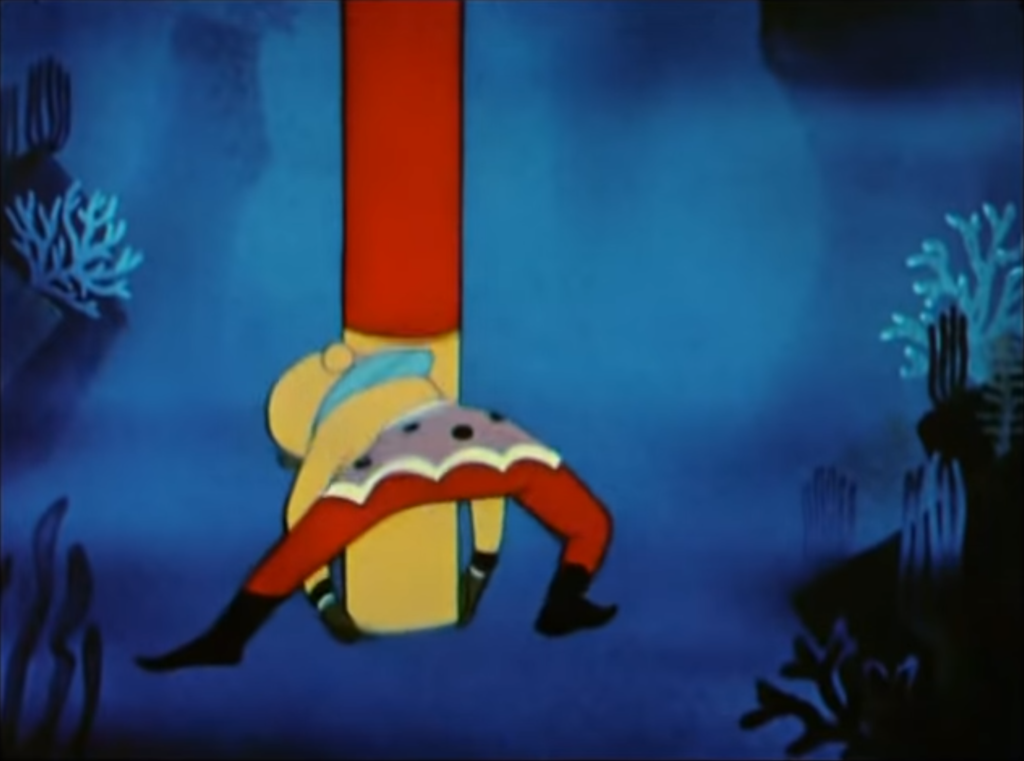
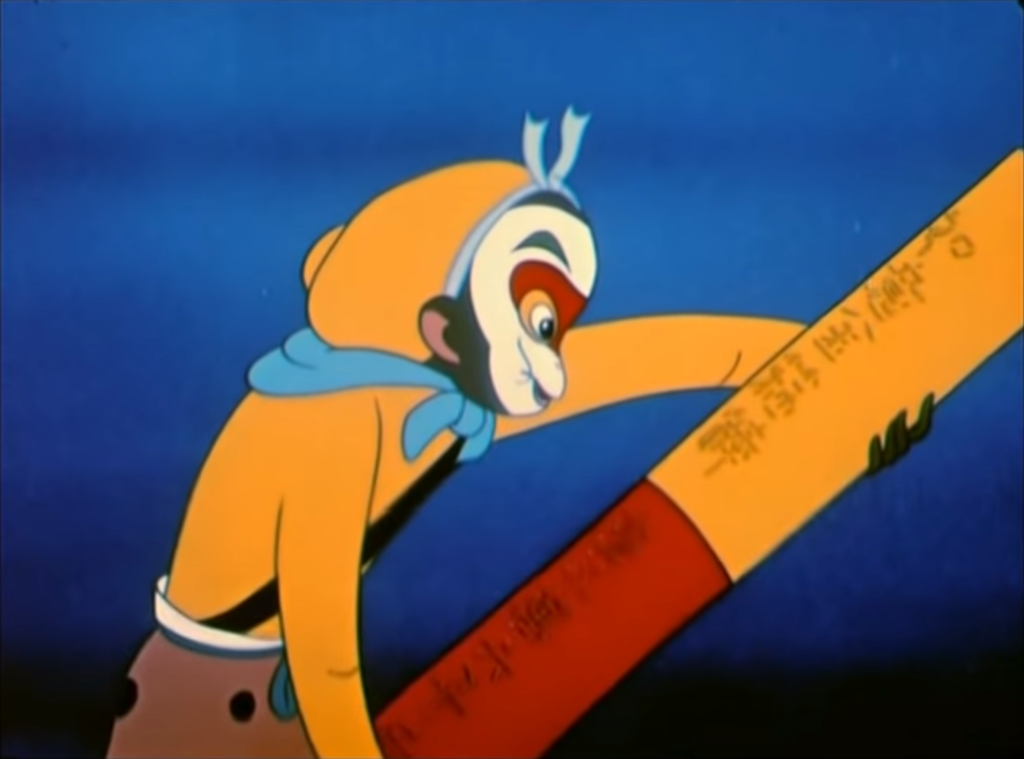
The Dragon King accordingly led him to the center of the ocean treasury, where all at once they saw a thousand shafts of golden light. Pointing to the spot, the Dragon King said, “That’s it—the thing that is glowing.” Wukong girded up his clothes and went forward to touch it: it was an iron rod [tie zhuzi, 鐵柱子] more than twenty feet long and as thick as a barrel. Using all his might, he lifted it with both hands [fig. 2], saying, “It’s a little too long and too thick. It would be more serviceable if it were somewhat shorter and thinner.” Hardly had he finished speaking when the treasure shrunk a few feet in length and became a layer thinner. “Smaller still would be even better,” said Wukong, giving it another bounce in his hands. Again the treasure became smaller. Highly pleased, Wukong took it out of the ocean treasury to examine it. He found a golden hoop at each end, with solid black iron in between. Immediately adjacent to one of the hoops was the inscription, “’As-you-will’ Gold-Banded Cudgel. Weight: thirteen thousand five hundred catties [Ruyi jingu bang zhong yiwan sanqian wubai jin, 如意金箍棒,重一萬三千五百斤] [fig. 3].” He thought to himself in secret delight, “This treasure, I suppose, must be most compliant with one’s wishes.” As he walked, he was deliberating in his mind and murmuring to himself, bouncing the rod in his hands, “Shorter and thinner still would be marvelous!” By the time he took it outside, the rod was no more than twelve feet in length and had the thickness of a rice bowl (Wu & Yu, 2012, vol. 1, p. 135). [5]

Fig. 2 – Monkey lifts the iron pillar (larger version). Fig. 3 – Sun looks at the inscription, including the weight (larger version). Screenshots from the 1960s classic Havoc in Heaven.

2. Comparison

Both scenes involve a hero (Wu Song vs. Sun Wukong) asking someone (Shi En vs. Ao Guang) to show them a heavy object that cannot be moved (stone block vs. iron pillar). Both heroes then adjust their clothing before easily lifting the object with both hands. Most importantly, the Chinese characters for the weight of each object (三五百斤 vs. 一萬三千五百斤) are similar. The only difference is the addition of 一萬 and 千, respectively (fig. 4). [6] Now, someone might say the numbers are meaningless as “three to five hundred” is a common estimate for lengths, distances, and people used throughout the Water Margin (some examples). But the proposed connection is strengthened when you take into account the many similarities shared by Monkey and Wu. I show in this article that both are reformed supernatural spirits previously trapped under the weight of magic mountains, slayers of tigers, Buddhist monks nicknamed “Pilgrim”, monastic masters of martial arts, wearers of moralistic golden headbands, and wielders of bin steel weapons. Therefore, given the close historical and cultural ties between the two characters, I believe the author-compiler of Journey to the West embellished the Water Margin episode to portray Sun as a hero like no other, a divine immortal that can lift weights far beyond even Wu Song himself.

Fig. 4 – The weight of Monkey’s staff where the red characters represent additions to the weight of Wu Song’s stone in black.


Update: 03-11-23

My friend and contributor Saie Surendra (website) was recently sent a video similar to this one suggesting another possible origin for the weight of Monkey’s staff. [7] The speaker, Lan yanling (兰彦岭), states, “The Golden-Hooped Staff weighs 13,500 catties, and everyday a person breathes 13,500 times” (金箍棒重13,500斤,人一天呼吸13,500次). The specific number of breaths is drawn from ancient medical treatises, some of which were absorbed into the Daoist canon.

For example, the first scroll of The Yellow Emperor’s Canon of Eighty-One Difficult Issues (Huangdi bashiyi nanjing, 黃帝八十一難經) reads:

A person, in the course of one day and one night, breathes altogether 13,500 times (Unschuld, 1986, p. 65). 

人一日一夜,凡一萬三千五百息。

This second possibility is interesting as Sun achieves immortality through a series of breathing and energy circulation exercises. This means that, if the number did influence the weapon’s weight, one could speculate that the staff is a physical manifestation of the methods by which he gained his powers. 

I’m not quite sure how I feel about this new possibility. On one hand, it doesn’t require adding characters (i.e. 一萬 and 千) to come up with the figure 13,500 (refer back to section 2 above). But on the other, it lacks the literary context laid out in the main article. I’ll have to look into this more.

Notes:

1) I have changed Yu’s (Wu & Yu, 2012) dry rendering “Compliant Golden-Hooped Rod” to the more pleasant one based on W.J.F. Jenner (Wu & Jenner, 1993/2001, p. 56). Also, Yu’s (Wu & Yu, 2012) original translation says “thirteen thousand five hundred pounds” (Wu & Yu, 2012, vol. 1, p. 135). However, the Chinese version uses jin (斤), known in English as “catty.” The catty and pound are two different measures of weight, the former being heavier than the latter. Therefore, the English text has been altered to show this. The catty during the Ming Dynasty when the novel was compiled equaled 590 grams (Elvin, 2004, p. 491 n. 133), so 13,500 catties would equal 17,560 lbs.

2) The scene happens in chapter 28 of the English translation (see Shi, Luo, & Shapiro, 1999).

3) The English translation doesn’t mention the specific name of the temple appearing in the original Chinese version. I’ve corrected this.

4) The English translation says “four or five hundred catties” (Shi, Luo, & Shapiro, 1999, pp. 845-847), whereas the Chinese says “three to five hundred catties” (san wu bai jin, 三五百斤). I’ve corrected this.

5) Again, I have slightly modified Yu’s (Wu & Yu, 2012) translation. Also, both the original Chinese and the translation say the staff was shrunk to “no more than twenty feet in length” (zhiyou er zhang changduan, 只有二丈長短) (Wu & Yu, 2012, vol. 1, p. 135), but it was close to 20 feet from the start. This is likely an error (thanks to Irwen Wong for pointing this out).

6) These mean “10,000” (yiwan, 一萬) and “1,000” (qian, 千), respectively. When combined with the character for three, the latter becomes “3,000” (sanqian, 三千).

7) The video was sent to him by an acquaintance named Afeng.

Sources:

Elvin, M. (2004). The Retreat of the Elephants: An Environmental History of China. New Haven (Conn.): Yale university press.

Shi, N., Luo, G., & Shapiro, S. (1999). Outlaws of the Marsh (Bilingual ed.). Beijing, China: Foreign Languages Press.

Unschuld, P. (1986). Nan-Ching: The Classic of Difficult Issues; With Commentaries by Chinese and Japanese Authors from the Third through the Twentieth Century. Berkeley, CA: University of California Press.

Wu, C., & Jenner, W. J. F. (2000). Journey to the West (Vol. 1). Beijing, China: Foreign Languages Press. (Original work published 1993)

Wu, C., & Yu, A. C. (2012). The Journey to the West (Vols. 1-4) (Rev. ed.). Chicago, Illinois: University of Chicago Press.

Parallels between Sun Wukong and Wu Song

Last updated: 06-18-2022

It recently occurred to me that Sun Wukong from Journey to the West (Xiyouji, 西遊記, 1592) (hereafter, JTTW) and Wu Song (武松) from the Water Margin (Shuihu zhuan, 水滸傳, c. 1400) (hereafter, WM) share a number of similarities. Each is a reformed supernatural spirit, a tiger-slayer, a Buddhist monk nicknamed “Pilgrim”, and a monastic martial artist, and each wears a moralistic headband and wields a weapon made from the same fanciful metal. Since the WM predates the publication of JTTW by nearly two hundred years, one might be tempted to speculate that the latter influenced the former. However, both story cycles first appeared during the Song dynasty, with various iterations from the Yuan to the Ming (see Ge, 2001). In this article I show the parallels are due to the respective narratives drawing on similar religious, folkloric, and historical source material. I feel such a comparison is important as it presents a fuller picture of the cultural landscape in which the Monkey King developed. 

I. Reformed supernatural spirits

Chapters one through seven of JTTW present Sun Wukong as a celestial stone-born monkey who studies under a Buddho-Daoist master and achieves great magic powers, which he uses to rebel against heaven. After being defeated by the Buddha, Monkey is imprisoned under Five Elements Mountain for five hundred years. In chapter fourteen, the repentant immortal is later released to protect the monk Tripitaka on his journey to retrieve scriptures from India.

Sun Wukong trapped under mountain - In Flames toy - small

Fig. 1 – A modern action figure of Sun Wukong’s imprisonment under a section of Five Elements Mountain (larger version).

Chapter one of the WM tells how one hundred and eight spirits were quelled by a Daoist sage during the Tang dynasty and imprisoned in a bottomless pit under a great stone slab. Four or five hundred years later during the Song dynasty, a haughty government official orders the slab dug up and removed to sate his curiosity, allowing the spirits to escape in a plume of miasmic black fumes and later be reborn on earth. Wu Song, whose main story appears in chapters 23 to 32, is one of these extraordinary men and women who come to use their martial, intellectual, or magical skills to rebel against the corrupt Song government. A heaven-sent stone slab in chapter 71 is later discovered to list the names of each bandit with the corresponding name of their previous incarnation, which make up the “Thirty-Six Heavenly Stars” (Tiangang sanshiliu xing, 天罡三十六星) and the “Seventy-Two Earthly Fiend Stars” (Disha qishier xing, 地煞七十二星). Wu Song is listed as the “Heavenly Harm Star” (Tianshang xing, 天傷星), the fourteenth of the Thirty-Six Heavenly Stars.

So we see both are formerly evil spirits who were conquered by a religious figure and imprisoned under stone for centuries. After being released, each rebellious figure becomes a force for good.

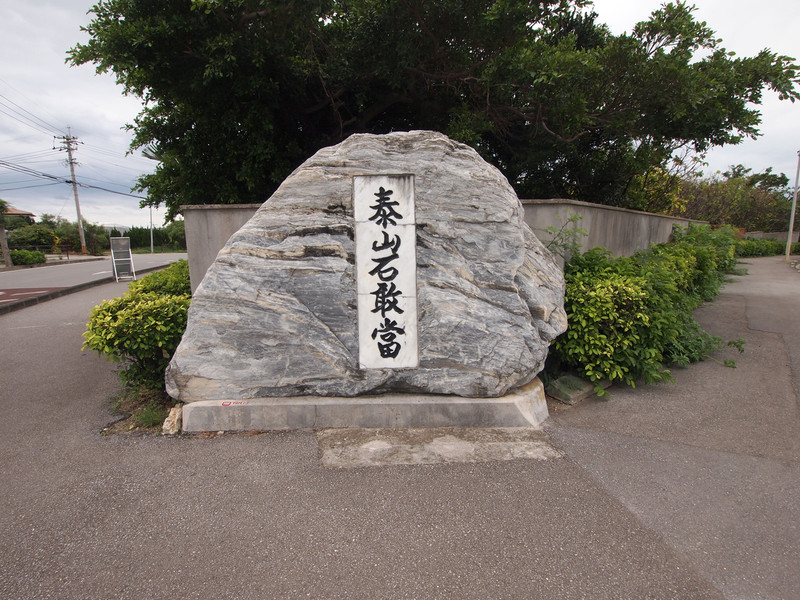
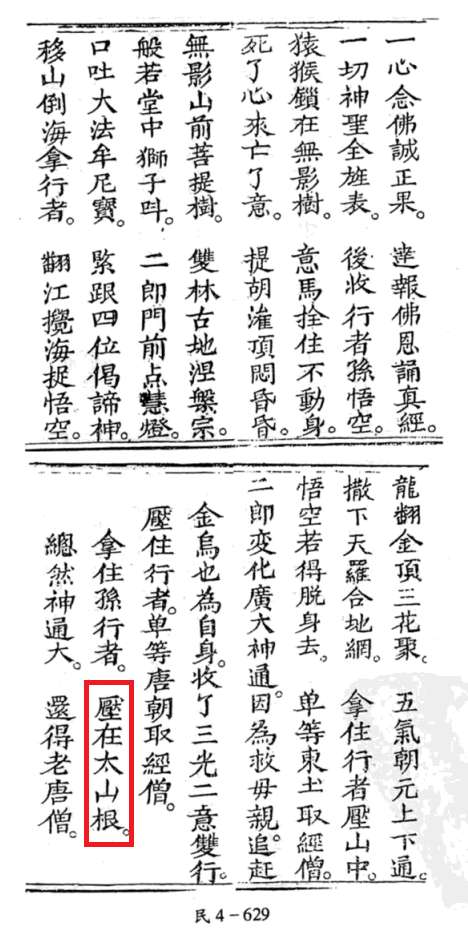
Monkey’s punishment can be traced to Tang and Song dynasty tales about the sage king Yu the Great imprisoning a simian water demon under a mountain. To my knowledge, the first recorded mention of this punishment appears in an early Ming zaju play in which Guanyin traps Sun Wukong under Flower Fruit Mountain. Wang (1992) suggests the stone slab from the WM was likely influenced by the Taishan stone (taishan shi, 泰山石) (fig. 2), a class of “evil-warding stones” (shigandang, 石敢當) often placed outside of homes and temples or at the intersection of roads as protection from malevolent forces (pp. 71-72 and 254). The Taishan stone represents Mount Tai and its deity. The landmass is considered the heaviest thing imaginable in Chinese culture. This means the evil would be completely immobilized by the great weight.

Taishan stone example - small

Fig. 2 – A modern Japanese example of a Taishan stone (larger version). They often read “Taishan stone takes upon itself” (Taishan shi gandang, 泰山石敢當), denoting its duty of protection (Wang, 1992, p. 71). Original image from Wikipedia

Additionally, the pit containing the spirits can be traced to a Song-era Daoist ritual in which an exorcist draws the character for “well” (jing, 井/丼) on the ground, thereby dividing the ritual space into nine sections, representing the Nine Palaces (jiugong, 九宮), [1] and creating an earth prison. The Compilation of Rituals of the Way (Daofa huiyuan, 道法會元) reads:

[U]se the Sword mudrā to draw the character for “well” on the ground. Transform it into a black prison, ten-thousand zhang deep, and ten thousand li wide. [2] Black vapors burst out of it. Inside the prison, visualize how cangues and locks, as well as tools and machinery are laid out. Then recite the Spell for Fast Arrest [cu zhuo zhou, 促捉咒] (Meulenbeld, 2007, p. 142).

The black vapors should remind readers of that released upon the spirits’ escape from their centuries-long imprisonment.

Mountain mudra with Chinese character

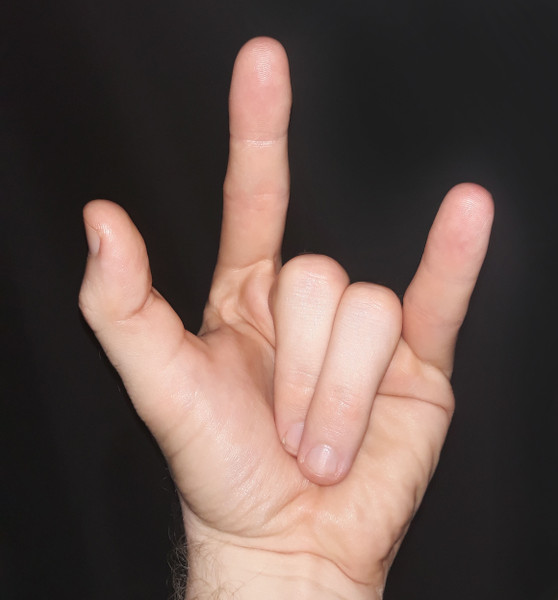
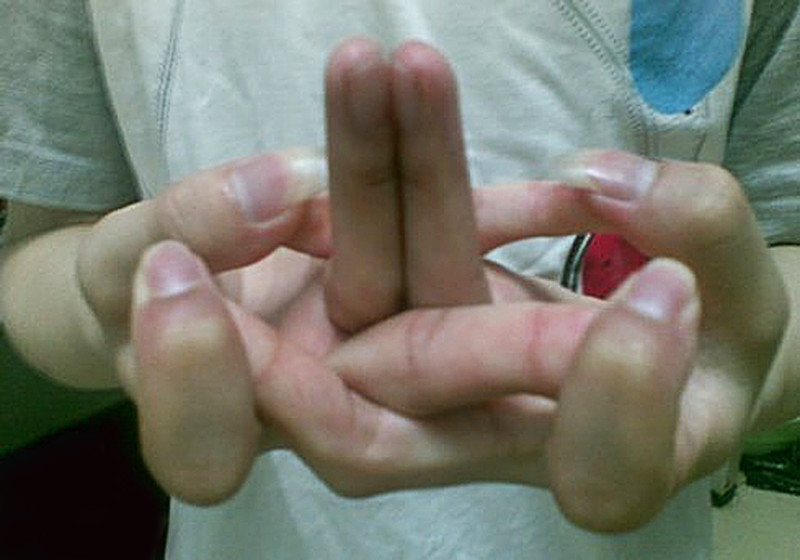
Fig. 3 – The Chinese character for mountain (shan, 山) (larger version). Fig. 4 – The Mountain mudra (shanzi jue, 山字訣) (larger version). Photo by the author. Fig. 5 – The double-handed Mount Tai mudra (Taishan jue, 泰山訣) (larger version). Original picture from here.

Another version of the ritual sees the spirits being coaxed or forced inside of a liquid-filled jar placed in the center of the well diagram. Afterwards, the opening is sealed with paper and the exorcist performs a mudra representing the immense pressing weight of a mountain (just like the aforementioned Taishan stone). [3] Meulenbeld (2007) writes:

The spirits captured within the grid of the Nine Palaces were kept inside their prison by symbolically pressing them down underneath a mountain. The symbolism here lies in the fact that the mountain was represented by a posture of the hand forming the character for mountain (“Mountain Mudrā” 山字訣 with the thumb, index-finger, and little finger all pointing upward [fig. 3 and 4]. Oftentimes the specific “mudrā of Mt. Tai” 泰山訣 [fig. 5], was used, representing the heaviest of all mountains. Moreover, many present-day exorcist talismans contain a character composed of a “demon” 鬼 underneath a “mountain” 山, namely the character wei 嵬 (p. 145, n. 92).

This means the respective punishments of Sun Wukong and Wu Song (and his brethren) are for all intents and purposes the same: they are imprisoned under mountains. The Taishan stone and the Mountain mudra are no doubt based on the same belief that mountains can immobilize evil spirits. Most importantly, the mudra likely influenced the concept of the Buddha transforming his hand into Five Elements Mountain in chapter 7 of JTTW. The fictional mountain is then a cognate of Mount Tai. 

Five Thunders talisman - small

Fig. 6 – A paper fu talisman marked with an image of the Five Thunders (Wu Lei, 五雷) (larger version).

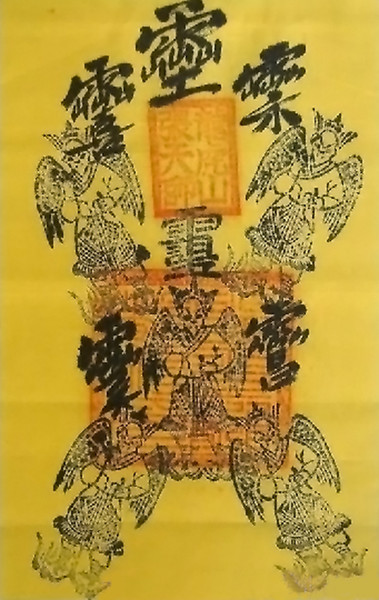
Lastly, the idea that evil spirits can be reformed and their powers put to good use—i.e. Sun Wukong protecting Tripitaka and Wu Song standing against a corrupt government—is tied to the Song-era “Thunder Ritual” (Leifa, 雷法). Meulenbeld (2007) explains stories from the Tang to the Song present the characteristics of the thunder god, Sire Thunder (Lei Gong, 雷公), becoming increasingly demonic, changing from a muscular deity to a number of animals and finally a Garuda-like bird monster. Likewise, while he was a respected force of nature in the past, Sire Thunder becomes an impulsive agent of heaven, one capable of being challenged and even captured by a brave individual or ritual master. The subjugation of this demonic god allows his captors to appropriate his heavenly power for their own purposes. The deity and his four brothers, comprising the “Five Thunders” (Wu Lei, 五雷) (fig. 6), can be summoned on command via talismans and charms and made to bring rain, heal sicknesses, or conquer demons. [4] Such ritual accouterments are just a small part of a much larger subsequent Thunder Ritual liturgy that is, according to one Song dynasty source, capable of “control[ing] the demons and spirits of the Sixfold Heavens, [expelling] evil and avert[ing] disaster” (Meulenbeld, 2007, p. 67). 

II. Tiger-Slayers

JTTW, ch. 14 – Sun Wukong’s first act of protecting Tripitaka upon his release is effortlessly killing a tiger with a single stroke of his staff. This happens the day after a huntsman had come to the monk’s defense by fighting a tiger for hours before dispatching it with a trident. The difference in power between the immortal and human heroes leads the monk to exclaim, “For the strong, there’s always someone stronger!” (Wu & Yu, 2012, vol. 1, p. 310).

WM, ch. 23 – Wu Song gets drunk on a trip home to see his elder brother, and after ignoring warnings not to take a mountain shortcut, the hero is set upon by a ferocious man-eating tiger. In the process of initially defending himself, Wu snaps his walking staff on a nearby tree, forcing him to resort to brute strength. He manages to wrestle the big cat’s face into the dirt and rains down sixty or seventy fist blows before it stops moving (fig. 7). He then finishes off the beast with the remains of his staff.

Wu Song kills tiger - small

Fig. 7 – “Wu Song Beats the Tiger” (Wu Song da hu, 武松打虎) by Wang Kewei (王可偉) (larger version).

I can’t help but imagine the episode from JTTW is a sly nod to that from the WM. Tripitaka’s statement could be a way of propping up the Monkey King as the most powerful hero, one who can dispatch tigers with no effort at all.

The ability to kill a tiger was considered the sign of a powerful warrior in Chinese folklore. For example, A New Account of the Tales of the World (Shishuo xinyu, 世說新語, 5th-century), a collection of historical and fictional anecdotes, tells the story of how the Western Jin general Zhou Chu (周處, 236–297) was originally a wayward youth considered the worst of Yixing‘s “Three Scourges”—a tiger, a dragon, and himself. Wanting to prove his strength, Zhou is said to have easily killed the tiger but disappeared for three days and nights fighting the dragon. The youth later returned to find the people celebrating his apparent death. This caused Zhou to mend his ways and eventually become a great general (Knechtges & Chang, 2010, pp. 2274-2275).

III. Buddhist monks with matching religious nicknames 

JTTW, ch. 14 – Sun Wukong takes the tonsure as a Buddhist monk upon his release. [5] His master Tripitaka then gives him the religious nickname “Pilgrim Sun” (Sun xingzhe, 孫行者), and the character is often simply referred to as “Pilgrim” (xingzhe, 行者; literally: “traveler”) throughout the narrative.

WM, ch. 31 – Wu Song kills a thug and his Song government official friend for framing the hero for theft and attempting to have him murdered en route to a prison camp. As a result, he is forced to dress as a Buddhist monk, taking a slain priest’s religious garb and ordination certificate (jiedie, 戒牒) and calling himself “Pilgrim Wu” (Wu xingzhe, 武行者).

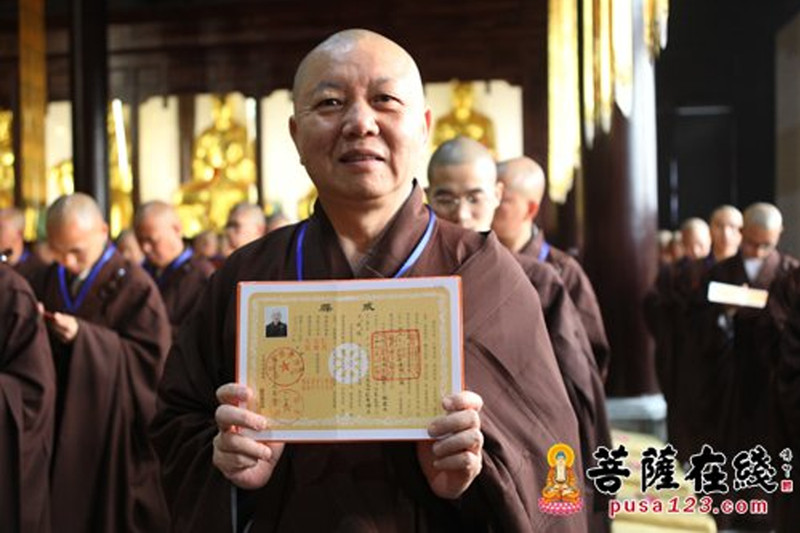
The term Pilgrim refers to a “postulant”, a lay Buddhist acolyte who has yet to be ordained but lives as an untonsured monk, one expected to follow the Five Precepts (Pali: Pañcasīla; Ch: Wujie, 五戒) against killing, lying, stealing, sexual misconduct, and drinking alcohol (Robert & David, 2013, pp. 1011-1012). Ch’en (1956) writes that such trainees were historically required to complete a long period of intense religious study and pass a rigorous examination before being awarded the aforementioned ordination certificate (fig. 8), thereby becoming a full-fledged monk. This certification system was originally initiated during the Tang to weed out those wanting to evade the draft and taxes, as well as bandits like Wu Song who sought refuge from the law. However, during the Song, the government sold these documents like war bonds in order to help pay for their ongoing struggle against the barbarians of northern China. Therefore, ordination certificates were often exuberantly expensive, [6] meaning those who had the training but could not afford the document were doomed to live as a postulant. This contrasts with the thousands upon thousands of people who bought their way into the Buddha’s fold simply for the draft and tax exemption. They forwent the training altogether and were monks only on paper. This continued practice naturally resulted in a major decline in the quality of monks during the Song.

Monk with ordination certificate - small

Fig. 8 – A present day monk showing his ordination certificate (jiedie, 戒牒) (larger version). Original image found here.

Having read the above, we can say Sun Wukong is called Pilgrim because he assists a Buddhist priest but lacks the religious education and ordination certificate. While Wu Song has the document (taken from a dead priest), he lacks the required education. It should be remembered that Wu is a bandit-turned-monk. At the same time, both characters typify the “itinerant monk”, the second meaning of Pilgrim (xingzhe, 行者), as both are on a journey: Sun is traveling to India and Wu is traveling the road—albeit secretly to meet with fellow outlaws. But I would like to suggest that the titles may have also been meant as a jab at the violent, untrained riffraff passing for monks during the Song (more on this below). After all, the earliest references to our characters with these titles come from this period.

“Pilgrim Wu” appears in scholar-painter Gong Shengyu‘s (龔聖予, 1222–1307) In Praise of the Thirty-Six [men] of Song Jiang (Song Jiang sanshiliu zan, 宋江三十六贊), a collection of poems eulogizing each of the thirty-six bandits then associated with the early WM story cycle.

Pilgrim Wu Song: You resisted women, obeyed the Five Precepts, among Wine, Women, Wealth and Force, you were inclined to kill people (Børdahl, 2013, p. 29).

Gong claims the poems were based on “stories of the streets and tales of the lanes” (jie tan xiang yu, 街談巷語), popular narratives performed by storytellers at local venues.  Given that such early tales no longer exist, its impossible to say whether or not Wu Song was always a monk or a bandit-turned-impostor monk like his counterpart from the published edition of the WM (Børdahl, 2013, pp. 28-29). Either way, this suggests Wu’s predilection for killing was a prominent aspect of his story cycle by at least the 13-century.

Sun Wukong first appears as the “Monkey Pilgrim” (Hou xingzhe, 猴行者) in The Story of How Tripitaka of the Great Tang Procures the Scriptures (Da Tang Sanzang qujing shihua, 大唐三藏取經詩話), a seventeen chapter storytelling prompt dated to the late 13th-century. Like Wu Song, Monkey is also depicted as comfortable with killing. For example, in chapter five, he turns an evil sorcerer’s wife into grass so that she will be eaten by a young monk who had been transformed by her husband into a donkey. After both parties are changed back to normal, Monkey threatens to “mow down all the grass of [his] house” (i.e. kill his wife and anyone else he loves) if the man ever misuses his magic again. [7] Later in chapter six, Monkey brutally tortures and then kills a white tiger demon who tries to eat his master (Wivell, 1994, pp. 1181-1207)

Wu Song and Lu Zhishen - Small

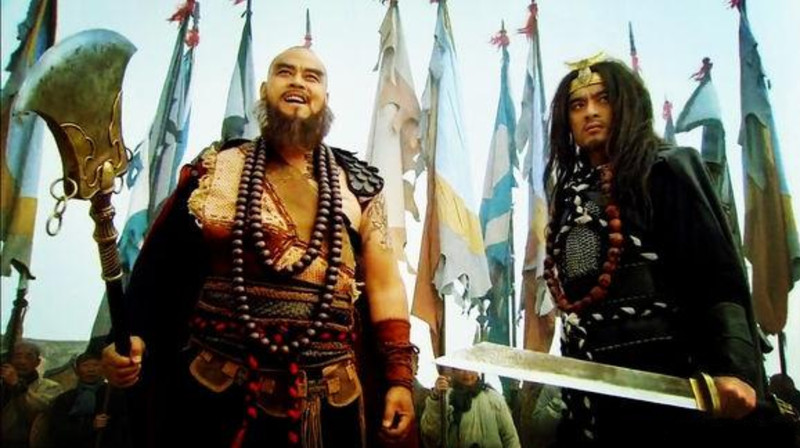
Fig. 9 – The “Pilgrim” Wu Song (right) and the “Flower Monk” Lu Zhishen (left) from a recent WM television series (larger version).

Additionally, two early WM-related tales titled “Pilgrim Wu” (Wu xingzhe, 武行者) and the “Flower [Tattooed] Monk” (Hua heshang, 花和尚) are listed under the “staff” (ganbang, 桿棒) category of popular stories in The Drunken Man’s Talk (Zuiweng tanlu, 醉翁談錄), a circa 13th-century collection of short stories, anecdotes, and poetry. [8] So-called staff tales were character-driven narratives about heroes, in this case Wu Song and his fellow outlaw-turned-monk Lu Zhishen (fig. 9), righting injustices using staves. [9] I should note that The Story describes the Monkey Pilgrim wielding two such weapons in his adventures.

Sun and Wu’s association with killing and staff fighting were likely influenced by historical warrior monks and bandit monks. Shahar (2008) explains warrior monks were seasoned fighters who lived in subsidiary shrines away from the devout community and protected monasteries in times of trouble. These “monks” regularly drank wine and ate meat, associating the latter with physical strength and fighting ability, and even worshiped wrathful deities like Vajrapani, who is described in scripture as killing in the name of Buddha. Their weapon of choice was a wooden staff, which was originally chosen for being non-lethal. However, a metal staff like the one wielded by Sun Wukong in JTTW was sometimes used by warrior monks for its killing capacity in times of war. The most famous monastic staff method belongs to the Shaolin Monastery (Shaolin si, 少林寺) (video 1). After the Shaolin warrior monks helped the Ming dynasty government repel Japanese pirate incursions from the Chinese coast during the 1550s, their staff method was touted in military encyclopedias and civilian weapons manuals. [10]

Video 1 – A demonstration of Shaolin Wind Devil Staff (Fengmo gun, 風魔棍).
 

Bandit monks are outlaws like Wu Song who dressed as monks to avoid problems with the law. [11] Lorge (2012) comments that the characteristics of bandit monks were nearly indistinguishable from that of warrior monks.

[I]t is easy to see how bandit-monks are virtually the same as warrior-monks. These men drank wine, at meat, and had sex with women—practices alien to true Buddhist monks. A number of Buddhist authorities were deeply troubled by the presence of monks who directly violated Buddhist precepts. We do not know whether there was a sharp break between ordained and trained monks who carefully followed monastic rules in their search for enlightenment and men who simply claimed to be monks, wore monastic robes, shaved their heads, but otherwise did not follow monastic rules (p. 174).

He goes on to explain that the Shaolin monastery, for example, became heavily militarized after a nasty defeat in 1356 during the Red Turban Rebellion and so may have replenished its ranks using formerly deactivated soldiers at the turn of the Ming dynasty. Such violence-prone men would naturally turn towards a life of crime. Therefore, these bandits “would have been easy enough to recruit and send out as warrior-monks to fight against [other] bandits” (Lorge, 2012, p. 175).

So we see there existed a class of staff-bearing pseudo-monks who regularly took life and drank alcohol. Serving as mainly monastic bodyguards, these fighters lacked the devotion to the precepts and, especially, the religious education to be considered real monks. Therefore, Sun and Wu’s characterization as such warriors may further explain why they are called Pilgrim.

IV. Monastic martial artists

I want to preface this section by stating upfront that it overlaps to some degree with the previous one. But while the former explored Sun and Wu’s connection to staff-wielding warrior monks by way of their characterization in late Song oral literature, this one will discuss the connection between their images as monastic martial artists and the historical practice of boxing by warrior monks.

While the Great Sage is primarily known for his skill with the staff, he displays a mastery of unarmed combat twice in JTTW. Chapter 51, for example, describes Sun and a demonic opponent fighting with a long list of punches, kicks, grapples, and throws.

Hitching up his clothes and walking forward, the fiend assumed a boxing posture; his two fists upraised looked truly like two iron sledge hammers. Our Great Sage also loosened his legs at once and moved his body to attack; right before the cave entrance, he began to box with the demon king. This was quite a fight! Aha!

Opening wide the “Four Levels Posture”;
The double-kicking feet fly up.
They pound the ribs and chests;
They stab at galls and hearts.
“The Immortal pointing the Way”;
“Lao Zi Riding the Crane”;
“A Hungry Tiger Pouncing on the Prey” is most hurtful;
“A Dragon Playing with Water” is quite vicious.
The demon king uses a “Serpent Turning Around”;
The Great Sage employs a “Deer Letting Loose its Horns.”
The dragon plunges to Earth with heels upturned;
The wrist twists around to seize Heaven’s bag.
A green lion’s open-mouthed lunge;
A carp’s snapped-back flip.
Sprinkling flowers over the head;
Tying a rope around the waist;
A fan moving with the wind;
The rain driving down the flowers.
The monster-spirit then uses the “Guanyin Palm,”
And pilgrim counters with the “Arhat Feet.”
The “Long-Range Fist,” stretching, is more slack, of course.
How could it compare with the “Close-Range Fist’s” sharp jabs?
The two of them fought for many rounds—
None was the stronger, for they are evenly matched (Wu & Yu, 2012, vol. 3, pp. 12-13)

I show in this article that many of the named techniques are real and are still practiced to this day. Furthermore, the poem’s bias for close-range fighting over long-range “is typical of late Ming and early Qing military literature”, as noted by Shahar (2008, p. 117). He continues, “Sixteenth- and seventeenth-century military experts allude to various short-range styles including ‘Cotton Zhang’s Close-Range Fist’ (Mian Zhang duanda [綿張短打]), ‘Ren Family Close-Range Fist’ (Renjia duanda [任家短打]), and ‘Liu [Family] Close-Range Fist’ (Liu duanda [劉短打])” (Shahar, 2008, p. 117). This shows the author-compiler of JTTW consulted real martial arts material to make this fight more authentic.

Having donned the monk persona, Pilgrim Wu stops by an inn while on a journey to meet with fellow outlaws in chapter 32. The monk’s great tolerance for wine (fig. 13) and request for meat surprises the inn keeper, whom Wu slaps to the ground upon seeing the man serve better wine and even chicken to a different patron. The patron and his friends attack the monk but are soundly beaten by his superior strength and fighting ability. [12]

Wu’s characterization as a meat-eating, alcohol-drinking monk with a thirst for combat is obviously tied to the warrior and bandit monks discussed earlier.

Wu Song with jug of wine and sword - small

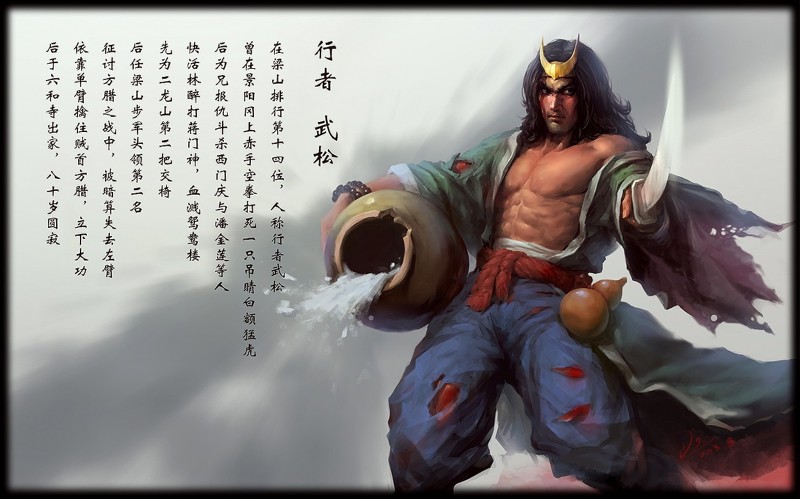
Fig. 15 – A modern depiction of Pilgrim Wu holding a jar of wine and brandishing a saber (larger version). By Leewiart user Du_YH. Original image found here

While it precedes Wu becoming a monk, the best example of his martial prowess appears in chapter 29:

But Jiang was scornful of his foe [Wu Song], thinking that he was drunk, and he closed in rapidly. Quicker than it takes to tell, Wu Song flourished his two fists at Jiang’s face, then turned and started away. Enraged, Jiang raced after him. Wu Song lashed out backwards with his left foot and kicked him in the groin. As Jiang clasped his injured section and doubled over in pain, Wu Song whirled around and swung his right foot in a flying kick to the forehead that slammed the big man over on his back. Wu Song planted one foot on his chest and, with keg-like fists, began pommeling Jiang’s head.

This maneuver we just described—the flourish of fists and turning away, the backward left kick, the whirling around and the forward right kick—is called “the Jade-Circle Steps with Duck and Drake Feet” [Yuhuan bu, yuanyang jiao, 玉環步, 鴛鴦腳]. It was one of Wu Song’s most skillful moves. A remarkable trick! (Shi, Luo, & Shapiro, 2015, p. 332).

Wu’s style is possibly another name for “Piercing Foot” (Chuojiao, 戳腳), a northern Chinese martial art known for its dynamic kicking skills. Modern folklore traces the style to the Song dynasty due to its association with WM heroes. [13]

While JTTW never openly describes Sun Wukong training in martial arts, it does imply that he learns armed and unarmed combat as a young monk studying under the Buddho-Daoist Sage Subodhi. Monkey learning boxing in a religious institution is actually a faithful depiction of one aspect of monastic life during the Ming. Shahar (2008) shows Shaolin warrior monks took up unarmed combat during the late Ming-period, when boxing saw an explosion in popularity in Chinese culture (as demonstrated by the named techniques recorded in JTTW and the WM). Textual evidence suggests the first styles practiced by Shaolin were Drunken Eight Immortals Boxing (Zui baxian quan, 醉八仙拳), popularized by Jackie Chan in The Drunken Master (1978), and Lost Track Boxing (Mizong quan, 迷蹤拳), the fighting style of the national hero Huo Yuanjia popularized by Bruce Lee in Fist of Fury (1972). The monks may have adopted boxing as a form of calisthenic exercise. To this they later added Daoyin (導引), a regimen of yoga-like Daoist breathing and stretching exercises designed to absorb qi (氣) energy and circulate it throughout the body. Therefore, the monks elevated their boxing practice from mere fighting to a form of spiritual cultivation. This synthesis of martial and spiritual practices simultaneously took place in wider Ming culture, leading to the creation of so-called “internal” (Neijia, 内家) martial arts like Taiji and Xingyi boxing. [14]

sengchou-jumps-into-the-rafters-small-1.jpg

Fig. 10 – A modern drawing of the monk Sengchou showing off his newfound powers by jumping above the rafters of the Shaolin monastery (larger version). Original image found here.

That’s not to say Shaolin monks did not practice unarmed martial arts prior to the 17th-century. It’s just boxing was only a form of entertainment practiced by a few and not part of the official training regimen. For example, the Tang-era anthology Complete Records from Court and Commonality (Chaoye qian zai, 朝野僉載, c. 8th-century), contains the story of the famed dhyana master and Shaolin monk Sengchou (僧稠, 480–560) beseeching a religious statue of Vajrapani to bless him with martial strength so that the other monks, who enjoy sparring in their free time, will stop bullying him. After six straight days of prayer, the deity appears before him and offers the young novice a bowl of sinews to eat. Sengchou initially refuses due to the prohibition against eating meat, but he ultimately finishes the meal for fear Vajrapani will smite him with his vajra club. Like the radioactive spider bite that changes Peter Parker into Spider-Man, the sinews transform the monk, blessing him with a god-like physique and miraculous powers, such as the ability to walk on walls, leap great heights (fig. 10), and lift thousands of pounds. Most importantly, it drastically improves his fighting skills, so much so, in fact, that his former tormentors come to grovel in his presence (Shahar, 2008, pp. 35-37).

From whom might have Sengchou’s religious brothers learned their unarmed martial arts centuries prior to it becoming an official part of Shaolin’s training regimen? The simplest answer is someone like Wu Song who learned boxing as a bandit or soldier and later joined the sangha. Readers may recall such violence-prone men may have been tapped as warrior monks to protect the monastery in times of trouble. They could have easily passed their fighting skills to the next generation of warrior monks.

A good example of a soldier-turned-monk is the brutish former general Huiming (惠明) from the Platform Sutra (Liuzu tanjing, 六祖壇經, written from the 8th to 13th-c.). The text tells how the disciples of Hongren (弘忍, 601–674), the fifth Chan patriarch, were enraged when their master passed the mantle onto the illiterate postulant laborer Huineng (惠能, 638–713). Hundreds of monks are said to have pursued the fleeing Pilgrim south intent on forcefully taking the patriarchal symbols of the begging bowl and robe for themselves. Huiming persevered and managed to corner Huineng on a mountain. He attempted to wrestle the treasures away, but, by a miracle, he could not lift them. Realizing Huineng was the rightful heir, the monk became his disciple (Huineng & Cleary, 1998, pp. 11-12). Jealousy and anger are obviously qualities unbecoming of a real monk. In fact, the only thing that separates Huiming’s actions of hounding and attempted strong arm robbery from a bandit is his monkhood.

So we see Sun Wukong typifies a next generation warrior monk who learns boxing inside a religious institution. Wu Song typifies the soldier or bandit who learns boxing outside the monastery and later becomes a monastic fighter, one who passes on their skills to younger monks.

V. Moralistic headbands

JTTW, ch. 14 – The Monkey King is tricked into wearing a brocade hat under the pretense of gaining the ability to recite scripture without rote memorization. However, the hat houses a golden fillet (jinguquan, 金箍圈) that soon takes root and painfully tightens around the immortal’s head when the correct spell is chanted (fig. 11). This allows the feeble monk Tripitaka to control the celestial monkey’s unruly nature.

WM, ch. 31 – When Wu Song disguises himself as a monk, he wears the garments of a priest who had previously been killed by bandits. The habit includes a metal “Precepts fillet” (jiegu, 戒箍) that he wears over his long hair (fig. 12).

Fillet examples - small

Fig. 11 – (Top left) Sun Wukong’s golden fillet from the 1986 JTTW television series (larger version). Fig. 12 – (Top right) Wu Song’s Precepts fillet from a recent WM television series (larger version). Fig. 13 – (Bottom left) A late 11th to early 12th-century copper alloy statue of the wrathful deity Hevajra (larger version). He is portrayed with the same Esoteric Buddhist ritual attire as his followers, including the headband, arm cuffs, a bone (skull) rosary, bracelets, a girdle, anklets, and a tiger skin sarong. Courtesy of the Los Angeles County Museum of ArtFig. 14 – (Bottom center) A detail of the Monkey Pilgrim’s fillet featured in an 11th-century mural from Eastern Thousand Buddha Cave number two in Gansu Province, China (larger version). It has been slightly enhanced for clarity. A fuller version of the image can be seen here. Fig. 15 – (Bottom right) A military monk from a modern Beijing Opera production (larger version). From Bonds, 2008, p. 178.

I explain in this article that the heroes’ fillets share a common origin in an ancient Indo-Tibetan Esoteric Buddhist ritual headband, one representing the Buddha Akshobhya and thereby moral self-restraint. It was one of several ritual items worn while worshiping wrathful protector deities like Heruka. Such deities were often depicted wearing the same attire as their followers, leading to the band becoming a symbol of powerful Buddhist spirits (fig. 13). The Hevajra Tantra (Ch: Dabei kongzhi jingang dajiao wang yigui jing, 大悲空智金剛大教王儀軌經), the original 8th-century Indian Buddhist text mentioning the ritual items, was translated into Tibetan and Chinese during the 11th-century. Interestingly, the earliest example of Monkey wearing the circlet (likely symbolizing the taming of the monkey of the mind) hails from this time (fig. 14). But Wu’s association with the headband was likely influenced by the Precepts fillet worn by the warrior monks of Chinese Opera (fig. 15). These heroes wear the band to show that they have taken a vow of abstinence (Bonds, 2008, pp. 177-178 and 328).

VI. Bin steel weapons

JTTW, ch. 3 – Sun Wukong comes into possession of a magic staff (fig. 16) taken from the Dragon King’s underwater treasury. A poem in chapter 75 describes the weapon being hand-forged from Bin steel (bintie, 鑌鐵) by the high Daoist god Laozi.

WM, ch. 31 – Apart from wearing the fallen monk’s religious clothing, Wu Song also takes possession of his Buddhist sabers made from “snowflake pattern” Bin steel (huaxue bintie jiedao, 雪花鑌鐵戒刀) (fig. 17). [15]

Sun Wukong and Wu Song weapons - small

Fig. 16 – A modern action figure of Sun Wukong holding his magic Bin steel staff (larger version). Fig. 17 – A modern painting of Wu Song wielding his Bin steel sabers (larger version). Artist unknown. 

Sun’s staff and Wu’s sabers are not the first bin steel weapons to appear in Chinese literature. A bladed pole arm example is the Bin steel great sword (bintie da podao, 鑌鐵刀) wielded by a bandit from the Old incidents in Xuanhe period of the Great Song Dynasty (Da Song Xuanhe Yishi, 大宋宣和遺事, mid-13th-century), a storytelling prompt containing WM material predating the published novel. [16] Another pole arm is the Bin steel spear (bintie qiang鑌鐵槍) wielded by a general from The Three Sui Quash the Demons’ Revolt (San sui pingyao zhuan, 三遂平妖傳, c. late 16th-century), which also takes place in the Song-era (Luo, n.d.). 

I explain in this article that Bin steel is a real world metal akin to Damascus that was imported to China from Persia starting from the 6th-century, and the secret of its manufacture eventually reached the Middle Kingdom by the 12th-century. The metal was considered an exceptionally fine steel and was often used to make strong, durable, and sharp knives and swords, some worth more than silver. One general is described as boasting that rebels would “have to nick (chi, 齒) his sword of bin iron” if they wished to rise up (Wagner, 2008, p. 269). This is a simultaneous declaration of his unbreakable resolve and a statement praising the seemingly indestructible metal. Therefore, JTTW and the WM portray the finest of heroes wielding the finest of steel weapons.

VII. Conclusion

As shown, the parallels between Sun Wukong and Wu Song are the result of JTTW and the WM borrowing from the same cultural source material. Monkey’s imprisonment under Five Elements mountain and Wu’s time as an evil spirit trapped in a well beneath stone was influenced by the Daoist belief that mountains—be they sympathetically represented by stone or hand mudras—could immobilize malevolent forces. Likewise, our heroes’ portrayal as reformed demons can be tied to the Daoist “Thunder Ritual”, which aims to conquer evil and repurpose its power for good. Sun and Wu’s image as tiger-slayers was influenced by stories of tiger-killing strongmen from Chinese folklore. Their religious nickname “Pilgrim” and characterization as monastic martial artists can be tied to uneducated pseudo-monks and holy warriors skilled in both staff fighting and boxing from Chinese history. Their religious fillets were inspired by an Esoteric Buddhist ritual headband worn as a reminder of moral self-restraint. And the metal comprising Sun and Wu’s weapons can be traced to a real world steel prized in ancient China for its durability. 

This was a fun piece to write because it shows the Great Sage obviously didn’t develop in a vacuum. It’s interesting to me that much of Sun and Wu’s influences hail from the Song dynasty. These include the Daoist rituals for trapping and reforming spirits, the Pilgrim nickname and characterization as staff-wielding warrior monks, and the translation of the tantric text mentioning the moralistic headband and Monkey’s earliest known depiction wearing it.


Update: 10-04-20

I have written a follow up article explaining the parallels between Monkey and the historical Buddha.

Parallels Between the Monkey King and the Buddha


Update: 07-08-21

I’ve written an article that shows the weight of Sun Wukong’s magic staff (一萬三千五百斤) is an embellishment on the weight of a stone block (三五百斤) lifted by Wu Song in ch. 27 of the WM.


Update: 10-02-21

My friend over at Journey to the West Library has written a sequel to this article detailing further similarities between Sun Wukong and Wu Song.

https://journeytothewestlibrary.weebly.com/parallels-between-wukong-and-wu-song

Update: 02-26-22

I’m thinking about writing a piece on characters from world myth trapped under mountains. Here’s the list I have so far:

  1. Sun Wukong (various Journey to the West iterations) – Mt. Huaguo by Guanyin or Five Elements Mountain by the Buddha
  2. 108 stars (Water Margin) – Imprisoned in an earth prison under a stone slab by a Daoist master. As mentioned above, Jing Wang (1992) suggests the stone slab was likely influenced by the Taishan stone (泰山石).
  3. Goddess Yaoji (Precious Scroll of Erlang) – Mt. Tai by the Jade Emperor
  4. Goddess Sanshengmu (Precious Lotus Lamp) – Mt. Hua by Erlang
  5. Wuzhiqi (Extensive Records of the Taiping Reign) – Turtle Mountain by Yu the Great
  6. Ravana (Ramayana) – Mt. Kailash by Shiva
  7. Typhon (Dionysiaca/various) – Sicily/ Mt. Etna by Zeus
  8. Enceladus (Apollodorus/various) – Sicily by Athena or Mt. Etna by Zeus
  9. Polybotes (Apollodorus/various) – Kos/Nisyros by Poseidon

The parameters may later be expanded to include “earth prisons” in general, which would open the door to Lucifer.


Update: 03-11-22

I recently archived the Precious Scroll of Erlang (Erlang baojuan, 二郎寳卷, 1562), a baojuan that venerates and records the various deeds of the immortal demi-god. This work states that the Monkey King was “pressed under the base of Mt. Tai” (yazai, taishan gen, 壓在太山根) (PDF page 46) (fig. 18). This supports my suggestion above that Five Elements Mountain is a cognate for Mt. Tai.

Fig. 18 – The Mt. Tai sentence is indicated in red (larger version).


Update: 06-18-22

I’ve written an article that lists a number of surprising parallels shared by Monkey and the Greco-Roman hero Heracles (see section 2).

Hercules vs Sun Wukong Death Battle Analysis

Notes

1) The nine palaces are a cosmic geographical concept in which stars are mapped according to the five Chinese cardinal directions (N, S, E, W, and center) and the four intermediate directions. Thus, they represent the universe as a whole.

2) A zhang (丈) is ten Chinese feet, so 10,000 zhang would be 100,000 feet. A li (里) is one-third of a Western mile. More importantly, in Chinese culture, the number 10,000 represents an infinitely large concept. Therefore, by squaring the number, the well prison is described as an unfathomably large and inescapable place. I would like to thank the Dragon Ball scholar Derek Padula (his website) for suggesting this note as it helps better visualize the prison. He was kind enough to read an earlier draft of this article.

3) See Meulenbeld, 2007, pp. 143-145 for more information about the jar ritual. It likely influenced media that influenced Akira Toriyama of Dragon Ball fame to create the Mafuba (魔封波; Ch: mofengbo), or “Demon Containment Wave” ritual. Padula (2016) describes the etymology and background of the Mafuba (pp. 122 to 126). He graciously provided me with a digital copy of his book.

4) See chapter two.

5) This is not openly stated in chapter 14 but is implied in chapter 27. See this article for more information.

6) Ch’en (1956) gives examples. During the Song, the official selling prices for the certificates ranged from one hundred thirty to eight hundred strings of cash. To put these prices in perspective, he notes the lowest cost would pay for the equivalent of seventy-five bolts of silk or one hundred twenty-five bushels of rice (pp. 316-317). 

7) Wivell, 1994, p. 1187. The full episode appears on pages 1186-1187.

8) Ge, 2001, p. 38. The eight types of stories appearing in The Drunken Man’s Talk are: “lingguai [靈怪] (spirits and demons), yanfen [煙粉] (rouge and powder), chuanqi [傳奇] (marvels), gong’an [公案] (court cases), podao [朴刀] (broadsword), ganbang [桿棒] (staff), shenxian [神仙] (immortals), and yaoshu [妖術] (sorcery)” (Ge, 2001, p. 209, n. 6).

9) Huang, 2018, p. 61 and n. 8. It’s interesting to note that the monk Lu Zhishen is said to wield an impossibly heavy metal staff like Sun Wukong. See this article for more details.

10) See chapters three and four.

11) Lorge (2012) cites a Tang-era story about an 8th-century prince who discovers an abandoned wardrobe while hunting in the forest. It is found to contain a young woman who had been kidnapped the previous night by bandits but was subsequently whisked away by two monks among the group. The prince replaces her with a wild bear that later mauls the bandit monks to death when the wardrobe is reopened (pp. 106-107). The monks were likely impostors like Wu Song.

12) Wu Song is famed in Chinese folklore for his martial arts ability. This led to the creation of a wushu form known as “Wu Song Breaks Manacles” (Wu Song tuo kao, 武松脫拷), which mimics a person fighting with their hands clasped as if shackled, forcing them to rely on doubled fist and elbow strikes and lots of kicking. The form is based on an episode from chapter 30 of the WM when the hero is attacked by assassins while being led in shackles to a prison camp. Wu Song is forced to defend himself in such a manner before breaking his restraints.

13) See, for example, Chlumsky, 2005, p. 72. The author also repeats folklore further tying the style to the Song dynasty heroes Yue Fei and his teacher Zhou Tong.

14) See chapters five and six.

15) I think it’s interesting that each weapon is presented as having some level of sentienceCalled the “As-you-wish” Gold-Banded Cudgel (Ruyi jingu bang, 如意金箍棒), Sun’s staff grows or shrinks according to his whim. Wu’s peerless blades are said to “often groan in the night” (Shi, Luo, & Shapiro, 2015, p. 350), suggesting a magic longing for combat. The sentience of each weapon is based on different sources, however. I note in this article that the compliance of Monkey’s weapon is based on the Ruyi (如意) scepter, a symbol of religious and secular authority that was at some point associated with the similarly named wish-fulfilling cintamani jewel (ruyi zhu, 如意珠) from Buddhist mythology. The vocal ability of Wu Song’s blades may be based on the Chinese belief that swords have a soul. Two prime examples are the famed treasure swords Longyuan (龍淵, a.k.a. Longquan, 龍泉) and Tai’e (泰阿/太阿) made by the legendary swordsmith Ou Yezi (歐冶子) during the Spring and Autumn period. Yuan poet Jia Penglai (賈蓬萊, c. mid-14th-ccentury) described them as mated lovers who pine for each other when separated and even leap from the scabbard to seek out their beloved (Lee & Wiles, 2015, pp. 161-163).

16) See Luo (n.d.). The original source says “po bintie dadao” (潑鑌鐵大刀). This is likely a transcription error. I have corrected it above. 

Sources

Bonds, A. B. (2008). Beijing opera costumes: The visual communication of character and culture. Honolulu: University of Hawai’i Press.
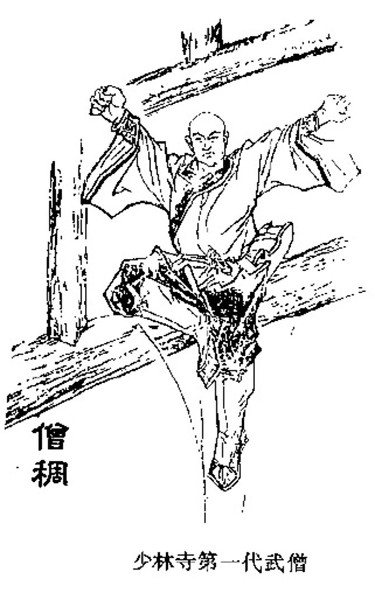
Børdahl, V. (2013). Wu Song fights the tiger: The interaction of oral and written traditions in the Chinese novel, drama and storytelling. Copenhagen, Denmark: NIAS Press.
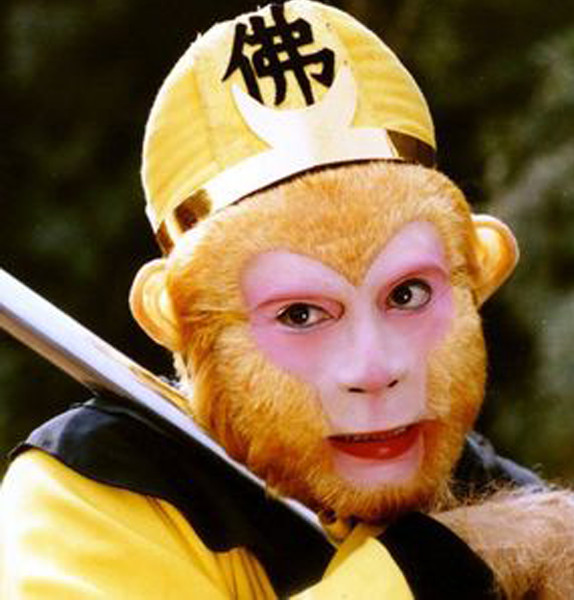
Ch’en, K. (1956). The sale of monk certificates during the Sung dynasty: A factor in the decline of Buddhism in China. The Harvard Theological Review 49(4), pp. 307-327.

Chen, P., & Petersen, V. (2016). The development of Chinese martial arts fiction. Cambridge, U.K.: Cambridge University Press.
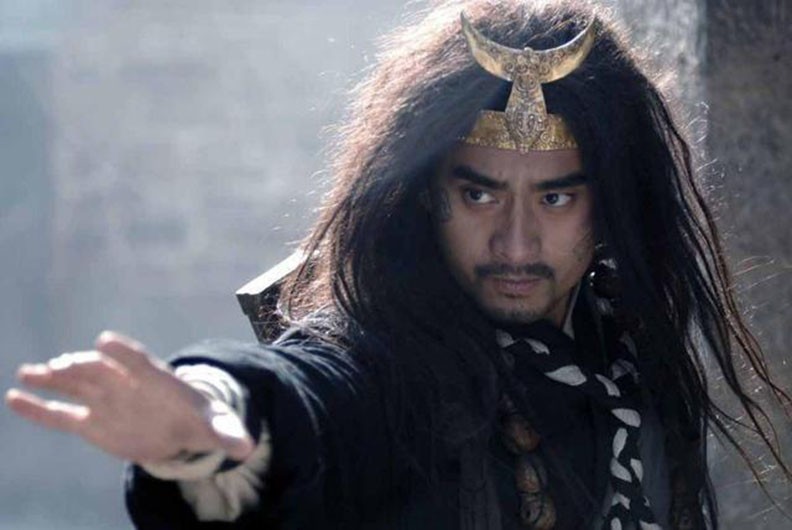
Chlumsky, N. (2015). Inside kungfu: Chinese martial arts encyclopedia. [n.p.]: Lulu.com.

Da song xuanhe yishi [Old incidents in xuanhe period of the great Song dynasty] (n.d.). [archived document]. Retrieved from https://zh.wikisource.org/zh-hant/%E5%A4%A7%E5%AE%8B%E5%AE%A3%E5%92%8C%E9%81%BA%E4%BA%8B

Huang, Y. (2018). Narrative of Chinese and western popular fiction: Comparison and interpretation. Berlin, Germany: Springer.

Huineng, & Cleary, T. F. (1998). The Sutra of Hui-neng, grand master of Zen: With Hui-neng’s commentary on the Diamond Sutra. Boston: Shambhala.

Ge, L. (2001). Out of the margins: The rise of Chinese vernacular fiction. Honolulu: University of Hawaii Press.
Knechtges, D. R., & Chang, T. (2010). Ancient and early medieval Chinese literature: A reference guide. Leiden: Brill.

Lee, L. X. H., & Wiles, S. (2015). Biographical dictionary of Chinese women: Tang through Ming: 618-1644. Abingdon: Routledge.

Lorge, P. A. (2012). Chinese martial arts: From antiquity to the twenty-first century. New York, NY: Cambridge University Press.
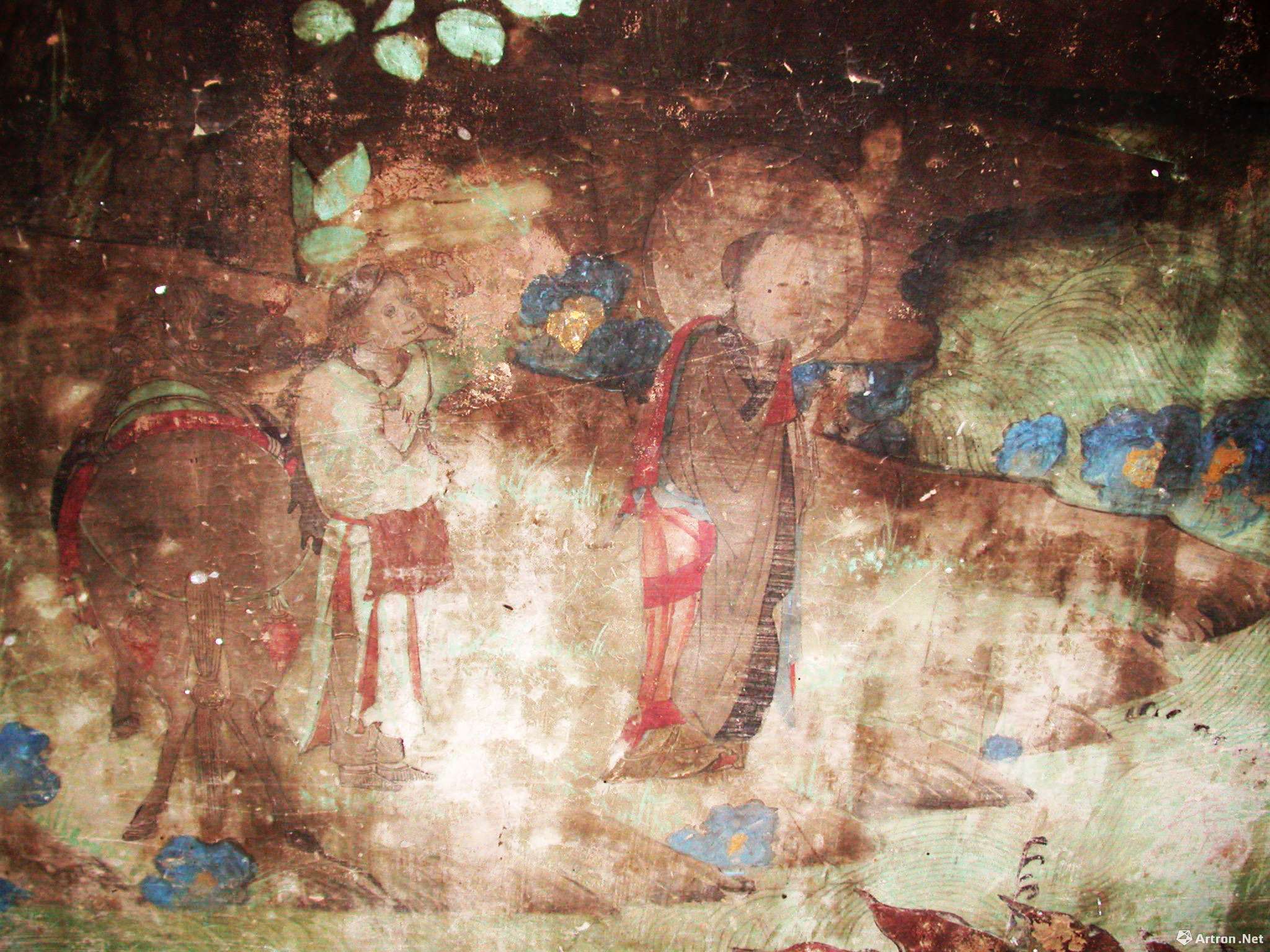
Luo, G. (n.d.). San sui pingyao zhuan [The three sui quash the demons’ revolt] [archived document]. Retrieved from https://zh.wikisource.org/wiki/%E4%B8%89%E9%81%82%E5%B9%B3%E5%A6%96%E5%82%B3/16

Meulenbeld, M. R. E. (2007). Civilized demons: Ming thunder gods from ritual to literature (Doctoral dissertation). Available from ProQuest Dissertations and Theses database (UMI No: 3247802).

Padula, D. (2016). Dragon ball culture: Volume 5. (n.p.): Derek Padula.

Robert, E. B. J., & David, S. L. J. (2013). The Princeton Dictionary of Buddhism. Princeton University Press.
Shahar, M. (2008). The Shaolin monastery: History, religion, and the Chinese martial arts. Honolulu: University of Hawai’i Press.
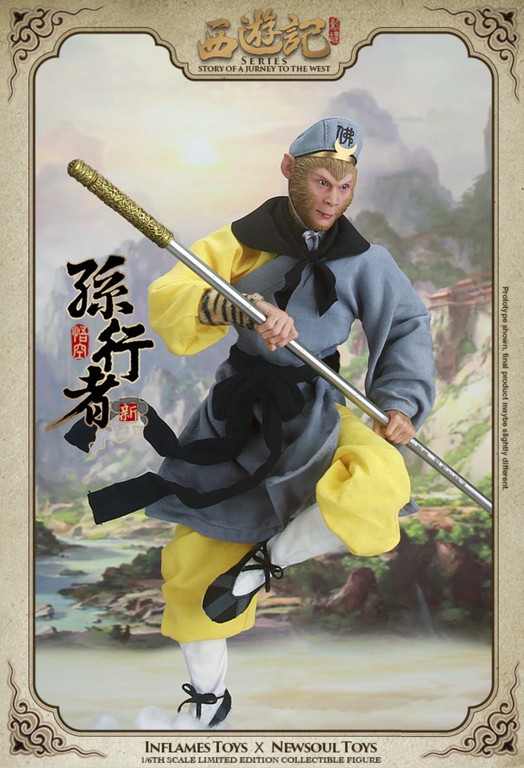
Shi, N., Luo, G., & Shapiro, S. (2015). Outlaws of the marsh. California: CreateSpace Independent Publishing Platform.

Wagner, D. (2008). Science and civilisation in China: volume 5, chemistry and chemical technology, part 11, ferrous metallurgy. Cambridge: Cambridge Univ. Press.

Wang, J. (1992). The story of stone: Intertextuality, ancient Chinese stone lore, and the stone symbolism in Dream of the red chamber, Water margin, and the journey to the west. Durham, N.C: Duke University Press.

Wivell, C.S. (1994). The story of how the monk Tripitaka of the great country of T’ang brought back the sūtras. In V. Mair (Ed.). The Columbia anthology of traditional Chinese literature (pp 1181-1207). New York: Columbia University Press.

Wu, C., & Yu, A. C. (2012). The journey to the West: Vol. 1-4. Chicago, Illinois: University of Chicago Press.