Buddhist Deities Exiled From the Western Heaven in Chinese Vernacular Literature

Last updated: 1-25-2025

Anyone who has read Journey to the West (Xiyouji西遊記, 1592) will know that the Tang monk Tripitaka (Tang Sanzang, 唐三藏; a.k.a. Xuanzang) is said to be an incarnation of Master Golden Cicada (Jinchan zi, 金蟬子), the Buddha’s second disciple. The full picture of his past can be pieced together from verse and character dialogue throughout the narrative. This culminates with the Tathagata‘s explanation in chapter 100:

Because you failed to listen to my exposition of the law and slighted my great teaching, your true spirit was banished to find another incarnation in the Land of the East [i.e. China]. Happily you submitted and, by remaining faithful to our teaching, succeeded in acquiring the true scriptures (Wu & Yu, 2012, vol. 4, p. 381).

因為汝不聽說法,輕慢我之大教,故貶汝之真靈,轉生東土。今喜皈依,秉我迦持,又乘吾教,取去真經 …

In the course of my research, I’ve come across two other examples of Buddhist deities from Ming-Qing Chinese vernacular literature that are exiled from the Western Heaven. In this article, I would like to highlight these stories, as well as analyze them alongside Master Golden Cicada’s tale to record parallels. It’s important to note that all examples are connected to the Journey to the West story cycle. Finally, I will show that the presented examples share similarities with Greek philosophy.

I wrote this to better understand how the story of Master Golden Cicada’s exile may have come about.

1. Master Golden Cicada

For the record, the fullest account of Tripitaka’s past is described by Sun Wukong in chapter 81:

“You don’t realize that Master was the second disciple of our Buddha Tathagata, and originally he was called Elder Gold Cicada. Because he slighted the Law, he was fated to experience this great ordeal.”

“Elder Brother,” said Eight Rules, “even if Master did slight the Law, he had already been banished back to the Land of the East where he took on human form in the field of slander and the sea of strife. After he made his vow to worship Buddha and seek scriptures in the Western Heaven, he was bound whenever he ran into monster-spirits and he was hung high whenever he met up with demons. Hasn’t he suffered enough? “Why must he endure sickness as well?”

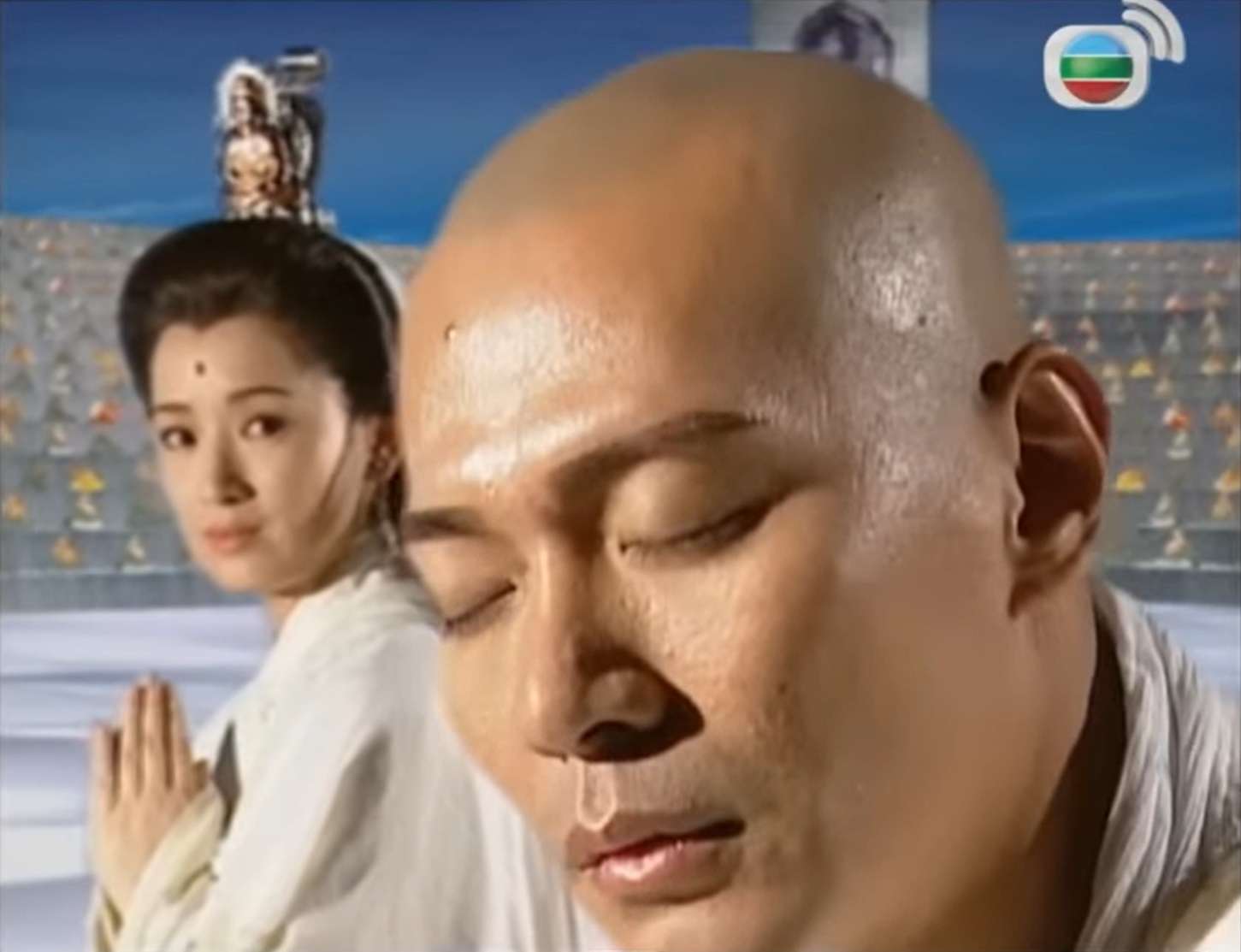
“You wouldn’t know about this,” replied Pilgrim. “Our old master fell asleep while listening to Buddha expounding the Law [fig. 1]. As he slumped to one side, his left foot kicked down one grain of rice. That is why he is fated to suffer three days’ illness after he has arrived at the Region Below.” [1]

Horrified, Eight Rules said, “The way old Hog sprays and splatters things all over when he eats, I wonder how many years of illness I’d have to go through!”

“Brother,” said Pilgrim, “you have no idea either that the Buddha is not that concerned with you and other creatures. But as people say:

Rice stalks planted in noonday sun
Take root as perspiration runs.
Who knows of this food from the soil
Each grain requires most bitter toil?

Master still has one more day to go, but he’ll be better by tomorrow” (Wu & Yu, 2012, vol. 4, p. 82).

你不知道。師父是我佛如來第二個徒弟,原叫做金蟬長老,只因他輕慢佛法,該有這場大難。」八戒道:「哥啊,師父既是輕慢佛法,貶回東土,在是非海內,口舌場中,託化做人身,發願往西天拜佛求經,遇妖精就捆,逢魔頭就吊,受諸苦惱,也夠了,怎麼又叫他害病?」行者道:「你那裡曉得。老師父不曾聽佛講法,打了一個盹,往下一試,左腳屣了一粒米,下界來,該有這三日病。」八戒驚道:「像老豬吃東西潑潑撒撒的,也不知害多少年代病是。」行者道:「兄弟,佛不與你眾生為念,你又不知。人云:『鋤禾日當午,汗滴禾下土。誰知盤中餐,粒粒皆辛苦。』師父只今日一日,明日就好了。」

Fig. 1 – Master Golden Cicada falls asleep during the Buddha’s sermon (larger version). Screenshot from episode one of the 1996 Journey to the West TV show.

2. Miao Jixiang

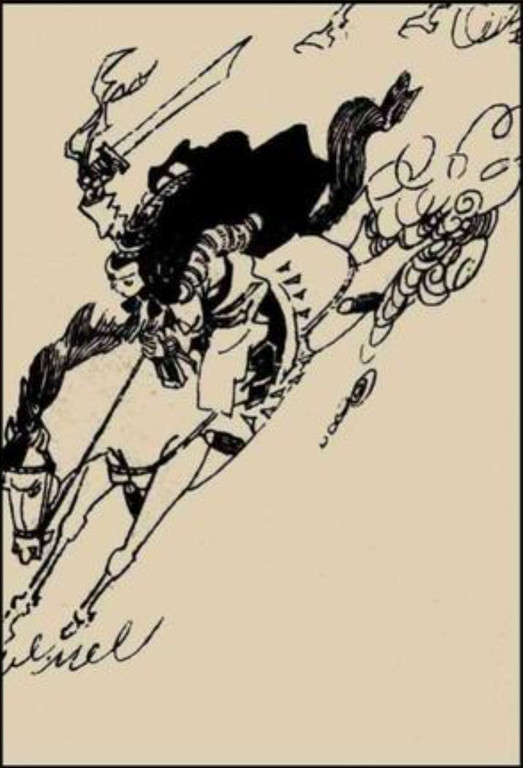
Miao Jixiang (妙吉祥) is a former oil lamp-turned-humanoid Buddhist disciple who briefly appears in chapter one of Journey to the South (Nanyouji南遊記, c. 1570s-1580s). He is exiled from the Western Heaven for using his holy flame to kill a belligerent sage. But Miao escapes underworld punishment thanks to the intervention of the Bodhisattva Guanyin. He is later reborn in China as a number of figures, most famously the popular martial deity Huaguang dadi (華光大帝; variously translated as “Great Emperor of Flowery/Resplendent/Magnificent/Majestic Light”):

That Great King of the Single Flame [Duhuo dawang, 独火大王] … wanted to incinerate Spirit Mountain. Fortunately, the Tathagata foresaw this with his all-seeing eyes, and so he recited a mantra, summoning five hundred dragons that brought forth dew and fog to cover the mountain.

Unable to unleash his fire, this Single-Flame demon became angry, rampaging to the left and right of the temple and hurling insults.

Miao Jixiang [2] offered a word of advice, “You are not the same caliber of wisdom as we Buddhist disciples. You can leave if you want; it makes no difference.”

“If you enrage my heart-mind, I will burn your dog bones to death!” replied the Great King of the Single Flame.

Miao Jixiang laughed, “You can only burn others. You can never burn me. If you can burn me, I will acknowledge you as superior.”

Anger racing through him, the Great King set loose his Fire of the Five Dippers, but Miao Jixiang remained perfectly still.

He laughed, “You monster, how could your fire burn me? I used to be the oil lamp before the Tathagata’s Dharma Hall, burning brilliantly day and night, listening to the sutras, and inquiring about the Dharma. I have accumulated many candle wicks during this time. But one day, Tathagata recited a spell and bestowed onto me a human body. With my appearance, spirit, hearing, and origins all arising from fire, how could you burn me? You monster, if you continue to harass our Spirit Mountain and cause us unease, I will inevitably bring forth my Perfected Fire of Samadhi to burn you monster to death, so as to avoid any future troubles.”

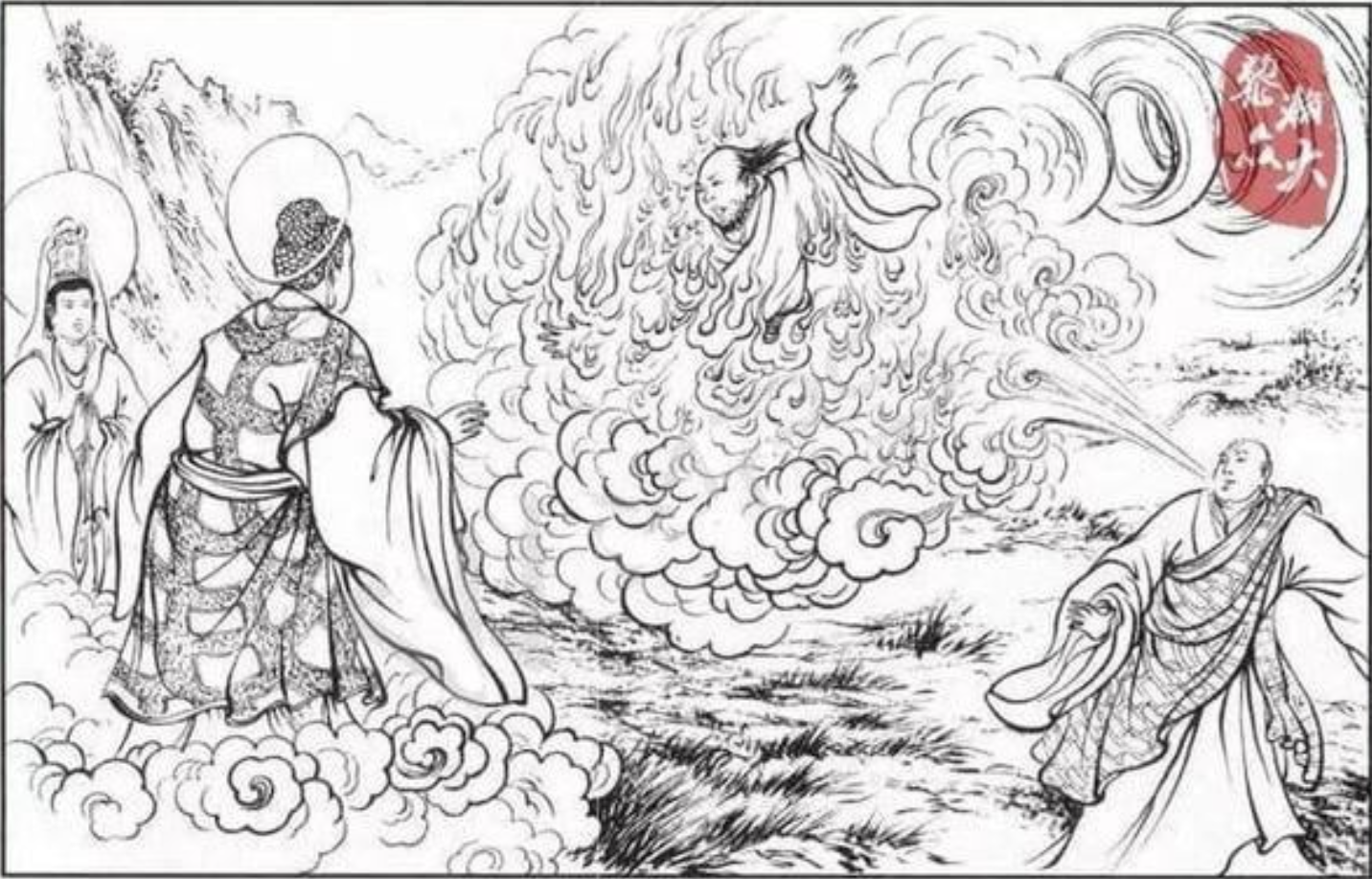
Watching this with his all-seeing eyes, the Tathagata was about to stop Miao Jixiang, but the latter had already unleashed his fire and burned that damnable Single Flame to death [fig. 2].

Furious, the Tathagata summoned heavenly generals to arrest Miao Jixiang, “You beast, how dare you break my precepts?” Tathagata scolded. “Although he is wrong, you and I are Buddhists (chujia zhi ren, 出家之人, lit: “people who have left their families”); we’re supposed to be infinitely merciful. Why did you burn him to death? Such an act is intolerable by the Buddhist Dharma. I shall banish you to the underworld (yinshan, 陰山; lit: “mountain of yin/darkness”) to suffer.”

Miao Jixiang begged for forgiveness.

The Reverend Mother Guanyin came forward from one said to defend him by saying, “Although he is guilty, Miao Jixiang is a disciple of Spirit Mountain. He should not be banished to the underworld. When he was still alive, the Great King of Horse-Ear Mountain approached our Spirit Mountain to pray for a son. Now that his wife is pregnant, why not send Miao Jixiang to be reincarnated as her son? After Miao Jixiang goes through this catastrophe, he shall be allowed to return to Spirit Mountain and serve the Master. Why not do this?”

Nodding, Tathagata was about to send Miao Jixiang away.

“My master, you order me to reincarnate,” Miao Jixiang said in tears, “but if I am deprived of the Divine Way, I am afraid that I will be bullied.”

Sitting atop his treasured throne, Tathagata recited a spell, “I shall now bestow you with the five supernatural powers: the heaven power, with which you can travel freely to heaven; the earth power, with which the earth will crack by itself if you want to get inside; the wind power, with which you are shadowless in the wind; the water power, with which you can travel without any obstacle in water; the fire power, with which you feel ease in the fire.”

Tathagata pointed his dharma finger at Miao Jixiang’s forehead, saying, “I will also bestow you with a heavenly eye, with which you can see all across the three realms.”

Tathagata ordered the Reverend Mother Guanyin to deliver Miao Jixiang to his reincarnation (adapted from pp. 10-11 of this PDF).

那大王 … 即要放火烧灵山。幸如来慧眼一见,便念动咒语,放出五百条逆龙,涌起露雾罩住灵山,此火便不能发。独火鬼见火不发,十分著恼,于寺中左冲右撞,出言不逊,妙吉祥进言曰:「我们佛家弟子,亦不比你见识,你可去也罢。」独火大王曰:「恼得我心一边来,把你这狗骨头亦将来烧死。」妙吉祥笑曰:「你的火只好烧别人,烧得我不成;你若烧得我,便见你高。」大王怒起,就放出五斗火,便烧吉祥,吉祥端然不动。笑曰:「你这妖怪,你那火如何烧得我?我乃如来法堂前一盏油灯,昼夜煌煌,听经问法,灯花堆积,一日如来念咒,咒成人身。我这火之相,火之灵,火之听,火之起,你焉能烧我?你这妖怪,今你若再在整日闹我灵山,不得自在,我不免请出三昧真火,烧死你这妖怪,免致后患。」如来慧眼看见,便叫不可之时,独火鬼已被他烧死在地。如来大怒,喝声叫将妙吉祥拿下,责曰:「你这畜生如何敢破我戒?他虽不是,我你俱出家之人,当大慈大悲终是,为何将他烧死?佛法难容,贬去阴山受罪。」吉祥告饶。观音老母在旁保曰:「妙吉祥虽然有罪,乃灵山弟子,不可贬去阴山。当日马耳山大王在日之时,来我灵山祈嗣。今日那娘娘有孕有身,不如送去投胎,等他大难满日,取回灵山,伏侍师父,何不可也。」如来依言,便欲送去。吉祥流泪告曰:「师父命我投胎,奈我不晓神道,恐后被人欺负。」如来于宝座中,念动咒语,说:「我就赐你五通:你一通天,天中自行;二通地,地赶自裂;三通风,风中无影;四通水,水中无碍;五通火,火里自在。」又用法手一指顶门:「赐你一个天眼挪门,可见三界。」就叫观音老母送去投胎。

Fig. 2 – Miao Jixiang kills the Great King of the Single Flame (larger version). From a modern lianhuanhua comic. Image found here

3. The Great Peng

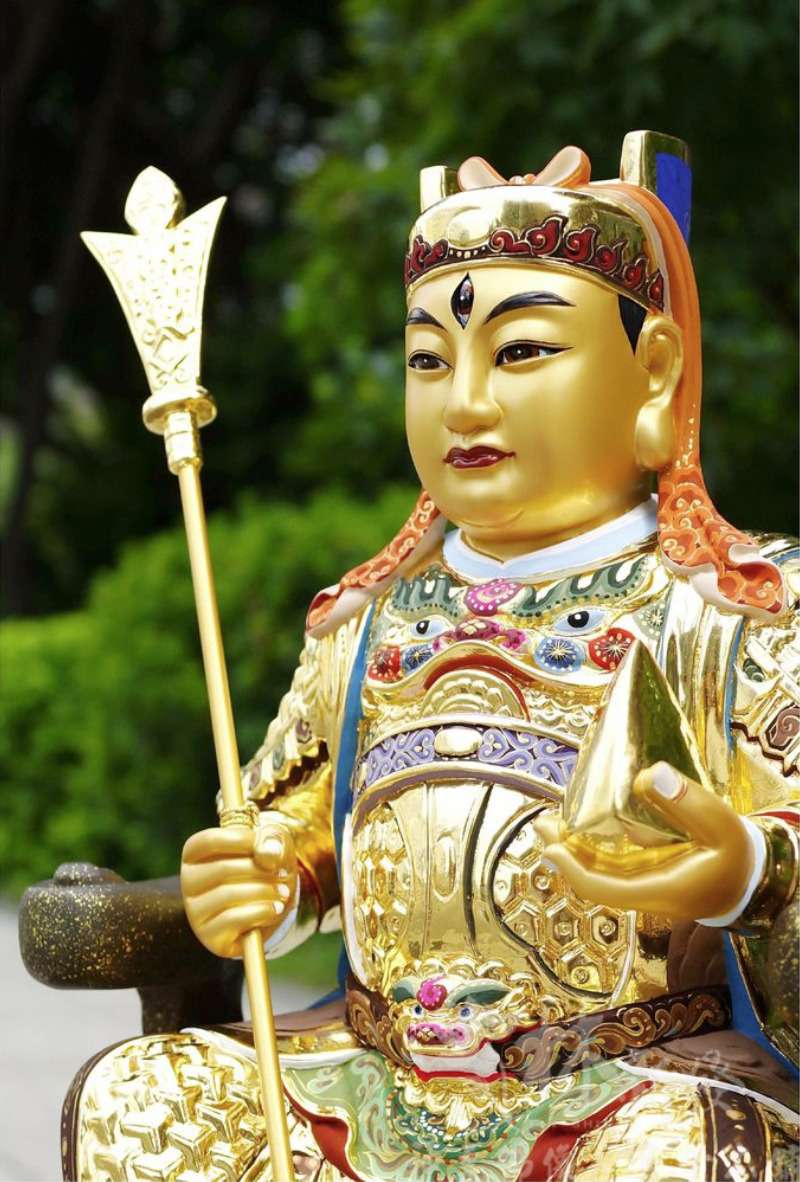
The Complete Vernacular Biography of Yue Fei (Shuo Yue quanzhuan說岳全傳, 1684) depicts the Great Peng, the Golden-Winged King of Illumination (Dapeng jinchi mingwang, 大鵬金翅明王), [3] as a hot-tempered avian dharma protector stationed above the Buddha’s head (fig. 3). He is exiled from the Western Heaven for killing a bat-spirit who farts during the Buddha’s sermon, and the bird is later reborn in China as the famed Song-era General Yue Fei (岳飛, 1103-1142):

Let’s talk about the Buddha Tathagata at the Great Thunderclap Monastery in the Western Paradise. One day, he sat on a nine-level lotus throne, and the Four Great Bodhisattvas, the Eight Great Vajra Warriors, the five hundred Arhats, the three thousand Heavenly Kingsnuns and monks, male and female attendants, all of the heavenly sages who protect the Dharma, gathered to listen to his lecture on the Lotus Sutra. His words were like flowers and precious jewels raining from the heavens. But, at that time, a star-spirit, the Maiden Earth Bat, who had been listening to the lecture from beneath the lotus throne, couldn’t bear it any longer and unexpectedly let out a stinky fart.

The Buddha was a great, merciful lord, so he didn’t mind even the slightest bit. But don’t console the Dharma protector above his head, [4] the “Great Peng, the Golden-Winged King of Illumination,” whose eyes shone with golden light and whose back was a scene of auspiciousness. He became angry when he saw the nasty, filthy Maiden Earth Bat, and so he unfurled both his wings and dropped down to kill the spirit by pecking her on the head. The light-point of her soul shot out of the Great Thunderclap Monastery and went to the Lands of the East (China) in the world below to find a mother and reincarnate. She was reborn as a daughter of the Wang clan. She would later marry the Song Prime minister Qin Hui (1091-1155) and come to cruelly kill the righteous (Yue Fei) as a means to get revenge against today’s enemy. We will talk about this later.

Let’s return to the Buddha, who saw what happened with his all-seeing eyes and exclaimed, “Good! Good! It turns out that this is an episode of karma (cause and effect).” Then he called the Great Peng bird to come closer and shouted, “You evil creature! You already took refuge in my teachings. How can you not follow the five precepts by daring to commit such a horrible crime? I don’t need you here; you will descend to the mortal world to pay off your (karmic) debt and wait until you have fulfilled your work. Once that is completed, only then will I allow you to return to the mountain to achieve the right fruit (Buddhist merit).” The Great Peng complied with the decree, flying out of the Great Thunderclap Monastery directly to the Lands of the East to be reincarnated. We will stop here (translated by the author).

且說西方極樂世界大雷音寺我佛如來,一日端坐九品蓮臺,旁列著四大菩薩、八大金剛、五百羅漢、三千偈諦、比丘尼、比丘僧、優婆夷、優婆塞,共諸天護法聖眾,齊聽講說妙法真經。正說得天花亂墜、寶雨繽紛之際,不期有一位星官,乃是女土蝠,偶在蓮臺之下聽講,一時忍不住,撒出一個臭屁來。我佛原是個大慈大悲之主,毫不在意。不道惱了佛頂上頭一位護法神祗,名為大鵬金翅明王,眼射金光,背呈祥瑞,見那女土蝠污穢不潔,不覺大怒,展開雙翅落下來,望著女土蝠頭上,這一嘴就啄死了。那女土蝠一點靈光射出雷音寺,徑往東土認母投胎,在下界王門為女,後來嫁與秦檜為妻,殘害忠良,以報今日之讎。此是後話,按下不提。

且說佛爺將慧眼一觀,口稱:「善哉,善哉!原來有此一段因果。」即喚大鵬鳥近前,喝道:「你這孽畜!既歸我教,怎不皈依五戒,輒敢如此行兇?我這裡用你不著,今將你降落紅塵,償還冤債,直待功成行滿,方許你歸山,再成正果。」大鵬鳥遵了法旨,飛出雷音寺,徑來東土投胎不表。

Fig. 3 – Detail of an altar to the Great Peng, the Golden-Winged King of Illumination (larger version). Full image found here.

4. Analysis

There are four parallels shared between these stories. First, each character is exiled for disrespecting the Buddha. Master Golden Cicada falls asleep during the Tathagata’s sermon. Miao Jixiang kills a belligerent sage on the grounds of the Thunderclap Monastery. And the Great Peng kills the Maiden Earth Bat in the same hallowed place during the Buddha’s lecture. The latter two examples are similar in that both characters are admonished by the Tathagata for breaking the precept against killing. For the former, the Buddha exclaims, “You beast, how dare you break my precepts? … Such an act is intolerable by the Buddhist Dharma” (你這畜生如何敢破我戒?… 佛法難容). And for the latter, he screams, “You evil creature! You already took refuge in my teachings. How can you not follow the five precepts by daring to commit such a horrible crime?” (你這孽畜!既歸我教,怎不皈依五戒,輒敢如此行兇?). Admittedly, these acts make Master Golden Cicada’s sleeping far less serious in comparison.

Second, each is exiled from the Western Heaven in India to be reborn as a hero in China. Master Golden Cicada lives out a number of pious incarnations before his final life as Tripitaka, a learned monk who procures scriptures needed to release untold numbers of orphaned souls from the underworld. Miao Jixiang experiences several adventurous incarnations before his final life as Huaguang dadi, a martial deity who rids the world of evil spirits. And the Great Peng is reborn as Song Dynasty General Yue Fei, a patriot who fights against invading Jurchen forces which threaten the Middle Kingdom.

Third, all are exiled with the understanding that they will return once they have accumulated enough Buddhist merit and/or paid off a karmic debt. This is more implied in Master Golden Cicada/Tripitaka’s case when the Buddha reveals his past transgression and then grants him an elevation in spiritual rank to an enlightened being, thereby allowing him to return to the Western Heaven at the end of his story arc (Wu & Yu, 2012, vol. 4, p. 381). Whereas with Miao Jixiang, this is openly suggested by Guanyin: “After [he] goes through this catastrophe, he shall be allowed to return to Spirit Mountain and serve the Master. Why not do this?” (等他大难满日,取回灵山,伏侍师父,何不可也。) The Tathagata agrees to this arrangement. As for the Great Peng, the Buddha states,

[Y]ou will descend to the mortal world to pay off your (karmic) debt and wait until you have fulfilled your work. Once that is completed, only then will I allow you to return to the mountain to achieve the right fruit (Buddhist merit).

今將你降落紅塵,償還冤債,直待功成行滿,方許你歸山,再成正果。

And fourth, all are connected to the Journey to the West story cycle. For instance, in chapter one of Journey to the South (c. 1570s-1580s), “Pilgrim Sun” (Sun xingzhe, 孫行者; i.e. Sun Wukong) wins first place in a competition between the gods of the Buddho-Daoist pantheon to see who owns the greatest celestial treasure (see pp. 6-7 of this PDF). And in chapter 17, Monkey fights Miao Jixiang’s reincarnation, Huaguang dadi, because the latter framed the former for the theft of immortal peaches. The Great Sage initially wins the encounter, but he is unexpectantly burned at the last minute, leaving his non-canonical daughter to finish the fight (see pp. 107-110 of this PDF). And the Great Peng originally appears as a demon king named the “Peng of Ten Thousand Cloudy Miles” (Yuncheng wanli peng, 雲程萬里鵬) in chapters 74 to 77 of Journey to the West (1592). At the end of his arc, he is trapped above the Buddha’s head (fig. 4):

Perceiving the Peng’s intentions, Tathagata produced a golden light and, facing the wind, and gave his head (which had once supported the nests of magpies) a shake. The head changed at once into a piece of meat dripping with fresh blood. Stretching out his claws, the monster-spirit drew near and tried to clutch at the piece of meat. Our Father Buddha pointed at him with his finger and immediately the monster-spirit felt such cramps throughout his huge wings that he could not fly away. He was trapped above the Buddha’s head in his true form: the Great Peng, a golden-winged eagle [fig. 4] (based on Wu & Yu, 2012, vol. 4, p. 31).

如來情知此意,即閃金光,把那鵲巢貫頂之頭迎風一幌,變做鮮紅的一塊血肉。妖精掄利爪叼他一下。被佛爺把手往上一指,那妖翅膊上就了筋,飛不去,只在佛頂上不能遠遁,現了本相,乃是一個大鵬金翅鵰。

The Great Peng later begrudgingly agrees to submit to Buddhism (Wu & Yu, 2012, vol. 4, p. 31). Therefore, this explains his lofty position in The Complete Vernacular Biography of Yue Fei (1684).

Fig. 4 – The Great Peng trapped above the Buddha’s head (larger version). From Chen Huiguan’s Newly Illustrated and Complete Journey to the West (Chen Huiguan Xinhui Quanben Xiyouji, 陈惠冠新绘全本西游记, 2001).

5. Similarities to Western Philosophy

McEvilley (2002) comments that the Greek philosopher Empedocles (5th-c. BCE) wrote of gods being exiled for ten thousand years for the crime of murder or lying under oath. The fallen deity was believed to reincarnate into every creature of land, air, and sea, and when their long punishment was over, they were reborn in their last life as a person of high culture, such as royalty, religious leaders, and scholars. They then returned to their former heavenly station upon death (McEvilley, 2002, pp. 106-107). These beliefs mirror the misdeeds (sleeping and murder), exile from heaven, experience of reincarnation, and then eventual return to heaven of Master Golden Cicada, Miao Jixiang, and the Great Peng. These similarities likely point to a broader concept in Greco-Indian philosophy that made its way into Chinese vernacular fiction.


Update: 01-25-25

I have suggested that a historical disciple of the Buddha influenced the episode of Master Golden Cicada falling asleep. See 01-25-25 update here:

The Monk Tripitaka and the Golden Cicada

Notes:

1) Tripitaka’s additional punishment points to the supreme importance of rice in an agrarian society like ancient China.

2) Miao Jixiang should not be confused with the Bodhisattva Manjushri, who has the same Chinese name in some older Buddhist literature (Von Glahn, 2004, p. 214).

3) The mingwang (明王, “illumination king”) of the Great Peng’s Buddhist title could also mean “wisdom king,” which refers to spiritual knowledge.

4) My previous article traces the religious motif of a bird (Garuda) hovering above the heads of Buddhist personages to Hindo-Buddhist architecture in ancient India.

Sources:

McEvilley, T. (2002). The Shape of Ancient Thought: Comparative Studies in Greek and Indian Philosophies. New York: Allworth.

Von Glahn, R. (2004). The Sinister Way: The Divine and the Demonic in Chinese Religious Culture. United Kingdom: University of California Press.

Wu, C., & Yu, A. C. (2012). The Journey to the West (Vols. 1-4) (Rev. ed.). Chicago, Illinois: University of Chicago Press.

Archive #40 – Journey to the South (Nanyouji) English Translation PDF

Journey to the South (Nanyouji南遊記, c. 1570s-1580s), [1] is one of four shenmo novels, dubbed the Four Journeys (Siyou ji, 四遊記), (re)published during the Wanli era by Yu Xiangdou (余象斗, c. 1560-c. 1640). This eighteen chapter work follows the adventures of the martial deity Huaguang dadi (華光大帝) (fig. 1), variously translated as “Great Emperor of Flowery/Resplendent/Magnificent/Majestic Light.” He begins the story as a divine disciple of the Buddha who is exiled from paradise for taking a life. But after a series of rebirths in which he causes trouble as a trickster, Huaguang redeems himself by using his powers to subdue evil.

What’s interesting for the purposes of this blog is that the Monkey King appears as a tertiary character in chapters one and seventeen. The latter is notable among fans of Journey to the West as it mentions that our hero has children. One in particular, his monstrous daughter Yuebei xing (月孛星, “Moon Comet Star”), is shown to be a powerful sorceress who can threaten the lives of even immortals with her magic skull weapon.

Here, I would like to archive an English translation of Journey to the South found online. It is by a translator with the penname “Peter Pan.” My thanks to them.

Fig. 1 – A modern Huaguang dadi idol (larger version). Readers will notice that he shares many iconographical similarities with Erlang shen. Image found here.

I. Synopsis

After killing a havoc-wreaking Single-Flame King, Manjusri is banished by Tathagata [Buddha] to reincarnate into Spirit Light as a son of Mount Horse-Ear King, endowed with five accesses to natural elements and a heavenly eye.

[Jim here: One of Manjushri’s old Chinese Buddhist names is Miao Jixiang (妙吉祥). Huaguang’s previous incarnation, a divine flame-turned-Buddhist deity, also shares this name, but the two are not related (Von Glahn, 2004, p. 214). Therefore, translating the name as Manjushri is not accurate.]

During his trip to the Spiritual Void Palace, Spirit Light frees two ghosts by stealing a golden spear, but he is killed by Purple Subtlety Heaven Emperor. He again reincarnates as Three-Eye Spirit Flare in the family of Blazing Darkness Heavenly King. He steals from his master Wonderful Joy Celestial Being a golden broadsword, to make it into a triangular golden brick as his divine weapon.

Later, he wreaks havoc in the Jade Flower Gathering in the heavens and assumes the title of Huaguang, but he is subdued by Black Sky Heaven Emperor. Afraid of being punished by the Jade Emperor, Huaguang reincarnates again into Xiao’s Family Village, where he subdues demons and evil spirits with his divine power. Considering his meritorious deeds, the Jade Emperor grants pardon to him.

Huaguang has no idea that his mother is a man-eating monster named Ganoderma who is later detained by Dragon Auspice King in Fengdu, the demon capital.

Searching around for his mother, Huaguang cheats the Goddess Jade Ring for her pagoda, intending to melt it as his weapon. He meets her daughter Princess Iron Fan and takes her as his wife. He continues to subdue more demons and evil spirits.

Still missing his mother, Huaguang learns she was in the underworld and ventures there without hesitation.

Could Huaguang save his mother? Could he prevent his mother from eating humans again? What stories occur between Huaguang and the legendary Monkey King? What is the fate of Huaguang himself after his undulating reincarnations?

Read on to know more about the making of Heavenly King Resplendent Light, a renowned divine figure in Chinese mythology.

II. Archive Link

Click to access Journey_to_the_South_ENG.pdf

III. Disclaimer

This has been posted for educational purposes. No malicious copyright infringement is intended. If you liked the digital version, please support the official release when it once again becomes available on Amazon.

Note:

1) Evidence suggests that the book was originally published prior to the 1590s (Cedzich, 1995, as cited in Von Glahn, 2004, p. 311 n. 145). Yu Xiangdou later renamed the book when he combined it with the other novels to create the Four Journeys. Von Glahn (2004) explains:

The full title of the earliest known copy of Journey to the South, the 1631 edition in the British Museum, is Quanxiang Huaguang tianwang nanyou zhizhuan [全像華光天王南游志傳] (A Fully Illustrated Chronicle of the Journey to the South by the Heavenly King Huaguang) (p. 311 n. 145).

Sources:

Von Glahn, R. (2004). The Sinister Way: The Divine and the Demonic in Chinese Religious Culture. United Kingdom: University of California Press.

Yuebei xing, Daughter of the Monkey King

Last updated: 04-27-2024

Ever since I published my article “The Monkey King’s Children” (2021), I’ve noticed that people have fallen in love with Sun Wukong’s monstrous, magic skull-wielding daughter Yuebei xing (月孛星, “Moon Comet Star”) from Journey to the South (Nanyouji, 南遊記, c. 1570s-1580s). For instance, search Tumblr and you will find plenty of art and short stories featuring her. The character does not appear in the original Journey to the West (Xiyouji, 西遊記, 1592) novel, so I’m honestly surprised that she has captured the imagination of so many.

Here, I would like to collect all that I’ve written about her, along with new information, into a single article. This piece discusses her brief character arc, her astrological origins, her appearance in other literature, and her religious iconography.

I. Character arc

In chapter 17 of Journey to the South, Sun Wukong is framed for once again stealing immortal peaches. The Jade Emperor threatens to remand him to the Buddha for punishment but is convinced to give him a month-long reprieve to find the true culprit. Monkey returns to the Mountain of Flowers and Fruit, and it is here, among his people, that the story briefly mentions three children, including sons Jidu (奇都, “Ketu”) and Luohou (羅猴, “Rahu”) and daughter Yuebei xing (月孛星, “Moon Comet Star”).

Sun eventually seeks out Guanyin, who reveals that the troublemaker is the rogue immortal Huaguang (華光). Returning home once more, Monkey’s news prompts his daughter to volunteer to battle the impostor. But her tribe simply pokes fun at her monstrous appearance. Yuebei Xing is said to have a crooked head with huge eyes and a broad mouth, coarse hands, a wide waist, and long legs with thunderous steps.

Sun travels with his daughter to Huaguang’s home of Mt. Lilou (Lilou shan, 離婁山) to provoke battle by chastising him for stealing the immortal peaches. Monkey strikes at him with his magic staff, causing Huaguang to deploy his heavenly treasure, a golden, triangular brick (sanjiao jinzhuan, 三角金磚). But Sun responds by creating untold monkey clones that not only confiscate the weapon but also overwhelm the immortal. Huaguang is seemingly defeated at this point; however, he manages to deploy one last treasure, the Fire Elixir (Huodan, 火丹). This weapon engulfs the Great Sage in heavenly flame (akin to the Red Boy episode), causing him to flee to the Eastern Sea. Yuebei xing then calls Huaguang’s name while holding her own magic treasure, a skull (kulou tou, 骷髏頭). The immortal is immediately stricken with a headache and stumbles back to his cave in a daze. Her weapon is said to be quite dangerous; anyone whose name is called will die within three days.

Huanguang’s religious teacher, the Flame King Buddha of Light (Huoyan wang guangfo, 火炎王光佛), then intervenes in order to sooth the situation between his disciple and the Great Sage. He promises to bring the rogue immortal to justice on the condition that Yuebei Xing withdraws her deadly magic. In the end, all parties are pardoned by the Jade Emperor, and Huaguang and Monkey become bond brothers (Yu, n.d.).

II. Astrological origins

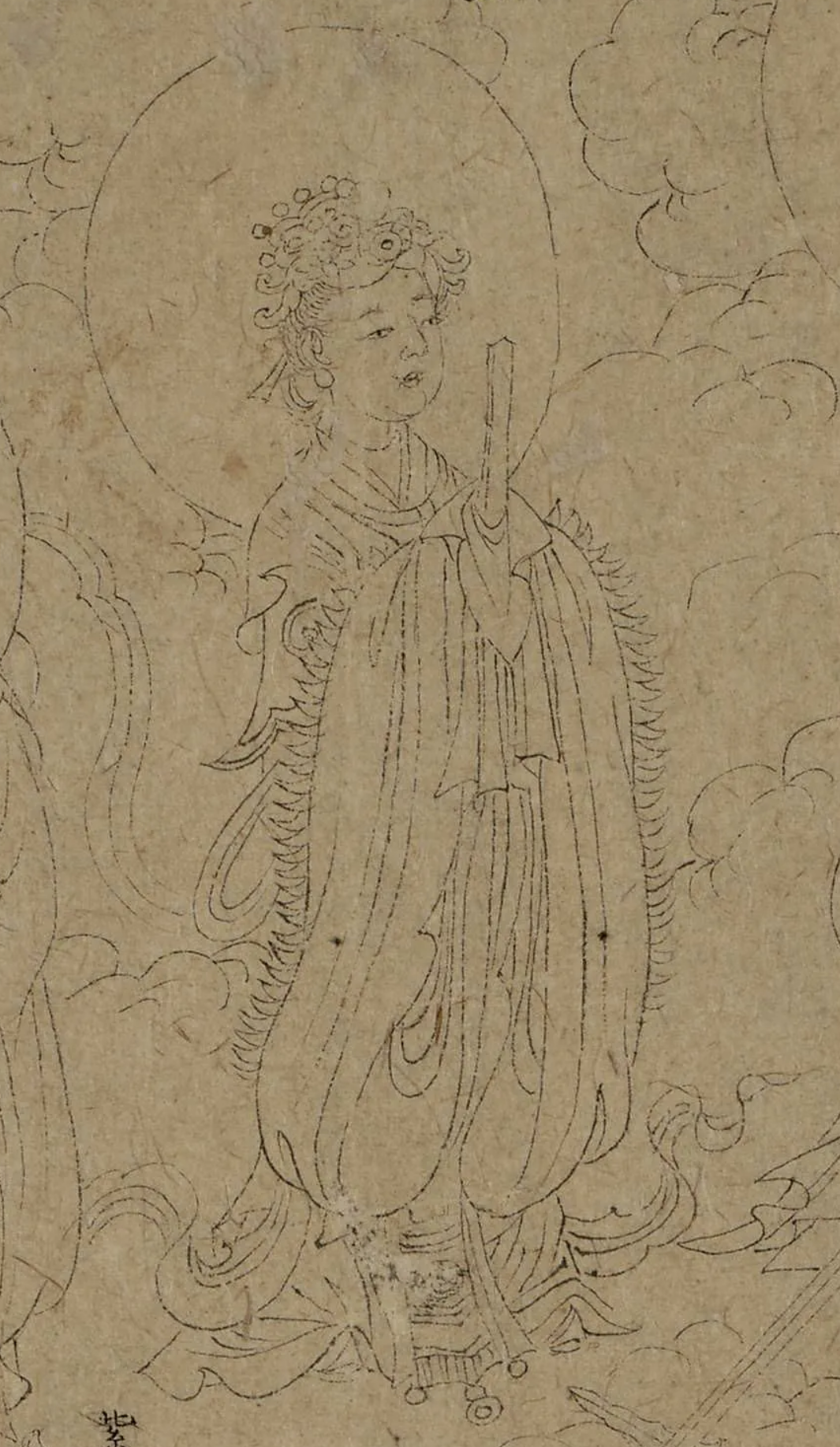
The Monkey King’s daughter is based on Yuebei xing, a shadowy planetary deity representing the lunar apogee, or the furthest point in the moon’s orbit. They are counted among the “Eleven Luminaries” (Shiyi yao, 十一曜) of East Asian astrology (fig. 1). These include the “Nine Planets” (Sk: Navagraha; Ch: Jiuyao, 九曜, “Nine Luminaries”) of Hindu astrology, namely the Sun, Moon, Mars, Mercury, Jupiter, Venus, Saturn, and Rahu and Ketu (Gansten, 2009), as well as Yuebei and another shadowy planet called Ziqi (紫氣/紫炁; “Purple Mist”) (Kotyk, 2017, p. 60). The latter two are mentioned in Daoist writings as early as the late-9th-century (Kotyk, 2017, pp. 61-62).

Fig. 1 – A Chinese depiction of the Eleven Luminaries from the Ink Treasure of Wu Daozi (Daozi mobao, 道子墨寶, c. 13th-century) (larger version). Yuebei xing is located first from the left on the top row. Image found here.

The late-Yuan to early-Ming scripture Secret Practice of the Primordial Lord Yuebei (Yuanhuang Yuebei mifa, 元皇月孛祕法; Secret Practice hereafter) describes them having two forms, one human and the other monstrous:

姓朱, 諱光, 天人相, 披髮裸體, 黑雲掩臍, 紅履鞋, 左手提旱魃頭, 右手杖劍, 騎玉龍, 變相青面獠牙, 緋衣, 杖劍, 駕熊。

Surnamed Zhu [Vermillion] with the honorific title of Guang [Luminous]. In the form of a celestial human, their hair is let down over their naked body. Their mass of black hair covers the navel. Red sandals. Their left hand holds the head of a drought demon. Their right hand holds a blade. They ride a jade dragon. In their modified form, [they display] a blue face with long fangs, a crimson garment and blade, while driving a bear (Kotyk, 2017, p. 62).

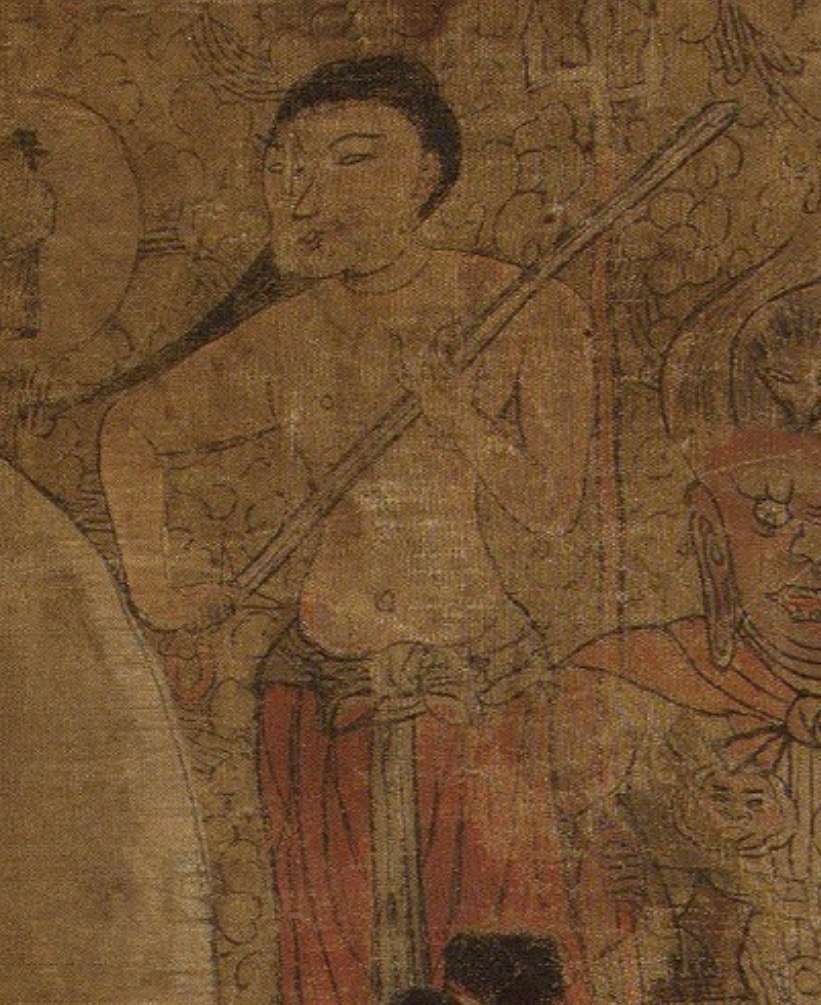
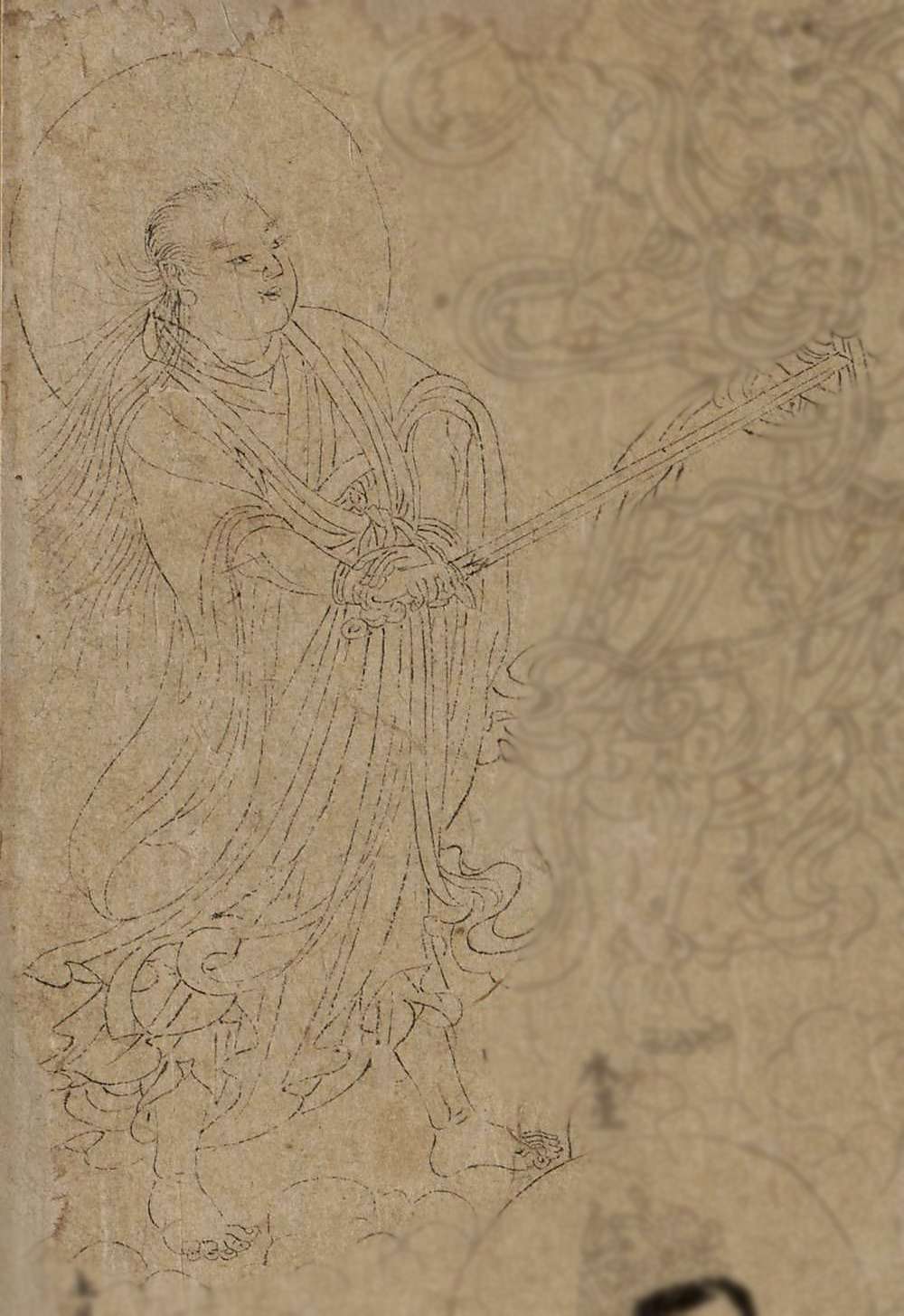
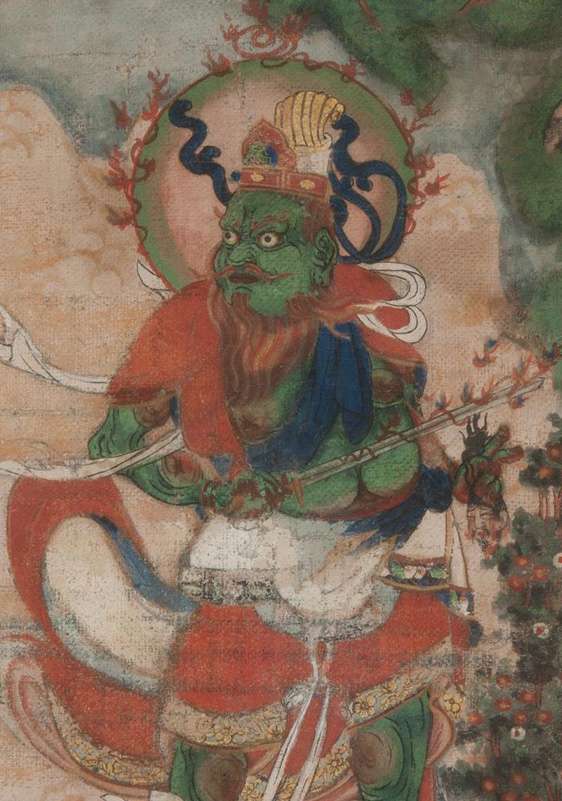
Both versions are known from late-Xixia dynasty (1038-1227) art. The first figure takes the form of a lightly clad or even topless woman with long, sometimes unkempt hair and red garments. One painting shows her with a bloody head in her right hand and a sword hanging from her hip (fig. 2). (Though, I should point out that she isn’t always depicted with the head in Xixia or Chinese art (fig. 3 & 4).) The second figure is much rarer and takes the form of a yaksha-like guardian with green skin, a fiery red beard and hair, and red garments. He wields a flaming sword in his right hand and a bloody head in the other (fig. 5). Thank you to Dr. Jeffrey Kotyk for bringing these to my attention.

Fig. 2 – Yuebei as a woman (larger version). Take note of the severed head in her right hand and the sword at her waist. Detail from a 13th to 14th-century Xixia painting in the Hermitage Museum. Fig. 3 – A topless Yuebei wielding only a sword (larger version). Detail from a 13th to 14th-century Xixia painting in the Hermitage Museum. Fig. 4 – Detail of Yuebei from the Chinese Ink Treasure of Wu Daozi (c. 13th-century) (larger version). She too is holding only a sword. Take note of her lunar halo. Fig. 5 – Yuebei as a man (larger version). He clutches a small head in his left hand. Detail from a 13th-century Xixia painting in the Hermitage Museum.

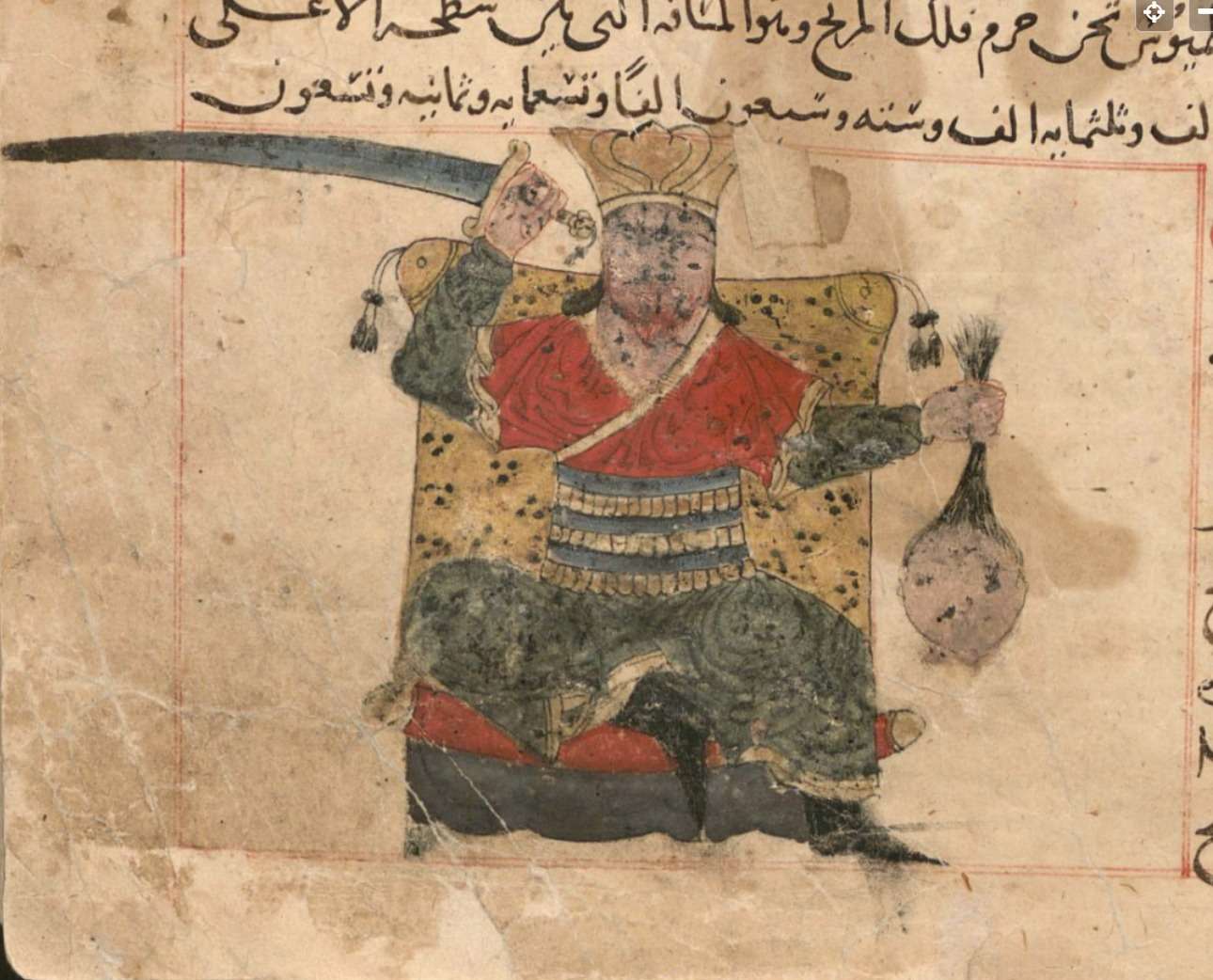
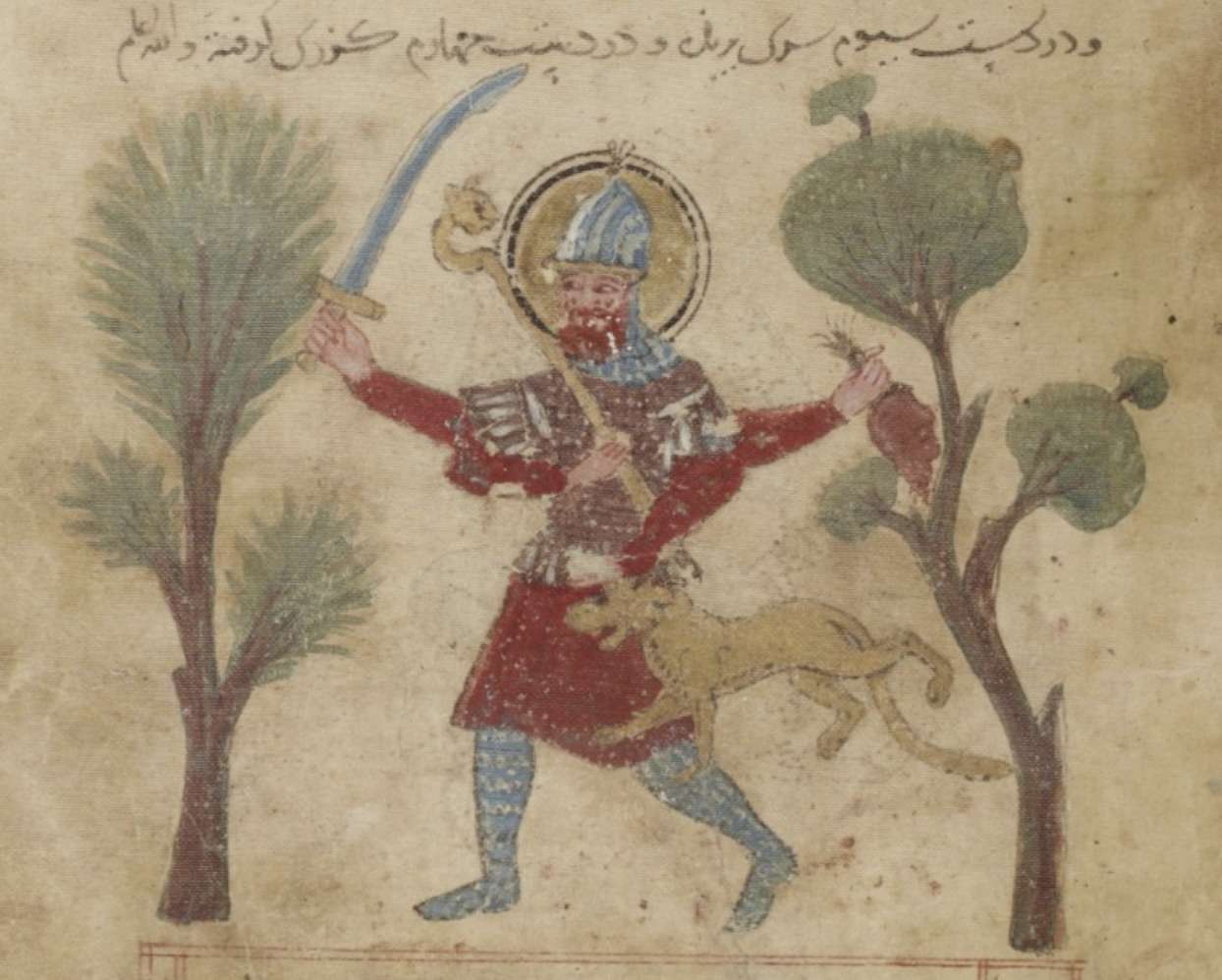
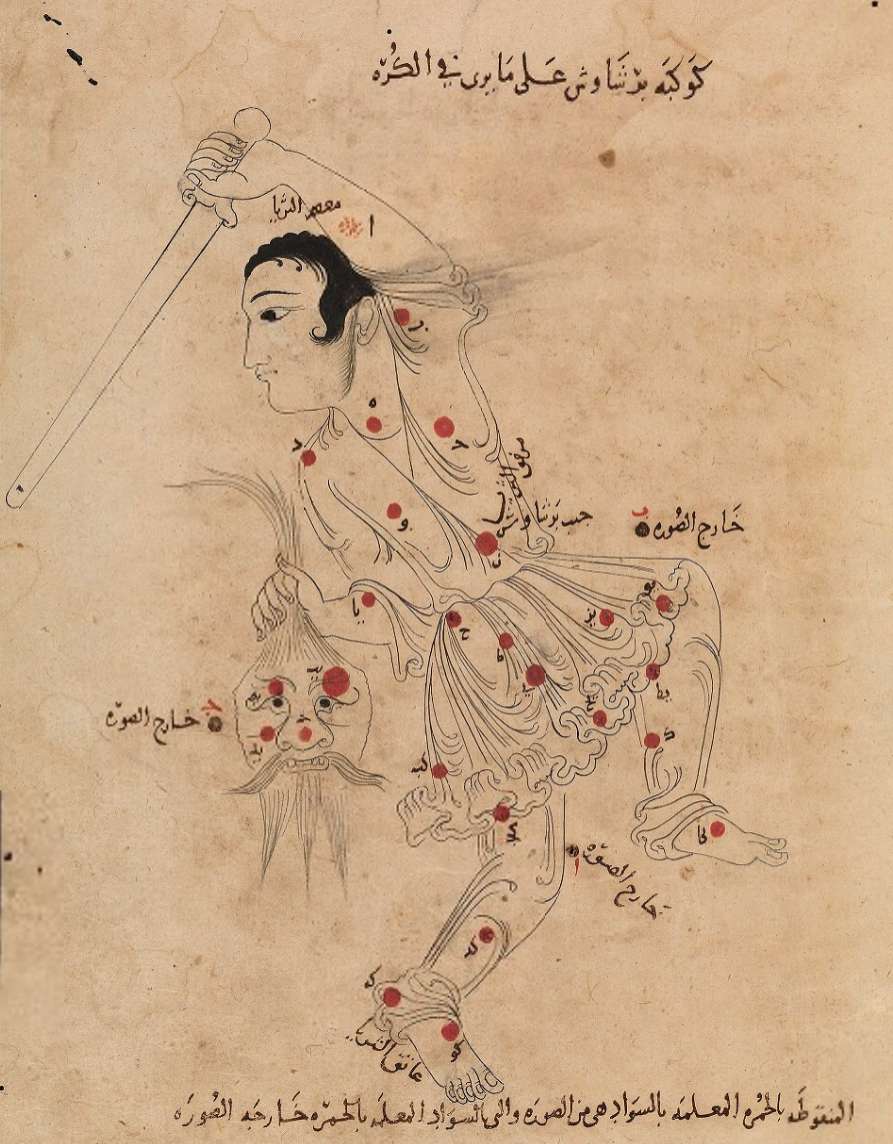
What’s interesting about the yaksha-male Yuebei is that his iconography is strikingly similar to Arabo-Persian depictions of al-Mirrīkh (Mars), who is also known for wielding a sword and head. Dr. Kotyk has directed me to several examples (fig. 6-8). Carboni (Carboni & MET, 1997) suggests that the war god’s imagery is connected to another deity:

The bold iconography of the severed head underscores the warlike character of the planet but it probably is also related to the astronomical image of the constellation of Perseus, called in Arabic ḥāmil ra’s al-ghūl (“the Bearer of the Demon’s Head”), which represents a transformation of the Greek iconography of the severed head of Medusa [fig. 9] (p. 17).

The literary Yuebei’s use of a deadly skull is fitting considering its possible link to the beheaded Gorgon. [1] Remember that the Secret Practice describes Yuebei’s symbol as that of a “drought demon’s head” (batou, 魃頭), and Arabic sources call Perseus’ symbol the “demon’s head” (ra’s al-ghūl). This shows that both cultures considered the head some kind of supernatural monster.

Fig. 6 – Detail of al-Mirrīkh (Mars) on a late-12th to early-13th century bowl from Central or Northern Iran (larger version). From the Met Museum website. Fig. 7 – Detail from The Wonders of Creation (‘Aja’ib al-Makhluqat wa Ghara’ib al-Mawjudat, 13th-century) (larger version). Found on the Library of Congress website. Fig. 8 – Detail from the Degrees of Truths (Daqa’iq al-haqa’iq, 1272) (larger version). Found on the Bibliothèque nationale de France website. Fig. 9 – The Perseus constellation from the early-11th-century Book of Pictures of the (fixed) Stars (Kitāb Ṣuwar al-kawākib (al-thābitah) (larger version). Found on the Bodleian Library website.

Dr. Kotyk tells me that East Asian depictions of Mars do not show him holding a head. But given the similar iconography of the Arabo-Persian deity and the yaksha-male Yuebei xing, there could be a South Asian intermediary. Bhattacharyya (1958) describes the Indian Buddhist iconography of Maṅgala (Mars) in similar terms: “[He] rides on a Goat. He is red in colour. In the right hand he holds the Kaṭṭāra (cutter) and in the left a severed human head in the act of devouring” (p. 368). But I don’t know how established this description is considering that a cursory search doesn’t turn up any ancient depictions of the Hindo-Buddhist deity holding a head (I’ll update the article if new evidence arises). Another possibility is that the similarities are evidence of cultural exchange between Muslim and Xixia (Tangut) astrologers. Either way, I should point out that the paintings of the yaksha-male Yuebei xing and al-Mirrīkh come from the same time period, the 13th-century. 

Recall that Xixia dynasty art (refer back to fig. 2) and the Secret Practice associate the human-female Yuebei xing with the head and sword, showing that it’s not the purview of the yaksha-male figure. It’s interesting to note that both the female figure and Mars are associated with the color red. Kotyk (2017) explains that there is a likely connection between Yuebei xing and the Irano-Semitic ĀlLīlīṯ (a.k.a. Lilith), who is also described as a demoness with a red, naked body and long, unkempt hair (pp. 63-64).

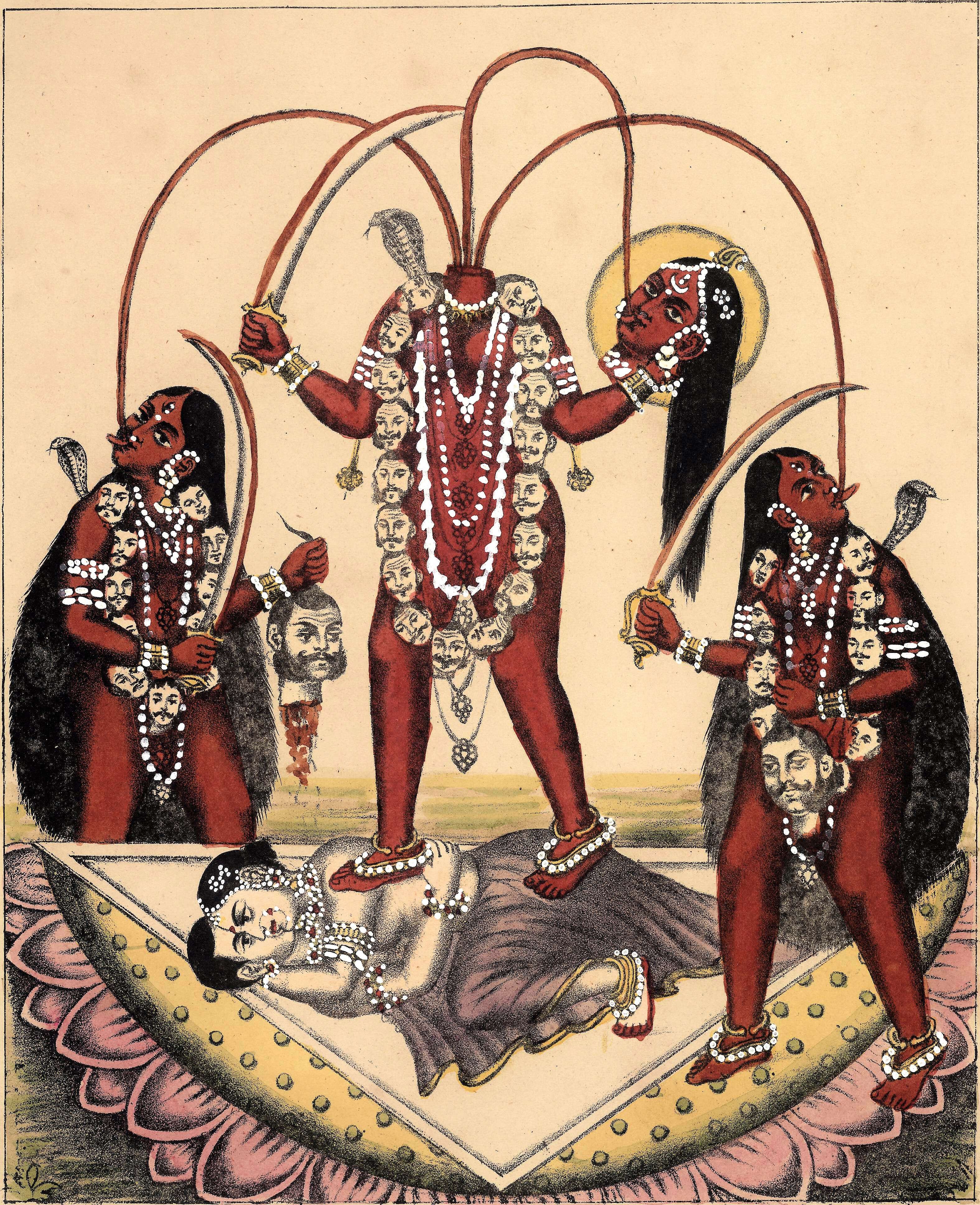
While I’m unsure if there is a connection, Yuebei’s imagery brings to mind the Hindo-Buddhist goddess ChinnamastāChinnamunda (Vajrayoginī). She is commonly shown as a naked, red-bodied figure holding a bloody head in one hand and a sword in the other (Kinsley, 1997, p. 144). In this case, the severed head is her own. Her sister attendants are also sometimes shown holding a head and sword (fig. 10).

Fig. 10 – A 19th-century lithograph of Chinnamastā (larger version). Image found on Wikipedia.

Beyond art, I learned that the respective astrological paths of Yuebei xing and Mars can cross in East Asian astrology. According to Wan Minying (萬民英), author of the Great Compendium of Astral Studies (Xingxue dacheng, 星學大成, 1563):

If Yuebei and Mars are conjunct in the same sign, [the native’s] heart will enjoy virtue, but they will be unable to actually act. They will also have many noxious sores, and pus and blood 孛火同宮心好善而實不能行亦多癰疽膿血. [2] 

III. Appearance in other literature

Apart from Journey to the South, Yuebei briefly appears in an earlier Ming-era fiction titled Drama of Yang Jiajiang (Yang Jiajiang yanyi, 楊家將演義, 16th-century). Kotyk (2017) explains that she is depicted as a red-skinned figure “holding in her hand a skeleton (手執骷髏骨)” (p. 63). I should note that the kulou (骷髏) in kulou gu (骷髏骨) can also mean “skull”, which aligns with her iconography. 

Recall that the Irano-Semitic demoness Lilith and the Hindo-Buddhist goddess Chinnamastā-Chinnamunda are described or depicted as having red skin. This might explain Yuebei xing’s vermillion body in the novel.

IV. Religious iconography

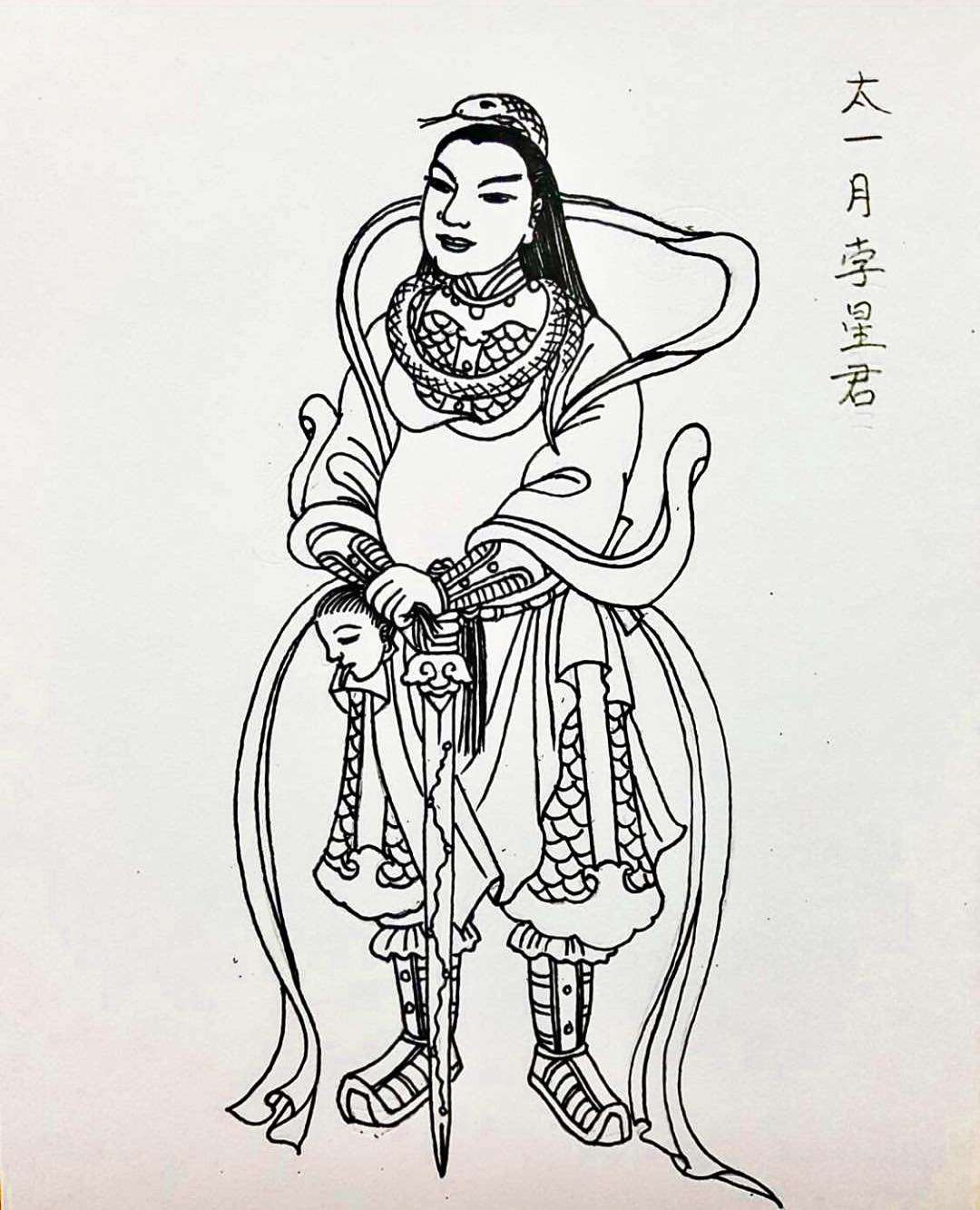
I know nothing of the actual worship of Yuebei xing, but Ronni Pinsler of the BOXS project was kind enough to show me a pattern sheet of her from an idol-maker’s shop in 1970s Singapore (fig. 11). She wears flowing robes just like her ancient Chinese depictions (refer back to fig. 4), but the signature sword and head are not included. They are instead replaced by a fly-whisk and a placard marked “moon” (yue, 月), which compliments the lunar halo behind her head. Additionally, she is labeled the “Vermillion (Comet) Inspiring Goddess, Heavenly Lord of the Moon Comet” (Zhuli[bei?] fu niang Yuebei tianjun, 朱李[孛?]孚娘 月孛天君). This is similar to the way it’s listed among the 36 celestial generals of the Journey to the North (Beiyou ji, 北遊記, 1602), the “Vermillion Comet Goddess, Heavenly Lord of the Moon Comet” (Zhubei wei Yuebei tianjun, 朱孛娘為月孛天君). I also found a more recent religious drawing that appears to mix the feminine and masculine iconography to depict her as an armored general named “Stellar Lord of the Great Monad Moon Comet” (Taiyi Yuebei xingjun (太一月孛星君) (fig. 12). Both the head and sword are present.

Fig. 11 – The vintage Yuebei pattern sheet from a Singaporean idol shop (larger version). Original photograph by Keith Stevens. Fig. 12 – The Yuebei general image (larger version). It was posted by an Indonesian Daoist priest of the Quanzhen school on Facebook.

IV. Conclusion

Yuebei xing (月孛星, “Moon Comet Star”) briefly appears in chapter 17 of Journey to the South (Nanyouji, 南遊記, c. 1570s-1580s) as the Monkey King’s monstrous daughter who uses a magic skull weapon to curse a rogue immortal. The demoness is based on a shadowy planetary deity from East Asian astrology that represents the lunar apogee. Xixia dynasty art and the Yuan-Ming Secret Practice scripture depict this deity having two forms, a lightly clad or even topless human-female with red clothing and long, disheveled hair, or a green-skinned, red-bearded yaksha-male. Both of these forms are sometimes depicted wielding a sword and a disembodied head.

The yaksha-male Yuebei xing surprisingly shares iconography with Arabo-Persian depictions of al-Mirrīkh (Mars), who is also represented as a bearded figure wielding a sword and head. Carboni (Carboni & MET, 1997) suggests that the Middle Eastern iconography is related to the constellation of Perseus (a.k.a. “Bearer of the Demon’s Head”) in which he holds the head of Medusa. This is interesting as the head held by the human-female figure is called a “drought demon” in the Secret Practice. This suggests a possible connection between the literary Yuebei xing’s skull and the deadly Gorgon.

Kotyk (2017) notes a possible connection between the human-female Yuebei xing and the Irano-Semitic Lilith. The latter too is described as having a red, naked body and unkempt hair. This same iconography is shared by the Hindo-Buddhist goddess Chinnamastā-Chinnamunda, who is also depicted bearing a sword and (her own) head. This may then explain why Yuebei xing is described as having red skin in the Drama of Yang Jiajiang (16th-century), which predates Journey to the South.

Yuebei xing is worshiped in modern Chinese folk religion. Religious art depicts them as either a robed figure or an armored general. In both cases, the deity is a woman, but only the martial aspect is shown with the head and sword.


Update: 01-11-2023

Bunce (1994) describes Maṅgala (Mars) just like Bhattacharyya (1958) (refer back to the material below figure 9):

Face: one, angry; arms/hands: two, right hand holds ritual chopper (karttrika, grig-gug), left hand holds severed human head (emphasis added); legs: two; color: red; vahana: goat (p. 328).

But I still haven’t been able to find any ancient drawings of the planetary deity like this.

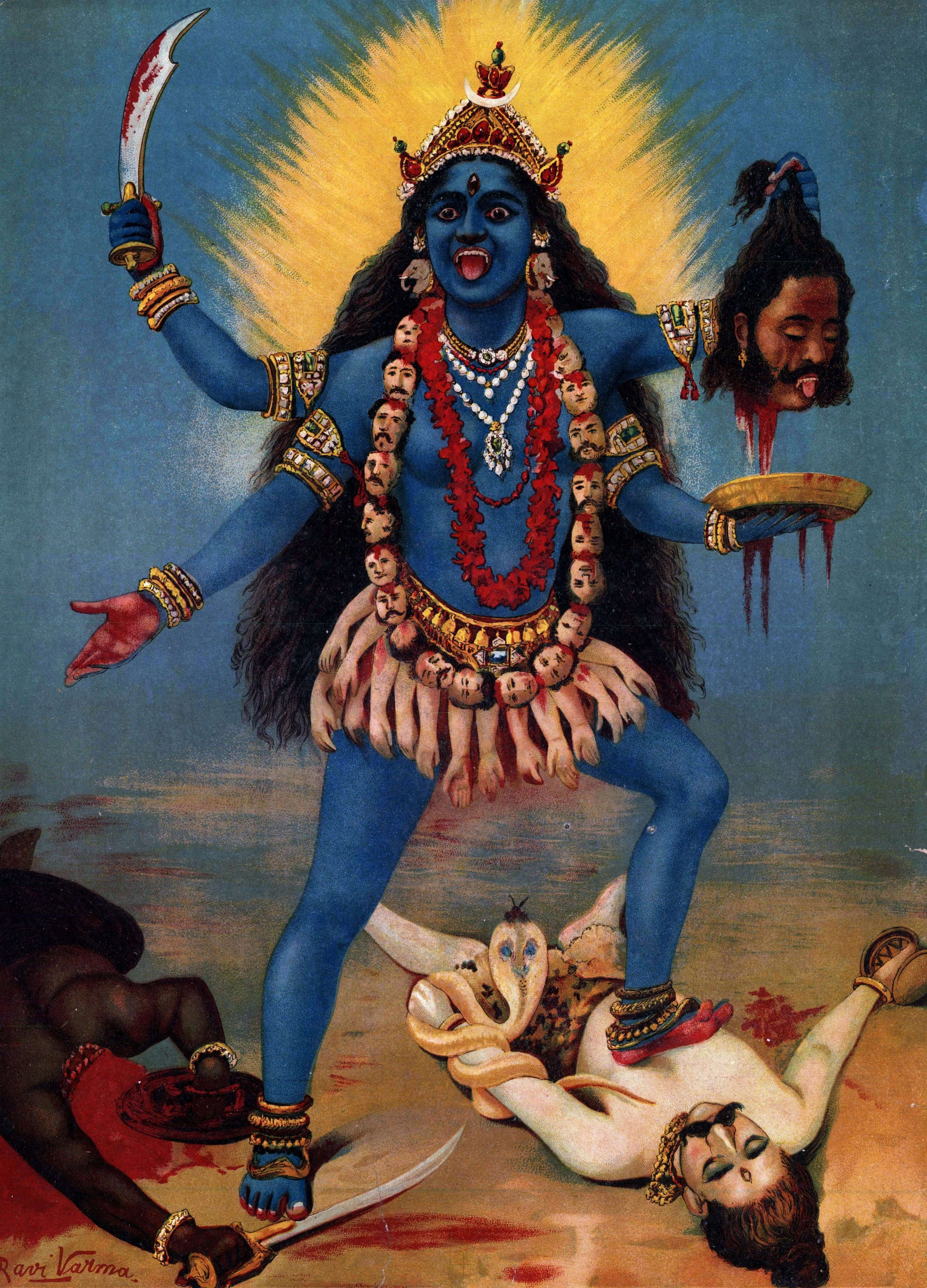
The iconography of the Hindu goddess Kālī also includes a sword and severed head (fig. 13). I didn’t mention her in the original article because she is traditionally depicted with dark skin, but she likely influenced the red-skinned Chinnamastā-Chinnamunda. It’s important to note that her mythos also associates the head with demons (asuras). For example, the Devī-Māhātmyam (c. 400-600 CE) reads:

Mounting her great lion, the Goddess ran at Caṇḍa, / And having seized him by the hair, she cut off his head with her sword. / On seeing Caṇḍa slain, Muṇḍa rushed at her. / She caused him to fall to the ground, wrathfully smitten with her sword. / On seeing Caṇḍa slain, and also the valorous Muṇḍa, / What was left of the assaulted army was overcome with fear and fled in all directions. / Picking up the heads of Caṇḍa and Muṇḍa, Kali / Approached C’aṇḍikā [Durgā] and spoke words mixed with loud and cruel laughter: / “Here, as a present from me to you, are Caṇḍa and Muṇḍa, two beasts / slain in the sacrifice of battle…” (Coburn, 1991, p. 62).

This adds to our list of sword-wielding, demon head-holding deities: 1) Perseus-Medusa; 2) Yuebei xing-Drought Demon; and 3) Kali-Asura.

Fig. 13 – An early-20th-century painting of Kali by Raja Ravi Varma (larger version). Image found here.


Update: 01-16-23

I thought of a way for artists and fan fiction writers to mix Yuebei xing’s skull with Medusa’s head. But first recall that section 1 reads:

Yuebei xing then calls Huaguang’s name while holding her own magic treasure, a skull. The immortal is immediately stricken with a headache and stumbles back to his cave in a daze. Her weapon is said to be quite dangerous; anyone whose name is called will die within three days.

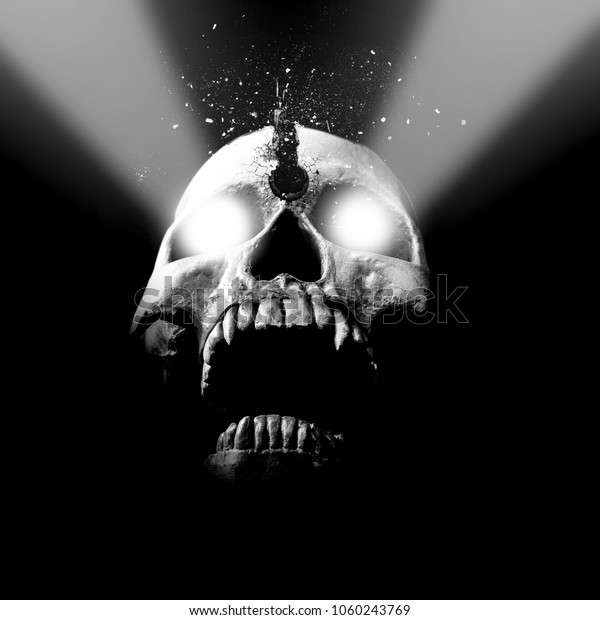
Perhaps the skull’s gaze can turn any living thing into stone, but this lithic death happens over the aforementioned three days. After the target’s name is called, the skull’s glowing eyes open wider and wider upon the dawn of each successive day, causing compounding confusion and pain. The final dawn sees the eyes open wide (fig. 14), making the unfortunate soul (no matter their location) turn to stone.

Refer back to note #1 for a possible defense.

Fig. 14 – The skull would look something like this on the third and final dawn (minus the bullet hole) (larger version). Image found here.


Update: 01-17-23

“Who is the mother of Sun Wukong’s children in Journey to the South?” This is a question I’ve been asked a few times on Tumblr. The novel never answers this, but one can make an educated guess for the purposes of fan fiction.

Each child is based on one of three lunar deities appearing among the “Eleven Luminaries” (Shiyi yao, 十一曜) (mentioned above). The specific gods are:

  1. Jidu (奇都, “Ketu”) = Represents the southern (descending) lunar node, or the point where the moon crosses the earth’s orbit around the sun. Associated with eclipses.
  2. Luohou (羅睺, “Rahu”) = Represents the northern (ascending) lunar node. Also associated with eclipses.
  3. Yuebei Xing (月孛星, “Moon Comet Star”) = Represents the lunar apogee, or the furthest point in the moon’s orbit.

Given their close connection to the night time celestial body, it would make sense for the mother to be Taiyin xing (太陰星, “Star of Supreme Yin”), goddess of the moon from the Eleven Luminaries.

Taiyin xing is commonly equated with Chang’e, goddess of the moon in Chinese mythology. However, Journey to the West chapter 95 depicts her as a separate deity and the leader of an unknown number of Chang’e moon goddesses (cf. Wu & Yu, 2012, vol. 4, p. 302).

Fig. 15 – A detail of Taiyin xing from the Ink Treasure of Wu Daozi (Daozi mobao, 道子墨寶, c. 13th-century) (larger version). See figure 1 for the complete image. She is the fourth person from the left on the top row.

Update: 01-18-23

I’ve decided to make this the only article on my blog where Yuebei xing information can be found. Therefore, I have removed all of it from “The Monkey King’s Children.” This means I have to also transfer some previous updates.

Posted: 02-13-22

I’ve recently started watching the Lego Monkie Kid series, which follows the adventures of Sun Wukong’s human disciple, MK, in a very toyetic, Lego-inspired world. This is why @TustiLoliPop‘s lovely drawing of Yuebei xing (fig. 16) really stood out to me. They were kind enough to give me permission to post it here. It’s based on the Xixia dynasty painting from figure 2.

Fig. 16 – The Lego Monkie Kid-style Yuebei xing by @TustiLoliPop (larger version). Used with permission.

Posted: 07-13-22

Tumblr user @sketching-shark has drawn some great pictures of Monkey and his children. Here is one of them (fig. 17). I love the alternating black and white color scheme of Rahu and Ketu, as well as Yuebei xing’s size.

Fig. 17 – Monkey’s family by @sketching-shark (larger version). Used with permission.


Update: 07-23-23

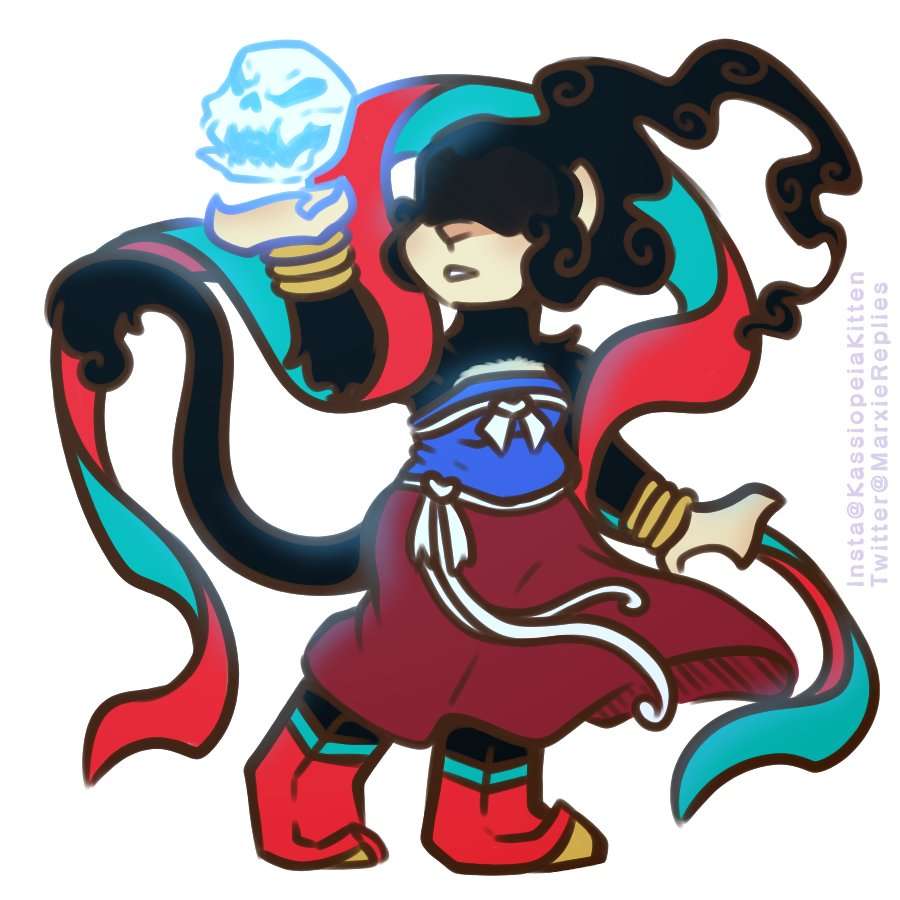
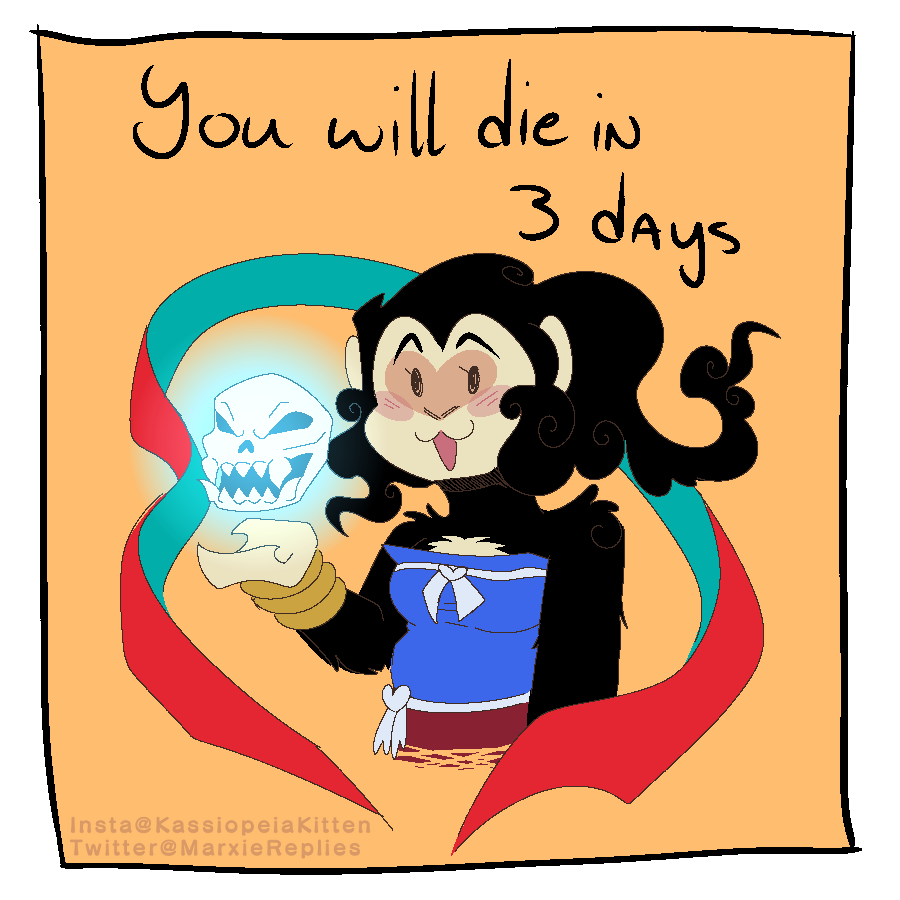
Tumblr user @MarxieReplies has drawn two Lego Monkie Kid-inspired pictures of Yuebei xing (fig. 18 & 19). Her clothing is based on the Xixia dynasty paintings of the lunar goddess (refer back to figure 2). I love the glowing skull and the flow of her ponytail and divine sashes.

Fig. 18 – A full body drawing of Yuebei (larger version). Fig. 19 – A head and torso drawing (larger version). Used with permission.


Update: 01-06-24

I just learned that a “Sun Yuebei” (孫月孛), daughter of the Monkey King, appears in the Japanese video game Touhou Monjusen ~ Bubbling Imaginary Treasures (東方門殊銭 ~ Bubbling Imaginary Treasures, 2021). She looks like a young, pink-haired human girl wearing red, feminine clothing with a bright green bow and light, red armor. And like her old man, she wears the golden headband and tiger skin and wields the iron staff along with her magic skull (video 1).

Video 1 – Sun Yuebei appears at min 3:34. I am 100% positive that the programmers hate people with epilepsy.

On a related note, Journey to the South fans wanting to write fanfiction about our monkey demoness can call her Sun Yuebei, [3] but as mentioned above, the original astrological goddess is surnamed Zhu (朱, “vermillion,” i.e. a shade of red). If anyone wants to create a version of Monkey’s daughter that is more in line with her religious counterpart, then she should be called “Zhu Yuebei” (朱月孛). I’m sure someone can think of a reason for why she wouldn’t take her father’s surname.


Given the connection of Sun Wukong’s children to the moon, it’s interesting to note that he displays an intimate knowledge of the Earth’s satellite as both an astrological body and alchemical symbol. He explains in chapter 36:

When the moon reaches the thirtieth day, the metal [phase] in its yang spirit is completely dissolved, whereas the water [phase] of its yin soul is filled to the brim of the orb. This is the reason for the designation of that day with the term Obscure [Hui, 晦], for the moon is completely dark and without light. It is at this moment also that the moon copulates with the sun, and during the time of the thirtieth day and the first day of the month, it will become pregnant by the light of the sun. By the third day, one [stroke] of the yang will appear, and two [strokes] of the yang will be born by the eighth day. At this time, the moon will have half of its yang spirit in the middle of its yin soul, and its lower half is flat like a rope. That is the reason why the time of the month is called the Upper Bow [Shangxian, 上弦]. By the fifteenth day, all three [strokes] of the yang will be ready, and perfect union will be achieved. That is why this time of the month is called To Face [Wang, 望]. On the sixteenth day, one [stroke] of the yin will be born, and the second stroke will make its appearance on the twenty-second day. At that time half of the yin soul will be in the middle of the yang spirit, and its upper half is flat like a rope. That is the reason why this time of the month is called the Lower Bow [Xiaxian, 下弦]. By the thirtieth day; all three [strokes] of the yin will be ready, and the moon has then reached the state of obscurity once more. All this is the symbol of the process of cultivation practiced by nature (Wu & Yu, 2012, vol. 2, pp. 159-160).

月至三十日,陽魂之金散盡,陰魄之水盈輪,故純黑而無光,乃曰『晦』。此時與日相交,在晦朔兩日之間,感陽光而有孕。至初三日一陽現,初八日二陽生,魄中魂半,其平如繩,故曰『上弦』。至今十五日,三陽備足,是以團圓,故曰『望』。至十六日一陰生,二十二日二陰生,此時魂中魄半,其平如繩,故曰『下弦』。至三十日三陰備足,亦當『晦』。此乃先天採煉之意。

Note:

1) I’ve already suggested that an acquaintance draw Yuebei wielding Medusa’s head in place of her signature skull. The real question is, “Could Medusa’s glare actually kill an immortal?” This insightful reddit post provides evidence from the Dionysiaca showing that even the god Dionysus considered it deadly enough to bring a magic diamond to protect himself from the Gorgon’s death stare:

The thyrsus was held up in his hand, and to defend his face he carried a diamond, the gem made stone in the showers of Zeus which protects against the stony glare of Medusa, that the baleful light of that destroying face may do him no harm (Rouse, 1940, vol. 3, p. 413). 

2) Translation by Dr. Kotyk.

3) Xing (星) just indicates her position has a planetary body.

Sources:

Bhattacharyya, B. (1958). The Indian Buddhist Iconography: Mainly Based on the Sādhanamālā and Cognate Tāntric Texts of Rituals (2nd ed.). Calcutta: Firma K.L. Mukhopadhyay.

Bunce, F. W. (1994). An Encyclopaedia of Buddhist Deities, Demigods, Godlings, Saints and Demons: With Special Focus on Iconographic Attributes (Vols.1-2). New Delhi: D.K. Printworld.

Carboni S. & Metropolitan Museum of Art. (1997). Following the Stars: Images of the Zodiac in Islamic Art. New York: Metropolitan Museum of Art.

Coburn, T. B. (1991). Encountering the Goddess: A Translation of the Devī-Māhātmya and a Study of its Interpretation. Albany: State University of New York Press.

Gansten, M. (2009). Navagrahas. In K. A. Jacobsen (Ed.), Brill’s Encyclopedia of Hinduism (Vol. 1) (pp. 647-653). Leiden: Brill.

Kinsley, D. R. (1997). Tantric Visions of the Divine Feminine: The Ten Mahāvidyās. Berkeley, CA: University of California Press.

Kotyk, J. (2017). Astrological Iconography of Planetary Deities in Tang China. Journal of Chinese Buddhist Studies, 30, 33-88, Retrieved from http://enlight.lib.ntu.edu.tw/FULLTEXT/JR-BJ001/bj001575268.pdf

Rouse, W. H. D. (Ed.) (1940), Nonnos. Dionysiaca, with an English Translation by W. H. D. Rouse, Mythological Introduction and Notes by H. J. Rose and Notes on Text Criticism by L. R. Lind (Vols. 1-3). Cambridge, Ma: Harvard University Press. Retrieved from https://archive.org/details/dionysiaca03nonnuoft/page/412/mode/2up.

Wu, C., & Yu, A. C. (2012). The Journey to the West (Vols. 1-4) (Rev. ed.). Chicago, Illinois: University of Chicago Press.

Yu, X. (n.d.). Nanyouji: Huaguang sanxia Fengdu [Journey to the South: Huaguang goes to the Underworld Three Times]. Retrieved from https://ctext.org/wiki.pl?if=gb&chapter=506975&remap=gb#%E5%8D%8E%E5%85%89%E4%B8%89%E4%B8%8B%E9%85%86%E9%83%BD


The Monkey King’s Children

Last updated: 04-04-2022

Modern media occasionally depicts Sun Wukong with children. Examples include the book series The Monkey King’s Daughter (2009-2011) and the DC Comics character the Monkey Prince (first appearing in 2021). The anime High School DxD (2012) even features a descendent some generations removed called Bikou. But the idea of the Great Sage having children goes back centuries. Two late-Ming novels influenced by the original Journey to the West (Xiyouji, 西遊記, 1592) reference multiple offspring. In this article, I will highlight these children and discuss their connection to Buddhism and Asian astrology.

Those interested in this subject may fancy learning about Sun’s brothers and sisters.

1. King PāramitāA Supplement to the Journey to the West (Xiyoubu, 西遊補, 1640)

This novel is set between the end of chapter 61 and the beginning of chapter 62 of the original. It follows the Monkey King as he travels time seeking a magic weapon, while also striving to unmask the identity of a mysterious foreign king who has persuaded Tripitaka to give up the quest to India. The first reference to Sun’s children appears in chapter 13 when actors in a royal play describe an alternate timeline where our hero settled down: “His wife is so beautiful, his five sons so dashing. He started out as a monk, but came to such a good end! Such a very good end!” (Dong, Lin, & Schulz, 2000, p. 114). Later, in chapter 15, Monkey meets one of these sons on the battlefield. “King Pāramitā” (Boluomi wang, 波羅蜜王) (fig. 1) is portrayed as a sword-wielding general capable of fighting Sun for several rounds. Pāramitā goes on to recount his family history, revealing that, although he’s never met his father, he’s the son of the Great Sage and Princess Iron Fan (Tie shan gongzhu, 鐵扇公主) (Dong, Lin, & Schulz, 2000, pp. 123-124). In addition, he suggests that he was conceived during an event from chapter 59 of the original:

[Sun Wukong] changed into a tiny insect and entered my mother’s belly. He stayed there a while and caused her no end of agony. When my mother could no longer bear the pain, she had no choice but to give the Banana-leaf Fan to my father, Monkey [1] … In the fifth month of the next year, my mother suddenly gave birth to me, King Pāramitā. Day by day I grew older and more intelligent. If you think about it, since my uncle [the Bull Demon King] and mother had never been together, [2] and I was born after my father, Monkey, had been inside my mother’s belly, the fact that I am his direct descendant is beyond dispute (Dong, Lin, & Schulz, 2000, p. 124).

Fig. 1 – King Pāramitā leaps into battle (larger version). Detail from a modern manhua. Image found here.

1.2. Links to Buddhism

The translators of A Supplement to the Journey to the West explain King Pāramitā’s name serves as a pun:

In the Chinese transliteration for Pāramitā, the character used to render the syllable “mi” [蜜] has the intrinsic meaning of “honey,” while the character t’ang [唐] in T’ang dynasty is homophonous with the character meaning “sugar” [糖]. King Pāramitā is punning on these associations (Dong, Lin, & Schulz, 2000, p. 123 n. 2). [3]

However, the name also has deep connections with Buddhism. The Princeton Dictionary of Buddhism defines the Sanskrit term Pāramitā (“perfection”) as “a virtue or quality developed and practiced by a Bodhisattva on the path to becoming a buddha” (Buswell & Lopez, 2014, p. 624). Various traditions recognize six to ten perfections, with the latter including the former six plus an additional four. The Mahayana perfections, for example, include giving, morality, patience, effort, concentration, wisdom, method, vow, power, and knowledge. Bodhisattvas are believed to master these virtues in the listed order, compounding spiritual wisdom and merit over the course of their journey towards Buddhahood (Buswell & Lopez, 2014, p. 624).

2. Jidu, Luohou, and Yuebei XingJourney to the South (Nanyouji, 南遊記, c. 1570s-1580s)

The novel follows the exile of Miao Jixiang (妙吉祥), a divine flame-turned Buddhist deity, from the Western Paradise through several mischievous reincarnations. [5] As the rogue immortal Huaguang (華光), he works to end his mother’s demonic lust for flesh by procuring an immortal peach in chapter 17. He does this by transforming into Sun Wukong and stealing the magic fruit from heaven. The real Monkey King is subsequently accused of his double’s misdeeds, much like the Six-Eared Macaque episode of the original novel. The Jade Emperor threatens to remand him to the Buddha for punishment but is convinced to give Sun a month-long reprieve to find the true culprit.

Monkey returns to the Mountain of Flowers and Fruit, and it is here, among his people, that the story mentions three children, including sons Jidu (奇都, “Ketu”) and Luohou (羅猴, “Rahu”) and daughter Yuebei Xing (月孛星, “Moon Comet Star”). [4] Sun eventually seeks out Guanyin, who reveals the troublemaker is none other than Huaguang. Returning home once more, Monkey’s news prompts his daughter to volunteer to battle the impostor. But her tribe simply pokes fun at her monstrous appearance. Yuebei Xing is said to have a crooked head with huge eyes and a broad mouth, coarse hands, a wide waist, and long legs with thunderous steps.

Sun travels with his daughter to Huaguang’s home of Mt. Lilou (Lilou shan, 離婁山) to provoke battle by chastising him for stealing the immortal peaches. Monkey strikes at him with his magic staff, causing Huaguang to deploy his heavenly treasure, a golden, triangular brick (sanjiao jinzhuan, 三角金磚). But Sun responds by creating untold numbers of clone monkeys that not only confiscate the weapon but also overwhelm the immortal. Huaguang is seemingly defeated at this point; however, he manages to deploy one last treasure, the Fire Elixir (Huodan, 火丹). This weapon engulfs the Great Sage in heavenly flame (akin to the Red Boy episode), causing him to flee to the Eastern Sea. Yuebei Xing then calls Huaguang’s name while holding her own magic treasure, a skull (kulou tou, 骷髏頭). The immortal is immediately stricken with a headache and stumbles back to his cave in a daze. Her weapon is said to be quite dangerous; anyone whose name is called will die within three days.

Huanguang’s religious teacher, the Flame King Buddha of Light (Huoyan wang guangfo, 火炎王光佛), then intervenes in order to sooth the situation between his disciple and the Great Sage. He promises to bring the rogue immortal to justice on the condition that Yuebei Xing withdraws her deadly magic. In the end, all parties are pardoned by the Jade Emperor, and Huaguang and Monkey become bond brothers (Yu, n.d.).

2.1. Links to Asian Astrology

All three of Sun’s children are named after planetary bodies associated with the moon in Asian astrology. [6] His sons Jidu and Luohou are respectively named after Ketu (Jidu, 奇都) and Rahu (Luohou, 羅睺), two of the “Nine Planets” (Sk: Navagraha; Ch: Jiuyao, 九曜, “Nine Luminaries”) from Hindu astrology. [7] These two shadowy planetary deities represent the respective southern (descending) and northern (ascending) lunar nodes, or points where the moon crosses the earth’s orbit around the sun. As such, the pair are associated with eclipses, and sources sometimes depict them as the head (Rahu) and tail (Ketu) of a great eclipse serpent. Other interpretations include Rahu as a disembodied head and Ketu as the torso, or Ketu as a comet or emerging from a cloud of smoke (Gansten, 2009, p. 652-653; Kotyk, 2017, pp. 59-60).

Before continuing, there are two interesting things to note: 1) Sun Wukong singlehandedly battles and defeats the Nine Planets in chapter five of the original novel (Wu & Yu, 2012, vol. 1, pp. 170-172). But the Ketu and Rahu in this group should be considered distinct from his sons; and 2) one of the original Chinese characters for Rahu (Luohou, 羅睺) was changed in Journey to the South to play on Luohou’s (羅猴) primate origins by using the homophonous word for “monkey” (hou, 猴).

All information about Yuebei xing has been moved to a new article.

Yuebei xing, Daughter of the Monkey King

3. Honorable Mention: Sun Luzhen – Later Journey to the West (Hou Xiyouji, 後西遊記, 17th-century)

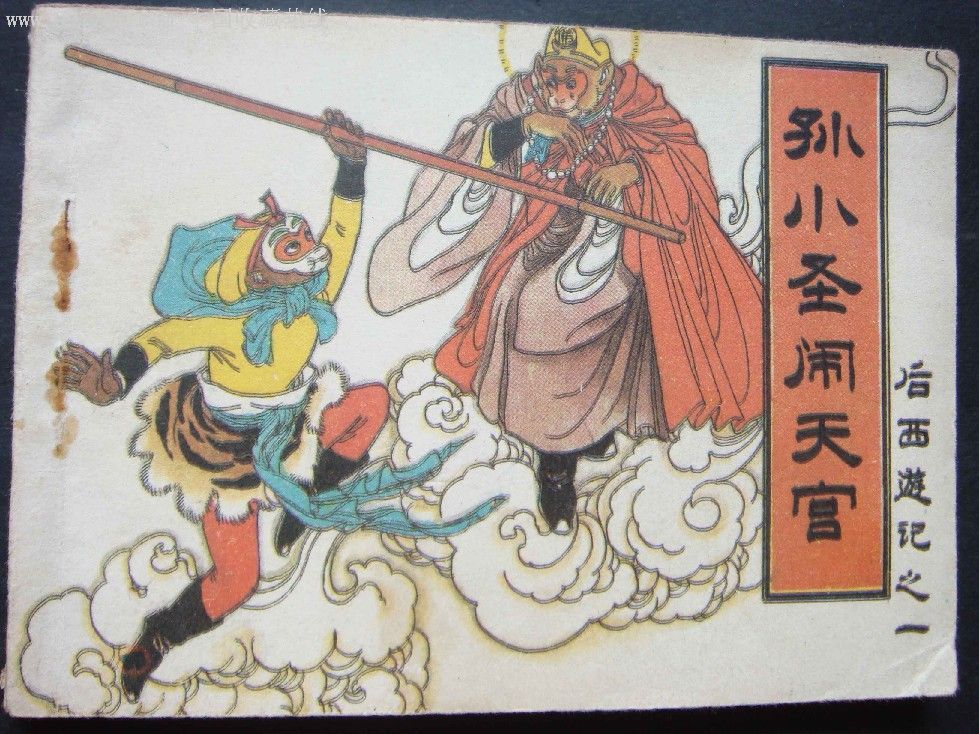
The novel is set two hundred years after the original and follows the adventures of Sun Wukong’s spiritual descendant Sun Luzhen (孫履真, “Monkey who Walks Reality”) (fig. 2). He too learns the secrets of immortality and causes havoc in heaven, before being tasked to protect the historical monk Dadian (大顛, 732-824) on a similar journey to India. The two are accompanied by the son of Zhu Bajie, Zhu Yijie (豬一戒), and the disciple of Sha Wujing, Sha Zhihe (沙致和). I did not include Luzhen in the main list as he is born from a stone in the same fashion as the original Monkey King (see Liu, 1994).

Fig. 2 – “Small Sage Sun’s Havoc in the Heavenly Palace” (larger version). The cover to a modern manhua. Image found here.

4. Conclusion

The Monkey King has a total of eight children shared between two late-Ming novels, but only four are mentioned by name, and only two of these actually have parts in the respective stories. King Pāramitā is one of the Great Sage’s five sons born to Princess Iron Fan in A Supplement to the Journey to the West (1640). He is portrayed as a handsome, sword-wielding general whom Sun faces on the battlefield. His name references the Pāramitās (“perfections”), or the wisdom and merit-building virtues that Bodhisattvas master in their quest for Buddhahood. Monkey has three children in Journey to the South (c. 1570s to 1580s), including sons Jidu and Luohou and daughter Yuebei Xing. The latter is depicted as a grotesque monster with a magic skull weapon cable of harming even celestials. She uses it to defeat the rogue immortal Huaguang. Jidu and Luohou are respectively named after the lunar nodes Ketu and Rahu, two of the Nine Planets from Hindu astrology. Yuebei is named after a shadowy planet representing the lunar apogee, which counts among the Eleven Luminaries of East Asian astrology. Ancient Xixia art sometimes depicts them as a woman or man bearing a sword and a severed head. The feminine iconography appears holding a skull in a novel from the 16th-century.

An honorable mention is Sun Luzhen from Later Journey to the West. He is a stone-bone monkey who follows in his spiritual ancestors footsteps by attaining immortality, causing havoc in heaven, and later protecting a holy monk on the journey to India.


Update: 04-04-22

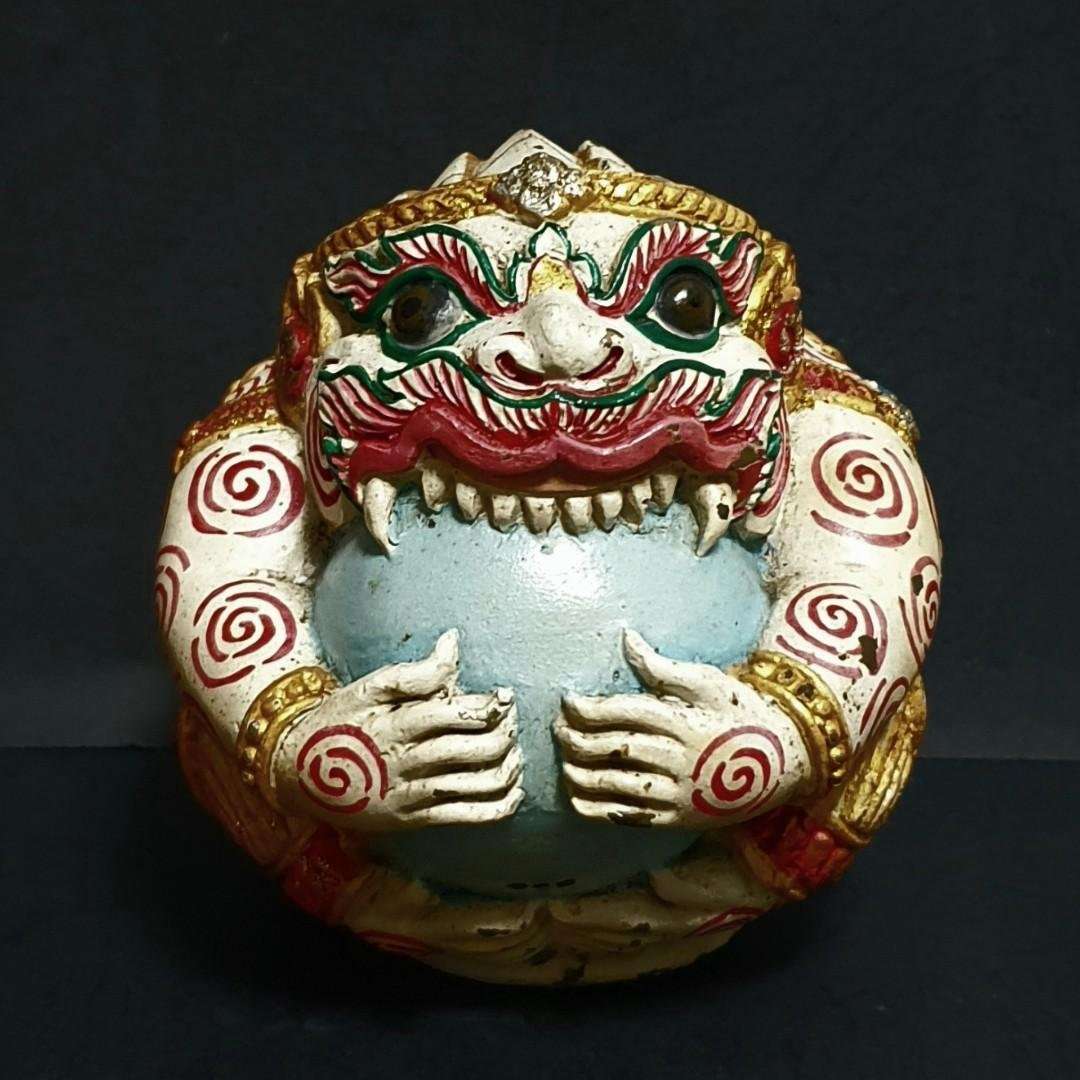
Back in November 2021, I made a post on twitter about a Rahu amulet that a collector friend of my was selling (and later sold). The deity is generally portrayed as a sharp-toothed, giant-mouthed monster devouring the moon. This piece is carved in a similar manner but Rahu is instead patterned after Thai depictions of Hanuman (fig. 3). I imagine his association with the monkey god is based on the latter’s attempt to eat the sun in his youth. 

Fig. 3 – The front of the Hanuman-like Rahu amulet (larger version).

Notes:

1) See Wu & Yu, 2012, vol. 3, p. 129.

2) This statement of course overlooks the conception and birth of the couple’s son Red Boy (Hong haier, 紅孩兒). But King Paramita might be referring to the Bull Demon King’s long absence while living with his mistress.

3) This pun plays out in chapter 14 of Journey to the West when an old patron remarks on Monkey’s monstrous appearance:

“Though you [Tripitaka] may be a Tang man,” the old man said, “that nasty character is certainly no Tang man!” “Old fellow!” cried Wukong in a loud voice, “you really can’t see, can you? The Tang man is my master, and I am his disciple. Of course, I’m no sugar man or honey man! I am the Great Sage, Equal to Heaven!” (Wu & Yu, 2012, vol. 1, p. 312).

Thank you to Irwen Wong for reminding me of this passage.

4) I’m indebted to Jose Loayza for bringing this to my attention.

5) To my knowledge, the only English translation available is this amateur version by Panying Zhao. Thank you to Ronni Pinsler for bringing it to my attention.

6) Thank you to Dr. Jeffrey Kotyk for confirming the astrological connection.

7) Sun, Moon, Mars, Mercury, Jupiter, Venus, Saturn, Rahu, and Ketu (Gansten, 2009).

8) These include the aforementioned Nine Planets (see note #6 above), Yuebei, and another shadowy planet called Ziqi (紫氣/紫炁; “Purple Mist”) (Hart, 2010, p. 145 n. 43; Kotyk, 2017, p. 60). Engravings of the Eleven Luminaries appear on Zhu Bajie’s battle rake (Wu & Yu, 2012, vol. 1, p. 382). See also note #10 on the linked article.

Sources:

Dong, Y., Lin, S. F., & Schulz, L. J. (2000). The Tower of Myriad Mirrors: A Supplement to Journey to the West. Ann Arbor: Center for Chinese Studies, The University of Michigan.

Gansten, M. (2009). Navagrahas. In K. A. Jacobsen (Ed.), Brill’s Encyclopedia of Hinduism (Vol. 1) (pp. 647-653). Leiden: Brill.

Hart, R. (2010). The Chinese Roots of Linear Algebra. United States: Johns Hopkins University Press.

Kotyk, J. (2017). Astrological Iconography of Planetary Deities in Tang China. Journal of Chinese Buddhist Studies, 30, 33-88), Retrieved from https://chinesebuddhiststudies.org/previous_issues/jcbs3002_Kotyk(33-88)_e.pdf

Liu, X. (1994). The Odyssey of the Buddhist Mind: The Allegory of the Later Journey to the West. Lanham, Md: University Press of America.

Buswell, R., & Lopez, D. (2014). The Princeton Dictionary of Buddhism. Princeton University Press.

Wu, C., & Yu, A. C. (2012). The Journey to the West (Vol. 1-4). Chicago, Illinois: University of Chicago Press.

Yu, X. (n.d.). Nanyouji: Huaguang sanxia Fengdu [Journey to the South: Huaguang goes to the Underworld Three Times]. Retrieved from https://ctext.org/wiki.pl?if=gb&chapter=506975&remap=gb#%E5%8D%8E%E5%85%89%E4%B8%89%E4%B8%8B%E9%85%86%E9%83%BD