Note: See also my more recent 100-chapter catalog of all the Monkey King’s powers and skills.
Last updated: 11-27-2018
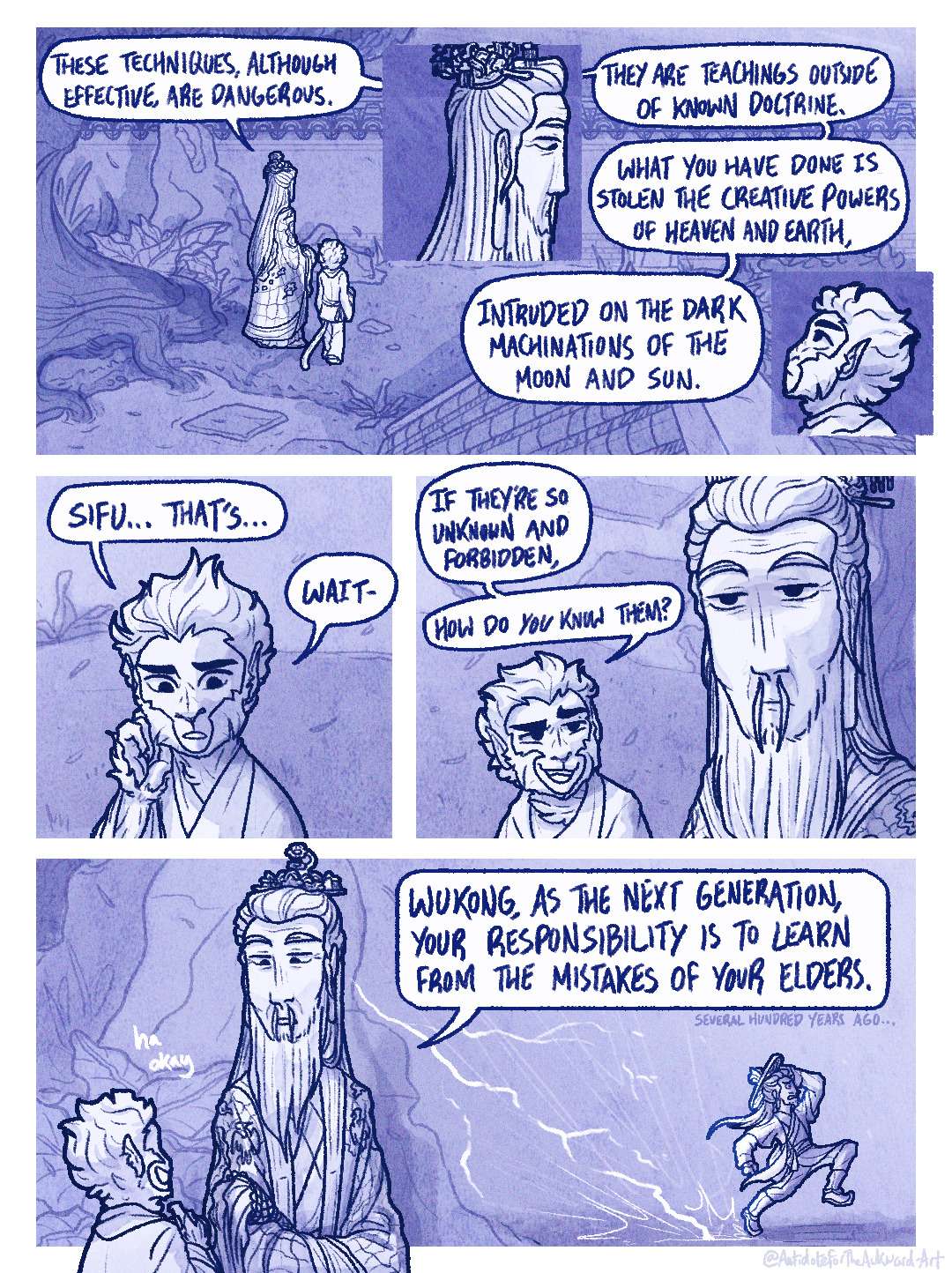
This entry will explore the curriculum that Sun Wukong follows while studying under the Buddho-Daoist sage, Patriarch Subodhi, in Journey to the West (Xiyouji, 西遊記, 1592; “JTTW” hereafter). Monkey stays in the immortal’s monastery for a total of ten years, the first seven living as a junior monk and the last three as a close disciple of Subodhi. Apart from menial tasks like fetching firewood and water, tending the garden, and cleaning the monastery grounds, Monkey first receives lessons on human language and etiquette, calligraphy, scripture reading, and minor ritual procedures like incense burning. These are taught to him by his senior religious brothers, thereby freeing up the Sage to teach higher level lessons on philosophy, internal alchemy, magic, and other skills to his more advanced students.
I should point out that Sun’s greatest asset during his training appears to be a supernatural mental acuity. Upon becoming Subodhi’s close disciple, Monkey rapidly masters skills that even his more senior religious brothers cannot grasp. The novel, therefore, refers to our hero as “someone who, knowing one thing, could understand a hundred” (Wu & Yu, 2012, vol. 1, p. 122). Monkey’s intellect allows him to outsmart many opponents and bypass many obstacles during his later adventures.
Table of Contents
- 1. Overtly Stated (Ch. 2)
- 2. Mentioned in Passing
- 3. Implied
- 4. Monkey as a Scholar Warrior
- 5. Conclusion
- 6. Updates
1. Overtly Stated (Ch. 2)
Chinese Philosophy
One poem best describes the philosophical lessons taught by Subodhi:
With words so florid and eloquent
That gold lotus sprang from the ground.
The doctrine of three vehicles he subtly rehearsed,
Including even the laws’ minutest tittle.
The yak-tail waved slowly and spouted elegance:
His thunderous voice moved e’en the Ninth Heaven.
For a while he lectured on Dao;
For a while he spoke on Chan–
To harmonize the Three Parties is a natural thing.
One word’s elucidation filled with truth
Points to the birthless showing nature’s mystery
(Wu & Yu, 2012, vol. 1, p. 122).天花亂墜,地湧金蓮。妙演三乘教,精微萬法全。慢搖麈尾噴珠玉,響振雷霆動九天。說一會道,講一會禪,三家配合本如然。開明一字皈誠理,指引無生了性玄。
This poem is a prime example of the Ming syncretic philosophy of the Three Teachings (Sanjiao, 三教): Confucianism, Daoism, and Buddhism. “The doctrine of the three vehicles” could refer to the three main branches of Buddhism, namely Theravada, Mahayana, and Vajrayana, but could also be referring to the Three Teachings (the same as the “Three Parties” mentioned further down the poem). “The yak-tail waved slowly and spouted elegance” refers to the bingfu (秉拂), or “to take hold of the whisk,” a phrase denoting a sermon by a learned Chan (Zen) master conducted from a high chair. The phrase derives from the fly whisk (Sk: vālavyajana; Ch: fuzi, 拂子; Jp: hossu, 払子), a symbol of religious authority held in hand during a lesson (Buswell & Lopez, 2014, p. 120). “His thunderous voice moved e’en the Ninth Heaven” refers to the Nine Heavens (jiutian, 九天) of Daoism (Pregadio, 2008, pp. 593-594). And, of course, the poem goes onto mention Subodhi lecturing on both Chan and the Dao, thereby identifying him as a teacher of unparalleled knowledge.
An immortal lecturing on Buddhism may come as a surprise to some readers. However, it should be remembered that Subodhi is based on one of the Buddha’s historical disciples.

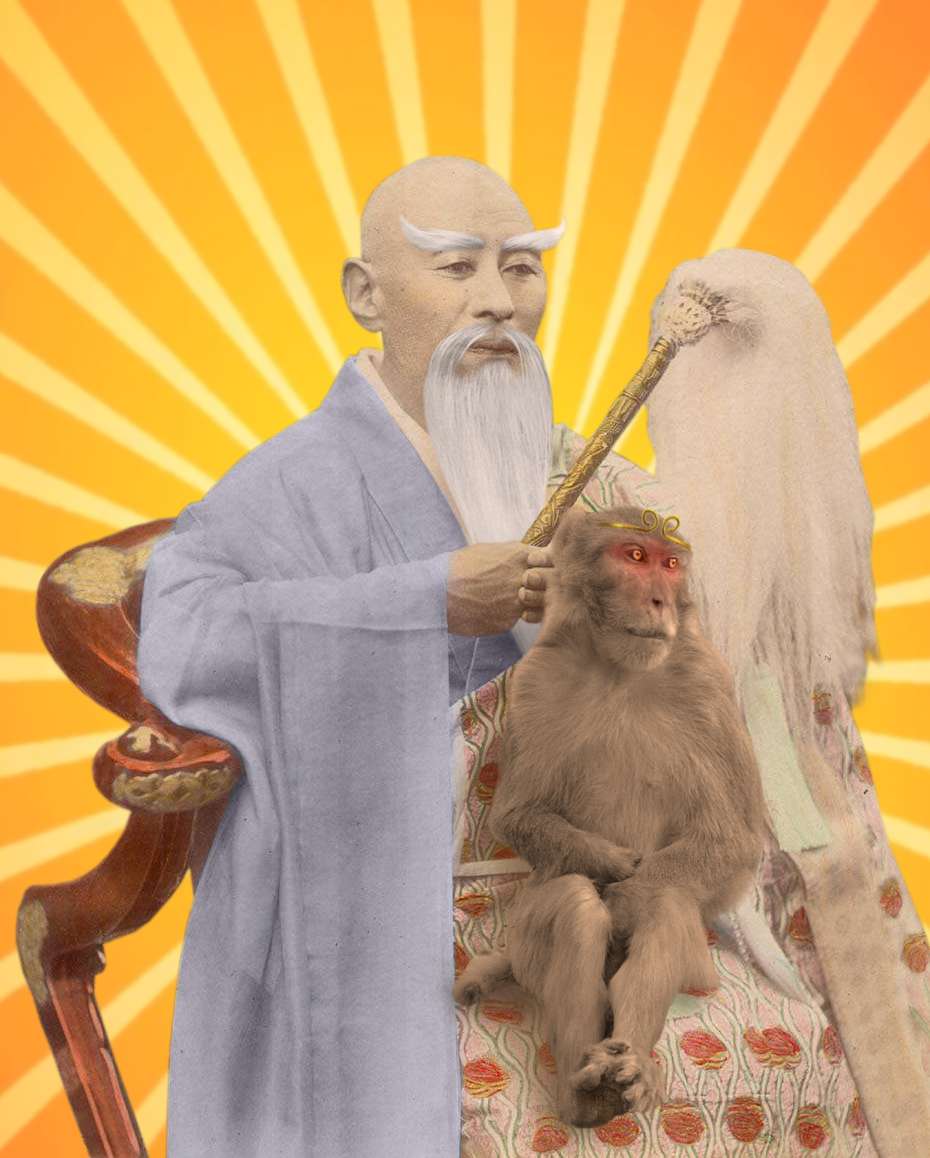
Sun Wukong and Master Subodhi. Take note of the fly whisk in the sage’s hands. Photomanipulation by the author (larger version). The original photo of the monk can be found on this blog about the fly whisk.
The Secret of Immortality
As I’ve explained in this article, Sun achieves immortality via breathing exercises designed to absorb yang energy during prescribed times (after midnight and before noon), the retention of chaste semen and transformation into qi energy, and the purification and circulation of the resulting spiritual energy throughout his body. While these practices are traditionally associated in Daoist internal alchemy with the formation of an immortal spirit that is eventually freed from the mortal shell, Monkey’s practice results in an ageless, adamantine physical body, one capable of lifting even cosmic mountains.

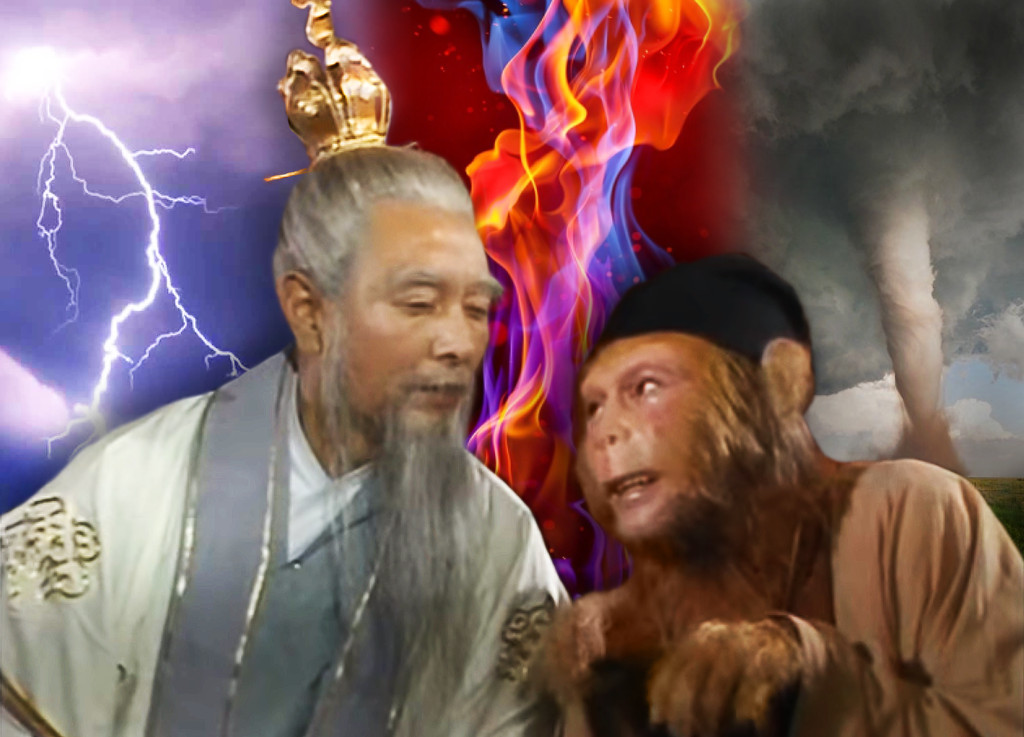
Monkey achieves immortality. Photomanipulation by the author (larger version).
The 72 Transformations
This series of oral formulas allows Wukong to change his physical appearance into anything from other humanoid figures (gods, monsters, and humans), animals, insects, miscellaneous objects, incorporeal beams of light, and even buildings. Subodhi teaches this skill to Monkey with the expressed purpose of escaping three heaven-sent calamities meant to destroy immortals for defying their fate. Despite the intended use, this skill becomes one of his greatest strengths.
Because of Monkey’s mental acuity he is able to instantly remember all of the oral formulas imparted to him, and after some practice, he quickly masters the transformations.
Sun’s heated battle of transformations with the god Erlang. From the 1965 animated classic Havoc in Heaven.
The Cloud-Somersault
The combination of a hand mudra and an oral formula allows Monkey to rise above the ground and travel at immense speed by somersaulting from cloud to cloud, each leap being 108,000 li, or 33,554 miles (54,000 km) long. (However, it is not wise to attach a real world distance to the ability. See this update for more info.)
This power is mastered in a single night.

Monkey flying on clouds. Drawing by Funzee on deviantart (larger version).
2. Mentioned in Passing
Martial Arts (ch. 67)
Monkey only makes a passing reference to his martial training in a later poem, part of which reads: “I bowed to the Patriarch of the Heart and Mind Spirit Platform and perfected with him the martial arts” (身拜靈臺方寸祖,學成武藝甚全周) (based on Wu & Yu, 2012, vol 3, p. 243).
The following skills are inferred based on this reference and internal story details.
Boxing
Sun displays a mastery of unarmed boxing in chapters two and 51, the former against a demon who takes over his mountain home in his absence and the latter against a Buffalo demon who steals his staff. Both chapters describe Monkey using techniques akin to short fist, a style known for quick, compact punches. Learning this close range style may be out of necessity, though, considering that Sun is so short—he’s less than 4-Chinese feet (122 cm) tall.
In his wonderful book The Shaolin Monastery (2008), Prof. Meir Shahar of Tel Aviv University reveals that Shaolin kungfu developed during the Ming-Qing transition from a synthesis of Daoist gymnastics (stretching and breathing exercises), religious rituals, and fist techniques. This new form of spiritual cultivation ushered in the era of so-called “internal martial arts,” Taiji boxing being the most famous among them.
Interestingly, some of the real world techniques used by Monkey and his opponent in chapter 51 appear in Taiji boxing.
JTTW was published during the late-Ming when this synthesis was in full swing. Therefore, Sun’s study of martial arts in a religious institution is an accurate snapshot of one facet of 16th-century monastic life.

Sun teaching a young human apprentice martial arts. Drawing by Celsohenrique on deviantart (larger version).
Weapons
After returning home in chapter 3, the young immortal teaches his children how to wield a plethora of weapons, including swords, spears, axes, bows and arrows, etc. He shortly thereafter acquires his magic staff, the weapon most commonly associated with him. Monkey’s skill with the staff is so great, in fact, that his supernatural technique is likened in chapter 33 to two of the Seven Military Classics of China.
Monkey’s broad knowledge of weapons implies that he learns the famous “Eighteen Martial Arts” (Shiba ban wuyi, 十八般武藝). A vague list of these war implements first appeared during the Song Dynasty, but a later definitive list became “a standard shorthand for complete martial arts knowledge” in Yuan-period stage plays (Lorge, 2012, p. 146). One version of the list appearing in the great Chinese classic The Water Margin (Shuihu zhuan, 水滸傳, c. 1400) includes everything from chains, clubs, and whips to axes, halberds, and even early firearms (Lorge, 2012, p. 147). Variations on the eighteen weapons remained a staple of Chinese stage plays, oral literature, and written fiction. Therefore, it’s no wonder a great warrior like Sun Wukong would come to be associated with the mastery of so many weapons.

Monkey assaults heavenly forces with his magic staff. Drawing by JeremyBLZ on deviantart (larger version).
Military Maneuvers
Monkey goes onto train his children in how to march, go on patrol, follow orders directed by flags and battle drums, and advance and retreat, turning the tangled mass of monkeys into an elite army.
Sun’s children engaging in mock battles during their training. From Havoc in Heaven.
3. Implied
Sun Wukong’s tutelage in these subjects are never stated but are understood to have taken place.
General Daoist Magic
This ability allows him to call forth gods and spirits, grow or shrink to any size, part fire and water, create an impassable barrier, conger a wind storm, cast illusions, freeze someone in place, unlock any lock, give human disciples superhuman strength, etc.
What’s interesting is that during his training, Monkey expressly passes on learning the bureaucratic-style magic rites normally used by earthly priests simply because they won’t result in his immortality. Instead, after achieving eternal life, Sun is just so powerful he can command the very gods themselves to do his bidding. His lack of ritual knowledge is highlighted in chapter 45 when he agrees to engage in a rain-making competition with an animal spirit disguised as a Daoist priest. The spirit relies on an established liturgy involving a ritual sword and tablet, as well as the burning of a written note. This elaborate ritual initiates a bureaucratic chain in which the request is sent to heaven, the Jade Emperor agrees to the appeal, and then heavenly officials, namely the gods of wind, clouds, lightning, and rain, are dispatched to fulfill the application. But Monkey rises into the clouds above to bully the respective deities into helping him instead, noting: “I don’t know how to burn charms, issue summons, or strike any tablet. So all of you must play along with me” (Wu & Yu, 2012, vol. 2, p. 293).
Likewise, Monkey is so powerful that he can bring the dead back to life by simply fetching a person’s soul from the underworld (like he does for an elderly benefactor in chapter 97).

Sun casting a magic spell. Drawing by Poppindollars on deviantart (larger version).
Chinese Medicine (chs. 68 & 69)
Monkey works to diagnose the long-standing malady of a foreign emperor. But due to the immortal’s monstrous appearance, he is forced to analyze the ruler from afar, using three magic hairs-turned-golden strings to measure the vibrations of the pulse from three locations of each forearm. Sun deduces that the illness is caused by fear and anxiety over the loss of the monarch’s queen, who had been kidnapped by a demon. Monkey then concocts three pills from a recipe of herbs, kettle soot, and dragon horse urine and administers the elixir with dragon king saliva. The medicine causes the emperor to pass an obstruction in his bowls, thus restoring the natural qi flow in his body and curing him of his sickness.
Baring the strings, Monkey’s method of reading the pulse aligns with real Chinese medicinal practice. The area of the forearm analyzed by traditional Chinese doctors is known as Cunkou (寸口, the “inch opening”), and this is broken up into the three spots Cun (寸, “inch”), Guan (關, “pass”), and Chi (尺, “foot”). The mirrored spots on each arm are believed to correspond to specific internal organs. For example, the Cun spot (nearest the wrist) on the right hand corresponds to the lungs, while that of the left hand corresponds to the heart (Liao, 2011, pp. 55-56). Therefore, analyzing the pulse at these spots is believed to reveal the health of the corresponding organs.

The spots analyzed during pulse diagnosis. Picture originally found here.
4. Monkey as a Scholar Warrior
The abilities and skills learned by Sun are varied, straddling the religious, the literary, and the martial. Therefore, Monkey is a perfect example of what Deng Mingdao (1990) calls the “Scholar Warrior”:
Skill is the essence of the Scholar Warrior. Such a person strives to develop a wide variety of talents to a degree greater than even a specialist in a particular field. Poet and boxer. Doctor and swordsman. Musician and knight. The Scholar Warrior uses each part of his or her overall ability to keep the whole in balance, and to attain the equilibrium for following the Tao. Uncertainty of the future inspires no fear: whatever happens, the Scholar Warrior has the confidence to face it (p. 10).
5. Conclusion
Monkey stays in Subodhi’s monastery for a total of ten years, the first seven living as a junior Daoist monk and the last three as a close disciple of Subodhi. During his time as a junior monk, he learns human language and etiquette, calligraphy, scripture reading, and incense burning. These foundational skills are taught to him by his senior religious brothers. During his time with Subodhi, Sun learns Chan and Daoist philosophy; the secret of immortality; the 72 heavenly transformations; cloud-somersaulting; military arts like troop maneuvering, weapons, and boxing; general Daoist magic; and medicine.
6. Updates
Update: 11-27-2018
I’ve written a continuation of this article where I use the above info to speculate that Sun Wukong is a warrior monk in Master Subodhi’s immortal monastic army. It’s good fodder for fanfiction. I even suggest a mythological baddie for the warrior monks to fight, the headless deity Xingtian.
Sources
Buswell, R. E. , & Lopez, D. S. (2014). The Princeton Dictionary of Buddhism. Princeton, NJ: Princeton University Press.
Deng, M. D. (1990). Scholar Warrior: An Introduction to the Tao in Everyday Life. San Francisco: HarperSanFrancisco.
Liao, Y. (2011). Traditional Chinese Medicine. Cambridge: Cambridge University Press.
Lorge, P. A. (2012). Chinese Martial Arts: From Antiquity to the Twenty-First Century. New York, NY: Cambridge University Press.
Pregadio, F. (2008). Jiutian 九天 Nine Heavens In F. Pregadio (Ed.), The Encyclopedia of Taoism: Volume 1 (pp. 593-594). London [u.a.: Routledge].
Shahar, M. (2008). The Shaolin Monastery: History, Religion, and the Chinese Martial Arts. Honolulu: University of Hawai’i Press.
Wu, C., & Yu, A. C. (2012). The Journey to the West (Vols. 1-4) (Rev. ed.). Chicago: University of Chicago Press.