Last updated: 10-12-2024
My blog currently hosts several articles related to Fujian Province, China, including Sun Wukong’s cult, some of his mainland temples, a 13th-century pagoda relief carving, and a rare Yuan-Ming Journey to the West (Xiyouji, 西遊記) puppet play entitled Tripitaka Seeks the Scriptures (Sanzang Qujing, 三藏取經). Here, I would like to add to the list by shining a spotlight on the traditional “decorated dough figurines” (zhuanggao ren, 粧糕人) of Maan Uiling (Wan Weilong, 萬偉龍; Insta: @maanuiling) from Quanzhou City.
This article will serve as a very basic introduction to dough figurines. The artform of food-based dolls has many names across Asia, including niemian ren or liat bin/bian jin/lin (捏面/麵人) and niesu or liat sok/so (捏塑) in Chinese and Hokkien-speaking countries, amezaiku (飴細工) in Japan, and to he in Vietnam.
I will update this piece when new information becomes available.
Table of Contents
- 1. Uiling’s Work
- 1.1. Brief Interview
- 1.2. Style Influences
- 2. Dough Figurine Folk History
- 3. Updates
1. Uiling’s Work
I first learned about Uiling’s art from a Facebook post (video 1). It features Sun Wukong in whimsical, brightly-colored scenes of combat and worship.
Video 1 – A video of Great Sage dough figurines.
1.1. Brief Interview
Uiling was kind enough to answer some questions:
1. I would really like to learn more about the history and uses of decorated dough figurines. Are they related to religion?
The figurines are only available during the Yulanpen [i.e. Hungry Ghost] Festival in the seventh month of the lunar calendar. They are used to ward off evil spirits. In my seaside hometown of Quanzhou, Fujian, adults buy them for children to play with in order to drive away evil spirits.
[…]
The most popular figure purchased by everyone during the seventh lunar month is Sun Wukong, and there’s also Nezha, Three-Eyed Yang Jian [i.e. Erlang, 二郎], the Pagoda-Bearing Heavenly King [i.e. Li Jing, 李靖], Mother Guanyin, Lord Guan, Tripitaka riding the white horse, Mu Guiying, He Xiangu, and Iron Crutch Li bearing a hu-gourd.
你好,粧糕人是农历七月盂兰盆节才有的东西。用来镇邪。我的家乡在海边福建泉州,大人买来给小孩子拿在手上玩,驱逐鬼恶。
[…]
七月的时候大家买的比较多的是孙悟空,还有哪吒、三目杨戬、托塔天王、观音妈、关公、三藏骑白马、穆桂英、何仙姑、铁拐李有一粒葫芦。
(The demonifugic properties of the figurines no doubt explain why Sun Wukong is a popular subject of dough figurine makers. He is after all the demon queller par excellence.)
2. Can you tell me how you started making decorated dough figurines? Is this a family tradition? And can you walk me through the process? What materials do you use, and how long does it take to make the figurines?
The materials are wheat flour, glutinous rice flour, salt, honey, etc. It takes five hours to make one. I have enjoyed this since I was a child and have learned from people everywhere. I want to produce items that suit how I feel in my soul. I have written a book titled Quanzhou Clay Toys.
材料是面粉糯米粉盐蜂蜜等。制作目前是五个小时。我从小就喜欢这个,到处跟人学。我想做出适合我灵魂的感觉。我有写一本书《泉州土怂玩具》。
Those wishing to purchase his creations should download the REDnote (小红书) app. Then, search “泉郡粧糕宫.” If this doesn’t work, you can reach out to the artist on Facebook. Again, search “泉郡粧糕宫.”
1.2. Style Influences
Uiling’s version of Sun Wukong features long hair, something that may seem unique to the laymen (fig. 1).

Fig. 1 – Uiling’s version of the Monkey King (larger version). Screenshot from this Instagram video.
But this can be tied to his depiction in Fujian glove puppetry (fig. 1) and folk religion (fig. 2).

Fig. 1 (left) – A (porcelain or wood) Quanzhou glove puppet Monkey King head (larger version). Photo found here. Fig. 2 (right) – A Fujian Great Sage statue in my personal collection (larger version).
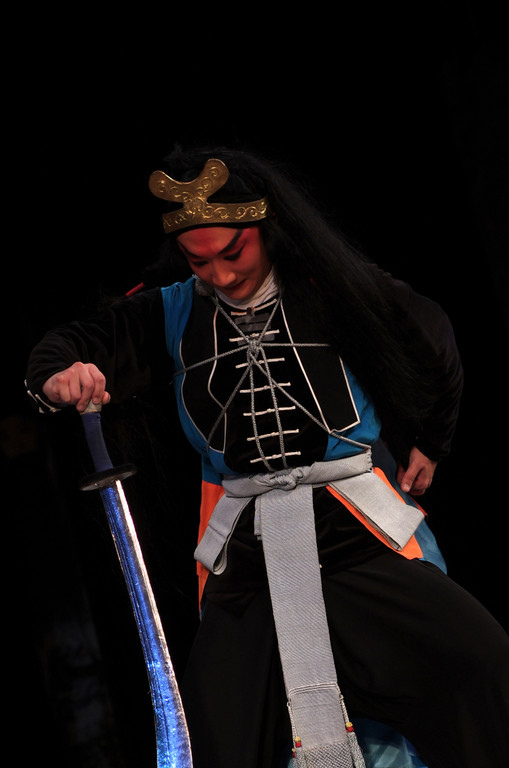
And these in turn are modeled on long-haired military monks (wuseng, 武僧) from Chinese opera (fig. 3).

Fig. 2 – A detail of the literary hero and military monk Wu Song from a Chinese opera about his adventures (larger version). Full version available on Wikimedia Commons.
2. Dough Figurine Folk History
Several online articles link dough figurines to the origins of mantou pastries. Thankfully, I was able to find a dynastic source mentioning the legend. [1] The Song-era Records on the Origins of Things and Affairs (Shiwu jiyuan, 事物紀原, c. 11th century) contains an entry reading:
Steamed Buns [Mantou, 饅頭]
The novel says: In the past, when Martial Marquis Zhuge [Zhuge wuhou, 諸葛武侯; i.e. Zhuge Liang, 諸葛亮] was leading an expedition to capture Meng [孟; i.e. Meng Hou, 孟获], people said that the land of the Man-barbarians [蠻] was permeated with sorcery. So, he had to pray to the gods in order to procure spirit-soldiers to help him. But the local custom involved killing sacrificial victims before the gods would send troops. However, the Martial Marquis refused, choosing instead to wrap mutton and pork in rice dough and shape them like human heads [rentou, 人頭]. After this “sacrifice,” the gods sent the soldiers.
From then on, later generations called these “steamed buns” [mantou, 饅頭; i.e. a homonym of “Man-barbarian heads”]. In Lu Di’s (Miscellaneous) Methods of Sacrifice [(Za) Ji fa, (雜)祭法] of the Jin Dynasty, steamed buns were used during the spring sacrifice as items offered to the gods. And Xu Shi’s “Rhapsody on Pasta” [Bing fu, 餅賦] also mentions this, so it’s suspected that steamed buns originated from the Martial Marquis.
It’s easy to see how this story was associated with our subject. Both the steamed buns and and figurines are humanoid representations that are shaped from rice dough. And both serve a religious function.
I hope to write more about this fascinating artform in the future.
Updates
Update: 10-12-24
Dr. Robin Ruizendaal, a noted scholar of traditional Chinese puppetry, recently posted a colorized photo of a dough figurine maker from the mid-20th century (fig. 3). His original description reads:
1940年代四川成都龍泉驛區賣捏麵人演偶戲
Dough puppet maker and vendor brings his merchandise to life on a small stage in Chengdu, Sichuan province (1940s).
The maker appears to be using his figurines as puppets to entertain/entice the young lads to buy some of his wares.

Fig. 3 – The dough maker and crowd (larger version).
Notes:
1) I learned about said source from Ma (2019, p. 981). However, I am not following their translation of the passage because it is different from the version I have.
Source:
Ma, B. (2019). History Of Medicine In Chinese Culture (Vols. 1-2). Singapore: World Scientific Publishing.


_1.jpg)

#/media/File:Kagamibuta_netsuke_front.jpg)


.jpeg)

.jpg)