
[Since writing this article, I have come to appreciate a Chinese origin for the depiction of Monkey’s staff as an iron pillar. Please see the entry for 09-26-16 below. I am keeping this article up for posterity so others may see my thought process.]
Last updated: 07-04-2021
Much of my recent work on Journey to the West (Xiyouji, 西遊記; “JTTW” hereafter) has focused on the origins of Sun Wukong‘s magic staff. This is because, as far as I know, scholars haven’t attempted to trace it beyond the 13th-century JTTW. This entry discusses the staff’s influence by the ringed and metal staves respectively carried by religious and martial Buddhist monks. Over time, these were combined into a single weapon: the rings from the former were fused at the ends of the latter. However, this doesn’t explain all aspects of the weapon. Take for example the initial description of the staff as a black iron pillar with an inscription:
[Sun] Wukong girded up his clothes and went forward to touch it: it was an iron rod more than twenty feet long and as thick as a barrel (emphasis added). Using all his might, he lifted it with both hands, saying, “It’s a little too long and too thick. It would be more serviceable if it were somewhat shorter and thinner.” Hardly had he finished speaking when the treasure shrunk a few feet in length and became a layer thinner. “Smaller still would be even better,” said Wukong, giving it another bounce in his hands. Again the treasure became smaller. Highly pleased, Wukong took it out of the ocean treasury to examine it. He found a golden hoop at each end, with solid black iron in between. Immediately adjacent to one of the hoops (emphasis added) was the inscription, “The Compliant Golden-Hooped Rod. Weight: 17,550 lbs” (based Wu & Yu, 2012, p. 135). [1]
If the weapon is based on historical objects, could it be possible that this description is based on something real? I believe I have found the object that may have influenced Monkey’s treasure: the famous Iron Pillar of Delhi (Ch: Deli tiezhu, 德里鐵柱) (fig. 1).

Fig. 1 – The Iron Pillar of Delhi (4th-cent. CE) (larger version). Image found on Wikipedia.

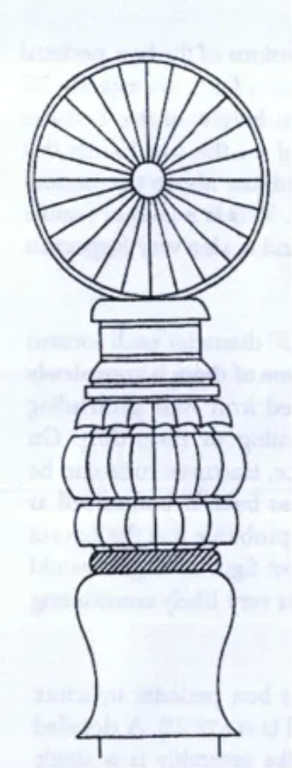
This Hindu monument was erected by King Chandragupta II (r. 380–413) of the Gupta Empire and dedicated to the deva Vishnu (Balasubramaniam, 2005, p. 14). It is nearly 24-feet (7.31 m) long, 21-feet (6.4 m) of which is sticking out of the ground (“an iron rod more than twenty feet long”). The shaft has a very wide diameter, 24-inches (60.96 cm) at the base and 17-inches (43.18 cm) at ground level (“as thick as a barrel”) (Balasubramaniam, 2005, p. 30). It has an ornamental bell capital that was originally topped by a chakra disc (“He found a golden hoop at each end”) (fig. 2) (Balasubramaniam, 2005, pp. 36-42). [2] And it also carries an inscription describing the military feats of the king (“Immediately adjacent to one of the hoops was the inscription…”) (fig. 3) (Balasubramaniam, 2005, pp. 6-8).

Fig. 2 (left) – A reconstruction of the chakra disc (larger version) (Balasubramaniam, 2005, p. 42). Fig. 3 (right) – The inscription (larger version).

What’s most interesting is the fact that the pillar is famous for resisting corrosion over the last 1,600 years. Scientists have analyzed its composition to find that it has a high phosphorous content, which forms a protective barrier against corrosive agents (Balasubramaniam, 2005, pp. 3 and 50-51). This means that the metallurgists of ancient India were far more advanced than originally thought. In addition, a local tradition in Delhi associates the pillar with Bhima, a supernaturally strong warrior from the great Hindu epic the Mahabharata (4th-cent. BCE). A legend circulating from at least the 19th-century (and maybe earlier) claims that he wielded the monument as a club in his ancient war against a rival army (Chunder, 1869, p. 152). Therefore, a black iron rod that defies time and is associated with martial heroes would surely make a fine weapon for an immortal monkey, no?
I unfortunately don’t know of any Chinese sources mentioning the pillar, so connecting it directly to JTTW is difficult. However, the pillar was around for 1,200 years prior to the standard 1592 version of the novel, and Buddhist monks such as Faxian and the historical Xuanzang made pilgrimages to northern India where the monument is located. Not to mention there is the possibility that Indian and Chinese merchants traveling back and forth between the two countries could have spread tales about the marvelous iron rod to China. These oral tales could have then reached the ear of the novel’s author-compiler during the Ming. I’ve contacted experts in Chinese history, religion, and literature to determine whether or not I’m on the right path. I’ll make a sister entry in the future if I happen upon any more information.
Update: 06-04-14
I recently learned that famed Muslim sojourner Ibn Battuta (1304-1377) referenced the pillar in his travel log:
In the center of the [Mosque of Delhi] is the awe-inspiring column of which [it is said] nobody knows of what metal it is constructed. One of their learned men told me that it is called Haft Jūsh, which means ‘seven metals’, and that it is composed of these seven. A part of this column, of a finger’s length, has been polished, and this polished part gives out a brilliant gleam. Iron makes no impression on it. It is thirty cubits high, and we rolled a turban round it, and the portion which encircled it measured eight cubits (Ibn Batuta & Gib, 2002, p. 622). [3]
Ibn Battuta traveled to China after his time in India, so this is just an example of how stories of the pillar could have come to the Middle Kingdom.
Update: 12-30-14
I just posted the third and final installment of my investigation on the history of Monkey’s staff. It can be read here.
Update: 09-26-16
Since writing the top entry, I’ve come to appreciate a Chinese origin for the staff’s depiction as an iron pillar. This entry serves as an addendum until I can write a longer blog on the subject.
The Connection Between the Monkey King’s Staff, Yu the Great, and Flood Control
Update: 12-09-16
I recently learned about the origins of Monkey’s birth from stone, which may have influenced the hero’s connection with Yu’s ruler.
Sun Wukong’s Birth from Stone and More Connections to Yu the Great
Update: 02-06-21
I have written an article that discusses the magic powers of the staff. These include the ability to shrink and grow, control the ocean, astral project and entangle with Monkey’s spirit, multiply endlessly, pick locks, and transform into various objects. It also has sentience to a certain degree.
Update: 07-04-21
Here I present my theory on why Sun Wukong’s staff weighs 13,500 catties (17,560 lbs/7,965 kg). I believe the number is an embellishment on the weight of a stone block lifted by the bandit Wu Song in the Water Margin (c. 1400).
Notes:
1) Anthony Yu’s (Wu & Yu, 2012) original translation states “thirteen thousand five hundred pounds” (vol. 1, p. 135). However, Chinese versions of the novel use jin (斤), known in English as “catty.” Catty and pound are two different measures of weight, the former being heavier than the latter. The catty during the Ming Dynasty when the novel was compiled equaled 590 grams (Elvin, 2004, p. 491 n. 133), so 13,500 catties would equal 17,550 lbs. Therefore, the English text has been altered to show the more accurate weight.
2) Balasubramaniam (2005) states that the discus was probably removed during the Muslim era for iconoclastic reasons (p. 43). I’m not sure when (if it all) stories of the pillar made it to China. Whether before or after the Muslim conquest, the ornamental nature of the discus and/or the remaining bell capital could have influenced the fusion of the rings from the religious staff to the ends of the martial iron staff.
3) A big thanks to Historum member Jinit for bringing the reference to my attention.
References
Balasubramaniam, R. (2005). Story of the Delhi Iron Pillar. Delhi: Foundation Books.
Chunder, B. (1869). The Travels of a Hindoo to Various Parts of Bengal and Upper India (Vol. 2). London: N. Trübner.
Elvin, Mark. (2004). The Retreat of the Elephants: An Environmental History of China. New Haven (Conn.): Yale University Press.
Ibn Batuta & Gib, H. A. R. 2000. The Travels of Ibn Baṭṭūṭa, A.D. 1325-1354 (Vol. 3). London: Hakluyt Society.
Wu, C., & Yu, A. C. (2012). The Journey to the West (Vol. 1) (Rev. ed.). Chicago, Illinois: University of Chicago Press.