Why was Sun Wukong Able to Live 342 Years Prior to his Immortality?

Last updated: 04-23-2026

Someone on reddit recently asked why Sun Wukong was able to live just shy of 400 years before even attaining immortality. I thought this was a good question, so I decided to split off related material from an old piece that I never finished and make a quick article. The short answer is tied to Daoist concepts of fate, and the long answer ultimately explains why Monkey strikes his name from the ledger of life and death in hell.

Table of Contents

1.  Novel Info

Here, I would like to quote two early sections from Journey to the West (Xiyouji西遊記, 1592) that refer to Sun Wukong’s age. The first appears in chapter one after he becomes monarch of the primates:

The Handsome Monkey King thus led a flock of gibbons, macaques, and horse-monkeys, some of whom were appointed by him as his ministers, aides, and envoys. They toured the Flower-Fruit Mountain in the morning, and they lived in the Water-Curtain Cave by night. Living in concord and sympathy, they did not mingle with bird or beast but enjoyed their independence in perfect happiness. For such were their activities:

In the spring they gathered flowers for food and drink.
In the summer they went in quest of fruits for sustenance.
In the autumn they amassed taros and chestnuts to ward off time.
In the winter they searched for yellow-sperms to live out the year.

The Handsome Monkey King had enjoyed this insouciant existence for three to five hundred years (emphasis added) when one day, while feasting with the rest of the monkeys, he suddenly grew sad and shed a few tears (based on Wu & Yu, 2012, p. 106).

美猴王領一群猿猴、獼猴、馬猴等,分派了君臣佐使。朝遊花果山,暮宿水簾洞,合契同情,不入飛鳥之叢,不從走獸之類,獨自為王,不勝歡樂。是以:

春採百花為飲食,夏尋諸果作生涯。
秋收芋栗延時節,冬覓黃精度歲華。

美猴王享樂天真,何期有三五百載。一日,與群猴喜宴之間,忽然憂惱,墮下淚來。

And the second appears in chapter three after Monkey is dragged to hell. He bullies underworld officials into giving him his ledger of life and death, in which he learns his exact age and fate:

You see, though this monkey resembled a human being [i.e. his body], he was not listed under the names of men; though he resembled the short-haired creatures [i.e. his fur], he did not dwell in their kingdoms; though he resembled other animals, he was not subject to the unicorn; and though he resembled flying creatures [i.e. his beak-like, protruding face], he was not governed by the phoenix. He had, therefore, a separate ledger, which Wukong examined himself. Under the heading “Soul1350” he found the name Sun Wukong recorded, with the description: “Heaven-born Stone Monkey. Age: three hundred and forty-two years. A good end” (emphasis added) (Wu & Yu, 2012, p. 140).

又看到猴屬之類,原來這猴似人相,不入人名;似臝蟲,不居國界;似走獸,不伏麒麟管;似飛禽,不受鳳凰轄。另有個簿子,悟空親自檢閱,直到那「魂」字一千三百五十號上,方注著孫悟空名字,乃「天產石猴,該壽三百四十二歲,善終」

So why then was he able to live so long?

2. Religious Background

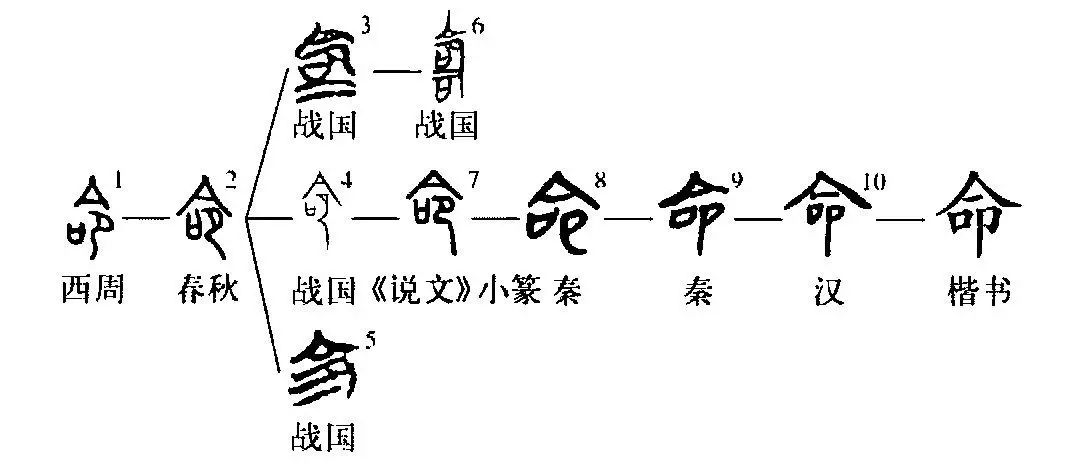
The answer lies in the concept of “pre-allotted lifespans” (ming, 命; a.k.a. “fate”) (fig. 1), which can be traced to weft texts [1] and Grand Purity (Taiqing, 太清) scriptures of the Han dynasty (3rd-c. BCE to 3rd-c. CE). According to 1st to 3rd-century CE commentators, a person’s lifespan and good or bad fortune in life were determined according to whatever combination of “heavenly pneumas” (tianqi, 天氣) and “astral essences” (xingjing, 星精) that they were born under, meaning one’s fate was not handpicked by heaven (Campany, 2005, pp. 131-134). This allotted lifespan was not set in stone, however, for it was subject to subtractions and additions based on one’s bad or good deeds. The deity in charge of this tally system was called the “Director of Allotted Life Spans” (Siming, 司命), and, unlike the underworld officials who provided Monkey with his ledger, he was said to reside in heaven where he regularly received reports on individual human sins by the tutelary Stove god (Zaoshen, 竈神) on the first, fifteenth, and last day of every month. Additionally, he received reports from the three corpses/worms (sanshi, 三尸) inhabiting a person’s body. [2] The more a person sinned, the more points (time) was subtracted, anywhere from almost a year for major offences to just three days for minor offences. Doing good deeds or cheating the system were the only ways to live out the entirety of the allotted lifespan (Campany & Ge, 2002, pp. 47-52).

Evolution of the character ming () (larger version). Image found here.

Ways of “living off the books” included magically disguising clothing or a sword as a body (fig. 2), ritually bribing the gods of life and death with a golden statue to be used as a substitute body, or inserting a fake death certificate into the coffin of a recently deceased grandfather. These methods essentially tricked heaven into thinking that the person had died (Campany, 2005, pp. 134-138; Campany & Ge, 2002, pp. 60). The use of longevity-bestowing elixirs was considered the only true way of breaking free of the allotted lifespan and achieving immortality. Interestingly, the Han-era Scripture on the Elixirs of the Nine Tripods (Jiuding danjing, 九鼎丹經) describes how taking a fired concoction of cinnabar, vinegar, and lacquer for a thousand days straight would result in the “Director of Allotted Life Spans expung[ing] your name from the registers of death, so that you will end only when Heaven and Earth do” (Campany & Ge, 2002, pp. 52).

Fig. 2 – A type of Chinese jian (劍) sword that might be magically disguised to look like a decoy body (larger version). Image found here.

2.1. Relation to Monkey

Therefore, we can see that Wukong’s allotted lifespan was 342 years and his birth fell under fortunate cosmic circumstances, for he was born onto an island paradise, served as the king of monkeys, and was destined to have a “good end” (shan zhong, 善終). Monkey had already achieved immortality via Daoist practices prior to being dragged to hell, so he had no need for cheating the system in order to live out the rest of his allotted lifespan. Nor did he need to take an elixir. He was simply so powerful that he could strike his name from the ledgers by force, thereby freeing himself from heaven’s control.

As for the significance of 342, Irwen Wong over at the Journey to the West Library blog has pointed out to me that the numbers add up to nine (3+4+2 = 9), which is an important digit in religious numerology. However, he also suggests that 342 could just be a random number chosen by the author-compiler. (See the 04-23-26 update below for more info.)


3. Updates

Update: 10-15-24

I was reminded that the max level in the hit video game Black Myth: Wukong (2024) is 342, an obvious reference to Monkey’s lifespan.


Update: 10-26-24

Someone on reddit disagreed with me regarding allotted lifespans. Instead, they suggested that Sun Wukong somehow naturally performs the Daoist breathing exercises that would eventually lead to his immortality, as in he lengthened his life via cultivation practices just like Monkey deduces the 270-year-old Buddhist abbot, “Elder of the Golden Pool” (Jinchi changlao金池長老), did in chapter 17 (Wu & Yu, 2012, vol. 1, p. 356). But this explanation ignores two elements from the novel. One, as mentioned above, the Great Sage’s allotted lifespan of 342 years is clearly recorded in the ledgers of life and death. This is beyond dispute. And two, the book presents cultivated longevity as a crime against heaven. For example, when Sun achieves immortality, the Patriarch Subodhi gives him a warning:

“What you have learned,” said the Patriarch, “is no ordinary magic: you have stolen the creative powers of Heaven and Earth and invaded the dark mysteries of the sun and moon. Your success in perfecting the elixir is something that the gods and the demons cannot countenance. Though your appearance will be preserved and your age lengthened, [heaven will send the three calamities to destroy you]” (Wu & Yu, 2012, vol. 1, p. 121).

祖師道:「此乃非常之道:奪天地之造化,侵日月之玄機;丹成之後,鬼神難容。雖駐顏益壽,但到了五百年後,天降雷災打你,須要見性明心,預先躲避。躲得過,壽與天齊;躲不過,就此絕命。再五百年後,天降火災燒你。這火不是天火,亦不是凡火,喚做『陰火』。自本身湧泉穴下燒起,直透泥垣宮,五臟成灰,四肢皆朽,把千年苦行,俱為虛幻。再五百年,又降風災吹你。這風不是東南西北風,不是和薰金朔風,亦不是花柳松竹風,喚做『贔風』。自顖門中吹入六腑,過丹田,穿九竅,骨肉消疏,其身自解。所以都要躲過。」

The aforementioned calamities are elemental attacks of divine lightening, fire, and wind that are respectively sent every 500 years to kill cultivators for defying their fated age and attaining immortality (Wu & Yu, 2012, vol. 1, pp. 121-122).

This negative view of immortality also extends to the cultivation practices that produce it. Campany (1985) explains that demons are evil in the novel because they try to bypass the natural cosmic hierarchy by using spiritual practices to encapsulate the universe within themselves, while the pilgrims follow the “correct” path by submitting to Buddhism and building Buddhist merit in place of the selfish quest for immortality (pp. 112-113). This is perfectly summed up by the Great Sage’s story trajectory. He was considered a monster until he reformed and became Tripitaka’s disciple.

Having said that, I would like to return to the Golden Pool Elder. It’s important to remember that he learned his life-prolonging techniques from a nearby spirit, and that he was, as Monkey puts it, also a member of the fiend’s “monster’s gang” (yaojing jiedang, 妖精結黨) (Wu & Yu, 2012, vol. 1, p. 356). And when you take into account his willingness to set his own monastery on fire just to murder Tripitaka and attain the monk’s heaven-sent robe (Wu & Yu, 2012, vol. 1, p. 340), the abbot is just as much of a devil as those he congregated with. Therefore, his cultivation falls into the same category as demons, making him an ill-suited example to use.


Update: 04-23-26

The Book to Enlightenment of the Journey to the West (Xiyou Zhengdao Shu, 西遊證道書, 1663), a Daoist commentary on the novel, points out the numerological significance of 342:

This is extremely absurd but nonetheless true. Three hundred is ten thirties; plus three tens and three fours, it equals three hundred and forty-two, also a sum of three times three (nine).

荒唐極矣,說來卻是逼真。奇絕奇絕。 〇三百者,十個三十也;又加三個十,三個四,恰是三百四十二,亦是三三之數。(Converted from simplified Chinesesource)

Notes:

1) The term “Weft texts” draws on a weaving analogy to refer to side texts that compliment or complete existing material.

2) The ancient Chinese believed that the body was inhabited by upwards of ten souls, namely three hun (魂) and seven po (魄) souls. In addition, the body was inhabited by three demonic parasites, the three corpses/worms (sanshi, 三尸), who wanted nothing more than to be rid of their mortal confinement so they’d be free to wander and eat sacrificial offerings left for ghosts. Therefore, they would report the sins of their human vessel to heaven in order to hasten their demise (Campany & Ge, 2002, p. 49, for example).

Monkey’s own three corpses/worms are referenced in chapter 32 when a demon magically calls forth a mountain that crushes our hero:

Exerting his spirit even more, he [the monster] recited another spell and sent up the Tai Mountain to press down on Pilgrim’s head. With this magic of the Tai Mountain Pressing the Head, the Great Sage was overpowered as his strength ebbed and his tendons turned numb; the weight was so great that the spirits of the Three Worms inside his body exploded (emphasis added) and blood spouted from his seven apertures [i.e. his eyes, ears, nostrils, and mouth] (Wu & Yu, 2012, vol. 2, pp. 108-109).

又整性情,把真言念動,將一座泰山遣在空中,劈頭壓住行者。那大聖力軟觔麻,遭逢他這泰山下頂之法,只壓得三尸神咋,七竅噴紅。

Sources:

Campany, R. F. (1985). Demons, Gods, and Pilgrims: The Demonology of the Hsi-yu ChiChinese Literature: Essays, Articles, Reviews (CLEAR), 7(1/2), 95-115. doi:10.2307/495195

Campany, R. F., & Ge, H. (2002). To Live as Long as Heaven and Earth: A Translation and Study of Ge Hong’s Traditions of Divine Transcendents. Berkeley: University of California Press.

Campany, R. F. (2005). Living off the Books: Fifty Ways to Dodge Ming in Early Medieval China. In C. Lupke (Ed.), The Magnitude of Ming: Command, Allotment, and Fate in Chinese Culture (pp. 129-150), University of Hawaii Press.

Wu, C., & Yu, A. C. (2012). The Journey to the West (Vols. 1-4) (Rev. ed.). Chicago, Illinois: University of Chicago Press.

Archive #43: The 72 and 36 Taoist Skills of the Lidai Shenxian Tongjian

Last updated: 08-18-2023

Fans of Journey to the West (Xiyouji, 西遊記, 1592 CE; hereafter JTTW) sometimes debate whether Sun Wukong’s 72 “Multitude of Terrestrial Killers” (Disha shu, 地煞數; a.k.a. “… Earthly Fiends”) and Zhu Bajie’s 36 “Multitude of Heavenly Rectifiers” (Tiangang shu, 天罡數; a.k.a. “… the Heavenly Ladle or Northern Dipper”) [1] are just transformations or actual lists of individual magical skills. For example, in March of 2023, a reddit user claimed in one post that “72 transformations” was a mistranslation for “72 different spells.” And then they asked if there existed a list of the 36 spells. I responded by saying:

There is no official list of the 72 or 36 transformations. This is because they are never mentioned in the novel. Any attempt at making a list is a guesstimate at best or completely made up at worst.

[…]

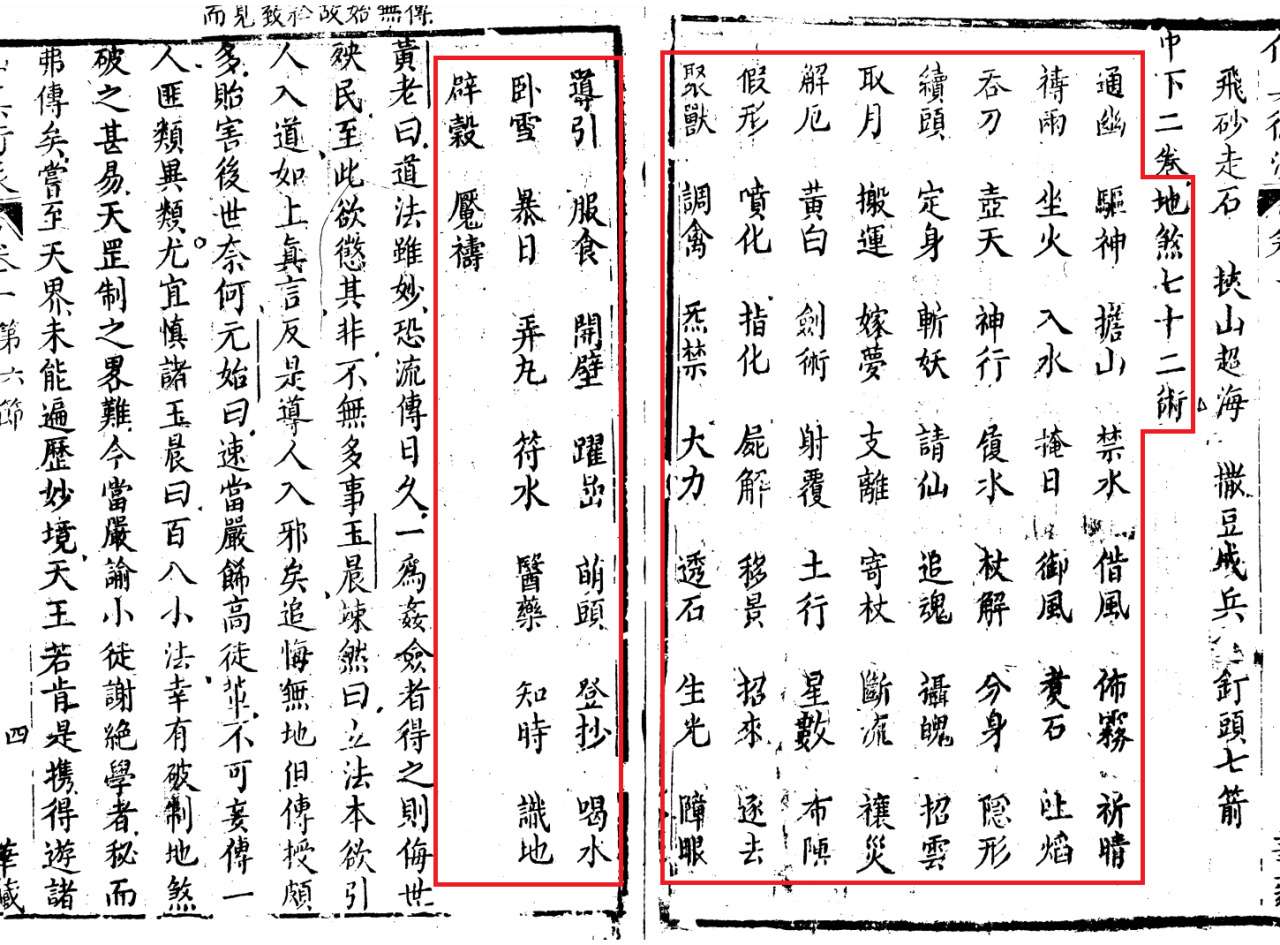
But I was recently contacted by a different reddit user who linked me to a dynastic source, The Comprehensive Mirror of Successive Divine Immortals (Lidai shenxian tongjian, 歷代神仙通鑑, c. 1700; hereafter The Comprehensive Mirror), [2] which does include respective lists for the “Thirty-Six Methods of the Heavenly Rectifiers” (Tiangang sanshiliu fa, 天罡三十六法) and the “Seventy-Two Arts of the Terrestrial Killers” (Disha qishier shu, 地煞七十二術) (said redditor translates the list of 72 abilities in video game terms here). The skills range from creating earthquakes to resurrecting the dead.

However, there are three reasons why these lists should not be associated with Sun and Zhu: 1) They do not appear in JTTW; 2) They postdate the novel by nearly a century; and 3) The JTTW narrative firmly establishes that the numbers of the 72 Terrestrial Killers and 36 Heavenly rectifiers are symbolic of the many ways that Monkey and Pigsy can change their shape. I will discuss this in more detail in section I.

But for the sake of posterity, I would like to translate both lists so that anyone interested can see them for themselves. The info might serve as good fodder for fanfiction or D&D character development. Having said that, I don’t consider myself a translator or an expert on esoteric Taoist jargon. So, if you know of a better rendering for a given phrase, please let me know in the comments below or by email (see the “contact” button).

Also, I will be archiving the section of The Comprehensive Mirror containing the lists of the 72 and 36 skills. See section IV below for the PDF link. It was downloaded from Google Books.

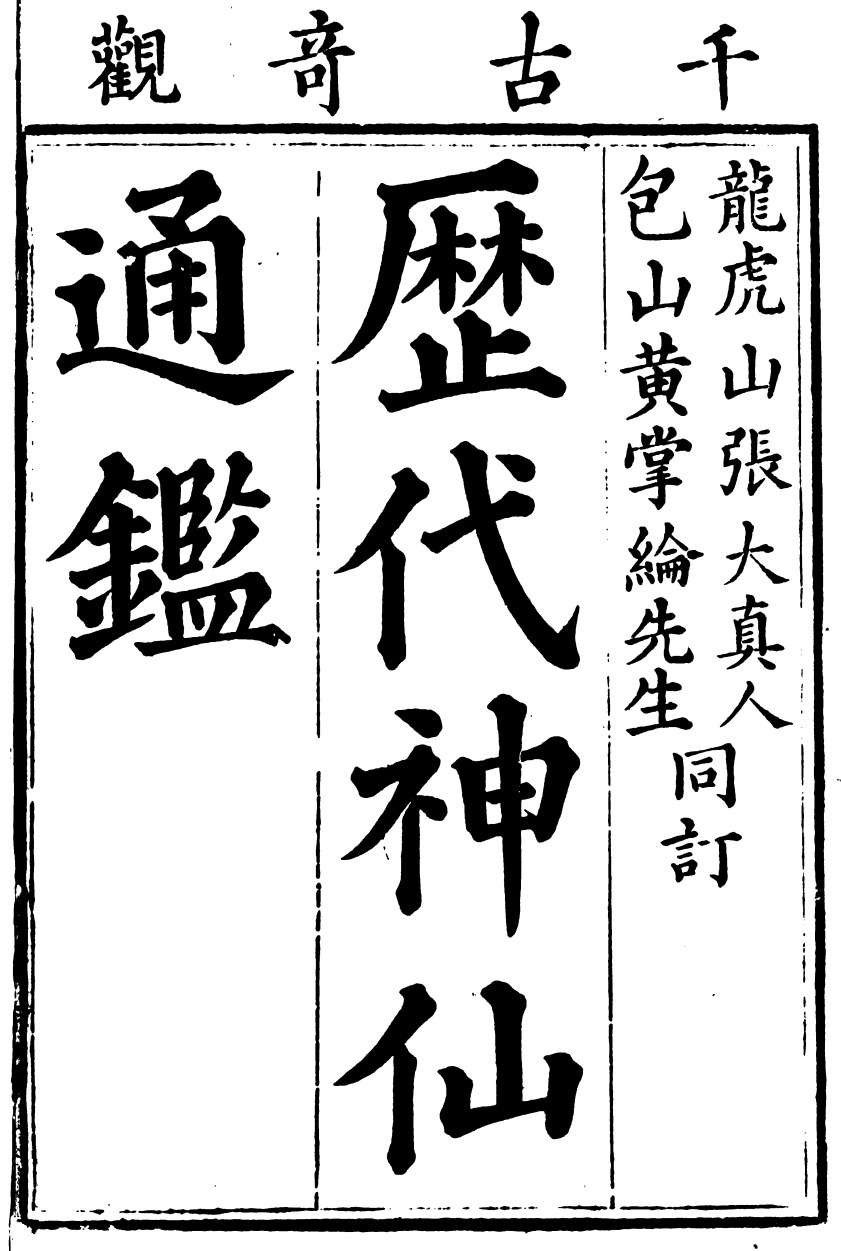
The title page of The Comprehensive Mirror (larger version) (PDF p. 6).

I. Arguments Against the Lists

First, they are not canonical as they don’t appear in JTTW. I’m sure someone could comb through the novel and find parallels, but this wouldn’t necessarily constitute proof of direct influence. This is because immortals have displayed similar powers in Taoist hagiography since at least Ge Hong‘s Book of the Master Who Embraces Simplicity (Baopuzi, 抱樸子, 4th-century CE). For example, just like Sun Wukong, the late-Han alchemist Zuo Ci (左慈) was known for enraging enemies, in this case the warlord Cao Cao (曹操), by using magic clones of himself in hilarious ways to escape trouble (see the 11-24-19 update here for a full translation of his shenanigans). Campany & Ge (2002), especially part II, is a treasure trove of such hagiographic tales.

Second, the lists postdate JTTW by almost a century. Whose to say that the popularity of the novel didn’t influence the creation of said lists? Even The Comprehensive Mirror refers at one point to the skills as the “thirty-six changes and seventy-two transformations” (sanshiliu bian, qishier hua, 三十六變,七十二化) (PDF p. 295). This mimics the metamorphic abilities of Monkey and Zhu discussed below. All one would need to do to create the lists is gather skills from Taoist hagiography and then assign them a place and number among the 72 Terrestrial Killers (Disha, 地煞) or 36 Heavenly Rectifiers (Tiangang, 天罡).

(I should note that the names of these numbered groups are based on malevolent and benevolent stellar deities that appear throughout Chinese culture and literature. See, for instance, the 108 stars of the Water Margin (Shuihu zhuan, 水滸傳, c. 14th-century CE) (Meulenbeld, 2019).) [4]

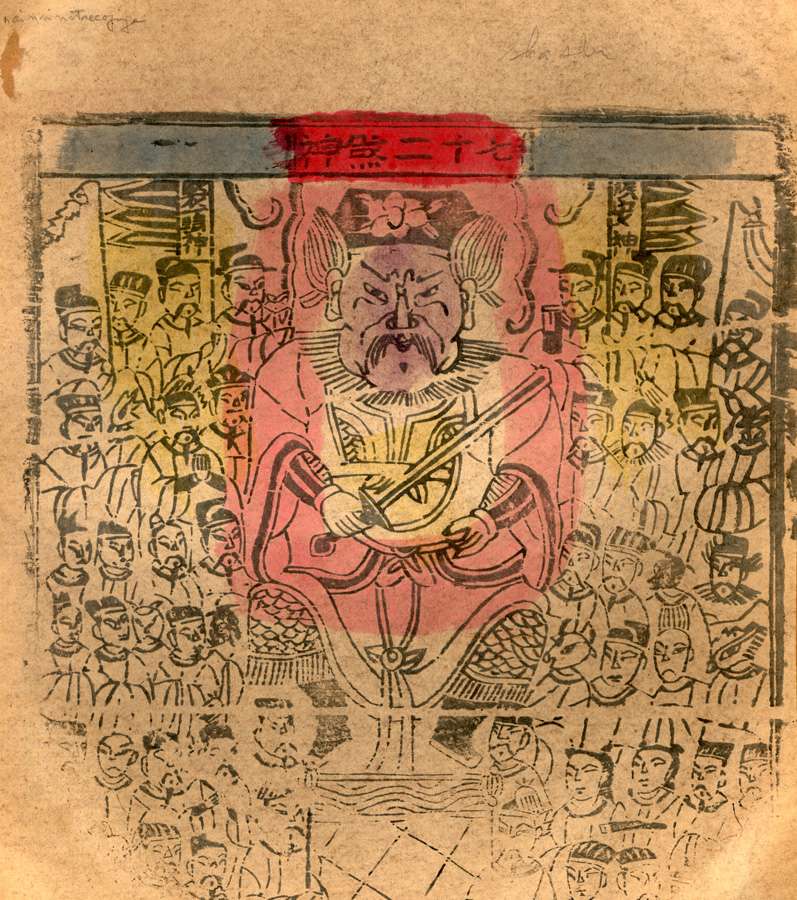
A folk print of the “72 Killer Gods” (Qishier Shashen, 七十二煞神) from the Anne S. Goodrich Collection (larger version). Image found here.

And third, most importantly, JTTW specifically states that Monkey has “seventy-two kinds of transformations” (qishier ban bianhua, 七十二般變化) and Zhu “thirty-six kinds of transformations” (sanshiliu ban bianhua, 三十六般變化). Therefore, the numbers of the 72 Terrestrial Killers and 36 Heavenly rectifiers are symbolic of the many ways that our heroes can change their shape. This is made clear in several places throughout the novel. Here, I will list a few examples.

In chapter 2, the Patriarch Subodhi teaches the 72 changes to Sun Wukong with the expressed purpose of helping him “hide” (duobi, 躲避) from the Three Calamities (sanzai lihai, 三災利害) of cosmic lightning, fire, and wind sent by heaven every 500 respective years to destroy immortals for defying fate and achieving eternal life:

“Very well, then,” said the Patriarch, “what method of hiding would you like to learn? There is the “Multitude of the Heavenly Rectifiers,” which numbers thirty-six transformations, and there is the “Multitude of Terrestrial Killers,” which numbers seventy-two transformations.” Wukong said, “Your pupil is always eager to catch more fishes, so I’ll learn the “Multitude of Terrestrial Killers.” “In that case,” said the Patriarch, “come up here, and I’ll pass on the oral formulas to you.” He then whispered something into his ear, though we do not know what sort of wondrous secrets he spoke of. But this Monkey King was someone who, knowing one thing, could understand a hundred! He immediately learned the oral formulas and, after working at them and practicing them himself, he mastered all seventy-two transformations (based on Wu & Yu, 2012, vol. 1, 122).

祖師說:「也罷,你要學那一般?有一般天罡數,該三十六般變化;有一般地煞數,該七十二般變化。」悟空道:「弟子願多裡撈摸,學一個地煞變化罷。」祖師道:「既如此,上前來,傳與你口訣。」遂附耳低言,不知說了些甚麼妙法。這猴王也是他一竅通時百竅通,當時習了口訣,自修自煉,將七十二般變化都學成了。

In chapter 18, Zhu states, “I have the transformations of the Heavenly Rectifiers” (我有天罡數的變化). [3] And later in chapter 67, he reveals that the 36 changes have their shortcomings:

I, old Hog, after all, am capable of thirty-six kinds of transformation. If you want me to change into something delicate, elegant, and agile, I simply can’t do it. But if it’s a mountain, a tree, a boulder, an earth mound, a scabby elephant, a graded hog, a water buffalo, or a camel, I can change into all these things (Wu & Yu, 2012, vol. 3, p. 253).

我老豬本來有三十六般變化,若說變輕巧華麗飛騰之物,委實不能;若說變山,變樹,變石塊,變土墩,變賴象、科豬、水牛、駱駝,真個全會。

II. The 36 Methods of the Heavenly Rectifiers

I have included reference numbers when certain skills are similar or related.

Take note that several of these skills appear in Investiture of the Gods (Fengshen yanyi封神演義, c. 1620), a famous vernacular novel containing the mythos of many gods still worshiped today in Chinese folk religion.

  1. Woxuan zaohua (斡旋造化, lit: “mediate good luck”) – Creating good fortune.
  2. Diandao yinyang (顛倒陰陽, lit: “reverse yin and yang”) – Disturbing the natural flow of the cosmos (switching the sun and moon, reversing right and wrong, confusing black and white, etc.).
  3. Yixing huandou (移星換斗, lit: “shift the stars and switch the Big Dipper) – Altering the position of the stars. Perhaps this is a metaphor for changing someone’s fate.
  4. Huitian fanri (迴天返日, lit: “turn around heaven to bring back the sun) – Rewinding the day to raise the setting sun into the sky.
  5. Huanyu hufeng (喚雨呼風, Lit: “call the rain and summon the wind) – Summoning storms (see sec. II, nos. 5-8 & 28).
  6. Zhenshan handi (振山撼地, lit: “shake mountains and earth”) – Making earthquakes.
  7. Jiawu tengyun (駕霧騰雲) – Flying on the mist and clouds (see sec. II, no. 12).
  8. Huajiang chenglu (劃江成陸) – Parting water to make new land.
  9. Zongde jinguang (縱地金光, lit: “releasing golden light”) – Transforming into light, thus allowing one to travel thousands of Chinese miles in a single day (see sec. II, no. 55).
  10. Fanjiang jiaohai (翻江攪海, lit: “overturn rivers and disturb oceans) – Creating turbulent rapids and violent tsunamis.
  11. Zhidi chenggang (指地成鋼) – Transforming earth into steel with just a point of the finger (see no. 23).
  12. Wuxing dadun (五行大遁, lit: “five elements great escape”) – Escaping a place or situation through any of the five Chinese elements (wood, fire, earth, metal, and water) (see no. 32 and sec. II, nos. 40, 54, & 59).
  13. Liujia jimen (六甲奇門, lit: “Strang Door of the Six Jia Spirits) – A computational divination system used to foretell fate.
  14. Nizhi weilai (逆知未來) – Foreknowledge of the future.
  15. Bianshan yishi (鞭山移石, lit: “whipping mountains and shifting stones”) – A kind of earth bending where one can change the landscape at will (see sec. II, no. 47).
  16. Qisi huisheng (起死回生) – Bringing the dead back to life.
  17. Feishen tuoji (飛身托跡, lit: “flying body trace”) – Traveling heaven and earth without leaving a trace.
  18. Jiuqi fuqi (九息服炁, lit: “nine breaths air swallowing) – A kind of Taoist “embryonic breathing” thought to bring about immortality.
  19. Daochu yuanyang (導出元陽) – Extracting someone’s primal yang energy (see no. 36).
  20. Xianglong fuhu (降龍伏虎) – Subduing dragons and tigers. Apart from the literal reading, this could also be a metaphor for mastery of yin and yang energy.
  21. Butian yuri (補天浴日) – Mending the heavens and bathing in the sun. Is this perhaps some kind of power of purification?
  22. Tuishan tianhai (推山填海) – Pushing mountains and filling oceans.
  23. Zhishi chengjin (指石成金) – Turning stone into gold with just a point of the finger (see no. 11).
  24. Zhengli wuying (正立無影) – Standing in broad daylight without casting a shadow.
  25. Taihua yixing (胎化易形, lit: “changing form into a fetus”) – Regressing one’s form to a youthful appearance (see sec. II, no. 43). Could this be a reference to the “spirit embryo” from Taoist internal alchemy?
  26. Daxiao ruyi (大小如意) – Enlarging or shrinking things to meet one’s desires (see sec. II, no. 16).
  27. Huakai qingke (花開頃刻) – Making flowers bloom and plants grow instantly.
  28. Youshen yuqi (遊神御氣) – Traveling in spirit and riding the wind (see sec. 1, no. 17).
  29. Geyuan dongjian (隔垣洞見) – Seeing through walls and partitions.
  30. Huifeng fanhuo (迴風返火) – Repelling wind and fire (see sec. II, no. 4).
  31. Zhangwo wulei (掌握五雷, lit: “controlling the five thunders”) – Controlling divine, often wrathful beings to expel evil.
  32. Qianyuan suodi (潛淵縮地, lit: “diving into the abyss and contracting earth”) – Traveling deep within the water and earth unimpeded (see no. 12 and sec. II, nos. 40, 54, & 59). This likely also refers to immortals contracting the landscape in order to travel quickly or stay out of reach of those pursuing them.
  33. Feisha zoushi (飛砂走石, lit: “flying sand and moving rocks”) – Calling forth a mighty wind (see no. 5 and sec. II, nos. 5 & 12).
  34. Jiashan chaohai (挾山超海) – Carrying mountains under arm while crossing oceans (see sec. II, no. 3). This could also just mean the ability to do impossible things.
  35. Sadou chengbing (撒豆成兵) – Transforming scattered beans into an army of soldiers.
  36. Ding touqi jian (釘頭七箭, lit: “fixing the seventh posthumous day arrow”) – An arcane ritual involving killing someone from afar by stealing their spirit, attaching it to a straw effigy, and shooting it with an arrow (see no. 19).

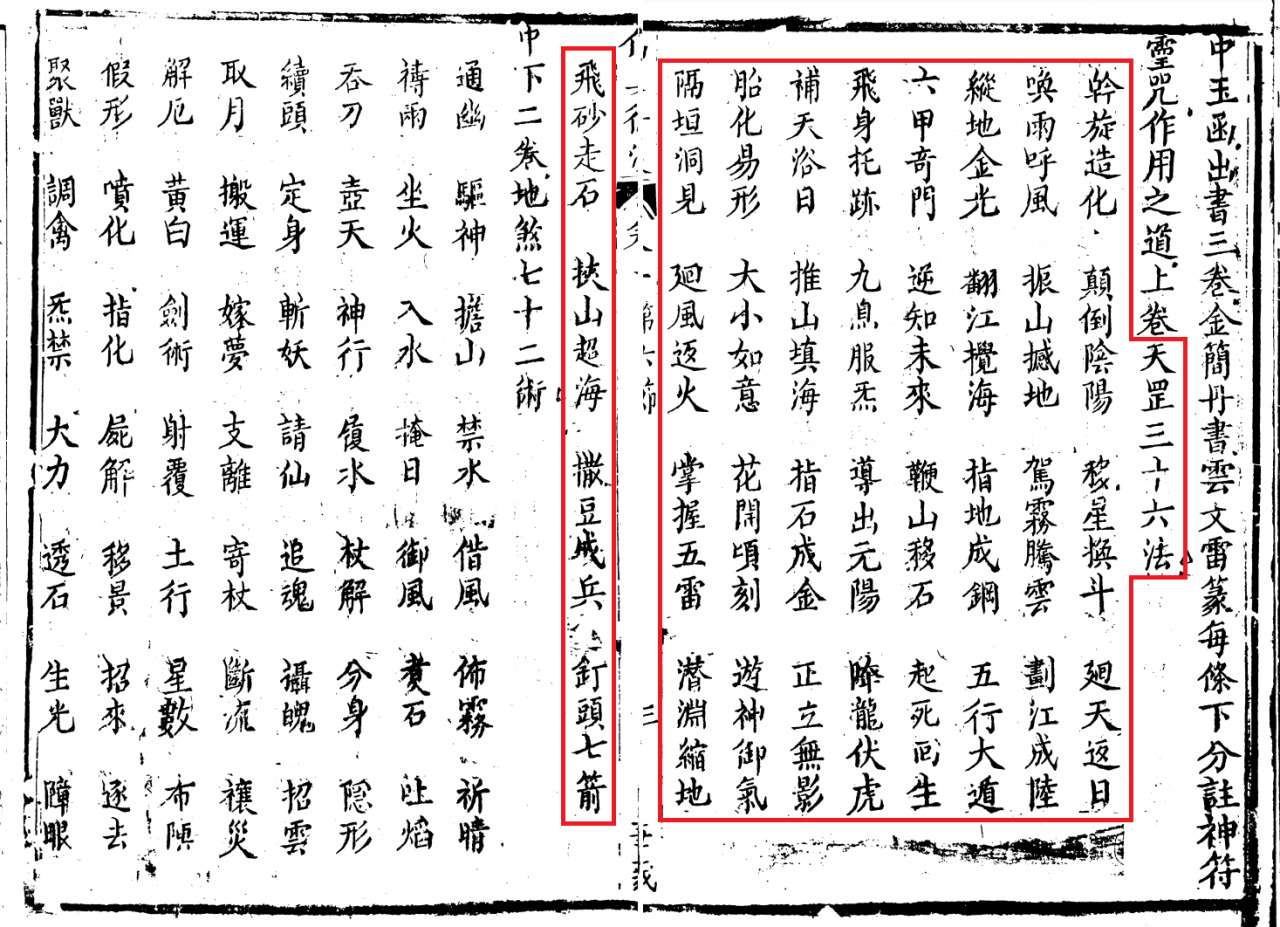
The 36 Methods of the Heavenly Rectifiers (larger version) (PDF pp. 297-298).

III. The 72 Arts of the Terrestrial Killers

I have again included reference numbers.

  1. Tongyou (通幽) – Traveling through the underworld.
  2. Qushen (驅神) – Expelling spirits.
  3. Danshan (擔山) – Carrying mountains (see sec. I, no. 34).
  4. Jinshui (禁水) – Repelling water (see sec. II, no. 30).
  5. Jiefeng (借風) – Controlling wind (see sec. 1, no. 5)
  6. Buwu (佈霧) – Spreading fog (see sec. 1, no. 5).
  7. Qiqing (祈晴) – Summoning good weather (see sec. 1, no. 5).
  8. Daoyu (禱雨) – Summoning rain (see sec. 1, no. 5).
  9. Zuohuo (坐火, lit: “sit in fire”) – Resisting flame.
  10. Rushui (入水, lit: “entering water”) – Parting water.
  11. Yanri (掩日) – Eclipsing the sun (see no. 65).
  12. Yufeng (御風) – Riding the wind (see sec. I, no. 7).
  13. Zhushi (煮石, Lit: “cooking stones”) – Cooking immortality elixir (see no. 37).
  14. Tuyan (吐焰) – Breathing fire.
  15. Tundao (吞刀) – Swallowing swords.
  16. Hutian (壺天, lit: “pot heaven”) – Creating one’s own immortal land (pocket universe) within a pot or gourd (see sec. 1, no. 26).
  17. Shenxing (神行) – Traveling in spirit (see sec. I, no. 28).
  18. Lushui (履水) – Treading on water.
  19. Zhangjie (杖解, lit: “staff liberation”)Magically turning an object into a fake corpse in order to escape and take on a new identity (see no. 46).
  20. Fenshen (分身) – Dividing the body into clones.
  21. Yinxing (隱形) – Invisibility (see no. 56).
  22. Xutou (續頭, lit: “continue head”) – Living without a head after decapitation (see no. 61).
  23. Dingshen (定身) – Fixing someone or something in place.
  24. Zhanyao (斬妖) – Beheading (or slaying) monsters.
  25. Qingxian (請仙) – Summoning divine beings.
  26. Zhuihun (追魂, lit: “chase a soul”) – Reaping a soul.
  27. Shehun (攝魂, lit: “take in a soul”) – Summoning or resurrecting a soul.
  28. Zhaoyun (招雲) – Summoning clouds (see nos. 5-8 and sec. 1, no. 5).
  29. Quyue (取月) – Fetching the moon.
  30. Banyun (搬運) – Transporting people or things to or away from you.
  31. Jiameng (嫁夢) – Manipulating dreams (see no. 72).
  32. Zhili (支離) – Fragmenting or destroying objects.
  33. Jizhang (寄杖, lit: “transmit the rod”) – Sending the pain of a beating to another person or thing.
  34. Duanliu (斷流) – Halting the flow of water.
  35. Rangzai (禳災) – Averting calamity.
  36. Jie’e (解厄) – Liberating someone from calamity.
  37. Huangbai (黃白, lit: “The (Art of) Yellow and White”) – Producing immortal elixirs via external alchemy (see no. 13).
  38. Jianshu (劍術, lit: “sword art”) – Mastery of swordplay and possibly the ability to direct the weapon like a drone.
  39. Shefu (射覆) – Divining hidden objects.
  40. Tuxing (土行) – Traveling through earth (see no. 54 & 59 and sec. I, nos. 12 & 32).
  41. Xingshu (星數, “star enumeration”) – Divining fate.
  42. Buzhen (布陣, lit: “spread troops”) – Knowledge of military battle arrays.
  43. Jiaxing (假形, lit: “artificial shape”) – Changing shape (see sec. I, no. 25).
  44. Penhua (噴化, “spray transformation”) – Changing the shape of a person or thing by spitting magic water or blood on them.
  45. Zhihua (指化, lit: “finger transformation”) – Changing something’s shape by pointing at it.
  46. Shijie (屍解) – Corpse liberation (see no. 19).
  47. Yijing (移景) –  Magically shifting the landscape (see sec. I, no. 15).
  48. Zhaolai (招來) – Beckoning a person or thing to you.
  49. Zhuqu (逐去) – Sending said person or thing back.
  50. Jushou (聚獸, lit: “assemble beasts”) – Controlling animals.
  51. Diaoqin (調禽, lit:  “move birds”) – Controlling birds.
  52. Qijin (炁禁, lit: “qi restraint”) – A method to affect reality with one’s internal energy (e.g. heal disease, restrain ghosts or animals, reverse the flow of rivers, etc.).
  53. Dali (大力) – Increasing strength.
  54. Toushi (透石) – Passing through solid rock (see no. 40 & 59 and sec. I, nos. 12 & 32).
  55. Shengguang (生光) – Producing a splendid light (see sec. 1, no. 9).
  56. Zhangyan (障眼, lit: “Obstruct vision”) –  Creating a blind spot in someone or something’s eyesight (see no. 21).
  57. Daoyin (導引) – Taoist breathing and stretching exercises.
  58. Fushi (服食) – Consuming alchemical medicine (see no. 68).
  59. Kaibi (開壁, lit: “open ramparts”) – Walking through walls (see nos. 40 & 54 and sec. I, nos. 12 & 32).
  60. Yueyan (躍岩, lit: “jump cliffs”) – Supernatural jumping?
  61. Mengtou (萌頭) – Sprouting a new head after decapitation (see no. 22).
  62. Dengchao (登抄) – I’m not sure what this is. A few online sources point to this skill increasing the course of something, such as making a fire burn faster and hotter. But someone  has also suggested to me that it involves theft. I’m open to other suggestions
  63. Heshui (喝水) – Imbibing supernatural amounts of water.
  64. Woxue (臥雪, lit: “lie in snow”) – Warding off the cold of snow and ice.
  65. Baori (暴日) – Exposing the sun (see no. 11).
  66. Nongwan (弄丸, lit: “manage pellets”) – Skill with projectiles, like pellets and rocks.
  67. Fushui (符水, lit: “talisman water”) – Creating disease-curing talismans meant to be burnt and swallowed with water.
  68. Yiyao (醫藥) – Making medicinal remedies.
  69. Zhishi (知時) – Knowledge of time and the seasons.
  70. Shidi (識地) – Knowledge of the earth and all places.
  71. Pigu (辟穀, lit: “grain law”) – Abstaining from the five grains in order to attain immortality. This may also refer to the common trope of immortals subsisting on wind and dew. [5]
  72. Yandao (魘禱, lit: “nightmare prayer”) – Assuaging nightmares (see no. 32).

The 72 Arts of the Terrestrial Killers (larger version) (PDF pp. 298-299).

IV. Lidai Shenxian Tongjiang PDF File

Lidai Shenxian Tongjian – 歷代神仙通鑑 – 1


Update: 08-18-23

The Saṃyutta Nikāya (Sk: संयुक्त निकाया; Ch: Xiang ying bu相應部, c. 250 BCE) notes that Buddhist cultivators develop a host of supernatural powers once they master the four mental qualities (Pali: Iddhipāda). Notice how similar they are to those discussed above:

  1. Multiplying the body
  2. Vanishing and reappearing
  3. Passing through solid objects (walls, ramparts, mountains, etc.)
  4. Diving into the earth like water
  5. Walking on water like earth
  6. Traveling through space
  7. Touching the sun and moon
  8. Hearing all sounds, both human and divine
  9. Knowing the minds of others
  10. Having memories of all of one’s past lives
  11. Knowing the future rebirths (and their causes) of all beings
  12. Liberation from the filth of the world through supreme wisdom (Bodhi, 2000, pp. 1727-1728)

Notes:

1) Anthony C. Yu (Wu & Yu, 2012) translates these as the “Art of the Heavenly Ladle” and the “Art of the Earthly Multitude” (vol. 1, p. 122). I instead follow the translation used by Meulenbeld (2019). In regards to Tiangang (天罡), he explains: “In its exorcist manifestation, the Northern Dipper is known as gang 罡, which I translate here as ‘rectifier’ due to the ritual function it has in righting wrong” (Meulenbeld, p. 7). “Terrestrial Killers” is a direct translation of Disha (地煞).

2) This work is a collection of Taoist hagiographic material from ancient times to the Ming.

3) Yu (Wu & Yu, 2012) translates this sentence as, “I know as many transformations as the number of stars in the Heavenly Ladle” (vol. 1, p. 376).

4) For religious views on the 72 Terrestrial Killers (Disha, 地煞), see the cited quotes here.

5) This is funny considering that Monkey is punished to eat hot iron pellets and drink molten copper during his time under Five Elements Mountain.

Sources:

Bodhi, B. (2000). The Connected Discourses of the Buddha: A Translation of the Saṃyutta Nikāya; Translated from the Pāli by Bhikkhu Bodhi (Vols. 1-2). Boston: Wisdom Publications.

Campany, R. F., & Ge, H. (2002). To Live as Long as Heaven and Earth: A Translation and Study of Ge Hong’s Traditions of Divine Transcendents. Berkeley: University of California Press.

Meulenbeld, M. (2019). Vernacular “Fiction” and Celestial Script: A Daoist Manual for the Use of Water Margin. Religions10(9), 518. MDPI AG. Retrieved from http://dx.doi.org/10.3390/rel10090518.

Wu, C., & Yu, A. C. (2012). The Journey to the West (Vols. 1-4) (Rev. ed.). Chicago, Illinois: University of Chicago Press.