The Great Sage Detecting “Ping-Pong” Bottle

Last updated: 06-26-2021

Elliott (1955/1990) describes a curious glass bottle used in the worship of Sun Wukong in Singapore. Filled with “twelve o’clock water” and topped with a consecrated bulbous glass stem, it is said to make a pinging noise to signal the arrival of the monkey god in a home or temple.

Table of Contents

1. Description

Elliott (1955/1990) explains:

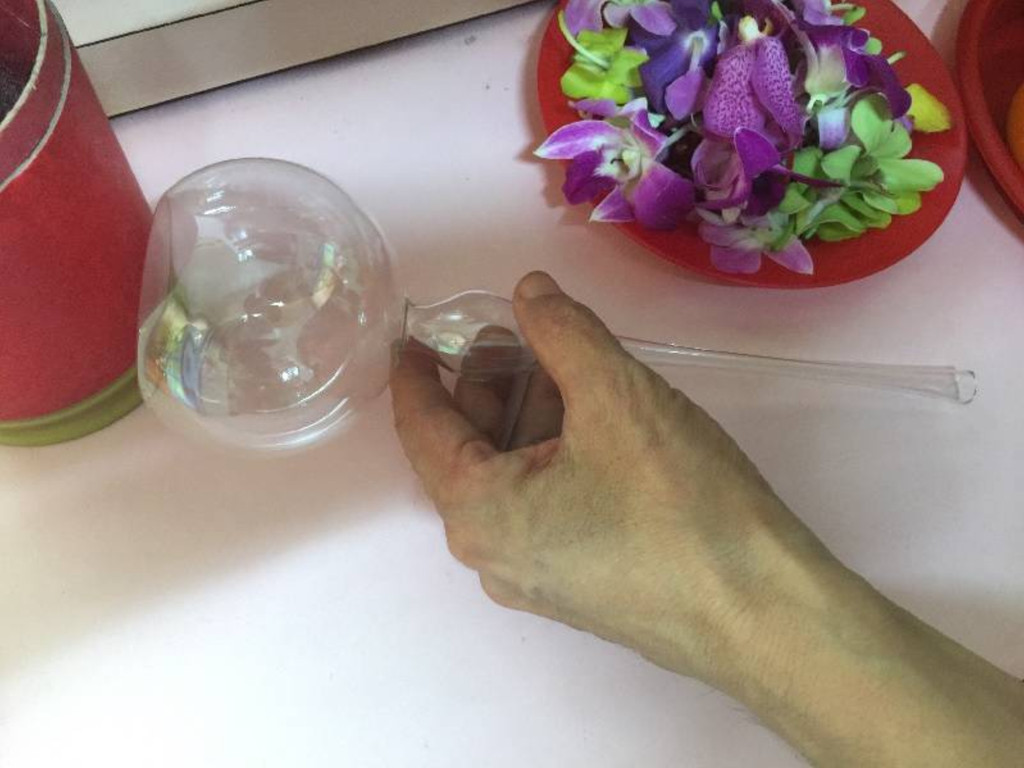
There are, also, sometimes other pieces of apparatus, apart from images, which devotees like to keep in their own homes. An outstanding example is an article of equipment almost exclusively associated with the ‘Great Saint’ [大聖] which goes by the onomatopoeic name of ‘ping-pong’ [乒乓]. It consists of an ordinary bottle filled with ‘twelve o’clock water’, water drawn from a tap or well at midday. Into the neck is fitted a funnel-like piece of glass-ware open at the lower end of the funnel, which dips into the water but completely closes the top [fig. 1 & 2]. Everyday at noon, and sometimes at other hours as well, this apparatus gives off a sudden ‘pinging’ sound, as if bubbles were rising and forcing up the funnel in the bottle’s neck. When this occurs, the shen [神, god] is supposed to be revealing his presence in the temple or the home, and an immediate act of worship must be carried out by the persons there. These ‘ping-pong’ are invariably found in temples associated with the ‘Great Saint’. Devotees will purchase their own funnels and bring them to the temple for the dang-ki [童乩, spirit-medium] to consecrate them with a lick of his blood (p. 58).

Fig. 1 – The ping-pong bottle, a.k.a. “Great Sage bottle” (Dasheng ping, 大聖瓶), fitted with the bulbous stem, which is closed at the top and open at the bottom (larger version). Fig. 2 – A detail of the stem (larger version). Images found on google.

2. Use Outside of Singapore

The device was also used in Hong Kong according to one personal account shared with me:

I believe the apparatus was used not just in Singapore. My mom told me that as a kid in HK in the 1940s/50s, her aunt also had something similar on the altar where she worshipped the [Great] Saint. And when the apparatus made a noise which signified his arrival, they would light up a joss stick.

I don’t know when the bottle was first associated with Sun Wukong, but the above information points to its active use in Asia as far back as the 1950s. It’s my understanding that the bottle is a rarity in modern practice, suggesting that it flourished prior to mid-century.

3. Speculation

Why the bottle was associated with the Great Sage is also a mystery to me, but the significance of twelve o’clock water may provide some clues. Astrological theory associates noon with wu (午), the seventh of twelve earthly branches, which is in turn identified with horses, the heart, fire yang, the summer solstice, and the direction south (Wu & Taylor, 2014, pp. 133-134). Readers may remember that Sun Wukong is appointed the keeper of the heavenly horses (bimawen, 弼馬溫) in chapter four of Journey to the West (Wu & Yu, 2012, pp. 148-149). Additionally, Chinese philosophy considers the heart to be the seat of the mind (xin, 心; a.k.a. “heart-mind”). This is important as Sun is called the “Mind Monkey” (xinyuan, 心猿; a.k.a. “Mind Ape”), which is a Buddho-Daoist concept denoting the disquieted, transient thoughts that keep man trapped in Samsara. Examples include the titles for chapters seven (“From the Eight Trigrams Brazier the Great Sage escapes; Beneath the Five Phases Mountain, Mind Monkey is still”) and fourteen (“Mind Monkey returns to the Right; The Six Robbers vanish from sight”). 

(Before I continue, I must warn that using the 16th-century novel as a source for modern folk religion surely overlooks beliefs that I am not aware of. The above info should, therefore, be considered purely speculative.)

A naturalistic explanation for the pinging noise is air escaping from the bottle due to changes in atmospheric pressure. However, I’d like to speculate on a possible esoteric reason. As mentioned above, noon is identified with fire yang, which is considered the height of yang power. In fact, the hours before wu and after zi (子, midnight) are considered the best time to practice Daoist exlixir cultivation. [1] And since heaven is the embodiment of yang, [2] it’s possible worshipers believe that water collected at noon is infused with strong yang energy, thereby giving it the ability to detect the presence of celestial deities like the Great Sage.


4. Updates

4.1. Significance of the Twelve O’clock Water

Update: 08-11-20

J.D. Martinsen contacted me and noted that “drawing noon water” (da wushi shui, 打午時水) is a common practice in coastal China during the Dragon Boat Festival. The water is apparently known for its demonifugic and medicinal properties. In fact, this custom is even practiced in Taiwan where there is a common saying: “A sip of noon water is better than three years of herbal medicine” (wushi shui yin yi zui, jiao hao buyao chi san nian, 午時水飲一嘴,較好補藥吃三年) (Chen, 2011, p. 210). Therefore, this association with warding malevolent influences/sickness may explain why Sun Wukong is connected with noon water. He is after all the exorcist par excellence, as well as a healer.


4.2. How the Twelve O’clock Water is Captured and Used

Update: 06-23-21

An informant from Singapore, who is the head of a monkey god temple, shared with me some wonderful folk knowledge about the ping-pong bottle. The words below were edited for readability:

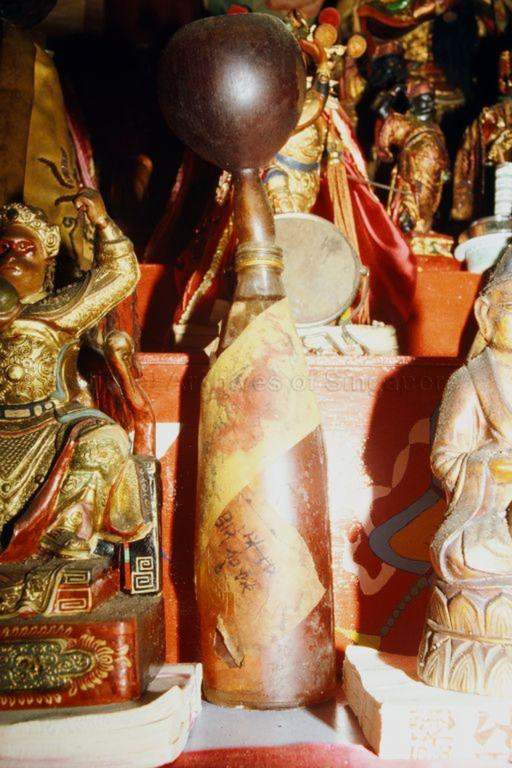
He flies at a high speed which generates high heat and causes the ping pong to sound. The water inside the bottle where you place the ping pong is changed on 五月初五 (端午節) [i.e. the Dragon Boat Festival]. Every year, the replacement water is collected from your rain water. The former water will be used to bathe to purify our well-being. I have poured it into a large pail. And bottle it and give it to devotees to bathe. Talismans are issued when we change the water at noon (fig. 3), we will paste them on the bottle on 端午節. When urgent or dangerous matters happen, we will use the ping pong holy water to ward off bad omens.

My informant told me that some of this knowledge was revealed to him by the monkey god.

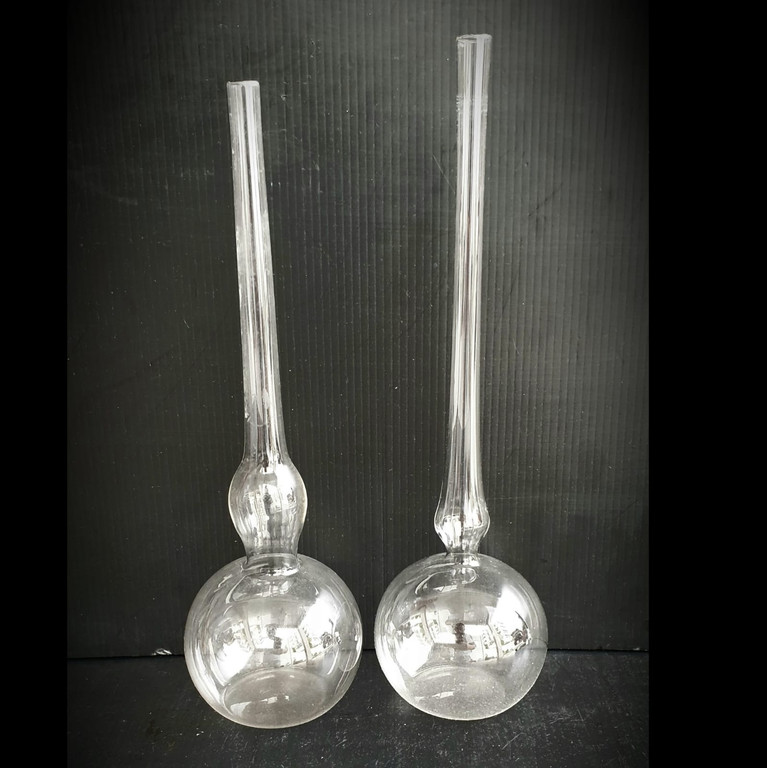
I was also told by a collector-seller that there are different-sized glass stems (fig. 4). Though, he believes that their hand-made nature means that no two are exactly the same. My informant also states that the stems with “larger diameters will sound louder” when the Great Sage arrives.

Fig. 3 – Talismans on a ping-pong bottle (larger version). Photo taken at the Wallich Street “Tai Seng Yah” (Dasheng ye) temple in Singapore during the 1970s. Courtesy of Ronni Pinsler of the BOXS project. Fig. 4 – The different sizes of ping-pong stems (larger version). Photo from a private collector.


4.3. How to Prepare the Ritual Bottle

Update: 06-26-21

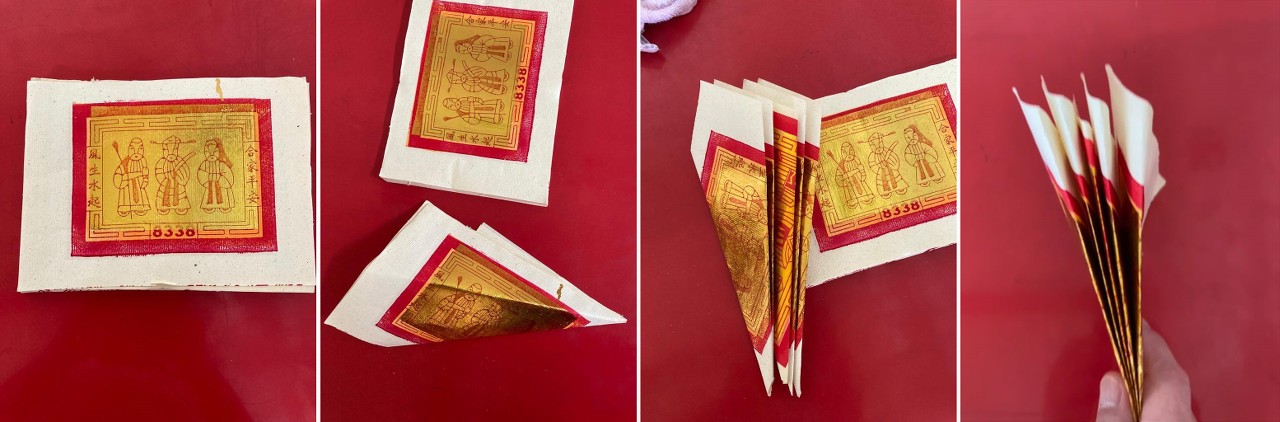
My informant tells me that a beer bottle can be used to hold the ping-pong stem. It must be washed and all labels removed. The preparation for the stem is a little more involved. The stem must be washed along with five kinds of flowers. The types of flowers do not matter, but no white flowers are permitted. Also, slices of green lemon can be included, but no yellow lemons are permitted. This washing must be done on the first or the 15th of the lunar month. The holy water is gathered in a pail between 11am and noon from rain the day before the Dragon Boat Festival, for it is believed that it always rains on this day. This water is poured one index finger length from the rim. This ensures that it will not overflow once the ping-pong stem is inserted. Then triangle-folded joss paper (jin zhi, 金紙) (fig. 5 to 8) is waved three times around the ping-pong (nuo pingpong, 挪乒乓) while prayers are said. Finally, the paper is left atop the ping-pong bulb for a given time. The ping-pong bottle must be placed next to a statue of the Great Sage.

Fig. 5 to 8 – The process of folding the joss paper into triangles (larger version). Photos by my informant.

Notes:

1) This is noted as early as the fourth century CE work Wondrous Record of the Golden Casket on the Spirit Immortals’ Practice of Eating Qi (Shenxian shiqi jin’gui miaolu, 神仙食氣金櫃妙錄) (Kohn, 2008, p. 84).

2) See, for example, Clearly (2003), p. 391.

Sources:

Chen, X. (2011). Taiwan li shi shang de yi min yu she hui yan jiu [The History of Taiwanese Immigration and Social Studies]. Beijing: Jiu zhou chu ban she.

Cleary, T. F. (2003). The Taoist Classics: The Collected Translations of Thomas Cleary, Volume Two. Boston, Mass: Shambhala.

Elliott, A. J. (1990). Chinese Spirit-Medium Cults in Singapore. London: The Athlone Press. (Original work published 1955)

Kohn, L. (2008). Chinese Healing Exercises: The Tradition of Daoyin. Honolulu: University of Hawaiʻi Press.

Wu, C., & Yu, A. C. (2012). The Journey to the West (Vol. 1) (Rev. ed.). Chicago, Illinois: University of Chicago Press.

Wu, Z., & Taylor, W. K. (2014). Heavenly Stems and Earthly Branches – TianGan DiZhi: The Heart of Chinese Wisdom Traditions. London: Jessica Kingsley Publishers.

Archive #17 – PDFs of Creation of the Gods Library of Chinese Classics Chinese-English Bilingual Edition (Vols. 1-4)

Note: My blog is not monetized, so I am not making any money from this post. My hope is that the PDF will make this legendary story more accessible to a wider audience. If you enjoyed the digital version, please, please, please support the official release.

Last updated: 04-06-2026 

Here I present a PDF of the Library of Chinese Classics bilingual edition of Creation of the Gods (Fengshen yanyi, 封神演義, c. 1620 CE), sometimes translated as Investiture of the Gods or Enfeoffment of the Gods.

Table of Contents

1. Novel Description

This 100 chapter shenmo novel tells of the great struggle between the declining Shang (c. 1600–1046 BCE) and ascending Zhou (c. 1046–256 BCE) dynasties. In the beginning, King Zhou of Shang offends the primordial goddess Nuwa by leaving a lewd poem in her temple, and in response, the devi summons a trio of spirits (a fox, a pheasant, and a lute) to bring about the dynasty’s downfall. The fox spirit takes the place of the king’s concubine Daji and, over the course of nearly 30 years, leads him down a path of imperial neglect, decadence, and sadism. This causes many of the kingdom’s dukes, marquis, and generals to later rebel in favor of King Wu of Zhou, the monarch destined by heaven to rule China.

The majority of the story follows the countless battles between the forces of Shang and Zhou. Along the way, the latter are aided by immortals of the Chan (闡) sect (an analogy for Quanzhen Daoism), which favors spiritual cultivation, while the former are aided by the Jie (截) sect (an analogy for Zhengyi), which favors charms and incantations. [1] Each transcendent wields any number of swords, fans, hooks, staves, axes, halberds, scissors, hammers, rings, sashes, nails, dippers, pennants, pearls, gourds (etc.), each with not only the power to take the lives of thousands of humans but also immobilize other immortals and even kill them. These celestial battles escalate to the point that Laozi and the Buddha must fight side-by-side to defeat a trap designed to kill 10,000 immortals.

A story line present throughout the novel is the fate of Jiang Ziya, a Daoist adept and the military strategist and stalwart commander of the Zhou army. He is destined to deify the souls of the humans and immortals who die in battle using the “List of Creation” (Fengshen bang, 封神榜), an index of preordained names agreed upon at the beginning of time by the heads of the three sects. This list is housed in the “Terrace of Creation” (Fengshen tai, 封神臺), a reed pavilion in which the souls of the dead are gathered to await their apotheosis. In the end, after defeating the Shang forces, Jiang deifies a total of 365 major gods, along with thousands of lesser gods, ranging from holy mountains, weather, and plagues to constellations, the time cycle, and the five elements.

Considering that the story takes place a millennia prior to the arrival of Buddhism in China, the novel portrays the religion having no presence in the east. There are several times in the narrative when a Buddhist deity travels from the western paradise to halt the execution of a powerful immortal or demon as they are fated to submit to Buddhism. Furthermore, when the Buddha intervenes in the great battle towards the end, he does so to find talented disciples who will help him spread the religion in the east. In fact, Bodhisattvas like Guanyin and Manjusri are depicted as former Chan sect immortals who later become disciples of Buddhism.

See also this chapter-by-chapter summary.

2. Relationship to JTTW

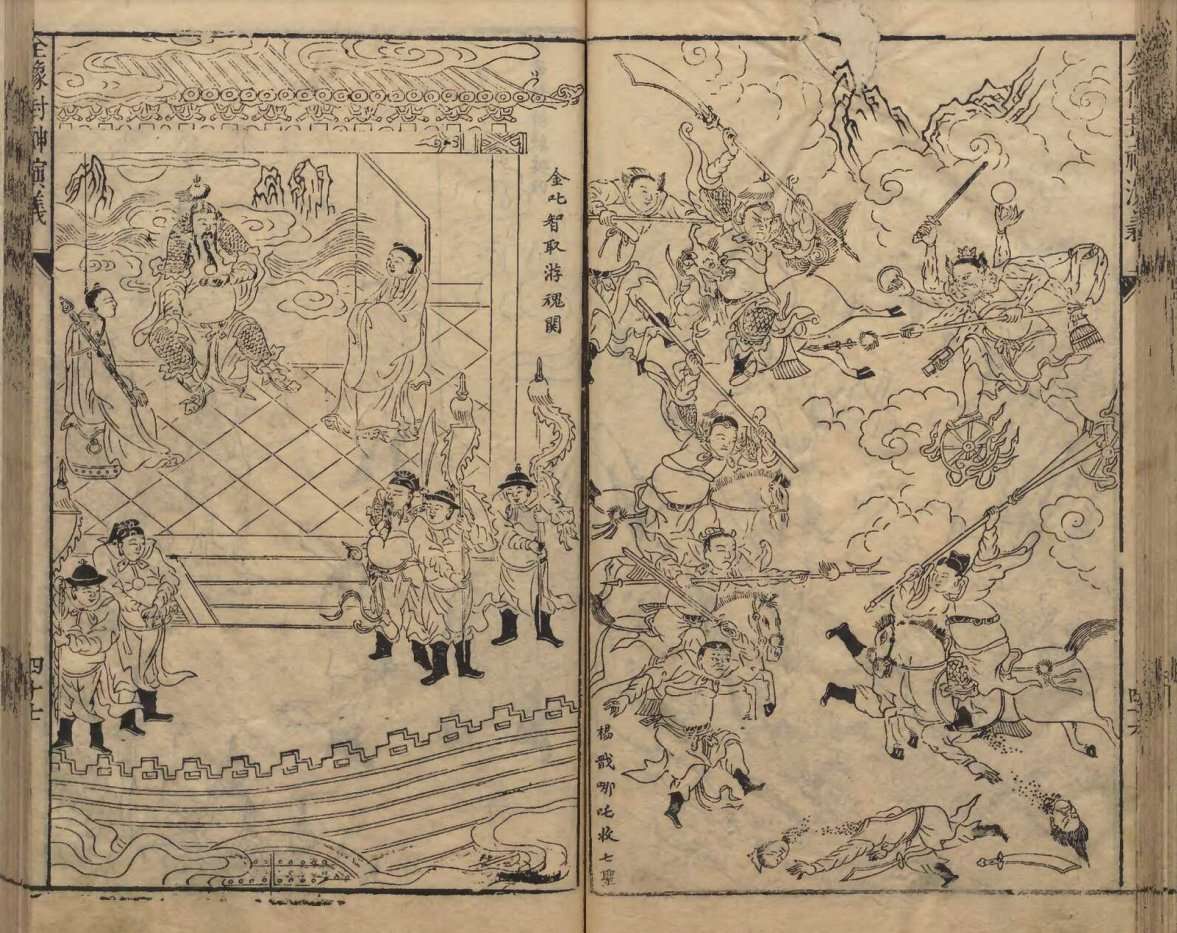
For the purposes of this blog, several characters from Journey to the West (Xiyouji, 西遊記, 1592) appear in the novel, including Laozi, the Buddha, Nezha (fig. 1), Muzha, and Li Jing, Ao Guang, Erlang (called Yang Jian, 楊戩) and his hound, etc. Journey to the West also had a number of clear influences on the book, one being the ape spirit Yuan Hong (袁洪) from later chapters who wields a staff and 72 transformations in a fight with Yang Jian. Sound familiar?

Fig. 1 – A detail of Nezha striking at an enemy during battle. Image from The Newly Printed, Zhong Bojing Annotated, Investiture of the Gods (Xinke Zhong Bojing xiansheng piping Fengshen yanyi, 新刻鍾伯敬先生批評封神演義, c. 1620) (larger version).

3. Translation: Pros and Cons

This edition of the novel was originally translated by Gu Zhizhong (顾执中, 1898–1995) in 1992. Dr. Barbara Witt notes that the translation has its pros and cons:

The positive: It is the only complete translation of Fengshen yanyi into a Western language that I am aware of. The edition I read (from 1992 I think), was also nicely done with interesting woodcut illustrations throughout the novel.

The negative: Firstly, it is not a very faithful translation. Poems are generally left untranslated and sentences often paraphrased. [2] I think, when ever the translator found something difficult, he just skipped it. Secondly, I think Gu Zhizhong was not an English native speaker and not very familiar with Western mythology and some of his translations are really off. For example Taiyi zhenren 太乙真人 (“True Man Primordial”), a powerful Daoist immortal, becomes “Fairy Primordial” in his translation, which conjures up a very different image.

3.1. Example

Chapter 12 describes how young Nezha inadvertently causes havoc in the aquatic realm when washing himself in a river with a powerful magic sash. This eventually leads to Li Gen (李艮), a yaksha water-spirit soldier, to attack him with an ax. Gu’s (2000) description of the fight reads:

Nezha, naked and empty-handed, dodged the vicious blow, raised his Universal Ring and struck Li Gen on the head. How could the Yaksha withstand the magic weapon from Fairy Primordial! His skull broke open and he fell dead on the river bank (vol. 1, p. 239).

However, the full encounter should read:

Standing there naked, Nezha dodged the advancing warrior’s attack and upraised the Universal Ring in his right hand. This treasure was originally bestowed by the Jade Emptiness Palace of Mt. Kunlun to the Perfected Man of the Grand Monad to secure the items of his Golden Light Cave. How could the yaksha withstand the magic weapon as it struck downward on his head? His brains exploded from the blow, and he fell dead on the shore.

哪吒正赤身站立,見夜叉來得勇猛,將身躲過,把右手套的乾坤圈望空中一舉。此寶原係崑崙山玉虛宮所賜太乙真人鎮金光洞之物,夜叉那裏經得起,那寶打將下來,正落在夜叉頭上,只打的腦漿迸流,即死於岸上。

You can see that quite a bit of information was left out. This happens throughout the entire novel. This makes me angrier the more that I think about. Why even bother to translate something if you are only going to paraphrase or even skip over passages? It seems like a pointless enterprise.

However, while imperfect, I think that the translation is a must read as many of the gods mentioned therein are worshiped in modern temples throughout China, Taiwan, Malaysia, and Singapore. It is a lens into modern folk religion.

4. PDF File

The following PDF is a combination of all four volumes making up Gu (2000):

Click to access fsyy-en-cn.pdf


5. Updates

Update: 11-28-21 

I’ve added Wan (1987), a doctoral thesis analyzing the historical sources and micro/macro structure of the story. It also provides a summary of the tale in the end.

PDF File

Click to access Investiture-of-the-gods-Fengshen-yanyi-Sources-narrative-structure-and-mythical-significance.pdf


Update: 03-14-23

Here is a PDF for volume one of The Newly Printed, Zhong Bojing Annotated, Investiture of the Gods (Xinke Zhong Bojing xiansheng piping Fengshen yanyi, 新刻鍾伯敬先生批評封神演義, c. 1620), the oldest known edition of the novel. It is full of lovely woodblock prints (fig. 2).

PDF File

Click to access Investiture-of-the-Gods-1620-prints.pdf

Fig. 2 – A random page from vol. 1 of The Newly Printed, Zhong Bojing Annotated, Investiture of the Gods (larger version).

Thank you to the National Archives of Japan for offering the complete 1620 edition of FSYY. It can be downloaded here.


Update: 09-13-23

Tumblr user digitalagepulao has drawn an amazing Nezha (fig. 3). The theme is based on the feud between the prince and his father, which leads to the former’s suicide and divine resurrection. The artist describe a tense scene from the novel:

Li Jing in a fury grabbed his halberd, leapt on his horse and galloped out of the headquarters. He was astonished to see Nezha with his Wind-Fire Wheels and Fire-Tipped Spear. He swore loudly, “You damned beast! You caused us endless suffering before your death, and now that you’ve been reborn, you’re troubling us again!”

“Li Jing! I’ve returned my flesh and bones to you [via suicide], and there’s no longer any relation between us. Why did you smash my golden idol with your whip and burn down my temple? Today I must take my revenge!

The drawing is part of digitalagepulao’s Expedition to the West au (JTTW alternate universe) storyline based on this article.

Fig. 3 – Digitalagepulao’s Nezha (larger version).


Update: 09-08-24

@ryin-silverfish of Tumblr (author of this guest post) has made a catalog of the fantastic pets from the novel.

https://docs.google.com/document/d/1NozJF8nbhy8t6Jta7AZ5WKbyCmEMYtgFM_akcSt9D-Y/edit?usp=drivesdk

They have also made a catalog of Nezha’s powers.

https://docs.google.com/document/d/1FjHQPXmEalChk7PNiw9ljAJ8Cq66-AjevgEfdEa6wgI/edit?usp=sharing

A very big thank you to them. I’ll add more later if or when new lists are available.


Update: 11-03-24

My friend Dario Virga (Onibotokemaru on Instagram) (fig. 4) has completed an Italian translation of the novel titled L’investitura degli Dei: Romanzo cinese di epoca Ming (2024). This 1,120 page, two-volume edition can be purchased here for € 50,00:

https://www.libraccio.it/libro/9788879847049/xu-zhonglin/investitura-degli-dei-romanzo-cinese-di-epoca-ming.html?tr=C3137

Fig. 4 – Dario and his translation (larger version). 


Update: 04-06-26

See my archives of other translations.

Notes:

1) Prof. Shi Changyu notes in his preface to this translation that the friction between the fictional Chan and Jie sects serves as an analogy for that of Quanzhen and Zhengyi during the Ming, for the former was marginalized, while the latter was held in high esteem and fell prey to decadence, naturally hindering its ability to contribute anything of value to the development of Daoism at this time (Gu, 2000, pp. 50-53).

2) Those interested in reading some of the poetry from the novel should consult Koss (1979), which compares them with those from Journey to the West.

Sources:

Gu, Z. (2000). Creation of the Gods (Vols. 1-4). Beijing: New World Press.

Koss, N. (1979). The Relationship of Hsi-yu chi and Feng-shen yen-i: An Analysis of Poems Found in Both Novels. T’oung Pao,65(4/5), second series, 143-165. Retrieved May 5, 2020, from http://www.jstor.org/stable/4528175

Wan, P. (1987). Investiture of the Gods (“Fengshen yanyi”): Sources, Narrative Structure, and Mythical Significance (UMI No. 8810607) [Doctoral dissertation, University of Washington]. Available from ProQuest Dissertations and Theses database.

Wu, C., & Yu, A. C. (2012). The Journey to the West (Vols. 1-4) (Rev. ed.). Chicago, Illinois: University of Chicago Press.

Taiwanese Religious Humor: The Epidemic Prevention Conference

From time to time I like to post a fun blog not directly related to (though sometimes informed by) my research. Past examples can be seen here, here, and here. Regular articles will resume after this entry.

“The Epidemic Prevention Conference” (Fangyi dahui, 防疫大會) is a humorous COVID-19-related short story that has been circulating in Taiwan. It gets longer and longer as people add new details. I wanted to share it because it mentions many figures from Journey to the West (Xiyouji, 西遊記, 1592), including Xuanzang and Sun Wukong. I’ve added notes at the bottom to explain the cultural context of particular statements.

I. English Translation

The Anti-Epidemic Conference was held in the celestial court. The Jade Emperor was worried when he discovered many seats were vacant, and so he asked the gods:

Jade Emperor: “Why don’t I see the ‘Thousand-Armed’ Guanyin Bodhisattva?”

The gods answered: “She is still washing her hands!”

thousand_armed_avalokitesvara_-_guanyin_nunnery_-_2

Jade Emperor asked again: “Why didn’t Brahma, the Four-Faced Buddha, come?”

The gods replied: The government only gave him three masks for the week, so he is short one and can’t come.” [1]

brahma_the_four-faced_buddha

Jade Emperor asked again: “Why didn’t Bhaisajyaguru, the Medicine Buddha, come?”

The gods answered: “The Medicine Buddha is selling masks.”

korea-gangneung-deungmyeongnakgasa-medicine_buddha-01

Jade Emperor asked again: “What about the Eight Immortals?”

The gods replied: “Because they returned from overseas and had to be quarantined at home.” [2]

eight_immortals_crossing_the_sea_-_project_gutenberg_etext_15250

Jade Emperor asked again: “What about Sage Emperor Guan?”

The gods replied: “His face was flush and he had a fever of more than 37.5 °C (99.5° F). [3] He is isolated at home.”

guan_yu_statue_2016_temple_of_guan_yu_28xuchang29_1

Jade Emperor asked again: “Why did Tang Sanzang not come?” [4]

The gods replied: “He has a history of travel and is quarantined at home, so he cannot come.”

xuanzang_w

Jade Emperor asked again: “What about King Yama?”

The gods answered: “Because too many people have died. He is still taking roll of their names.”

kagamibuta_netsuke_front

Then the Jade Emperor asked again: “Why did Mazu Lin Moniang not come?”

The gods replied: “The DPP government discovered that she is originally from Fujian and thus a foreign national. Now she cannot return, and her pilgrimage festival has been cancelled.”

e9a6ace7a596e58d97e7abbfe98489e5aabde7a596e5ae97e69599e59c92e58d80e4b98be5aabde7a596e5b7a8e7a59ee5838f

“The Plague God did not come because he is busy spreading the plague.

93323008_3172456276099464_9036148687230730240_n

The God of Wealth didn’t come because he is busy giving financial relief.”

93244583_880452579084105_6486426117711331328_n

“Why didn’t the Bodhisattva King Kṣitigarbha come?”

The gods answered: “The death toll is skyrocketing, so there’s no time to come!”

bodhisattva_ksitigarbha_2819531360529

“Why didn’t Sun Wukong come?”

“Because of contact with the pathogen bat demon. [5] He is in quarantine.”

Monkey King Kicking - small

“Why didn’t the Earth God come yet?”

The gods replied: “He and King Kṣitigarbha are looking for land with good fengshui, [6] so he has no time to come!

tudi_gong_28129

II. Chinese Original

天庭開防疫大會,玉皇大帝發現有許多空位,關心問眾神。

玉帝問:怎麼沒見到千手觀音?

眾神回答:還在洗手!

玉帝又問: 為何四面佛也沒來?

眾神回答:—周領3個口罩,所以少—個囗罩,不能來。

玉帝又問:為何藥師佛沒來?

眾神回答:藥師在賣口罩

玉帝又問:那八仙呢?

眾神回答:因為從海外回來,要居家隔離。

玉帝又問:那關聖帝君呢?

眾神回答:他臉紅發燒超過37.5度,在家裡自我隔離⋯

玉帝又問: 為何唐三藏也沒來

眾神回答: 他有旅遊史, 被居家檢疫,不能來…

玉帝又問: 閻羅王呢?

眾神回答: 因為死了太多人,他還在點名中…

然後玉帝又問: 為何媽祖林默娘也沒來?

眾神回答: 民進黨政府查出她是福建人,屬外籍人氏,現在不能入境,不能來了,遶境也取消了。

瘟神也沒來,因為忙著散播瘟疫。

財神也沒來,因為忙著紓困呀!

為何地藏王菩薩也沒來? 眾神回答 :死亡人數超飆 無暇前來!

孫悟空為何沒來?因為接觸過病原體蝙蝠妖所以被隔離。

為何土地公也沒來,眾神回答 :地藏王正在和他一起找風水寶地,無暇前來!

Notes:

1) At the time this story first started circulating, the Taiwanese government was providing each citizen with three masks a week. This number has since then increased to nine (at least the last time I picked up mine).

2) This references a famous story in which the Eight Immortals cross a sea using their own magic treasures.

3) Guan Yu is typically portrayed with a deep red face.

4) This obviously references Xuanzang’s quest to India.

5) Genomic sequences suggest COVID-19 originated in bats.

6) Edward White notes on Twitter that this “is a reference to seeking gravesites with good Fengshui.”

The Great Sage Purple Cloud Temple of Yilan, Taiwan: A Photo Essay

I recently visited another Great Sage temple, this time the Wujian Purple Cloud Temple (Wujian Ziyu si, 五間紫雲寺) of Yilan (宜蘭), Taiwan. The temple was bustling with people during the Chinese New Year celebrations, so I didn’t have time to ask many questions. This entry will serve more as a picture essay until I return to conduct proper research.

1. History

Legend has it that around 1899 a man found a monkey-shaped stone and enshrined it in a thatched shed. This was eventually converted to a temple a few years later. It was destroyed by a typhoon in 1960 but subsequently rebuilt. The temple appears to recognize a trinity, with countless monkey soldiers beneath them. The Great Sage has two aspects: the “Martial Great Sage” (Wu Dasheng, 武大聖) (standing statues), who exorcises evil, and the “Civil Great Sage” (Wen Dasheng, 文大聖) (seated statues), who insures the safety of people and animals.

2. How to get there

(Note: Always consult google if you are directionally challenged like myself)

Address: No. 449, Section 3, Dafu Road, Zhuangwei Township, Yilan County, Taiwan, 263

I took bus #1571 (google calls it #1571A) from gate 15 of the Taiwan City Hall Bus Station. This heads towards the Yilan Bus Station. (If you plan to take this route, please note that buses headed to different areas of Yilan will board from this gate. So pay very close attention to the calls of the bus station attendant. For example, they called “Jiaoxi” (礁溪) (bus #1572), a small township in Yilan, and those waiting for another destination had to stand off to the side while those from different sections of the line made their way to the front. If you aren’t careful, you might end up on the wrong bus.) My destination was the first stop, the Zhuangwei (壯圍) bus stop, a small shelter by an overpass. My short walk to the temple took me passed rows of flooded rice fields and small patches of buildings.

(Click images for larger versions)

1

Gate 15 at the Taiwan City Hall Bus Station.

2

The Zhuangwei bus stop shelter (as seen from the opposite outgoing bus stop).

1a - Map to Purple Cloud Temple

The route map from the Zhuangwei bus stop to the temple.

4
5

Random rice fields along Gonglao Road (see map).

6

A panorama of a rice field next to Lane 423, Sect. 3, Dafu Road (see map). 

3. The Outside

The temple is located on the side of a busy road. It appears almost out of nowhere since the face of the holy structure is in line with the buildings on either side. The first thing that caught my eye was the highly ornate roof of the furnace covered in mythical creatures, divine heroes, and gods, features typical of South Chinese and Taiwanese temple architecture. Each face of the hexagonal body was covered with beautiful carvings on black marble, two of which included the pilgrims from Journey to the West.

7

The furnace visible on the left side of the temple (as seen from the road).

8
9
10
11

A marble carving of Guanyin, the White Dragon Horse, Monkey, and Tripitaka.

12

A detail of Monkey.

13

Monkey, Sha Wujing, Tripitaka on the White Dragon Horse, and Zhu Bajie.

14

A detail of the group.

The front of the temple houses an ornate statue of three brightly colored dragons enclosed in a fence. Looking up, I noticed beautiful hand-painted dragons and Qilin on the ceiling, along with paintings of events from Chinese mythology and Journey to the West on the cross beams. Walking towards one of the five entrances, I noticed the facade was covered in highly detailed stone carvings, some depicting events from the novel.

15

The front of the Purple Cloud Temple.

17
18

The front of the temple. Three of the five entrances are visible behind the dragons.

19

A detail of the three dragon statues.

20

Five hand-painted dragons on the ceiling. The Eight Immortals grace the crossbeam below. 

21

A pair of Qilin on the ceiling. The cross beam below portrays an event from Prince Nezha‘s life.

22

Zhu Bajie protecting his master from the ogre that will become Sha Wujing.

23

Monkey escaping from Laozi’s furnace.

24 - BW

A stone carving on the facade showing Monkey (top right), Zhu bajie (top center right), and Sha Wujing (center left) battling a monster (top left). The image has been enhanced for clarity.

25 - BW

Monkey (center) battling the heavenly army. Enhanced for clarity. 

26 - BW

Monkey (center) leaping from Laozi’s furnace. Enhanced for clarity. Apologies for the blur. 

28 - BW

A detail of Monkey leaping.

29 - BW

The Great Sage (top center) and his monkey army battling heaven. Enhanced for clarity. These are just a few of the many carvings covering the temple facade. 

4. The Inside

The interior hall is wide yet shallow in depth and split between three altars, Folk religion to the right, the Great Sage in the Center, and Daoist to the left. I must admit in my zeal to photograph anything Monkey-related, I completely forgot to take pictures of the other two sections. This online image shows the folk section includes Mazu, Budai, and other deities. This image shows the Daoist section includes the Jade emperor, the Earth god, and others. Surprisingly, the incense burner in front of the main entrance was not marked with the name of the Great Sage (unlike what I’ve seen at other such temples) but that of the Jade Emperor, 玉皇上帝 (Yuhuang shangdi).

30

The main hall.

20190206_123034

The incense burner bearing the name of the Jade Emperor (visible from the hall looking out the main door).

Upon entering the right side of the main hall, the first thing that caught my eye was a large wooden sculpture of a tree-bound monkey holding onto a branch with one hand and a pair of peaches in the other. Immediately behind him was a stone carving of a vague monkey with two children. (I’m not sure of the ritual importance of either statue. I’ll report on this later. However, I will say the stone statue recalls Sun Wukong’s origins as a stone monkey.) Next to both statues is one of two cylindrical towers, one positioned on each end of the hall. Each is topped by a Great Sage statue and the towers themselves are comprised of hundreds of small compartments, each filled with a small Great Sage figure. These represent a donor who has given money to the temple.

31

The wooden monkey statue.

32

A detail of the monkey holding peaches.

33

The stone monkey with children.

34

The tower of donor Great Sages.

35

The Great Sage topping each tower. He holds a fly whisk in one hand and a peach of immortality in the other.

36

The many compartments.

37

A mini Great Sage donor figure. He sits on a throne with his staff held over head in one hand and a calabash gourd held to his front in the other. 

4.1. The Great Sage Altar

The central offering table to the Great Sage was covered in all sorts of fruits, candies, and flowers. Also included were an incense burner, offerings of wine, and a pair of crescent moon-shaped wooden blocks. These blocks are used in tandem with fortune sticks and oracles revealed on slips of paper, all of which are housed in a metal cylinder to the left of the table (see section three of this article on how these items are used).

39
38

The table laden with offerings. Take note of the young woman praying to the Great Sage. She told me that she was from Vietnam and that Monkey was not a common deity there.

40

The incense burner (back center), tea offerings (three cups visible in the center) and wooden blocks (front right).

41

The metal cylinder housing the fortune sticks (top), with the corresponding oracles located in each of the surrounding drawers.

Like in other parts of Taiwan and Singapore, this temple appears to recognize a plethora of Great Sages, from a holy trinity to an army of soldier monkeys. (I don’t yet know their individual names. I will report on this later.) All of the Great Sage figures are portrayed with golden armor, red-painted humanoid faces, golden fillets, and long, dark hair. The headband and long hair are no doubt influenced by depictions of Military Monks (Wuseng, 武僧) from Chinese opera (Bonds, 2008, pp. 177-178 and 328). Red face paint is also associated with such characters (Bonds, 2008, p. 211). While the red paint of the statues references the red faces of macaque monkeys, it definitely plays into the military monk personna. Portraying Monkey as such defines him as a divine warrior and a guardian deity.

Military Monk - Beijing Opera (Bonds, 2008)

A military monk from a modern Beijing Opera production (Bonds, 2008, p. 178).

I was pleasantly surprised to see statues of Zhu Bajie appear among the Great Sage’s army. It’s quite appropriate given this is the year of the pig according to the Chinese zodiac. Also included were statues of Ksitigarbha and Nezha.

42

The three main Great Sages visible in front of the ornate dragon statue. Note the long hair.

43

Statues of Zhu Bajie among Monkey’s soldiers.

44

More soldier monkeys. Take note of the Ksitigarbha (front right).

45

Nezha figures mixed in with the monkey soldiers (left).

46

This soldier monkey holds a calabash gourd at the ready.

47

More Nezha figures among the soldiers (right).

I have more pictures of the interior but I’ll leave those for a later article. Lastly, I want to share one of the temple flags stationed opposite the main building.

z

(Left) “Great Sage Equaling Heaven”. (Right) “(Yi)lan Wujian Purple Cloud Temple”.

Sources:

Bonds, A. B. (2008). Beijing Opera Costumes: The Visual Communication of Character and Culture. Honolulu: University of Hawai’i Press.

Archive #8 – The Pig and the Prostitute: The Cult of Zhu Bajie in Modern Taiwan

I’ve previously written about Zhu Bajie‘s worship in Taiwan as the god of prostitutes and the hospitality industry. Now, a new paper has been published by Prof. Ben Brose (University of Michigan) that takes a more in-depth look at the phenomenon.

Abstract

Before the publication of the famous Chinese novel The Journey to the West, the central characters of the narrative—the Tang Monk, the monkey Sun Wukong, the pig Zhu Bajie, and the monk Sha—were venerated as deities. These same figures continue to be invoked today in a range of rituals throughout the Chinese world. This article focuses on the cult of Zhu Bajie in modern Taiwan. As a “licentious” spirit known for his voracious appetite and irrepressible libido, Zhu Bajie has attracted devotees from among Taiwan’s “special professions,” namely masseuses, hostesses, and sex workers [fig. 1]. Unable to turn to conventional, ethically demanding deities for assistance, purveyors of illicit goods and services make offerings to spirits like Zhu Bajie who they hope will be more sympathetic to their needs. In this way, Zhu Bajie, a figure familiar from children’s books, cartoons, and blockbuster movies, has also become a patron saint of prostitutes.

Paper link

Click to access the-pig-and-the-prostitute-the-cult-of-zhu-bajie-in-modern-taiwan.pdf

zhu bajie prostitute - 2

Fig. – An altar statue (shenxiang, 神像) of Zhu Bajie holding a nude woman (larger version).

Disclaimer

Prof. Brose was kind enough to give me permission to post the article. However, in the event that the hosting journal requests I pull the article, I will do so when asked. This has been posted for educational purposes. No copyright infringement is intended.

Citation

Brose, B. (2018). The pig and the prostitute: The cult of Zhu Bajie in modern Taiwan. Journal of Chinese Religions, 46 (2), pp. 167-196, DOI:
10.1080/0737769X.2018.1507091