
Last updated: 03-08-2025
The God Erlang Captures the Great Sage Equaling Heaven (Erlang shen suo Qitian dasheng / Erh-lang shen so Ch’i-t’ien Ta-sheng, 二郎神鎖齊天大聖) is a zaju play from the Yuan-Ming period. To my knowledge it is roughly contemporaneous with the early-Ming Journey to the West zaju play (Xiyou ji zaju, 西遊記雜劇). Here, I would like to archive the Chinese script, as well as provide a brief description for those unable to read the original.
1. Synopsis
Dudbridge (1970) gives a brief overview of the play:
The action, in brief, is as follows: An ape-demon, Qitian dasheng [齊天大聖], steals Taoist elixir and fairy wine from the Immortal Yuanshi tianzun [元始天尊] and returns with it to his home Shuilian dong [水簾洞] on Huaguo shan. The theft reported, Erlang is summoned to capture him. The ape meanwhile feasts with members of his family on Huaguo shan. Erlang, mustering his traditional followers, advances in company with Juling shen [巨靈神] and effects the capture. In the final act he surrenders the prisoner to the Taoist deity Quxie yuanzhu [驅邪院主]. The ape begs for clemency and is finally dismissed with only a firm injunction to reform (p. 129). [1]
Apart from Erlang and his followers, some of these figures carried over into the 1592 Journey to the West novel. Yuanshi tianzun (“Celestial Worthy of Original Commencement”) is mentioned by name in the novel six times. Juling shen (“Might-Spirit God”) is easily bested by Sun Wukong in chapter four (Wu & Yu, 2012, vol. 1, pp. 153-154). His name is mentioned a total of 15 times.
Quxie yuanzhu (驅邪院主, “Lord of the Court for Exorcising Evils”) does not appear in the novel.
2. Similarities with the JTTW Zaju
As noted in the introduction, this zaju shares parallels with the early-Ming JTTW zaju. Dudbridge (1970) explains:
A number of details demand attention:
the name of the ape: Qitian Dasheng;
the name of his home: Huaguo shan, Shuilian dong [花果山水簾洞];
the members of his family: “My elder brother Tongtian Dasheng [通天大聖], myself Qitian Dasheng, my elder sister Guishan shuimu [龜山水母], my younger sister Tiese mihou [鐵色獼猴], my younger brother Shuashua Sanlang [耍耍三郎]” (speech in the first act);
the stealing of elixir and wine;
the role of Erlang and Juling shen;
the ‘iron cudgel’ [鐵棒], with which the ape defends himself in the third act;
the name Sun xingzhe [孫行者] claimed by the youngest brother in the same act;
minor details of the battle—the attendants of Erlang, the Taoist gods—also peripherally related to the Xiyouji story (pp. 129-130).
For a list comparing the names of Monkey’s siblings from both plays, see the 12-20-23 update here.

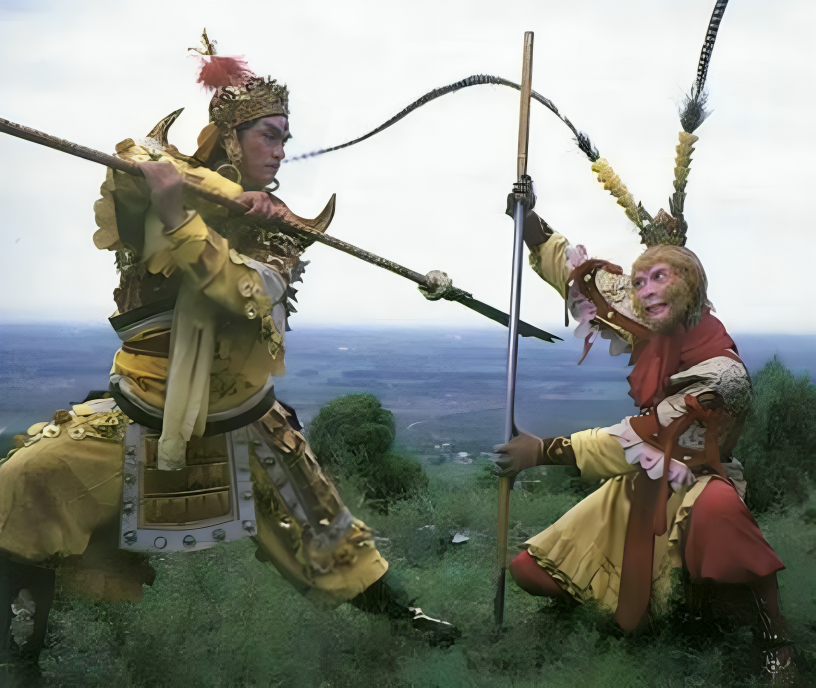
Erlang vs the Great Sage (larger version).
3. Archive link
The Chinese text is split up in sections just like it was posted to Text Court (see below).
Click to access The-God-Erlang-Captures-the-Great-Sage-Equaling-Heaven.pdf
Thanks:
Thank you to the Text Court of the University of Oxford for making this zaju play freely available. The original can be found here.
Update: 03-07-25
Above, Quxie yuanzhu (驅邪院主, “Lord of the Court for Exorcising Evils”) was mentioned as a character that didn’t carry over to the 1592 JTTW. I originally couldn’t find any info about said deity, but I have found a possible lead. According to Kohn (2020), “In Daoism under the Song, [the immortal Zhongli Quan] was particularly honored as the head of the Department of Exorcism (Quxie yuan 驅邪元[院]), a central part of the celestial administration” (p. 13). Perhaps there is a connection between the two.
Update: 03-08-25
I apparently didn’t look hard enough because Text Court (thanked and linked above) provides a list of the character’s other titles:
- 北極鎮天真武玉虚師相玄天元聖仁威
- 北極驅邪院主
- 北極驅邪院都教主
The first title, “北極鎮天真武玉虚師相玄天元聖仁威” (Beiji Zhentian Zhenwu Yuxushi Shixiang Xuantian Yuansheng Renwei), or the “Northern Ultimate and Suppressing Heaven True Warrior, Jade Emptiness Prime Minister, Dark (or Mysterious) Heaven Primal Sage of Humane Power,” contains several illusions to a deity associated with exorcism. The most obvious of these is Zhenwu (真武) and Xuantian (玄天), both of which refer to a singular martial god. I guess this is mystery solved.
Zhenwu appears as the “Demon-Conquering Celestial Worthy” (Dangmo tianzun, 蕩魔天尊) in JTTW chapter 66 (Wu & Yu, 2012, vol. 3, p. 226), but his role is small like in the play.
Notes:
1. All Wade-Giles has been converted to Pinyin.
Source:
Dudbridge, G. (1970). The Hsi-yu chi: A Study of Antecedents to the Sixteenth-Century Chinese Novel. Cambridge: Cambridge University Press.
Kohn, L. (2020). The Zhong-Lü System of Internal Alchemy. Russia: Three Pines Press.