Story Idea: Master Subodhi’s Curriculum II – Immortal Warriors and Shaolin Monks – Some Fun Monkey King Fanfiction Speculation

From time to time I like to post a fun blog not directly related to (though informed by) my research. A past example can be seen here. Regular articles will resume after this entry.

Last Updated: 05-15-2022

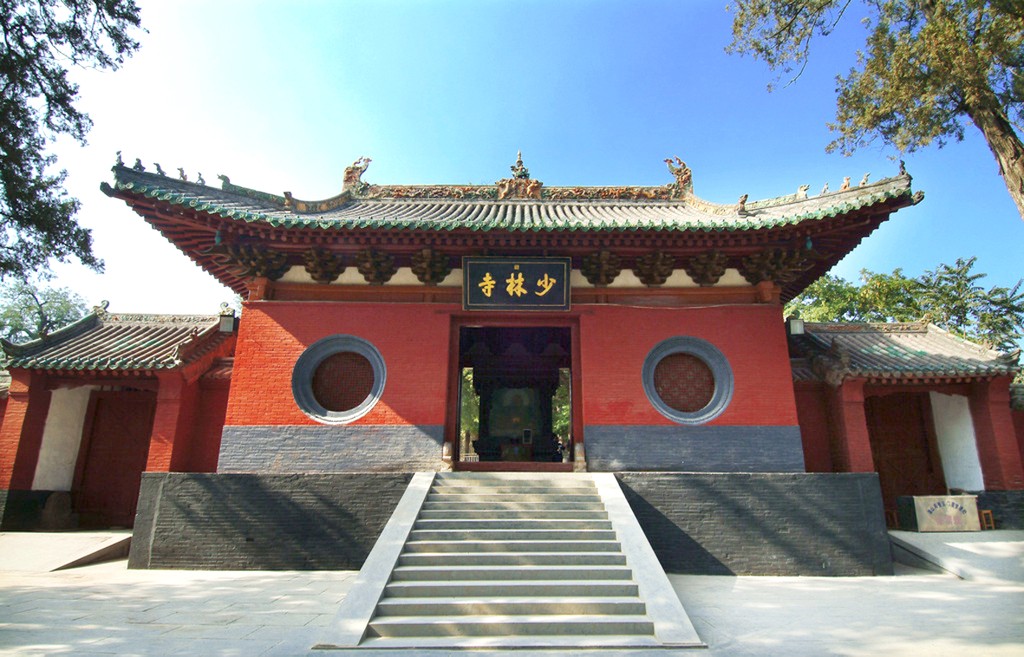
As noted in part one, the immortal sage Subodhi teaches Sun Wukong Chan (Zen) and Daoist philosophy; the secret of immortality; the 72 heavenly transformations; cloud-somersaulting; general Daoist magic; military arts like troop maneuvering, weapons, and boxing; and medicine. But why would a Daoist monk need to know how to wield weapons and fight in battle formations? In this piece I would like to speculate that the Sage’s school is a training ground for an immortal monastic army! I am by no means suggesting there is actual textual support for my conjecture. This is purely a fun exercise, fodder for fanfiction, if you will. I plan to supplement what we already know from the novel with historical information about monastic armies in China, particularly focusing on the warrior monks of the famed Shaolin monastery (Shaolinsi, 少林寺) (fig. 1).

Shaolin front gate

Fig. 1 – The front gate of Shaolin (larger version).

I. The Evolution of Shaolin’s Monastic Army: A Brief Survey

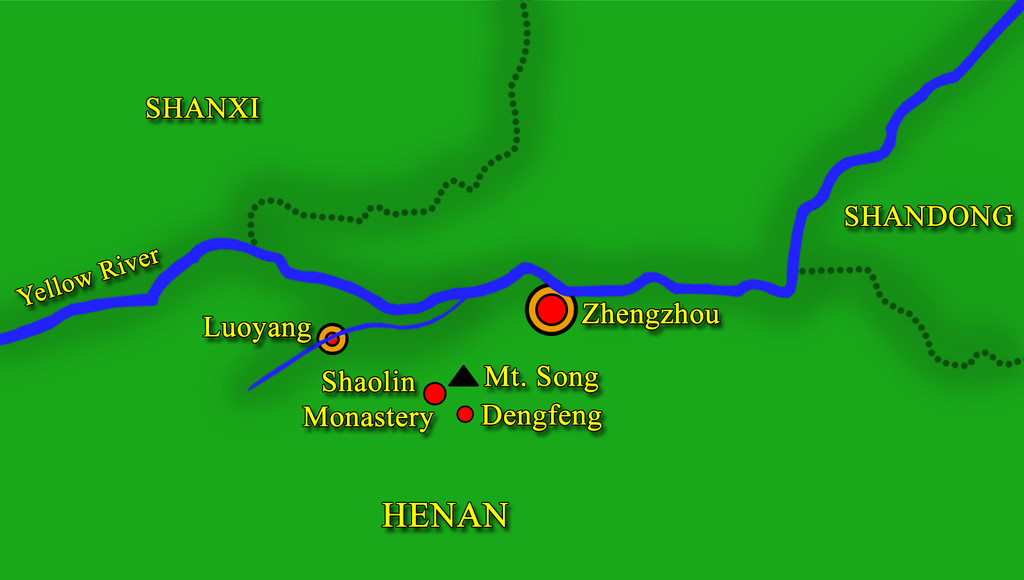
Founded in 496 during the Northern Wei Dynasty, the Shaolin monastery was built on Song Mountain, a mountain range located in Henan Province, China (fig. 2). It became the home of Chan Buddhism and a center for Buddhist learning, even attracting the likes of Xuanzang (on whom Tripitaka is based), whose request to move there in 645 was denied by the Tang Emperor Taizong (Shahar, 2008, p. 17). Despite being a school of higher religious learning, the monastery later came to be associated with elite warriors. The term “Warrior Monk” seems like an oxymoron considering Buddhism is generally considered a religion of peace. However, evidence suggests the monks may have first taken up arms to protect their property, for monasteries were often lavishly decorated and laden with treasures from rich donors, making them prime targets for bandits (Shahar, 2008, p. 18). For example, one of Shaolin’s worst bandit raids took place in 1356 when Red Turban rebels attacked, “peeling off the gold coating of the Buddha images and breaking the statues in search of hidden treasures”, eventually destroying part of the complex (Shahar, 2008, p. 85).

Fig. 2 – A map showing the location of Shaolin and the nearby town of Dengfeng in northern Henan (larger version). The ancient Sui and Tang capital of Luoyang is visible to the left, while the modern day capital of Zhengzhou is visible to the right. Henan shares a border with the provinces of Shanxi and Shandong to the north. Adapted from Shahar, 2008, p. 10. By the author.

The first documented case of Shaolin monks protecting their monastery took place in 610 when they repelled a bandit attack that saw many of their stupas burnt. Their combat experience would come in handy years later when, in 621, the monks aided Li Shimin, the future Emperor Taizong of the newly formed Tang Dynasty, by assaulting a stronghold and capturing the nephew of Wang Shichong, a former general of the defunct Sui Dynasty and the founder of a competing dynasty. Wang had captured valuable farmland belonging to Shaolin and established the stronghold there because it was located in a valley through which passed the strategically important route to the Sui capital of Luoyang. The monks’ intervention was not a display of loyalty to the fledgling Tang but solely a move to regain control of their property, a political gamble that paid off and benefited the monastery for centuries (Shahar, 2008, pp. 25-27). Three of the monks who took part in the battle were awarded titles by Li. One in particular was given the high military rank of Generalissimo (Da Jiangjun, 大將軍) (Shahar, 2008, p. 31). This wasn’t the last time Shaolin soldier monks came to the aid of the Chinese empire.

By the late Ming Dynasty Shaolin was famed far and wide for their mastery of the staff, their method appearing in various military encyclopedias. The interest in their martial prowess was likely spurred by news of their military victories during the 1550s against the Wokou (倭寇, “Dwarf/Japanese pirates”), a conglomeration of Japanese, Chinese, and Korean sea bandits who plagued China’s eastern and southeastern coasts (fig. 3). The Ming’s hereditary army was all but useless at this time, forcing local governments to rely more on prefectural level troops (xiang bing, 廂兵), including contingents of Buddhist warrior monks from different monasteries (Shahar, 2008, p. 68). Monks from Shaolin and sister temples were mobilized in the spring of 1553 and fought the pirates a total of four times through the autumn of 1555. Shahar (2008) explains:

The monks scored their biggest victory in the Wengjiagang battle. On July 21, 1553, 120 fighting monks defeated a group of pirates, chasing the survivors for ten days along the twenty-mile route southward to Wangjiazhuang (on the Jiaxing Prefecture coast). There, on July 31, the very last bandit was disposed of. All in all, more than a hundred pirates perished, whereas the monks suffered four casualties only. Indeed, the monks took pity on no one in this battle, one employing his iron staff to kill an escaping pirate’s wife (p. 69).

It’s interesting to note that the head priest who led the monastic army in their victory over the Wokou was himself from Shaolin and was documented to have single-handedly defeated eight armed monks from a neighboring temple who challenged his position (Shahar, 2008, pp. 69-70).

Wokou pirates vs ming

Fig. 3 – Detail from a Ming painting depicting soldiers fighting the Wokou (larger version). More information about the scroll can be seen here.

In a chapter titled “The Monastic Armies’ First Victory” (Seng bing shou jie ji, 僧兵首捷記, 1568), the geographer Zheng Ruoceng extolled Shaolin’s skill and called for their regular use, along with other holy warriors from sister temples, in combat:

In today’s martial arts, there is no one in the land who does not yield to Shaolin. Funiu [in Henan] should be ranked as second. The main reason [for Funiu’s excellence] is that its monks, seeking to protect themselves against the miners, studied at Shaolin. Third comes Wutai [in Shanxi]. The source of the Wutai tradition is the method of the “Yang Family Spear” (Yangjia qiang), which has been transmitted for generations in the Yang family. Together, these three [Buddhist centers] comprise hundreds of monasteries and countless monks. Our land is beset by bandits inside and barbarians outside. If the government issues an order for [these monks’] recruitment it will win every battle (Shahar, 2008, p. 70).

The warrior monks were just one type of disciple at Shaolin. For example, modern Shaolin has four types: 1) ordained monks; 2) ordained martial arts monks who often leave to open their own schools around the monastery or abroad; 3) non-ordained martial arts performers (a.k.a. “fake monks”); and 4) lay disciples. Only the first type strictly adheres to Buddhist dietary laws. The martial type are historically known for eating meat and drinking alcohol, associating the former with physical strength and fighting ability. During the Ming and Qing Dynasties, such monks lived in subsidiary shrines (fangtou, 房頭) away from the monastery proper or lived an itinerant lifestyle (Shahar, 2008, pp. 46-51). Therefore, the warrior monks who bloodied their hands during wartime and regularly ate meat lived away from the devout, vegetarian body within the main monastery. Their unruly nature was for the most part accepted because of the protection they provided.

II. Speculation

Now the fun begins! Here I would like to take what we know about the novel (part I) and the above information to speculate on the martial history of Subodhi’s school.

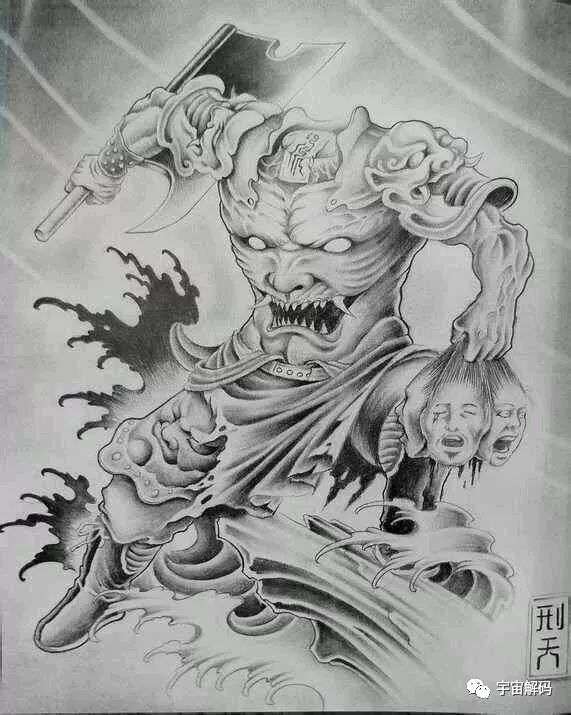
Like Shaolin, Subodhi’s school is located in the mountains and most likely houses great heavenly treasures, the likes of which might be sought after by demon kings. Conflict with these demons would naturally necessitate the immortal monks take up arms in defense of their school. Continued conflict would allow them to hone their skills until their services might be called upon by one of two celestial factions vying for control of heaven during times immemorial, much like Li Shimin’s struggle against Wang Shichong. Chinese mythology is full of numerous baddies threatening the primacy of heaven. One in particular is the headless deity Xingtian (刑天) (fig. 4) from the Classic of Mountains and Seas (c. 4th–1st century BCE):

Xingtian and the Supreme God Di came to this place and struggled against each other for ultimate power. The Supreme God cut off Xingtian’s head and buried him at Eternally Auspicious Mountain. Xiangtian’s nipples then transformed into eyes, and his navel became a mouth. He performs a dance with an ax and shield (Strassberg, 2002, p. 171).

Xingtian was originally a retainer of the Flame emperor, who lost his bid for power against the Yellow Emperor. Xingtian then continued his master’s war, even refusing to die after being beheaded (Strassberg, 2002, p. 171).

Xingtian

Fig. 4 – A modern depiction of Xingtian (larger version). Artist unknown.

The deity’s sustained, obsessive defiance, illustrated by his war dance, could serve as an ever present threat working in the shadows, waiting and plotting. Perhaps untold millennia after his first defeat Xingtian amasses a huge army that attacks the celestial realm via the Tianhe (天河, “Heavenly River), or the Milky Way, much like the Wokou attacked the Chinese coast by sea. The Yellow emperor then calls up Master Subodhi’s immortal warriors to help neutralize the threat, emerging victorious and winning the admiration of deities throughout the cosmos like their Shaolin counterparts.

So where does Sun Wukong fit in to this fanciful yarn? As an ordained-martial monk, Monkey would regularly train in weapons and fight in the monastic army, possibly rising through the ranks due to his supernatural talent and becoming a general who leads an assault against Xingtian’s forces. (Perhaps he would even have to defend his position against older, jealous immortals, much like the aforementioned Shaolin monk during the Ming.) Sun’s time in the monastic army would explain why, as noted in part I, the young immortal knows how to train his monkey children to march, go on patrol, follow orders directed by flags and battle drums, and advance and retreat. Only a person who studied military classics and had prior experience with leading troops would have such knowledge.

This in turn would explain why Subodhi expels Monkey and warns him to never reveal the sage had been his teacher. Sun Wukong is a powerful immortal and seasoned fighter with vast magical powers. Combine that with little impulse control and you’ve got the makings of a demon. Heaven discovering that Subodhi had trained the very demon who came to rebel against it would stain the sage’s name and the achievements of his school.

I would love to see someone use this information to write a prequel set during Sun Wukong’s time in Subodhi’s monastery.


Update: 09-18-21

Sun is originally expelled from Subodhi’s school for flaunting his newfound powers of transformation (Wu & Yu, 2012, vol. 1, pp. 123-124). But given Monkey’s ability to acquire amazing powers in just three short years, perhaps Subodhi fears his student’s potential for exponential spiritual growth. Whether this is because he sees a spark of malice in his disciple or he’s just plain jealous (the former seems more likely), Subodhi could just use the transformation as an excuse to halt his progression. But imagine Sun after another three years! I imagine high-level cosmic beings like the Buddha would be interested in keeping an eye on his progress.


Update: 05-15-22

I’ve posted an article that expands on the ideas from above.

Story Idea: The REAL Reason Sun Wukong is Expelled from Subodhi’s School

Sources

Shahar, M. (2008). The Shaolin Monastery: History, Religion, and the Chinese Martial Arts. Honolulu: University of Hawai’i Press.

Strassberg, Richard (2002). A Chinese Bestiary: Strange Creatures from the Guideways Through Mountains and Seas. University of California Press.

Wu, C., & Yu, A. C. (2012). The Journey to the West (Rev. ed.) (Vols. 1-4). Chicago: University of Chicago Press.

Master Subodhi’s Curriculum

Last updated: 11-27-2018

This entry will explore the curriculum that Sun Wukong follows while studying under the immortal sage Master Subodhi in India. Monkey stays in the immortal’s monastery for a total of ten years, the first seven living as a junior Daoist monk and the last three as a close disciple of Subodhi. Apart from menial tasks like fetching firewood and water, tending the garden, and cleaning the monastery grounds, Monkey first receives lessons on human language and etiquette, calligraphy, scripture reading, and minor ritual procedures like incense burning. These are taught to him by his senior religious brothers, thereby freeing up the Sage to teach higher level lessons on philosophy, internal alchemy, magic, and other skills to his more advanced students.

I should point out that Sun’s greatest asset during his training appears to be a supernatural mental acuity. Upon becoming Subodhi‘s close disciple, Monkey rapidly masters skills that even his more senior religious brothers cannot grasp. The novel therefore refers to our hero as “someone who, knowing one thing, could understand a hundred” (Wu & Yu, 2012, vol. 1, p. 122). Monkey’s intellect allows him to outsmart many opponents and bypass many obstacles during his later adventures.

I. Overtly stated

These subjects are overtly mentioned in chapter two.

1) Chinese Philosophy – One poem best describes the philosophical lessons taught by Subodhi:

With words so florid and eloquent
That gold lotus sprang from the ground.
The doctrine of three vehicles he subtly rehearsed,
Including even the laws’ minutest tittle.
The yak-tail waved slowly and spouted elegance:
His thunderous voice moved e’en the Ninth Heaven.
For a while he lectured on Dao;
For a while he spoke on Chan–
To harmonize the Three Parties is a natural thing.
One word’s elucidation filled with truth
Points to the birthless showing nature’s mystery
(Wu & Yu, 2012, vol. 1, p. 122).

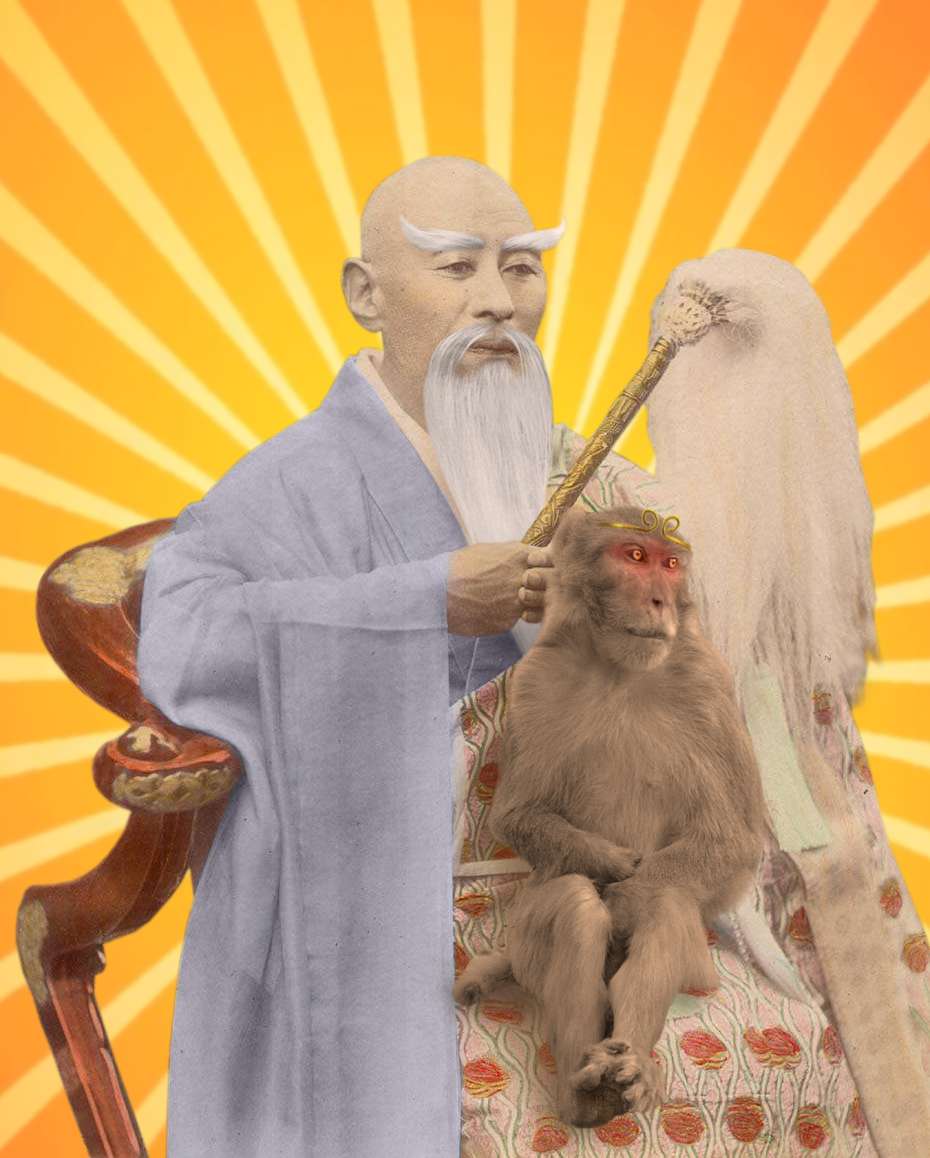
This poem is a prime example of the Ming syncretic philosophy of the Three Teachings (Sanjiao, 三教): Confucianism, Daoism, and Buddhism. “The doctrine of the three vehicles” could refer to the three main branches of Buddhism, namely Theravada, Mahayana, and Vajrayana, but could also be referring to the Three Teachings (the same as the “Three Parties” mentioned further down the poem). “The yak-tail waved slowly and spouted elegance” refers to the bingfu (秉拂), or “to take hold of the whisk”, a phrase denoting a sermon by a learned Chan (Zen) master conducted from a high chair. The phrase derives from the fly whisk (Sk: vālavyajana; Ch: fuzi, 拂子; Jp: hossu, 払子), a symbol of religious authority held in hand during a lesson (Robert & David, 2013, p. 120). “His thunderous voice moved e’en the Ninth Heaven” refers to the Nine Heavens (jiutian, 九天) of Daoism (Pregadio, 2008, pp. 593-594). And of course the poem goes onto mention Subodhi lecturing on both Chan and the Dao, thereby identifying him as a teacher of unparalleled knowledge.

An immortal lecturing on Buddhism may come as a surprise to some readers. However, it should be remembered that Subodhi is based on one of the Buddha’s historical disciples.

Sun Wukong and Subhuti

Sun Wukong and Master Subodhi. Take note of the fly whisk in the sage’s hands. Photomanipulation by the author (larger version). The original photo of the monk can be found on this blog about the fly whisk.

2) The Secret of Immortality – As I’ve explained in this article, Sun achieves immortality via breathing exercises designed to absorb yang energy during prescribed times (after midnight and before noon), the retention of chaste semen and transformation into qi energy, and the purification and circulation of the resulting spiritual energy throughout his body. While these practices are traditionally associated in Daoist internal alchemy with the formation of an immortal spirit that is eventually freed from the mortal shell, Monkey’s practice results in an ageless, adamantine physical body, one capable of lifting even cosmic mountains.

Immortal Awakened

Monkey achieves immortality. Photomanipulation by the author (larger version).

3) The 72 Transformations – This series of oral formulas allows Wukong to change his physical appearance into anything from gods, monsters, and humans to animals, insects, and even inanimate objects like buildings. Subodhi teaches this skill to Monkey with the expressed purpose of escaping three heaven-sent calamities meant to destroy immortals for defying their fate. Despite the intended use, this skill becomes one of his greatest strengths.

Because of Monkey’s mental acuity he is able to instantly remember all of the oral formulas imparted to him and, after some practice, he quickly masters the transformations.

Sun’s heated battle of transformations with the god Erlang. From the 1965 animated classic Havoc in Heaven.

4) Cloud-Somersaulting – The combination of a hand mudra and an oral formula allows Monkey to rise above the ground and travel at immense speed by somersaulting from cloud to cloud, each leap being 108,000 li, or 33,554 miles (54,000 km) long.

This skill is mastered in a single night.

37e2fc9cebe000bb1c76c73e7ad2963a-d5oas0h

Monkey flying on clouds. Drawing by Funzee on deviantart (larger version).

II. Implied

Sun Wukong’s tutelage in these subjects are never stated but are understood to have taken place.

5) General Daoist Magic –  This skill allows him to call forth gods and spirits, grow or shrink to any size, part fire and water, create an impassable barrier, conger a wind storm, cast illusions, freeze someone in place, unlock any lock, give human disciples superhuman strength, etc.

What’s interesting is that, during his training, Monkey expressly passes on learning the bureaucratic-style magic rites normally used by earthly priests simply because the skill won’t result in his immortality. Instead, after achieving eternal life, Sun is just so powerful he can command the very gods themselves to do his bidding. His lack of ritual knowledge is highlighted in chapter 45 when he agrees to engage in a rain-making competition with an animal spirit disguised as a Daoist priest. The spirit relies on an established liturgy involving a ritual sword and tablet, as well as the burning of a written note. This elaborate ritual initiates a bureaucratic chain in which the request is sent to heaven, the Jade Emperor agrees to the appeal, and then heavenly officials, namely the gods of wind, clouds, lightning, and rain, are dispatched to fulfill the application. But Monkey rises into the clouds above to bully the respective deities into helping him instead, noting: “I don’t know how to burn charms, issue summons, or strike any tablet. So all of you must play along with me” (Wu & Yu, 2012, vol. 2, p. 293).

Likewise, Monkey is so powerful that he can bring the dead back to life by simply fetching a person’s soul from the underworld (like he does for an elderly benefactor in chapter 97).

123 magic

Sun casting a magic spell. Drawing by Poppindollars on deviantart (larger version).

6) The Art of War – I’m including military and civilian martial arts in this section as both are related.

Weaponry – After returning home in chapter 3, the young immortal teaches his children how to wield a plethora of weapons, including swords, spears, axes, bows and arrows, etc. Of course, he shortly thereafter acquires his magic staff, the weapon most commonly associated with him. Monkey’s skill with the staff is so great, in fact, that his supernatural technique is likened in chapter 33 to two of the Seven Military Classics of China.

Monkey’s broad knowledge of weapons implies that he learns the famous “Eighteen Martial Arts” (Shiba ban wuyi, 十八般武藝). A vague list of these war implements first appeared during the Song Dynasty, but a later definitive list became “a standard shorthand for complete martial arts knowledge” in Yuan-period stage plays (Lorge, 2012, p. 146). One version of the list appearing in the great Chinese classic The Water Margin (c. 1400) includes everything from chains, clubs, and whips to axes, halberds, and even early firearms (Lorge, 2012, p. 147). Variations on the eighteen weapons remained a staple of Chinese stage plays, oral literature, and written fiction. Therefore, it’s no wonder a great warrior like Monkey would come to be associated with the mastery of so many weapons.

the_monkey_king_by_jeremyblz_d21hdow-pre

Monkey assaults heavenly forces with his magic staff. Drawing by JeremyBLZ on deviantart (larger version).

Military Maneuvers – Monkey goes onto train his children how to march, go on patrol, follow orders directed by flags and battle drums, and advance and retreat, turning the tangled mass of monkeys into an elite army.

Sun’s children engaging in mock battles during their training. From Havoc in Heaven. 

Boxing – Sun displays a mastery of unarmed boxing in chapters one and 51, the former against a demon who takes over his mountain home in his absence and the latter against a Rhinoceros demon who steals his staff. Both chapters describe Monkey using techniques akin to short fist, a style known for quick, compact punches. Learning this close range style may be out of necessity, though, considering Sun is so short (he’s less than 4 ft (122 cm) tall).

In his wonderful book The Shaolin Monastery (2008), Prof. Meir Shahar of Tel Aviv University shows Shaolin kungfu developed during the Ming-Qing transition from a synthesis of Daoist gymnastics (stretching and breathing exercises), religious rituals, and fist techniques. This new form of spiritual cultivation ushered in the era of so-called “internal martial arts“, Taiji boxing being the most famous among them.

Interestingly, some of the real world techniques used by Monkey and his opponent in chapter 51 appear in Taiji boxing.

Journey to the West (1592) was published during the late Ming when this synthesis was in full swing. Therefore, Sun’s study of martial arts in a religious institution is an accurate snapshot of one facet of 16th-century monastic life.

boxing

Sun teaching a young human apprentice martial arts. Drawing by Celsohenrique on deviantart (larger version).

7) Chinese Medicine – This skill is displayed only once in the novel. In chapter 69, Monkey works to diagnose the long-standing malady of a foreign emperor. But due to the immortal’s monstrous appearance, he is forced to analyze the ruler from afar, using three magic hairs-turned-golden strings to measure the vibrations of the pulse from three locations of each forearm. Sun deduces the illness is caused by fear and anxiety over the loss of the monarch’s queen, who had been kidnapped by a demon. Monkey then concocts three pills from a recipe of herbs, kettle soot, and dragon horse urine and administers the elixir with dragon king saliva. The medicine causes the emperor to pass an obstruction in his bowls, thus restoring the natural qi flow in his body and curing him of his sickness.

Baring the strings, Monkey’s method of reading the pulse aligns with real Chinese medicinal practice. The area of the forearm analyzed by traditional Chinese doctors is known as Cunkou (寸口, the “inch opening”), and this is broken up into the three spots Cun (寸, “inch”), Guan (關, “pass”), and Chi (尺, “foot”). The mirrored spots on each arm are believed to correspond to specific internal organs. For example, the Cun spot (nearest the wrist) on the right hand corresponds to the lung, while that of the left hand corresponds to the heart (Liao, 2011, pp. 55-56). Therefore, analyzing the pulse at these spots is believed to reveal the health of the corresponding organs.

TCM hand chart

The spots analyzed during pulse diagnosis. Picture originally found here.

III. Monkey as a Scholar Warrior

The skills learned by Sun are varied, straddling the religious, the literary, and the martial. Therefore, Monkey is a perfect example of what Deng Mingdao (1990) calls the “Scholar Warrior”:

Skill is the essence of the Scholar Warrior. Such a person strives to develop a wide variety of talents to a degree greater than even a specialist in a particular field. Poet and boxer. Doctor and swordsman. Musician and knight. The Scholar Warrior uses each part of his or her overall ability to keep the whole in balance, and to attain the equilibrium for following the Tao. Uncertainty of the future inspires no fear: whatever happens, the Scholar Warrior has the confidence to face it (p. 10).

IV. Conclusion

Monkey stays in Subodhi’s monastery for a total of ten years, the first seven living as a junior Daoist monk and the last three as a close disciple of Subodhi. During his time as a junior monk, he learns human language and etiquette, calligraphy, scripture reading, and incense burning. These foundational skills are taught to him by his senior religious brothers. During his time with Subodhi, Sun learns Chan and Daoist philosophy; the secret of immortality; the 72 heavenly transformations; cloud-somersaulting; general Daoist magic; military arts like troop maneuvering, weapons, and boxing; and medicine.


Update: 11-27-2018

I’ve written a continuation of this article where I use the above info to speculate Sun Wukong is a warrior monk in Master Subodhi’s immortal monastic army. It’s good fodder for fanfiction. I even suggest a mythological baddie for the warrior monks to fight, the headless deity Xingtian.

https://journeytothewestresearch.com/2018/11/25/master-subhutis-curriculum-2-immortal-monastic-army/

Sources

Deng, M. D. (1990). Scholar warrior: An introduction to the Tao in everyday life. San Francisco: HarperSanFrancisco.

Liao, Y. (2011). Traditional Chinese medicine. Cambridge: Cambridge University Press.

Lorge, P. A. (2012). Chinese martial arts: From antiquity to the twenty-first century. New York, NY: Cambridge University Press.

Pregadio, F. (2008). Jiutian 九天 Nine Heavens In F. Pregadio (Ed.), The encyclopedia of Taoism: Volume 1 (pp. 593-594). London [u.a.: Routledge].

Robert, E. B. J., & David, S. L. J. (2013). The Princeton Dictionary of Buddhism. Princeton University Press.

Shahar, M. (2008). The Shaolin monastery: History, religion, and the Chinese martial arts. Honolulu: University of Hawai’i Press.

Wu, C., & Yu, A. C. (2012). The journey to the west: Volumes 1-4. Chicago: University of Chicago Press.

The Possible Origin of Wanfu Temple’s Multiple Great Sages

Last updated: 03-22-2026

The Wanfu Temple (Wanfu an, 萬福庵) of Tainan, Taiwan worships Sun Wukong in his guise as the Great Sage Equaling Heaven (Qitian dasheng, 齊天大聖). Most surprisingly, they recognize more than one Great Sage, each with his own function. These include a trinity, three in administrative positions, and an army of dozens of other Monkeys. The idea of multiple Great Sages goes back centuries to an early Ming dynasty (14 to 15th century) operatic stage play (zaju, 雜劇) by Yang Jingxian (杨景賢) titled Journey to the West (Xiyouji, 西遊記), which predates the similarly named novel by two hundred years. Scene nine of this play sees Monkey introduce himself, his past misdeeds, and his family. He claims to be one of several siblings:

We are five brothers and sisters: my elder sister is Lishan Laomu [離山老母, Venerable Mother of Mount Li], my second sister Wuzhiqi Shengmu [巫支祇聖母, Holy Mother Wuzhiqi]; my older brother is Qitian Dasheng [齊天大聖, Great Sage Equaling Heaven], I myself am Tongtian Dasheng [通天大聖, Great Sage Reaching Heaven], and my younger brother Shuashua Sanlang [耍耍三郎] (Dudbridge, 1970, p. 110). [1]

Astute readers will notice a discrepancy with the novel. Sun Wukong is referred to here as the Great Sage Reaching Heaven, while an older brother is known as the Great Sage Equaling Heaven. Sun (2018) suggests the older brother is the result of confusing similar titles given to Monkey during the long history of the story cycle (pp. 44-45). It’s interesting to note, however, that the female siblings have their own history. The Venerable Mother of Mount Li (more commonly written 驪山 and 黎山) was historically worshiped as a deity from at least the Song Dynasty (960-1279), and myths often associate her with the creation/flood-conquering goddess Nuwa (女媧) (Theobald, 2010; Yang & An, 2005, pp. 222-223). Wuzhiqi (also written 無支祁) is a monkey-like flood demon appearing in stories as far back as the Tang dynasty (618-907) (Andersen, 2001). So both sisters are associated with flooding.

The Journey to the West novel provides a possible answer to the mystery of the multiple Great Sages. After returning home to the Mountain of Flowers and Fruit in chapter two, Wukong tells his children about his new name:

“My surname is Sun,” replied Wukong, “and my religious name is Wukong.” When the monkeys heard this, they all clapped their hands and shouted happily, “If the great king is Elder Sun, then we are all Junior Suns, Suns the Third, small Suns, tiny Suns—the Sun Family, the Sun Nation, and the Sun Cave!” (Wu & Yu, 2012, vol. 1, p. 130)

This would explain the army of monkey soldiers who do the bidding of the aforementioned trinity.

Additionally, another Great Sage appears in the pious novel Pacification of the Demons of Linshui (Linshui Pingyao zhuan, 臨水平妖傳, c. 17th-18th-cent.). The narrative recounts the miraculous deeds and deification of Chen Jinggu (陳靖姑) (fig. 1), more commonly known as the Lady of Linshui (臨水夫人), a highly popular Fujian and Taiwanese protector goddess of pregnancy and children. The novel depicts the Cinnabar Cloud Great Sage (Danxia Dasheng, 丹霞大聖) as a red-furred, mulberry staff-wielding monkey who, just like Sun Wukong, stole heavenly peaches and survived a turn in Laozi’s furnace. He teams up with another demon to attack the goddess and her heavenly companion, but both are beaten back. The Great Sage is so badly burnt by a magic flaming pearl used by the companion that it takes an entire year for him to heal his wounds. One year later, he resumes his misdeeds and takes on the appearance of a young man, causing so much havoc that the real human is chased from his village. The young man calls on the goddess, who promptly captures the Great Sage and castrates him “in order, she says, to open to him the way of true asceticism stripped of desire, of true wisdom allowing him to obtain the ‘just fruits’, zhengguo [正果]” (Baptandier, 2008, p. 111). After being deprived of his manhood, the novel reveals the Cinnabar Cloud Great Sage to be the “double” of Sun Wukong. He goes on to become an agent of justice charged with conquering demons. [2]

LM0510臨水夫人順天聖母陳靖姑大奶順懿三山女神G樟木雕1尺3 (复制)

Fig. 1 – A modern altar statue of the Lady of Linshui (larger version).

I want to briefly mention the idea of the Cinnabar Cloud Sage being Sun Wukong’s double is most likely based on the Six-Eared Macaque (Liu‘er mihou, 六耳獼猴) from chapters 56 to 58 of Journey to the West (fig. 2 and 3). [3] This demon takes on Monkey’s form, much like the Cinnabar Cloud Great Sage does the young man in the aforementioned novel, and causes all sorts of trouble. When the twins seek the Buddha’s wisdom to tell one from the other, the Enlightened One reveals the fraud to be one of four supernatural primates, the other three being the intelligent stone monkey, the red-buttocked baboon, and the bare-armed gibbon. The demon attempts to flee but is eventually killed by Sun Wukong (Wu & Yu, 2012, vol. 3, pp. 112-116).

6 eared macaque fighting monkey

Fig. 2 – An artist’s depiction of the six-eared macaque. Fig. 3 – Sun Wukong fighting his double (video).

A religious tradition in Fujian appears to borrow from both the Yuan-Ming play and the Linshui novel to derive a trinity of familiar Great Sages. These are the red-faced Cinnabar Cloud Great Sage (丹霞大聖), the black-faced Great Sage Reaching Heaven (通天大聖), and the white-faced Shuashua Sanlang (耍耍三郎/爽爽三郎) (fig. 4) (Chinese Monkey God(s)?, n.d.; Wu, n.d.). Therefore, this plethora of Great Sages could have influenced the many venerated in Wanfu temple.

The 3 monkey gods

Fig. 4 – An example of the Three Great Sages from a Lady of Linshui temple (larger version).


Update: 04-21-18

Elliott (1955/1990) describes a Chinese medium in Singapore who channels two of five Great Sages.

According to the current version of the legend, for which no supporting authority can be found elsewhere, there are five Monkey Brothers who may appear when the shen [神, god] is invoked. Each is likely to appear for a number of years before handing over to another brother, unless for any special reason the others have to be consulted. The first Monkey Brother is the wisest and most quiescent of them all. When possessing the dang-ki [童乩, the medium] he can be identified by the manner in which he shades his eyes with his right hand while gazing into the distance. The second Monkey Brother is of fiercer temperament, and can be identified by the manner in which he scratches at his ears as a monkey would. He has a predilection also for eating fire and fruit. The third, fourth and fifth Monkey Brothers are more and more irascible, but there is no detailed knowledge concerning their characteristics since they have never yet appeared. So far it is only the second Monkey Brother who possesses the dang-ki, although the eldest brother is sometimes deferred to in difficult cases and may make a temporary appearance (p. 82).

This shows the concept of multiple Great sages is not restricted to Fujian or Taiwan.


Update: 04-24-18

Another possible avenue opens to us thanks to Monkey’s resemblance to the Chinese god Sire Thunder (Leigong, 雷公). Sun Wukong is compared to the weather deity numerous times throughout the novel (Wu & Yu, 2012, vol 3, p. 352, for example). The connection between the two is an old one, for two tales from the early Song Dynasty (960-1279) portray the thunder god as having the form of an ape with flashing, mirror-like eyes (Meulenbeld, 2007, p. 72). These sound very much like Sun Wukong’s fiery eyes and diamond pupils. Most importantly, tales from the same time period refer to the thunder deity having numerous brothers. Their attributes are similar to the aforementioned five Great Sages:

We are five brothers. If you want to hear the sound of thunder, only call Thunder the old, and Thunder two; then you will have an immediate response. But Thunder five is tough and hot-tempered; if there is no urgent business, you must not call him (Meulenbeld, 2007, p. 69).

The concept of five thunder brothers was solidified by the second half of the Song Dynasty and remains a common belief to this day (Meulenbeld, 2007).


Update: 03-22-26

It dawned on me that a story element from chapters 34 and 35 of the original novel might reference the aforementioned triad of divine brothers from religion and theater. The specific arc sees Monkey escaping capture three times, and in each instance, he presents himself as a brother come to rescue him/them. The following paragraph sums up the event nicely:

The little fiend dashed inside to make the report, saying, “Great King, there is a so-called Sun Pilgrim showing up outside our door.” “Worthy Brother,” said the old demon, deeply shaken, “that’s bad! We have stirred up a whole nest of pestilence! Look! The yellow-gold rope has caught a Pilgrim Sun, while the gourd has stored up a Grimpil Sun. How can it be that there is another Sun Pilgrim? It must be that they have several brothers and they have all arrived” (Wu & Yu, 2012, vol. 2, p. 133).

那小妖急入裡報道:「大王,門外有個甚麼行者孫來了。」老魔大驚道:「賢弟,不好了,惹動他一窩風了。幌金繩現拴著孫行者,葫蘆裡現裝著者行孫,怎麼又有個甚麼行者孫?想是他幾個兄弟都來了。」

These names require some explanation since wordplay is involved. I have used color-coding to make the subject easier to understand. As I note hereGrimpil Sun (Zhexing Sun, ) and Sun Pilgrim (Xingzhe Sun, ) are variants of Monkey’s religious name, Pilgrim Sun (Sun xingzhe, ). 

Notes:

1) The name of the youngest brother could be translated as “Shuashua, the third son” considering the god Erlang (二郎) is literally the “Second Son.” Shuashua is after all the third of three sons.

2) See chapter four in Baptandier (2008) for a complete description of the life and deeds of the Cinnabar Cloud Great Sage.

3) Anthony Yu (Wu & Yu, 2012) suggests the concept of six ears “may have been derived from the common Buddhist saying, ‘The dharma is not to be transmitted to the sixth ear [i.e., the third pair or person] 法不傳六耳'” (vol. 3, p. 387 n. 7).

Sources:

Andersen, P. (2001). The Demon Chained Under Turtle Mountain: The History and Mythology of Chinese River Spirit Wuzhiqi. Berlin: G-und-H-Verl.

Baptandier, B. (2008). The Lady of Linshui: A Chinese Female Cult. Stanford, Calif: Stanford University Press.

Chinese Monkey God(s)? – What You Don’t Know. (n.d.). Retrieved from http://taoist-sorcery.blogspot.tw/2015/08/chinese-monkey-gods-what-you-dont-know.html

Dudbridge, G. (1970). The Hsi-yu chi: A study of antecedents to the sixteenth-century Chinese novel. Cambridge: Cambridge Univ. Press.

Elliott, A. J. (1990). Chinese Spirit-Medium Cults in Singapore. London: The Athlone Press. (Original work published 1955)

Meulenbeld, M. R. E. (2007). Civilized Demons: Ming Thunder Gods from Ritual to Literature (Doctoral dissertation). Available from ProQuest Dissertations and Theses database (UMI No: 3247802).

Sun, H. (2018). Transforming Monkey: Adaptation and representation of a Chinese epic. Seattle: University of Washington Press.

Theobald, U. (2010). Lishan laomu 驪山老母, the Old Lady from Mt. Lishan. Retrieved from http://www.chinaknowledge.de/Literature/Religion/personslishanlaomu.html.

Wu, C., & Yu, A. C. (2012). The Journey to the West (vol. 1-3). Chicago, Illinois: University of Chicago Press.

Wu, J. (n.d.). The Three Monkey Sages of Lin Shui Palace. Retrieved from http://javewutaoismplace.blogspot.tw/2014/01/three-monkey-sages-of-lin-shui-palace.html

Yang, L., & An, D. (2005). Handbook of Chinese mythology. Santa Barbara, Calif.: ABC-CLIO.

The Origin of Sun Wukong’s Battle with Lord Erlang and Its Ties to Han Dynasty Funerary Rites and Folklore

Did you know the battle between Monkey and Lord Erlang is tied to Han Dynasty funerary rights and folklore? Wu (1987) notes that, during the Eastern Han Dynasty (25-220 CE), the people of Sichuan often buried their dead in stone tombs decorated with brave heroes, such as archers and crossbowmen, and fierce animals, such as tigers and hounds. Regarding the latter, the canines are sometimes depicted attacking or intimidating apes, which were considered emblems of disease or bad luck (fig. 1). Therefore, by portraying the subjugation of such evil forces, the carvings are thought to have served the ritual function of protecting deceased loved ones from dark influences on their wayward journey to the afterlife (pp. 100-101).

The idea of dogs overcoming apes should bring to mind Sun Wukong’s capture at the mouth of Lord Erlang’s loyal hound at the end of chapter six.

Fig. 1 – A Han Dynasty tomb rubbing of oversized dogs intimidating apes (larger version).

One recurring motif depicts an archer drawing his bow to fall an ape in a tree (fig. 2). This is based on a third-century BCE tale about the legendary Chu archer Yang Youji (養由基) shooting an elusive white ape held in the palace of the King of Jing. This in turn is based on an even older tale about the archer Yi (羿) bringing order to the primordial earth by killing nine of ten suns that took the form of monstrous crows. Han era tombs are known to portray Yi drawing a bow to shoot said birds flying around a tree, so it most likely influenced the motif of Yang shooting the ape in a tree (Wu, 1987, pp. 102-106). Despite his later connection with the three-pointed polearm, Erlang was also portrayed as an archer in early media.

Fig. 2 – A Han tomb decoration depicting an archer shooting at an ape (larger version).

Lord Erlang was originally worshiped during the Han as a hunting god and queller of mountain ghosts by the Qiang (羌) ethnic group of the western Sichuan region. His cult grew and absorbed other deities and heroes under his mantle. For instance, Wu (1987) writes:

The Er-lang cult became even more popular in Sichuan under the patronage of the Later Shu emperor, Meng Chang 孟昶 (r. 934-65), and in 965, when the Song dynasty conquered the kingdom, it adopted the cult, erecting temples for the god in the capital and throughout the country.

When the Er-lang cult became increasingly popular in Sichuan, the previous divine archers such as Yang Youji and Yi, (like many other legendary demon-quellers), were mologized into this new cult, and their defeat of an ape demon became an important part of the Er-lang legend. Er-lang’s traits in later stories and art works clearly disclose this transformation (pp. 107-108).

It should also be noted that Erlang was at some point associated with the historical engineer Li Bing (李冰, c. 3rd-cent. BCE) and the official Zhao Yu (趙昱, c. 6th/7th-cent CE), both of whom were worshipped for defeating flood demons (Wu, 1987, p. 107). I suggest this may have led to his cult being connected to that of Yu the Great (大禹), the flood-queller par excellence in Chinese folklore. This is important because Tang Dynasty legends state Yu battled a simian water demon and eventually imprisoned it under a mountain (see Andersen, 2001). Sound familiar? This may have been another avenue in which Erlang was associated with quelling ape demons.

One anonymous 13th-century album leaf ink painting portrays Erlang seated in a kingly fashion and watching as his spirit soldiers round up and execute ape demons (fig. 3). An anonymous 15th-century scroll reproduces the scene in color (fig. 4 & 5).

Fig. 3 – (Top L) – The 13th-century painting depicting Erlang and his soldiers rounding up and executing ape demons. A captive ape can be seen on the bottom left between the two soldiers (larger version). Fig. 4 (Top R) – A detail from the 15th-century painting showing the ape, his humanoid wives, and their gibbon-like children being rounded up (larger version). This section is located in the last four-fifths of the scroll. Fig. 5 (Bottom) – A detail showing Erlang near the front of the same scroll (larger version).

The image of the deity as a queller of ape monsters culminated in an anonymous Yuan-Ming Dynasty play called The God Er-lang Locks up the Great Sage-Equal to Heaven (二郎神鎖齊天大聖, Er-lang Shen suo Qitian Dasheng). Much like JTTW, the god is sent to capture a magical primate, in this case an ape, who has stolen immortal food and wine from heaven (Wu, 1987, pp. 108-109). This no doubt influenced Monkeys mischief in heaven and subsequent battle with the deity.

Sources:

Andersen, P. (2001). The Demon Chained Under Turtle Mountain: The History and Mythology of the Chinese River Spirit Wuzhiqi. Berlin: G-und-H-Verl.

Wu, H. (1987). The Earliest Pictorial Representations of Ape Tales: An Interdisciplinary Study of Early Chinese Narrative Art and Literature. T’oung Pao LXXIII, pp. 86-112.