Archive #50 – Heracles as Vajrapani

Last updated: 10-04-2025

I’ve previously archived a book about wrathful protectors of Buddhism due to their likely influence on Sun Wukong. One such protector is Vajrapāṇi (Sk: वज्रपाणि), the so-called “Bodhisattva holding the Vajra (Thunderbolt)” (Jingang shou pusa, 金剛手菩薩). This Yakṣa-turned-Dharmapāla is often portrayed in religious art as a muscular, club-wielding guardian of the Buddha. What’s interesting, though, is that this depiction can be traced to representations of the Greco-Roman hero HeraclesHercules (Ἡρακλῆς; Ch: Helakelesi, 赫拉克勒斯) that passed from Greece into Central Asia and India and eventually to China over a period of several hundred years (Flood, 1989; Hsing & Crowell, 2005; Galinsky, 2020). The Greco-Buddhist art of Gandhara (modern day Afghanistan and Pakistan) is an early example of this converging iconography (fig. 1).

I’ve decided to archive three papers on the subject for a few reasons: 1) it’s such a fascinating topic; 2) it compliments two of my previous articles about Monkey and Heracles-Hercules (here and here); and 3) the information will be used in a future story idea pitting Wukong against the demi-god (see the 10-04-25 update below). Said piece will also briefly discuss times when the primate immortal and Vajrapāṇi have crossed paths in historical literature and folklore.

Fig. 1 – Detail of a stone carving of the Buddha preaching while Heracles-Vajrapāṇi watches over him, Gandhara, 2nd-century (larger version). The full image can be seen here. Copyright the Trustees of the British Museum.

1. Archive links

  • Herakles and the ‘Perpetual Acolyte’ of the Buddha: Some Observations on the Iconography of Vajrapani in Gandharan Art (Flood, 1989)

[No abstract]

Click to access Herakles-and-the-Perpetual-Acolyte-of-the-Buddha-Some-Observations-on-the-Iconography-of-Vajrapani-in-Gandharan-Art.pdf


  • Heracles in the East: The Diffusion and Transformation of His Image in the Arts of Central Asia, India, and Medieval China (Hsing & Crowell, 2005)

[No abstract]

Click to access Heracles_in_the_East_Asia_Major_2005_vol.pdf


  • Herakles Vajrapani, the Companion of Buddha (Galinsky, 2020)

[Abstract: Herakles had a continuing and high-profile existence in the east and the crossroads of Asia from the time of Alexander onwards. The Alexander/Herakles portrait and other representations of Herakles appear in Tajikistan, which was absorbed into the Kushan empire. Cultural contact continued with the west throughout the first and second centuries CE under rulers who patronised Buddhism. It is in this context that Herakles, the most popular hero of Greece and Rome, makes his appearance in Buddhist iconography as Vajrapani. In Gandharan art Vajrapani is the Buddha’s faithful companion and protector in scenes of the Buddha’s life from the Great Departure to his death. The paper examines the hybridisation of Herakles/Vajrapani in a number of reliefs and sculptures to demonstrate that this is not a process of borrowing some stylistic details but of considerable familiarity with the Herakles myth. Both Herakles and Vajrapani had many dimensions and their traditions and characteristics had multiple layers, which facilitated their adaptability.]

Click to access Herakles-Vajrapani-the-Companion-of-Buddha.pdf


Update: 08-20-25

It just occurred to me that not everyone is familiar with Heracles/Hercules or Vajrapani, so I have decided to post more info about them.

I’ll start with Heracles. This is an AMAZING resource that I’ve used in a previous article.

  • The Oxford Handbook of Heracles (Ogden, 2021) 

[Blurb: Heracles is the quintessential ancient Greek hero. The rich and massive tradition associated with him encompasses myths of all kinds: quest myths, monster-fights, world-foundational myths, aetiological myths, philosophical myths, allegorical myths, and more. It informs and is informed by every genre and variety of Classical literature. The figure of Heracles opens windows onto numerous aspects of ancient religion, including those of cult, syncretism, Christian reception, the relationship between gods and heroes, and the intersection of religion with politics.

The Oxford Handbook of Heracles is the first large-scale guide to Heracles, his myth-cycle the Twelve Labors, and, to the pervasive impact of the hero upon Greek and Roman culture. The first half of the volume is devoted to the lucid exposition and analysis of the ancient evidence, literary and iconographic, for Heracles’ life and deeds. In the second half, the Heracles tradition is analyzed from a range of thematic perspectives, including the contrasting projections of the figure across the major literary genres and in art; the ways in which Greek communities and even Roman emperors exploited the figure in the fashioning of their own identities and for political advantage; his cult in Greece and Rome and its syncretism with that of the Phoenician Melqart; and Heracles’ reception in later Western tradition.

Presenting, in 39 chapters, the authoritative work of international experts in a clear and well-structured format, this volume provides a convenient reference tool for scholars and offers an accessible starting-point for students.

Click to access The-Oxford-Handbook-of-Heracles-2021.pdf


Next is Vajrapani. I unfortunately don’t know of any dedicated books on the subject, so here are two papers about his presence in Indian Buddhism.

  • Vajrapani in India I (Lamotte, 1966/2003a)

[No abstract]

(Please note that the formatting of this PDF was already wonky when I found it online.)

Click to access Lamotte-–-Vajrapaṇi-in-India-I.pdf


  • Vajrapani in India II (Lamotte, 1966/2003b)

[No abstract]

Click to access Lamotte-–-Vajrapaṇi-in-India-II.pdf

I’ll add more Vajrapani info in the future when I get a chance.


Update: 08-25-25

Here is the entry for Vajrapani in The Princeton Dictionary of Buddhism (Buswell & Lopez, 2014):

Vajrapāṇi. (P. Vajirapāṇi; T. Phyag na rdo rje; C. Jingangshou pusa; J. Kongōshu bosatsu; K. Kŭmgangsu posal 金剛手菩薩). In Sanskrit, “Holder of the VAJRA”; an important bodhisattva in the MAHĀYĀNA and VAJRAYĀNA traditions, who appears in both peaceful and wrathful forms. In the Pāli suttas, he is a YAKṢA (P. yakkha) guardian of the Buddha. It is said that whoever refuses three times to respond to a reasonable question from the Buddha would have his head split into pieces on the spot; carrying out this punishment was Vajrapāni’s duty. In such circumstances, Vajrapāni, holding his cudgel, would be visible only to the Buddha and to the person who was refusing to answer the question; given the frightening vision, the person would inevitably then respond. Vajrapāni is sometimes said to be the wrathful form of ŚAKRA, who promised to offer the Buddha protection if the Buddha would teach the dharma; he thus accompanies the Buddha as a kind of bodyguard on his journeys to distant lands. Vajrapāni is commonly depicted in GANDHĀRA sculpture, flanking the Buddha and holding a cudgel. In the early Mahāyāna sūtras, Vajrapāni is referred to as a yakṣa servant of the bodhisattvas, as in the AṢṬASĀHASRIKĀPRAJÑĀPĀRAMITĀ. In the SUVARṆAPRABHĀSOTTAMASŪTRA, he is called the “general of the yakṣas” (yakṣasenādhipati), and is praised as a protector of followers of the Buddha. In the SADDHARMAPUṆḌARĪKASŪTRA, AVALOKITEŚVARA explains that one of the forms that he assumes to convert sentient beings is as Vajrapāni. In later Mahāyāna and early tantric Buddhism, Vajrapāni becomes a primary speaker in important sūtras and tantras, as well as a principal protagonist in them, and comes to be listed as one of the “eight close sons” (*UPAPUTRA), the principal bodhisattvas. In the MAÑJUŚRĪMŪLAKALPA, as leader of the vajra family (VAJRAKULA), he flanks ŚĀKYAMUNI in the MAṆḌALA. In the SARVATATHĀGATATATTVASAṂGRAHA, his transition from “general of the yakṣas” to “the supreme lord of all tathāgatas” is played out through his subjugation of Maheśvara (Śiva). At the command of the buddha VAIROCANA, Vajrapāni suppresses all of the worldly divinities of the universe and brings them to the summit of Mount SUMERU, where they seek refuge in the three jewels (RATNATRAYA). Only Maheśvara refuses to submit to the Buddha. Through Vajrapāni’s recitation of a MANTRA, Maheśvara loses his life, only to be reincarnated in another world system, where he eventually achieves buddhahood. Vajrapāni’s Yakṣa origins continue in his wrathful aspects, most common in Tibet, such as the three-eyed Caṇḍa Vajrapāni. It is in this form that he is part of a popular triad with Avalokiteśvara and MAÑJUŚRĪ known as the “protectors of the three families” (T. RIGS GSUM MGON PO). These three bodhisattvas are said to be the physical manifestation of the wisdom (Mañjuśrī), compassion (Avalokiteśvara), and power (Vajrapāni) of all the buddhas. Vajrapāni is also said to be the bodhisattva emanation of the buddha AKṢOBHYA and the chief bodhisattva of the vajra family. He himself has numerous forms and emanations, including Mahābāla (who may have developed from his early attendant Vajrapuruṣa), Vajrasattva, Vajradhara, Vajrahūṃkāra, Ucchuṣma, Bhūtaḍāmara, and Trailokyavijaya. Vajrapāni is closely related especially to VAJRADHARA, and indeed Vajradhara and Vajrapāni may have originally been two names for the same deity (the Chinese translations of the two deities’ names are the same). Vajrapāni’s MANTRA is oṃvajrapāṇi hūṃphaṭ. He is also known as Guhyakādhipati, or “Lord of the Secret.” The secret (guhyaka) originally referred to a class of yakṣas that he commanded, but expanded in meaning to include secret knowledge and mantras. Vajrapāni is the protector of mantras and those who recite them, and is sometimes identified as the bodhisattva responsible for the collection, recitation, and protection of the VIDYĀDHARAPIṬAKA (p. 955).


Update: 08-27-25

Here is another work about the Greek hero.

  • Herakles (Stafford, 2012)

[Blurb: There is more material available on Herakles than any other Greek god or hero. His story has many more episodes than those of other heroes, concerning his life and death as well as his battles with myriad monsters and other opponents. In literature, he appears in our earliest Greek epic and lyric poetry, is reinvented for the tragic and comic stage, and later finds his way into such unlikely areas as philosophical writing and love poetry. In art, his exploits are amongst the earliest identifiable mythological scenes, and his easily-recognisable figure with lionskin and club was a familiar sight throughout antiquity in sculpture, vase-painting and other media. He was held up as an ancestor and role-model for both Greek and Roman rulers, and widely worshipped as a god, his unusual status as a hero-god being reinforced by the story of his apotheosis. Often referred to by his Roman name Hercules, he has continued to fascinate writers and artists right up to the present day.

In Herakles, Emma Stafford has successfully tackled the ‘Herculean task’ of surveying both the ancient sources and the extensive modern scholarship in order to present a hugely accessible account of this important mythical figure. Covering both Greek and Roman material, the book highlights areas of consensus and dissent, indicating avenues for further study on both details and broader issues. Easy to read, Herakles is perfectly suited to students of classics and related disciplines, and of interest to anyone looking for an insight into ancient Greece’s most popular hero.]

Click to access Emma-Stafford-Herakles-2012.pdf


Update: 10-04-25

I have posted an article that proposes a more natural reason for Sun Wukong to battle Heracles

Story Idea: Sun Wukong vs Heracles / Hercules

Disclaimer:

These have been posted for educational purposes. No malicious copyright infringement is intended. My blog is not monetized, so I am not financially benefiting from posting these. If you enjoyed the digital versions, please support the official releases.

Citations:

Buswell, R. E. , & Lopez, D. S. (2014). The Princeton Dictionary of Buddhism. Princeton, NJ: Princeton University Press.

Flood, F. B. (1989). Herakles and the ‘Perpetual Acolyte’ of the Buddha: Some Observations on the Iconography of Vajrapani in Gandharan Art. South Asian Studies, 5(1), 17-27.

Galinsky, K. (2020). Herakles Vajrapani, the Companion of Buddha. In A. Allan, E. Anagnostou-Laoutides, & E. Stafford (Eds.), Herakles Inside and Outside the Church. Leiden, The Netherlands: Brill

Hsing, I.T., & Crowell, W. G. (2005). Heracles in the East: The Diffusion and Transformation of His Image in the Arts of Central Asia, India, and Medieval China. Asia Major, 18(2), 103-154.

Lamotte, É. (2003a). Vajrapāṇi in India (I) (S. Boin-Webb, Trans). Buddhist Studies Reviews, 20(1), 1-30. (Original work published 1966)

Lamotte, É. (2003b). Vajrapāṇi in India (II) (S. Boin-Webb, Trans). Buddhist Studies Reviews, 20(2), 119-144. (Original work published 1966)

Ogden, D. (Ed.), The Oxford Handbook of Heracles. United Kingdom: Oxford University Press.

Stafford, E. (2012). Herakles. New York, N.Y.: Routledge.

Story Idea: The REAL Reason Sun Wukong is Expelled from Subodhi’s School

From time to time I like to post a fun blog not directly related to (though informed by) my research. A past example can be seen here. Regular articles will resume after this entry.

Last Updated: 08-27-2022

Sun Wukong is kicked out of Patriarch Subodhi‘s (Xuputi zushi, 須菩提祖師) school in chapter two of Journey to the West (Xiyouji, 西遊記, 1592) for showing off his transformation skills to his less-accomplished religious brothers. Upon their request, he changes into a perfect pine tree that’s completely indistinguishable from a real one. The subsequent applause greatly disturbs the Master, who reprimands and expels the Monkey King under the pretense of saving his life from those who would harm him to learn his heavenly secrets (Wu & Yu, 2012, vol. 1, pp. 123-125). [1]

This event is a turning point in Sun’s life, for he transitions from an inward pursuit of spiritual cultivation to an external quest for power, ending with an attempt to unseat the Jade Emperor (Yuhuang shangdi, 玉皇上帝). This ultimately leads to the Buddha imprisoning the seditious primate beneath Five Elements Mountain and punishing him to a hellish diet for 600 plus years.

Here, I would like to prepose a different reason, one that makes more sense and better aligns with some of my previous story ideas.

I. The story so far

Last year I posted a story prompt to reddit to inspire writers looking for a Xianxia (仙俠, “immortal hero”) plot. It serves as a good summation of my past ideas:

The novel briefly mentions that Sun Wukong lives for ten years in the mountain home of the Buddho-Daoist sage Master Subodhi. The first seven are spent as a junior Daoist monk doing menial tasks and learning basic religious or life skills. However, the last three years are spent as a close disciple of Subodhi, learning elixir arts, magic, and combat skills. The novel glosses over his early cultivation in order to jump directly into the action. But imagine a Xianxia story focusing on those three years.

Drama with fellow disciples could arise from Monkey’s supernatural aptitude for quickly learning and mastering a skill. After all, it only takes him three years to go from a mere stone monkey to a powerful immortal capable of going toe-to-toe with gods and demons with millennia of cultivation and combat experience. Think of the resulting battles between our hero and his jealous senior religious brothers and sisters frustrated with his great progress.

In addition, given Sun’s demonstrated knowledge in boxing, weapons, and troop movement, I came up with the story idea that Subodhi’s school is the training ground for an immortal monastic army akin to the famous Shaolin temple. Shaolin was mobilized by the Chinese government during the 16th-century to battle pirates attacking the coast. Records indicate that one historical Shaolin monk was made the leader, and he was later forced to singlehandedly defend himself against eight individuals vying for his position. Likewise, I imagine heaven calls up Subodhi’s army to battle some demonic evil, and Monkey might quickly rise through the ranks. This would naturally lead to more tension with his fellow disciples, causing him to defend his position. All of these challenges, plus any action seen by the monastic army in heavenly battles, would explain how Sun Wukong became such a seasoned fighter in such a short time.

Plus, there is the added bonus of Subodhi’s army being called upon to fight Sun during his rebellion against heaven. He might have far surpassed his religious brothers and sisters in skill at this point.

II. Additions

In chapter one, Subodhi is shown to have 12 generation names (zibei, 字輩) used to name the students of his religious lineage, three of which were historically used by Daoism. [2]

  1. Guang (廣)
  2. Da (大)
  3. Zhi (智)
  4. Hui (慧)
  5. Zhen (真)
  6. Ru (如)
  7. Xing (性)
  8. Hai (海)
  9. Ying (穎)
  10. Wu (悟)
  11. Yuan (圓)
  12. Jue (覺) (Wu & Yu, 2012, p. 115).

Monkey is part of the tenth generation (Wu & Yu, 2012, p. 115). This means that all of Subodhi’s students taken in around the same time would all have Wu (悟) in their name. Perhaps Sun trains with his fellow Wu cohort but quickly moves on to older generations as his skill rapidly progresses.

This leads me to my next point. Above, I mentioned that Subodhi’s army might be called to bear against Monkey during his rebellion. But wouldn’t they recognize him? This feeds into a common question asked around the internet:

Why doesn’t Wukong run into any fellow disciples on the journey?

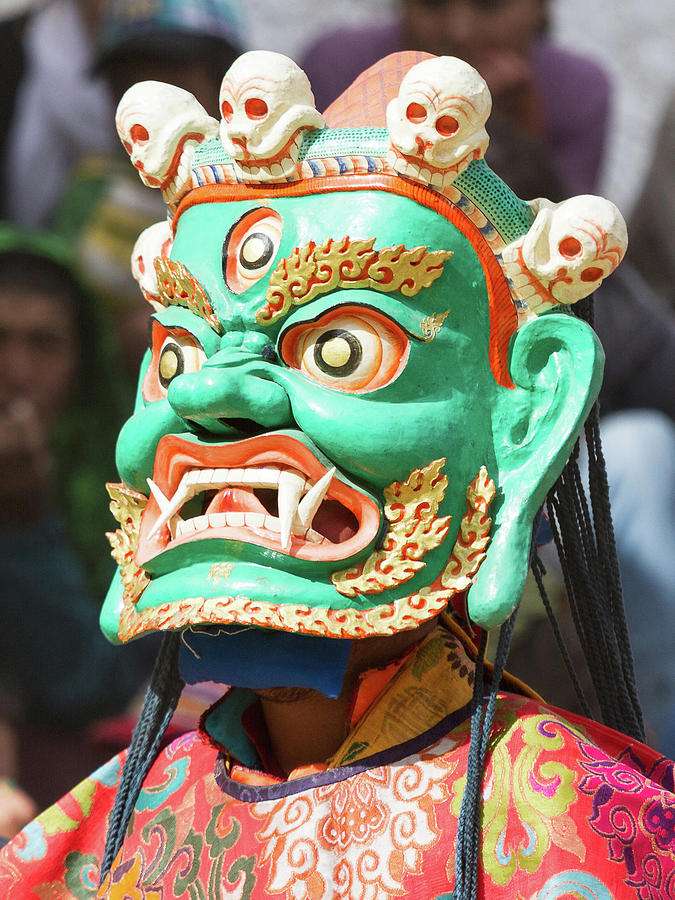
Well, the simple answer is that this isn’t important to the plot. But I’ve considered two ideas to work around this: One, his younger religious brothers are likely still studying under the Master. And two, the older generations⁠—the ones serving in the monastic army⁠—probably don’t know what Monkey looks like because advanced disciples, within the present story, are made to wear a host of fierce, multi-colored masks (fig. 1) as a way to forsake their identity and subsume the self into deep spiritual and martial cultivation. They would represent the negative thoughts and emotions that keep humans trapped in the illusionary world of Saṃsāra and chained to the wheel of rebirth. Perhaps the face becomes more human and peaceful-looking as the students progress through their training. 

Monk in dharmapala mask performs a mystery dance of Tantric Tibetan Buddhism  on Cham Dance Festival Photograph by Oleg Ivanov

Fig. 1  – “Monk in dharmapala mask performs a mystery dance of Tantric Tibetan Buddhism on Cham Dance Festival” (larger version). Photo by Oleg Ivanov. Image found here.

Also, in my version of the story universe, all immortals and deities attain a halo upon achieving divine status. Here, for example, is a photomanipulation of a haloed Sun Wukong by Elijah McTaggart and myself. Take note of the fiery aureola engulfing the halo. This will come into play shortly (fig. 2). I imagine that these halos/aureolas respectively spin and shine brighter when a divinity’s spiritual power is used.

Fig. 2 – The Monkey King with a halo (larger version). As seen on deviantart. Based on my original photomanipulation.

III. Why he is really kicked out

The reason I’ve devised is connected to one of the aforementioned fights between Monkey and his older religious brothers or sisters. Perhaps Sun is attacked by multiple powerful assailants at once (just like the historical Shaolin monk), and when they start to overwhelm him, his anger ignites his halo, which begins to furiously spin and produce a radiant splendor. Instantly, he takes on a titanic cosmic form, growing 100,000 feet (30,480 m) tall and stomping on his assailants. At the same time, his docile-looking mask cracks and reverts to it’s original, fierce form. This, combined with a fiery aureola, gives him the appearance of a giant Dharmapala (Ch: Fahu, 法護), a wrathful “Protector of the Dharma” (Buddhist Law) (fig. 3) (Buswell & Lopez, 2014, pp. 249-250). This display of raw, untamed spiritual power frightens his older religious brethren. Subodhi himself is also taken aback as Monkey exhibits a great, fiery anger, while also manifesting advanced cultivation techniques that haven’t even been taught to him yet⁠—a testament to his great spiritual intelligence. The Master fears that this rage, combined with Monkey’s demonstrated talent for exponential spiritual growth and perhaps a problem with controlling this power (given Sun’s short years of study), will lead him down the path to villainy. 

This brings us back to the pine tree incident. Perhaps the fight causes Subodhi to uncharacteristically allow Monkey a chance to visit his generational cohort. And when Sun acquiesces to their requests to see his transformation powers, the Master uses this as an opportunity to expel his student.  

Fig. 3 – A modern thangka of the Six-Armed Mahakala dharmapala (larger version). Image found here.

IV. My thoughts

I like this idea because it foreshadows Sun’s cosmic transformations throughout the novel (ch. 3, 6, 61, and 97). It also foreshadows his later mischief throughout the cosmos and eventual rebellion. 


Update: 05-16-22

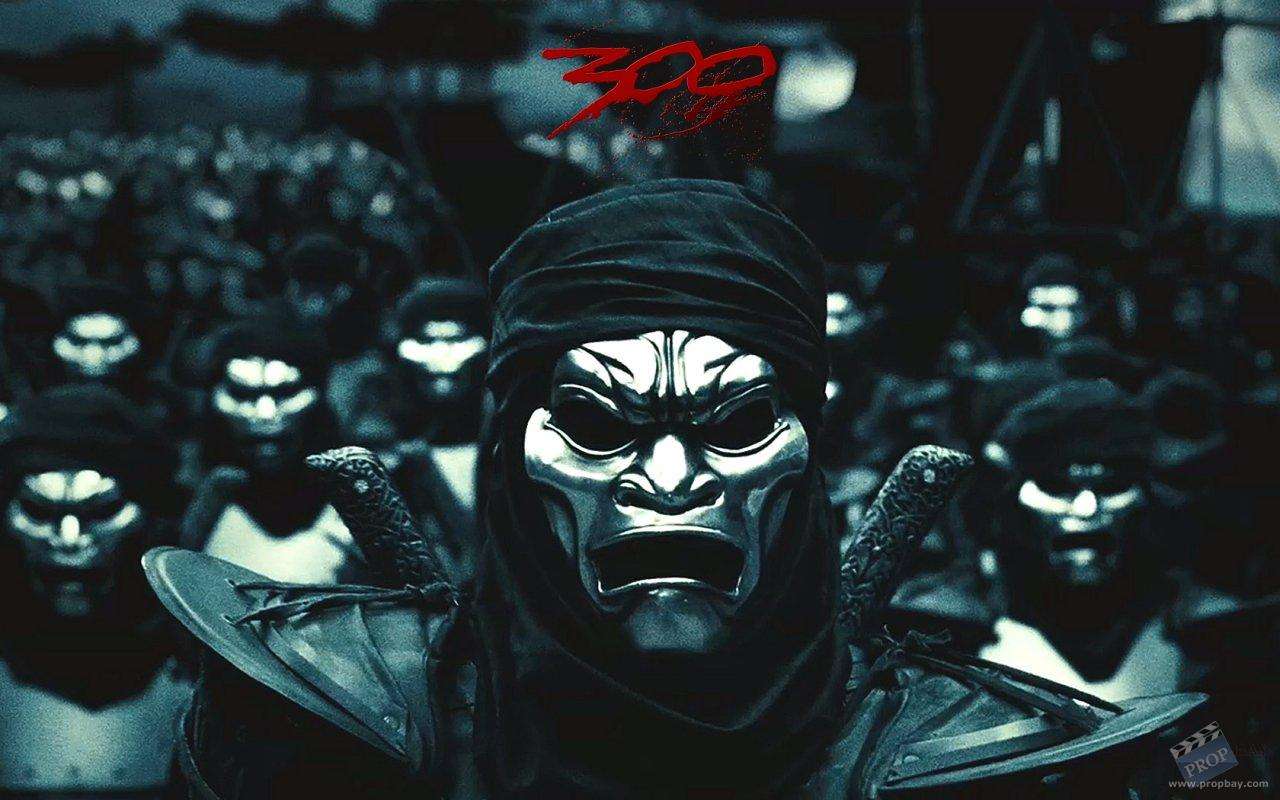
I imagine Master Subodhi’s mask-wearing monastic army would have an ominous feel to them just like the stylized Persian “immortals” from the film 300 (2006) (fig. 4). 

Fig. 4 – The Persian Immortals from 300 (2006) (larger version).


Update: 05-20-22

On second thought, a better mask would emulate the six paths of reincarnation in Buddhist cosmology:

As before, each would indicate the level of a disciple’s spiritual attainment. Perhaps Master Subodhi’s army would have different units of each category, each one being more powerful than the last.


Update: 05-24-22

Some readers might question why I’ve included so many Buddhist elements if Master Subodhi is a Daoist immortal. While this is true, I choose instead to refer to him as a “Buddho-Daoist Sage” as he preaches aspects of both religions in his lectures: 

With words so florid and eloquent
That gold lotus sprang from the ground.
The doctrine of three vehicles he subtly rehearsed,
Including even the laws’ minutest tittle.
The yak-tail waved slowly and spouted elegance:
His thunderous voice moved e’en the Ninth Heaven.
For a while he lectured on Dao;
For a while he spoke on
Chan
To harmonize the Three Parties is a natural thing.
One word’s elucidation filled with truth
Points to the birthless showing nature’s mystery (Wu & Yu, 2012, p. 122) (emphasis mine).

He even advocates for his students to become Buddhas. For example, the poem that Subodhi uses to reveal the secret of immortality to Monkey ends with: “When that’s done, be a Buddha or immortal at will!” (Wu & Yu, 2012, p. 120).

It’s also important to remember that Master Subodhi is based on Subhuti, a historical disciple of the Buddha.


Update: 08-27-23

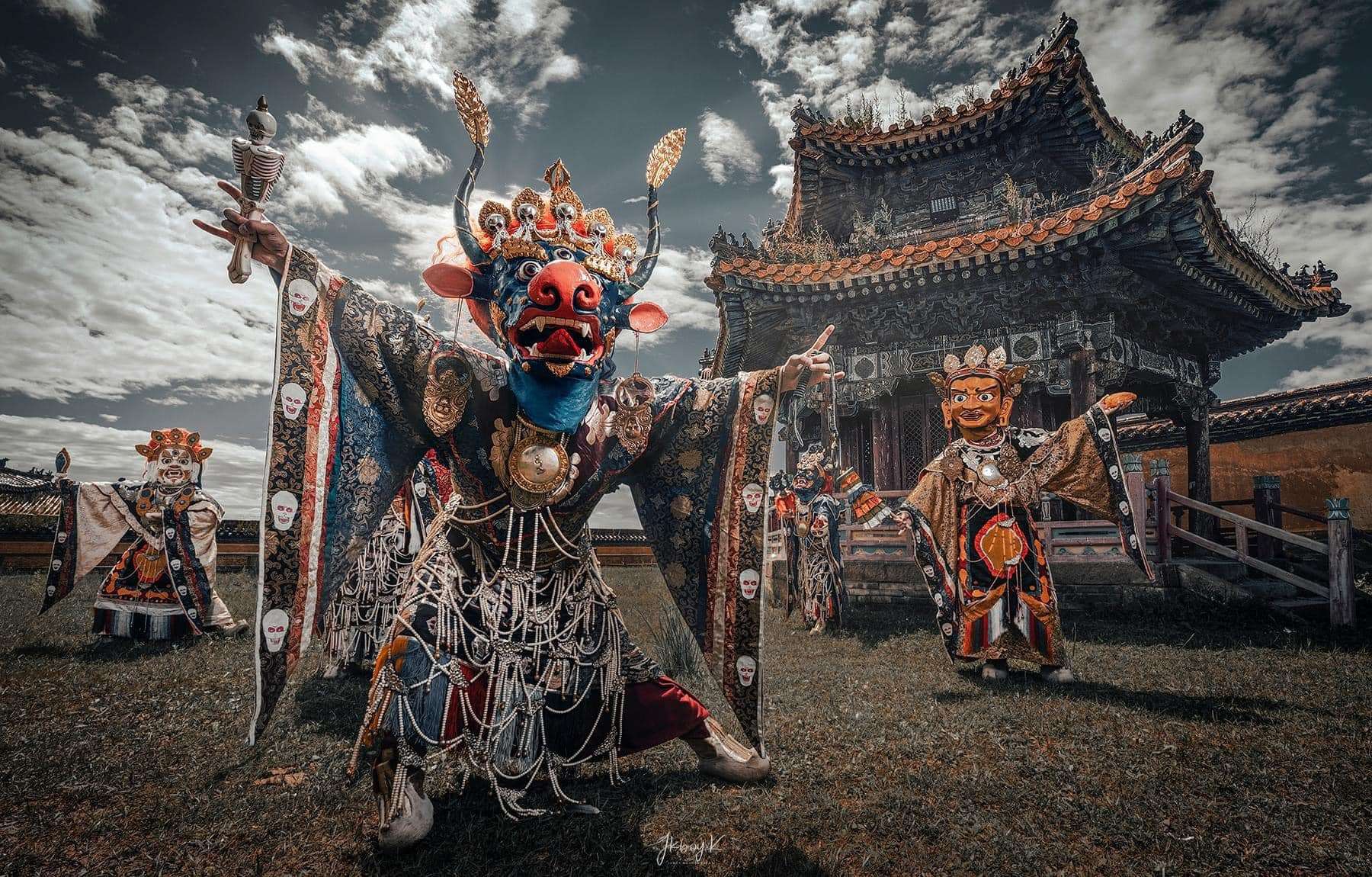
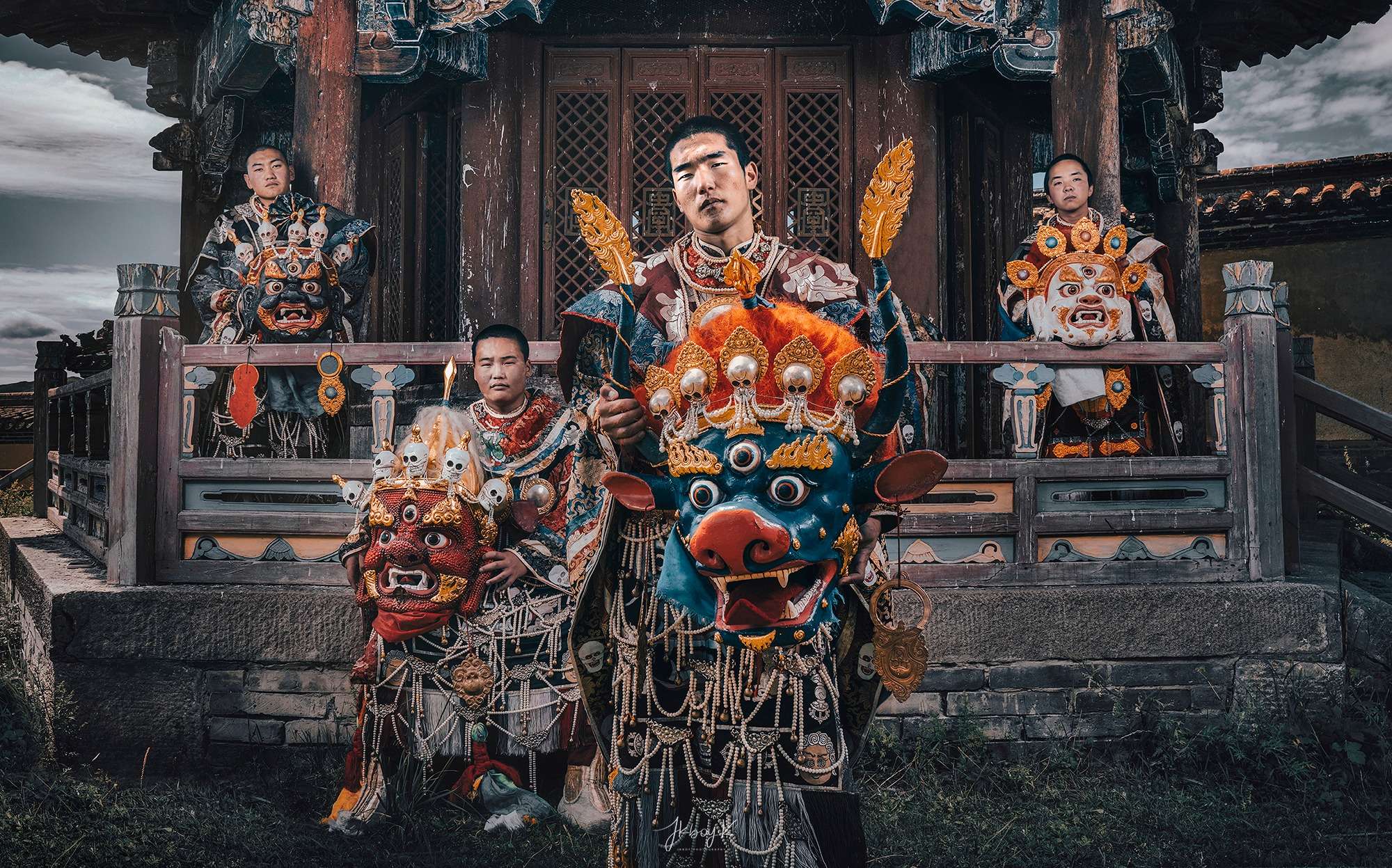
Above, I suggested that Subodhi’s advanced students could wear masks similar to the Tibetan Cham dancers. Well, someone on Facebook posted lovely images of said dancers by the photographer “JKBoy” Jatenipat Ketpradit (fig. 5-7). I just wanted to share some of them so that readers will have a better understanding of what the students might look like.

Fig 5 (top) – The monks performing the Cham dance (larger version). Fig. 6 (middle) – The dancers with their masks off (larger version). Fig. 7 (bottom) – A portrait of a Cham dancer (larger version). Images found here. Copyright Jatenipat Ketpradit.

Notes:

1) I quote the scene of his expulsion below:

“You, Wukong, come over here! I ask you what sort of exhibition were you putting on, changing into a pine tree? This ability you now possess, is it just for showing off to people? Suppose you saw someone with this ability. Wouldn’t you ask him at once how he acquired it? So when others see that you are in possession of it, they’ll come begging. If you’re afraid to refuse them, you will give away the secret; if you don’t, they may hurt you. You are actually placing your life in grave jeopardy.” “I beseech the master to forgive me,” Wukong said, kowtowing. “I won’t condemn you,” said the Patriarch, “but you must leave this place.” When Wukong heard this, tears fell from his eyes. “Where am I to go, Teacher?” he asked. “From wherever you came,” the Patriarch said, “you should go back there.” “I came from the East Purvavideha Continent,” Wukong said, his memory jolted by the Patriarch, “from the Water-Curtain Cave of the Flower-Fruit Mountain in the Aolai Country.” “Go back there quickly and save your life,” the Patriarch said. “You cannot possibly remain here!” “Allow me to inform my esteemed teacher,” said Wukong, properly penitent, “I have been away from home for twenty years, and I certainly long to see my subjects and followers of bygone days again. But I keep thinking that my master’s profound kindness to me has not yet been repaid. I, therefore, dare not leave.” “There’s nothing to be repaid,” said the Patriarch. “See that you don’t get into trouble and involve me: that’s all I ask.” Seeing that there was no other alternative, Wukong had to bow to the Patriarch and take leave of the congregation. “Once you leave,” the Patriarch said, “you’re bound to end up evildoing. I don’t care what kind of villainy and violence you engage in, but I forbid you ever to mention that you are my disciple. For if you but utter half the word, I’ll know about it; you can be assured, wretched monkey, that you’ll be skinned alive. I will break all your bones and banish your soul to the Place of Ninefold Darkness [Jiuyou zhi chu, 九幽之處], from which you will not be released even after ten thousand afflictions!” “I will never dare mention my master,” said Wukong. “I’ll say that I’ve learned this all by myself.” Having thanked the Patriarch, Wukong turned away, made the magic sign, pulled himself up, and performed the cloud-somersault (Wu & Yu, 2012, pp. 124-125).

2. Ter Haar (2021) provides a list of such generational names:

Table 1. The use affiliation characters by People of the Way

Dao 道 (Huzhou, Jiaxing, Taizhou, Suzhou) (13 cases) – The Way
Zhi 智 (Huzhou, Jiaxing) (6 cases) – Wisdom
Yuan 圓 (Huzhou, Jiaxing, Taizhou) (5 cases) – Complete
Pu 普 (Taicang, Taizhou, Huating) (4 cases) – Universal
Miao 妙 (Deqing, Jiaxing) (3 cases) – Wondrous
Jue 覺 (Huating) (1 case) – Awareness (p. 39)

Sources:

Buswell, R. E., & Lopez, D. S. (2014). The Princeton Dictionary of Buddhism. Princeton University Press.

Ter Haar, B. (2021). The White Lotus Teachings in Chinese Religious History. Netherlands: Brill.

Wu, C. & Yu, A. C. (2012). The Journey to the West (Vol. 1) (Rev. ed.). Chicago, Illinois: University of Chicago Press.