The Possible Origin of Wanfu Temple’s Multiple Great Sages

Last updated: 03-22-2026

The Wanfu Temple (Wanfu an, 萬福庵) of Tainan, Taiwan worships Sun Wukong in his guise as the Great Sage Equaling Heaven (Qitian dasheng, 齊天大聖). Most surprisingly, they recognize more than one Great Sage, each with his own function. These include a trinity, three in administrative positions, and an army of dozens of other Monkeys. In this article, I would like to explore the possible origins of this multifaceted pantheon.

Table of Contents

1. Possible Origins

1.1. The JTTW Zaju

The idea of multiple Great Sages goes back centuries to a Yuan-Ming zaju play by Yang Jingxian (杨景賢) titled Journey to the West (Xiyouji, 西遊記, “JTTW zaju” hereafter), which predates the similarly named novel (“JTTW” hereafter) by two hundred years. Scene nine sees Monkey introduce himself, his past misdeeds, and his family. He claims to be one of several siblings:

This small sage has five brothers and sisters: My elder sister is the “Venerable Mother of Mount Li” (Lishan Laomu, 驪山老母), my second sister is the “Holy Mother Wuzhiqi” (Wuzhiqi Shengmu, 巫支祇聖母), my older brother is the “Great Sage Equaling Heaven” (Qitian Dasheng, 齊天大聖), I myself am the “Great Sage Reaching Heaven” (Tongtian Dasheng, 通天大聖), and my younger brother is the “Third Son Shuashua” (Shuashua Sanlang, 耍耍三郎) (based on Dudbridge, 1970, p. 110). [1]

小聖弟兄、姊妹五人,大姊驪山老母,二妹巫枝祗聖母,大兄齊天大聖,小聖通天大聖,三弟耍耍三郎。

Astute readers will notice a discrepancy with the novel. Sun Wukong is referred to here as the Great Sage Reaching Heaven, while an older brother is known as the Great Sage Equaling Heaven. Sun (2018) suggests that the older brother is the result of confusing similar titles given to Monkey during the long history of the story cycle (pp. 44-45). It’s interesting to note, however, that the female siblings have their own history. The Venerable Mother of Mount Li (驪/黎山) was historically worshiped as a deity from at least the Song Dynasty (960–1279), and myths often associate her with the creation/flood-conquering goddess Nuwa (女媧) (Theobald, 2010; Yang & An, 2005, pp. 222-223). Wuzhiqi (also written 無支祁) is a monkey-like flood demon appearing in stories as far back as the Tang Dynasty (618–907) (Andersen, 2001). So, both sisters are associated with flooding.

1.2 JTTW – The “Sun Family”

The novel provides a possible answer to the mystery of the multiple Great Sages. After returning home to the Mountain of Flowers and Fruit in chapter two, Wukong tells his children about his new name:

“My surname is Sun,” replied Wukong, “and my religious name is Wukong.” When the monkeys heard this, they all clapped their hands and shouted happily, “If the great king is Elder Sun, then we are all Junior Suns, Suns the Third, small Suns, tiny Suns—the Sun Family, the Sun Nation, and the Sun Cave!” (Wu & Yu, 2012, vol. 1, p. 130)

悟空道:「我今姓孫,法名悟空。」眾猴聞說,鼓掌忻然道:「大王是老孫,我們都是二孫、三孫、細孫、小孫一家孫、一國孫、一窩孫矣!」

This would explain the army of monkey soldiers who do the bidding of the aforementioned trinity.

1.3 The Linshui Novel

Another Great Sage appears in the pious novel Pacification of the Demons of Linshui (Linshui Pingyao zhuan, 臨水平妖傳, c. 17th or 18th century; “The Linshui novel” hereafter). The narrative recounts the miraculous deeds and deification of Chen Jinggu (陳靖姑) (fig. 1), more commonly known as the Lady of Linshui (臨水夫人), a highly popular Fujian and Taiwanese protector goddess of pregnancy and children. The novel depicts the Cinnabar Cloud Great Sage (Danxia Dasheng, 丹霞大聖) as a red-furred, mulberry staff-wielding monkey who, just like Sun Wukong, stole heavenly peaches and survived a turn in Laozi’s furnace. He teams up with another demon to attack the goddess and her heavenly companion, but both are beaten back. The Great Sage is so badly burnt by a magic flaming pearl used by the companion that it takes an entire year for him to heal his wounds. One year later, he resumes his misdeeds and takes on the appearance of a young man, causing so much havoc that the real human is chased from his village. The young man calls on the goddess, who promptly captures the Great Sage and castrates him “in order, she says, to open to him the way of true asceticism stripped of desire, of true wisdom allowing him to obtain the ‘just fruits’, zhengguo [正果]” (Baptandier, 2008, p. 111). After being deprived of his manhood, the novel reveals the Cinnabar Cloud Great Sage to be the “double” of Sun Wukong. He goes on to become an agent of justice charged with conquering demons. [2]

Fig. 1 – A modern altar statue of the Lady of Linshui (larger version).

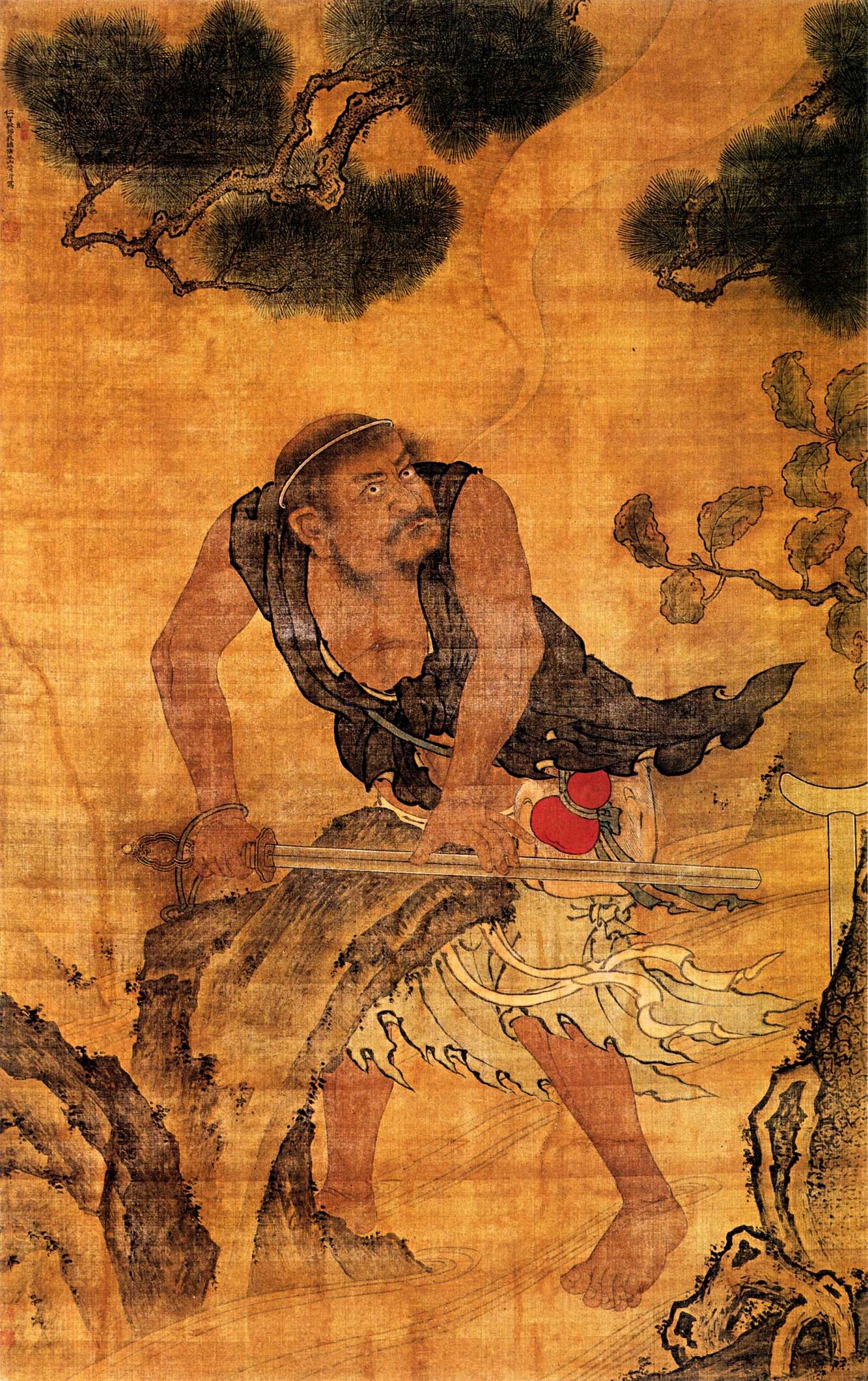
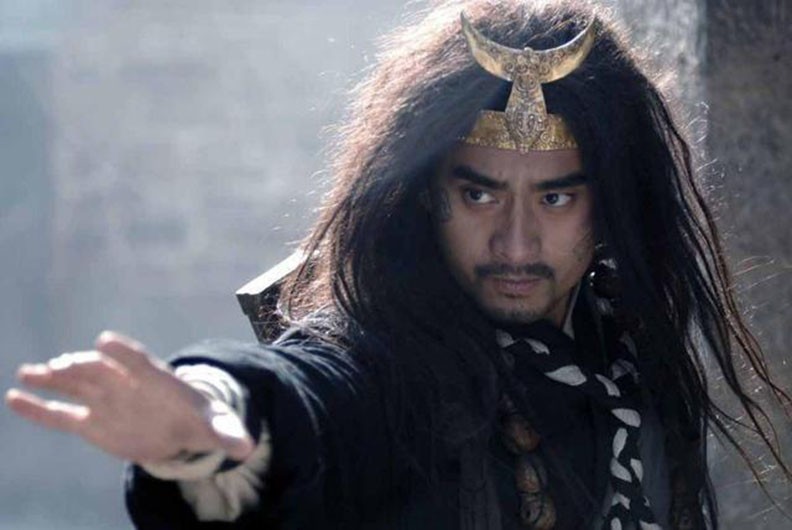
The Cinnabar Cloud Sage being Sun Wukong’s double is most likely based on the Six-Eared Macaque (Liu‘er mihou, 六耳獼猴) from JTTW chapters 56 to 58 (fig. 2 and 3). [3] This demon takes on Monkey’s form, much like the Cinnabar Cloud Great Sage does the young man in the aforementioned novel, and causes all sorts of trouble. When the twins seek the Buddha’s wisdom to tell one from the other, the Enlightened One reveals the fraud to be one of four supernatural primates, the other three being the intelligent stone monkey, the red-buttocked horse-monkey, and the long-armed gibbon. The demon attempts to flee but is eventually killed by Sun Wukong (Wu & Yu, 2012, vol. 3, pp. 112-116).

Fig. 2 (left) – An artist’s depiction of the six-eared macaque. Fig. 3 (right) – A production still of Sun Wukong fighting his evil double (video).

1.4. The Religious Trinity

A religious tradition in Fujian appears to borrow from both the Yuan-Ming zaju play and The Linshui novel to derive a trinity of familiar Great Sages. These are the red-faced Cinnabar Cloud Great Sage (丹霞大聖), the black-faced Great Sage Reaching Heaven (通天大聖), and the white-faced Shuashua Sanlang (耍耍三郎/爽爽三郎) (fig. 4) (Chinese Monkey God(s)?, n.d.; Wu, n.d.). Therefore, this plethora of Great Sages could have influenced the many venerated in Wanfu temple.

Fig. 4 – An example of the Three Great Sages from a Lady of Linshui temple (larger version).

2. Updates

Update: 04-21-18

Elliott (1955/1990) describes a Chinese medium in Singapore who channels two of five Great Sages.

According to the current version of the legend, for which no supporting authority can be found elsewhere, there are five Monkey Brothers who may appear when the shen [神, god] is invoked. Each is likely to appear for a number of years before handing over to another brother, unless for any special reason the others have to be consulted. The first Monkey Brother is the wisest and most quiescent of them all. When possessing the dang-ki [童乩, the medium] he can be identified by the manner in which he shades his eyes with his right hand while gazing into the distance. The second Monkey Brother is of fiercer temperament, and can be identified by the manner in which he scratches at his ears as a monkey would. He has a predilection also for eating fire and fruit. The third, fourth and fifth Monkey Brothers are more and more irascible, but there is no detailed knowledge concerning their characteristics since they have never yet appeared. So far it is only the second Monkey Brother who possesses the dang-ki, although the eldest brother is sometimes deferred to in difficult cases and may make a temporary appearance (p. 82).

This shows the concept of multiple Great sages is not restricted to Fujian or Taiwan.


Update: 04-24-18

Another possible avenue opens to us thanks to Monkey’s resemblance to the Chinese god Sire Thunder (Leigong, 雷公). Sun Wukong is compared to the weather deity numerous times throughout the novel (Wu & Yu, 2012, vol 3, p. 352, for example). The connection between the two is an old one, for two tales from the early Song Dynasty (960–1279) portray the thunder god as having the form of an ape with flashing, mirror-like eyes (Meulenbeld, 2007, p. 72). These sound very much like Sun Wukong’s fiery eyes and diamond pupils. Most importantly, tales from the same time period refer to the thunder deity having numerous brothers. Their attributes are similar to the aforementioned five Great Sages:

We are five brothers. If you want to hear the sound of thunder, only call Thunder the old, and Thunder two; then you will have an immediate response. But Thunder five is tough and hot-tempered; if there is no urgent business, you must not call him (Meulenbeld, 2007, p. 69).

The concept of five thunder brothers was solidified by the second half of the Song Dynasty and remains a common belief to this day (Meulenbeld, 2007).


Update: 03-22-26

It dawned on me that a story element from chapters 34 and 35 of the original novel might reference the aforementioned triad of divine brothers from religion and theater. The specific arc sees Monkey escaping capture three times, and in each instance, he presents himself as a brother come to rescue him/them. The following paragraph sums up the event nicely:

The little fiend dashed inside to make the report, saying, “Great King, there is a so-called Sun Pilgrim showing up outside our door.” “Worthy Brother,” said the old demon, deeply shaken, “that’s bad! We have stirred up a whole nest of pestilence! Look! The yellow-gold rope has caught a Pilgrim Sun, while the gourd has stored up a Grimpil Sun. How can it be that there is another Sun Pilgrim? It must be that they have several brothers and they have all arrived” (Wu & Yu, 2012, vol. 2, p. 133).

那小妖急入裡報道:「大王,門外有個甚麼行者孫來了。」老魔大驚道:「賢弟,不好了,惹動他一窩風了。幌金繩現拴著孫行者,葫蘆裡現裝著者行孫,怎麼又有個甚麼行者孫?想是他幾個兄弟都來了。」

These names require some explanation since wordplay is involved. I have used color-coding to make the subject easier to understand. As I note hereGrimpil Sun (Zhexing Sun, ) and Sun Pilgrim (Xingzhe Sun, ) are variants of Monkey’s religious name, Pilgrim Sun (Sun xingzhe, ). 

Notes:

1) The name of the youngest brother could be translated as “Shuashua, the third son” considering the god Erlang (二郎) is literally the “Second Son.” Shuashua is after all the third of three sons.

2) See chapter four in Baptandier (2008) for a complete description of the life and deeds of the Cinnabar Cloud Great Sage.

3) Anthony Yu (Wu & Yu, 2012) suggests that the concept of six ears “may have been derived from the common Buddhist saying, ‘The dharma is not to be transmitted to the sixth ear [i.e., the third pair or person] 法不傳六耳'” (vol. 3, p. 387 n. 7).

Sources:

Andersen, P. (2001). The Demon Chained Under Turtle Mountain: The History and Mythology of Chinese River Spirit Wuzhiqi. Berlin: G-und-H-Verl.

Baptandier, B. (2008). The Lady of Linshui: A Chinese Female Cult. Stanford, Calif: Stanford University Press.

Chinese Monkey God(s)? – What You Don’t Know. (n.d.). Retrieved from http://taoist-sorcery.blogspot.tw/2015/08/chinese-monkey-gods-what-you-dont-know.html

Dudbridge, G. (1970). The Hsi-yu chi: A study of Antecedents to the Sixteenth-Century Chinese Novel. Cambridge: Cambridge Univ. Press.

Elliott, A. J. (1990). Chinese Spirit-Medium Cults in Singapore. London: The Athlone Press. (Original work published 1955)

Meulenbeld, M. R. E. (2007). Civilized Demons: Ming Thunder Gods from Ritual to Literature (Doctoral dissertation). Available from ProQuest Dissertations and Theses database (UMI No: 3247802).

Sun, H. (2018). Transforming Monkey: Adaptation and Representation of a Chinese Epic. Seattle: University of Washington Press.

Theobald, U. (2010). Lishan laomu 驪山老母, the Old Lady from Mt. Lishan. Retrieved from http://www.chinaknowledge.de/Literature/Religion/personslishanlaomu.html.

Wu, C., & Yu, A. C. (2012). The Journey to the West (Vols. 1-4) (Rev. ed.). Chicago, Illinois: University of Chicago Press.

Wu, J. (n.d.). The Three Monkey Sages of Lin Shui Palace. Retrieved from http://javewutaoismplace.blogspot.tw/2014/01/three-monkey-sages-of-lin-shui-palace.html

Yang, L., & An, D. (2005). Handbook of Chinese Mythology. Santa Barbara, Calif.: ABC-CLIO.

The Origin of the Monkey King’s Punishment in Laozi’s Furnace

The beginning of Journey to the West (Xiyouji西遊記, 1592; “JTTW” hereafter) chapter seven sees Sun Wukong transported to the realm above to be executed for his rebellion against the primacy of heaven. However, his immortal body proves impervious to blades, fire, and lightning, leading Laozi to theorize that Monkey’s extreme invulnerability is the result of having consumed large quantities of immortal peaches, wine, and elixir that were later refined in his stomach “to form a single solid mass” (Wu & Yu, 2012, vol. 1, p. 188). The Daoist high god goes on to suggest that the demon be subjected to his Brazier of Eight Trigrams (Bagua lu, 八卦爐) in order to separate out the elixir and make his subsequently weakened body susceptible to death:

Arriving at the Tushita Palace, Laozi loosened the ropes on the Great Sage, pulled out the weapon from his breastbone, and pushed him into the Brazier of Eight Trigrams. He then ordered the Daoist who watched over the brazier and the page boy in charge of the fire to blow up a strong flame for the smelting process. The brazier, you see, was of eight compartments corresponding to the eight trigrams of Qian [☰/乾], Kan [☵/坎], Gen [☶/艮], Zhen [☳/震], Xun [☴/巽], Li [☲/離], Kun [☷/坤], and Dui [☱/兌]. The Great Sage crawled into the space beneath the compartment that corresponded to the Xun trigram. Now Xun symbolizes wind; where there is wind, there is no fire. However, wind could churn up smoke, which at that moment reddened his eyes, giving them a permanently inflamed condition. Hence they were sometimes called Fiery Eyes and Diamond Pupils (Wu & Yu, 2012, vol. 1, p. 189).

那老君到兜率宮,將大聖解去繩索,放了穿琵琶骨之器,推入八卦爐中,命看爐的道人、架火的童子,將火搧起鍛煉。原來那爐是乾、坎、艮、震、巽、離、坤、兌八卦。他即將身鑽在巽宮位下。巽乃風也,有風則無火。只是風攪得煙來,把一雙眼火煼紅了,弄做個老害病眼,故喚作「火眼金睛」。

Laozi checks the furnace forty-nine days later expecting ashes, but he is surprised when Sun emerges and kicks over the mystical oven (fig. 1). This episode has two likely sources.

Fig. 1 – Monkey knocking over Laozi’s furnace (larger version).

Table of Contents

1. Sources

1.1. The Story

The first source is The Story of How Tripitaka of the Great Tang Procures the Scriptures (Da Tang Sanzang qujing shihua大唐三藏取經詩話, c. late-13th century; “The Story” hereafter), the earliest known published edition of JTTW. The 17th chapter describes the trials of Daffy (Chi’na, 癡那), a merchant’s son, at the hands of his evil stepmother, a woman of the Meng clan (孟氏). She resents the boy as he stands to inherit all of his father’s wealth, leaving her son with nothing. Therefore, she and her handmaiden try to kill the heir by respectively boiling him in a pot, ripping out his tongue, starving him, and finally pushing him into a river, but each time he is magically saved by heaven. For instance, after four days boiling in the pot, Daffy emerges unscathed and claims:

[T]he iron cauldron changed into a lily pad on which I sat, surrounded by the cool waters of a pond. I could sleep or just sit there. It was very comfortable (Wivell, 1994, p. 1203).

一釜變化蓮花坐,四伴是冷水池;此中坐臥,甚是安穩。

Mair (1987) notes that the story of a youth being tortured by his stepmother is based on a Dunhuang transformation text with two versions dated 946 and 949, respectively (p. 43). The text focuses on the trials of the future Emperor Shun. [1] However, the boiling episode does not appear in the story.

1.2. Laughing at the Dao

The second source is Laughing at the Dao (Xiaodao lun, 笑道論, 570), an anti-Daoist polemic written as part of a court debate between Buddhist and Daoist representatives vying for state sponsorship. One section recounts Laozi’s rebirth in the mortal world and his later attempt to convert a king in India:

He [Laozi] had (long) hairs on the temples and his head was hoary; his body was sixteen feet tall; he wore a heavenly cap and held a metal staff. He took Yin Xi with him to convert the barbarians. (Once arrived in India) he withdrew to the Shouyang 首陽 mountains, covered by a purple cloud. The barbarian king suspected him of sorcery (妖). He (attempted) to boil him in a cauldron, but (the water) did not grow hot … [2]

頭鬢皓首身長丈六。戴天冠捉金杖。將尹喜化胡。隱首陽山。紫雲覆之。胡王疑妖。鑊煮而不熱。

I find this source particularly amusing because the high god of Daoism is in essence subjected to the same punishment as the one that he later suggests for Sun Wukong!

2. The Furnace in Daoist Alchemy

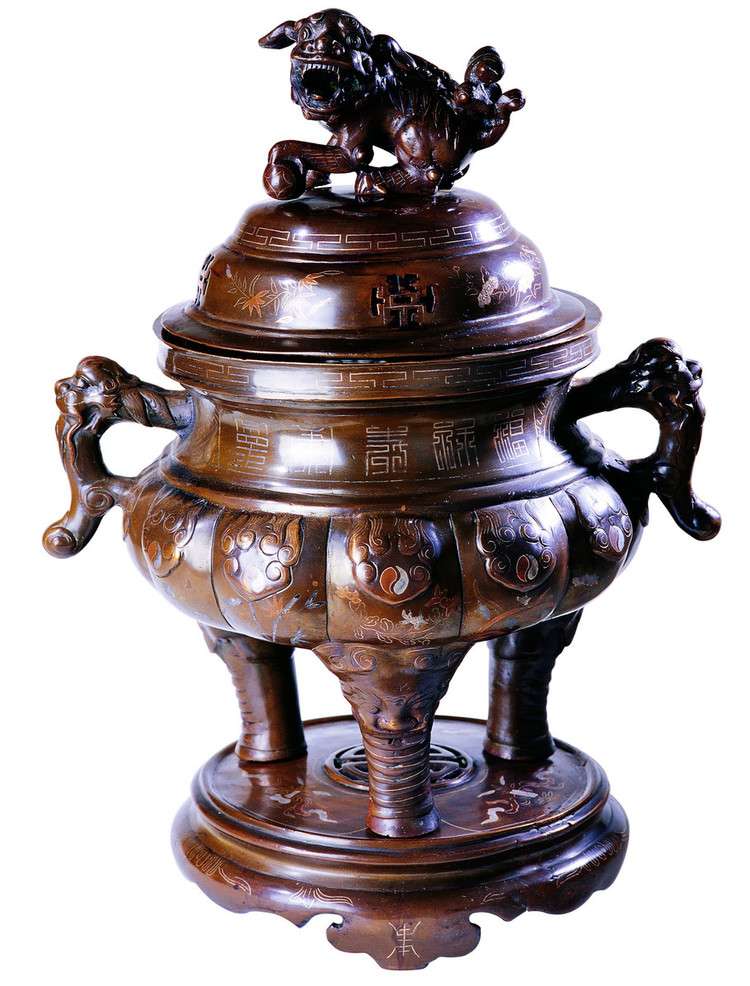
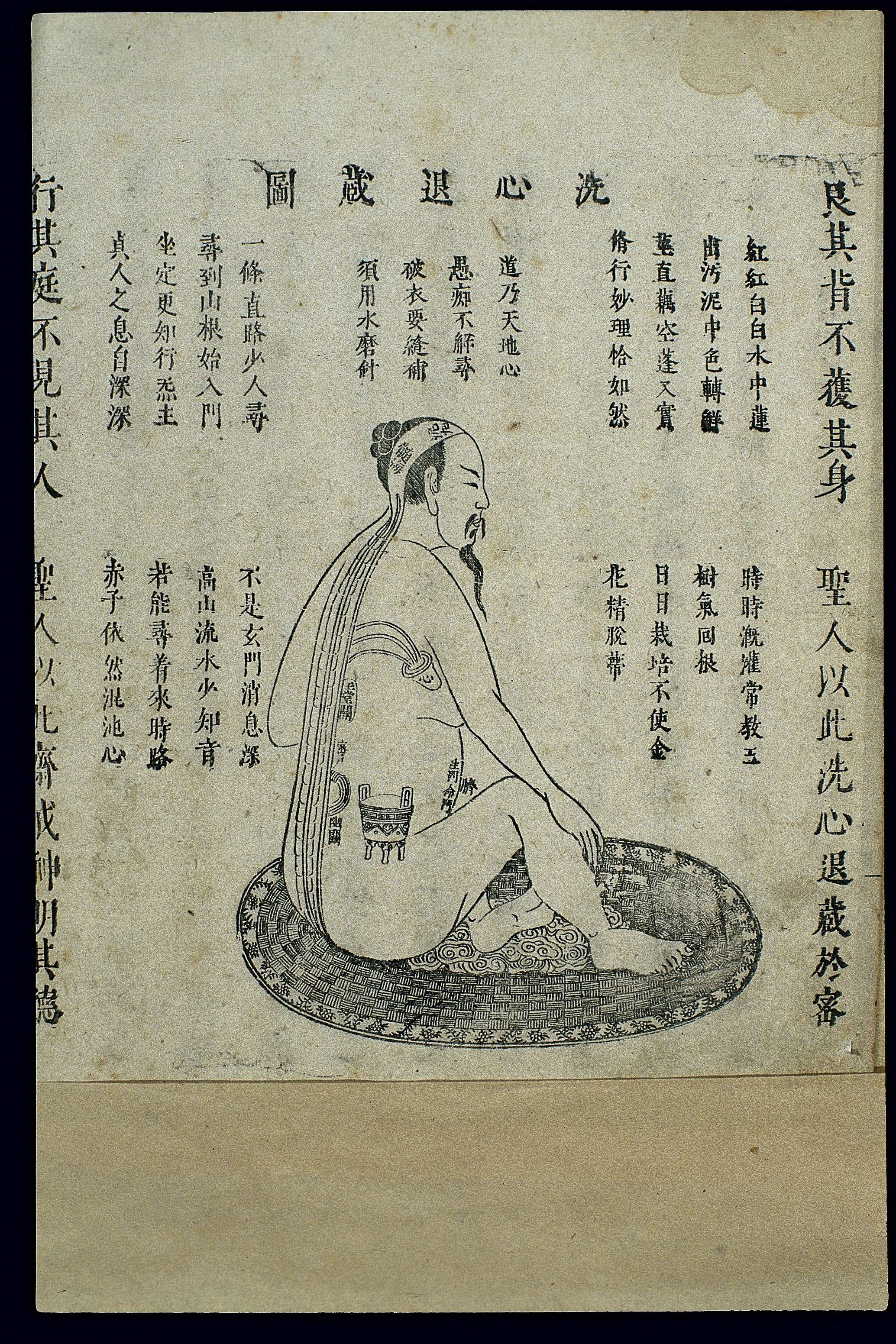
The furnace has two meanings in Daoist alchemy. The first refers to the physical vessel and stove (dinglu, 鼎爐) combo used in external alchemy (waidan, 外丹) to smelt the elixir of immortality (fig. 2). Kim (2008) describes the various parts and models of this contraption:

The reaction vessel has fire around it (when it is placed inside the heating apparatus), under it (when it is placed over the heating apparatus), or above it (when it is entirely covered by ashes inside the heating apparatus). It may contain an inner reaction-case in which the ingredients are placed. In a more complex model, a “water-vessel” containing water and a “fire-vessel” containing the ingredients can be assembled, the former above and the latter below or vice versa. The vessel must be hermetically closed and should not bear any openings or cracks.

The heating apparatus has fire within it and is often placed over a platform or “altar” (tan 壇). The openings on the wall sides allow air to circulate, while those on the top serve to settle the reaction vessel or to emit flame and smoke. One of the main functions of the heating apparatus is to control the intensity and duration of the heat. (pp. 360-361)

Fig. 2 – An ornate wooden replica dinglu reminiscent of the metal type used in external alchemy (larger version). Fig. 3 – An early 17th-century woodblock print depicting a Daoist practitioner’s dantian as a ding vessel (larger version).

The concept of consuming alchemically derived elixirs is first mentioned in Discourses on Salt and Iron (Yantie tun, 鹽鐵論, c. 60 BCE). Later, the Token for the Agreement of the Three According to the Book of Changes (Zhouyi cantong qi, 周易參同契, c. 2nd century CE; “The Token” hereafter) standardized the use of toxic materials, such as lead and mercury, for making said elixir, and this idea remained entrenched until the Tang Dynasty (618–907 CE) (Pregadio, 2008, pp. 1002-1003). External alchemy was eventually superseded in popularity by internal alchemy (neidan, 内丹) from the Tang onward and was still popular during the Ming Dynasty (1368–1644 CE) when the standard 1592 version of JTTW was published.

The second meaning is the human body as a metaphor for the furnace—i.e. internal alchemy. The Token considers “the 5 organs, 12 vessels, 24 vertebrae, and 360 joints … all part of this body dinglu” (Wang, 2012, p. 192). The corporal furnace, the ingredients (yao, 藥), and the firing time (huohou, 火候) combine to make the “three essentials” (sanyao, 三要) of internal alchemy (Robinet, 2008). The ingredients are yin and yang energy, and the firing time is the measured absorption of said energies and the time at which this activity is partaken (Wang, 2012, pp. 192-193).

3. External vs Internal in JTTW

Laozi’s use of the Eight Trigrams Furnace stands as a perfect example of external alchemy, and Sun’s use of breathing exercises and qi circulation serves as a prime example of internal alchemy. So how are these competing processes depicted in JTTW? Well, recall that the external type had long been supplanted by the internal type by the time the novel was published. Hence, one could say Laozi’s methods were dated compared to those used by Monkey. This might then explain a surprising story element from JTTW chapter seven.

When Sun first escapes from the furnace, “Laozi rushes up to clutch at him, only to be greeted by such a violent shove that he falls head over heels while the Great Sage escapes” (based on Wu & Yu, 2012, vol. 1, p. 189). Think about that for a moment. Monkey, a proponent of internal alchemy, physically assaults the Daoist high god, a proponent of external alchemy. Add to this the fact that Sun seemingly only respects/fears immortals that promote internal alchemy—a good example being his first master, Patriarch Subodhi (Xuputi zushi, 須菩提祖師)—and a picture begins to form: perhaps this is the JTTW author-compiler’s way of touting the superiority of the internal over the external. What do you think?

4. Conclusion

Monkey’s time in Laozi’s furnace likely borrows from (one or both of) two sources, the story of a child magically surviving boiling in The Story, the 13th century CE precursor of JTTW, and the story of Laozi magically surviving boiling from Laughing at the Dao, an anti-Daoist polemic of the 6th-century CE. The latter is humorous as it shows Monkey’s punishment is a recapitulation of the high god’s punishment.

JTTW presents two forms of alchemy: the concept of Laozi’s furnace refers to “external” alchemy and harkens back to Han Dynasty China when alchemists used such furnaces to fire toxic mercury and lead in an attempt to produce an elixir of immortality; Sun Wukong’s use of breathing exercises and qi circulation is a prime example of “internal” alchemy in which the body is used as the furnace to fire the immortal elixir. External alchemy fell out of favor during the Tang and was superseded by Internal alchemy from then on into the Ming, when JTTW was published. Therefore, the novel portrays the high god of Daoism as a proponent of the dated external school, while immortals like Monkey are portrayed as proponents of the then current internal school.

Notes:

1) For a complete translation, see Bodman (1994).

2) See Zürcher & Teiser (2007), pp. 299-300 and 431 n. 53.

Sources:

Bodman, R. W. (1994). The Transformation Text on the Boy Shun’s Extreme Filial Piety. In V. H. Mair (Ed.), The Columbia Anthology of Traditional Chinese Literature (pp. 1128-1134). New York: Columbia University Press.

Kim, D. (2008). Dinglu: I. Waidan In F. Pregadio (Ed.), The Encyclopedia of Taoism (2 Vols.) (pp. 360-361). London [u.a.: Routledge].

Mair, V. H. (1987). Parallels Between Some Tun-Huang Manuscripts and the 17th Chapter of the Kozanji Journey to the West. Cahiers d’Extrême-Asie, 3, 41-53.

Pregadio, F. (2008). Waidan In F. Pregadio (Ed.), The Encyclopedia of Taoism (2 Vols.) (pp. 1002-1005). London [u.a.: Routledge].

Robinet, I. (2008). Dinglu: II. Neidan In F. Pregadio (Ed.), The Encyclopedia of Taoism (2 Vols.) (pp. 361-362). London [u.a.: Routledge].

Wang, R. (2012). Yinyang: The Way of Heaven and Earth in Chinese Thought and Culture. Cambridge: Cambridge University Press.

Wivell, C. S. (1994). The Story of How the Monk Tripitaka of the Great Country of T’ang Brought Back the Sūtras. In Mair, Victor H. The Columbia anthology of traditional Chinese literature (pp. 1181-1207). New York: Columbia University Press.

Wu, C., & Yu, A. C. (2012). The Journey to the West (Vols. 1-4) (Rev. ed.). Chicago, Illinois: University of Chicago Press.

Zürcher, E., & Teiser, S. F. (2007). The Buddhist Conquest of China: The Spread and Adaptation of Buddhism in Early Medieval China. Leiden: Brill.

The Origin of Sun Wukong’s Golden Headband

Last updated: 12-24-2023

The golden headband or fillet (jingu, 金箍; a.k.a. jingu, 緊箍, lit: “tight fillet”) is one of the Monkey King’s most recognizable iconographic elements appearing in visual media based on the great Chinese classic Journey to the West (Xiyouji西遊記, 1592 CE; “JTTW” hereafter). It is generally portrayed as a ringlet of gold with blunt ends that meet in the middle of the forehead and curl upwards like scowling eyebrows (type one) (fig. 1). A different version is a single band adorned with an upturned crescent shape in the center (type two) (fig. 2). Another still is a simple band devoid of decoration (type three) (fig. 3). Sun first earns the headband as punishment for murdering humans. The circlet is a heaven-sent magic treasure designed to reign in the immortal’s unruly, rebellious nature. Since Sun Wukong is a personification of the Buddhist concept of the “Monkey of the Mind” (xinyuan, 心猿), or the disquieted mind that bars humanity from enlightenment, the fillet serves as a not-so-subtle reminder of Buddhist restraint. Few scholars writing in English have attempted to analyze the treasure’s history.

In this paper, I present textual and visual evidence from India, China, and Japan that suggests it is ultimately based on a ritual headband worn by Esoteric Buddhist Yogin ascetics in 8th century CE India. I also show how such fillets became the emblem of some Chinese protector deities, as well as military monks in Chinese opera.

Table of Contents

1. Literary Origin and Purpose

The headband is first mentioned in chapter eight when three such “tightening fillets” are given to the Bodhisattva Guanyin by the Buddha in order to conquer any demons that she may come across while searching for a scripture pilgrim:

“These treasures are called the tightening fillets, and though they are all alike, their uses are not the same. I have a separate spell for each of them: the Golden, the Constrictive, and the Prohibitive Spell. If you encounter on the way any monster who possesses great magic powers, you must persuade him to learn to be good and to follow the scripture pilgrim as his disciple. If he is disobedient, this fillet may be put on his head, and it will strike root the moment it comes into contact with the flesh. Recite the particular spell which belongs to the fillet and it will cause the head to swell and ache so painfully that he will think his brains are bursting. That will persuade him to come within our fold” (Wu & Yu, 2012, vol. 1, pp. 206-207).

此寶喚做緊箍兒,雖是一樣三個,但只是用各不同。我有金緊禁的咒語三篇。假若路上撞見神通廣大的妖魔,你須是勸他學好,跟那取經人做個徒弟。他若不伏使喚,可將此箍兒與他戴在頭上,自然見肉生根。各依所用的咒語念一念,眼脹頭痛,腦門皆裂,管教他入我門來。

Guanyin later explains in JTTW chapter 42 which demons get which fillet (Wu & Yu, 2012, vol. 2, p. 251).

Sun Wukong earns the “Constrictive” (jin, 緊) band in JTTW chapter 14 after brutally murdering six thieves who accost his master Tripitaka, the chosen scripture pilgrim, on the road to the west. The killings cause the two to part ways, and it is during Monkey’s absence when Guanyin gives the monk a brocade hat containing the fillet and teaches him the “True Words for Controlling the Mind, or the Tight-Fillet Spell” (喚做『定心真言』,又名做『緊箍兒咒』) (Wu & Yu, 2012, vol. 1, p. 317). Sun is eventually persuaded to return and tricked into wearing the hat under the guise of gaining the ability to recite scripture without rote memorization. It soon takes root, and the powerful immortal is brought under control through the application of pain. He then promises to behave and to protect Tripitaka during their long journey to the Western Paradise. [1]

The remaining two fillets are used by Guanyin to conquer monsters in later episodes. She throws the “Prohibitive” (jin, 禁) band onto the head of the Black Bear Demon (Hei xiong jing, 黑熊精) in JTTW chapter 17, and after reciting the spell, he agrees to become the rear entrance guard of her Potalaka Island paradise (Wu & Yu, 2012, vol. 1, p. 365). The “Golden” (jin, 金) band is split into five rings—one each for the head, wrists, and ankles—and used to subdue Red Boy (Hong hai’er, 紅孩兒), the fire-spewing son of the Bull Demon King and Princess Iron Fan, at the end of JTTW chapter 42 and the beginning of 43 (Wu & Yu, 2012, vol. 2, pp. 251-252). The child demon becomes her disciple and eventually takes the religious name “Sudhana.” [2]

Monkey is forced to wear the fillet until he attains Buddhahood in JTTW chapter 100, causing it to vanish (Wu & Yu, 2012, vol. 4, p. 383). The band’s disappearance at the end of the novel denotes Sun’s internalization of self-control, but the treasure doesn’t disappear forever. It appears once more in the Later Journey to the West (Hou Xiyouji, 後西游記, 17th century CE), an unofficial sequel set 200 years after the original. The story follows a similar trajectory, with Monkey’s descendant Sun Luzhen (孫履真, “Monkey who Walks Reality”) attaining immortality and causing havoc in heaven. But this time the macaque Buddha is called in to quell the demon. Monkey quickly disarms the “Small Sage Equaling Heaven” of his iron staff and pacifies him not with trickery but with an enlightening Buddhist koan. He then places the band on Luzhen’s head to teach him restraint (see Liu, 1994).

Fig. 1 – (Left) The “Type One” headband. From the comedy A Chinese Odyssey Part Two: Cinderella (1995). (Center) The “Type Two” headband. From the famous 1986 TV show. (Right) The “Type Three” headband. From the 2011 TV show (larger version).

2. Past Research into the Origins of the Headband

It appears very few scholars writing in English have attempted to trace the origins of the golden fillet. Wang Tuancheng theorizes that the idea for the headband came from two sources. First, the historical journal of Xuanzang (602–664 CE), the Tang Dynasty monk on whom Tripitaka is loosely based, details how he was challenged to a religious debate by a man in a foreign kingdom who offered his own head as the price of defeat. Xuanzang won, but instead of collecting his prize, the monk took the man as his servant. Second, Wang notes that slaves during the Han Dynasty (206 BCE–220 CE) wore a metal collar around their neck shaped like the Chinese character for twenty (nian, 廿). He goes on to explain: “…the author transformed the metal hoop that the non-Buddhist might have worn to Sun Wukong’s headband” (Wang, 2006, p. 67).

I’m not particularly persuaded by this argument since Wang doesn’t offer any evidence as to why a Han-era slave implement would still be in use during the Tang (618–907 CE) four to five hundred years later; nor does he suggest a reason for why such a collar would be moved from the neck to the head. Besides, there exists religious art featuring the fillet (see below) that predates the novel by centuries, meaning it wasn’t the sole invention of the JTTW author-compiler.

Before I continue, I would like to point out that the 13th century CE precursor of the novel, The Story of How Tripitaka of the Great Tang Procures the Scriptures, does not mention the fillet at all. (This is just one of many differences between it and the final 16th century CE version.) Monkey is simply portrayed as a concerned celestial who purposely seeks out Tripitaka to ensure his safety, as the monk’s two previous incarnations have perished on the journey to India. In other words, he comes as a willing participant, which negates the need for punishment via the ringlet. [3] But at least two pictorial representations of Monkey coinciding with the Song Dynasty (960–1279 CE) depict him wearing a band, which, again, excludes the treasure being a later invention.

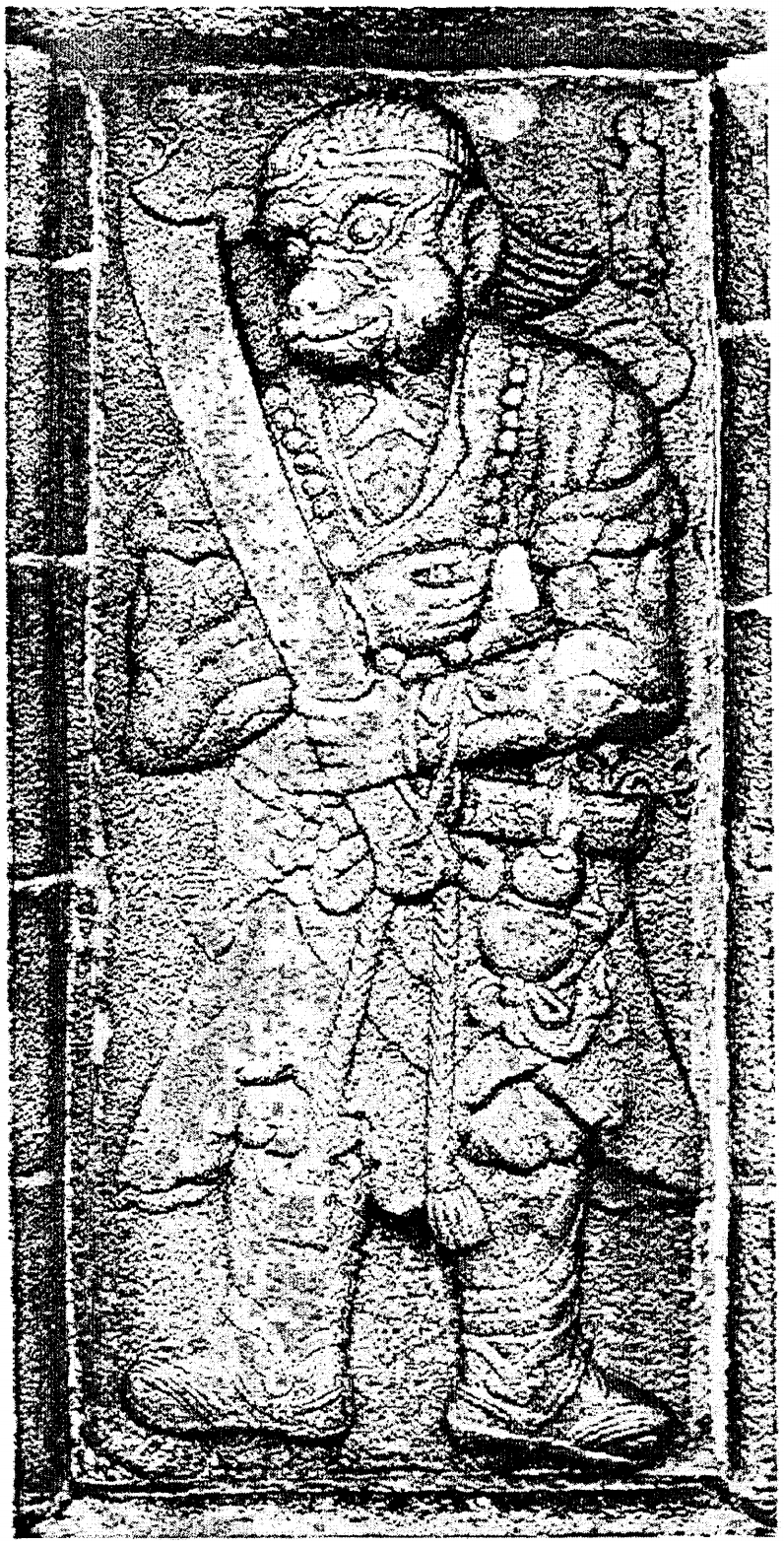
In her excellent paper on the origins of Sun Wukong, Hera S. Walker (1998) discusses a 13th century CE stone relief from the western pagoda of the Kaiyuan Temple (開元寺) in Quanzhou, Fujian province, China that portrays a sword-wielding, monkey-headed warrior (pp. 69-70). Considered by many to be an early depiction of Monkey, the figure wears a robe, a Buddhist rosary, and, most importantly, a type one fillet on the forehead (Fig. 4). [4] Walker quotes Victor Mair, who believes that the fillet “recalls the band around the head of representations of Andira, the simian guardian of Avalokitesvara” (the Indian counterpart to Guanyin) (Walker, 1998, p. 70). He goes on to list similarities between the stone relief and depictions of Andira, while also suggesting said depictions are based on south and southeast Asian representations of the Hindu monkey god Hanuman:

Identical earrings (these are key iconographic features of H[anuman] in many Southeast Asian R[ama saga]s), comparable tilt of the head… which seems to indicate enforced submission, long locks of hair… flaring out behind the head, elongated monkey’s mouth, similar decorations on the forearm and upper arm, etc. It is crucial to note that all these features can be found in South Asian and Southeast Asian representations of H[anuman] (Walker, 1998, p. 70).

So as it stands, the 13th century CE appears to be the furthest that the motif has been reliably traced.

Fig. 4 – The 13th century CE stone relief of Sun Wukong from the Kaiyuan Temple in Quanzhou, Fujian province, China (larger version).

3. My Findings

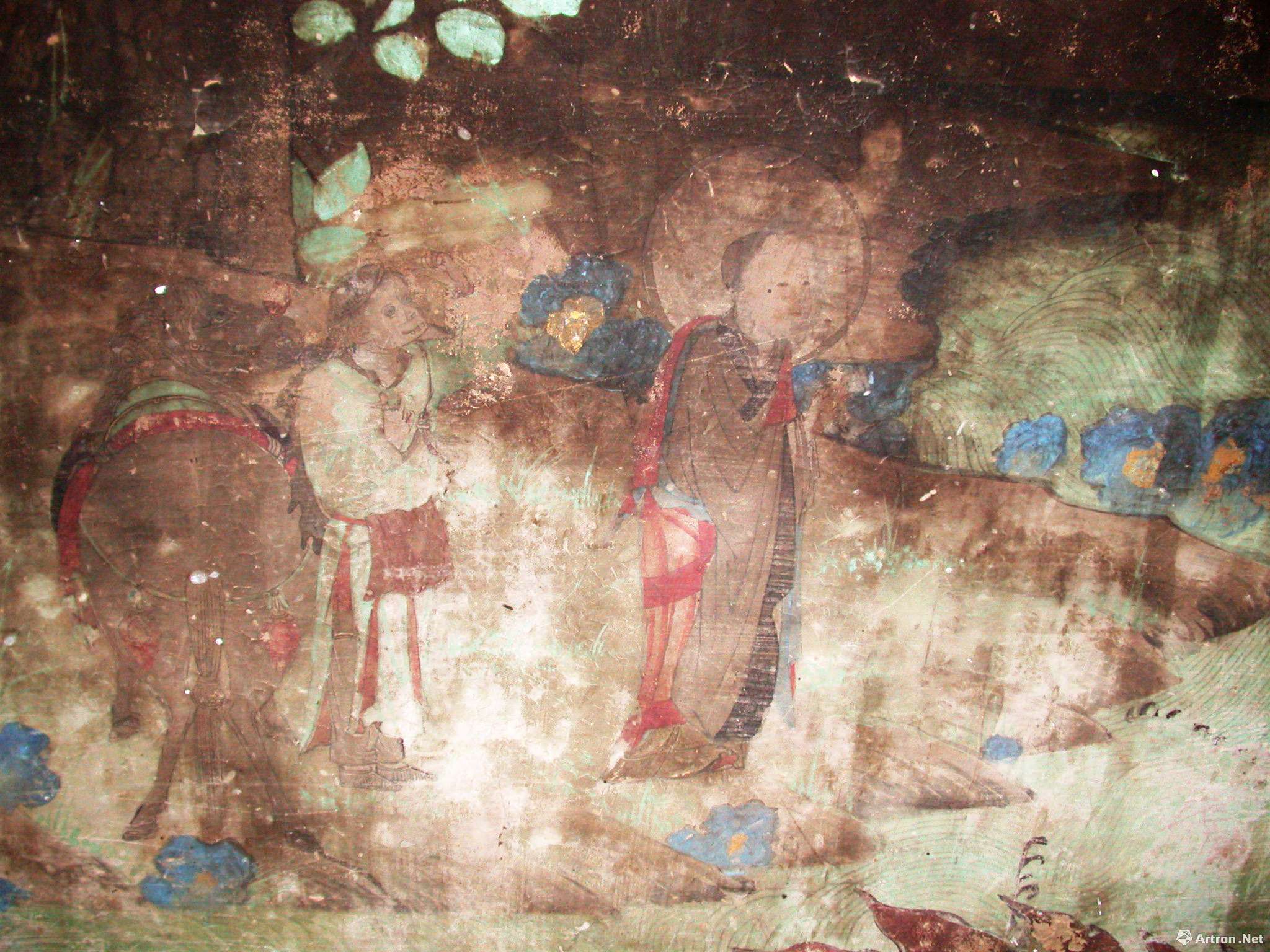
While Mair suggests a Southeast Asian Hindo-Buddhist influence, I know of at least one example from northeastern China that suggests an Indo-Tibetan Buddhist influence. The Eastern Thousand Buddha Cave no. 2 (Dong qianfo dong di 2 ku, 東千佛洞第2窟) in the Hexi Corridor of Gansu Province contains a late-Xixia dynasty (late-12th to early-13th century CE) mural of Xuanzang worshiping Guanyin from a riverbank. Monkey stands behind him tending to a brown horse. He is portrayed with a type three circlet on his head, waist length hair, and light blue-green robes with brown pants (fig. 5). This painting was completed during a time when China was seeing an influx of monks fleeing the inevitable fall of India’s Buddhist-led Pala Dynasty (750–1174 CE) from the 10th to the 12th century CE. They brought with them the highly influential Pala Buddhist art style and Vajrayana Buddhism, a form of esoteric Buddhism. The MET (2010) writes:

A mixture of Chinese-style and Vajrayana traditions and imagery was employed in the Tangut Xixia Kingdom …  which was based in Ningxia, Gansu, and parts of Shanxi … It is difficult to imagine that this “new” type of Buddhism, which not only was flourishing in Tibet in the late tenth century but was also found in the neighboring Xixia Kingdom and may have been practiced by Tibetans based in the Hexi Corridor region of Gansu Province, was completely unknown in central China until the advent of the Mongols (p. 19).

The painting of Monkey and Tripitaka was surely created by an Indian or Tibetan Buddhist monk, or at the very least a fellow Tangut or Chinese practitioner living in the area. This suggests that the imagery within the painting, such as the fillet, could have an Esoteric Buddhist pedigree, and textual evidence shows such headbands were indeed worn in some esoteric rituals.

For example, the Indian Buddhist Hevajra Tantra (Dabei kongzhi jingang dajiao wang yigui jing, 大悲空智金剛大教王儀軌經, 8th century CE) instructs adherents on how to adorn and dress themselves for worshipping Heruka, a Wrathful Destroyer of Obstacles:

The yogin must wear the sacred ear-rings, and the circlet on his head (emphasis added); on his wrists the bracelets, and the girdle round his waist, rings around his ankles, bangles round his arms; he wears the bone-necklace and for his dress a tiger-skin… (Linrothe, 1999, p. 250).

彼修觀者當如是行:謂頂想寶輪、耳帶、寶鐶,手串寶釧,腰垂寶帶,足繫寶鐸及妙臂釧,頸嚴寶鬘衣、虎皮衣 …

Furthermore, it describes how each of the ritual adornments and implements used in the ceremony represents each of the five esoteric Buddhas, as well as other religio-philosophical elements:

Aksobhya is symbolized by the circlet (emphasis added), Amitabha by the ear-rings, Ratnesa by the necklace, and Vairocana (by the rings) upon the wrists. Amogha is symbolized by the girdle. Wisdom by the khatvanga [staff] and Means by the drum, while the yogin represents the Wrathful One himself [i.e. Heruka]. Song symbolizes mantra, dance symbolizes meditation, and so singing and dancing the yogin always acts (Linrothe, 1999, p. 251).

「輪者,表阿閦如來;鐶者,無量壽如來;頸上鬘者,寶生如來;手寶釧者,大毘盧遮那如來;腰寶帶者,不空成就如來。於是色相而生念住:金剛渴椿誐杖者,表勝慧相;奎樓鼓者,即善方便故;瑜伽行者,瞋業清淨;住金剛歌詠者,真言清淨。

「又復,不應為求利養作是金剛歌舞事業。是故,瑜伽者當如是行…

As can be seen, the circlet represents Aksobhya (Sk: “Immovable”; Ch: Achu, 阿閦; Budong, 不動). This deity is known for his adamantine vow to attain buddhahood through the practice of Sila, or “morality,” the aim of which “is to restrain nonvirtuous deeds of body and speech, often in conjunction with the keeping of precepts” (Buswell & Lopez, 2014, pp. 27 and 821). So, the ritual band most likely served as a physical reminder of right speech and action, making it the best candidate for the origin of Monkey’s fillet. Sun is after all the representation of the “Monkey of the Mind” (as noted in the introduction), so his inclusion in the Eastern Thousand Buddha Cave painting was probably meant to convey the taming of this Buddhist concept via the circlet (apart from referencing the popular tale itself).

The Hevajra Tantra, the text in which the circlet appears, was first translated into Tibetan by Drogmi (993–1074 CE) and adopted during the 11th century CE as a central text by the respective founders of the Kagyu and Sakya sects, two of the six major schools of Tibetan Buddhism. Various members of the Sakya sect were invited by Mongol royalty to initiate them into the text’s esoteric teachings during the 13th century CE. These include Sakya Pandita and his nephew Chogyal Phagpa, who tutored Genghis Khan‘s grandson Prince Goden in 1244 and Kublai Khan in 1253, respectively. The meeting between Kublai and Chogyal resulted in Vajrayana Buddhism becoming the state religion of Mongolia. The Hevajra Tantra was translated into Chinese by the Indian monk Dharmapala (963–1058 CE) in 1055 during the Northern Song Dynasty (960–1127 CE). The text, however, did not become popular within the Chinese Buddhist community like it would with the Mongols in the 13th century CE (Bangdel & Huntington, 2003, p. 455). But this evidence shows how the concept of the 8th century CE ritual circlet could have traveled from India to East Asia to influence depictions of Sun Wukong in the 12th/13th century CE. And the relatively unknown status of the text in China might ultimately explain why there are so few ancient depictions of Chinese deities wearing the fillet, or why it does not appear in the 13th century CE version of JTTW.

While the late-Xixia mural (fig. 5) lacks many of the ritual adornments (apart from the fillet) mentioned in the Hevajra Tantra, the Quanzhou stone relief (refer back to fig. 3) includes the band, earrings, necklace, bangles, and possibly even a tiger skin apron, suggesting it too has an esoteric origin (most likely based on Chinese source material). The band’s connection to esoteric Buddhism is further strengthened by a 12th century CE painting from Japan. Titled Aka-Fudo (赤不動), or “Red Fudo [Myoo],” it depicts the wrathful esoteric god seated in a kingly fashion, holding a fiery, serpent-wrapped Vajra sword in one hand and a lasso in the other (fig. 6). He wears a golden, three-linked headband (similar to the curls of type one), which stands out against his deep red body and flaming aureola. Biswas (2010) notes: “… the headband on his forehead … indicate[s], according to some, a relation to the habit of groups of ascetics who were among the strong supporters of Acalanatha” (p. 112). His supporters were no doubt yogin practitioners in the same vein as those who worshipped Heraku and other such wrathful protector deities.

Fig. 5 – A portion of the late-Xixia (late-12th to early-13th century CE mural) in the Eastern Thousand Buddha Cave number two (larger version). Fig. 6 – The 12th century CE Japanese painting “Aka-Fudo” (赤不動) (larger version).

3.1. Symbol of Martial Deities and Warrior Monks

It’s important to note that Monkey was not the only cultural hero of the Ming Dynasty (1368–1644 CE) to wear a golden fillet. Another example is Li Tieguai (李鐵拐), or “Iron Crutch Li,” the oldest of the Eight Immortals. [5] Li is generally portrayed as a crippled beggar leaning on a cane. Legend has it that his original body was cremated prematurely by a disciple while the immortal traveled in spirit to answer a summons from Lord Laozi, the high god of Daoism. Li’s spirit returned a day later to find only ashes, thus forcing him to inhabit the body of a recently deceased cripple. According to Allen and Philips (2012), “Laozi gave him in recompense a golden headband and the crutch that was to become his symbol” (p. 108). Some depictions of Li wearing the fillet predate JTTW. The most striking example is Huang Ji’s Sharpening a Sword (early-15th century CE) (Fig. 7), which portrays the immortal wearing a type three band and sharpening a double-edged blade on a stone while staring menacingly at the viewer. [6] One theory suggests Li’s martial visage identifies him as a “spirit-guardian of the [Ming] state” (Little, 2000, p. 333). Both Monkey and Li are, therefore, portrayed as brutish, weapon-bearing, golden headband-wearing immortals who serve as protectors. This shows that the fillet was associated with certain warrior deities during the Ming.

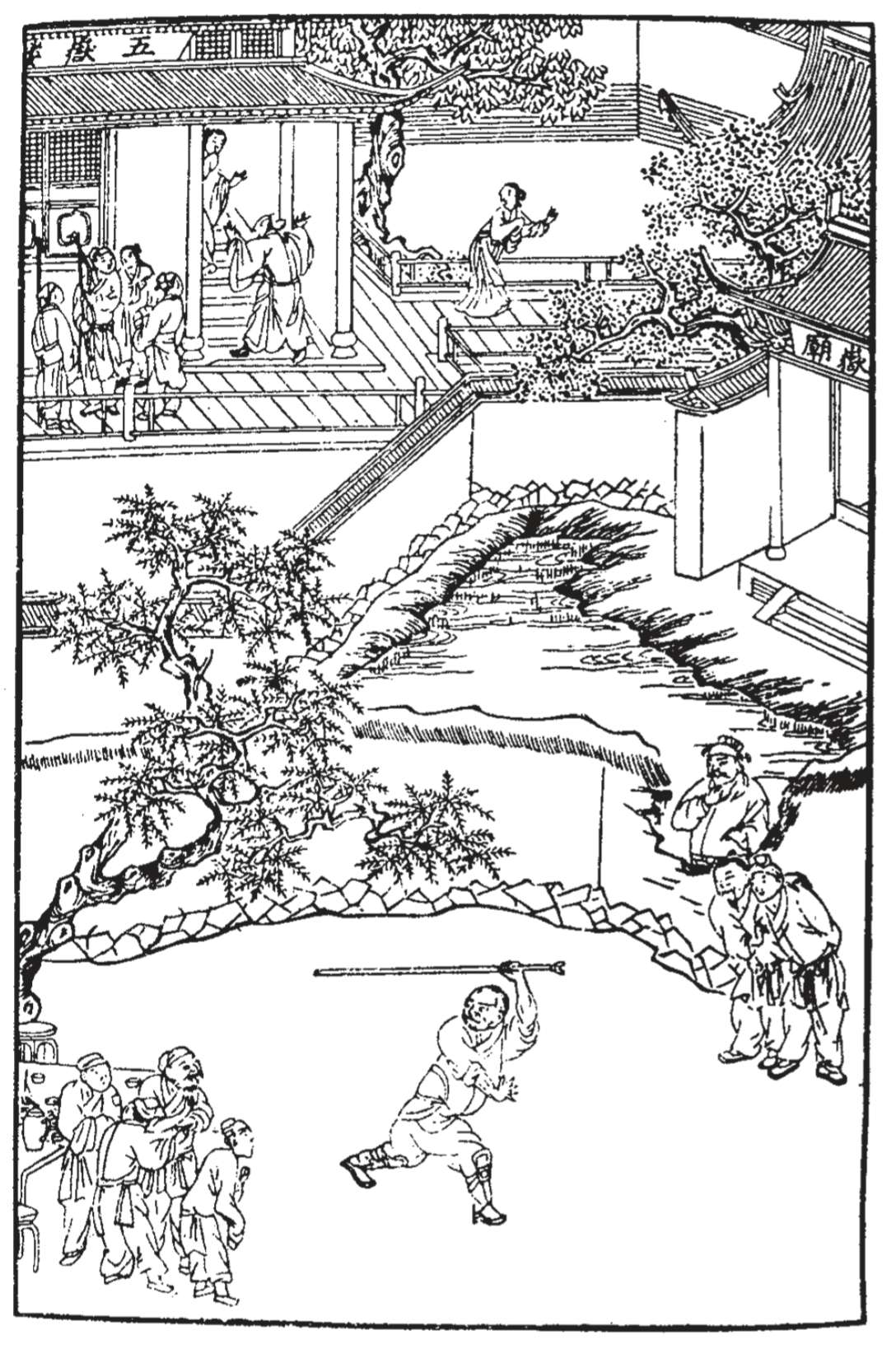
The fillet’s connection to religion and martial attributes culminated in the Jiegu (戒箍, “ring to forget desires”), a type two band worn by Military Monks (Wuseng, 武僧) in Chinese opera to show that they have taken a vow of abstinence (fig. 8). Such monks are depicted as wearing a Jiegu over long hair (Bonds, 2008, pp. 177-178 and 328), which contrasts with the bald heads of religious monks. [7] I would like to suggest that the band’s half-moon shape may have some connection to a Ming-era woodblock print motif in which martial monks are shown wielding staves tipped with a crescent (fig. 9) . The exact reason for the shape is still unknown (Shahar, 2008, pp. 97-98), but the association between the crescent and martial monks seems obvious. (See the 07-25-22 update below for the foreign origins of this motif.) The use of the fillet in Chinese opera led to it being worn by Sun Wukong in the highly popular 1986 live-action TV show adaptation of the novel (fig. 2). [8]

Fig. 7 (Left) – Huang Ji’s “Sharpening a Sword” (early-15th century CE) (larger version). Fig. 8 (Center) – An image of the military monk Wu Song wearing a jiegu (戒箍) fillet from a 2011 Water Margin TV show (larger version). Fig. 9 (Right) – A late-Ming woodblock of the warrior monk Lu Zhishen with a crescent staff (larger version). From Shahar (2008).

4. Conclusion

Examples of past research into the origins of the golden fillet respectively point to a slave collar from the Han dynasty (206 BCE–220 CE) and circa 13th century CE South and Southeast Asian depictions of the Buddhist guardian Andira and the Hindu monkey god Hanuman as possible precursors. However, the first isn’t credible, and the second, while on the right track, doesn’t go back far enough. A late-12th to early-13th century CE mural in the Eastern Thousand Buddha Cave complex depicts Sun Wukong wearing a type three fillet with possible ties to a ritual circlet worn by Esoteric Buddhist Yogin ascetics in 8th century CE India. The Hevajra Tantra, the esoteric text that mentions the band, associates it with the Aksobhya Buddha and thereby his moralistic, self-restraining practices. The text was transmitted from India to Tibet, China, and Mongolia from the 11th to the 13th centuries CE, showing a clear path for such imagery to appear in East Asia. A 12th century CE Japanese Buddhist painting of the guardian deity Fudo Myoo with a fillet suggests that the practice of wearing circlets in esoteric rituals continued for centuries. Other non-Buddhist deities became associated with the fillet during the Ming Dynasty. A 15th century CE painting of the immortal Li Tieguai, for example, depicts him as a type one circlet-wearing, sword-wielding guardian of the Ming dynasty. All of this suggests that the band became a symbol of Chinese protector deities. The association between the fillet and religion and martial attributes led to its use as the symbol of military monks in Chinese opera.


5. Updates

Update: 12-23-17

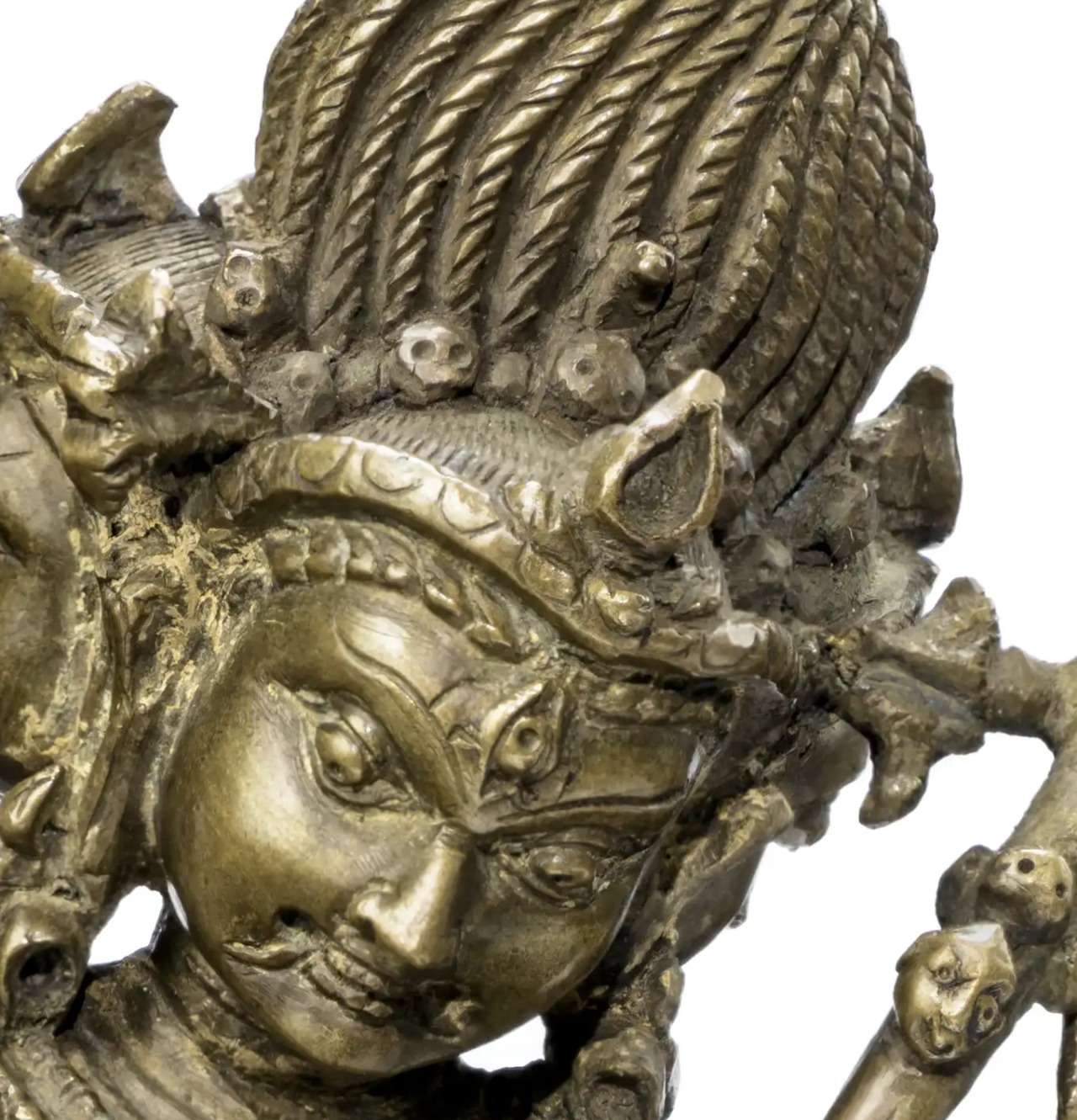
I’ve been wondering what the 8th century CE version of the circlet (along with the other ritual implements) mentioned in the Hevajra Tantra might have looked like. While I have yet to find a contemporary sculpture or painting, I have found an 11th to 12th century CE interpretation from Tibet. Titled The Buddhist Deity Hevajra (fig. 10), this copper alloy statue somewhat follows the prescribed iconography of the god as laid out in the aforementioned text:

Dark blue and like the sun in colour with reddened and extended eyes, his yellow hair twisted upwards, and adorned with the five symbolic adornments,/ the circlet, the ear-rings and necklace, the bracelets and belt. These five symbols are well known for the purificatory power of the Five Buddhas./ He has the form of a sixteen-year-old youth and is clad in a tiger-skin. His gaze is wrathful. In his left hand he holds a vajra-skull, and a khatvahga [staff] likewise in his left, while in his right is a vajra of [a] dark hue…(Linrothe, 1999, p. 256)

Fig. 10 – The Buddhist Deity Hevajra, late-11th to early-12th century CE, copper alloy (larger version). Courtesy of the Los Angeles County Museum of Art. Fig. 11 – Detail of the circlet (larger version).

The circlet here is depicted as a fitted band with crescent trim and a teardrop-shaped adornment (a conch?) (fig. 11). The statue’s iconography more closely follows that from the Sadhanamala (“Garland of Methods”), a compilation of esoteric texts from the 5th to 11th centuries CE. The following information probably derives from the later part of this period:

He wields the vajra in the right hand and from his left shoulder hangs the Khatvanga [staff] with a flowing banner, like a sacred thread. He carries in his left hand the kapala [skull cap] full of blood. His necklace is beautified by a chain of half-a-hundred severed heads. His face is slightly distorted with bare fangs and blood-shot eyes. His brown hair rises upwards and forms into a crown which bears the effigy of Aksobhya. He wears a kundala [ear decoration] and is decked in ornaments of bones. His head is beautified by five skulls (Donaldson, 2001, p. 221).

Our statue has many of these features but lacks the image of the Buddha in his hair. This suggests the knob visible in the coif (fig. 10) once carried such a figure. So, once again we see the importance of the Aksobhya Buddha. The statue is similar to 10th and 11th century CE stone statues from India. [9]

While this doesn’t get us any closer to what the original circlet looked like, this statue adds to the mutability of the fillet imagery. The Hevajra Tantra is vague in its description, and so it is no surprise that so many variations have appeared over the centuries. The original sanskrit text uses the word cakri (circle) to refer to the band (Farrow & Menon, 2001, pp. 61-62). This might explain the simple type three fillet worn by Monkey in the Eastern Thousand Buddha Cave no. two painting (fig. 2).


Update: 08-16-20

I have written an article suggesting an origin for the type one headband, or as I now call it, the “curlicue headband.”

Sun Wukong’s Curlicue-Style Headband


Update: 12-12-21

One thing I figured out a while ago but never explained here was the reason why the Japanese Buddhist protector deity Aka-Fudo (赤不動) (fig. 6) is depicted with a headband. I believe this is a visual representation of the fillet’s association with the Aksobhya Buddha. This is because the fudo (Ch: budong, 不動) of Aka-Fudo and the Sanskrit meaning of Aksobhya respectively mean “immovable.” So, the image of Aka-Fudo is encapsulating both his position as a protector deity and the Buddha represented by the headband. 


Update: 01-23-22

I’ve written an article suggesting a mantra for the secret spell that causes the golden fillet to tighten.

The Tightening Spell of Sun Wukong’s Golden Headband


Update: 07-25-22

I’ve written an article that explains the origins of the “crescent-style” headband.

The Monkey King’s Crescent-Style Headband


Update: 06-26-23

Above, I mentioned that the novel contains three kinds of headbands:

  1. Sun Wukong/Six Ears – “Constrictive” (jin, 緊) – ch. 14
  2. Black Bear Demon – “Prohibitive” (jin, 禁) – ch. 17
  3. Red Boy – “Golden” (jin, 金) – ch. 42

It’s interesting that all of them are pronounced “jin” (with varying tones).

Now imagine that there is a secret fourth headband not intended to punish but to empower. Called the “Strength” (jin, 勁) headband, it would only be used in the most extreme emergencies.

It would be neat to see someone work this into their fanfiction.


Update: 12-24-23

A character is briefly punished to wear a golden headband in the famed Ming-era novel Investiture of the Gods (Fengshen yanyi封神演義, c. 1620; summary). Chapter 82 reads: 

Ma Sui [馬遂] attacked him with his sword, and after only one round, threw a gold hoop [jingu, 金箍] around the immortal’s head. The Yellow Dragon Immortal [Huanglong zhenren, 黃龍真人] writher in pain but was quickly rescued and brought back to the pavilion.

The Yellow Immortal Dragon Immortal tried to take the hoop off his head but found it was impossible. It was so tight the true samadhi fire went out of his eyes.

The Immortal of the South Pole [Nanji xianweng, 南極仙翁] came in to announce Heavenly Primogenitor’s [Yuanshi tianzun, 元始天尊] arrival. The religious leader entered the pavilion and said, “The Yellow Dragon Immortal was destined to be caught in this gold hoop. Come here and let me help you.”

He pointed at the gold hoop, and it dropped to the ground (Gu, 2000, pp. 1713-1715).

只一合,馬遂祭起金箍,把黃龍真人的頭箍住了。真人頭疼不可忍,眾仙急救真人,大家回蘆篷上來。真人急忙除金箍,除又除不掉,只箍得三昧真火從眼中冒出;大家鬧在一處。不表。且說元始天尊來會萬仙陣,先著南極仙翁持玉符先行。南極仙翁跨鶴而來,雲光縹緲。馬遂抬頭,見是南極仙翁,急駕雲光至半空中來,阻住去路。仙翁笑曰:「馬遂,你休要猖獗,掌教師尊來了。」馬遂正欲爭持,只見後面仙樂一派,遍地異香,馬遂知不可爭持,按落雲頭,回歸本陣。南極仙翁先至蘆篷,率眾仙迎鑾接駕,上篷坐下。眾門人拜畢,侍立兩傍。元始曰:「黃龍真人有金箍之厄。」忙叫:「過來。」黃龍真人走至面前;元始用手一指,金箍隨脫。

(Gu (2000) skips over some elements in the original Chinese.)

I’ve known about this episode for a while but forget to post about it.

Notes

1) For the entire episode, see Wu & Yu, 2012, vol. 1, pp. 314-320.

2) The child first speaks his new name in chapter 49 (Wu & Yu, 2012, vol. 2, p. 354). The original Sudhana originates from the Avatamsaka Sutra (Wu & Yu, 2012, vol. 2, pp. 386-387 n. 3).

3) For a complete English translation, see Wivell (1994).

4) This is just one of many relief carvings that grace the pagoda. It includes other guardian-type figures with esoteric elements but rendered in the Chinese style. See Ecke and Demiéville (1935).

5) The Eight Immortals are Daoist saints who came to be worshipped as a group starting sometime in the Jin Dynasty (1115–1234 CE) (Little, 2000, p. 319).

6) The sword is usually a symbol of the immortal Lu Dongbin, but as noted above, it is used to identify Li Tieguai as a Ming guardian (Little, 2000, p. 333).

7) Shahar (2008) discusses the historical differences between religious and military monks in ancient China.

8) Liu Xiao Ling Tong (六小龄童; born Zhang Jinlai, 章金萊, 1959), the actor who played Monkey in the 1986 TV show, comes from a family who has specialized in playing Sun Wukong in Chinese opera for generations (Ye, 2016).

9) See the Heruka chapter in Linrothe (1999). He includes our statue in his study, but other sources describe it as Tibetan instead of Indian (Bangdel & Huntington, 2003, p. 458).

Bibliography

Allan, T., & Phillips, C. (2012). Ancient China’s Myths and Beliefs. New York: Rosen Pub.

Bangdel, D., & Huntington, J. C. (2003). The Circle of Bliss: Buddhist Meditational Art. Chicago, Ill: Serindia Publications.

Biswas, S. (2010). Indian Influence on the Art of Japan. New Delhi: Northern Book Centre.

Bonds, A. B. (2008). Beijing Opera costumes: The Visual Communication of Character and Culture. Honolulu: University of Hawai’i Press.

Buswell, R. E., & Lopez, D. S. (2014). The Princeton Dictionary of Buddhism. Princeton, NJ: Princeton University Press.

Donaldson, T. E. (2001). Iconography of the Buddhist Sculpture of Orissa. New Delhi: Indira Gandhi National Centre for the Arts.

Ecke, G., & Demiéville, P. (1935). The Twin Pagodas of Zayton: A Study of the Later Buddhist Sculpture in China. Cambridge, Mass: Harvard University Press.

>Farrow, G. W., & Menon, I. (2001). The Concealed Essence of the Hevajra Tantra: With the Commentary Yogaratnamālā. Delhi: Motilal Banarsidass Publ.

Gu, Z. (2000). Creation of the Gods (Vols. 1-4). Beijing: New World Press.

Linrothe, R. N. (1999). Ruthless Compassion: Wrathful Deities in Early Indo-Tibetan Esoteric Buddhist Art. Boston, Mass: Shambhala.

Little, S. (2000). Taoism and the Arts of China. Chicago, IL: Art Institute of Chicago.

Liu, X. (1994). The Odyssey of the Buddhist Mind: The Allegory of the Later Journey to the West. Lanham, Md: University Press of America.

Metropolitan Museum of Art, Leidy, D. P., Strahan, D. K., & Becker, L. (2010). Wisdom Embodied: Chinese Buddhist and Daoist sculpture in the Metropolitan Museum of Art. New York: Metropolitan Museum of Art.

Shahar, M. (2008). The Shaolin Monastery: History, Religion, and the Chinese Martial Arts. University of Hawaii Press.

Walker, H.S. (1998). Indigenous or Foreign? A Look at the Origins of Monkey Hero Sun Wukong. Sino-Platonic Papers, 81, 1-117.

Wang, T. (2006). Dust in the Wind: Retracing Dharma Master Xuanzang’s Western Pilgrimage. Taipei: Rhythms Monthly.

Wivell, C.S. (1994). The Story of How the Monk Tripitaka of the Great Country of T’ang Brought Back the Sūtras. In V. H. Mair (Ed.), The Columbia Anthology of Traditional Chinese Literature (pp. 1181-1207). New York: Columbia University Press.

Wu, C., & Yu, A. C. (2012). The Journey to the West (Vols. 1-4) (Rev. ed.) Chicago, Ill: University of Chicago Press.

Ye, X. (2016). Liu Xiao Ling Tong and Sun Wukong. Retrieved December 15, 2017, from https://www.youlinmagazine.com/story/liu-xiao-ling-tong-and-sun-wukong/Njgw

Why the Monkey King Wears a Tiger Skin Loincloth and How it Ties Him to Supreme Esoteric Buddhist Guardian Deities
Last updated: 05-20-2026

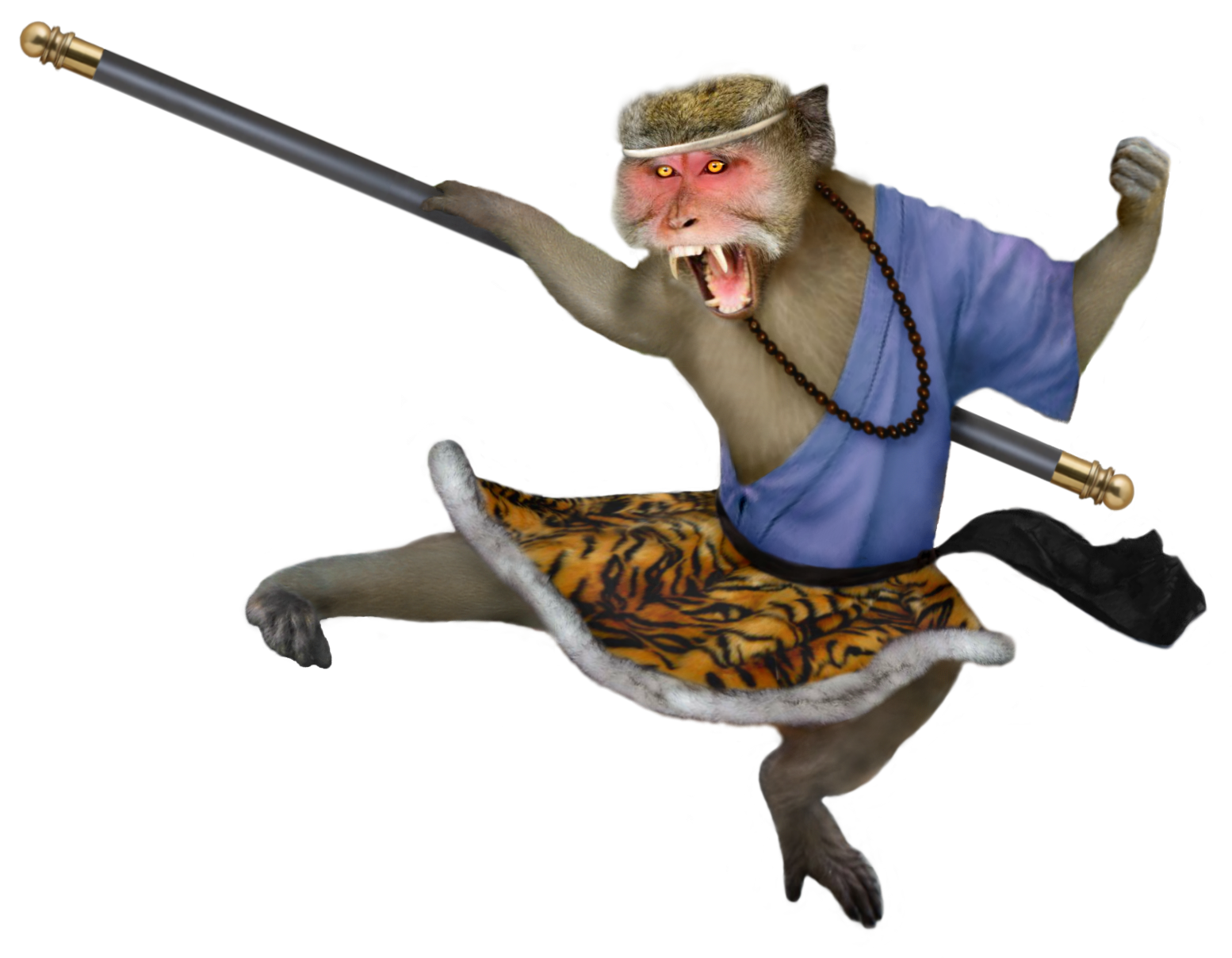
After being released from his mountain prison in  Journey to the West (Xiyou ji西遊記, 1592 CE, “JTTW” hereafter) chapter fourteen, Sun Wukong effortlessly kills a tiger with his iron staff and uses a magic hair-turned-knife to skin the beast. He cuts a large square from the fur and uses half to create a loincloth to cover his naked body (Wu & Yu, 2012, vol. 1, pp. 309-310). This tiger skin clothing is a highly recognizable element of Monkey’s iconography (fig. 1). But did you know that it has a connection to the Wrathful Destroyers of Obstacles (Sanskrit: Krodha-vighnantaka; “WDO” hereafter), [1] a class of supreme guardian deities in Indo-Tibetan Esoteric Buddhism?

Table of Contents

1. WDO Background

Esoteric Buddhism first developed in India as an offshoot of Mahayana Buddhism during the 6th century CE. WDOs appear in three recognized iconographic phases stretching from the sixth to the twelfth century. The first and longest phase (6th to 12th cent.) depicts the WDO as a dwarfish attendant to a full-size Bodhisattva. [2] He serves as the personification of his master’s wisdom and abilities. The second phase (8th to 10 cent.) represents the WDO as an independent deity with his own attendants. He serves as the personification of the attributes of the five esoteric Buddhas. The third phase (late-10th to 12th cent.) represents the WDO as the equal of Buddhas (Linrothe, 1999, pp. 11-14).

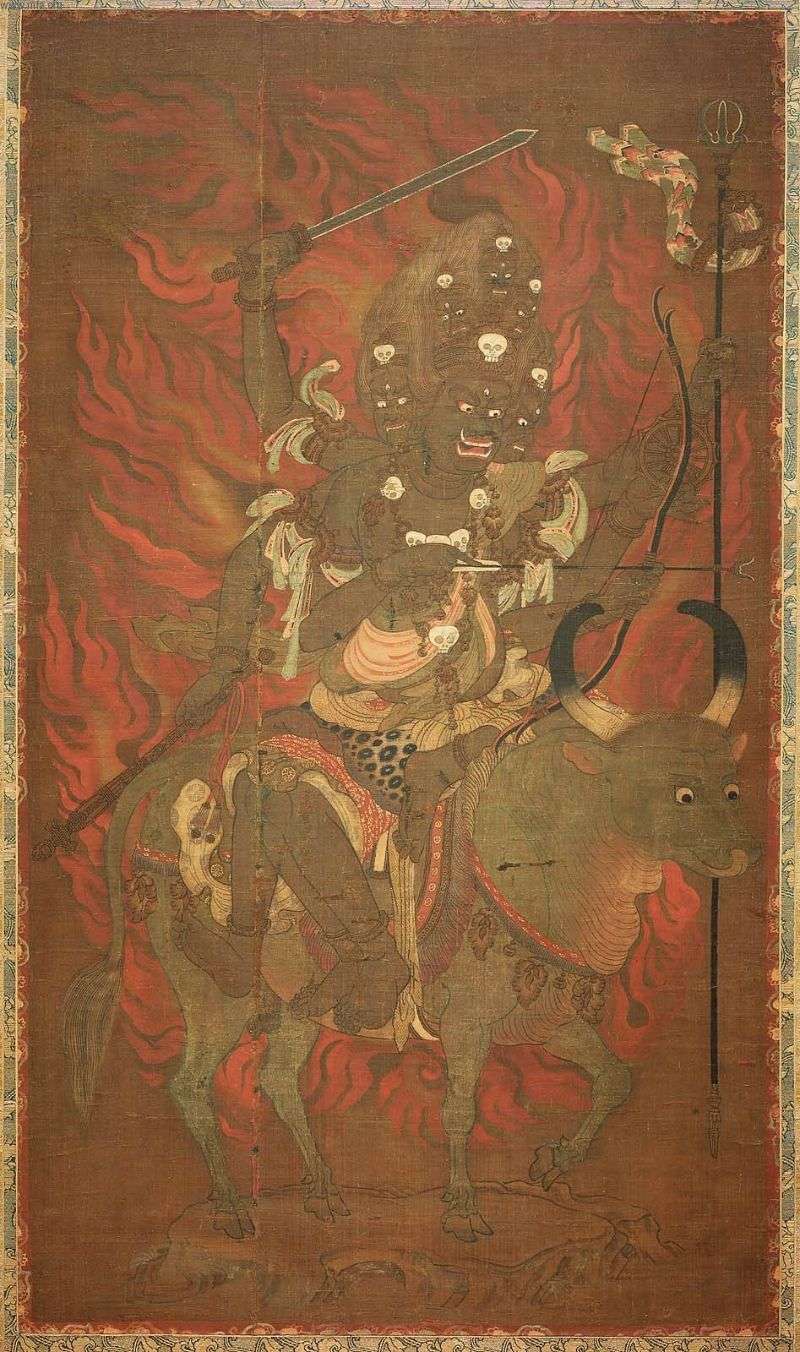
Wrathful Destroyers of Obstacles are often depicted as fierce, multi-armed figures bearing weapons and, most importantly, wearing tiger skin loincloths (Sanskrit: Vyaghracarma-nivasana). For example, the Manjusrimulakalpa, an 8th-century esoteric text, dictates the prescribed iconography of Manjusri’s WDO guardian Yamantaka (“the Destroyer of Yama, god of death”):

Six faces, six arms and feet/Black in color, with a big belly / Bearing a skull, his hair flaring out in anger / A tiger skin wrapped around the hips (emphasis added) / Holding all kinds of implements and weapons” (fig. 2) (Linrothe, 1999, p. 66). (emphasis mine)

The Hevajra Tantra, another 8th-century esoteric work, ties tiger skin clothing to Yogin practices. The text instructs them on how to adorn and dress themselves for worshipping the WDO Heruka:

The yogin must wear the sacred ear-rings, and the circlet on his head; on his wrists the bracelets, and the girdle round his waist, rings around his ankles, bangles round his arms; he wears the bone-necklace and for his dress a tiger-skin (emphasis added)… (Linrothe, 1999, p. 250). (emphasis mine)

Furthermore, it describes how each of the ritual adornments and implements used in the ceremony represent each of the five esoteric Buddhas, as well as other religio-philosophical elements:

Aksobhya is symbolized by the circlet, Amitabha by the ear-rings, Ratnesa by the necklace, and Vairocana (by the rings) upon the wrists. Amogha is symbolized by the girdle. Wisdom by the khatvanga [staff] and Means by the drum, while the yogin represents the Wrathful One himself [Heruka]. Song symbolizes mantra, dance symbolizes meditation, and so singing and dancing the yogin always acts (Linrothe, 1999, p. 251).

Van Kooij (as cited in Linrothe, 1999) comments, “Heruka is more or less a deified hypostasis of the … yogin himself” (p. 251). This suggests that the WDO are dressed according to what is worn by the very Yogin ascetics who worship them. But I would like to take this one step further. It is important to note that many of these elements, such as the earrings, bracelets, arm bangles, bone necklace, tiger skin dress, khatvanga staff, drum, and dancing, are all attributes of the Hindu God Shiva. He is considered the yogin par excellence, as well as a wrathful deity in his own right (Elgood, 1999, pp. 44-54). I, therefore, suggest that the practice of wearing tiger skin was just one of many elements that esoteric Buddhism borrowed from Hindu asceticism.

Fig. 1 – (Left) A modern depiction of Sun Wukong (by the author) (larger version). Fig. 2 – (Center) A 13th-century Japanese depiction of the Wrathful Destroyer of  Obstacles Yamantaka (larger version). Fig. 3 – (Right) A modern depiction of the Hindu god Shiva (larger version).

Shiva is often depicted as wearing a tiger skin and/or using it as a meditation mat (Skt: Asana) (fig. 3). This skin has two interpretations: 1) it represents his power over nature; 2) it represents him killing the personified “tiger of desire” (Elgood, 1999, p. 52; Beer, 2003, p. 65). When viewed from a Buddhist context, it seems only natural that Buddhist ascetics and deities would use the skin to represent the cessation of desire. It should also be noted that tigers and their skin were symbols of strength in ancient India. For instance, the great Hindu epic the Mahabharata (circa 4th cent. BCE), describes the martial feats or attributes of many powerful warriors and kings as being tiger-like (Śarmā, 1988, p. 66). In addition, during the royal consecration ceremony (Skt: Rajasuya), newly appointed Vedic kings would step on a tiger skin to gain the animal’s strength (MacDonell & Keith, 1995, p. 337). I, therefore, suggest that the WDO tiger skin loincloth serves a secondary function as a symbol of the WDOs spiritual or physical strength.

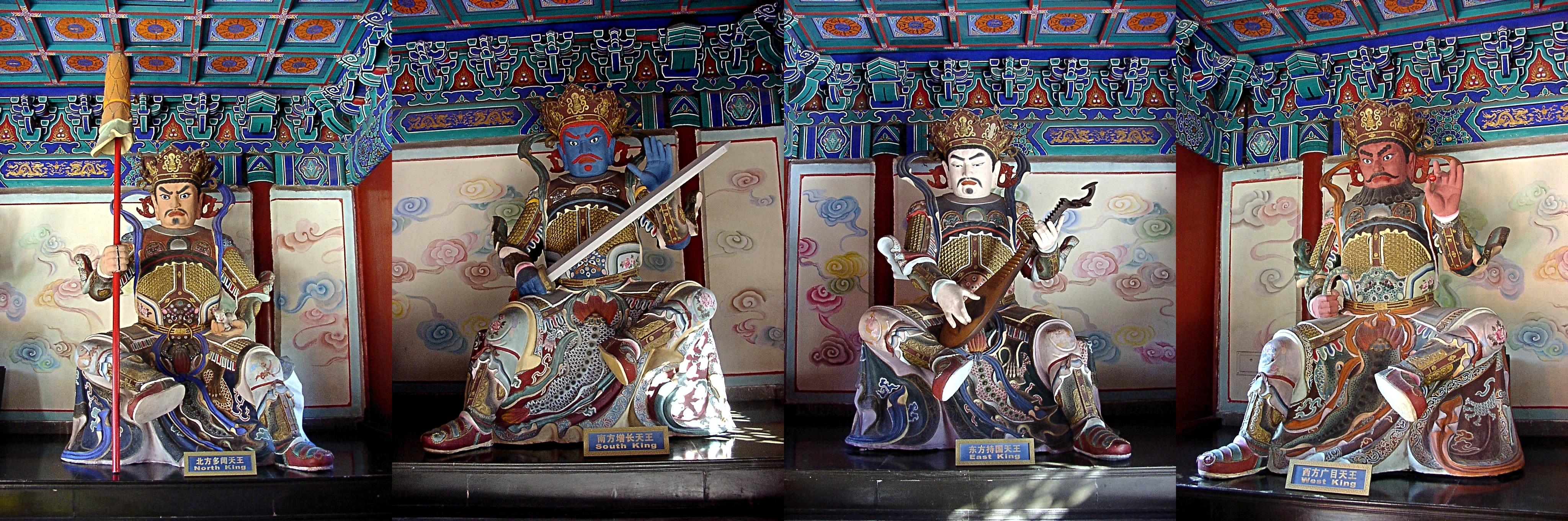
There are numerous classes of Buddhist deities that share similarities with the WDO, such as having a wrathful appearance and serving a protective function, but do not rank as high in the esoteric pantheon. These include the Heavenly Kings (天王, tianwang; Skt: Lokapala) (fig. 4), who protect righteous kingdoms and monasteries; Gate Guardians (門神, Menshen; Skt: Dvarapala), who protect the doorways of monasteries and temples; the Protector of Fields (Skt: Ksetrapala), who protect plots of land; the Guardians of the Directions (Skt: Dikpala), former Hindu gods who protect the eight directions; and the Dharma Protectors (Skt: Dharmapala), who protect the Buddha’s teachings. The WDO are high-level members of the latter group (Linrothe, 1999, pp. 20-22).

WDOs stand high above other guardians because they are charged “with the destruction of barriers which prevent the experience of enlightenment” (Linrothe, 1999, p. 25). These barriers include external threats like manifested demons and internal threats like demon-caused mental and bodily illness, the “three poisons,” and karmic debt (Linrothe, 1999, pp. 24-25). [3] And they have the power to subdue even supreme devas. For example, the Compendium of the Truth of All Buddhas (Skt: Savra-tathagata-tattva-samgraha, late-7th cent.) tells of the Cosmic Buddha Mahavairocana ordering the WDO Trailokyavijaya (the wrathful form of Vajrapani) to conquer Mahesvara (a.k.a., Shiva), king of the gods and master of the three realms. After being subdued, the fallen god asks the Buddha: “[H]ow it can be that Vajrapani, whom in anger [I]…called a mere Yaksa, can be so strong, stronger even than the Tathagata as Lord of the Trikaya[?]” (Linrothe, 1999, p. 26). [4]

Fig. 4 – (Left) Statues of the Four Heavenly Kings located in Beihai Park, Beijing, China (larger version). Fig. 5 – (Right) A modern toy depicting Monkey’s fearsome three-headed, six-armed form (larger version).

2. The Monkey King as a WDO

Many of Sun Wukong’s attributes and abilities align with those mentioned above, I would, therefore, like to argue that he is a WDO. First, he wears the tiger skin loincloth, which ties him to the same spiritual tradition represented by WDOs and Yogin ascetics. Second, he has a wrathful appearance (Skt: krodha). During his war with heaven, he takes on a fearsome form with three heads and six arms and multiplies his iron staff to defeat wave after wave of celestial opponents (fig. 5) (Wu & Yu, 2012, vol. 1, pp. 157 and 191). This is similar to the multiple heads, arms, and weapons of the WDO Yamantaka, as well as other such deities (Linrothe, 1999, pp. 188, 268-269 and 279-280, for example). Third, he serves as a destroyer of obstacles (Skt: vighnantaka). By vanquishing the various monsters, spirits, and fallen stars that threaten the life of Tripitaka, Sun clears the path of manifested demons that obstruct his master’s path to enlightenment. Thanks to his help Tripitaka becomes a Buddha at the end of the novel (Wu & Yu, 2012, vol. 4, p. 381). Fourth, Sun serves as the guardian and strong-arm of a Bodhisattva, per phase one of the recognized WDO iconography. Tripitaka is after all the Golden Cicada Bodhisattva reborn on earth (see the 05-20-26 update below for more info). Fifth, Monkey is so powerful that he poses a threat to the August Jade Emperor of Heaven, just like the WDO Trailokyavijaya did for the supreme deva Mahesvara. This ultimately explains why the celestial army is no match for Sun and why other guardian deities, like the Heavenly Kings, fear and respect him. [5] Identifying the Great Sage as a WDO helps locate his position in the novel’s Buddhist pantheon prior to his elevation to Buddhahood. This means that Monkey is no longer the Buddho-Daoist “wild card” that doesn’t really seem to fit in anywhere.

The author-compiler of JTTW would have had plenty of esoteric material to influence his depiction of Sun. Esoteric Buddhism filtered into China by the early-Tang Dynasty (618–907) and continued into the Song (960–1279) thanks to royal patronage. People of the neighboring foreign Khitan Liao (907–1125), Tangut Western Xia (1038–1227), and Jurchen Jin (1115–1234) dynasties, all of whom conquered northern China at one time or another, adopted the religion. The Mongols, another foreign ruler of the Middle Kingdom, were great adherents of Vajrayana Buddhism during the Yuan Dynasty (1271–1368), which ensured the continued presence of esoteric imagery in China. And during the Ming (1368–1644), when JTTW was first published, the Yongle (r. 1402–1424) and Zhengde (r. 1505-1521) emperors, as well as other elite members of society, patronized and/or practiced the religion (Stoddard, 2008; Orzech, Sorensen, & Payne, 2011).


3. Update

Update: 12-16-2017

My new article expands on the WDO connection by highlighting Monkey’s association with the circlet mentioned above as one of the ritual items worn by yogis. This shows Sun’s trademark headband can be traced to Esoteric Buddhism.

The Origin of Sun Wukong’s Golden Headband


Update: 06-07-2018

A stone carving of Sun Wukong from one of the Kaiyuan temple’s stone pagodas (erected in 1237) portrays him wearing nearly all of the aforementioned ritual items, further solidifying his image as a WDO.

The Sun Wukong Stone Relief of Kaiyuan Temple


Update: 05-20-26

I mistakenly referred to Tripitaka as a bodhisattva. Evidence points to him being an arhat/luohan. See section 4.1. of this article.

The Monk Tripitaka and the Golden Cicada

Notes:

1) The Krodha-vighnantaka term was coined by Rob Linrothe (1999) since the names traditionally given to said wrathful deities over the centuries are not appropriate to cover all three historical phases of their existence (pp. 19-20).

2) The first artists to represent WDOs drew on previous depictions of semi-divine Yaksa spirits, the dwarf-like Gana attendants of Shiva, and the humanoid personification of divine Hindu weapons (Skt: Ayudhapurusa) (Linrothe, 1999, pp. 12-13).

3) The three poisons are stupidity, greed/lust, and anger. These are often depicted in the center of Buddhist Wheel of Life art as a boar, a snake, and a rooster, each biting the others tail, forming a circle.

4) Linrothe (1999) writes that Shiva in this case represents the conquering of ego instead of “a Hinduism which must be humiliated” (p. 26).

5) During the Great Sage’s rebellion, the August Jade Emperor is forced to ask the Buddha to intervene because Sun Wukong is too strong (Wu and Yu, 2012, vol. 1, p. 191-192). Monkey defeats the celestial army, along with the Heavenly Kings, prior to being subdued (Wu and Yu, 2012, vol. 1, p. 172). And later the guardians “ben[d] low to bow to him and dare not bar his way” when he visits heaven some centuries after his rebellion (Wu and Yu, 2012, vol. 4, p. 118).

Sources:

Beer, R. (2003). The Handbook of Tibetan Buddhist Symbols. Chicago, Illinois: Shambhala.

Elgood, H. (1999). Hinduism and the Religious Arts. London, u.a.: Cassell.

Linrothe, R. N. (1999). Ruthless Compassion: Wrathful Deities in Early Indo-Tibetan Esoteric Buddhist Art. Boston, Mass: Shambhala.

Orzech, C. D., Sorensen, H. H., & Payne, R. K. (2011). Esoteric Buddhism and the tantras in East Asia. Leiden: Brill.

MacDonell, A. A., & Keith, A. B. (1995). Vedic index of names and subjects. Delhi: Motilal Banarsidass.

Stoddard, H. (2008). Early Sino-Tibetan art. Bangkok: Orchid Press.

Wu, C., & Yu, A. C. (2012). The Journey to the West (Vols. 1-4) (Rev. ed.). Chicago, Illinois: University of Chicago Press.

The Historical Origins of Zhu Bajie’s Previous Incarnation and his Battle Rake

Last updated: 11-13-2023

Journey to the West (Xiyou ji西遊記, 1592 CE, “JTTW” hereafter) depicts Zhu Bajie as a reincarnation of the Marshal of the Heavenly Reeds (Tianpeng Yuanshuai, 天蓬元帥) (Wu & Yu, 2012, p. 212). But did you know that this general was actually venerated as a deity? His very name suggests that the god can be traced to early shamanistic beliefs about magico-religious medicine, for a better translation of Heavenly Reeds is “Heaven’s Mugwort.” Van Glahn (2004) explains that this “curious name…alludes to the plant’s demonifugic properties” (p. 121). This suggests that the ancient belief that mugwort exorcised demons/illnesses was eventually anthropomorphized and deified as the general.

Table of Contents

1. History of the Deity

Sui Dynasty (581–618) sources describe this god serving under the Northern Emperor (Beidi, 北帝), the Hades of Daoism, as a powerful exorcist. This is best exemplified by the “Northern Emperor’s Method of Killing Demons” (Beidi shagui zhi fa, 北帝殺鬼之法), a sixth-century rite which contains a prayer invoking Tianpeng by name (Davis, 2001, p. 75; Pregadio, 2008, p. 979). Another text identifies him as one of nine stellar gods associated with the Big Dipper constellation and “assign[s him] the function of security and protection” (Davis, 2001, p. 75; see also Andersen, 1989, pp. 35-36). Early-Song Dynasty (960–1279) sources expand on Heavenly Reed’s position under the Northern Emperor and describe him as head of the thirty-six generals of the Department of Exorcism (Andersen, 2008, pp. 991-992). Most importantly, this is when he was associated with two other powerful exorcist deities, namely Black Killer (Heisha, 黑煞) and Dark Warrior (Xuanwu, 玄武), to form the trinity of the “Three Great Generals of Heaven” (Davis, 2001, p. 75). This was later expanded to a quaternity known as the “Four Saints” (Sisheng, 四聖), which included Heavenly Reed, Black Killer, the True Martial God (Zhenwu, 真武, a variant of the Dark Warrior), and Heavenly Scheme (Tianyou, 天猷) (Pregadio, 2008, p. 479; Little, Eichman, & Ebrey, 2000, p. 298).

Tianpeng’s position as a protector and association with the military led to his worship by soldiers. Davis (2001) writes, “The cult of Tianpeng remained popular among military circles into the Southern Song, when [legend has it] he aided various generals in their battles with the Jin” (p. 75). The Song also happened to be when he was bestowed the military rank of Marshal (Yuanshuai, 元帥) (Pregadio, 2008, p. 979), the name by which he is called in JTTW. During the Ming, a martial arts style (Tianpeng’s Fork, 天蓬釵) and a weapon technique (Tianpeng’s Spade, 天蓬鏟) were named in his honor.

Tianpeng is described in one Song dynasty source as a multi-armed god “dressed in black clothes and a dark hat” (Davis, 2001, p. 75). The names of his trinity companions also reveal their connection with black (i.e, “Black Killer” and “Dark Warrior”). This is because the color is associated with the direction north and thereby the Northern Emperor, whom the three serve (Davis, 2001, p. 75; Welch, 2008, p. 223). A circa 1460 painting of the aforementioned Four Saints actually portrays the Marshal of Heavenly Reeds with black Skin (fig. 1). Why is this important? Because JTTW describes Zhu as having a black face (Wu & Yu, 2012, p. 375, for example).

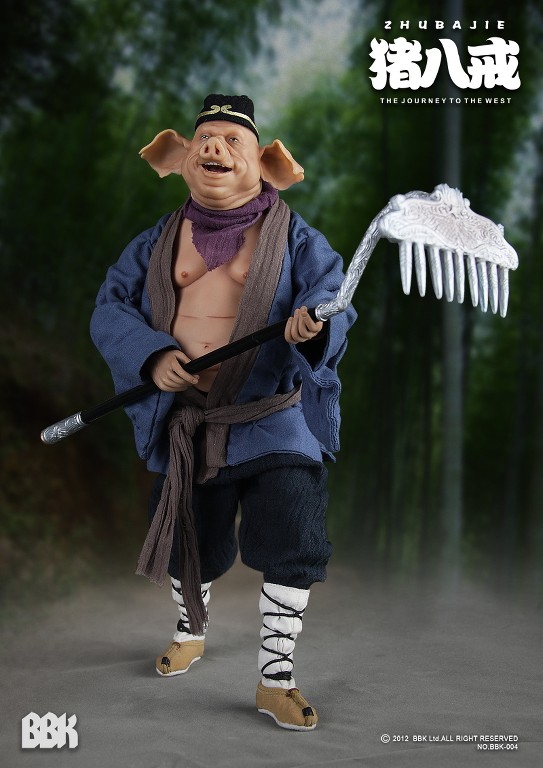
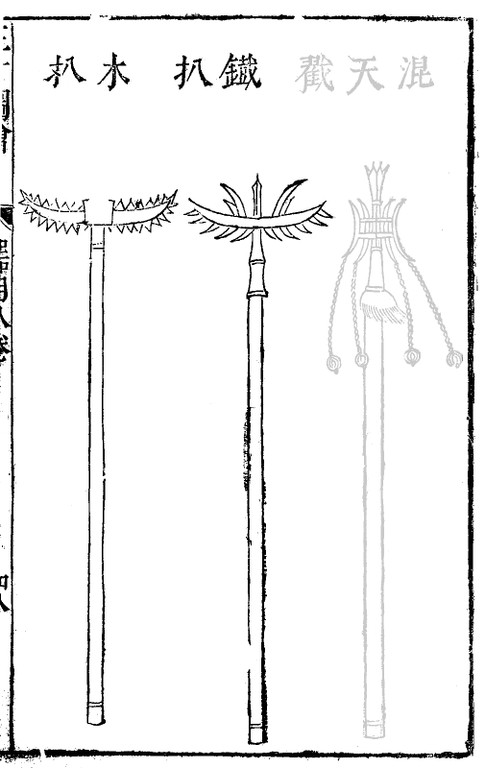
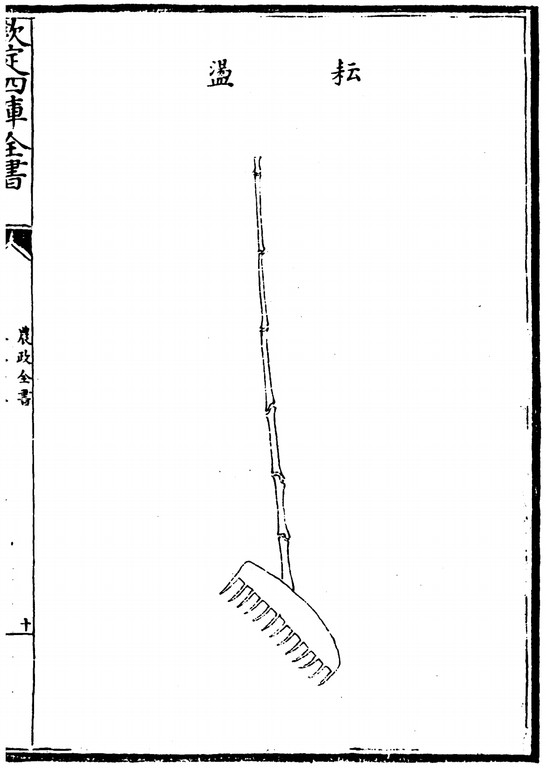
Fig. 1 – (Left) The circa 1460 painting depicting the Four Saints (Sisheng, 四聖) (larger version). Heavenly Reed is the black-skinned figure in the upper left. Fig. 2 – (Center Left) A modern Zhu Bajie action figure with an ornate silver-headed rake (larger version). Fig. 3 – (Center Right) A pair of Pa () military rakes from the San Cai Tu Hui (三才圖會, 1609) (larger version). Fig. 4 – (Right) A Yundang (耘盪hand harrow) from a Ming Dynasty agricultural treatise that borrows heavily from the Nongshu (農書) (larger version). 

2. Zhu’s Rake

JTTW describes Zhu’s rake as being a polearm with nine teeth (fig. 2). But did you know that, despite serving as a general in heaven, his weapon is not the kind that was historically used by the Chinese military. Those of the Ming Dynasty (1368–1644), when the book was written, “were [two] meters in length and used to unseat enemy riders and hook and grab enemy weapons” (Swope, 2009, p. 78). The Pa (鈀, rake) (fig. 3), for example, was covered with hooks in place of teeth to aid in the aforementioned hooking action. [1] But noted Ming General Qi Jiguang (戚繼光, 1528–1588) considered it useless in his battle against Japanese pirates (Tang Pa (钂鈀), 2015).

Zhu’s weapon more closely resembles agricultural tools that were traditionally used by peasant farmers as far back as the Yuan Dynasty (1271–1368). The Book of Agriculture (Nongshu, 農書, 1313), by the Confucian scholar and inventor Wang Zhen (王禎, fl. 1290–1333), includes descriptions and woodblock prints of several manual and water-powered farming implements. The book itself was written in response to the devastation that the Mongols had wrought on China over decades of war, so the featured tools were meant to help make life easier for farmers toiling away in the fields (Bray & Needham, 2004, pp. 59-60). One such innovation to come from the book was the Yundang (耘盪, hand harrow) (fig. 4), a bamboo-handled rake with metal teeth designed to weed rice crops (Bray & Needham, 2004, pp. 61-62). I suggest that this (or other tools like it) most likely influenced Zhu’s weapon.

I also posit that the hog spirit was given such a weapon because it added to his image as a country bumpkin. Whereas Monkey wields a magic iron staff once used by Yu the Great to tame the world flood, Zhu brandishes a gardening tool. The weapon itself is comical in that it is said to have been handcrafted by Laozi (老子) from “divine ice steel” and etched with arcane symbols (Wu & Yu, 2012, pp. 382-383). That’s one fancy rake!


3. Updates

3.1. The Rake in 1592 JTTW Woodblock Prints

Update: 05-15-18

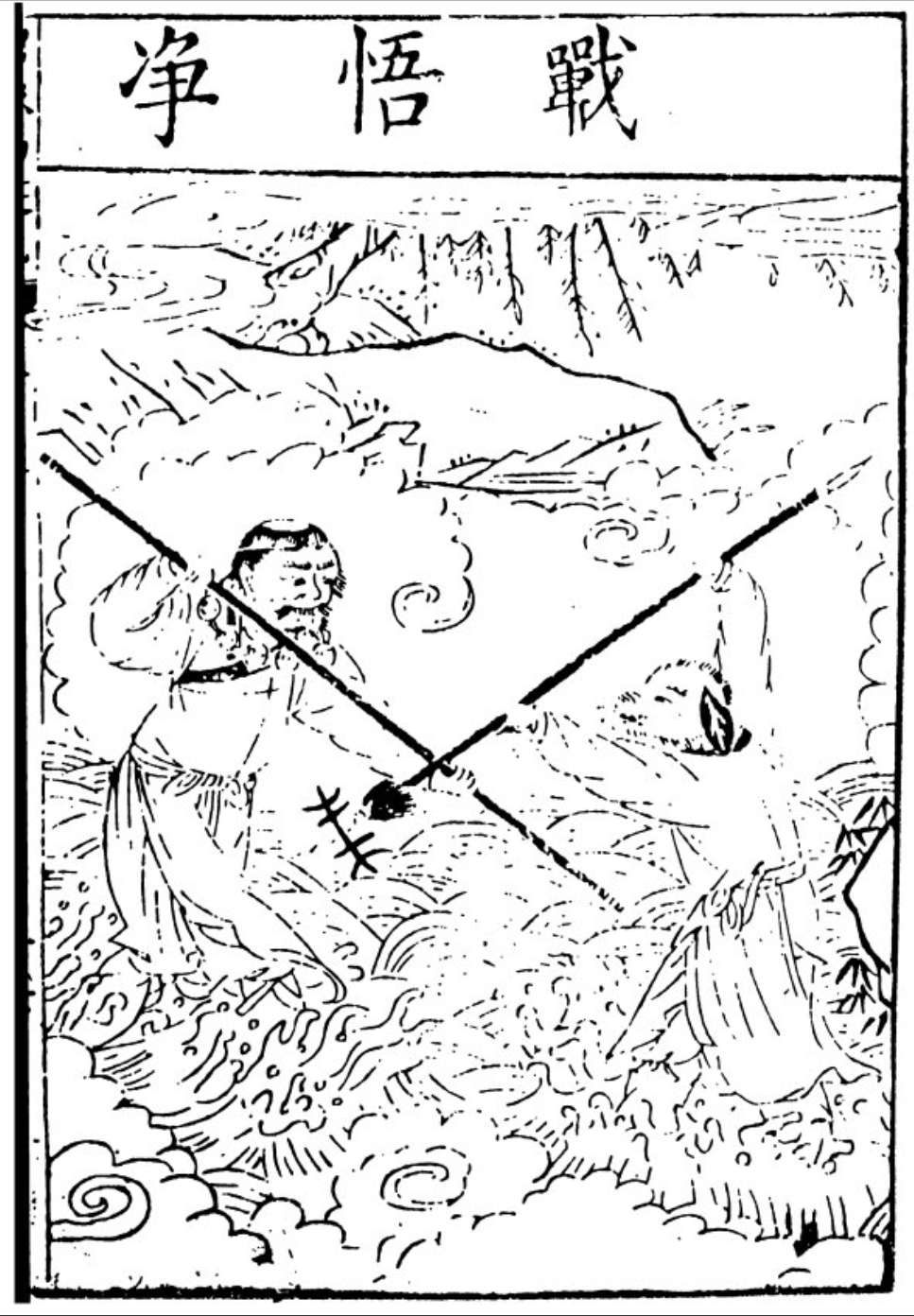
Feng Dajian of Nankai University was kind enough to direct me to this Ming-era woodblock print (fig. 5) by Shide tang (世德堂本), publisher of the original 1592 edition of JTTW. Check out Zhu’s war rake! Again, his weapon from the novel is the agricultural type, but this print is an interesting change of pace. Also, notice how Sandy’s staff doesn’t have any metal blades (as normally shown in pop culture).

Shide tang print (Sandy vs Pigsy) - Small

Fig. 5 – Ming-era Shide tang print of Pigsy vs Sandy (larger version).


3.2. Song-Era Image of Marshal Tianpeng

Update: 12-21-2018

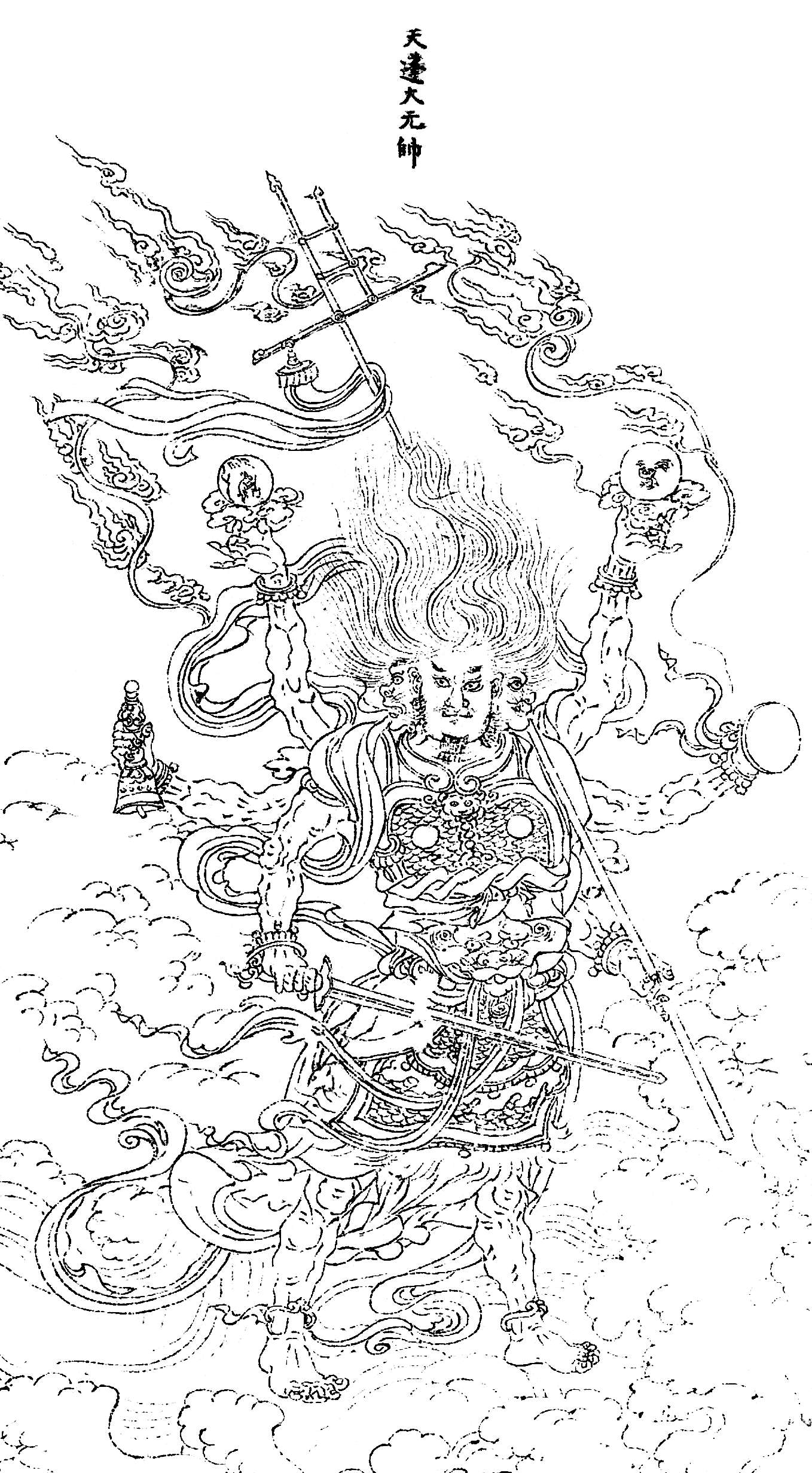
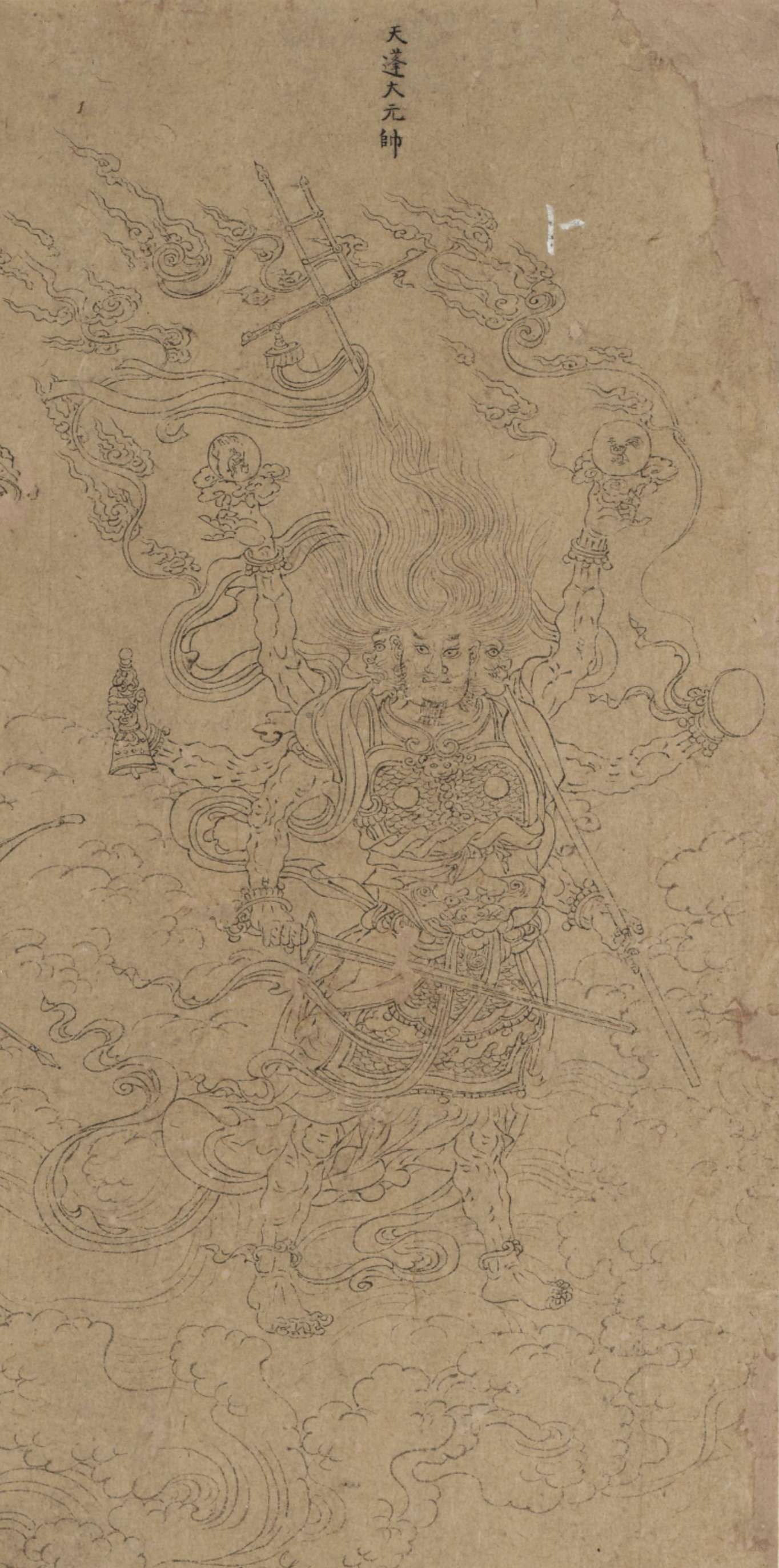
A beautiful rendering of Marshal Tianpeng (fig. 6) appears in the Ink treasures of [Wu] Daozi (Daozi mobao, 道子墨寶), a collection of ink drawings traditionally attributed to the noted 7th/8th-century artist Wu Daozi but likely hails from the 13th century. Tianpeng is portrayed as an esoteric protector deity with multiple arms holding implements of both war and religion. The military arms include a halberd and a sword, while the religious items include a vajra bell, a mirror, and two orbs adorned with a rabbit and a rooster, respectively (fig. 7). These animals represent the moon and the sun, being zoomorphic symbols of yin and yang forces. Interestingly, the rabbit is seen mixing the elixir of immortality, a common motif in Chinese art (fig. 8).

Zhu Bajie Origin pics #2
Fig. 6 – Tianpeng from the 13th-century Ink Treasures of Wu Daozi (larger version). The original drawing can be seen here. Fig. 7 – Details of the Moon Rabbit and Sun Rooster (larger version). Fig. 8 – The Moon Rabbit motif from an 18th-century court robe (larger version).

What’s most interesting about the drawing is the obvious esoteric Buddhist influence. In this article, I mention a 13th-century stone relief carving of Sun Wukong in which he is portrayed with a headband, arm ornaments, bangles, a bone rosary, a girdle, a tiger skin apron, and anklets. These items are listed among an 8th-century source as ritual adornments worn by Buddhist yogis, each one representing a different esoteric Buddha or philosophical aspect of the religion. Many of these same ritual items appear on Tianpeng, pointing to a borrowing of esoteric Buddhist motifs by Daoism.


3.3. Zhu as a Stellar Boar

Update: 01-28-19

Brose (2018) explains that Zhu Bajie is connected to a sun goddess worshiped in China. Known as Marici (Molizhi, 摩利支) in Buddhism and Doumu (斗母/斗姆, “Mother of the Dipper”) in Daoism, [2] she is often depicted as a fearsome, multi-armed guardian astride a boar or aloft a boar-driven chariot, and among whose multiple faces is a boar (fig. 9). This is because a stage play that predates the Ming novel represents Zhu as the goddess’ mount come to earth (Brose, 2018, p. 174). This would mean Zhu Bajie’s connection to Marshal Tianpeng is a later addition to the story cycle. Both Tianpeng and Marici are associated with the stellar bodies of the Big Dipper constellation and share similar exorcistic duties (Brose, 2018, pp 175-176). This may explain why Zhu was later associated with the general.

marci goddess, martial aspect, modern shenxiang

Fig. 9 – A modern altar statue showing Marici’s martial aspect riding a boar (larger version). Take note of the boar-like face on the right.

Regarding the origin of Marici’s boars, Getty (1988) explains that Riksha, the Sanskrit word used to denote the bright stars of the Big Dipper, sounds just like the term for “bear.” Therefore, one hypothesis states that this confusion may have resulted in the sun goddess’ mount being a bear, but due to the scarcity of the animal in South Asia—or just plain iconographic confusion, in my opinion, since both animals are dark-furred quadrupeds—the iconography was changed to a boar over time. If true, this means Zhu could have been a bear! Furthermore, the seven boars shown to be pulling her chariot in some religious art are most likely based on the seven steeds of the Hindu sun god, Surya (pp. 117-118).


3.4. Marshal Tianpeng as a Bodily God?

Update: 09-01-19

Huang (2010) describes the common Daoist practice of visualizing gods residing in an adept’s body (shenshen, 身神, lit: “body gods”). The presence of these deities was thought to bring health and aid in the quest for immortality. She notes that the Ming edition of the Perfect Scripture of the Great Cavern (Dadong  zhenjing, 大洞真經), originally collected by the Supreme Clarity patriarch Jiang Zongying (蔣宗瑛, d. 1281) during the Southern Song, includes fifty illustrations of groups of gods standing on clouds emanating from the top of a seated Daoist’s head. Most importantly, these deities include protective guardians (lishi, 力士), “[o]ne particular trinity [of which] consists of a general ‘who resembles the Great General of Heavenly Mugwort (Tianpeng dajiang 天蓬大將)'” (Huang, 2010, p. 65 n. 12). An example of this illustration appears in the first scroll of the work (fig. 10).

Marshal Tianpeng from the first scroll of the Dadeng zhengjing, or the Perfect Scripture of the Great Cavern, Southern Song - small

The illustration of the trinity of protective deities, including a general that looks like Marshal Tianpeng (larger version). Image found here.

Again, I would like to highlight the fact that the general’s name, Heavenly Mugwort (Tianpeng, 天蓬), recalls the historical use of the plant as a magic medicine to ward off the evil spirits of illness (see the top of the article). Therefore, Tianpeng’s use in this form of Daoist meditation likely served a medical purpose.


3.5. What Zhu Bajie Looks Like

Update: 08-08-21

I’ve written an article about Zhu’s literary description.

What Does Zhu Bajie Look Like? A Resource for Artists and Cosplayers


3.6. The Pig God that Influenced Zhu

Update: 11-13-23

I recently learned about a Tang-era story that likely influenced Zhu Bajie’s characterization in chapter 18 as a dark, wind-riding pig spirit with a lust for young women. Thank you to friend of the blog @ryin-silverfish for giving permission to quote their synopsis. I have added links below where necessary:

  • The earliest tale about a lusty pig demon could be found in the Tang dynasty Xuan Guai Lu (玄怪录). Guo Yuanzhen, a historical general during the reign of Gaozong and Wu Zetian, came across a mansion in his youth during travel. The whole place was lavishly decorated, as if preparing for a wedding banquet, but eerily empty save for one crying woman.
  • Turned out, she was the unwitting soon-to-be bride of a god called “General Wu” (乌将军), who demanded a beauty as his wife every year from the locals, and because they would pay a hefty sum to “buy” said bride, her own father sold her out to be this year’s sacrifice. Furious, Guo disguised himself as a guest, pretended to offer General Wu some venison, then cut off his hand with the meat knife.
  • Wounded, the General fled, and his severed limb turned into a pig’s hoof once the sun came out. Soon, the bride’s family and village elders came to the manor, ready to collect her body for the funeral, and were so freaked out by what Guo did that they were ready to sacrifice him to General Wu too, since the “god” was known to summon storm and hails whenever he didn’t get his bride.
  • Guo scolded them for being so damn gullible because no real gods would demand human sacrifices or, y’know, have pig hooves as hands, before gathering the young men of the villages and following the trail of blood to the pig demon’s abode, where they proceeded to smoke it out and kill it with an assortment of arrows and farming tools.
  • The woman, after calling out her terrible parents, pledged herself to Guo and became one of his wives, and all was well.

Notes:

1) Other kinds of military rakes included the pitchfork-like Yi Pa (㑥耙), the trident-like Tang (钂) and Tangpa (钂鈀), and the more rare halberd-like Mao Lian Tang (茅鐮钂) (Tang Pa (钂鈀), 2015).

2) For information on Marici, see Getty (1988), pp. 117-119. For Doumu, see Esposito, 2008, pp. 282-283.

Sources:

Andersen, P. (1989). The Practice of Bugang. Cahiers d’Extrême-Asie, 5. Numéro spécial Etudes taoïstes II / Special Issue on Taoist Studies II en l’honneur de Maxime Kaltenmark. 15-53.

Andersen, P. (2008). Tianxin zhengfa. In F. Pregadio (ed.), The Encyclopedia of Taoism (Vols. 1-2) (pp. 989-993). Longdon: Routledge.

Bray, F. & Needham, J. (2004). Science and Civilisation in China: Volume 6, Biology and Biological Technology; Part 2 – Agriculture. Cambridge: Cambridge U.P.

Brose, B. (2018). The Pig and the Prostitute: The Cult of Zhu Bajie in Modern TaiwanJournal of Chinese Religions, 46 (2), 167-196, DOI: 10.1080/0737769X.2018.1507091

Davis, E. L. (2001). Society and the Supernatural in Song China. Honolulu: Univ. of Hawaií Press.

Getty, A. (1988). The Gods of Northern Buddhism: Their History and Iconography. New York: Dover Publications.

Huang, S. (2010). Daoist Body and Cosmos, Part I: Body Gods and Starry Travel. Journal of Daoist Studies 3, 57-90.

Little, S., Eichman, S., & Ebrey, P. B. (2000). Taoism and the Arts of China. Chicago: Art Institute of Chicago.

Swope, K. (2009). A Dragon’s Head and a Serpent’s Tail: Ming China and the First Great East Asian War, 1592–1598. Norman: University of Oklahoma Press.

Tang Pa (钂鈀). (2015, March 24). Retrieved November 02, 2017, from https://greatmingmilitary.blogspot.com/2015/03/tang-ba.html

Von, G. R. (2004). The Sinister Way: The Divine and the Demonic in Chinese Religious Culture. Berkeley: University of California Press.

Welch, P. B. (2008). Chinese Art: A Guide to Motifs and Visual Imagery. North Clarendon, VT: Tuttle Pub.

Wu, C., & Yu, A. C. (2012). The Journey to the West (Vols. 1-4) (Rev. ed.). Chicago, Illinoi: University of Chicago Press.