Note: My blog is not monetized, so I am not making any money from this post. If you enjoyed the digital version, please, please, please support the official release.
Last updated: 09-22-2024
I noted in my previous article that medicine was among the skills acquired by Monkey while training under the Buddho-Daoist sage, Patriarch Subodhi. In Journey to the West (Xiyouji, 西遊記, 1592) chapters 68 to 69, Monkey works to diagnose the long-standing malady of the Scarlet-Purple Kingdom emperor. But due to the immortal’s monstrous appearance, Sun is forced to analyze the ruler from afar, using three magic hairs-turned-golden strings to measure the vibrations of the pulse from three locations of each forearm. He deduces that the illness is caused by fear and anxiety over the loss of the monarch’s queen, who had been kidnapped by a demon. Monkey then concocts three pills from a secret recipe and administers the elixir with dragon king saliva. The medicine causes the emperor to pass an obstruction in his bowels, thus restoring the natural qi flow in his body and curing him of his sickness.

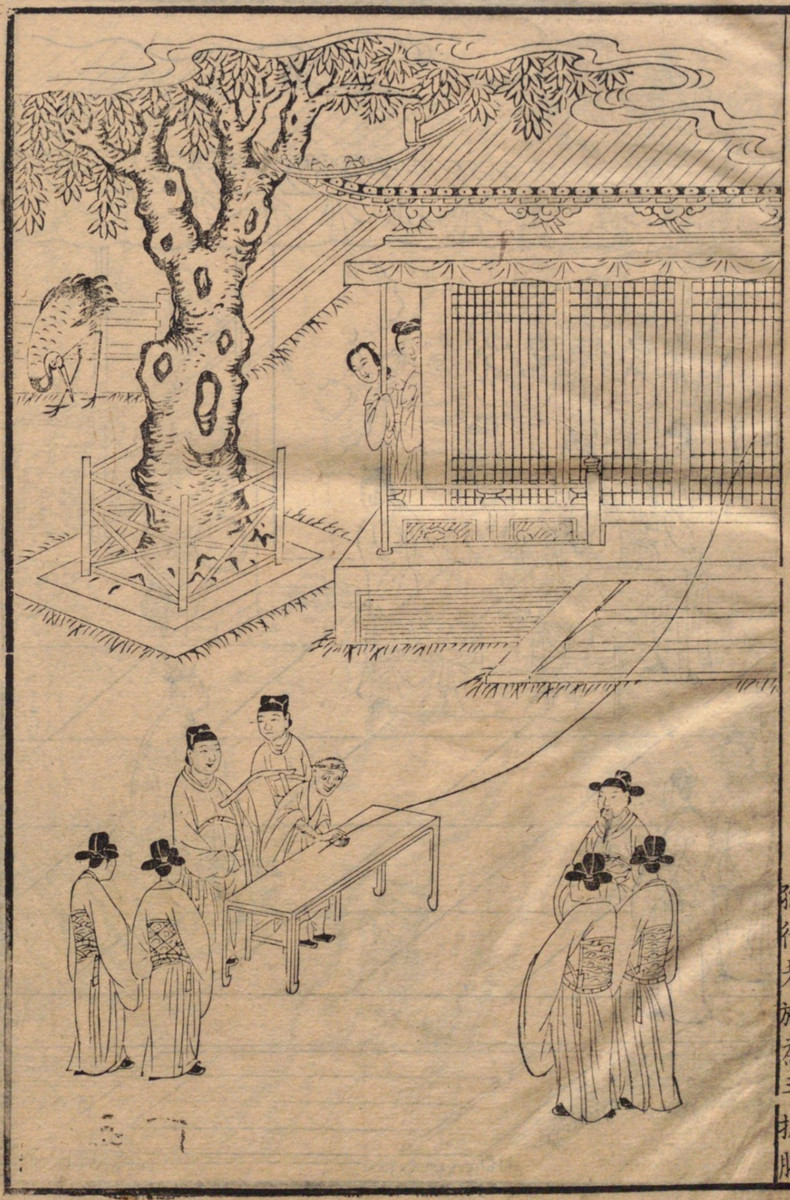
Fig. 1 – Monkey uses golden threads to analyze the emperor’s pulse (larger version). From Mr. Li Zhuowu’s Literary Criticism of Journey to the West (late-16th century).
Table of Contents
- 1. Examples of Sun’s Medical Knowledge
- 1.1. Chapter 68
- 1.2. Chapter 69
- 2. The Elixir of Black Gold and its Historical Origins
- 3. Archive Link
- 4. Updates
1. Examples of Sun’s Medical Knowledge
1.1. Chapter 68
Monkey first assuages the fears of court officials by reciting a poem explaining the proper procedure for analyzing a patient:
Most mysterious is the physician’s art;
His mind must ever be alert and keen.
To look, listen, ask, and take-these four things If one is missing, his craft’s not complete.
One, we look at the patient’s complexion:
Is it moist, dry, fat, or thin in waking or sleep?
Two, we listen for clear or turbid voice
When he speaks lucid or frenetic words.
Three, we ask for the ailment’s cause and length.
For how he eats, drinks, and eliminates.
Four, we scan the conduits by taking the pulse,
To learn how submerged or floating in and out.
If we do not look, listen, ask, and take, In this life his ailment will ne’er him forsake!” (based on Wu & Yu, 2012, vol. 3, p. 268).醫門理法至微玄,大要心中有轉旋。
望聞問切四般事,缺一之時不備全:
第一望他神氣色,潤枯肥瘦起和眠;
第二聞聲清與濁,聽他真語及狂言;
三問病原經幾日,如何飲食怎生便;
四才切脈明經絡,浮沉表裡是何般。
我不望聞並問切,今生莫想得安然。(source)
1.2. Chapter 69
Sun then follows through with the analysis:
We were telling you about the Great Sage Sun, who went with the palace attendant to the interior division of the royal palace. He stood still only after he had reached the door of the royal bedchamber. Then he told the attendant to take the three golden threads inside along with the instruction: “Ask one of the palace ladies or eunuchs to tie these three threads to the inch, the pass, and the foot sections of His Majesty’s left hand where the radial pulse are felt. Then pass the other ends of the threads out to me through the window shutters” [fig. 1].
The attendant followed his instruction. The king was asked to sit up on the dragon bed, while the three sections of his pulse were tied by the golden threads, and their other ends were then passed out to Pilgrim. Using the thumb and the index finger of his right hand to pick up one of the threads, Pilgrim first examined the pulse of the cun [寸] section; next, he used his middle finger and his thumb to pick up the second thread and examine the pulse of the guan [關] section; finally, he used the thumb and his fourth finger to pick up the third thread and examine the pulse of the chi [尺] section.
Thereafter Pilgrim made his own breathing regular and proceeded to determine which of the Four Heteropathic Pneumatics, the Five Stases, the Seven External Images of the Pulse, the Eight Internal Images of the Pulse, and the Nine Pulse Indications were present. [1] His pressure on the threads went from light to medium to heavy, and from heavy to medium to light, until he could clearly perceive whether the condition of the patient was repletion or depletion of energy and its cause. Then he made the request that the threads be untied from the king’s left wrist and be attached as before to the positions on his right wrist. Using now the fingers on his left hand, he then examined the pulse on the right wrist section by section. When he had completed his examination, he shook his body once and retrieved his hairs (based on Wu & Yu, 2012, p. 270).
Finally he delivers a very detailed diagnosis:
“Your Majesty,” he cried in a loud voice, “on your left wrist the pulse of your cun section feels strong and tense, the pulse of your guan section feels rough and languid, and the pulse of your chi section feels hollow and sunken. On your right wrist the pulse of your cun section feels floating and smooth, the pulse of your guan section feels retarded and hesitant, and the pulse of your chi section feels accelerated and firm. Now, when the pulse of your left cun section feels strong and tense, it indicates an internal energetic depletion with pain in the cardiac system of functions. When the pulse of your left guan section feels rough and languid, it indicates sweating that has led to numbness in the flesh. When the pulse of your left chi section feels hollow and sunken, it indicates a pink tinge to your urine and blood in your stool. When the pulse of the cun section on your right wrist feels floating and smooth, it indicates a congestion blocking the pneumatic energy circulation and leading to cessation of menses. When the pulse of your right guan section feels retarded and hesitant, it indicates a stasis of alimentary matter in the stomach system with retention of fluids. When the pulse of your right chi section feels accelerated and firm, it indicates discomfort caused by sensations of stuffiness and chills caused by energetic depletion. To sum up, your illness has been caused by fear and anxiety, and it may be the manifestation type of an illness called the ‘Paired Birds in Severance’ [shuangniao shiqun, 雙鳥失群]” (based on Wu & Yu, 2012, vol. 3, pp. 270-271).
Baring the strings, Monkey’s method of reading the pulse aligns with real Chinese medicinal practice. The area of the forearm analyzed by traditional Chinese doctors is known as cunkou (寸口, the “inch opening”), and this is broken up into the three spots cun (寸, “inch”), guan (關, “pass”), and chi (尺, “foot”) (fig. 2). The mirrored spots on each arm are believed to correspond to specific internal organs. For example, the cun spot (nearest the wrist) on the right hand corresponds to the lungs, while that of the left hand corresponds to the heart (Liao, 2011, pp. 55-56). Therefore, analyzing the pulse at these spots is believed to reveal the health of the corresponding organs.

Fig. 2 – The spots analyzed during pulse diagnosis (larger version). Picture originally found here.
2. The Elixir of Black Gold and its Historical Origins
Wukong selects his ingredients from among 808 requested substances in order to keep the recipe a secret from the foreign kingdom’s doctors. It is made from an ounce of powderized dahuang (大黃), which is said to “loosen phlegm and facilitate respiration [and] sweep out the chill and heat congealed in one’s stomach” (Wu & Yu, 2012, pp. 273-274); an ounce of shelled, powerderized badou (巴豆), which is said to “break up congestion and drain the intestines [and] take care of swellings at the heart and dropsy in the abdomen” (Wu & Yu, 2012, p. 274); half a flask of “Hundred-Grass Frost” (baicao shuang, 百草霜), or frying pan soot, which is said to “soothe a hundred ailments” (Wu & Yu, 2012, p. 274); and half a flask of dragon (horse) urine, which is said to “cure any kind of disease a human may have when it is ingested” (Wu & Yu, 2012, p. 274). The resulting paste is rolled into three pills and presented to the emperor as the “Elixir of Black Gold” (Wujin dan, 烏金丹) (video 1) (Wu & Yu, 2012, p. 276).
Video 1 – Episode 20 of the 1986 Journey to the West series portrays this story. See minute 19:19 for the preparation of the Elixir of Black Gold.
Andrew Schonebaum’s (2016) fascinating book Novel Medicine: Healing, Literature, and Popular Knowledge in Early Modern China explains the historical significance of the real world ingredients used in this elixir. He introduces the first two ingredients by way of their anthropomorphization as Badou Dahuang, the ruler of the fictional Hujiao (胡椒, black pepper) kingdom from the vernacular novel Annals of Herbs and Trees (Caomu chunqiu yanyi, 草木春秋演義, c. 17th/18th century), a work that gives human form to Chinese medicines, pitting armies of mortal, immortal, and demonic characters/remedies against one another. Badou is depicted as having the mandate of heaven (the right to rule) in his own country but wanting to invade the Han empire. This dual nature can be explained by the properties of the ingredients making up his name. Schonebaum (2016) writes:
[B]adou (croton) and dahuang (rhubarb), are two of the most common drugs in Chinese medicine. Badou is toxic and a strong purgative, and it was used to treat stagnation in the viscera and bowels, as well as to facilitate urination, eliminate malignant flesh, and purge vicious agents such as invading ghosts or worms. Dahuang is nontoxic and is sometimes referred to by the name “military general” because “the drug pushes away the old and brings in the new, like a military general putting down a riot and bringing peace” (pp. 99-100).
Regarding the “Elixir of Black Gold,” Schonebaum (2016) explains that “black gold” was the name of a common prescription and that badou and dahuang were part of its core, while other ingredients could be replaced with those of similar properties:
One commentator had never heard of this medicine, saying that it had a strange name, but this only reveals his own highbrow background (or general ignorance), since “black gold” was the name of various prescriptions common among hereditary doctors. In fact, it was mentioned in the Systematic Materia Medica repeatedly, and Xu Dachun recommends it in Medical Cases of Huixi, so it was not exclusively the purview of nonelite healers.
“Black gold pills” (wujin wan) was a name and a concoction similar to “elixir surpassing [the value of] gold” (shengjin dan) and “black spirit pills” (heishen wan). All of them were core formulas that could be modified in their effects by ingesting them with different liquids. These “black gold” medicines, along with the likes of “the prescription offering Guanyin’s all-encompassing help” (Guanyin puji fang) and “pills prepared with old ink” (gumo wan), treated a wide variety of ailments (in one medical manuscript, twenty-nine, forty, and seventy-one ailments, respectively), and were extremely common formula in the Qing. The “black gold” formulas had at their core the drugs dahuang and badou. One medical manuscript from the Republican period states in its introduction, “Black gold powder [wujin san] cures all ailments, just as the wind bends the grasses. Other names [of this prescription] are ‘pine smoke elixir’ [songyan dan] and ‘black spirit pills’ [heishen wan]. It cures thousands of illnesses, just as the sun melts the frost.”
Black gold pills (wan), powder (san), paste (gao), and elixir (dan) were commonly employed to cure gynecological issues. A prescription named “black gold powder” was first recorded in the Song work A Spring of Recipes in the Magic Park (Lingyuan fangquan) and was followed by references in the Southern Song prescription collection “Complete Collection of Effective Prescriptions for Women” (Furen daquan liangfang, 1237), Formulas for Universal Benefit (Puji fang, 1390), and other works. Over the centuries, numerous formulas, each with different ingredients, became known under the names “black gold powder,” “black gold pills,” and “black gold elixir.” The three designations of this formula result from the use of pitch (mo), a vernacular name for which is the “black gold” of these prescriptions.
Monkey’s prescription reflects a historical reality, namely that the advent of the imperial pharmacy (huimin yaoju) in the Song required doctors who had previously relied on simple medicines with one or two ingredients to employ formulas with numerous substances whose composition followed theories of systematic correspondences. From this conflict between empirical and theory-based recipes arose a new type of prescription eventually consisting of a nuclear formula that could be adapted to the requirements of a given patient’s disease by omitting or adding individual constituents in accordance with his pathological condition. Monkey is preparing simple, trusted medicine at the core, namely badou and dahuang, and adding to it many exotic, unobtainable ingredients (pp. 103-104).
As noted above, black gold medicines were sometimes used to treat gynecological issues. This makes Monkey’s prescription all the more comical as he had partly attributed the foreign emperor’s ails to a “cessation of the menses” (Wu & Yu, 2012, p. 271), obviously a woman’s problem. Schonebaum (2016) comments: “To understand this aspect of the carnivalesque comedy, or to realize that it was a mistake in the incorporation of medical materials into the novel, readers would have had to be quite familiar with medicine, at least enough to know that the medicine Monkey is preparing is consistent with his diagnosis” (p. 104).
3. Archive link
Chapter three of Novel Medicine (2016) is archived here.
4. Updates
4.1. Legendary Influence and Modern Ritual
Update: 09-22-24
As mentioned above, Sun Wukong analyzes the ailing king’s pulse from afar using three magic hairs-turned-golden threads. This is no doubt based on the story of the “Grand Emperor of Protecting Life” (Baosheng dadi, 保生大帝), the Daoist and folk religion god of medicine, curing an empress using the same method:
During the reign of Chengzu (1403–21), the Empress Wen suffered from an inflamed breast. A Taoist priest offered his skills, but the Emperor tested him by having him take her pulse with a string held on the other side of her bedroom wall. First the Emperor attached it to a cat. The Taoist said, “Not a bear, no not bear, it’s a cat.” Then the Emperor tied the string to a doorknob. The Taoist said that it was something of metal and wood, and not a human pulse. Finally, the Emperor tied the string to the woman’s breast and the Taoist said that the liver pulse was inflamed and the blood clotted, and that this indicated a breast infection which had to be treated by moxibustion. He offered to perform the operation by dangling a cord over the wall. He cured the ailment and vanished, refusing a reward of gold and office. In He Qiaoyuan’s version, the Emperor inquired about his name and discovered that he was the long-deceased Divine Doctor Wu Tao. In gratitude, the Emperor enfeoffed the god as Wanshou wuji baosheng dadi (Emperor Who Protects Life of Limitless Longevity) (Dean, 2014, p. 74).
What’s interesting is that this legend carried over into religious practices. A reader who contacted me in 2022 explains:
I observed a practice at [Sidian Xingji Temple (祀典興濟宮)] in Tainan where an individual would let the god Baosheng dadi check their pulse by resting three sticks of incense on their forearm. The temple brochure also mentions this procedure [fig. 3]. I believe this to be relevant to your article …

Fig. 3 – A detail from the aforementioned temple brochure showing the three incense sticks resting on a member’s wrist (larger version). Photo by Richard Malabarista.
Notes:
1) Yu (Wu & Yu, 2012) provides explanations for these terms in the end notes of his wonderful translation (pp. 448-449, n. 3-7).
Sources:
Dean, K. (2014). Taoist Ritual and Popular Cults of Southeast China. United States: Princeton University Press.
Liao, Y. (2011). Traditional Chinese medicine. Cambridge: Cambridge University Press.
Schonebaum, A. (2016). Novel Medicine: Healing, Literature, and Popular Knowledge in Early Modern China. Seattle: University of Washington Press
Wu, C., & Yu, A. C. (2012). The Journey to the West (Vol. 3) (Rev. ed.). Chicago, Illinois: University of Chicago Press.