Origin of the White Bone Spirit

Last updated: 01-31-2023

The twenty-seventh chapter of Journey to the West (Xiyouji, 西遊記, 1592) features a mountain spirit who resorts to magic disguises in an attempt to eat Tripitaka. Commonly referred to as the “White Bone Spirit” (Baigujing, 白骨精), she is one of a family of ghouls active in White Tiger Mountain (Baihu ling, 白虎嶺) who have long told legends of the monk’s immortality-bestowing flesh. She resorts to subterfuge because alone she is not powerful enough to contend with the holy man’s present disciples, Zhu Bajie and Sha Wujing.

The spirit first disguises herself as a peerless beauty described as having “ice-white skin hid[ing] jade-like bones” (Wu & Yu, 2012, pp. 18). She comes bearing a vegetarian meal, claiming it to be food intended for her pious husband toiling in the fields on the other side of the mountain. She instead decides to feed Tripitaka as this would allow her to keep her family’s vow of supporting monks. But before she can kidnap the monk, Sun Wukong returns from picking peaches for his master and sees through the magic facade, seemingly killing the young girl with his magic staff. The monster, however, is able to escape in spirit at the last second using the “Magic of Releasing the Corpse” (Jieshi fa, 解屍法), [1] leaving behind a fake body in her place. The innocent-looking food is then revealed to be bewitched frogs, toads, and maggots. Despite this, Zhu Bajie convinces their master that Monkey is trying to conceal the murder with magic, leading to the monk using the Tight-Fillet spell as punishment.

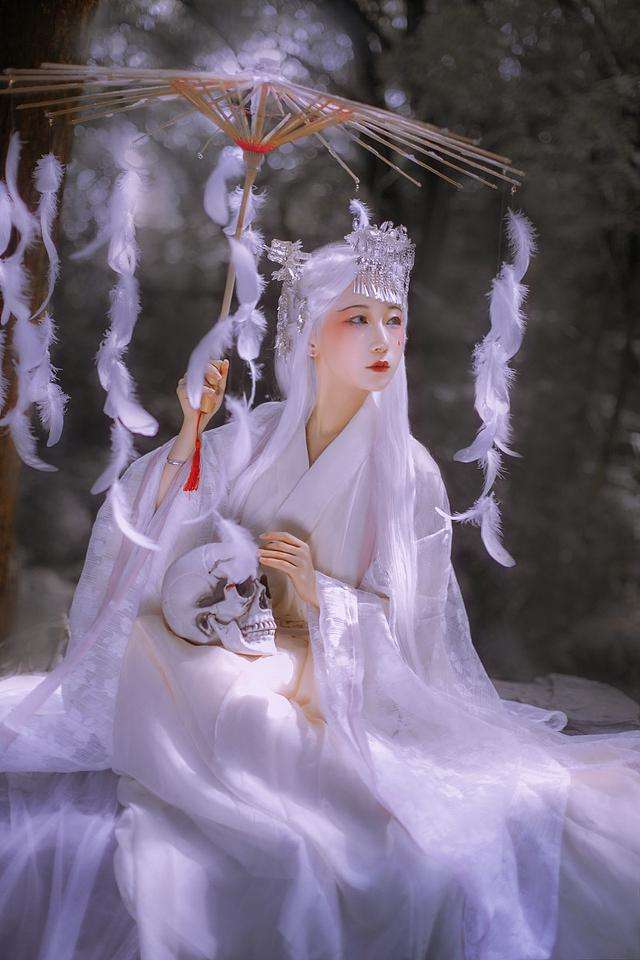
She subsequently disguises herself as the girl’s elderly mother searching the mountain for her daughter. Sun again sees through the disguise and seemingly kills her with his staff. This again leads to his punishment with the Tight-Fillet spell. The White Bone Spirit’s last disguise is that of the elderly father looking for his wife and daughter. But this time Monkey calls on local deities to guard any possible escape routes, and this time he succeeds in killing her. The spirit’s true form is revealed to be a “pile of flour-white skeletal bones” with the name “Lady White Bone” (Baigu furen, 白骨夫人) engraved on her spine (fig. 1) (Wu & Yu, 2012, pp. 26).

White Bone Spirit drawing - small

Fig. 1 – A lovely cosplay of Lady White Bone (larger version). More pictures can be seen here

I. Origin in oral literature

The precursor of the White Bone Spirit can be traced to a demon appearing in chapter six of The Story of How Tripitaka of the Great Tang Procures the Scriptures (Da Tang Sanzang qujing shihua, 大唐三藏取經詩話, c. late 13th-century), the earliest known printed edition of Journey to the West, which likely served as a prompt for ancient storytellers.

Chapter six: Passing Long Ditch and Great Serpent Peak (Guo changkeng dashe lingqu, 過長坑大蛇嶺處)

The pilgrims arrived at the valley of the fire-spitting White Tiger Spirit (Huo lei ao baohu jing, 火類坳白虎精). Coming closer they encountered a great ditch. The four steep entrances were pitch-black and they heard a roar of thunder. They could not advance. The Dharma Master [Fashi, 法師, i.e. Tripitaka] held up his [magic] golden-ringed staff and, flourishing it toward the distant heavenly palace, yelled: “Devaraja! Help us in our afflictions!” Suddenly a shaft of light shot out from the staff five tricents long. It slashed through the long ditch and soon they were able to get across.

Next they came to Great Serpent Peak. There they saw a gigantic serpent like a dragon. It likewise was not harmful to humans. Then they crossed the pit of the fire-spitters. Down, down into the fiery pit they looked and saw a pile of dry bones over forty tricents long. The Dharma Master asked Monkey Pilgrim [Hou xingzhe, 猴行者]: “What are those white withered bones piled up there like snow on a mountain?” Monkey Pilgrim replied: “This is the place where the Heir Apparent, Ming Huang…changed his bones.” [2] The Dharma Master, hearing this, joined his palms and bowed his head in reverence.

Next they suddenly came to a prairie fire which reached to the heavens. It sent off such a huge amount of smoke and sparks that the pilgrims could not proceed. The Dharma Master shone the light of his [magic] begging-bowl toward the fire and yelled: “Devaraja!” The fire died out immediately and the seven pilgrims crossed this pit. When they were halfway across, Monkey Pilgrim said: “Master, did you know this peak is inhabited by a white tiger spirit? It often appears as a vixen, demon, or goblin and even eats people.” The Master replied: “I didn’t know!” After a while they could see a spume of ominous-looking smoke rising behind the peak and from the cloud thus…fell a mixture of rain, snow, and sleet. In the cloudy mist there was a woman dressed all in white.

She wore a white bodice of gauze, a white gauze skirt with a white belt, and held in her hands a single white peony. [3] Her face was as pretty as a white lotus, her ten fingers like precious jades. Observing the form of the ogress, Monkey Pilgrim had his suspicions confirmed. “Master, don’t go any farther,” said Monkey Pilgrim. “It’s surely an ogress. Wait till I go up and ask who she is.” Monkey Pilgrim took one look at her and shouted in a loud voice: “What place are you from, demon? What shape is beneath your facade? If you are a sprite or goblin, why don’t you hurry back to your lair? If you are an ogress, hurriedly hid your traces. But, if you are the daughter of a human being, then tell me your name and surname. And be quick about it! If you procrastinate and don’t speak, I shall reduce you to dust and power!” Hearing the pilgrim’s ferocious tone of voice, the white-clad woman slowly advanced, smiled coyly, and inquired whither the master and his disciples were going. Monkey Pilgrim said: “Ask no more! We travel for the sake of the sentient beings of the Eastern Lands. And you must be none other than the White Tiger Spirit of the Fire-spitting Pit.”

Hearing this, the woman’s mouth gaped open and she screamed loudly, while at the same moment her skin burst open revealing claws, long fangs, a tail, and a feline head. She was fifteen feet long. In another instant the whole mountain was filled with white tigers. Monkey Pilgrim transformed his golden-ringed staff into a gigantic Yaksa whose head touched the sky and whose feet straddled the earth. In his hands he grasped a demon-subduing cudgel. His body was blue as indigo, his hair red as cinnabar; from his mouth a fiery gleam shot forth a hundred yards long. At the same time, the White Tiger Spirit advanced with a roar to do battle, but she was repulsed by the Monkey Pilgrim. After a short while, Monkey Pilgrim asked if the tiger spirit was ready to submit. She replied, “Never!” Monkey said: “If you will not submit, you will find an old monkey in your stomach!”

The tiger spirit heard what he said yet did not surrender right away. But no sooner had he yelled “Monkey!” than a monkey in the White Tiger Spirit’s stomach responded. The tiger spirit was forced to open her mouth and spit out the monkey. When it landed on the ground in front of her, it became twelve feet long with flashing eyes. The White Tiger Spirit spoke: “I still will not submit!” Monkey replied: “Then you will find another in your stomach!” Again, he caused the tiger spirit to open her mouth and spit out another monkey which landed in front of her. And again the tiger spirit said: “I still do not submit!” Monkey replied: “There are countless old monkeys in your stomach now, and even if you spit them out all day today until the next, all this month until the next, all this year until the next, all this life until the next, you will not be rid of them!” This made the tiger spirit angry. She was again afflicted by the Monkey when he transformed himself into a great stone in her stomach which gradually grew in size. Though she tried to spit it out, she couldn’t. Her stomach split asunder and blood poured from her seven orifices. [4] Monkey called upon the yaksa to slaughter the big White Tiger Spirit ruthlessly, and the yaksa pulverized its bones and obliterated its last vestiges.

The [Monkey Pilgrim], having withdrawn [his] magic, rested for a time before [the group] continued the journey. They left a poem:

The pit of fire-spitters and the White Tiger Spirit,
All that lot are vanquished, and peace and safety reign.
Now, the supernatural power of Monkey Pilgrim is displayed,
Protecting the monkish pilgrims across the great ditch (Wivell, 1994).

過長坑大蛇嶺處第六行次至火類坳白虎精。前去遇一大坑,四門陡黑,雷聲喊喊,進步不得。法師當把金鈽杖遙指天宮,大叫:「天王救難!」忽然杖上起五里毫光,射破長坑,須臾便過。

次人大虵嶺,目(德富氏本作「且」)見大蛇如龍,亦無傷人之性。

又過(巾箱本無「過」字)火類坳,坳下望,見坳上有一具枯骨,長四十馀裡。法師問猴行者曰:「山頭白色枯骨一具如雪?」猴行者曰:「此是明皇太子換骨之處。」法師聞語,合掌頂禮而行。

又忽遇一道野火連天,大生煙焰,行去不得。遂將缽盂一照,叫「天王」一聲,當下火滅,七人便過此坳。

欲經一半,猴行者曰:「我師曾知此嶺(巾箱本作「領」)有白虎精否?常作妖魅妖恠(怪),以至吃人。 「師曰:「不知。」良久,只見嶺後雲愁霧慘,雨細交霏;雲霧之中,有一白衣婦人,身掛白羅衣,腰繫白羅裙,手把白牡丹花一朵,面似白蓮,十指如玉。睹此妖姿,遂生疑悟。猴行者曰:「我師不用前去,定是妖精。待我向前向他姓字。」猴行者一見,高聲便喝:「汝是何方妖恠,甚處精靈?久為妖魅,何不速歸洞府? ,微微含笑,問:「師僧一行,往之何處?」猴行者曰:「不要問我行途,只為東土眾生。想汝是火類坳頭白虎精,必定是也!」

婦人聞語,張口大叫一聲,忽然面皮裂皺,露爪張牙,擺尾搖頭,身長丈五。定醒之中,滿山都是白老虎。被猴行者將金鈽杖變作一個夜叉,頭點天,腳踏地,手把降魔杵,身如藍靛青,發似朱沙,口吐百丈火光。當時,白虎精哮吼近前相敵,被猴行者戰退。半時,遂問虎精:「甘伏未伏!」虎精曰:「未伏!」猴行者曰:「汝若未伏,看你肚中有個老獼猴!」虎精聞說,當下未伏。一叫獼猴,獼猴在白虎精肚內應。遂教虎精開口,吐出一個獼猴,頓在面前,身長丈二,兩眼火光。白虎精又雲:「我未伏!」猴行者曰:「汝肚內更有一個!」再令開口,又吐出一個,頓在面前。白虎精又曰:「未伏!」猴行者曰:「你肚中無千無萬個老獼猴,今日吐至來日,今月吐至後月,今年吐至來年,今生吐至來生,也不盡。被猴行者化一團大石,在肚內漸漸會大。教虎精吐出,開口吐之不得;只見肚皮裂破,七孔流血。喝起夜叉,渾門大殺,虎精大小,粉骨塵碎,絕滅除蹤。

僧行收法,歇息一時,欲進前程,乃留詩曰:
火類坳頭白火精,渾群除滅永安寧。
此時行者神通顯,保全僧行過大坑 (source)

II. Development

The ancient chapter has a number of details that naturally led to the development of the White Bone Spirit:

  1. The demon is a White Tiger Spirit, hence the White Tiger Mountain mentioned in the novel.
  2. The “piles” of the future emperor’s bones recall the “piles” of the White Bone Spirit’s bones (her true form) after she is killed by Wukong.
  3. The White Tiger Spirit’s hunger for flesh and ability to take on any form (like “a vixen, demon, or goblin”) recalls the White Bone Spirit’s pursuit of Tripitaka and use of magic disguises.
  4. The White Tiger Spirit’s initial disguise as a beautiful woman with a “white lotus” face and jade-like fingers recalls the White Bone Demon’s “ice-white skin” and “jade-like bones.”

III. Popular Media

Here is the full length animated feature Sun Wukong Thrice Fights the White Bone Demon (Sun Wukong sanda Baigu jing, 孫悟空三打白骨精, 1985). It was produced twenty years after the highly popular Havoc in Heaven (Danao Tiangong, 大鬧天宮, 1965).


Update: 04-29-22

Shao (1997) writes: “Monkey kills the Cadaver demon three times as she manifests herself in three different forms in the symbolic sense of three cadavers which the Taoists hold accountable for voluptuary impulses” (p. 145). This makes the bone spirit an embodiment of the Three Corpses (Sanshi, 三尸).


Update: 01-31-23

I’ve used the word 髒 (zāng, “dirty”) for years now, but I never really paid attention to its components, 骨 (, “bone”) and 葬 (zàng, “bury”). It brings to mind taboos against being near or handling dead remains. This naturally reminds me of the White Bone Spirit.

Notes

1) This is related to an ancient Daoist concept called “Release by means of a corpse” (Shijie, 尸解). As far back as the Han, immortals are described as leaving a fake corpse (sometimes a magically disguised object) behind while they ascended in secret to heaven (Kirkland, 2008).

2) This changing of bones most likely refers to some type of realized spiritual cultivation that resulted in a new, pure body for the future emperor.

3) The color white is associated with death in Chinese culture.

4) Sun Wukong defeats several monsters in Journey to the West by invading their stomach. See, for example, chapters 59, 75, and 82.

Sources

Kirkland, R. (2008). Shijie In F. Pregadio (Ed.), The Encyclopedia of Taoism (Vol. 2) (pp. 896-897). London [u.a.: Routledge].

Shao, P. (1997). Monkey and Chinese Scriptural Tradition: A Rereading of the Novel Xiyouji (UMI No. 9818173) [Doctoral dissertation, Washington University]. Available from ProQuest Dissertations and Theses database.

Wivell, C.S. (1994). The Story of how the monk Tripitaka of the Great Country of T’ang brought back the Sūtras. In Mair, Victor H. The Columbia Anthology of Traditional Chinese Literature (pp 1181-1207). New York: Columbia University Press.

Wu, C., & Yu, A. C. (2012). The Journey to the West (Vol. 2) (Rev. ed.). Chicago, Ill: University of Chicago Press.

Sun Wukong and Miao Folklore

Last updated: 04-26-21

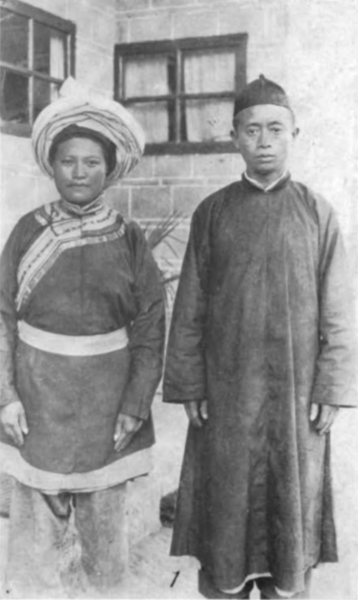
Sun Wukong appears in a body of Buddhist folklore passed on by the Miao ethnic group of Sichuan, also known as the “River Miao” (Chuan Miao, 川苗) or “Old Miao” (Miao: Hmong Bo) (fig. 1). The particular tale is quite different from the popular narrative appearing in Journey to the West (1592). For example, the unnamed monkey tends to a dragon king’s injury and later escorts a Tang dynasty emperor to India.

A Monkey Went Fishing, or Securing Buddhist Sacred Books (97)

The monkey changed into a fisherman and daily went fishing (with a line and hook). He hooked the dragon’s upper lip. When he pulled, the fishhook broke off in the dragon’s upper lip. The dragon’s lip therefore pained him every day. Then every day the dragon king called on his soldiers to go and get a doctor and heal it, but they could not find a doctor.

The monkey daily went to the sand bank to look for his fishhook. One day when he was looking for it two of the dragon king’s soldiers came and asked him, “What are you looking for?” He answered, “I am looking for medicine.” The two soldiers then said, “Old scholar, our old man’s upper lip pains him and he sent us to help him find a doctor. Can you heal him?” The monkey thought, “Probably he has been caught by my fishhook.” He then said, “I can heal it, but I must first look at the injury, then I will give the medicine.” Then the two soldiers invited him to come.

He said, “How can I go since there is so much water?” He had to go down into the water of the stream. The two men then said, “You may get under our fins and close your eyes, and do not open your eyes until we call you.” The monkey wanted to see the dragon, so he closed his two eyes. The two soldiers held him under their fins, and in a short time one of them called him, and he opened his eyes and looked.

When he opened his eyes he had already entered a fine palace. In a little while he heard the soldiers of the dragon king from both sides calling to the dragon king to come and have his wound looked at.

The monkey heard the inside gate resound, “Gu, ga.” He then saw the hands of a big man carrying the dragon king so that he could sit in the chair. Then they requested him to look at the wound. The monkey kowtowed just once to the dragon king and then looked. Then he took a pair of chop sticks and pushed aside the dragon king’s lips, and saw that the fishhook was hooked in the dragon king’s upper lip. Then he took the chopsticks and loosened the fishhook a little. He then asked the dragon king, “Is it any better?” The dragon king answered, “It is a little better.” Then the monkey sat down and rested a little. The dragon king said, “I am afraid that I will die from this illness.”

The monkey said, “You will not die from this sickness. You will certainly recover.” The dragon said, “If you are willing to heal me, I will give you whatever you want.” The monkey then used the chopsticks to push open the lips. Then he seized the fishhook with his chopsticks and with one jerk pulled out the fish book. The lip of the dragon king hurt no longer.

Then the dragon king called to his daughters to entertain the monkey fisherman. The monkey remained there several days. The dragon king was afraid that he [the monkey] was in a hurry and told his soldiers to give him some gold and silver. The monkey said, “I do not want gold and silver. I only want you to permit me to stay here a few days longer.” When the soldiers had reported this to the dragon king, he was glad to have him remain longer. He stayed several months.

One day he was visiting with the women in the palace. The monkey saw a yellow golden club. He then picked it up to play with. He struck with the golden club outside, and the club flew with him to the sea. Then he knew that this club was an ancient golden club. The dragon king did not pursue him.

The monkey lived until the Tang Dynasty, and the Tang Dynasty king wanted to go and get sacred books. But the king could not go himself because the demons and spooks were very numerous along the road. The Tang emperor then sent a messenger to call the monkey to him. The monkey said, “I cannot go. If anybody wants me to go, he must change likenesses with me, and then I will go.”

The Tang emperor himself returned, and for three years sought for a method. One day he came and said to the monkey, “Now I am able to change.” The monkey then requested the Tang emperor to change. The Tang emperor then changed into a big mountain, and the monkey went into the mountain. Then he was unable to come out again. The Tang emperor then said, “Now will you go with me?” The monkey then promised to go with him. Then the Tang emperor lifted aside the written character that had imprisoned him, and then the monkey came out. The monkey then went with the Tang emperor to the western horizon and brought back the sacred books. [79]

[Notes]

79) The Ch’uan Miao said that this is a story about a monkey of some repute, but they did not know his name. It is evidently the monkey god Sen Hou Tzu [Sun houzi, “the monkey Sun”] 孫猴子 or Sen Wu K’ung [Sun Wukong孫悟空 (Graham, 1954, p. 211).

I. Story influences

I suggest the first three-quarters of the Miao tale draws on the Asian variant of a widely known story cycle in which a fisherman is rewarded for releasing a magic fish (B375.1. Fish returned to the water: grateful, n.d.). This version sees the fisherman release a carp to later discover it was actually the transformed son of a dragon king. He is then rewarded with a magic treasure for his kindness. [1] This cycle is partially played out in another Miao legend in which a fisherman catches a fish, who turns out to be the daughter of the dragon king Ryuang Lan, and later marries her in human form (Graham, 1954, pp. 226-227). In our story, the monkey-turned-fisherman catches the dragon king and then frees him of the hook. He is subsequently rewarded with a prolonged stay in the dragon kingdom and thereafter retrieves the golden club, which is itself a magic treasure.

Miao couple (for Sun Wukong article) - small

Fig. 1 – A Miao couple (larger version). She is wearing traditional dress, while he wears that of the Chinese. From Graham, 1954, p. 125. Fig. 2 – Sun Wukong meets the dragon king Ao Guang (larger version). A screenshot from the classic Chinese animation Uproar in Heaven (1965).

Elements of the first three-quarters and all of the last quarter clearly borrow from Journey to the West. The monkey is presented as a shape-shifting immortal, for he changes into a fisherman and lives until the Tang dynasty. His aversion to water in the tale is a common trope throughout the novel, such as when Sun Wukong uses water-propelling magic or relies on others to fight water-based monsters. [2] The golden club is the Monkey King’s “As-you-will” gold-banded cudgel retrieved from the undersea dragon kingdom. This in turn identifies the dragon king as Ao Guang, the ruler of the Eastern Sea (fig. 2). The unnamed “Tang dynasty emperor”, Tang Taizong in Journey to the West, replaces the monk Tripitaka originally sent to retrieve holy scriptures. The monkey’s imprisonment inside the emperor-turned-mountain is based on Sun’s imprisonment under Five Elements Mountain in the novel, complete with a written amulet weighing the landmass down.

The monarch’s transformation into a mountain is particularly interesting to me, for I don’t recall ever reading any Asian folklore featuring such an event. I know of at least one instance of a hero in ancient European folklore being changed into a mountain as punishment (see fig. 5 in my article here). However, our tale presents the ruler’s transformation as a willing metamorphosis. The Miao consider mountains to be living beings, [3] having “heads, feet, hands, eyes, ears, hearts, breasts, veins, and arteries” (Graham, 1954, p. 9). Therefore, the mountain is a macrocosm of the human body, making the transformation one of degree and not kind. But this portion of the narrative remains a mystery to me as the original intended outcome was “switch[ing] likenesses.” I take this to mean that the monkey would look like the emperor and visa versa. Does this imply the primate was keen on usurping the throne and the monarch then used his transformation as a deterrent?

II. Monkey progenitors

The Monkey King’s inclusion in Miao folklore should come as no surprise since monkeys play an important role in their mythology. They believe humans are descended from a pair of monkeys who broke off their tails by accident and eventually evolved human features (Graham, 1954, p. 204). As explained in this article, having a monkey ancestor is a common belief among the various ethnic groups of Tibet and southwestern China. Sun Wukong also appears in the legends of the neighboring (and related) Qiang people of Sichuan.


Updated: 04-26-21

Author David Leffman was kind enough to ask his Miao friend of southeast Guizhou about this story. This is their response:

I feel personally that this story is maybe created recently by someone who want to find a reason to give better explanation of her embroidery. In our folk story we have monkey which is smart, used to play prank joke with human being Jiangyang. And Miao don’t have chronology, not even annals, never knew anything about Tang Dynasty which should be aliens for them. And in the history Miao lived away from Han Chinese, almost no contact except those who were called Shu Miao, the cooked ones in west Hunnan and some in east Guizhou, like Sheng Chongwen, the famous writer who grew up in Fenghuang ancient town. Then those Shu Miao may get some influence and confuse those Han Chinese culture as their own.

So it’s possible that the above story is a modern legend influenced by Chinese culture.

Notes

1) One version appears in the Complete Tale of Guanyin of the Southern Seas (Nanhai Guanyin quanzhuan, 南海觀音全傳), a 16th-century pious novelette detailing Guanyin’s former life as the Princess Miaoshan. After achieving enlightenment, Miaoshan/Guanyin looks to take on disciples. One is a dragon princess (longnu, 龍女) who bestows the Bodhisattva with a magic jewel for saving her brother, a dragon prince who had been caught by a fisherman while transformed into a carp (Idema, 2008, p. 31).

2) The water-propelling magic is first displayed in chapter three when Sun seeks a magic weapon from the underwater dragon kingdom (Wu & Yu, 2012, p. 133). An example of Monkey relying on others to fight a water-based monster happens in chapter 22 when he asks Zhu Bajie to battle Sha Wujing (Wu & Yu, 2012, p. 423).

3) According to Graham (1954), “The Ch’uan Miao regard all things as alive and sentient. The sun, moon, stars, mountains, rivers, rocks, trees, thunder, the echo, the rainbow, homes, fields, plains, recompense or karma, beds, marriage, swords, the harvest, the year…the ceremonial drum, and even the sound of the ceremonial drum are considered to be living things” (p. 9).

Sources

B375.1. Fish returned to the water: grateful (n.d.). S. Thompson. Motif-index of folk-literature. Retrieved from http://www.ruthenia.ru/folklore/thompson/index.htm.

Graham, D. C. (1954). Songs and stories of the Chʻuan Miao. Washington: Smithsonian Institution. Retrieved from https://babel.hathitrust.org/cgi/pt?id=inu.39000005872432;view=1up;seq=7

Idema, W. L. (2008). Personal salvation and filial piety: Two precious scroll narratives of Guanyin and her acolytes. Honolulu: University of Hawaii Press.

Wu, C., & Yu, A. C. (2012). The journey to the west: Vol. 1. Chicago, Ill: University of Chicago Press.

Story Idea: The Origin of Sun Wukong

Last updated: 02-22-2025

The following story sketch was originally posted on my external Historum blog on 01-20-2014. The site recently switched to a new server, but the blogs have yet to be migrated. I’m posting it here for posterity. Regular articles will resume after this entry.

Story Idea #1

As a lover of Chinese mythology and a former primatology major, I’ve always wanted to create my own primate-based character similar to Sun Wukong. I originally wanted him to be the son of Monkey or the son of one of his advisers or allies during his days as a demon. Either way, I thought he could train under Sun and gain similar powers. But then I decided that I wanted him to be a more civilized, yet more powerful version of the character; someone who is held in high regard by all beings of the six realms (demons, hungry ghosts, animals, humans, asuras, and devas) of Buddhist cosmology, as well as the Buddha himself. After reading about the ancient Chinese view of the gibbon, [A] a small, long-armed, arboreal ape native to Asia (fig. 1), I thought the character could be an ape immortal. It was only recently that I decided to pair him with a female since gibbons generally mate for life.

gibbon-jump-sachin-rai

Fig. 1 – A gibbon soaring through the treetops. Photo by Sachin Rai. A larger version can be found here.

1. Plot

This tale is meant to be a standalone story, but it includes details that explain the origin of Monkey and how his life parallels his spiritual parentage. I’ve drawn upon traditional Chinese religious and vernacular texts for inspiration. The notes below contain important information on the texts I used and why particular plot choices were made.

The Daodejing (道德經) reads:

The Dao (道, the way) gives birth to the One (yiqi, 一氣, the first breath);
The One gives birth to the Two (yin and yang, 陰陽);
The Two gives birth to the Three (San qing, 三清, the Three Pure Ones);
The Three gives birth to the Ten Thousand Things.
The Ten Thousand Things carry the Yin and enfold the Yang;
Kneading gently, they create harmony. [B]

In the beginning of the universe, the Three Pure Ones, the manifestations of the Dao, use the vital energies of the cosmos to create heaven, earth, and all living things. Among the first to be created are two gibbons, a male and a female (fig. 2). They become the progenitors of all apes and monkeys, just like the phoenix and his mate, the next to be created, are the progenitors of all birds. Being embodiments of yin and yang sexual forces, the pair propagates quickly. They frolic with their children and the following generations through the mountain tops soaking up qi (氣), prolonging their lives for thousands upon thousands of years. And Like modern apes, the pair shows a propensity for observation, watching the cyclical movement of the stars and planets and becoming aware of the ebb and flow of qi, studying the energy and cultivating its mysteries over endless eons.

Mated Gibbons

Fig. 2 – A pair of mated gibbons. A larger version can be found here.

Once their family grows to titanic proportions, the gibbons wield their arcane knowledge to create an island home, raising up Flower-Fruit Mountain (Huaguo shan, 花果山) from the ocean. There, they construct the Water Curtain Cave (Shuilian dong, 水簾洞) from which they continue to plumb the depths of the Dao. [C] Their exploration takes them to the heights of the mountain where heaven meets earth, using the corresponding yin (earth/female) and yang (heaven/male) energy to fuel their reenactment of the creation of the cosmos through sexual union. By chance, these powerful, creative sexual energies are absorbed by a boulder atop the mountain. [D]

As mated gibbons often do, the pair sings the most beautiful duets that echo throughout time and space. [E] The power of their song continues to increase as their immortal lives extend through the ages. It becomes so powerful that the duet is capable of crumbling mountains, churning the oceans, and shaking the very firmament of heaven. In fact, their song inadvertently topples one of the mountain pillars supporting the sky, and so the devi Nuwa (女媧) is forced to mend the heavens with five magic stones. [F] The primordial devas and spirits fear what might happen if the couple continues, so they plead with the gibbons to separate in order to avoid destroying the cosmos. They promise to allow the pair to see one another at some fixed period of time in the distant future.

The immortal lovers reluctantly agree and isolate themselves to two separate holy mountains; [G] the male becomes known as the “Eastern Ape Immortal” (東猿仙) and the “Ape Patriarch” (Yuan jiazhang, 猿家長), while the female becomes known as the “Western Ape Immortal” (Xi yuan xian, 西猿仙) and the “Ape Matriarch” (Yuan nu jiazhang, 猿女家長). The two are much sought after by animal, human, devil, and deva to teach them the essence of the Dao. Both become the religious teachers of countless beings, from the lowliest creature to the purest deva in the highest heaven. Former students include the Tathagata Buddha and the immortal Subodhi. [H]

The primordial devas are eventually superseded by deified humans after a great battle between the Shang and Zhou Dynasties. [I] The August Jade Emperor (Yuhuang dadi, 玉皇大帝) and the rest of the heavenly retinue go about setting the cosmos into order. The promise made by the primordial devas is lost to time.

It is during the interim when the previously mentioned boulder, having been nourished by the light of the sun and moon for centuries, births a stone embryo that is eroded by the elements into a stone monkey. He becomes the king of the monkeys on Flower-Fruit Mountain by rediscovering the Water Curtain Cave that the previous generations of his kin had forgotten long after the Ape Immortals went into exile. The monkey eventually trains under Subodhi, receiving the religious name Sun Wukong (孫悟空, Monkey Awakened to Vacuity) (fig. 3), and achieving great magical powers with which he later uses to rebel against heaven for not recognizing him as a full-fledged god. After being imprisoned by the Buddha for 600 years, Sun redeems himself by escorting the monk Tripitaka (Sanzang, 三藏) to India, and for this he is rewarded with Buddhahood, becoming the “Victorious Fighting Buddha” (Dou zhansheng fo, 鬥戰勝佛).

n8mflz

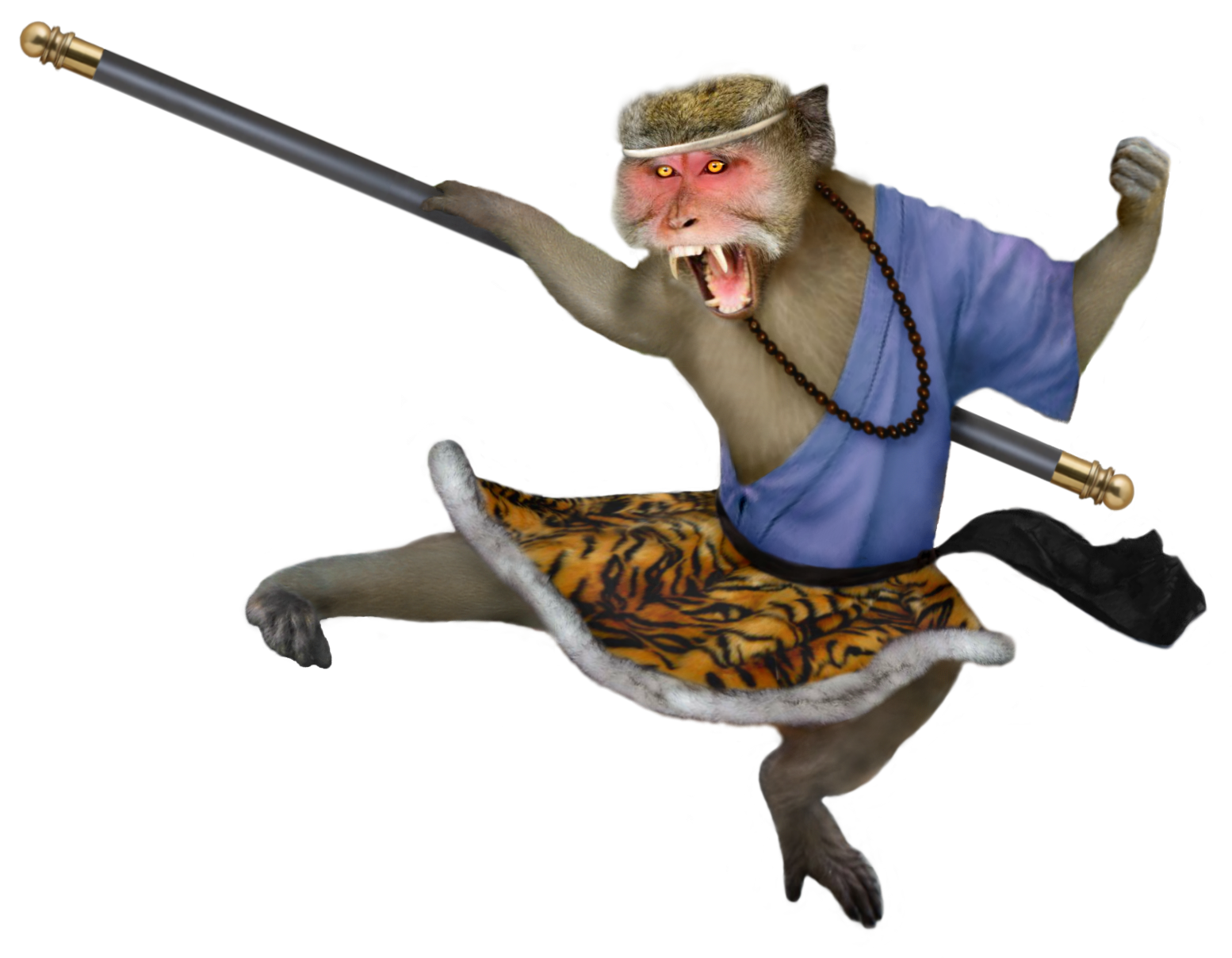
Fig. 3 – A modern depiction of Sun Wukong (larger version). A photomanipulation by the author.

After the fixed period of time has elapsed, the primordial gibbons request to leave their individual exile. The August Jade Emperor, however, refuses due to the potential for danger. Angered because heaven went back on its word, the immortal lovers leave their exile anyway, and so all of the devas, spirits, and devils struggle to keep them apart. This is an impossible task given that the two are among the highest immortals. A great battle ensues in which the pair uses their knowledge of the Dao to put the celestial army into disarray. For instance, the Ape Patriarch is a master of transformations; he grows to titanic proportions, multiplies his long arms, and captures the most powerful Daoist and Buddhist deities in his vice-like hands. The Ape Matriarch is a mistress of illusions; she clouds the minds of the soldiers, making them think they are fighting her when they are really fighting each other. [J] In addition, their individual songs have grown in power, now capable of destroying anything by separating the yin and yang forces therein (fig. 4).

Gibbon yawning

Fig. 4 – A gibbon yawning. Imagine powerful sound waves emanating from its mouth. A larger version can be found here.

The August Jade Emperor begs the Buddha to intervene like he had done for the rebelling Sun Wukong in the past. But considering that heaven went back on its word and the ape immortals are both friends and former teachers of the Enlightened One, the Tathagata sends their spiritual son, the Victorious Fighting Buddha, to ask them to pacify their rage instead of using trickery to halt the onslaught. [K] After a brief reunion, the pair acquiesces, and all three travel by cloud to the Buddha’s abode on Vulture Peak (Lingjiu shan, 靈鷲山) to discuss the matter. The immortal lovers opine the great injustice done to them by the heavenly hierarchy. The Buddha knows their duet is part of their primordial animal nature and is the ultimate expression of their love, which reaches back to the very beginning of time. Unfortunately, he realizes that the power of their song could destroy the universe if allowed to take place.

After some thought, the Tathagata gives them a lesson on the cyclical dissolution of the cosmos: at the end of each Mahakalpa (Da jie, 大劫), the universe is destroyed by a different element. There are fifty-six destructions by fire, seven by water, and one by wind. The latter is the most powerful, destroying all earthly and heavenly realms below the pure realm inhabited by the Buddha and his retinue. The Tathagata then suggests a compromise in which the couple can remain as his permanent guests of the Buddha realm, where they can frolic with the Victorious Fighting Buddha. This way the gibbons will be free to sing their melodious song without fear of negative effects. And when the end of the sixty-fourth Mahakalpa comes to a close, their song will serve the function of the wind element to bring about the dissolution of the universe to make way for the new one. [L]

2. Background information

A) The Chinese viewed the gibbon (Yuan, 猿) as symbolic of Confucian gentlemen and Daoist immortals. Their long arms were thought to be evidence of their expertise in soaking up qi. This resulted in long lives and occult powers (Geissmann, 2008).

B) This is based on chapter 42 of the Daodejing (道德經), the premiere holy text of Daoism. The original passage has been interpreted differently by different scholars. I’m using the interpretation presented in Laozi and Wilson, 2012, p. 197. The cited text, however, makes no mention of the Three Pure Ones. This is based on later Daoist texts and folk views on the supreme immortals. See Stevens, 1997, pp. 68-70.

C) JTTW never explains where the magical cave came from. This is my attempt to give it an origin story.

D) JTTW states the following about the boulder: “Since the creation of the world, it had been nourished for a long period by the seeds of Heaven and Earth and by the essences of the sun and moon, until, quickened by divine inspiration it became pregnant with a divine embryo” (Wu & Yu, 2012, p. 101). I’ve never been satisfied with the explanation for Monkey’s birth. Why would the rock produce a simian character? This is why I wrote that the Ape Immortals make love atop of the mountain, thereby impregnating the boulder with powerful, creative energies. In Daoist sexual practices, earth and heaven are often euphemisms for the feminine and masculine sexual energies of yin and yang (Wile, 1992, pp. 11-12 and 28-29). Therefore, what I have proposed is simply a difference in semantics.

E) Gibbon duets have an ethereal quality. Those wishing to listen to some can do so here and here (make sure your volume is not too high). It’s interesting to note that gibbons can naturally perform what takes professional opera singers years of dedicated practice to achieve (Lougheed, 2014).

F) The original mythology has the pillar being fallen by a water demon. I guess an explanation could be included somewhere that the original reason for the disaster, the gibbon song, was forgotten to time and confused with a different incident.

G) I wanted there to be a parallel between Monkey’s imprisonment and the pair’s exile, both of which are connected to mountains.

H) The Buddha’s tutelage under the gibbons happens in the distant past when he is still a Bodhisattva in the Tushita heaven. I listed Subodhi because I wanted there to be a further link between Monkey and the Ape Immortals. Therefore, the skills of Sun Wukong’s spiritual parents are transmitted to him by their former student.

I) This is based on the events in the 16th-century Chinese classic Fengshen Yanyi (封神演義), or Investiture of the Gods. In the story, chaos in heaven causes many gods to be reborn on earth as various heroes of the competing Shang and Zhou Dynasties. The King of Zhou wins the conflict and his strategist, an apprentice of the supreme immortal Yuanshi Tianzun (元始天尊), one of the Three Pure Ones, uses a magic list to deify the souls of those who died in battle. Thus, heaven is repopulated once more (Stevens, 1997, p. 60).

J) The strengths of each correspond to the skills passed on to the Buddha and the immortal Subodhi. Again, I wanted there to be a parallel between Monkey and his spiritual parents. The pair rebels like he did, but they do so because of injustice, not pride. However, I must say that lofty immortals would have surely evolved passed such earthly “wants and needs” (e.g. lust and anger). Daoist literature and vernacular Chinese fiction often describes immortals as being celibate. But the immortal love of the couple may transcend what might be expected of human-based immortals. That’s why I present them as living embodiments of yin and yang. Wile (1992) states: “The early [Daoist] texts are marked by the existential loneliness of yin and yang for each other, and their union consummates a cosmic synergy” (p. 29).

K) An example of trickery would be the way that the Buddha uses illusion to make Monkey think that he has left his palm in the seventh chapter of JTTW.

L) Buddhism recognizes a measurement of time called a Kalpa (jie, 劫), which can be many millions or even billions of years long depending on the tradition. Said traditions recognize between four and eighty kalpas (Buswell & Lopez, 2014, p. 409). The total of these respective ranges make up a Mahakalpa (dajie, 大劫), which is divided into four periods of nothingness, creation, subsistence, and finally destruction, each period being between one and twenty kalpas long (Buswell & Lopez, 2013, p. 496). For more information on the cyclical destruction of the universe by fire, water, and wind, see my article here.


Update: 01-17-21

Story idea #2

Last year I wrote an article that explored other stone-born figures from world mythology. In the conclusion I cautiously suggested that Wukong’s birth and later rebellion was influenced by the Hurrian myth the “Song of Ullikummi” (c. 1200 BCE), which appears in an extant Hittite cuneiform text comprising three fragmented clay tablets. For example, one scholar noted similarities between Ullikummi and a later figure from Greek mythology: “(1) The initial situation: the big stone; (2) a god fertilizes the stone; (3) the stone gives birth to a child; (4) the child thus created is a rebel against the gods; (5) the gods gather and plan countermeasures; (6) the enemy of the gods is rendered harmless” (see the linked article). Anyone who has read Journey to the West will no doubt notice the striking similarities with Monkey’s tale. Therefore, I think Ullikummi’s story would be a solid basis for a more authentic origin story for the Monkey King.

While the ancient tale is named after the eponymous stone monster (fig. 5), the story follows the machinations of Kumarbi, a resentful former ruler of the gods, who wishes to usurp the throne from his son, the storm god Tesub. Kumarbi sets about doing this by bedding a massive stone in an effort to produce a being powerful enough to rout the gods. Upon its birth, the doting father gives the creature a name meaning “Destroy Kummiya”, foreshadowing its intended fate to destroy Tesub’s home.

Fig. 5 – Ullikummi as a playable character from the online video game Final Fantasy XI (larger version).

Fearing that it may be killed by the gods before coming into full power, Kumarbi has the monster hidden in the underworld, where it is placed on the right shoulder of the Atlas-like god Upelluri. The creature quickly multiples in size, growing nine thousand leagues tall, eventually reaching heaven. When the goddess Ishtar fails to seduce the blind and deaf monster, the warrior god Astabi leads seventy deities into battle against the lithic menace only to be defeated and cast into the sea below. Tesub abandons the throne and, along with his vizier and brother Tasmisu, seeks the aid of Ea, the god of wisdom and witchcraft, who travels to the underworld in search of the creature’s origins. Upon questioning Upelluri, who effortlessly carries the weight of the heavens, earth, and sea, Ea learns a great weight, which turns out to be the monster, pains the titan’s right shoulder. In the end (of the third and final extant tablet), Ea calls for a tool originally used by the old gods to cleave heaven and earth and chisels Ullikummi free of Upelluri’s shoulder, thus breaking the monster’s base of power and leaving it vulnerable to attack by the gods. One scholar suggests there’s a missing fourth tablet that describes the monster’s ultimate defeat (again, see the linked article).

Xingtian

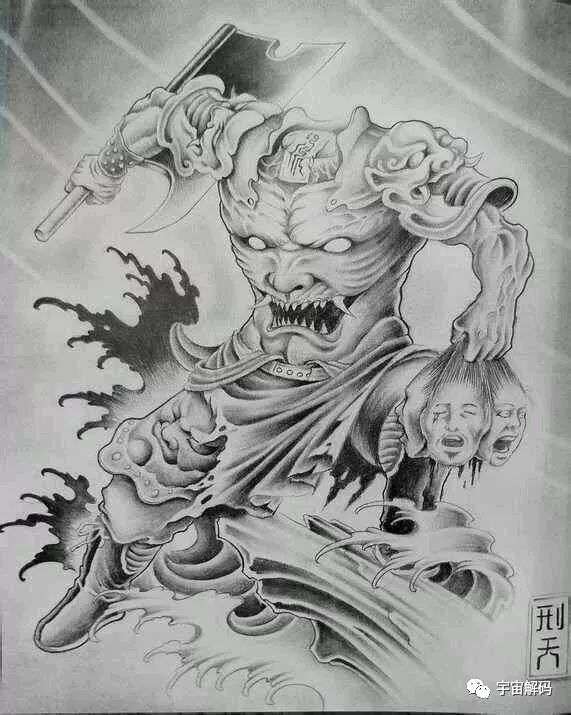
Fig. 6 – A modern depiction of Xingtian (larger version). Artist unknown.

Now, I’ve previously written a story sketch in which Master Subodhi’s school is actually a training ground for an immortal monastic army akin to the Shaolin Temple. I speculated that Wukong’s skill in martial arts and troop movement would come from his time serving as a soldier and eventual officer in this army. Additionally, I suggested that the baddie whom the army faces is the headless monster Xingtian (刑天) (fig. 6), who originally battled the supreme god Shangdi for control of the universe and was beheaded after his defeat. Perhaps he or a figure like him follows in Kumarbi’s footsteps and beds a stone, in this case the rock on the Mountain of Flowers and Fruits, in an effort to create a powerful son to finish what he started. Then, he works in the shadows, influencing the direction of Monkey’s life, leading to his famous rebellion against heaven. Wukong’s defeat of the seventy-two major gods in the heavenly army [1] would mirror Ullikummi routing the seventy gods led by Astabi. Likewise, the Jade Emperor’s call to the Buddha, leading to Monkey’s defeat, mirrors Tesub’s plea to Ea and the eventual downfall of the stone monster. Thoughts?


Update: 12-10-21

I’ve posted a piece about a folk Taoist white ape god. His story overlaps with Sun Wukong just like the spiritual parents I presented above.

The White Ape Perfected Man: Sun Wukong’s Divine Double


Update: 06-16-23

Story Idea #3

Another idea could predate Monkey’s stone birth and instead focus on a past life as a heavenly being. It would draw from three sources: First, the backstory of the Tang Monk, Tripitaka. Those who’ve read JTTW will know that his past life, an Arhat called Master Golden Cicada (Jinchan zi, 金蟬子), is exiled from paradise for ten lifetimes for falling asleep during the Buddha’s lecture.

Just like his master, Sun Wukong is formerly a celestial in paradise. A great name for this figure would be the “Arhat Steel Muscles and Iron Bones” (Gangjin tiegu luohan, 鋼筋鐵骨羅漢). This plays on a similar title given to Sun’s antecedent, the “Monkey Pilgrim” (Hou xingzhe, 猴行者), by Tang Emperor Taizong in the 13th-century oral version of JTTW. [3]

Second, the embellished life story of Song-era General Yue Fei (岳飛, 1103-1142). The Complete Vernacular Biography of Yue Fei (Shuo Yue quanzhuan, 說岳全傳, c. 17th-century; “The Biography of Yue Fei” hereafter) actually draws inspiration from the 1592 JTTW by portraying the general as a reincarnation of a bird monster-turned-Dharma protector from chapters 74 to 77. Originally called the “Peng Bird of Ten Thousand Cloudy Miles” (Yuncheng wanli peng, 雲程萬里鵬) in JTTW, the “Great Peng, the Golden-Winged King of Illumination” (Dapeng jinchi mingwang, 大鵬金翅明王) is exiled from paradise in chapter one of The Biography of Yue Fei for killing a stellar bat-spirit who farted during the Tathagata’s sermon on the Lotus Sutra. [4]

Just like the Great Peng bird, the Arhat Steel Muscles and Iron Bones kills a spirit for seemingly offending the Buddha. [5] I imagine the Enlightened One would admonish him by saying something like, “You are so sure of your strength, so proud of your physical gifts. And yet you don’t know how to defend the Dharma with it!” He then exiles the Arhat to live out ten lifetimes (à la Master Golden Cicada) where he’s a figure of great strength who is continually bested and humiliated and forced by circumstances to protect something weaker than him.

And third, the Buddha’s Jataka tales. The Tathagata has many birth stories where he is both humans and animals who embody an important lesson (Cowell, 1895). In fact, one tale depicts him as a Monkey King!

The Arhat is reborn in the lower three paths of reincarnation, and just like the Buddha, he has several past lives as animals. He works his way up the cosmic hierarchy by performing good deeds, such as a past life where he’s a man-eating tiger who comes to protect a small child. He attains the human-like form of a monkey in his final incarnation, leading to the events of JTTW.

I like this option a lot because this would make both Monkey and Tripitaka former Arhats who undergo prolonged trials that refine their spirits over many lifetimes. This would ultimately explain why both of them attain Buddhahood at the end of their respective character arcs, our hero becoming the “Buddha Victorious in Strife” (Dou zhansheng fo, 鬥戰勝佛) and the Tang Monk “Buddha of Candana Merit” (Zhantan gongde fo, 旃檀功德佛) (Wu & Yu, 2012, vol. 4, p. 381). I also like it because Sun Wukong’s past life references the Tibetan monkey bodhisattva Hilumandju, who is an avatar of the bodhisattva Avalokiteshvara (Guanyin) and a possible Buddhist syncretic version of the Hindu monkey god Hanumanji. What’s interesting about this legendary figure is that he mates with a rock ogress (see the 08-02-19 update here), which reminds one of Sun’s stone birth.


Update: 02-22-25

While I like elements from the first two story ideas, the third one is turning out to be more authentic and interesting.

I had previously referred to Monkey’s past life on this article as a Bodhisattva, but I changed this to an Arhat after finding evidence that Golden Cicada, Tripitaka’s past life, was a Buddhist saint. This includes the following:

  • Xuanzang was historically worshiped as one during the Song dynasty.
  • Two Yuan-Ming plays depict him as the reincarnation of Arhats.
  • The story of Golden Cicada is likely based on the Arhat Aniruddha, one of the ten principle disciples of the Buddha.
  • Two other principle disciples, the Arhats Ananda and Kasyapa, appear among the Tathagata’s retinue in JTTW (see here). 

In addition, my previous article on Sun Wukong’s first master, the Buddho-Daoist Sage Subodhi, suggests that he is the historical Arhat Subhuti, also one of the principle disciples. And if we insert the aforementioned Aniruddha as the original identity of Master Golden Cicada, that will make four of ten disciples appearing in the story. I stress this because maybe—within our fanfiction—Monkey’s previous life could be another principle disciple that has been conveniently inserted among the historical figures. That way, the Great Sage would have known both Golden Cicada (his master Tripitaka) and Subhuti (his master Subodhi) in the past!

This is neat because he (Arhat Steel Muscles and Iron Bones) and Golden Cicada could ideally be living out their respective transmigrational punishments around the same time. And this further stimulates my brain: what if each of Monkey’s incarnations have protected each of Tripitaka’s past lives?!?! 

Notes:

1) Koss (1981) writes: “Adding up the number of gods listed here [see Wu & Yu, 2012, p. 169] from the Twenty-Eight Constellations through the Deities of the Five Mountains and the Four Rivers, the number arrived at is seventy-three, if 東西星斗 [dongxi xingdou, the “Stars of East and West”] is counted as two, which Yu does in his translation, or seventy two, if the latter is taken as one, which is another possible interpretation” (p. 84).

2) This is how old the ledger of life and death lists Monkey as in chapter 3: “Heaven-born Stone Monkey. Age: three hundred and forty-two years. A good end” (Wu & Yu, 2012, vol. 1, p. 140).

3) In chapter 17, Tang Taizong names him the “Great Sage Steel Muscles and Iron Bones” (Gangjin tiegu dasheng, 鋼筋鐵骨大聖) (Wivell, 1994, p. 1207).

4) Chapter one of The Complete Vernacular Biography of Yue Fei reads:

Let’s talk about the Buddha Tathagata at the Great Thunderclap Monastery in the Western Paradise. One day, he sat on a nine-level lotus throne, and the Four Great Bodhisattvas, the Eight Great Vajra Warriors, the five hundred Arhats, the three thousand Heavenly Kings, nuns and monks, male and female attendants, all of the heavenly sages who protect the Dharma, gathered to listen to his lecture on the Lotus Sutra. His words were like flowers and precious jewels raining from the heavens. But, at that time, a star-spirit, the Maiden Earth Bat, who had been listening to the lecture from beneath the lotus throne, couldn’t bear it any longer and unexpectedly let out a stinky fart.

The Buddha was a great, merciful lord, so he didn’t mind even the slightest bit. But don’t sympathize with the Dharma protector above his head, the “Great Peng, the Golden-Winged King of Illumination,” whose eyes shone with golden light and whose back was a scene of auspiciousness. He became angry when he saw the nasty, filthy Maiden Earth Bat, and so he unfurled both his wings and dropped down to kill the spirit by pecking her on the head. The light-point of her soul shot out of the Great Thunderclap Monastery and went to the Lands of the East (China) in the world below to find a mother and reincarnate. She was reborn as a daughter of the Wang clan. She would later marry the Song Prime minister Qin Hui (1091-1155) and come to cruelly kill the righteous (i.e. Yue Fei) as a means to get revenge against today’s enemy. We will talk about this later.

Let’s return to the Buddha, who saw what happened with his all-seeing eyes and exclaimed, “Good! Good! It turns out that this is an episode of karma (cause and effect).” Then he called the Great Peng bird to come closer and shouted, “You evil creature! You already took refuge in my teachings. How can you not follow the five precepts by daring to commit such a horrible crime? I don’t need you here; you will descend to the mortal world to pay off your (karmic) debt and wait until you have fulfilled your work. Once that is completed, only then will I allow you to return to the mountain to achieve the right fruit (Buddhist merit).” The Great Peng complied with the decree, flying out of the Great Thunderclap Monastery directly to the Lands of the East to be reincarnated. We will stop here.

且說西方極樂世界大雷音寺我佛如來,一日端坐九品蓮臺,旁列著四大菩薩、八大金剛、五百羅漢、三千偈諦、比丘尼、比丘僧、優婆夷、優婆塞,共諸天護法聖眾,齊聽講說妙法真經。正說得天花亂墜、寶雨繽紛之際,不期有一位星官,乃是女土蝠,偶在蓮臺之下聽講,一時忍不住,撒出一個臭屁來。我佛原是個大慈大悲之主,毫不在意。不道惱了佛頂上頭一位護法神祗,名為大鵬金翅明王,眼射金光,背呈祥瑞,見那女土蝠污穢不潔,不覺大怒,展開雙翅落下來,望著女土蝠頭上,這一嘴就啄死了。那女土蝠一點靈光射出雷音寺,徑往東土認母投胎,在下界王門為女,後來嫁與秦檜為妻,殘害忠良,以報今日之讎。此是後話,按下不提。

且說佛爺將慧眼一觀,口稱:「善哉,善哉!原來有此一段因果。」即喚大鵬鳥近前,喝道:「你這孽畜!既歸我教,怎不皈依五戒,輒敢如此行兇?我這裡用你不著,今將你降落紅塵,償還冤債,直待功成行滿,方許你歸山,再成正果。」大鵬鳥遵了法旨,飛出雷音寺,徑來東土投胎不表。

5) A murderous Buddhist deity may seem weird, but Vajrapani (Jingang shou pusa, 金剛手菩薩; lit: “Bodhisattva Holding the Vajra Weapon”), a yaksha-turned-wrathful Dharma protector, is considered a bodhisattva (Buswell & Lopez, 2014, p. 955).

Sources:

Buswell, R. E. , & Lopez, D. S. (2014). The Princeton Dictionary of Buddhism. Princeton, NJ: Princeton University Press.

Cowell, E. B. (Ed.) (1895). The Jātaka, or Stories of the Buddha’s Former Births (Vols. 1-5). Cambridge: Cambridge University Press. Retrieved from https://archive.org/search?query=The+Ja%CC%84taka%2C+or%2C+Stories+of+the+Buddha%27s+former+births.

Geissmann, T. (2008). Gibbon paintings in China, Japan, and Korea: Historical distribution, production rate and context. Gibbon Journal, 4, 1-38. Received from http://www.gibbonconservation.org/07_publications/journal/gibbon_journal_4.pdf

Koss, N. (1981). The Xiyou ji in Its Formative Stages: The Late Ming Editions (Vols. 1-2). (Doctoral dissertation). Available from ProQuest Dissertations and Theses database. (UMI No. 8112445)

Laozi, & Wilson, W. S. (2012). Tao Te Ching: An All-New Translation. Boston & London: Shambhala

Lougheed, K. (2012, August 23). Helium reveals gibbon’s soprano skill. Retrieved January 20, 2014, from https://www.nature.com/news/helium-reveals-gibbon-s-soprano-skill-1.11257

Stevens, K. G. (1997). Chinese Gods: The Unseen World of Spirits and Demons. London: Collins & Brown.

Wile, D. (1992). Art of the Bedchamber: The Chinese Sexual Yoga Classics Including Women’s Solo Meditation Texts. Albany: State University of New York Press.

Wivell, C.S. (1994). The Story of How the Monk Tripitaka of the Great Country of T’ang Brought Back the Sūtras. In V. Mair (Ed.), The Columbia Anthology of Traditional Chinese Literature (pp. 1181-1207). New York: Columbia University Press.

Wu, C., & Yu, A. C. (2012). The Journey to the West (Vols. 1-4) (Rev. ed.). Chicago, Illinois: University of Chicago Press.

Yang, L., An, D., & Turner, J. A. (2011). Handbook of Chinese Mythology. Santa Barbara, Calif: ABC-CLIO.

The Monkey King’s Cosmic Body

Last updated: 04-04-2024

Sun Wukong is known for his limitless shape-changing powers, capable of taking the form of anything from gods, monsters, and humans to animals, insects, and even inanimate objects like buildings. But his most powerful transformation, that of a cosmic giant, is displayed only three times in the novel. It is used mostly in defense against other powerful characters, namely the god Erlang and the Bull Demon King. In this article, I will introduce the ancient astral-geographical term used to describe this phenomenon, associate the transformation with a divine giant from Chinese mythology, and explore possible ties to Hindu mythology.

Table of Contents

1. Episodes from the Novel

1.1. Chapter 3

The first instance takes place in chapter three after Monkey returns from the Dragon King’s undersea palace with his new weapon. The form is used to show off his magical abilities for his children (fig. 1):

Grasping the treasure [iron staff] in his hands, he began to perform the magic of cosmic imitation (emphasis added). Bending over, he cried, “Grow!” and at once grew to be ten thousand-zhang [104,300 ft or 31,800 m]-tall, [1] with a head like the Tai Mountain and a chest like a rugged peak, eyes like lightning and a mouth like a blood bowl, and teeth like swords and halberds. The rod in his hands was of such a size that its top reached the thirty-third Heaven and its bottom the eighteenth layer of Hell (based on Wu & Yu, 2012, vol. 1, p. 138). 

將寶貝揝在手中,使一個法天像地的神通,把腰一躬,叫聲:「長!」他就長的高萬丈,頭如泰山,腰如峻嶺,眼如閃電,口似血盆,牙如劍戟;手中那棒,上抵三十三天,下至十八層地獄。

Fig. 1 – Monkey performs the cosmic transformation for his children (larger version). A page from Chen Huiguan’s Newly Illustrated and Complete Journey to the West (Chen Huiguan xinhui quanben xiyouji, 陈惠冠新绘全本西游记, 2001). Image found here.

1.2. Chapter 6

The second takes place in chapter six during his battle with Erlang Shen. The form is used this time in response to the god’s own cosmic transformation.

The Immortal Master [Erlang] fought the Great Sage for more than three hundred rounds, but the result could still not be determined. The Immortal Master, therefore, summoned all of his magic powers; with a shake he made his body a ten thousand zhang tall. Holding with both hands the divine lance of three points and two blades like the peaks that cap the Hua Mountain, this green-faced, sabre-toothed figure with scarlet hair aimed a violent blow at the head of the Great Sage. But the Great Sage also exerted his magical power and changed himself into a figure having the features and height of Erlang. He wielded a compliant golden-hooped rod that resembled the Heaven-supporting pillar on top of Mount Kunlun to oppose the god Erlang (based on Wu & Yu, 2012, vol. 1, p. 181).

真君與大聖鬥經三百餘合,不知勝負。那真君抖擻神威,搖身一變,變得身高萬丈,兩隻手舉著三尖兩刃神鋒,好便似華山頂上之峰,青臉獠牙,朱紅頭髮,惡狠狠,望大聖著頭就砍。這大聖也使神通,變得與二郎身軀一樣,嘴臉一般,舉一條如意金箍棒,卻就是崑崙頂上擎天之柱,抵住二郎神。

[…]

Now we were telling you about the Immortal Master and the Great Sage, who had changed themselves into forms which imitated Heaven and Earth (emphasis added) (based on Wu & Yu, 2012, vol. 1, p. 182).

卻說真君與大聖變做法天象地的規模

1.3. Chapter 61

The third takes place in chapter sixty-one during Sun’s battle with the Bull Demon King (fig. 2). Again, the form is used in response to another powerful character’s transformation.

With a loud guffaw, the Bull King then revealed his original form of a gigantic white bull, with a head like a rugged mountain and eyes like bolts of lightning. The two horns were like two iron pagodas, and his teeth were like rows of sharp daggers. From head to toe, he measured more than ten thousand-plus zhang [10,430 ft or 3,179.06 m], while his height from hoof to neck was about eight hundred zhang [8,344 ft or 2,543.25 m]. [2]

“Wretched ape!” he roared at Pilgrim [Monkey]. “What will you do with me now?” Pilgrim also changed back to his true form; yanking out his golden-hooped rod, he bent his back and then straightened out, crying, “Grow!” At once he grew to a height of ten thousand zhang, with a head like Mount Tai, eyes like the sun and moon, a mouth like a bloody pound, and teeth like doors (based on Wu & Yu, 2012, vol. 3, p. 157).

牛王嘻嘻的笑了一笑,現出原身:一隻大白牛,頭如峻嶺,眼若閃光,兩隻角似兩座鐵塔,牙排利刃,連頭至尾有千餘丈長短,自蹄至背有八百丈高下。對行者高叫道:「潑猢猻!你如今將奈我何?」行者也就現了原身,抽出金箍棒來,把腰一躬,喝聲叫:「長!」長得身高萬丈,頭如泰山,眼如日月,口似血池,牙似門扇

[…]

[After Zhu Bajie returns from exterminating all of the demons in the Bull King’s cave] “You have achieved great merit, Worthy Brother,” said Pilgrim. “Congratulations! Old Monkey has waged in vain a contest of transformation with him [the Bull King], for I have not yet achieved victory. He finally changed into the biggest possible white bull, and therefore assumed the appearance that imitated Heaven and Earth” (emphasis added) (based on Wu & Yu, 2012, vol. 3, p. 158). 

行者道:「賢弟有功,可喜,可喜。老孫空與那老牛賭變化,未曾得勝。他變做無大不大的白牛,我變了法天象地的身量。

Fig. 2 – Monkey vs the Bull King, both in their cosmic transformations (larger version). An 1833 woodblock print by Yashima Gakutei. Photo by Prof. Vincent Durand-Dastès of the ‏National Institute for Oriental Languages and Civilizations. With permission. 

2. Ties to Ancient Chinese Astral-Geography and Mythology

The exact word used each time to describe Sun’s modus for attaining his cosmic form is Fatian Xiangdi (法天像(象)地), or the “method of modeling Heaven on Earth.” This is actually related to ancient Pre-Qin and Han concepts of astral-geography later used in the construction of imperial Chinese cities. The ancient Chinese viewed the heavens as a complex system of seven star units set in four cardinal sections, making up the Twenty-Eight Lunar Mansions, all of which enclosed and revolved around a central star ruled by one of two supreme gods, Shangdi or Taiyi. Known as the “Purple Palace Enclosure” (Ziweiyuan, 紫微垣), this bound star system was the heavenly abode from which the supreme god oversaw reality, while the surrounding stars represented his civil and military officials and even outlying areas, such as dwellings and a marketplace. The Chinese emperor, commonly called the Son of Heaven, was considered the earthly counterpart of the great god, serving as the mediator between the will of heaven and the needs of man. Therefore, architects often modeled imperial cities on these celestial patterns, placing the emperor at the center surrounded by outer layers of courts, residential quarters, markets, and streets (Chan, 2008, pp. 8-19).

The arcane-sounding Fatian Xiangdi term was no doubt chosen simply because Monkey’s magic body mirrors the vastness of the cosmos (both heaven and earth), not that it borrowed particular celestial patterns like earthly architects. Interestingly, though, legend states the ancient Yuan capital of Dadu was modeled on the magic body of the child god Prince Nezha, who also appears in Journey to the West. [3]

The novel likens aspects of Sun’s cosmic form to earthly features and celestial bodies. This resembles stories of the ancient god Pangu (盤古) (fig. 3), the first being born into primordial chaos who slaved to separate heaven from earth, cleaving one from the other and forcing them apart. Stevens (1997) writes this monumental task took its toll on the titan:

He died as the task was reaching a climax and his body became features of the Earth. His head became the mountains, his breath the wind and clouds; his voice became thunder, his left eye the sun and his right eye the moon, and his four limbs became the four quarters of the Earth. His blood ran as rivers, his veins and muscles were the strata of the rocks, and his flesh the soil. His skin sprouted and became vegetable patches, forests and paddy fields, while his bones and teeth became the minerals. His sweat became the rain and to complete creation humanity sprang from the parasites on his body (p. 54).

Monkey in a way becomes a living embodiment of the divine giant because he too is described as having a head like a mountain, eyes like the sun and moon, and a mouth like a large body of liquid, which also happens to be blood.

Fig. 3 – A modern (metal?) relief simultaneously symbolizing Pangu’s separation of heaven and earth and the decay of his body into earthly features and celestial bodies (larger version). Take note of the eye-like sun. Found on this news article about the god.

Giant characters were obviously not a new concept to Chinese literature by the Ming. An earlier example comes to us from The Story of How Tripitaka of the Great Tang Procures the Scriptures, the thirteenth-century precursor of Journey to the West. Chapter six sees Monkey transform his golden-ringed monk’s staff “into a gigantic Yakşa whose head touched the sky and whose feet straddled the earth. In his hands he grasped a demon-subduing cudgel. His body was blue as indigo, his hair red as cinnabar” (Wivell, 1994, p. 1189) (fig. 4). This line simultaneously predicts Sun’s goliath form and blunt weapon (that touches heaven and earth like the head and feet of the yaksha) and Erlang’s monstrous appearance (i.e. his green skin and red hair).

Fig. 4 – A guardian yaksha statue, Bangkok, Thailand (larger version). Take note of the large stature, blue skin, and club. Found on this article.

3. Possible Ties to Hindu Mythology

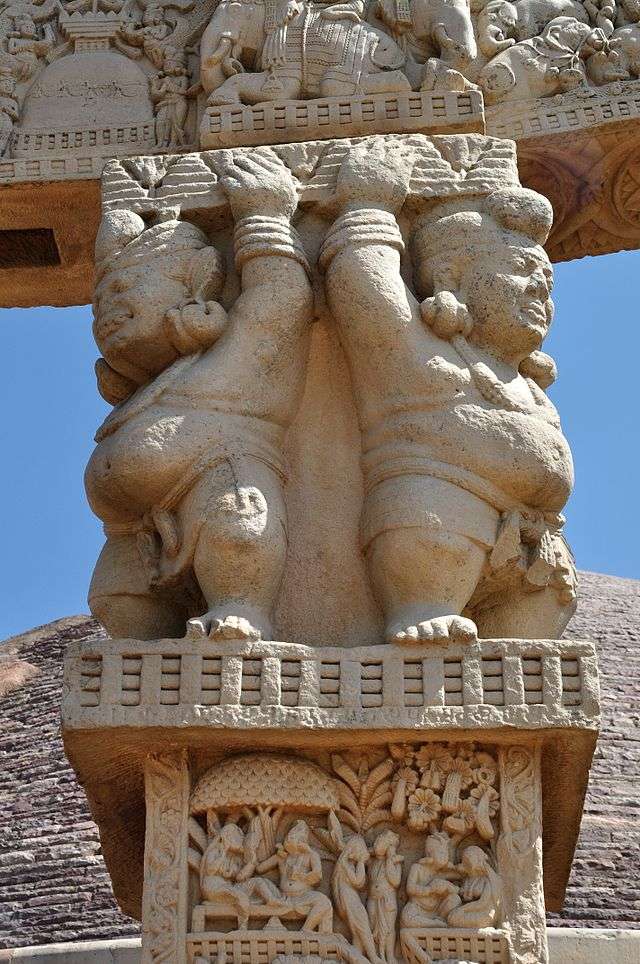
Yakşas or Yakshas (Ch: Yecha, 夜叉) appear in Hindu, Jain, and Buddhist scriptures as the assistants or protectors of divine beings. They are possessed of great magical powers and can do anything from flying to shape-changing (Dalal, 2014, p. 470; Buswell & Lopez, 2014, p. 1018). These nature spirits are often depicted in early religious art as portly dwarves (fig. 5), an element of iconography that they share with Vamana, the fifth avatar of the supreme deva Vishnu. This connection is important because the avatar is celebrated for his ability to eclipse the universe. According to Hindu mythology, Vishnu takes the form of the dwarf Brahmin when a benevolent asura named Mahabali wrestles control of the cosmos from the gods. Vamana visits the king during a great sacrifice, during which the asura grants gifts, and humbly requests only as much land as he can cover in three strides. But when his wish is granted, the deceptively small priest grows to cosmic proportions, “mightily waxing, swelling in every limb, with his first stride stepp[ing] beyond the sun and moon, with his second reach[ing] the limits of the universe, and with his third return[ing] to set his foot on the head of the conquered foe” (Zimmer & Campbell, 1992/1946, p. 132). With his feat (pun intended), Vishnu regains control of heaven (step one) and earth (step two), while simultaneously banishing the asura to the underworld (step three) (Dalal, 2014, p. 442).

Fig. 5 – A detail of chubby Yakshas from the western gateway of Stupa 1 at Sanchi (1st-cent.) (larger version). Image from here.

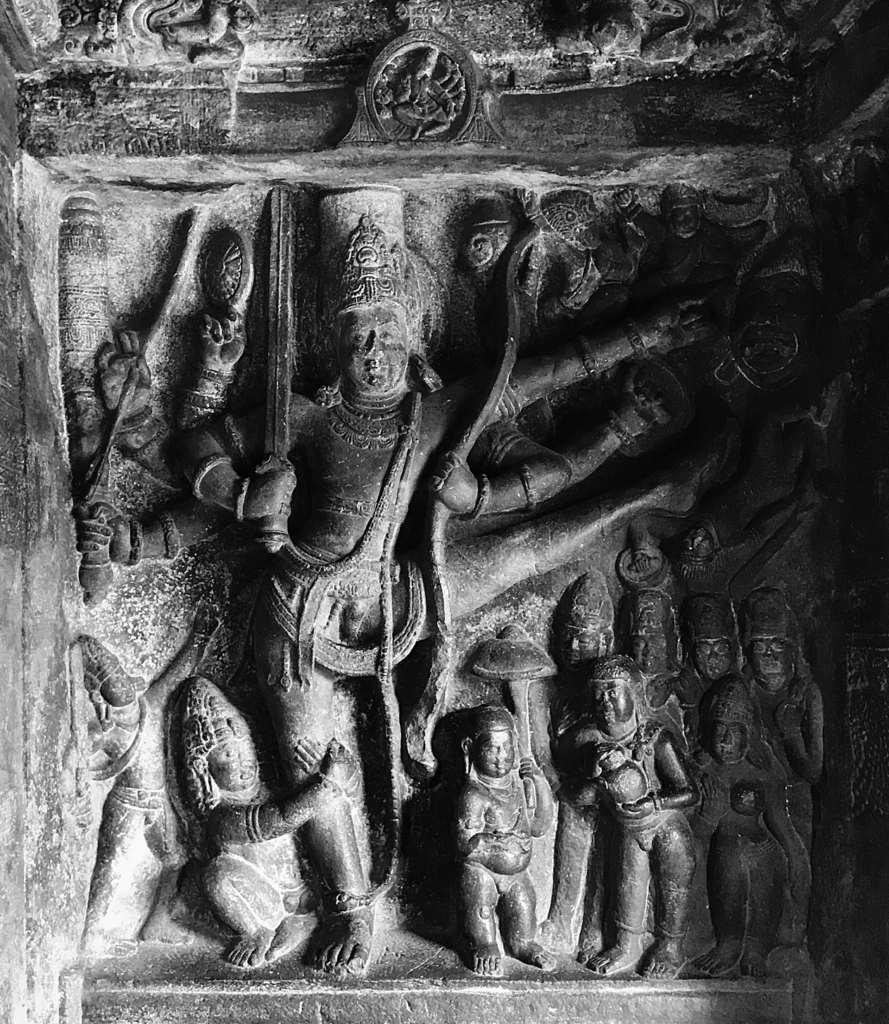
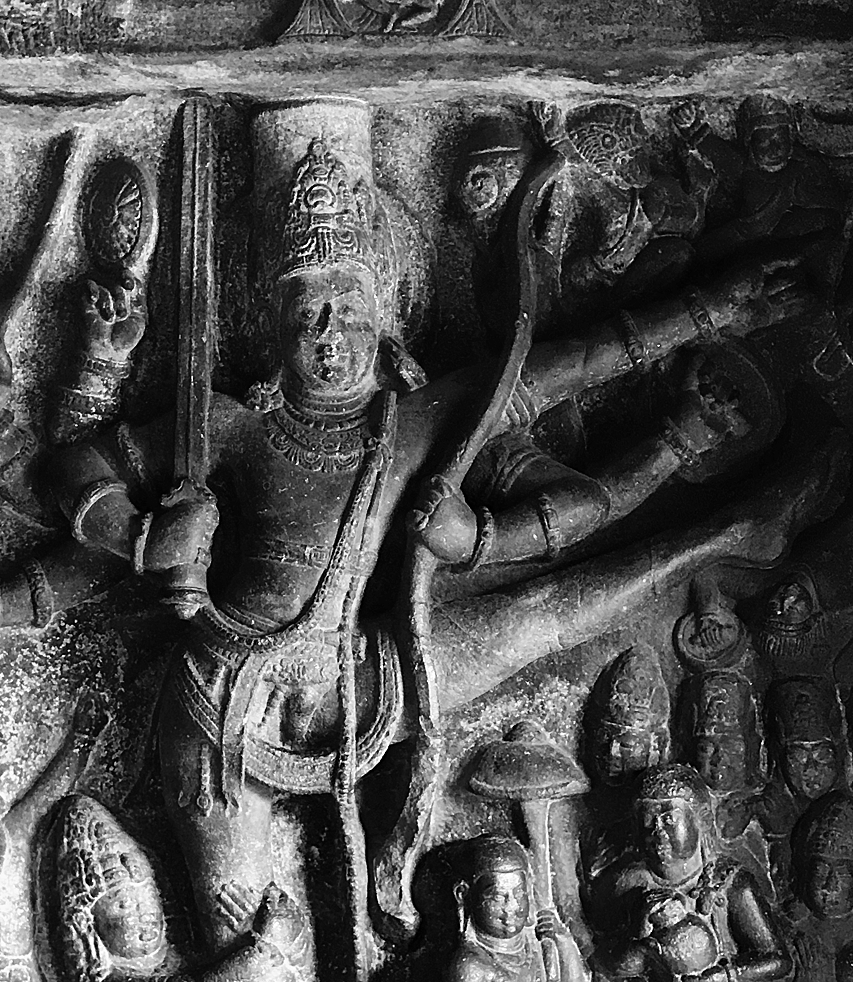
The noted art historian Heinrich Zimmer comments sculptures based on this story fall under a category of representationally kinetic art that he calls the “Phenomenon of Expanding Form” (Zimmer & Campbell, 1992/1946, p. 130). One cited example is the Trivikrama Vishnu (lit: “three steps” Vishnu), a sixth-century Badami cave number two relief (fig. 6) which presents a continuous narrative of the dwarf (fig. 7) growing to become the cosmic giant, the latter’s leg kicking high above his waist (fig. 8), symbolizing his mighty, universe-spanning strides. Though the piece is carved in stone, the dynamic nature of the composition gives it a feeling of swelling energy (Zimmer & Campbell, 1992/1946, p. 132).

The carving portrays the cosmic giant holding all manner of weapons, including a club, a sword, a bow, and a chakram, all of which are attributes of Vishnu (Dalal, 2014, p. 460).

badami vamana carving (total for blog)

Fig. 6 – The Trivikrama Vishnu relief carving of Vamana’s story, Badami cave number two (sixth-cent.) (larger version). Fig. 7 – A detail of the dwarf Brahmin holding a parasol (larger version). Fig. 8 – A detail of the cosmic giant holding celestial weapons and taking a supernaturally large stride (larger version). Adapted from this image.

The close association of the Yaksha and Vamana with a short, chubby body and shape-changing powers no doubt influenced the former to take on the latter’s ability to grow to huge proportions. In addition, after being absorbed into Buddhism, Yakshas are portrayed in scripture as divine warriors wielding clubs in defense of the dharma. Two prominent examples are Kubera (a.k.a. Vaisravana) and Vajrapani, both of whom are touted as the yaksha commander (Lutgendorf, 2007, p. 42; Buswell & Lopez, 2014, pp. 449 and 955). This surely influenced the later Chinese image of yakshas as club-wielding titans, such as the cited example from The Story. In turn, this and related material could have easily influenced the cosmic transformations of Monkey and other characters and their weapons from Journey to the West.

4. Conclusion

The novel describes Monkey taking on a giant cosmic form in chapters three, six, and sixty-one, the first time showing off his magic powers to his children and the second and third in response to the respective titanic transformations of Erlang and the Bull King. The magical spell used to achieve this form, titled Fatian Xiangdi (the “Method of modeling Heaven on Earth”), is based on ancient Pre-Qin and Han concepts of astral-geography later used in the construction of imperial Chinese cities. The idea of Sun’s body parts mirroring aspects of heaven and earth recalls the myth of the primordial god Pangu, whose body parts became the very building blocks of the cosmos after his death.

The cited episodes demonstrate that the characters involved transform both their bodies and weapons. Apart from being described as a 104,300-foot (31,800 m)-tall juggernaut with a head like Mt. Tai, Monkey’s staff is said to inhabit the upper and lowermost reaches of the universe (“its top reached the thirty-third Heaven and its bottom the eighteenth layer of Hell”) or that it resembles “the Heaven-supporting pillar on top of Mount Kunlun.” Likewise, Erlang’s three-pointed polearm is said to resemble “the peaks that cap the Hua Mountain.” Such transformations are predicted, for example, by an episode in the thirteenth-century precursor of Journey to the West in which Sun changes a monk’s staff into a gigantic Yaksha wielding a club.

While Yakshas are portrayed in early South Asian religious art as chubby dwarves, they most likely gained the ability to grow to enormous sizes thanks to iconographic similarities to Vamana, the fifth avatar of Vishnu famed for traversing the cosmos in three mighty steps. One sixth-century stone carving of the story portrays the dwarf-turned-cosmic giant wielding all sorts of celestial weapons. Additionally, Buddhist scriptures would come to portray yakshas as club-wielding warriors. Therefore, we can see how Monkey’s cosmic transformation could have ultimately been influenced by Hindu and Buddhist religious material.


5. Updates

Update: 10-17-21

Monkey also takes on his cosmic form in chapter 97. The episode calls it his “huge magic body” (da fa shen, 大法身). Read here for more information.

Watch Your Step: The Influence of Journey to the West on the “Ashiarai Yashiki” Yokai Story of Edo-Period Japan


Update: 08-06-22

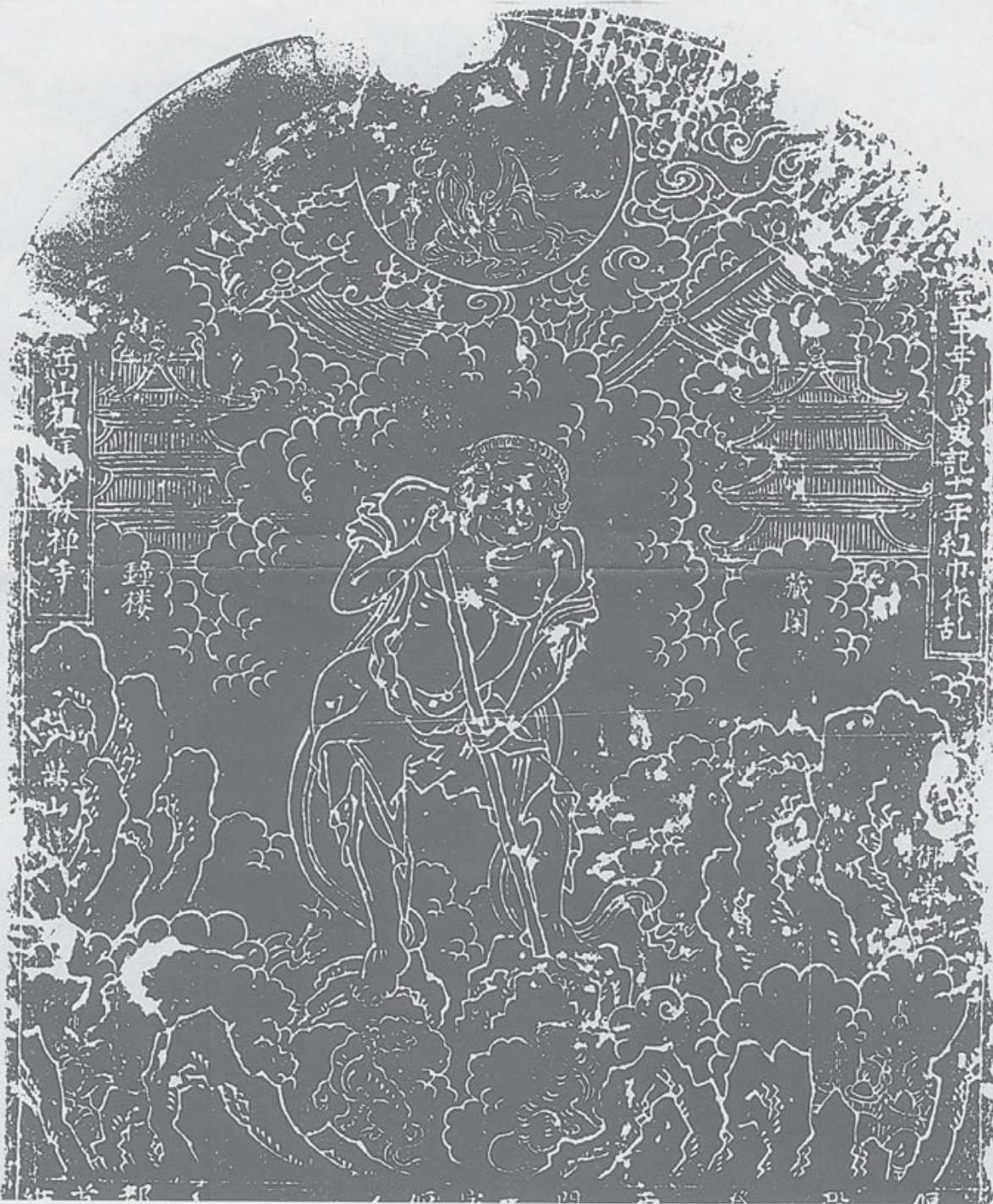
Sun Wukong’s cosmic body likely influenced Shaolin Monastery myth. The yaksha-bodhisattva Vajrapāni was historically worshiped as the progenitor of their famous staff method. A stele erected by Shaolin abbot Wenzai in 1517 shows that the deity’s vajra-club had been changed to a Chinese staff (fig. 9) (Shahar, 2008, p. 84). Vajrapāni’s Yaksha-like Nārāyana (Naluoyan(tian), 那羅延(天)) form was eventually equated with one of the four staff-wielding “Kimnara Kings” from the Lotus Sutra in 1575. His name was thus changed from Nārāyana to “Kimnara King” (Jinnaluo, 緊那羅) (Shahar, 2008, p. 87). One version of the story about his creation of the staff method takes place during the Yuan Dynasty‘s Red Turban Rebellion. Bandits lay siege to the monastery, but it is saved by a lowly kitchen worker wielding a long fire poker as a makeshift staff. He leaps into the oven and emerges as a monstrous giant tall enough to straddle both Mount Song and the imperial fort atop Mount Shaoshi, which are five miles (8.046 km) apart. The bandits flee when they behold this staff-wielding titan. The Shaolin monks later realize that the kitchen worker was none other than the Kimnara King in disguise (Shahar, 2008, pp. 87-88). Shahar (2008) suggests that mythical elements of the story were borrowed from the Monkey King’s adventures. He compares the worker’s transformation in the stove with Sun’s time in Laozi’s Eight Trigrams furnace (Bagua lu八卦爐), their use of the staff, and the fact that Monkey and his weapon can both grow to gigantic proportions (Shahar, 2008, p. 109). [4]

The aforementioned stele was erected in 1517, showing that Monkey’s cosmic body predates the standard 1592 edition of the novel.

Fig. 4 – The 1517 Shaolin stele showing a titanic Vajrapāni defending the monastery from rebels (larger version). From Shahar, 2008, p. 84.


Update: 04-04-24

In chapter 14, Sun Wukong lists a number of his powers, including the ability to grow as big as the cosmos:

“I, old Monkey, possess the ability to subdue dragons and tame tigers, and the power to overturn rivers and stir up oceans. I can look at a person’s countenance and discern his character; I can listen merely to sounds and discover the truth. If I want to be big, I can fill the universe; if I want to be small, I can be smaller than a piece of hair (emphasis added). In sum, I have boundless ways of transformation and incalculable means of becoming visible or invisible (Wu & Yu, 2012, vol. 1, p. 311).

我老孫頗有降龍伏虎的手段,翻江攪海的神通;見貌辨色,聆音察理;大之則量於宇宙,小之則攝於毫毛;變化無端,隱顯莫測

This might imply that the aforementioned “ten thousand zhang” (wanzhang, 萬丈; 104,300 ft or 31,800 m) number is instead meant to be a metaphor for a much larger height, one that would fill the universe.

Notes:

1) Here, Anthony C. Yu’s English translation says Monkey grows to be “ten thousand feet tall.” However, the original Chinese source reads “萬丈” (wanzhang), wan meaning 10,000 and zhang being a measure designating ten Chinese feet (10,000 x 10 = 100,000). Therefore, I have changed the source to read “ten thousand zhang.

2) Yu’s translation reads “eight hundred.” But, again, the original source is different. It reads “八百丈” (babai zhang), or 800 x 10 Chinese feet = 8,000. This makes more sense as he is said to be 10,000-plus feet long.

3) While the city is square, it has eleven gates, which legend states correspond to the three heads, six arms, and two legs of the god. For more information, see Chan (2008).

4) Yes, this information comes from Wikipedia, but I’m the one who originally added it under the screenname “Ghostexorcist.” See this edit history, for example.

Sources:

Chan, H. (2008). Legends of the Building of Old Peking. Seattle: University of Washington Press.

Dalal, R. (2014). Hinduism: An Alphabetical Guide. New Delhi, India: Penguin Books.

Lutgendorf, P. (2007). Hanuman’s Tale: The Messages of a Divine Monkey. Oxford: Oxford University Press.

Buswell, R., & Lopez, D. (2014). The Princeton Dictionary of Buddhism. Princeton University Press.

Shahar, M. (2008). The Shaolin Monastery: History, Religion, and the Chinese Martial Arts. Honolulu: University of Hawai’i Press.

Stevens, K. G. (1997). Chinese Gods: The Unseen World of Spirits and Demons. London: Collins & Brown.

Wivell, C.S. (1994). The Story of how the Monk Tripitaka of the Great Country of T’ang brought back the Sūtras. In Mair, Victor H. The Columbia Anthology of Traditional Chinese Literature (pp. 1181-1207). New York: Columbia University Press.

Wu, C., & Yu, A. C. (2012). The Journey to the West (Vols. 1-4) (Rev. ed.). Chicago, Illinois: University of Chicago Press.

Zimmer, H. R., & Campbell, J. (1992). Myths and Symbols in Indian Art and Civilization. Princeton, New Jersey: Princeton University Press. (Original work published 1946)

Sun Wukong and the Three Heavenly Calamities

Last updated: 11-09-2022

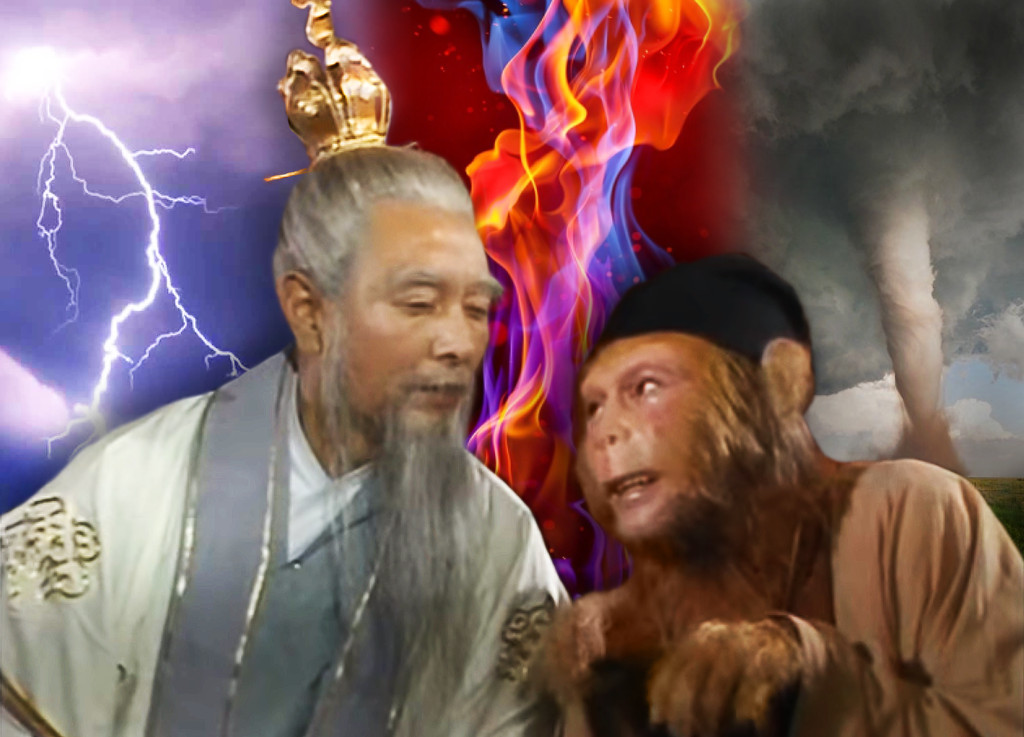
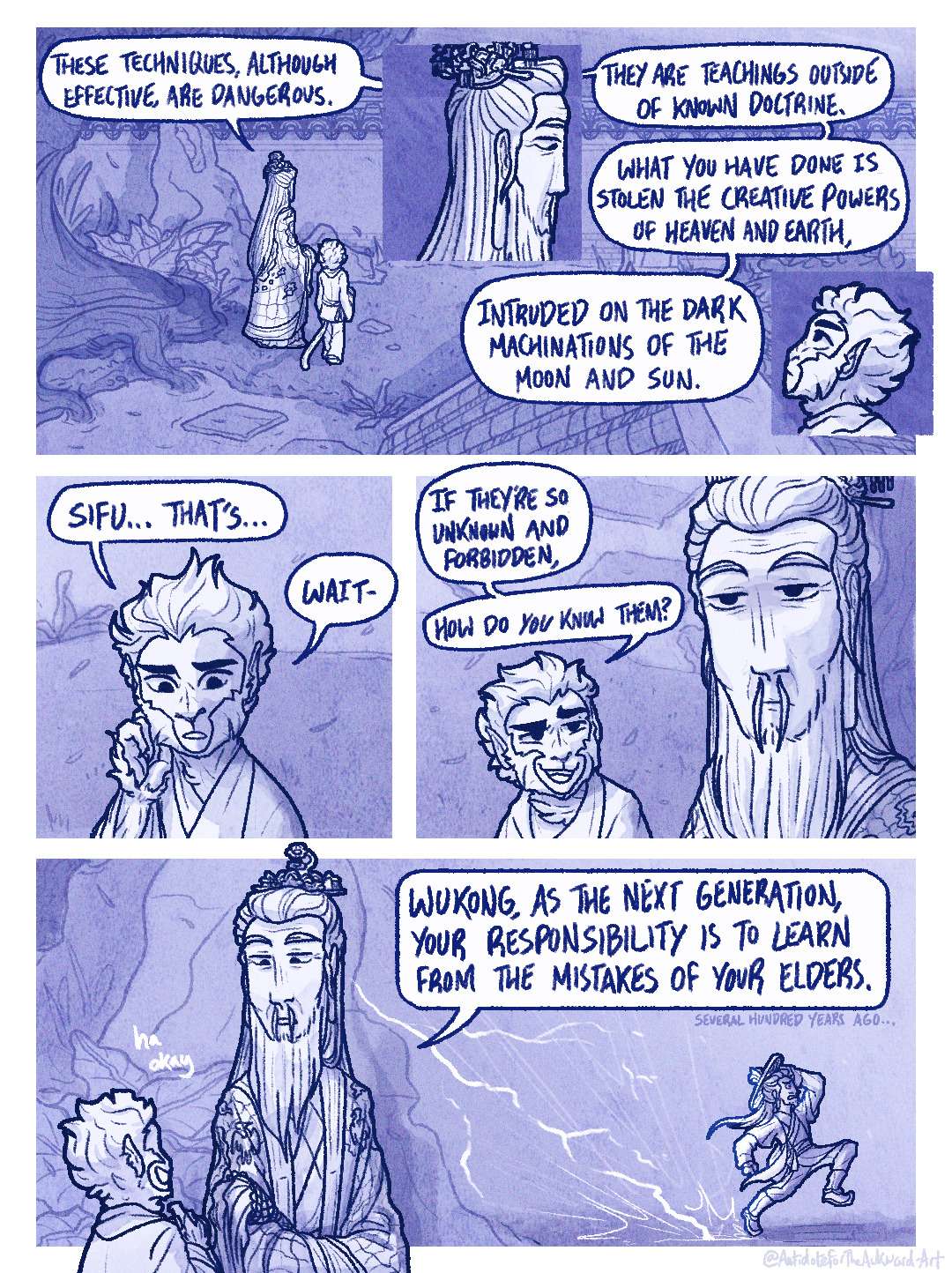
In chapter two of Journey to the West (Xiyouji西遊記, 1592), Master Subodhi warns Sun Wukong that he must protect himself from “Three Calamities” (sanzai lihai, 三災利害) sent by heaven to punish him for achieving immortality and defying his fate (fig. 1). These punishments come every half millennia in the form of destructive elements:

Though your appearance will be preserved and your age lengthened, after five hundred years Heaven will send down the calamity of thunder [leizai, 雷災] to strike you. Hence you must be intelligent and wise enough to avoid it ahead of time. If you can escape it, your age will indeed equal that of Heaven; if not, your life will thus be finished. After another five hundred years Heaven will send down the calamity of fire [huozai, 火災] to burn you. The fire is neither natural nor common fire; its name is the Fire of Yin [yinhuo, 陰火], and it arises from within the soles of your feet to reach even the cavity of your heart, reducing your entrails to ashes and your limbs to utter ruin. The arduous labor of a millennium will then have been made completely superfluous. After another five hundred years the calamity of wind [feng zai, 風災] will be sent to blow at you. It is not the wind from the north, south, east, or west; nor is it one of the winds of four seasons; nor is it the wind of flowers, willows, pines, and bamboos. It is called the Mighty Wind [bifeng, 贔風], and it enters from the top of the skull into the body, passes through the midriff, and penetrates the nine apertures. [1] The bones and the flesh will be dissolved and the body itself will disintegrate. You must therefore avoid all three calamities (Wu & Yu, 2012, pp. 121-122).

雖駐顏益壽,但到了五百年後,天降雷災打你,須要見性明心,預先躲避。躲得過,壽與天齊;躲不過,就此絕命。再五百年後,天降火災燒你。這火不是天火,亦不是凡火,喚做『陰火』。自本身湧泉穴下燒起,直透泥垣宮,五臟成灰,四肢皆朽,把千年苦行,俱為虛幻。再五百年,又降風災吹你。這風不是東南西北風,不是和薰金朔風,亦不是花柳松竹風,喚做『贔風』。自顖門中吹入六腑,過丹田,穿九竅,骨肉消疏,其身自解。所以都要躲過。

These calamities are important because Monkey subsequently learns the 72 transformations in order to escape punishment by hiding under any one of a myriad number of disguises. Therefore, exploring the origins of the three calamities has merit.

Fig. 1 – Master Subodhi tells Sun about the Three Calamities (larger version). Photomanipulation by the author.

Table of Contents

1. Origins

The novel likely borrows from a Buddhist cosmological concept called the “Three Calamities” (sanzai, 三災). We first need some background before continuing. Buddhism recognizes a measurement of time called a Kalpa (jie, 劫), which can be many millions or even billions of years long depending on the tradition. Said traditions recognize between four and eighty kalpas (Buswell & Lopez, 2014, p. 409). The total of these respective ranges make up a Mahakalpa (dajie, 大劫), which is divided into four periods of nothingness, creation, subsistence, and finally destruction, each period being between one and twenty kalpas long (Buswell & Lopez, 2014, p. 496). The Three Calamities are responsible for the destruction of each Mahakalpa.

Kloetzli (1983) describes the cyclical destruction of each Mahakalpa by an element:

The destructions are of three kinds: those by fire, those by water and those by wind. […] The destructions succeed one another in the following sequence: seven by fire followed by a destruction by water. This cycle of eight destructions is repeated a total of seven times. This is then followed by seven more destructions by fire, followed by a final by wind. Thus there are 7 x 8 or 56 destructions by fire; 7 by water and a final 64th by wind [fig. 2] (p. 75).

Therefore, the Three Calamities from Journey to the West follow a similar cycle of destructive elements appearing at set time intervals: lightning, fire, and wind every 500 years in place of fire, water, and wind at the end of every Mahakalpa. And instead of destroying the universe, the elements are sent to kill those who have achieved immortality.

Fig. 2 – A chart mapping the cyclical destructions by fire, water, and wind. A larger version is available on the CBETA page.

The earliest mention of Buddhism’s Three Calamities in Chinese writing that I know of appears in scroll one of the Pearl Forest of the Dharma Garden (Fayuan zhulin, 法苑珠林), a Chinese Buddhist encyclopedia published in 688. So there was plenty of time between this work and the publishing of Journey to the West in 1592.

2. Influence on Xianxia Literature

I was interested to learn that Monkey’s calamities made their way into modern Xianxia (仙侠, “Immortal hero”) literature. For example, the author of the Immortal Mountain wordpress writes:

Heavenly Tribulation (天劫 tiānjié) (重劫 zhòngjié) – in some novels, a trial encountered by cultivators at key points in their cultivation, which they must resist and ultimately transcend. Because immortal cultivation (generally) goes against the Will of Heaven, the Heavens will send down tribulations to oppress high-level cultivators who make progress towards Immortality, often right when they enter a new cultivation stage. This typically takes the form of a lightning storm, with extraordinarily powerful bolts of lightning raining down from the Heavens to strike at the cultivator (source).

The trial by lightning is exactly like the calamity of thunder mentioned by Master Subodhi.

3. Conclusion

Subodhi teaches Monkey the 72 transformations with the expressed purpose of hiding from three calamities (sanzai lihai, 三災利害) of celestial lightening, fire, and wind. They are sent by heaven every 500 years to punish cultivators for defying their fate and achieving immortality. Each was likely influenced by the three calamities (sanzai, 三災) of Buddhist cosmology, which states that the universe is alternately destroyed by fire, water, or wind at the end of every Mahakalpa. Both concepts include destructive elemental forces that appear at given times.

The oldest mention of the original Buddhist calamities that I’m aware of appears in a 7th-century religious encyclopedia titled Pearl Forest of the Dharma Garden (Fayuan zhulin, 法苑珠林).

The literary thunder calamity would later come to influence the “Heavenly Tribulation” (tianjie, 天劫; zhongjie, 重劫) of modern Xianxia literature.


4. Updates

Update: 09-10-2018

The Xianxia translator Deathblade (twitter) was kind enough to direct me to an example of a tribulation from a popular Chinese television show . The scene (video 1) involves a 20,000-year-old child immortal experiencing a trial by lightning. The heavenly bolts tear at his clothing and draw blood, but he survives the ordeal.

Video 1 – Start watching from minute 13:08.

Deathblade also directed me to an example from an online Xianxia novel called I shall Seal the Heavens (Wo yu feng tian, 我欲封天). Chapter 385(!) describes how the anti-hero Meng Hao (孟浩) uses a sentient heavenly treasure to protect himself from powerful bolts of lightning, which instead seek out and kill nearby spiritual cultivators on the cusp of immortality:

The Heavenly Tribulation boomed as one lightning bolt after another shot down onto Meng Hao, who held the meat jelly upraised in his hand to defend himself. The lightning would subsequently disperse into the area around him. Any nearby Cultivators would let out bloodcurdling screams. Soon, the air filled with the sounds of cursing and reviling.

Meng Hao didn’t care. This was something he had learned from Patriarch Reliance. When you con someone and then end up getting cursed by them, you must maintain your cool. It was really a realm unto itself.

Throughout the years, Meng Hao had conned many people, and had refined that skill to the very pinnacle. Therefore, he continued to redirect the descending lightning to the various Cultivators in the three thousand kilometer region.

Wherever he went, he was surrounded by a lake of lightning, along with plaintive cursing. What he left behind was scorched corpses.

To the Cultivators here, it was nothing but a massacre, a slaughter in which no one could do anything to fight back. They couldn’t attack him, nor could they flee as… they were horrified to discover that Meng Hao’ speed was incredible, even if he was being struck by lightning!

(read more here)

The character uses trickery to protect himself from the bolts just like Monkey intended to do with his transformations.


Update: 04-02-2021

As I explained above, Wukong learns the 72 transformations in order to escape the heaven-sent punishments of thunder, fire, and wind. Monkey attains eternal life around his 342nd year when his soul is taken to Hell. He is immortal for over 160 years [2] at the time he’s imprisoned under Five Elements Mountain. This means his 500th year of immortality, the year that the calamity of thunder would be scheduled to strike him, takes place during his imprisonment under the celestial mountain. But this is never described in the story. I assume this is just one of many inconsistencies born from oral storytelling. Although, one could argue that, within the fictional universe, the thunder calamity was voided since Wukong was undergoing punishment at the behest of the Buddha.


Update: 08-29-22

It turns out that punishment by lightning appears in other works of religious vernacular fiction. For example, in The Battle of Wits between Sun and Pang (Sun Pang douzhi yanyi, 孫龐鬥智演義, 1636; a.k.a. The Former and Latter Annals of the Seven KingdomsQianhou qiguo zhi前後七國志):

Sun Bin [孫臏, d. 316 BCE] was overjoyed when he received the Heavenly Book [from the magic White Ape], and hurriedly went back to light the lamp and read it carefully. But during his reading, he felt an eerie, cold wind and heard the rolling of thunder. The Immortal Master Ghost Valley was meditating on the futon when he heard thunder in the air, so he got up and walked immediately to the door of Sun Bin’s room, only to see him reciting the Heavenly Book. When Ghost Valley heard this, he was taken aback. He pushed the door open and went in and said, “I hid this book in the stone box of the prayer cave. I haven’t passed it onto you because your fate has not yet arrived. Where did you get it?

Sun Bin told the story of the white ape. Ghost Valley said: “It turns out that the evil beast stole it and came to you, but unfortunately it was too early. Besides, when you received the Heavenly Book, you didn’t bathe and burn incense, and you didn’t wash your hands or rinse your mouth, thus blaspheming the gods and provoking a great tribulation [da zainan, 大災難] of 100 days.”

Sun Bin’s continence changed. He asked: “Can master save your disciple?”

Ghost Valley said: “If you want me to save you, you must not disobey my nightmare-suppression method.”

Sun Bin said: “I dare not.”

Ghost Valley said: “Due south behind the mountain is an empty stone tomb. You should sleep in the stone tomb with your head to the south and your feet to the north, with 49 grains of raw rice in your mouth. Cover it with your saliva but don’t swallow the grains. You will feel fully nourished. As long as you hide for forty-nine days, you will escape the great tribulation and protect yourself.”

Sun Bin said, “I sincerely receive your instructions.”

Ghost Valley led Sun Bin to the empty tomb at night. Sun complied with his master’s nightmare-suppression method and followed his instructions. A stele was erected in front of the tomb which read: “The Tomb of Sun Bin of the State of Yan” (Wumen xiaoke & Yanshui sanren, 1636).

Another example comes from the Lady of Linshui Pacifies Demons (Linshui pingyao, 臨水平妖, 17th-century). This time, it involves the immortal Lu Dongbin (呂洞賓; a.k.a. Lu Chunyang, 呂純陽) angering Guanyin, who dispatches thunder deities after him. And just like Sun learns the transformations to hide from the calamities, Lu takes the form of a bug to hide from his punishment:

As we take up our tale anew, Guanyin opened wide her eye of wisdom and saw Pure Yang Lü standing on top of the cloud. She cursed him, saying, “A dumb beast like that has no sense of propriety!” Then she sent the Five Thunders (Wu Lei [五雷]) to strike him. The Immortal Ancestor Lü saw them coming and for an instant was helpless with fright. Unable to escape back to his mountain, he hastily fled to Liang Hao’s study. 

He called to Licentiate Liang, “In a moment of distraction, I offended the Heavenly Court, which has dispatched the Five Thunders to strike me. Save me!” As he spoke, the sound of thunder rolled violently. Liang Hao was so frightened that his hands and feet were like ice, and he was unable to reply. Pure Yang Lü said, “If you are willing to rescue me, then that would give this poor Daoist a place to hide.” Liang Hao agreed with alacrity. Pure Yang Lü then turned himself into a tiny insect, ran under Liang Hao’s fingernails, and hid himself. He waited for an hour and three quarters, until the thunder no longer rolled. There was nothing the Five Thunders could do, so they were obliged to go back to the Purple Bamboo Grove [on Guanyin’s mountain], having failed to carry out the Buddha’s [Guanyin’s] orders. At this time, an hour and three quarters having already elapsed, Pure Yang Lü resumed his original form. He thanked Liang Hao and returned to Zhong Mountain, as he did not dare remain in these harrowing circumstances any longer (Fryklund, Lewis, & Baptandier, 2021, p. 6). 


Update: 11-09-22

An artist known on Tumblr as “AntidoteForTheAwkward” has posted a wonderful comic (fig. 3) giving a reason for why the Patriarch Subhodi teachers Monkey the 72 transformations in order to avoid the heavenly calamities: personal experience.

Fig. 3 – AntidoteForTheAwkward’s comic (larger version). See the original post here.

Notes:

1) The eyes, ears, nose, mouth, genitals, and anus.

2) Wukong serves in heaven twice: first “for more than ten years” and second “for over a century” (Wu & Yu, 2012, vol. 1, pp. 150 and 166). Then he is punished to 49 days in Laozi’s furnace (Wu & Yu, 2012, vol. 1, p. 189). But the narrative revels “one day in heaven is equal to one year on Earth” (Wu & Yu, 2012, vol. 1, pp. 150 and 167). So this means his turn in the furnace lasts close to fifty years.

Sources:

Buswell, J., & Lopez, D. (2014). The Princeton Dictionary of Buddhism. Princeton, NJ: Princeton University Press.

Fryklund, K. I., Lewis, M. E., & Baptandier, B. (2021). The Lady of Linshui Pacifies Demons: A Seventeenth-Century Novel. Seattle, WA: University of Washington Press.

Kloetzli, R. (1983). Buddhist Cosmology: From Single World System to Pure Land: Science and Theology in the Images of Motion and Light. Oxford: Motilal Books.

Wu, C., & Yu, A. C. (2012). The Journey to the West (Vol. 1) (Rev. ed.). Chicago, Illinois: University of Chicago Press.

Wumen xiaoke, & Yanshui sanren (1636). Qianhou qiguo zhi [Annals of the Seven Kingdoms]. Retrieved from