The Crow’s Nest Chan Master of Journey to the West

Last Updated: 04-12-25

The end of Journey to the West (Xiyouji西遊記; “JTTW” hereafter) chapter 19 contains a strange, seemingly throwaway character called the “Crow’s Nest Chan Master” (Wuchao chanshi, 烏巢禪師) (fig. 1). Having met the Buddhist sage in the past, Zhu Bajie describes him as an accomplished cultivator who lives in a nest atop a juniper tree on Pagoda Mountain (Futu shan, 浮屠山), just beyond the border of Tibet (Wusizang, 烏斯藏). [1] Zhu also claims to have been invited by him to jointly practice austerities, but the pig-spirit passed on the opportunity (Wu & Yu, 2012, vol. 1, p. 388).

The pilgrims soon thereafter run into Crow’s Nest on their trek through his mountain, and following a brief chat, he orally passes on the Heart Sutra (Mohe bore boluomiduo xinjing, 摩訶般若波羅蜜多心經) to Tripitaka (Wu & Yu, 2012, vol. 1, pp. 389-390). This lesson is referenced a few times in later chapters. [2]

The narrative seems to indicate that Crow’s Nest and Zhu first met before the latter converted to Buddhism in the past. This is because he recognizes the pig-spirit not by his original Dharma name, Wuneng (悟能), but by his secular name: ”Aren’t you the Zhu Ganglie [豬剛鬣, “Stiff-Bristles Hog”] of the Fuling Mountain?” (Wu & Yu, 2012, vol. 1, p. 389). [3] The association between these two figures in JTTW may be based on homophonous surnames (see below).

Fig. 1 – A woodblock print of the Crow’s Nest Chan Master (larger version). From the Newly Annotated Journey to the West With Illustrations (Xinshuo Xiyouji tuxiang, 新說西遊記圖像, 1888).

1. Interesting facts

1.1. Powers

The first thing that interests me about the Chan Master is his supernatural abilities. He demonstrates his clairvoyance by reciting a poem [4] in which foretells some of the evils that the pilgrims will face on their quest. For example, one section reads: “Monsters all mountains populate; / Old tigers sit as magistrates; / Graying wolves act as registrars. / Lions, elephants—all called kings!” (Wu & Yu, ). The last line likely references the lion and elephant demon kings appearing in JTTW chapters 74 to 77.

Another part predicts the coming of Sha Wujing. The section reads: “A wild pig totes a hauling pole; / You’ll meet ahead a water sprite. / An old stone ape of many years / Now nurses over there his spite!” (Wu & Yu, 2012, vol. 1, p. 391). You’ll notice that Crow’s Nest spins his prediction between taking jabs at Zhu and Wukong. Monkey was already upset with him for not recognizing the Great Sage’s fame, so this afront leads the primate immortal to strike out.

In response, the cultivator uses defensive magic to protect himself:

The Chan Master, changing into a beam of golden light, went straight up to his crow’s nest, while the priest [Tripitaka] bowed toward him to express his gratitude. Enraged, Pilgrim lifted his iron rod and thrust it upward violently, but garlands of blooming lotus flowers were seen together with a thousand-layered shield of auspicious clouds. Though Pilgrim might have the strength to overturn rivers and seas, he could not catch hold of even one strand of the crow’s nest (Wu & Yu, 2012, vol. 1, p. 391).

那禪師化作金光,徑上烏巢而去。長老往上拜謝,行者心中大怒,舉鐵棒望上亂搗,只見蓮花生萬朵,祥霧護千層。行者縱有攪海翻江力,莫想挽著烏巢一縷籐。

This reminds me of an event from Acts of the Buddha (Sk: Buddhacarita; Ch: Fo suoxing za佛所行讚, 2nd-century), an ancient biography of the Tathagata:

The host of Mara hastening, as arranged, each one exerting his utmost force, taking each other’s place in turns, threatening every moment to destroy [the Buddha, but] … Their flying spears, lances, and javelins, stuck fast in space, refusing to descend; the angry thunderdrops and mighty hail, with these, were changed into five-colour’d lotus flowers…” (Beal, 1883, pp. 152 and 153).

魔眾相駈策, 各進其威力,
迭共相催切, 須臾令摧滅,

[…]

飛矛戟利矟, 凝虛而不下,
雷震雨大雹, 化成五色花 …

The similarities suggest that Crow’s Nest is also an enlightened being like the Tathagata.

1.2. History

The second thing that interests me is that the Chan Master is based on a historical monk, Niaoke Daolin (鳥窠道林, lit: “Bird’s Nest in the Forest of the Way”; 741–824), who was born nearly 80 years after the death of the historical Xuanzang (on whom Tripitaka is based) (Buswell & Lopez, 2014, pp. 1015-1016). His full biography appears in the Records of the Transmission of the Lamp (Jingde chuandenglu, 景德傳燈錄, 1004–1007):

Chan master Niaoke Daolin … was from Fuyang in Hangzhou and his family name was Pan. His mother, whose maiden name was Zhu, once dreamt of the rays of the sun entering her mouth, after which she conceived. When the baby was born a strange fragrance pervaded the room, so the name ‘Fragrant Light’ was given to the boy. He left the home life at the age of nine and received the full precepts at the Guoyuan Temple in Jing (Jingling, Hubei) when he was twenty-one years old. Later he went to the Ximing Monastery in Chang’an to study the Huayan Jing (Avataṃsaka Sūtra) and the Śāstra on the Arising of Faith (Śraddhotpada Śāstra, Aśvagosa) under the Dharma Teacher Fuli, who also introduced him to the Song of the Real and Unreal, and had him practise meditation.

Once Niaoke asked Fuli, ‘Could you say how one meditates and how to exercise the heart?’

Teacher Fuli was silent for a long time, so then the master bowed three times and withdrew.

It happened that at this time Tang Emperor Taizong had called the First Teacher in the Empire [Daoqin] of Jing Mountain to the Imperial Palace and Daolin went to pay him a formal visit, obtaining the True Dharma from him.

Returning south the master first came to the Yongfu Temple on Mount Gu (Zhejiang), where there was a stūpa dedicated to the Pratyekabuddhas. At this time both monks and laymen were gathering there for a Dharma-talk. The master also entered the hall, carrying his walking stick, which emitted a clicking sound. There was a Dharma-teacher present from a temple called Lingying, whose name was Taoguang, and who asked the master, ‘Why make such a sound in this Dharma-meeting?’

‘Without making a sound who would know that it was a Dharma-meeting?’ replied the master.

Later, on Qinwang Mountain, the master saw an old pine tree with lush foliage, its branches shaped like a lid, so he settled himself there, in the tree, which is why the people of that time called him Chan Master Niaoke (Bird’s Nest). Then magpies made their nest by the master’s side and became quite tame through the intimacy with a human – so he was also referred to as the Magpie Nest Monk.

One day the master’s attendant Huitong suddenly wished to take his leave. ‘Where are you off to then?’ asked the master.

‘Huitong left the home life for the sake of the Dharma, but the venerable monk has not let fall one word of instruction, so now it’s a question of going here and there to study the Buddha-dharma,’ replied Huitong.

‘If it could be said that there is Buddha-dharma,’ said the master, ‘I also have a little here,’ whereupon he plucked a hair from the robe he was wearing and blew it away. Suddenly Huitong understood the deep meaning.

During the Yuan reign period (806-820 CE) Bai Juyi was appointed governor of this commandery and so went to the mountain to pay the master a courtesy call. He asked the master, ‘Is not the Chan Master’s residing here very dangerous?’

‘Is not your Excellency’s position even more so?’ countered the master.

‘Your humble student’s place is to keep the peace along the waterways and in the mountains. What danger is there in that?’ asked Bai Juyi.

‘When wood and fire meet there is ignition – the nature of thinking is endless,’ replied the master, ‘so how can there not be danger?’

‘What is the essence of the Buddha-dharma?’ asked Bai.

‘To refrain from all evil and do all that is good,’ answered the master.

‘A three-year-old child already knows these words,’ said Bai.

‘Although a three-year-old can say them, an old man of eighty can’t put them into practice!’ countered the master.

Bai then made obeisance.

In the fourth year, during the tenth day of the second month of the reign period Changqing (824 CE), the master said to his attendant, ‘Now my time is up.’ And having spoken he sat on his cushion and passed away. He was eighty-four years old and had been a monk for sixty-three years.

(Textual note: Some say the master’s name was Yuanxiu, but this is probably his posthumous name.) (Whitfiled, n.d., pp. 56-58).

杭州鳥窠道林禪師。本郡富陽人也。姓潘氏。母朱氏夢日光入口。因而有娠。及誕異香滿室。遂名香光焉。九歲出家。二十一於荊州果願寺受戒。後詣長安西明寺復禮法師。學華嚴經起信論。復禮示以真妄頌俾修禪那。師問曰。初云何觀。云何用心。復禮久而無言。師三禮而退。屬唐代宗詔徑山國一禪師至闕。師乃謁之遂得正法。及南歸先是孤山永福寺有辟支佛塔。時道俗共為法會。師振錫而入。有靈隱寺韜光法師。問曰。此之法會何以作聲。師曰。無聲誰知是會。後見秦望山。有長松枝葉繁茂盤屈如蓋。遂棲止其上。故時人謂之鳥窠禪師。復有鵲巢于其側自然馴狎人。亦目為鵲巢和尚。有侍者會通。忽一日欲辭去。師問曰。汝今何往。對曰。會通為法出家。以和尚不垂慈誨。今往諸方學佛法去。師曰。若是佛法。吾此間亦有少許。曰如何是和尚佛法。師於身上拈起布毛吹之。會通遂領悟玄旨。元和中白居易出守茲郡。因入山禮謁。乃問師曰。禪師住處甚危險。師曰。太守危險尤甚。曰弟子位鎮江山。何險之有。師曰。薪火相交識性不停。得非險乎。又問如何是佛法大意。師曰。諸惡莫作眾善奉行。白曰。三歲孩兒也解恁麼道。師曰。三歲孩兒雖道得。八十老人行不得。白遂作禮。師於長慶四年二月十日。告侍者曰。吾今報盡言訖坐亡。壽八十有四。臘六十三(有云師名圓修者。恐是諡號)。(source)

2. Connection to Zhu Bajie (豬八戒)

I mentioned earlier that the literary Crow’s Nest and Zhu may have been associated in JTTW due to similar-sounding surnames. As stated in the above biography, the surname of Niaoke’s mother was Zhu (朱), which sounds exactly the same as the pig-spirit’s surname, Zhu (豬). This is important since our porcine hero is likely named after Zhu Shixing (朱士行), a Han-era monk with the Dharma name Bajie (八戒)—i.e. Zhu Bajie (朱八戒).

Can you imagine what Zhu’s story would be like if he had taken the Chan Master up on his offer? An enlightened pig-spirit devoid of lust, gluttony, and sloth would seem so foreign to us. This might be good fodder for a JTTW AU


Update: 04-12-25

Regarding the JTTW AU, a friend on discord suggested that Zhu’s cultivation would lead to him regaining his human form. This fits with the original novel because Princess Iron Fan had “attained the way of humanity” (i.e. a human form) via spiritual practices (Wu & Yu, 2012, vol. 3, p. 162).

Notes:

1) Yu (Wu & Yu, 2012) translates “烏斯藏” (Wusizang), the location of Gao village, as the “Kingdom of Qoco” (Wu & Yu, 2012, vol. 1, p. 369). However, this phrase actually refers to Dbus-gtsang, or Tibet (Zhang, 2023, pp. 32-33; Wilkinson, 2000, p. 728).

2) Although Tripitaka is the intended recipient of the Heart Sutra, Monkey thrice demonstrates (chapters 43, 85, and 93) that he understands its meaning better than his master (Wu & Yu, 2012, vol. 2, p. 254; vol. 4, pp. 144-145 and 264-265).

3) Zhu first reveals his secular name in chapter 18 (Wu & Yu, 2012, vol. 1, p. 376). He was given his original Dharma nameWuneng (悟能, “Awake to Power”), by Guanyin in chapter eight sometime in the past (Wu & Yu, 2012, vol. 1, p. 213).

4) Here is the Chan Master’s full poem:

“The way [to India] is not too hard to walk;
Try listening to what I say.
A thousand hills and waters deep;
Places full of goblins and snags;
When you reach those sky-touching cliffs,
Fear not and put your mind at rest.
Crossing the Rub Ear Precipice,
You must walk with steps placed sideways.
Take care in the Black Pine Forest;
Fox-spirits will likely bar your way.
Griffins will fill the capitals;
Monsters all mountains populate;
Old tigers sit as magistrates;
Graying wolves act as registrars.
Lions, elephants—all called kings! 
Leopards, tigers are coachmen all!
A wild pig totes a hauling pole;
You’ll meet ahead a water sprite.
An old stone ape of many years
Now nurses over there his spite!
Just ask that acquaintance of yours:
Well he knows the way to the West” (Wu & Yu, 2012, vol. 1, pp. 390-391).

道路不難行,試聽我吩咐。
千山千水深,多瘴多魔處。
若遇接天崖,放心休恐怖。
行來摩耳巖,側著腳蹤步。
仔細黑松林,妖狐多截路。
精靈滿國城,魔主盈山住。
老虎坐琴堂,蒼狼為主簿。
獅象盡稱王,虎豹皆作御。
野豬挑擔子,水怪前頭遇。
多年老石猴,那裡懷嗔怒。
你問那相識,他知西去路。(source)

Sources:

Beal, S. (Trans.). (1883). The Fo-sho-hing-tsan-king: A Life of Buddha by Asvaghosha Bodhisattva. Oxford: Clarendon Press. Retrieved from https://archive.org/details/foshohingtsankin00asva/mode/2up.

Buswell, R. E. , & Lopez, D. S. (2014). The Princeton Dictionary of Buddhism. Princeton, NJ: Princeton University Press.

Whitfiled, R. S. (Trans.). (n.d.). Records of the Transmission of the Lamp: Volume 2 – The Early Masters. Hokun Trust. Retrieved from https://terebess.hu/zen/mesterek/Lamp2.pdf.

Wilkinson, E. P. (2000). Chinese History: A Manual. United Kingdom: Harvard University Asia Center.

Wu, C., & Yu, A. C. (2012). The Journey to the West (Vols. 1-4) (Rev. ed.). Chicago, Illinois: University of Chicago Press.

Zhang, F. (2023). The Eastern Land and the Western Heaven: Qing Cosmopolitanism and Its Translation in Tibet in the Eighteenth Century. United Kingdom: Taylor & Francis.

Archive #34 – Understanding Reality: A Taoist Alchemical Classic

Last updated: 03-17-2022

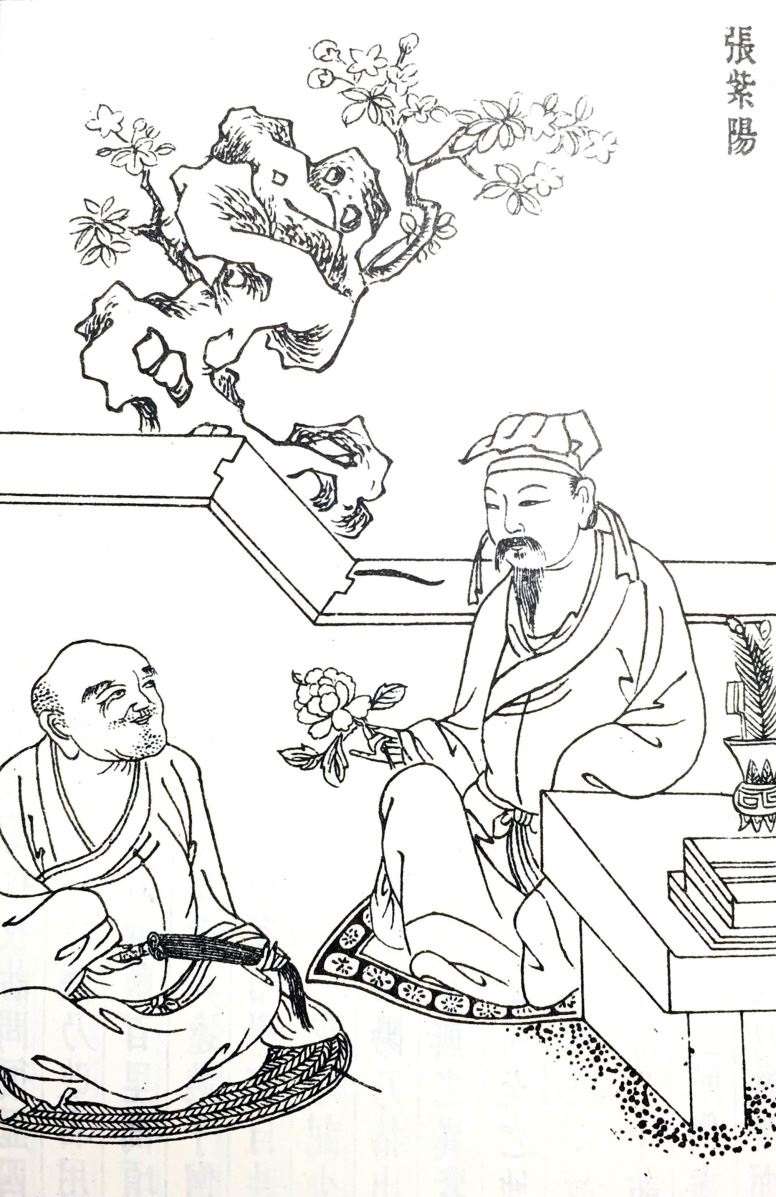
The Wuzhi pian (悟真篇, “Writings on Understanding / Becoming Aware of Reality”, 1075) is a Song-era work of Buddho-Daoist philosophy by the Southern Quanzhen School Patriarch Zhang Boduan (張伯端, mid to late-980s-1082) (fig. 1). Shao (1997) expertly shows that Zhang’s writing had a huge impact on the standard 1592 edition of Journey to the West (Xiyouji, 西遊記) (see especially ch. 4). For example, the reason that the first half of Sun Wukong‘s story (ch. 1 to 7) is Taoist heavy (i.e. his quest for immortality and later ascension to heavenly rank) is because this follows the first part of Zhang’s philosophy, which is attaining the golden elixir (jindan, 金丹). And the reason the second half (ch. 14 to 100) is Buddhist heavy (i.e. building merit by protecting Tripitaka on the pilgrimage west and the rise to Buddhahood) is because the second part of Zhang’s philosophy involves attaining the Buddha-Mind. Combined, these achievements make someone a true transcendent, one free from the wheel of rebirth.

A line from the Wuzhi pian is a prime example of Zhang’s stance on those who strive only to attain the elixir: “A halo behind the head is still a phantom; / Even when clouds rise beneath your feet you are still not an immortal” (Zhang, Liu, & Cleary, 1987, p. 161). This explains why Monkey is banished from heaven and imprisoned under Five Elements Mountain. He has yet to attain the Buddha-Mind.

An even better example of this two-stage process among Zhang’s other works reads:

The elixir is the most precious treasure for the physical body.
When cultivated to perfection, the transformations are endless.
If one further explores the true meaning of the buddha-nature,
One is bound to attain the ineffable bliss of the birthless (Xue, 1977, as cited in Shao, 1997, pp. 99-100).

I’m archiving an English translation of the Wuzhi pian by Thomas Clearly, with explanations by the Qing-era Daoist scholar Liu Yiming (1734-1821).

Fig. 1 – A print of Zhang Boduan (a.k.a. Zhang Ziyang, 張紫陽) from the Ming-era Traces of Immortals and Buddhas (Xianfo jizong, 仙佛奇蹤) (larger version).

Archive link:

Click to access Chang-Po-Tuan_-Thomas-Cleary_-Liu-Yiming-Understanding-Reality-University-of-Hawaii-Press-1987.pdf

Disclaimer:

This has been posted for educational purposes. No malicious copyright infringement is intended. If you liked the digital version, please support the official release.


Update: 03-17-2022

Jeff Pepper, writer and publisher of Imagin8 Press, left an informative comment reminding me that Zhang actually appears in a later chapter of JTTW.

It’s worth noting that Zhang Boduan (also referred to as Zhang Ziyang and Great Heaven’s Immortal Purple Cloud) appears in Chapter 71 of JTW. Sun Wukong has just returned Lady Golden Sage Palace to her husband, the king of Scarlet Purple Kingdom. The king tries to embrace her but is painfully pricked by the poison thorns on her cloak. Zhang appears in the clouds, comes to earth, points his finger at the Lady, and her poison cloak disappears. He explains that he was the one who put the cloak on her in the first place, to protect her from her captor, the evil demon Jupiter’s Rival.

Citation:

Zhang, B., Liu, Y., & Cleary, T. (1987). Understanding Reality: A Taoist Alchemical Classic. Honululu Univ. of Hawaii Press.

Shao, P. (1997). Monkey and Chinese Scriptural Tradition: A Rereading of the Novel Xiyouji (UMI No. 9818173) [Doctoral dissertation, Washington University]. Available from ProQuest Dissertations and Theses database.

Archive #17 – PDFs of Creation of the Gods Library of Chinese Classics Chinese-English Bilingual Edition (Vols. 1-4)

Note #1: See update 11-28-21 for a PDF of a doctoral thesis analyzing the historical sources for FSYY.

Note #2: See update 03-14-23 for a PDF of circa 1620 FSYY woodblock prints.

Last updated: 11-03-2024 

Here I present a PDF of the Library of Chinese Classics bilingual edition of Creation of the Gods (Fengshen yanyi, 封神演義, c. 1620 CE), sometimes translated as Investiture of the Gods or Enfeoffment of the Gods.

Here is a summary.

I. Description

This 100 chapter shenmo novel tells of the great struggle between the declining Shang (c. 1600–1046 BCE) and ascending Zhou (c. 1046–256 BCE) dynasties. In the beginning, King Zhou of Shang offends the primordial goddess Nuwa by leaving a lewd poem in her temple, and in response, the devi summons a trio of spirits (a fox, a pheasant, and a lute) to bring about the dynasty’s downfall. The fox spirit takes the place of the king’s concubine Daji and, over the course of nearly 30 years, leads him down a path of imperial neglect, decadence, and sadism. This causes many of the kingdom’s dukes, marquis, and generals to later rebel in favor of King Wu of Zhou, the monarch destined by heaven to rule China. 

The majority of the story follows the countless battles between the forces of Shang and Zhou. Along the way, the latter are aided by immortals of the Chan () sect (an analogy for Quanzhen Daoism), which favors spiritual cultivation, while the former are aided by the Jie () sect (an analogy for Zhengyi), which favors charms and incantations. [1] Each transcendent wields any number of swords, fans, hooks, staves, axes, halberds, scissors, hammers, rings, sashes, nails, dippers, pennants, pearls, gourds (etc.), each with not only the power to take the lives of thousands of humans but also immobilize other immortals and even kill them. These celestial battles escalate to the point that Laozi and the Buddha must fight side-by-side to defeat a trap designed to kill 10,000 immortals.

A story line present throughout the novel is the fate of Jiang Ziya, a Daoist adept and the military strategist and stalwart commander of the Zhou army. He is destined to deify the souls of the humans and immortals who die in battle using the “List of Creation” (Fengshen bang, 封神榜), an index of preordained names agreed upon at the beginning of time by the heads of the three religions. This list is housed in the “Terrace of Creation” (Fengshen tai, 封神臺), a reed pavilion in which the souls of the dead are gathered to await their apotheosis. In the end, after defeating the Shang forces, Jiang deifies a total of 365 major gods, along with thousands of lesser gods, ranging from holy mountains, weather, and plagues to constellations, the time cycle, and the five elements.

Fig. 1 – A detail of Nezha striking at an enemy during battle. Image from The Newly Printed, Zhong Bojing Annotated, Investiture of the Gods (Xinke Zhong Bojing xiansheng piping Fengshen yanyi, 新刻鍾伯敬先生批評封神演義, c. 1620) (larger version).

Considering the story takes place a millennia prior to the arrival of Buddhism in China, the novel portrays the religion having no presence in the east. There are several times in the narrative when a Buddhist deity travels from the western paradise to halt the execution of a powerful immortal or demon as they are fated to submit to Buddhism. Furthermore, when the Buddha intervenes in the great battle towards the end, he does so to find talented disciples who will help him spread the religion in the east. In fact, Bodhisattvas like Guanyin and Manjusri are depicted as former Chan sect immortals who later become disciples of Buddhism.

II. Relationship to JTTW

For the purposes of this blog, several characters from Journey to the West (Xiyouji, 西遊記, 1592) appear in the novel, including Laozi, the Buddha, Nezha (fig. 1), Muzha, and Li Jing, Ao Guang, Erlang (called Yang Jian, 楊戩) and his hound, etc. Journey to the West also had a number of clear influences on the book, one being the ape spirit Yuan Hong (袁洪) from later chapters who wields a staff and 72 transformations in a fight with Yang Jian. Sound familiar?

III. The Translation

This edition of the novel was originally translated by Gu Zhizhong (顾执中, 1898–1995) in 1992. Dr. Barbara Witt notes the translation has its pros and cons:

The positive: It is the only complete translation of Fengshen yanyi into a Western language that I am aware of. The edition I read (from 1992 I think), was also nicely done with interesting woodcut illustrations throughout the novel.

The negative: Firstly, it is not a very faithful translation. Poems are generally left untranslated and sentences often paraphrased. [2] I think, when ever the translator found something difficult, he just skipped it. Secondly, I think Gu Zhizhong was not an English native speaker and not very familiar with Western mythology and some of his translations are really off. For example Taiyi zhenren 太乙真人 (“True Man Primordial”), a powerful Daoist immortal, becomes “Fairy Primordial” in his translation, which conjures up a very different image.

While the translation may not be perfect, I think it is a must read as many of the gods mentioned therein are worshiped in modern temples throughout China, Taiwan, Malaysia, and Singapore. It is a lens into modern folk religion.

IV. PDF File

The following PDF is a combination of all four volumes making up Gu (2000):


Update: 11-28-21 

I’ve added Wan (1987), a doctoral thesis analyzing the historical sources and micro/macro structure of the story. It also provides a summary of the tale in the end.

PDF File

Click to access Investiture-of-the-gods-Fengshen-yanyi-Sources-narrative-structure-and-mythical-significance.pdf


Update: 03-14-23

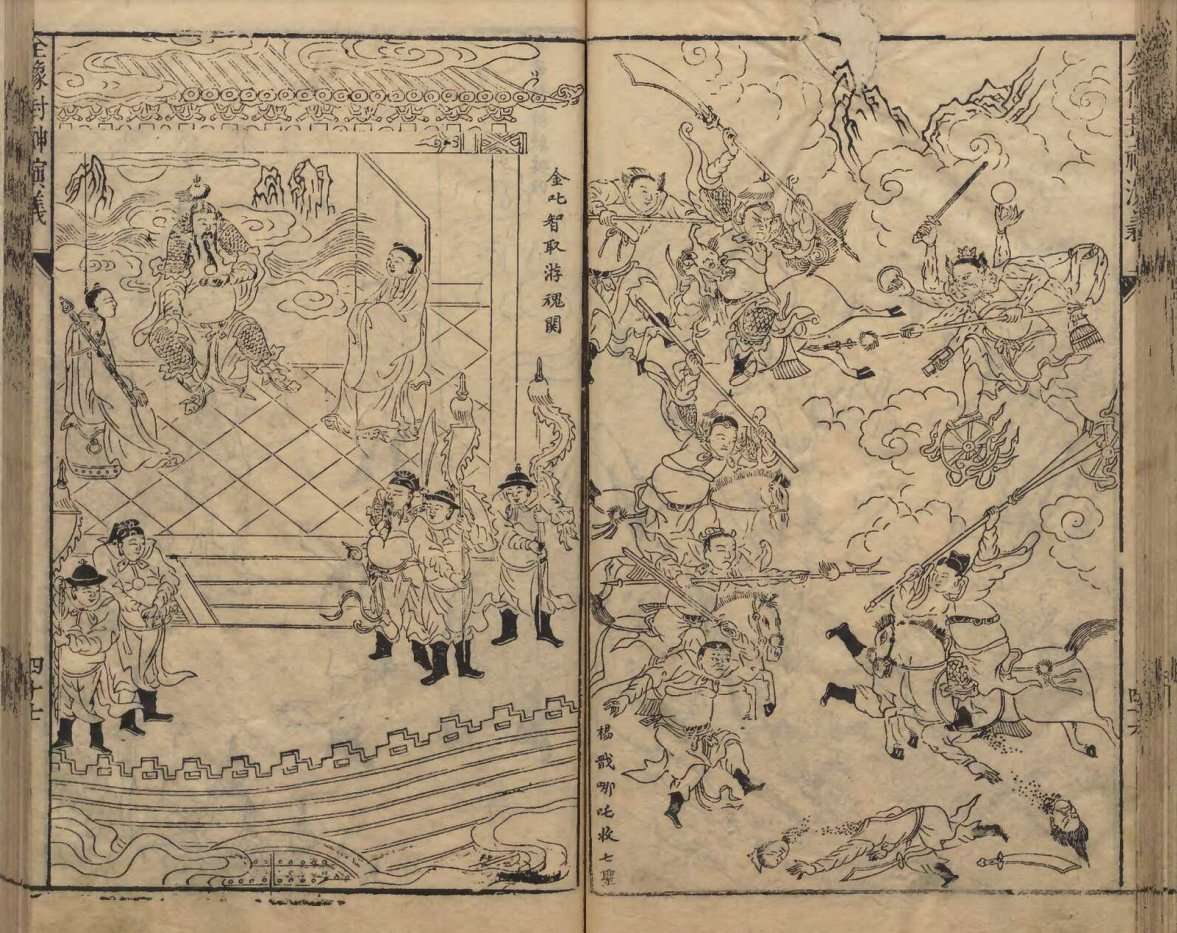
Here is a PDF for volume one of The Newly Printed, Zhong Bojing Annotated, Investiture of the Gods (Xinke Zhong Bojing xiansheng piping Fengshen yanyi, 新刻鍾伯敬先生批評封神演義, c. 1620), the oldest known edition of the novel. It is full of lovely woodblock prints (fig. 2).

PDF File

Click to access Investiture-of-the-Gods-1620-prints.pdf

Fig. 2 – A random page from vol. 1 of The Newly Printed, Zhong Bojing Annotated, Investiture of the Gods (larger version).

Thank you to the National Archives of Japan for offering the complete 1620 edition of FSYY. It can be downloaded here.


Update: 09-13-23

Tumblr user digitalagepulao has drawn an amazing Nezha (fig. 3). The theme is based on the feud between the prince and his father, which leads to the former’s suicide and divine resurrection. The artist describe a tense scene from the novel:

Li Jing in a fury grabbed his halberd, leapt on his horse and galloped out of the headquarters. He was astonished to see Nezha with his Wind-Fire Wheels and Fire-Tipped Spear. He swore loudly, “You damned beast! You caused us endless suffering before your death, and now that you’ve been reborn, you’re troubling us again!”

“Li Jing! I’ve returned my flesh and bones to you [via suicide], and there’s no longer any relation between us. Why did you smash my golden idol with your whip and burn down my temple? Today I must take my revenge!”

The drawing is part of digitalagepulao’s “Expedition to the West au” (JTTW alternate universe) storyline based on this article.

Fig. 3 – Digitalagepulao’s Nezha (larger version).


Update: 09-08-24

@ryin-silverfish of Tumblr (author of this guest post) has made a catalog of the fantastic pets from the novel.

https://docs.google.com/document/d/1NozJF8nbhy8t6Jta7AZ5WKbyCmEMYtgFM_akcSt9D-Y/edit?usp=drivesdk

They have also made a catalog of Nezha’s powers.

https://docs.google.com/document/d/1FjHQPXmEalChk7PNiw9ljAJ8Cq66-AjevgEfdEa6wgI/edit?usp=sharing

A very big thank you to them. I’ll add more later if or when new lists are available. 

Disclaimer:

These have been posted for educational purposes. No malicious copyright infringement is intended. Please support the official release.


Update: 11-03-24

My friend Dario Virga (Onibotokemaru on Instagram) (fig. 4) has completed an Italian translation of the novel titled L’investitura degli Dei: Romanzo cinese di epoca Ming (2024). This 1,120 page, two-volume edition can be purchased here for € 50,00:

https://www.libraccio.it/libro/9788879847049/xu-zhonglin/investitura-degli-dei-romanzo-cinese-di-epoca-ming.html?tr=C3137

Fig. 4 – Dario and his translation (larger version). 

Notes:

1) Prof. Shi Changyu notes in his preface to this translation that the friction between the fictional Chan and Jie sects serves as an analogy for that of Quanzhen and Zhengyi during the Ming, for the former was marginalized, while the latter was held in high esteem and fell prey to decadence, naturally hindering its ability to contribute anything of value to the development of Daoism at this time (Gu, 2000, pp. 50-53).

2) Those interested in reading some of the poetry from the novel should consult Koss (1979), which compares them with those from Journey to the West.

Sources:

Gu, Z. (2000). Creation of the Gods (Vols. 1-4). Beijing: New World Press.

Koss, N. (1979). The Relationship of Hsi-yu chi and Feng-shen yen-i: An Analysis of Poems Found in Both Novels. T’oung Pao,65(4/5), second series, 143-165. Retrieved May 5, 2020, from http://www.jstor.org/stable/4528175

Wan, P. (1987). Investiture of the Gods (“Fengshen yanyi”): Sources, Narrative Structure, and Mythical Significance (UMI No. 8810607) [Doctoral dissertation, University of Washington]. Available from ProQuest Dissertations and Theses database.

Wu, C., & Yu, A. C. (2012). The Journey to the West (Vols. 1-4) (Rev. ed.). Chicago, Illinois: University of Chicago Press.

Archive #13 – Huineng, Subhuti, and Monkey’s Religion in “Xiyou ji” (2006)

Last updated: 05-29-2022

I present an archived copy of Ping Shao’s (2006) wonderful paper exploring the origin of Sun Wukong’s characterization and how it effects his story cycle. Shao presents a three-fold objective: first, highlight Daoist and Buddhist concepts in chapters one and two that have previously been overlooked or not given enough weight, showing that they serve a function and are not just expendable story elements; second, provide a unified religious vision based on the Buddho-Daoist philosophy of the Daoist southern lineage patriarch Zhang Boduan (張伯端, 987?–1082); and 3) demonstrate that Zhang’s philosophy dictates the course of Sun’s story cycle from unruly immortal to enlightened Buddha. 

Shao (2006) suggests Monkey’s portrayal in the first two chapters is influenced by the sixth Chan patriarch Huineng (惠能, 638–713), founder of the “Sudden Enlightenment” school of Buddhism. [1] For example, Sun’s quick-wittedness, demonstrated by his deciphering of his teacher, Subodhi’s, chastisement for refusing to learn certain Daoist skills in chapter two as secret code to receive a private lesson at night, [2] is based on a similar episode involving Huineng and the previous patriarch Hongren. Additionally, Monkey’s 108,000 li (33,554 mi/54,000 km)-spanning somersault cloud (fig. 1) is based on the symbolic distance said by Huineng to separate the Buddha’s paradise from the world of man. [3] Only those who achieve enlightenment can arrive instantly. This is symbolized in the novel by Monkey zipping there instantly on his cloud, whereas Tripitaka must travel thousands of miles over many years. Shao (2006) provides further examples, but I feel these suffice.

37e2fc9cebe000bb1c76c73e7ad2963a-d5oas0h

Monkey flying on clouds. Drawing by Funzee on deviantart (larger version).

The unified religious vision is demonstrated by Sun Wukong’s name, which contains both Daoist and Buddhist elements. When broken into its individual components, the surname Sun (孫) refers to an immortality spirit embryo brought about via Daoist cultivation exercises. The given name Wukong (悟空) refers to a vacuous state of mind needed for attaining Buddha-nature. Here, Shao (2006) notes the literary Subodhi is based on Subhuti, a historical disciple of the Buddha, who was known for meditating on emptiness and having a superior grasp of the Enlightened One’s teachings. In later chapters, Sun himself shows a grasp of scripture far surpassing even that of Tripitaka. Therefore, an additional influence on Monkey was likely the historical monk. Shao (2006) contextualizes this information by comparing it to Zhang Boduan’s Buddho-Daoist philosophy. Zhang believed Daoists must first attain the elixir (i.e. a method increasing one’s lifespan) and then attain Buddha-nature to truly become an enlightened transcendent. Conversely, he warned Buddhists that achieving Buddha-Nature alone wouldn’t help them escape the wheel of reincarnation.

Monkey Buddha Has Awakened - small

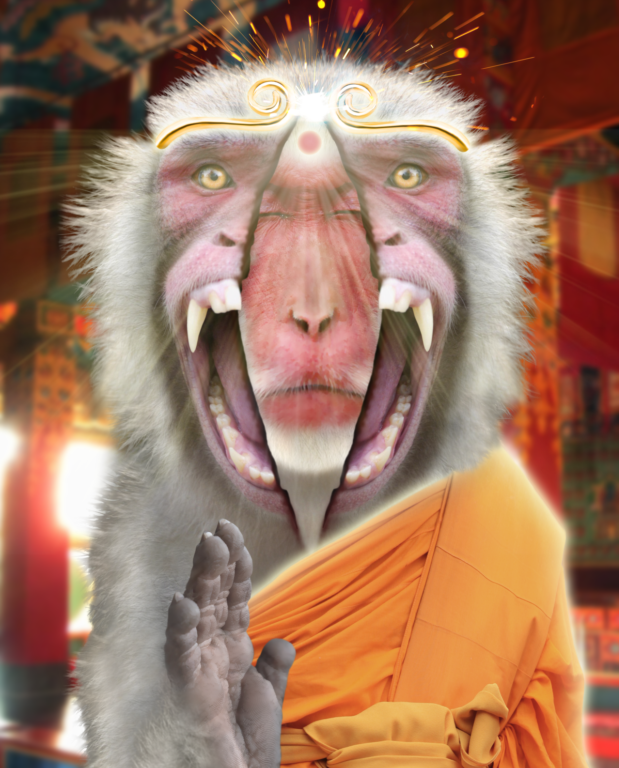
Fig. 2 – Sun Wukong becoming a Buddha (larger version). Photomanipulation by the author.

Shao (2006) illustrates how Zhang’s views are played out in the novel. Sun achieves immortality and is even invited to heaven like the hagiographies of famous transcendents, but his unruly nature symbolizes his lack of true spiritual attainment, causing him to wage war against the realm above. He remains a “deviant” or “bogus immortal” (yaoxian, 妖仙) until the journey proper, the tribulations serving to temper his mind. Moreover, when the pilgrims arrive in the Buddha’s paradise, they must first pass through a Daoist temple (referring again to Zhang’s philosophy). In the end, Sun is bestowed Buddhahood (fig. 2)—thereby Buddha-nature—completing the second step of Zhang’s two-part path to true transcendence.

Archive link:

https://journeytothewestresearch.com/wp-content/uploads/2019/12/huineng-subhuti-and-monkeys-religion-in-xiyouji.pdf


Update: 11-28-21

Shao (2006) is taken almost verbatim from the author’s doctoral thesis, Monkey and Chinese Scriptural Tradition: A Rereading of the Novel Xiyouji. This dissertation is a gold mine of information, and Shao’s (1997) Daoist reading of the novel explains many facets of the story. He even shows that Monkey has many religious influences. For example, the summation of one section reads: “[The author] allowed him Huineng’s intuition, Subhuti’s objective, and Laozi’s immortal body” (Shao, 1997, p. 108).

Archive Link:

Click to access Monkey-and-the-Scriptural-Tradition-in-China.pdf

Disclaimer:

This has been posted for educational purposes. No malicious copyright infringement is intended. Please support the official release.


Update: 05-29-22

I’ve taken information from this page and combined it with other material to write the ultimate guide on the Patriarch Subodhi.

The Patriarch Subodhi: Sun Wukong’s First Master

Notes:

1) In this article, I discuss how the “Monkey Pilgrim”, Sun Wukong’s precursor from Song Dynasty material, is based on the monk Mulian (Sk. Maudgalyayana), another of the Buddha’s disciples. 

2) The particular passage reads:

When the Patriarch heard this, he uttered a cry and jumped down from the high platform. He pointed the ruler he held in his hands at Wukong and said to him: “What a mischievous monkey you are! You won’t learn this and you won’t learn that! Just what is it that you are waiting for?” Moving forward, he hit Wukong three times on the head. Then he folded his arms behind his back and walked inside, closing the main doors behind him and leaving the congregation stranded outside […] But Wukong was not angered in the least and only replied with a broad grin. For the Monkey King, in fact, had already solved secretly, as it were, the riddle in the pot; he therefore did not quarrel with the other people but patiently held his tongue. He reasoned that the master, by hitting him three times, was telling him to prepare himself for the third watch; and by folding his arms behind his back, walking inside, and closing the main doors, was telling him to enter by the back door so that he might receive instruction in secret (Wu & Yu, 2012, pp. 118-119).

3) Huineng explains in the Platform Sutra:

This number refers to the ten evils and eight wrongs in one’s person […] Now I urge you, good friends, to first get rid of the ten evils; that is the equivalent of traveling ten [thousand li]. Then get rid of the eight wrongs; that is the equivalent of crossing eight thousand [li]. See essential nature in every moment, always acting with impartial directness, and you will arrive in a finger-snap and see Amitabha Buddha (Huineng & Cleary, 1998, pp. 26-27).

Sources:

Huineng, & Cleary, T. F. (1998). The Sutra of Hui-neng, grand master of Zen: With Hui-neng’s commentary on the Diamond Sutra. Boston: Shambhala.

Shao, P. (2006). Huineng, Subhūti, and Monkey’s Religion in “Xiyou ji”. The Journal of Asian Studies, 65(4), 713-740. Retrieved from www.jstor.org/stable/25076127

Shao, P. (1997). Monkey and Chinese Scriptural Tradition: A Rereading of the Novel Xiyouji (UMI No. 9818173) [Doctoral dissertation, Washington University]. Available from ProQuest Dissertations and Theses database.

Wu, C., & Yu, A. C. (2012). The journey to the West: Vol. 1. Chicago, Illinois: University of Chicago Press.