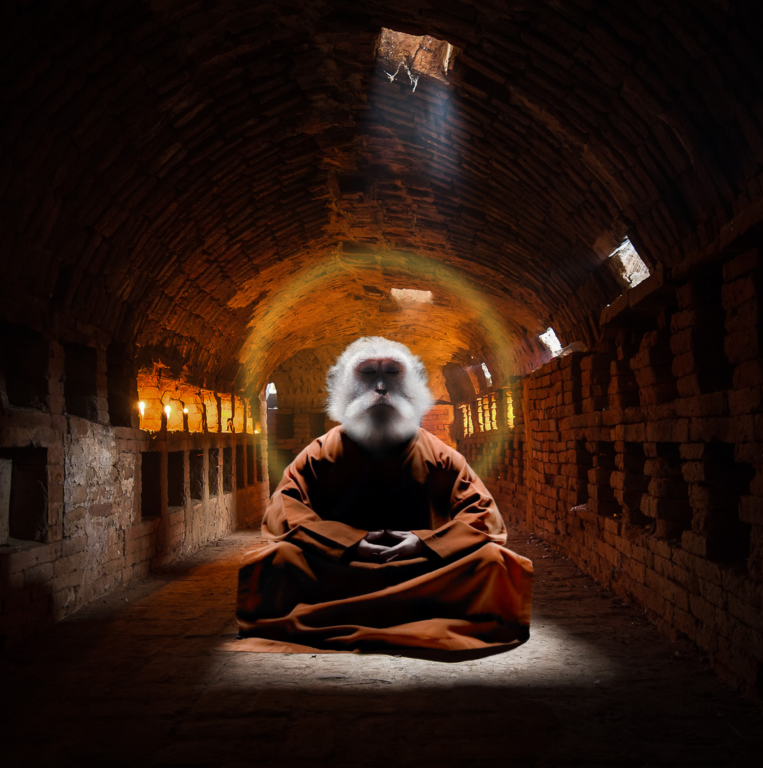
Last updated: 08-13-2026
I’ve previously written about the similarities between Sun Wukong and the Water Margin bandit Wu Song. In this article, I would like to explore the similarities shared by the Monkey King and the historical Buddha, Siddhartha Gautama (Ch: Xidaduo Qiaodamo, 悉達多 喬達摩). I know readers are now collectively scratching their heads in confusion and asking, “How in the world are a 6th- to 5th-century BCE Indian philosopher and an immortal monkey spirit from Ming-era Chinese literature similar?” It’s true that the particulars of their stories are different, but I will show that Wukong and the Buddha follow a similar trajectory in their early lives. Both experience a supernatural birth, produce a radiant splendor upon emerging from the womb, spend early years as royalty, feel a sense of shock upon realizing the impermanence of life, set out on a quest to find a means of escaping old age and death, and, finally, achieve this goal through spiritual practices. These similarities suggest that the author-compiler of Journey to the West (Xiyouji, 西遊記, 1592) may have borrowed from the Buddha’s story to make Sun Wukong’s early life more familiar to readers.
For details about the Awakened One’s life, I rely heavily on Acts of the Buddha (Sk: Buddhacarita; Ch: Fo suoxing za, 佛所行讚, 2nd century), a full-length biographical poem that survives thanks to its translation into Chinese from the original Sanskrit (Buswell & Lopez, 2014, p. 150). Information about Monkey will of course come from the standard 1592 edition of the novel.
I. The Parallels
1. Supernatural Birth
On the day of his birth, the bodhisattva’s mother, Queen Maya, feels the urge to go to the garden of Lumbini. There, following the tradition of sage-kings, the young prince Siddhartha is born from her right side (fig. 1):
Whilst she (thus) religiously observed the rules of a pure discipline, Bodhisattva was born from her right side, (come) to deliver the world, constrained by great pity, without causing his mother pain or anguish. / As king Yu-liu [Aurva] was born from the thigh, as king Pi-t’au [Pruthu] was born from the hand, as king Man-to [Mandhatri] was born from the top of the head, as king Kia-k’ha [Kakshivat] was born from the arm-pit, / So also was Bodhisattva on the day of his birth produced from the right side… (Beal, 1883, pp. 2-3).
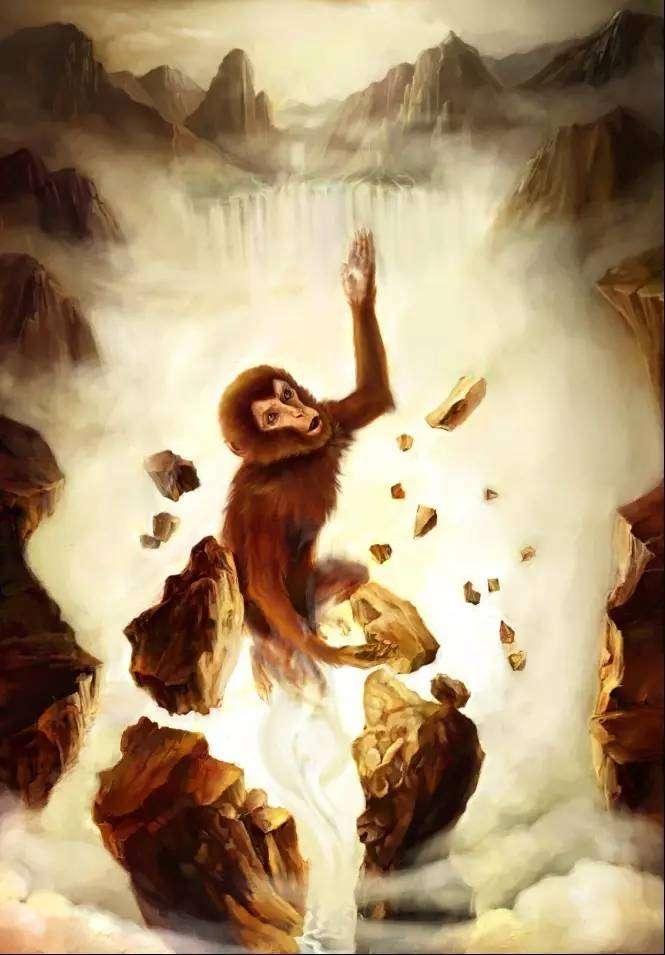
Chapter one of Journey to the West describes how an immortal stone atop the Mountain of Flowers and Fruit (Huaguo shan, 花果山) splits open and gives birth to a stone egg, which is transformed into a stone monkey (shi hou, 石猴) by the elements (fig. 2):
Since the creation of the world, it [the stone] had been nourished for a long period by the seeds of Heaven and Earth and by the essences of the sun and the moon, until, quickened by divine inspiration, it became pregnant with a divine embryo. One day, it split open [benglie, 迸裂], giving birth to a stone egg about the size of a playing ball. Exposed to the wind, it was transformed into a stone monkey endowed with fully developed features and limbs (Wu & Yu, 2012, p. 101) (emphasis mine).
As I’ve previously written, Wukong’s birth is likely based on the sage-king Yu the Great (大禹) and his son Qi (啟, “open”) of Xia, who are stated in various sources to have been born from stone. For example, one 4th-century tale states that Yu’s pregnant wife transformed into stone out of shame for having seen her husband’s shamanic metamorphosis into a bear. Yu ordered the stone to release his son, and it split open to give birth to Qi (Birrell, 1999, p. 123). The emphasis on the stone splitting open is related to ancient Chinese stories of sage-kings splitting the chest, back, or sides of their mothers upon birth, [1] much like the Buddha is born from Queen Maya’s side. For instance, the Genealogical Annals of the Emperors and Kings (Diwang shiji, 帝王世紀, 3rd century) writes:
“While traveling up in the mountains she [Yu’s mother] saw a falling star piercing the Mao region (of the sky). Then in a dream, she received and felt it, so upon swallowing a divine pearl and Job’s Tears, her chest split open and she gave birth to Yu at Stone Knob” (Cook & Luo, 2017, p. 101).
While Yu’s mother is not a stone in this case, his birth is effected by a pearl (a type of stone) and happens in a place named after stone. Such tales establish a link between split births and split stone births, thereby placing the Buddha and Monkey into the same broader birth myth category.

Fig. 1 – A stone carving depicting the birth of Siddhartha from Queen Maya’s side (Gandhara, 2nd to 3rd century) (larger version on Wikipedia). Fig. 2 – Monkey’s birth from stone by Zhang Moyi (larger version). Found on this article.
2. Radiant Splendor
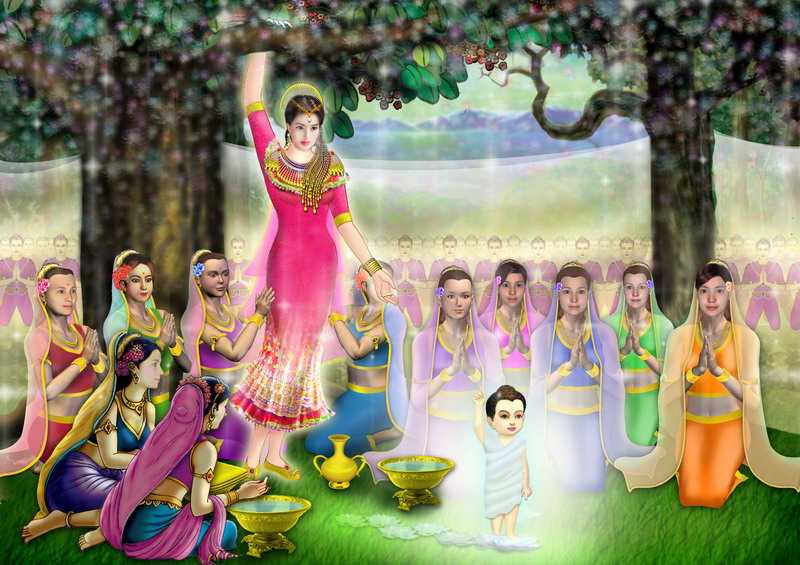
Upon his birth, the Buddha is said to have “shed in every direction the rays of his glory” (fig. 3) (Beal, 1883, p. 3). The source continues to describe this light, as well as the Bodhisattva’s first few moments outside the womb:
His body, nevertheless, was effulgent with light, and like the sun which eclipses the shining of the lamp, so the true gold-like beauty of the Bodhisattva shone forth and was diffused everywhere. / Upright and firm and unconfused in mind, he deliberately took seven steps, the soles of his feet resting evenly upon the ground as he went, his footmarks remained bright as seven stars. / Moving like the lion, king of beasts, and looking earnestly towards the four quarters, penetrating to the centre the principles of truth, he spake thus…” (Beal, 1883, pp. 4-5).
The historical Xuanzang (on whom Tripitaka is based) notes in his travelogue that the Buddha even walks towards the cardinal directions: “After he had been born the Bodhisattva walked seven steps unaided to each of the four quarters … [u]nder each step a large lotus flower sprang up from the earth” (Xuanzang, 1996/2016, p. 158).
Wukong too produces a great light in every direction: “Having learned at once to climb and run, this monkey also bowed to the four quarters, while two beams of golden light flashed from his eyes to reach even the Palace of the Polestar” (fig. 4) (Wu & Yu, 2012, p. 101).
Therefore, both shine their lights in the four cardinal directions.

Fig. 3 – Baby Buddha producing a radiant splendor upon his birth (larger version). Artist unknown. Found on this article. Fig. 4 – Bright beams of light shine from Wukong’s eyes as he bows to the four directions (larger version). From the Japanese children’s book Son Goku (1939).
3. Royal Years
Prince Siddhartha (fig. 5) is born into the royal Shakya clan ruled by his father, King Suddhodana (Beal, 1883, p. 1). Shortly after his son’s birth, the king is told by two sages that the new heir is fated to be either a universal monarch or a cosmic sage (Beal, 1883, pp. 8-18). Suddhodana attempts to defy the latter fate by surrounding his son with royal luxury and even finding him a wife with which to have his own son:
‘My son, the prince, having a son born to him, / ‘The affairs of the empire will be handed down in succession, and there will be no end to its righteous government; the prince having begotten a son, will love his son as I love him, / ‘And no longer think about leaving his home as an ascetic, but devote himself to the practice of virtue […] Would that this might lead my son (he prayed) to love his child and not forsake his home; the kings of all countries, whose sons have not yet grown up, / Have prevented them exercising authority in the empire, in order to give their minds relaxation, and for this purpose have provided them with worldly indulgences, so that they may perpetuate the royal seed; / So now the king, having begotten a royal son, indulged him in every sort of pleasure; desiring that he might enjoy these worldly delights, and not wish to wander from his home in search of wisdom (Beal, 1883, pp. 28 and 29).
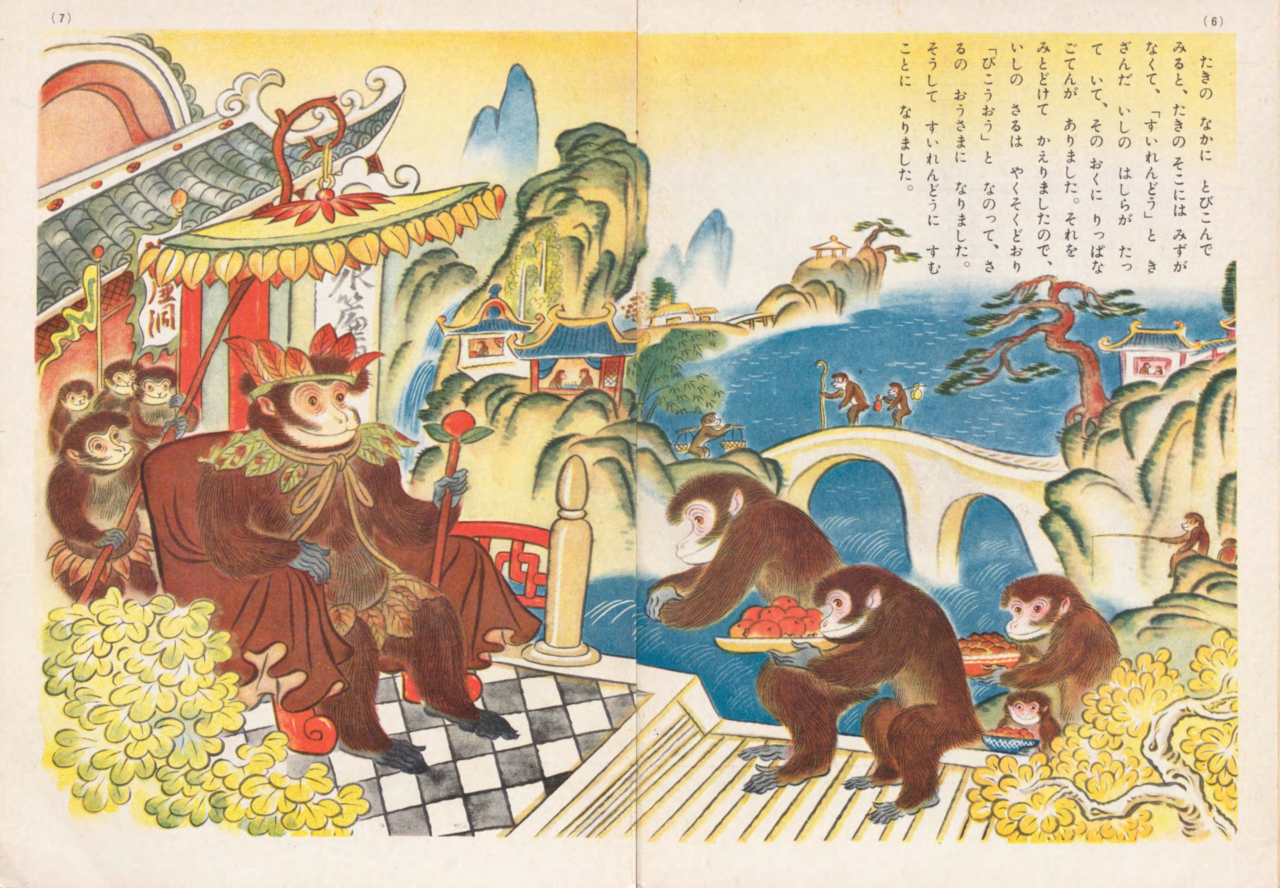
Following his birth, the stone monkey comes to live with a tribe of primates on the Mountain of Flowers and Fruit. One day, the monkeys and apes decide to follow a stream to its source in the mountain and find a beautiful waterfall. They state anyone who can discover what is behind the blanket of water will be proclaimed their king. The stone monkey takes up this challenge by leaping through and discovers the “Cave Heaven of Water-Curtain Cave” (Shuiliandong dongtian, 水簾洞洞天), a grotto paradise with a stone mansion and enough room for all the primates to live. After he emerges victorious,
Each one of them [the primates] then lined up according to rank and age, and, bowing reverently, they intoned, “Long live our great king!” From that moment, the stone monkey ascended the throne of kingship [fig. 6]. He did away with the word “stone” in his name and assumed the title, Handsome Monkey King [Mei hou wang, 美猴王] (Wu & Yu, 2012, p. 105).
The prince is born into a royal clan and yet never rules, while Wukong achieves kinghood through a test of bravery and leads his tribe for over three hundred years (Wu & Yu, 2012, p. 105). Siddhartha’s lack of authority is of course due to his father’s wish that he indulge in worldly pleasures and forget about leaving to become a sage. But birth tales (Sk: jataka) of the Buddha’s past lives do include several incarnations as rulers, even as a monkey king!

Fig. 5 – A stone carving of Prince Siddhartha as a young man (Gandhara, 3rd century) (larger version via the Norton Simon Museum). Fig. 6 – The Stone Monkey sits on his throne (larger version). From Son Goku (1939).
4. Shock at Impermanence
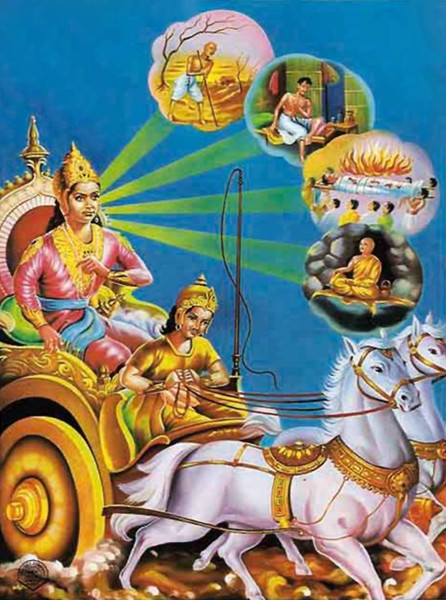
One day, Prince Siddhartha wishes to tour the land outside his personal palace for the first time in his sheltered life. Not wanting his son to see anything unpleasant, King Suddhodana has the path cleared of the old, sick, and poor and decorated with beautiful canopies, banners, and curtains (Beal, 1883, pp. 30-32). But a devaraja intervenes to initiate the first of the “four signs” (Sk: caturnimitta; Ch: sixiang, 四相; i.e. old age, sickness, death, and monasticism) to cause the future Buddha to pursue a spiritual path that will ultimately lead to his enlightenment (fig. 7) (Buswell & Lopez, 2014, pp. 171-172). The devaraja transforms into an extremely elderly man, and upon seeing the sight, Siddhartha is shaken when his chariot driver reveals that he too will suffer this fate:
The prince greatly agitated and moved, asked his charioteer another question and said, ‘Is yonder man the only one afflicted with age, or shall I, and others also, be such as he?’ / The charioteer again replied and said, ‘Your highness also inherits this lot, as time goes on, the form itself is changed, and this must doubtless come, beyond all hindrance: / ‘The youthful form must wear the garb of age, throughout the world, this is the common lot’. Bodhisattva, who had long prepared the foundation of pure and spotless wisdom, / Broadly setting the root of every high quality, with a view to gather large fruit in his present life, hearing these words respecting the sorrow of age, was afflicted in mind, and his hair stood up right. / Just as the roll of the thunder and the storm alarm and put to flight the cattle; so was Bodhisattva affected by the words; shaking with apprehension, he deeply sighed (Beal, 1883, p. 33).
After seeing the sign of sickness (Beal, 1883, pp. 34-35), the prince witnesses the sign of death:
(Once more) he asked, ‘What is this they carry? With streamers and flowers of every choice description, whilst the followers are overwhelmed with grief, tearing their hair and wailing piteously.’ / And now the gods instructing the coachman, he replied and said, ‘This is a “dead man,” all his powers of body destroyed, life departed; his heart without thought, his intellect dispersed; / ‘His spirit gone, his form withered and decayed; stretched out as a dead log; family ties broken—all his friends who once loved him, clad in white cerements, / ‘Now no longer delighting to behold him, remove him to lie in some hollow ditch (tomb).’ The prince hearing the name of death, his heart constrained by painful thoughts, / He asked, ‘Is this the only dead man, or does the world contain like instances?’ Replying thus he said, ‘All, everywhere, the same; he who begins his life must end it likewise; / ‘The strong and lusty and the middle-aged, having a body, cannot but decay (and die).’ The prince now harassed and perplexed in mind; his body bent upon the chariot leaning-board, / With bated breath and struggling accents, stammered thus, ‘Oh worldly men! How fatally deluded! Beholding everywhere the body brought to dust, yet everywhere the more carelessly living; / ‘The heart is neither lifeless wood nor stone, and yet it thinks not “all is vanishing!” (Beal, 1883, pp. 36-37).
After the Monkey King rules the Mountain of Flowers and Fruit for more than three centuries, he tells his children:
Though we are not subject to the laws of man today, nor need we be threatened by the rule of any bird or beast, old age and physical decay in the future will disclose the secret sovereignty of Yama, King of the Underworld. If we die, shall we not have lived in vain, not being able to rank forever among the Heavenly beings? (Wu & Yu, 2012, p. 106).
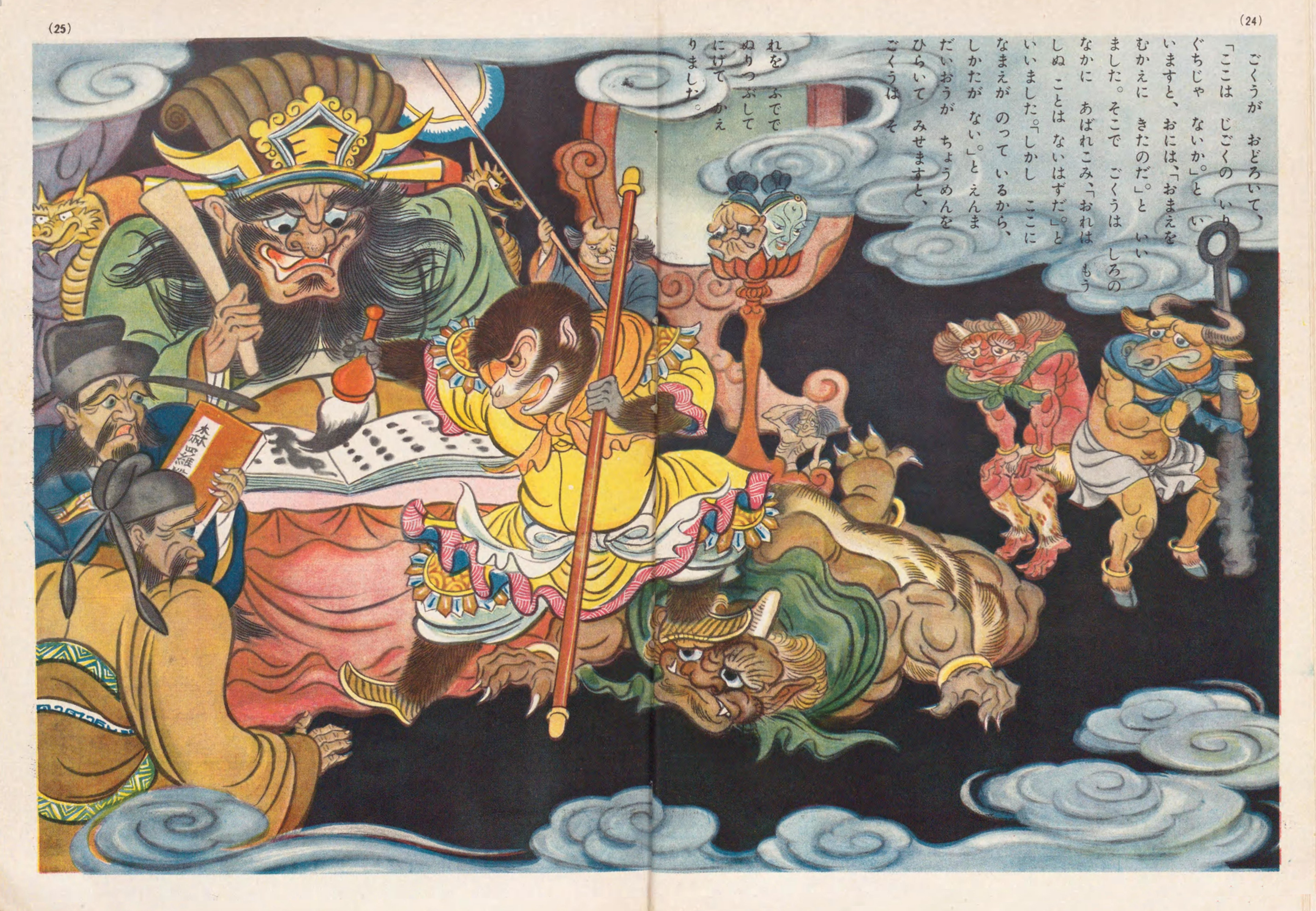
The “shock” felt by Prince Siddhartha and the Monkey King upon realizing the impermanence of life is known in Buddhism as Samvega (Ch: yanli, 厭離) (Thanissaro Bhikkhu, n.d.). It’s interesting that Siddhartha is led to the reality of impermanence, while Monkey comes to the conclusion by himself. This is no doubt due to the differences in their lives. King Suddhodana ensures that his son lives a protected life, one free from the woes of the outside world, by surrounding him with luxury and young, beautiful palace attendants. However, Monkey rules the Mountain of Flowers and Fruit for centuries, no doubt witnessing the decline and death of many of his companions, as well as the waning of his own youth. After all, the thought of impermanence would weigh heavy on anyone nearing the end of their life. This conclusion is supported by the fact that, when his soul is taken to hell in chapter three, Monkey learns from the ledgers of life and death that he was fated to die at the age of 342 (fig. 8) (Wu & Yu, 2012, vol. 1, p. 140).

Fig. 7 – Siddhartha experiences the “Four Signs” (larger version). Artist unknown. Fig. 8 – Monkey striking his name from the Book of Life and Death (larger version). From Son Goku (1939).
5. Quest to Overcome Impermanence
Siddhartha is wracked by constant, obsessive thoughts on the dangers of old age, sickness, and death. After venturing out once more and witnessing poor farmers toiling away in the fields, he proclaims on the spot that he will find some way to oppose life’s suffering. At that exact moment, a deva affects the fourth sign by transforming into a monk (sk: bhikshu), who tells the prince:
Depressed and sad at [the] thought of age, disease, and death, I have left my home to seek some way of rescue, but everywhere I find old age, disease, and death, all (things) hasten to decay and there is no permanency; / ‘Therefore I search for the happiness of some thing that decays not, that never perishes, that never knows beginning, that looks with equal mind on enemy and friend, that heeds not wealth nor beauty, / ‘The happiness of one who finds repose alone in solitude, in some unfrequented dell, free from molestation, all thoughts about the world destroyed, dwelling in some lonely hermitage…’ (Beal, 1883, pp. 49-50).
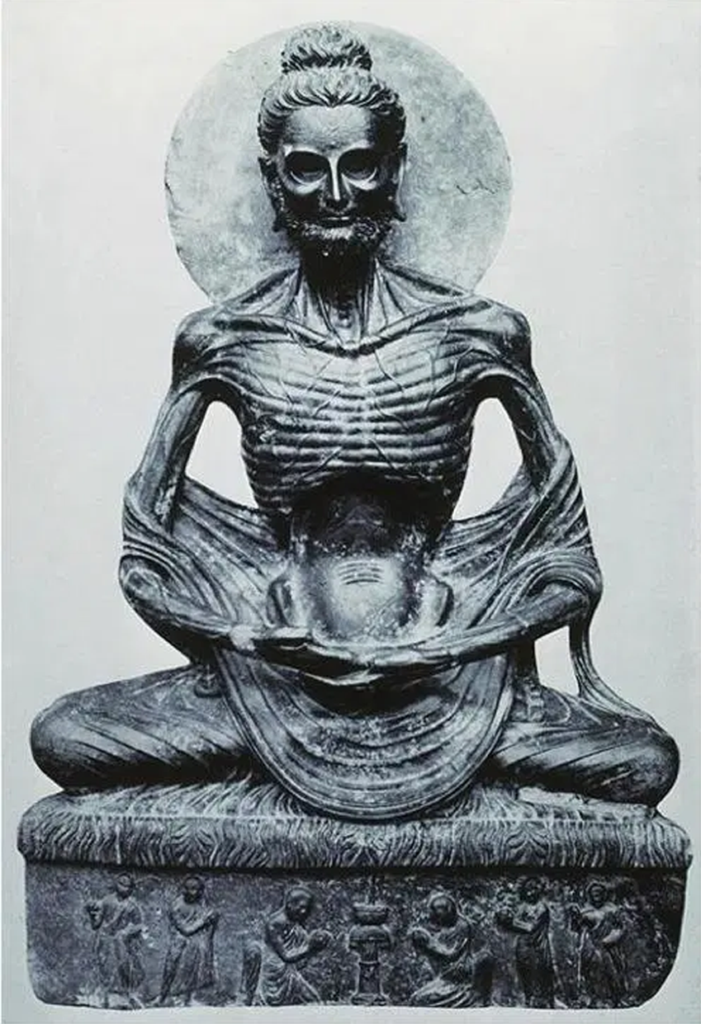
This influences Siddhartha to forsake his royal life to become an ascetic and search for a means of escape from the evils of old age, sickness, and death. Cutting off his topknot, thus severing his royal ties, the future Buddha sets out into the world (Beal, 1883, p. 68). Siddhartha travels the land studying meditation (Sk: dhyana; Ch: chan, 禪) under various sages, pondering concepts of the body, the mind, the soul, and selfhood for years, and even practicing severe austerities that result in the emaciation of his body (fig. 9). But he eventually forsakes these extreme practices, recovering his bodily strength and vowing to achieve perfect enlightenment via meditation beneath a banyan tree (Beal, 1883, pp. 131-147).
When the Monkey King opines the injustice of impermanence, one of his advisors tells him that only three beings live beyond the reach of Yama:
There are, among the five major divisions of all living creatures, only three species that are not subject to Yama, King of the Underworld.” The Monkey King said, “Do you know who they are?” The monkey said, “They are the Buddhas, the immortals, and the holy sages [shensheng, 神聖]; these three alone can avoid the Wheel of Transmigration as well as the process of birth and destruction, and live as long as Heaven and Earth, the mountains and the streams.” “Where do they live?” asked the Monkey King. The monkey said, “They do not live beyond the world of the Jambudvipa, for they dwell within ancient caves on immortal mountains” (Wu & Yu, 2012, p. 107).
Monkey then pledges to find these great men and women and learn their secret means of escape from Yama’s grasp:
“Tomorrow I shall take leave of you all and go down the mountain. Even if I have to wander with the clouds to the corners of the sea or journey to the distant edges of Heaven, I intend to find these three kinds of people. I will learn from them how to be young forever and escape the calamity inflicted by King Yama” (Wu & Yu, 2012, p. 107).
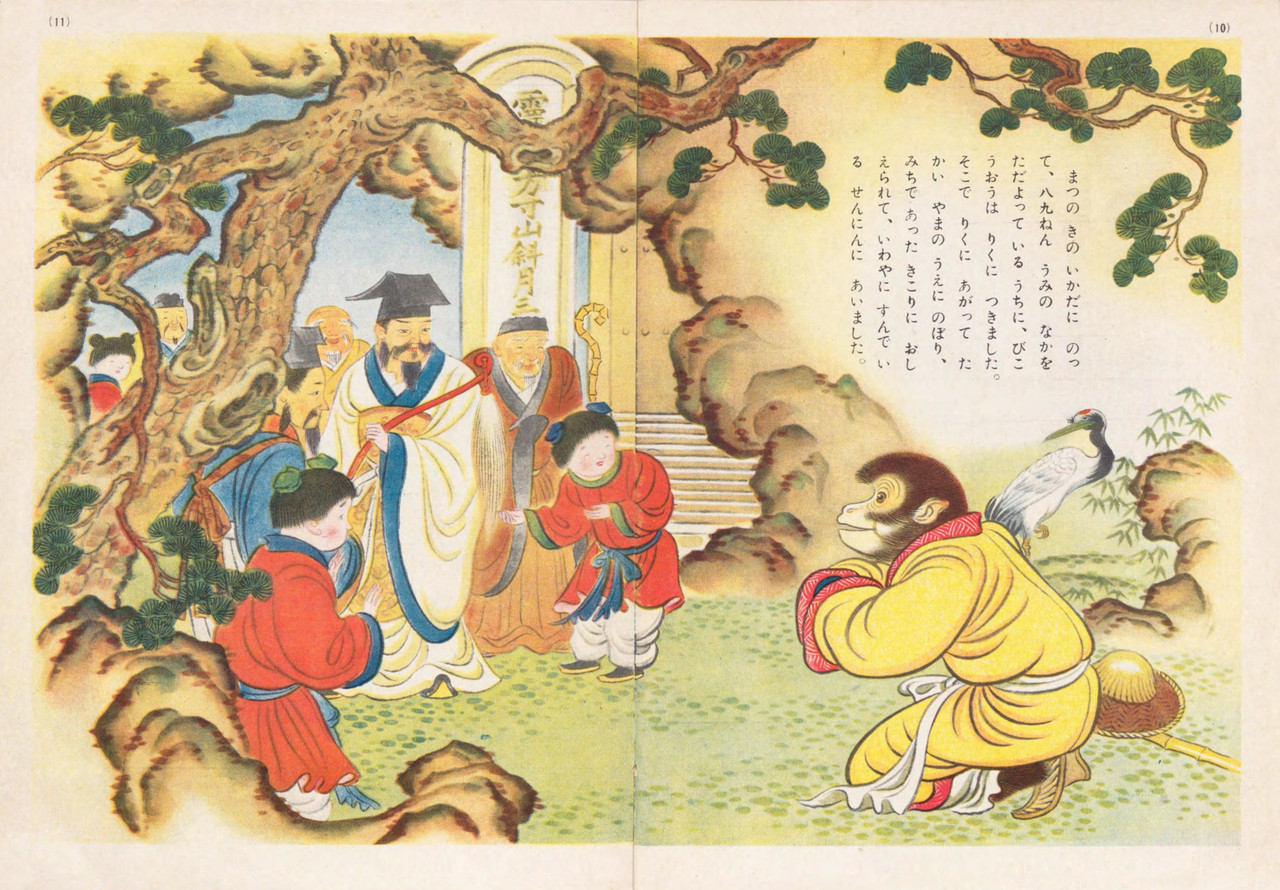
He sets sail in a makeshift raft and wonders the world for more than ten years, searching the towns and cities of the Jambudvipa continent before sailing to the Western Aparagodaniya continent. There, he is directed to the Cave of the Slanted Moon and Three Stars on the Mountain of Numinous Heart and Elixir Mind (Lingtai fangcun shan, xieyue sanxing dong, 靈台方寸山, 斜月三星洞), an immortal hermitage lorded over by the great Buddho-Daoist Sage Subodhi (Xuputi, 須菩提) (fig. 10). The sage accepts him as a student and gives him the religious name Sun Wukong (孫悟空), or “Monkey Awakened to the Void” (Wu & Yu, 2012, pp. 108-115).
Both tales show that Siddhartha and Monkey set out on their respective quests thanks to outside influences. The devas intervene numerous times to guide the future Buddha’s path to enlightenment, [2] proving that the heavenly realm has a vested interest in his fate. Wukong’s journey is instead influenced by the words of his mortal advisor. In this case, the gods have no interest in the fate of such “creatures from the world below” (Wu & Yu, 2012, p. 102). This, of course, changes once Monkey starts causing havoc throughout the cosmos.

Fig. 9 – A stone carving of the “Fasting Buddha” (Gandhara, 2nd to 3rd century BCE) (larger version). Fig. 10 – The Monkey King becomes Subhuti’s disciple (larger version). From Son Goku (1939).
6. Achieving a Means of Escape
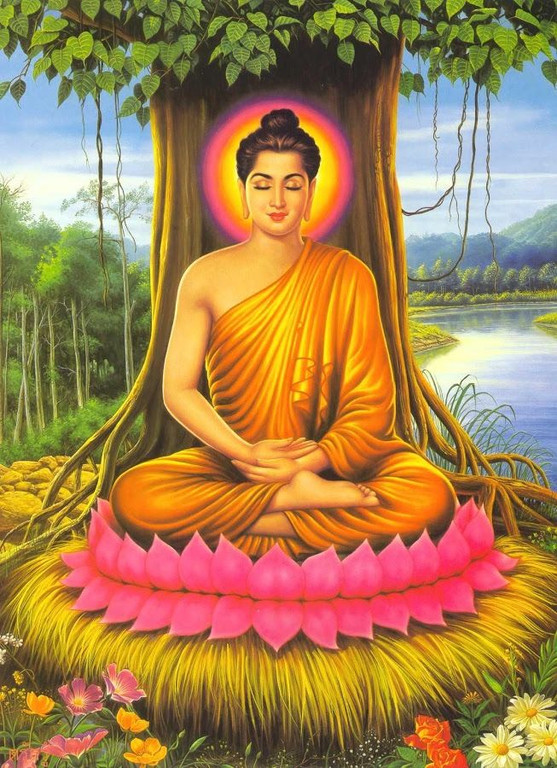
The heavenly demon Mara (Mo, 魔) fears that Siddhartha will achieve enlightenment and help mankind break free from his domain, the illusionary world of Samsara, and so he leads a monstrous army against the great rishi. But the army is rendered powerless by Siddhartha’s supreme focus of mind and burgeoning grasp of reality (Beal, 1883, pp. 147-156). [3] Continuing his meditation further, the rishi perceives his myriad past lives, as well as the karmic punishment of those who covet or perform bad deeds, being tortured in hell or reborn into lower levels of existence, respectively. He then comprehends that suffering arises from clinging, clinging from desire, desire from sensation, sensation from contact, contact from the six senses, and the senses from consciousness. Finally, Siddhartha comes to the realization that breaking each link (e.g. cessation of clinging will end suffering) will stop old age, sickness, and death and ultimately destroy the endless chain of rebirths (Beal, 1883, pp. 156-163). Having achieved perfect enlightenment (fig. 11),
the Buddha then devised for the world’s benefit the eightfold path, right sight, and so on, the only true path for the world to tread. / Thus did he complete the end (destruction) of ‘self,’ as fire goes out for want of grass; thus he had done what he would have men do; he first had found the way of perfect knowledge; / He finished thus the first great lesson (paramartha); entering the great Rishi’s house, the darkness disappeared; light coming on, perfectly silent, all at rest, / He reached at last the exhaustless source of truth (dharma); lustrous with all wisdom the great Rishi sat, perfect in gifts, whilst one convulsive throe shook the wide earth (Beal, 1883, p. 163).
Journey to the West chapter two tells how Wukong serves as a junior monk for seven years before Subodhi takes him as a close disciple. One night, the sage recites to him a poem full of flowery esoteric imagery revealing that the secret to Daoist immortality and Buddhahood is the cultivation of chaste semen (jing, 精), breath (qi, 氣), and spiritual energy (shen, 神). The poem has a profound effect on Monkey, for the novel states: “At that moment, the very origin was disclosed to Wukong, whose mind became spiritualized as blessedness came to him” (Wu & Yu, 2012, p. 120). Following Subodhi’s instructions, Monkey performs breathing exercises after midnight (zi, 子) and before noon (wu, 午), resulting in immortality after three years of dedicated practice (fig. 12). [4] I should note that the book borrows from real Daoist practices but leaves much of the process up to the reader’s imagination. As I explain here, historical methods combined the aforementioned breathing exercises with the circulation of chaste semen and spiritual energy to create a spirit embryo (shengtai, 聖胎), or an immortal spirit that is eventually freed from the mortal shell. But in the case of the novel, Monkey’s practice results in an ageless, adamantine physical body, one capable of lifting even cosmic mountains.
Interestingly, the title of chapter two also refers to Monkey overcoming Mara. It reads: “Fully awoke to Bodhi’s wondrous truths / He cuts off Mara, returns to the root, and joins Primal Spirit” (Wu che puti zhen miao li / Duan Mo gui ben he yuanshen, 悟徹菩提真妙理 / 斷魔歸本合元神) (Wu & Yu, 2012, p. 116). The title freely associates Buddhist and Daoist concepts, such as Mara and the primal spirit. This synthesis is explained by Darga (2008):
Comparing the development of the embryo to the revelation of Buddhahood is typical of neidan texts of the Ming period. For instance, the Xingming guizhi (Principles of Balanced Cultivation of Inner Nature and Vital Force) uses Body of the Law (fashen 法身, dharmakāya) as a synonym for shengtai. The birth of the embryo represents the appearance of the original spirit (yuanshen 元神) or Buddhahood and is understood as enlightenment (p. 884).
The Buddha’s biography goes on for pages about deep philosophical concepts on the self, suffering, and reality, showing that the means of his liberation was of the utmost importance. By contrast, as noted above, Journey to the West leaves little space for Wukong’s method of immortality. In fact, the hard won moment that he breaks free of Yama’s grasp is not even mentioned in the novel! [5] So the author-compiler no doubt felt that Monkey’s subsequent adventures were far more important. This is understandable considering that in material as far back as the Song Dynasty, Monkey is already an ancient immortal at the beginning of the story.
[Note: See the 06-12-22 update below for a seventh parallel.]

Fig. 11 – Siddhartha achieves enlightenment and becomes the Buddha (larger version). Artist unknown. Fig. 12 – Wukong achieves immortality (larger version). Photomanipulation by the author.
II. A Borrowed Story?
So did the author-compiler (AC) of Journey to the West base Monkey’s early life on the Buddha’s story? The many similarities discussed above are very suggestive, but if only there was documented evidence of borrowing from other Buddhist personages. And that’s exactly what is found in chapter two. Shao (2006) explains that Wukong’s spiritual intelligence is based on the sixth Chan Patriarch Huineng (惠能, 638-713):
[Monkey] sets the stage for a striking display of his unusually profound insight when he announces his intentions to become an immortal. This provokes Subhuti to issue him a challenge by refusing to teach him, for he is “some what different from other people.” Monkey may not realize that the master is trying to gauge his spiritual power, but he rises to the occasion with a genuine clarity of vision: “I have a round head pointing to Heaven, and square feet walking on Earth. Similarly, I have nine apertures and four limbs, entrails and cavities. In what way am I different from other people?”
[…]
[W]e may look to Huineng’s story from which Monkey garners meaning. No doubt, Monkey’s inspired cleverness is modeled on Huineng’s reply to Hongren, the fifth patriarch of Chinese Chan Buddhism, in Huineng’s Tanjing (The Platform Sutra). When Huineng announces his intentions to become a Buddha, Hongren pounces upon him with a poignant reminder that he is “from Lingnan,” a “barbarian,” and therefore cannot become a Buddha. Huineng refuses to be intimidated, however. He holds his own with an unparalleled depth of insight about Buddha-nature: There may be “northern and southern men,” but “the Buddha nature fundamentally has no north or south.” Surely Monkey’s phrasing, his unusual insightfulness, and the quickness and aplomb with which he rises to the challenge are reminiscent of Huineng… (pp. 719-720).
Therefore, if the AC borrowed from the life of Huineng, a Buddhist patriarch, then he certainly could have borrowed from the life of the Buddha. I suggest that this was done to make Wukong’s early life more familiar to the reader.
III. Conclusion
Despite the particulars of their stories being different, the Monkey King and the historical Buddha share six similarities. First, they experience a supernatural birth, both splitting open their mother in the same fashion as ancient Chinese sage-kings. Siddhartha emerges from the side of Queen Maya and Wukong forms from a stone egg birthed by a split rock. Second, they produce a radiant splendor upon their birth. Siddhartha’s body shines as he looks or walks to the four quarters, while beams shoot from Sun’s eyes as he bows to the four quarters. Third, they spend early years as royalty. The prince is born into the royal Shakya clan and Monkey achieves kinghood through a test of bravery. Fourth, they feel a sense of shock upon realizing the impermanence of life. Siddhartha is exposed to the evils of old age, sickness, and death via the “four signs” initiated by heaven. Wukong instead comprehends the fearsome hand of Yama through his observation of time. Fifth, they set out on a quest to find a means of escaping old age and death. The prince travels the land studying meditation and pondering concepts of the body, the mind, the soul, and selfhood. Monkey searches the world for over a decade before he is taken in by the Buddho-Daoist sage Subodhi. Sixth, they achieve their goal through spiritual practices. Siddhartha defeats Mara and achieves perfect enlightenment via intense meditation. Wukong breaks free from Yama/Mara and achieves immortality via Daoist elixir arts. And since the AC borrowed from the life of the Sixth Chan Patriarch Huineng, he likely modeled the Monkey King’s early life on the Buddha to make his story more familiar.
IV. Updates
Update: 06-12-22
I’ve noticed another parallel while reading two modern biographies of the Buddha.
7. Student Prodigies
The Prince is said to have had a great aptitude for learning in his youth: “And now he was brought to learn the useful arts, when lo! once instructed (at one hearing) he surpassed his teachers” (Beal, 1883, p. 24). [6] Wukong has the same talent. When Subodhi teaches him the method for the 72 Transformations, he masters them very quickly:
[T]his Monkey King was someone who, knowing one thing, could understand a hundred! He immediately learned the oral formulas and, after working at them and practicing them himself, he mastered all seventy-two transformations (Wu & Yu, vol. 1, p. 122).
Update: 06-18-22
I’ve written an article that lists a number of surprising parallels shared by Monkey and the Greco-Roman hero Heracles (see section 2).
Parallels Between Sun Wukong and Hercules
Update: 08-13-26
The Buddha: Life and Afterlife Between East and West (Almond, 2023) includes info that meshes well with this article:
Although it was unnecessary for him to do so, the Bodhisattva went to school. As his schoolmaster, Viśvāmitra, declared, ‘Whatever topics of knowledge are circulating in this world of humans – / Numbers, scripts, mathematics, the permutations of the elements, / And all the immeasurable mundane techniques of craftsmanship – / This child already learned these things many tens of millions of eons ago.’ Intellectual modesty was not one of the Bodhisattva’s virtues. When it came to the writing lesson, the Bodhisattva asked his teacher, ‘Which script, O master, will you be teaching me?’ and then proceeded to name at least sixty-four to choose from. As the teacher said the alphabet to the thousand other boys with the Bodhisattva, the Bodhisattva took the opportunity to deliver an ethical statement that began with each of the forty-six letters. Thus, as the schoolmaster taught the alphabet, the children also absorbed the Dharma teachings of the Bodhisattva. He was, in short, a child prodigy. As Aśvaghoṣa informs us, ‘in a few days he grasped the sciences / that were suitable for his family, / that commonly take many years to grasp’.
He was not only intellectually gifted but also spiritually skilled. From an early age he could become immersed in meditation. Thus, at the time of the Ploughing Festival, the Bodhisattva was reclining under a Jambu tree and found himself left alone, his nurses having gone to watch the king ploughing. Finding himself alone, the Bodhisattva ‘got up quickly, seated himself cross-legged, and holding his breath, sank into the first Jhāna [level of meditative absorption]’. While the shadows of the other trees turned round, that of the Jambu tree remained steady and circular in form. When the King saw the miracle that had occurred, he paid homage to his son, saying, ‘This, Beloved One, is the second homage paid to thee.’
Intellectually gifted and spiritually skilled, he was also superior in the ‘manly arts’– jumping, wrestling, running, rowing, swimming, elephant mounting and driving, horsemanship, chariot driving, and gymnastics. But to the warrior class it was archery that mattered. The Nidānakathā simply reports that, in a competition with masters of the bow, he was unsurpassed. But the Lalitavistara gives an extended version of the legend of the archery competition to extol his sporting prowess. His best opponent had hit the target ‘eight times shouting distance’ away but could shoot no further. Breaking every bow he tried, the Bodhisattva was given his grandfather’s bow. His opponents were unable even to string the bow, much less draw it. The Bodhisattva, by contrast, strung it with a single fingertip of his right hand. He then picked up an arrow, drew the bow, and released the arrow. It not only pierced his opponents’ targets but cleaved his own that was ten times shouting distance away and went straight through seven palm trees before finally entering the ground and disappearing (pp. 32-34).
This reminds me of how Sun is a student prodigy who is spiritually skilled—recall that his species is called the “Stone Monkey of Numinous Wisdom” (Lingming shihou, 靈明石猴)—and a master of martial arts.
Notes:
1) See Cook and Luo (2017) chapter five for more examples of split-births.
2) Other than the “Four Signs,” another example of the devas intervening in Siddhartha’s life takes place shortly after he forsakes the extreme austerities that emaciate his body. He bathes in a holy river but can’t leave the water due to weakness from malnourishment. That’s when a deva pushes down a tree branch, allowing Siddhartha to pull himself to safety (Beal, 1883, p. 144).
3) For example, one passage reads: “Their flying spears, lances, and javelins, stuck fast in space, refusing to descend; the angry thunderdrops and mighty hail, with these, were changed into five-colour’d lotus flowers…” (Beal, 1883, p. 153).
4) The original source says “breathing exercises before the hour of Zi [子, midnight] and after the hour of Wu [午, noon]” (Wu & Yu, 2012, p. 121). However, this is likely a transcription error as Daoist sources cite the opposite, after midnight and before noon (Kohn, 2008, p. 84, for example). Therefore, I have corrected the information.
5) The moment that Monkey achieves immortality is only alluded to in passing:
Suddenly he [Subodhi] asked, “Where’s Wukong?” Wukong drew near and knelt down. “Your pupil’s here,” he said. “What sort of art have you been practicing lately?” the Patriarch asked. “Recently,” Wukong said, “your pupil has begun to apprehend the nature of all things and my foundational knowledge has become firmly established.” “If you have penetrated to the dharma nature to apprehend the origin,” said the Patriarch, “you have, in fact, entered into the divine substance” (Wu & Yu, 2012, p. 121).
6) Nakamura (2000) offers an extremely wordy translation of the above sentence: “When he had passed beyond childhood, he in due time received the initiation ceremony. He mastered in only a few days the various sciences suitable to his standing that [ordinary people] took many years to learn” (p. 90).
Sources:
Almond, P. (2023). The Buddha: Life and Afterlife Between East and West. Cambridge University Press.
Beal, S. (Trans.). (1883). The Fo-sho-hing-tsan-king: A Life of Buddha by Asvaghosha Bodhisattva. Oxford: Clarendon Press. Retrieved from https://archive.org/details/foshohingtsankin00asva/mode/2up
Birrell, A. (1999). Chinese Mythology: An introduction. Baltimore: The Johns Hopkins University Press.
Buswell, R. E., & Lopez, D. S. (2014). The Princeton Dictionary of Buddhism. Princeton, NJ: Princeton University Press.
Cook, C. A., & Luo, X. (2017). Birth in Ancient China: A Study of Metaphor and Cultural Identity in Pre-Imperial China. Albany: State University of New York Press.
Cowell, E. B. (Ed.) (1895). The Jātaka, or stories of the Buddhas former births: Vol. 3. Cambridge: Cambridge University Press. Retrieved from https://archive.org/details/cu31924072231073/page/n249/mode/2up
Darga, M. (2008) Shengtai. In F. Pregadio (Ed.), The Encyclopedia of Taoism: Vol 1-2 (pp. 883-884). Longdon: Routledge.
Kohn, L. (2008). Chinese Healing Exercises: The Tradition of Daoyin. Honolulu: University of Hawaiʻi Press.
Nakamura, H. (2000). Gotama Buddha: A Biography Based on the Most Reliable Texts (G. Sekimori, Trans.) (Vols. 1-2). Tokyo: Kosei Publishing Co.
Shao, P. (2006). Huineng, Subhūti, and Monkey’s Religion in “Xiyou ji”. The Journal of Asian Studies, 65(4), 713-740. Retrieved from www.jstor.org/stable/25076127.
Thanissaro Bhikkhu (n.d.). Affirming the Truths of the Heart: The Buddhist Teachings on Samvega & Pasada. Retrieved from https://www.dhammatalks.org/books/NobleStrategy/Section0004.html.
Wu, C., & Yu, A. C. (2012). The Journey to the West (Vols. 1-4) (Rev. ed.) Chicago, Ill: University of Chicago Press.
Xuanzang (2016). The Great Tang Dynasty Record of the Western Regions (2nd ed., R. Li, trans.). California: BDK AMerica, Inc. (Original work published 1996)


#/media/File:SiddhartaBirth.jpg)