The Magic Powers of the Monkey King’s Iron Staff

Last updated: 04-23-2026

I’ve written several articles on Sun Wukong’s iron staff, including its origin from religious and martial staves used by historical Buddhist monks, the meaning of its inscription (“‘As-You-Will’ Gold-Banded Staff. Weight: 17,560 lbs” (7,965 kg)), the real world metal that it is made from, its ties to Yu the Great and flood control, its ties to the Buddhist Saint Mulian, its possible ties to a Hindu monument, and modern day misconceptions about its ability to weigh down the entire Milky Way galaxy. Now, I’d like to briefly survey the magic powers associated with this weapon. This will by no means be exhaustive.

Table of Contents

1. Powers

1.1. Size Manipulation

Sun travels to the Eastern Sea Dragon King’s underwater kingdom in ch. 3 to acquire a celestial weapon. But when the immortal fails to find a suitably heavy armament, the Dragon Queen suggests that they give him a black iron pillar from their treasury. It is described as over 20 feet (6.096 m) in height and the width of a barrel. Only when Monkey lifts the pillar and suggests a smaller size would be more manageable does it comply with his wishes:

Wukong girded up his clothes and went forward to touch it: it was an iron rod more than twenty feet long and as thick as a barrel. Using all his might, he lifted it with both hands, saying, “It’s a little too long and too thick. It would be more serviceable if it were somewhat shorter and thinner.” Hardly had he finished speaking when the treasure shrunk a few feet in length and became a layer thinner. “Smaller still would be even better,” said Wukong, giving it another bounce in his hands. Again the treasure became smaller. Highly pleased, Wukong took it out of the ocean treasury to examine it. He found a golden hoop at each end, with solid black iron in between. Immediately adjacent to one of the hoops was the inscription, “The ‘As-You-Wish’ Gold-Banded Staff. Weight: 17,560 lbs. [Ruyi jingu bang zhong yiwan sanqian wubai jin, 如意金箍棒重一萬三千五百斤]” (Wu & Yu, 2012, p. 135). [1]

Later in the chapter, Sun shows off the new weapon to his children by shrinking it to the size of a needle and then expanding it to a literal pillar of heaven.

He held the treasure [the staff] in his hands and called out, “Smaller, smaller, smaller!” and at once it shrank to the size of a tiny embroidery needle, small enough to be hidden inside the ear. Awestruck, the monkeys cried, “Great King! Take it out and play with it some more.” The Monkey King took it out from his ear and placed it on his palm. “Bigger, bigger, bigger!” he shouted, and again it grew to the thickness of a barrel and more than twenty feet long. He became so delighted playing with it that he jumped onto the bridge and walked out of the cave. Grasping the treasure in his hands, he began to perform the magic of cosmic imitation. Bending over, he cried, “Grow!” and at once grew to be one hundred thousand feet tall, [2] with a head like the Tai Mountain and a chest like a rugged peak, eyes like lightning and a mouth like a blood bowl, and teeth like swords and halberds. The rod in his hands was of such a size that its top reached the thirty-third Heaven and its bottom the eighteenth layer of Hell (fig. 1) (Wu & Yu, 2012, vol. 1, p. 138).

cosmic transformation

Fig. 1 – Monkey grows his staff to touch heaven as he performs a cosmic transformation for his children (larger version). Original artist unknown. Found on this article.

1.2. Controlling the Oceans

Prior to giving Monkey the staff, the Dragon King tells his wife, “That…was the measure with which [Yu the Great] fixed the depths of rivers and oceans when he conquered the Flood” (Wu & Yu, 2012, vol. 1, p. 135). Later, in ch. 88 our hero recites a poem in which he gives more detail about the weapon’s origins and history. The first few lines discuss its power over water:

An iron rod forged at Creation’s dawn
By Great Yu himself, the god-man of old.
The depths of all oceans, rivers, and lakes
Were fathomed and fixed by this very rod.
Having bored through mountains and conquered floods,
It stayed in East Ocean and ruled the seas,
[…] (Wu & Yu, 2012, vol. 4, p. 201).

Despite the staff’s influence on bodies of water both great and small, it paradoxically doesn’t grant Sun an advantage when traveling through the aquatic realm or fighting water-based demons. [3] I’ll just chalk this up to inconsistencies born from oral storytelling.

1.3. Astral Entanglement

Ch. 3 shows that Monkey’s soul is able to use the staff in the underworld even when the physical weapon is back with his body in the world of the living.

In his sleep the Handsome Monkey King saw two men approach with a summons with the three characters “Sun Wukong” written on it. They walked up to him and, without a word, tied him up with a rope and dragged him off. The soul of the Handsome Monkey King was reeling from side to side. They reached the edge of a city. The Monkey King was gradually coming to himself, when he lifted up his head and suddenly saw above the city an iron sign bearing in large letters the three words “Region of Darkness.” … Yanking and pulling, they were determined to haul him inside. Growing angry, the Monkey King whipped out his treasure. One wave of it turned it into the thickness of a rice bowl; he raised his hand once, and the two summoners were reduced to hash.

[…]

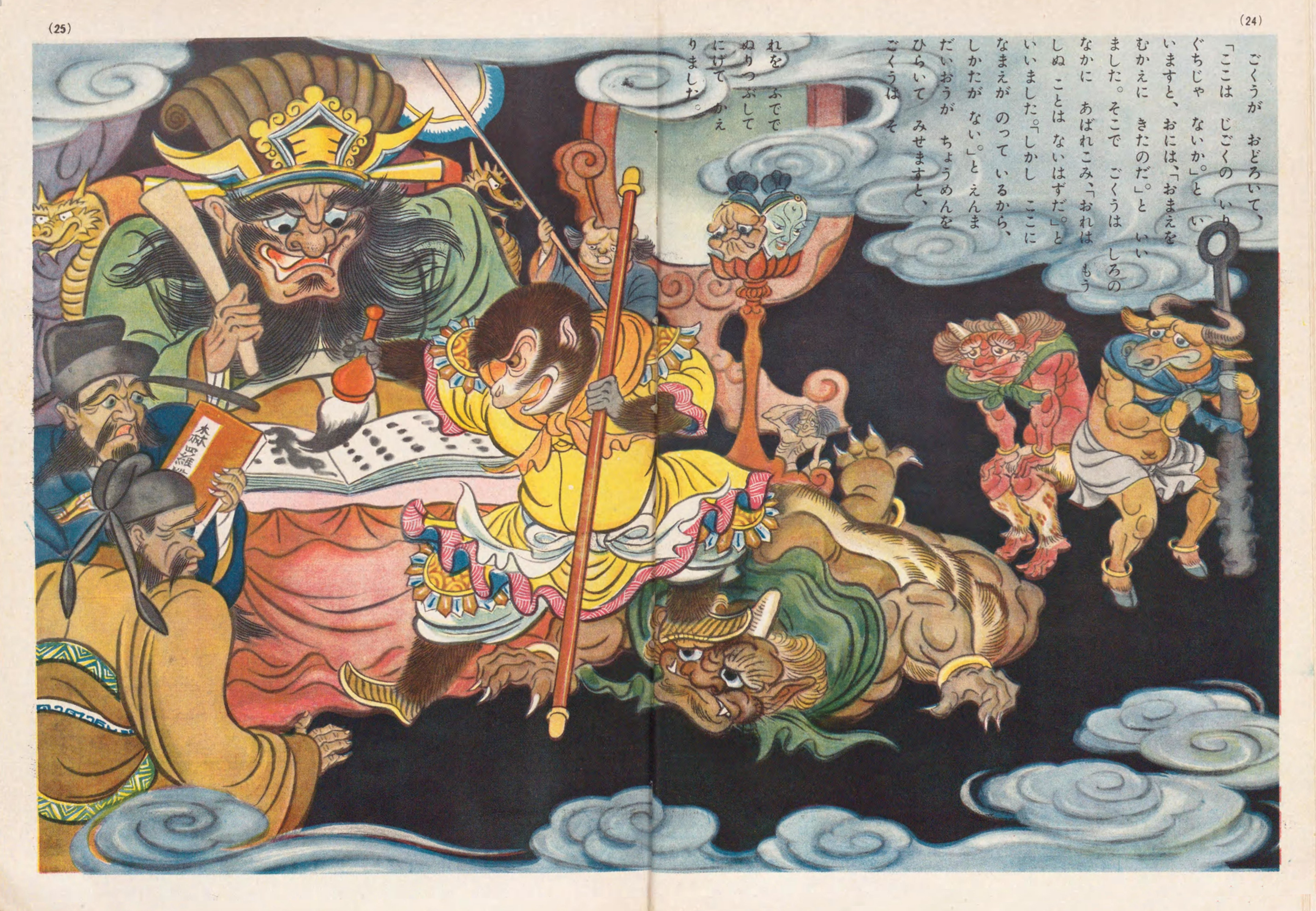
[After reprimanding the 10 judges for bringing his soul to hell, Sun says,] “All I want is to erase my name [from the ledgers of life and death]. Bring me a brush.” The judge hurriedly fetched the brush and soaked it in heavy ink. Wukong took the ledger on monkeys and crossed out all the names he could find in it [fig. 2]. Throwing down the ledger, he said, “That ends the account! That ends the account! Now I’m truly not your subject.” Brandishing his rod, he fought his way out of the Region of Darkness.

[…]

While our Monkey King was fighting his way out of the city, he was suddenly caught in a clump of grass and stumbled. Waking up with a start, he realized that it was all a dream (Wu & Yu, 2012, vol. 1, p. 139).

Sun’s ability to use the weapon as a disembodied spirit implies that it has some power of astral projection and entanglement (i.e. it goes where his soul goes). However, to my knowledge, this only happens once in the story, and the novel clearly demonstrates that he can’t use the weapon if it is physically taken away from him. [4] This is likely another inconsistency from oral storytelling.

Fig. 2 – Monkey holds his staff as he strikes his name from the Book of Life and Death (larger version). From the Japanese children’s book Son Goku (1939). 

1.4. Multiplication

The weapon is shown capable of creating manifold copies of itself. For example, in ch. 4, Monkey multiplies his staff to accommodate his monstrous, multi-armed form while fighting Prince Nezha: “Dear Great Sage! He shouted, ‘Change!’ and he too transformed himself into a creature with three heads and six arms. One wave of the golden-hooped rod and it became three staffs, which were held with six hands” (Wu & Yu, 2012, vol. 1, p. 155). Later in ch. 50, he rains staves down on a demonic army.

Using the tip of his lance to point at the ground, the demon king shouted for the little imps to attack together. All those brazen fiends, wielding swords, scimitars, staffs, and spears, rushed forward at once and surrounded the Great Sage Sun completely. Entirely undaunted, Pilgrim only cried, “Welcome! Welcome! That’s exactly what I want!” He used his golden-hooped rod to cover his front and back, to parry blows east and west, but that gang of fiends refused to be beaten back. Growing more agitated, Pilgrim tossed his rod up into the air, shouting, “Change!” It changed immediately into iron rods by the hundreds and thousands; like flying snakes and soaring serpents, they descended onto the fiends from the air” (Wu & Yu, 2012, vol. 2, p. 372).

1.5. Lock-Picking

Sun demonstrates the staff’s magic lock-picking ability in ch. 25.

The doors are all locked. Where are we going to go?” “Watch my power!” said Pilgrim. He seized his golden-hooped rod and exercised the lock-opening magic; he pointed the rod at the door and all the locks fell down with a loud pop as the several doors immediately sprung open. “What talent!” said Eight Rules, laughing. “Even if a little smith were to use a lock pick, he wouldn’t be able to do this so nimbly.” Pilgrim said, “This door is nothing! Even the South Heaven Gate would immediately fly open if I pointed this at it!” (Wu & Yu, 2012, vol. 1, pp. 468-469).

Admittedly, this passage could be read two ways: 1) The staff opens the lock; 2) Monkey uses the staff as a conduit for his own lock-picking magic. But I’m choosing the first interpretation as this ability was likely influenced by Saint Mulian unlocking the gates of hell with his staff. [5]

1.6. Transformation

In ch. 46, during a competition of Buddhist and Daoist prognostication, Sun magically disguises himself as a Daoist lad’s ritual master and convinces the boy to let him shave his head: “He changed his golden-hooped rod into a sharp razor, and hugging the lad, he said, ‘Darling, try to endure the pain for a moment. Don’t make any noise! I’ll shave your head.’ In a little while, the lad’s hair was completely shorn” (Wu & Yu, 2012, vol. 2, p. 305). In ch. 65, Sun turns the staff into a drill in order to escape from a pair of magic cymbals, using the tool to bore a hole in the horn of a dragon that was just able to pierce the seam: “Marvelous Great Sage! He changed the golden-hooped rod into a steel drill and drilled a hole on the tip of the horn. Transforming his body into the size of a mustard seed, he stuck himself inside the hole and yelled, ‘Pull the horn out! Pull the horn out!'” (Wu & Yu, 2012, vol. 3, p. 218).

1.7. Sentience

When the Dragon Queen originally suggests giving the pillar to Monkey, she tells her husband: “These past few days the iron has been glowing with a strange and lovely light [fig. 3]. Could this be a sign that it should be taken out to meet this sage?” (Wu & Yu, 2012, vol. 1, p. 135). This might imply the weapon was aware of its new master’s imminent arrival. Later in ch. 75, Sun recites a poem speaking of the staff’s desire for flight.

Its name was one Rod of Numinous Yang,
Stored deep in the sea, hardly seen by men.
Well-formed and transformed it wanted to fly,
Emitting bright strands of five-colored mist.
Enlightened Monkey took it back to the mount
To experience its pow’r for boundless change.
[…] (Wu & Yu, 2012, vol. 3, p. 375).

The phase “wanting to fly” (yao feiteng, 要飛騰) could be read as an allegory for yearning to be released from the dragon treasury and/or a call to adventure. Add to this the staff’s ability to follow Sun’s wishes to grow, shrink, multiply, change form, and pick locks. Therefore, the novel depicts the staff having a certain amount of awareness. [6]

Fig. 3 – Monkey pointing to the luminous iron pillar (larger version). From the Qing-Era Painted, Complete Edition Journey to the West (Qing caihui quanben Xiyouji, 清彩繪全本西遊記).

2. Conclusion

Journey to the West (1592) describes the Monkey King’s iron staff having the magic power to shrink and grow, control the ocean, astral project and entangle with Monkey’s spirit, multiply endlessly, pick locks, and transform into various objects. It also has sentience to a certain degree.

3. Updates

Update: 07-04-21

Here I present my theory on why Sun Wukong’s staff weighs 13,500 catties (17,560 lbs/7,965 kg). I believe the number is an embellishment on the weight of a stone block lifted by the bandit Wu Song in the Water Margin (c. 1400).

The Weight of the Monkey King’s Staff: A Literary Origin


Update: 04-23-26

Above, I wrote: “Ch. 3 shows that Monkey’s soul is able to use the staff in the underworld even when the physical weapon is back with his body in the world of the living.”

Sun’s use of said weapon also caught the attention of late-Ming commentators. The authors of The Book to Enlightenment of the Journey to the West (Xiyou Zhengdao Shu西遊證道書, 1663), a Daoist commentary on the novel, asked:

“Did he take this treasure with him in his dream?”

此寶貝夢中亦帶去耶? (Converted from simplified Chinese – source).

Notes

1) I have changed Yu’s (Wu & Yu, 2012) dry rendering “Compliant Golden-Hooped Rod” to “As-you-wish Gold-Banded Staff,” similar to W.J.F. Jenner (minus “cudgel”). Also, Yu’s original translation says “13,500 pounds.” However, the Chinese version uses jin (斤), known in English as “catty.” The catty and pound are two different measures of weight, the former being heavier than the latter. Therefore, the English text has been altered to show this. The catty during the Ming Dynasty when the novel was compiled equaled 590 grams (Elvin, 2004, p. 491 n. 133), so 13,500 catties would equal 17,550 lb.

2) Here, Yu’s (Wu & Yu, 2012) English translation says Monkey grows to be “ten thousand feet tall.” However, the original Chinese source reads “萬丈” (wanzhang), wan meaning 10,000 and zhang being a measure designating 10 Chinese feet (10,000 x 10 = 100,000). Therefore, I have changed the source to read “One hundred thousand feet,” much like Yu (Wu & Yu, 2012) translates it in chapters six (vol. 1, p. 181) and 61 (vol. 3, p. 157).

3) For example, Monkey relies on Zhu Bajie to fight Sha Wujing when they first come across him at the Flowing-Sands River. This is when Sun admits his weakness to water:

“Worthy Brother,” said Pilgrim with a laugh, “in this case I’ve really nothing to brag about, for I’m just not comfortable doing business in water. If all I do is walk around down there, I still have to make the magic sign and recite the water-repelling spell before I can move anywhere. Or else I have to change into a water creature like a fish, shrimp, crab, or turtle before going in. If it were a matter of matching wits in the high mountains or up in the clouds, I know enough to deal with the strangest and most difficult situation. But doing business in water somewhat cramps my style!” (Wu & Yu, 2012, vol. 1, pp. 423-424).

4) The rhinoceros demon sucks it away with Laozi’s magic steel bracelet in ch. 50 and 51. A lion spirit uses a magic wind to steal the weapons of all three pilgrims in ch. 88. In both cases, Monkey resorts to trickery to retrieve the physical staff from their respective mountain strongholds.

5) One section of Mulian’s tale reads: “With one shake of his staff, the bars and locks fell from the black walls, / On the second shake, the double leaves of the main gate [of hell] flew open” (Mair, 1994, p. 1113).

6) The idea of sentient weapons is certainly not unique to Journey to the West considering that the ancient Chinese ascribed souls to noted swords. For example, Yuan poet Jia Penglai (賈蓬萊, c. mid-14th-c.) described famed Spring and Autumn period blacksmith Ou Yezi‘s (歐冶子) treasure swords Longyuan (龍淵, a.k.a. Longquan, 龍泉) and Tai’e (泰阿/太阿) as mated lovers who pine for each other when separated and even leap from the scabbard to seek out their beloved (Lee & Wiles, 2015, pp. 161-163).

Sources:

Elvin, M. (2004). The Retreat of the Elephants: An Environmental History of China. New Haven (Conn.): Yale university press.

Lee, L. X. H., & Wiles, S. (2015). Biographical Dictionary of Chinese Women: Tang Through Ming: 618-1644. Abingdon: Routledge.

Mair, V. H. (1994). Transformation Text on Mahamaudgalyayana Rescuing his Mother From the Underworld With Pictures, One Scroll, With Preface In V. Mair (Ed.), The Columbia Anthology of Traditional Chinese Literature (pp. 1094-1127). New York: Columbia University Press.

Wu, C., & Yu, A. C. (2012). The Journey to the West: Vol. 1-4. Chicago, Illinois: University of Chicago Press.

Deciphering the Inscription on the Monkey King’s Staff

Last updated: 07-03-21

This is the third and final installment in my investigation of the history of the Monkey King’s staff from the great Chinese classic Journey to the West (Xiyouji西遊記, 1592). The previous two articles discussed historical staves and an imperial monument that may have influenced the weapon. The current piece will focus on the name of the staff, the “As-You-Wish Gold-Banded Cudgel” (Ruyi jingu bang, 如意金箍棒). This title comes from an inscription appearing on the pole. As the novel states: “There was a line of inlaid writing near the end which said that it was ‘The As-You-Wish Gold-Banded Cudgel. Weight: 13,500 Catties’” (17,560 lbs/7,960 kg) (Ruyi jingu bang zhong yiwan sanqian wubai jin, 如意金箍棒重一萬三千五百斤). [1] The significance of the gold bands (jinggu, 金箍) was discussed in the first article, so it will not be covered here. This leaves “As-you-wish” (ruyi, 如意) and “Weight: 13,500 catties” (zhong yiwan sanqian wubai jin, 重一萬三千五百斤). In this paper, I will trace the origin of each concept and tie them back to Chinese literature, history, and religion. As always, I hope that this will be of interest to layman and researchers.

Table of Contents

The Weight

Stating the weight of a weapon follows a tradition in Chinese Military Romance literature in which great heroes brandish heavy polearms and blades. For example, in Romance of the Three Kingdoms (Sanguo yanyi, 三國演義, 14th century), General Guan Yu (關羽) is said to have a glaive weighing 82 catties (107 lbs./48.5 kg). [2] This is referenced in a subsequent novel set hundreds of years later titled the Water Margin (Shuihu zhuan, 水滸傳, c. 1400). In the story, the bandit-turned-Buddhist monk Lu Zhishen (魯智深) asks a blacksmith to make him a cleric’s staff (chanzhang, 禪杖, lit: “Chan staff”) weighing 100 catties (130 lbs./59 kg). But when the latter refuses on the grounds that not even the legendary general would be able to lift it, Lu asks for a staff weighing just as much as Guan’s polearm (here stated as 81 catties) to prove his equal. After some minor bickering, the two finally settle on a more reasonable 62 catties (81 lbs./37 kg). [3]

The ability of these heroes to efficiently wield such weapons sets them apart from normal humans. Likewise, the extraordinary weight of Monkey’s staff sets him apart from his lowly human counterparts. He is, after all, a transcendent immortal capable of supernatural feats of strength. This then might explain the number appearing on the staff. Thirteen thousand five hundred is divisible by nine, which Chinese numerology considers to represent “infinity.” [4] (Note: I no longer agree with this. Please see the 07-03-21 update for my revised views on the origin of the staff’s weight.) So it’s possible the number (infinity multiplied) was meant to convey that the staff was heavy beyond comprehension, something that only a divine hero such as Monkey would be able to wield.

The “As-You-Wish”

Introduction of the Ruyi Scepter

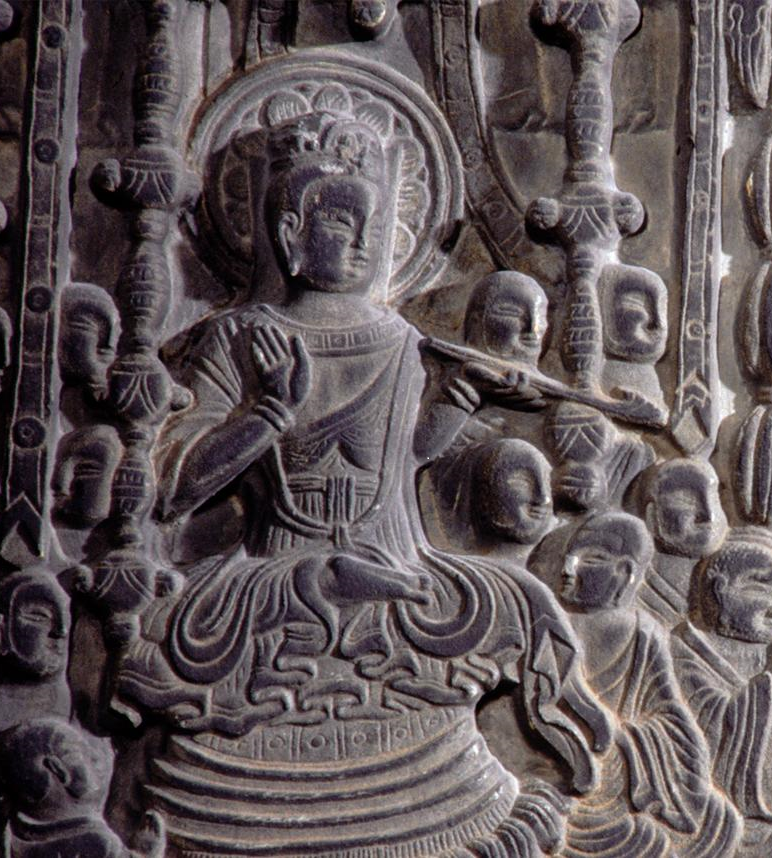
“As-you-wish” (ruyi, 如意), originates with a ritual scepter of that name shaped like an arching snake with a head in the form of a lingzhi mushroom (靈芝, a.k.a., “fungus of immortality”) (fig. 1). They are often seen carried by emperors and Buddho-Daoist deities in Chinese art. Prior to the 10th century, the scepter was closely associated with the Bodhisattva Manjusri (Wenshu, 文殊) and his famous debate with the householder Vimalakirti (Weimojie, 維摩詰). [5] Engravings of the event show him holding the object in the form of a tanbing (談柄), or “discussion stick,” an elongated, shoe horn-shaped wand historically used by religious and secular groups to designate the right to speak before an assembly (similar in function to the Native American “talking stick”) (fig. 2). [6] This implement was sometimes portrayed with vegetal features. For instance, a Chinese stele from the 6th century shows Manjusri debating while holding a sprig (fig. 3). [7] J. Leroy Davidson suggests that this type of scepter has its origin in an Indian Buddhist Jataka tale in which a group of royal sisters use branches to initiate debates with suitors and Buddhist priests. [8] The term ruyi comes from the “wish-fulfilling” Kalpavriksha tree of Hindu mythology. [9] This is suggested by a Chinese source from the 7th century which notes that during the celebration of Upavasatha, [10] lay hosts often gifted “ruyi shu” (如意樹), or “As-you-wish trees” (no doubt saplings or branches), to Indian Buddhist priests [11]. It’s possible that these gifts served as unofficial symbols of the priests’ authority and combined with the aforesaid tradition of debating with branches. This would explain why an instrument of debate would carry the ruyi title.

Fig. 1 – Ruyi scepter from the Qing Dynasty (1644–1911) (larger version). Image found here.

As a Symbol of Authority

Upon entering China with Buddhism, this symbol of authority was adopted by the upper echelons of society. [12] Early records describe emperors, generals, and ministers wielding the object as a means to assert or signify their power. For instance, during the Jin Dynasty (265–420), the court official Shi Chong (石崇, 249–300) used a metal ruyi to smash a coral tree, an imperial gift belonging to a rival aristocrat. [13] Jin General Xie Wan (謝萬, 320–361) used the object to point at his captains and direct his orders to them. [14]. General Wei Rui (韋叡, 442–520) of the Liang Dynasty (502–557) took this one step further and directed his troops in battle with a bamboo scepter. [15] Legend states that Northern Wei Dynasty (386–535) Emperor Xiaowen (孝文, 467–499) placed a bone ruyi (among other items) before his sons; the boy who chose it became his heir because it signified the right to rule. [16] During a time of war, Emperor Wu of Liang (梁武帝, 464–549) gave one of his generals a ruyi because, as one scholar suggests, it was sure to bring him victory in battle. [17]

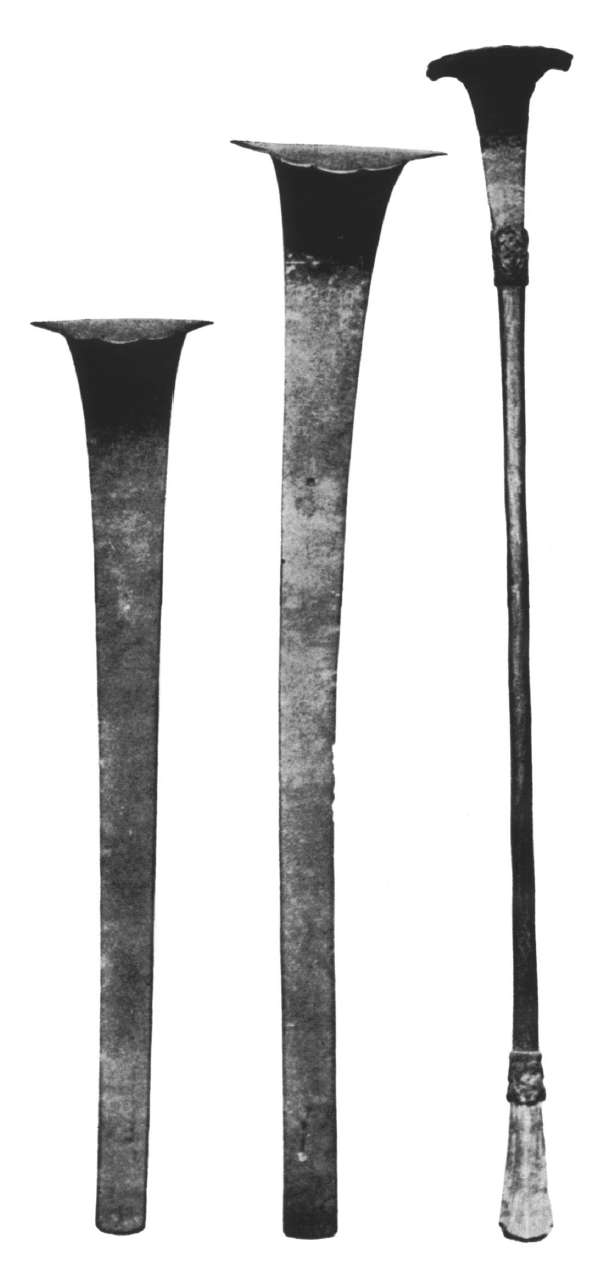
Fig. 2 – Examples of tanbing-style ruyi from 8th-century Japan (larger version). Due to slow culture transmission, these could be reminiscent of early Chinese scepters. Fig. 3 – Manjusri holding a sprig while debating Vimalakirti. Detail from a Chinese Buddhist stele dated 533–543 (larger version).

As a Weapon

Due to its historical association with military command, Literati ignorant of the scepter’s original function as an instrument of religious debate and authority came to consider the ruyi a type of weapon. For example, the Song Dynasty (960–1279) archaeologist Zhao Xigu (趙希鵠, c. 1195–post 1242) described the object as an iron club used for self-defense: “The men of old used the Ruyi for pointing or indicating the way, and also for guarding themselves against the unforeseen. It was made of wrought iron, and was over two feet in length…” [18] Zhao’s words were later echoed by the art collector Wen Zhenheng (文震亨, 1585–1645) during the Ming Dynasty (1368–1644). [19] The concept of an “As-you-wish” iron club used for self-defense no doubt influenced Monkey’s staff. This is especially true since Wen shows that the idea was current during the time that the Ming version of the novel was published.

The Possible Origin of Its Shape

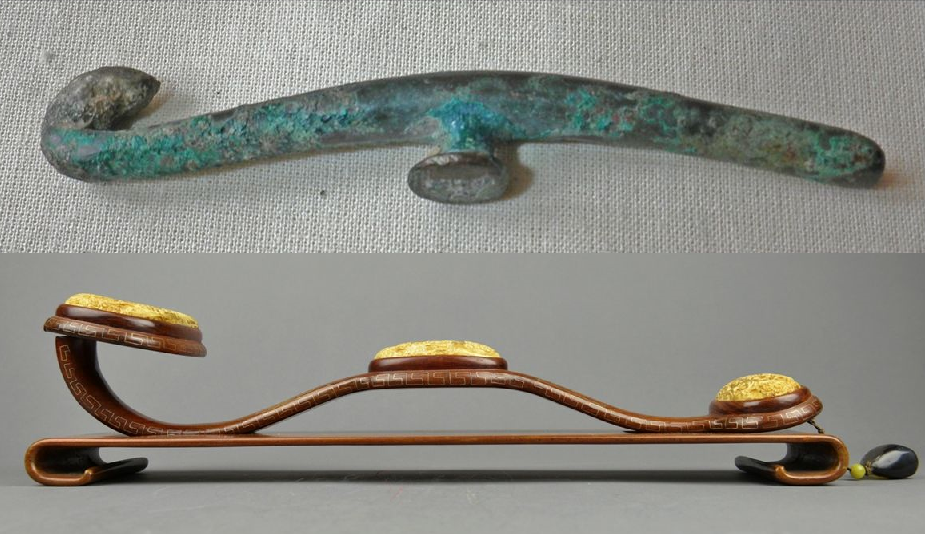
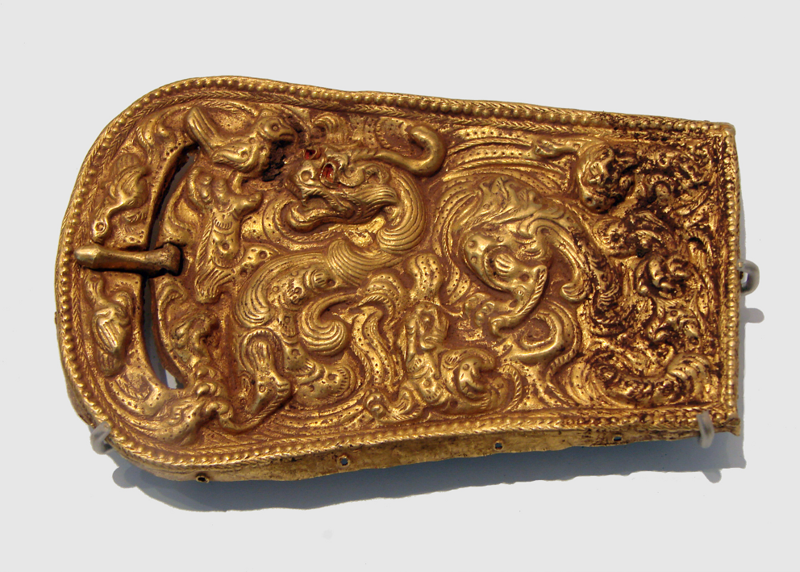
So how did the scepter come to have its signature serpentine curve and ornate head? J. Leroy Davidson believes that this is a simple case of misidentification. He cites material from the Song Dynasty concerning people digging up a “a bronze box in which was a white ruyi decorated with motives of a dragon and tiger.” [20] Davidson suggests that this archaeological artifact was actually a belt hook commonly worn during the Zhou and Han Dynasties (11th c. BCE to 3rd c. CE). Said hooks have an S-shaped curve and the accompanying buckles are often decorated with real and imagined creatures like those mentioned above (fig. 4 and 5). [21] It’s easy to see then how ancient belt buckles—perhaps the features weathered by time—could have been confused with a mushroom.

Fig. 4 – A profile comparison of a Han-era belt hook (top) and a ruyi (bottom) (larger version). Fig. 5 – A Han belt buckle featuring a dragon (larger version).

The Immortal Zhi Mushroom Aspect

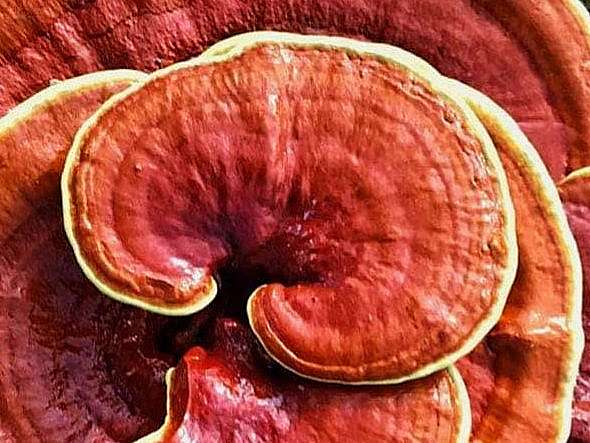
Just like the Vedic Soma and the Greek Ambrosia, the Chinese also had a magical, life-prolonging substance which they called Zhi (芝). [22] The Records of the Grand Historian (Shiji, 史記, c. 90 BCE) mentions that emperors Qin Shihuangdi (秦始皇帝, 260–210 BCE) and Han Wudi (漢武帝, 156–87 BCE) sent thousands of men over many years in search of magical islands housing this immortal herb. [23] It was during the time of the latter that the substance was equated with lingzhi (靈芝, Ganoderma), a genus of spade-shaped mushroom with a lacquered appearance (fig. 6). [24] This fungus became the subject of esoteric texts starting from the Han Dynasty, many of which are now lost. Drawing on these extinct texts, the Daoist adept Ge Hong (葛洪, 283–343) was the first to classify the lingzhi into five major types. [25] Methods For Planting the Zhi Plants (Zhong zhicao fa, 種芝草法), a late-Six Dynasties (220–589) text attributed to the Daoist god Laozi (老子), details how to seed this magical fungus by burying precious substances, such as gold or cinnabar, on a mountain side during solstices and equinoxes. [26] Originally written during the Song Dynasty, a Ming edition of Classification of Supreme Numinous Treasure Mushrooms (Taishang lingbao zhicao pin, 太上靈寶芝草品) lists one hundred twenty-six different kinds of immortality-bestowing fungi. It’s important to note that this text became part of the official Daoist Canon (Daozang, 道藏) during the mid-15th century. [27] This means that immortal mushrooms are a central tenet of Daoism.

Fig. 6 – A lingzhi mushroom (larger version).

The Religious Importance

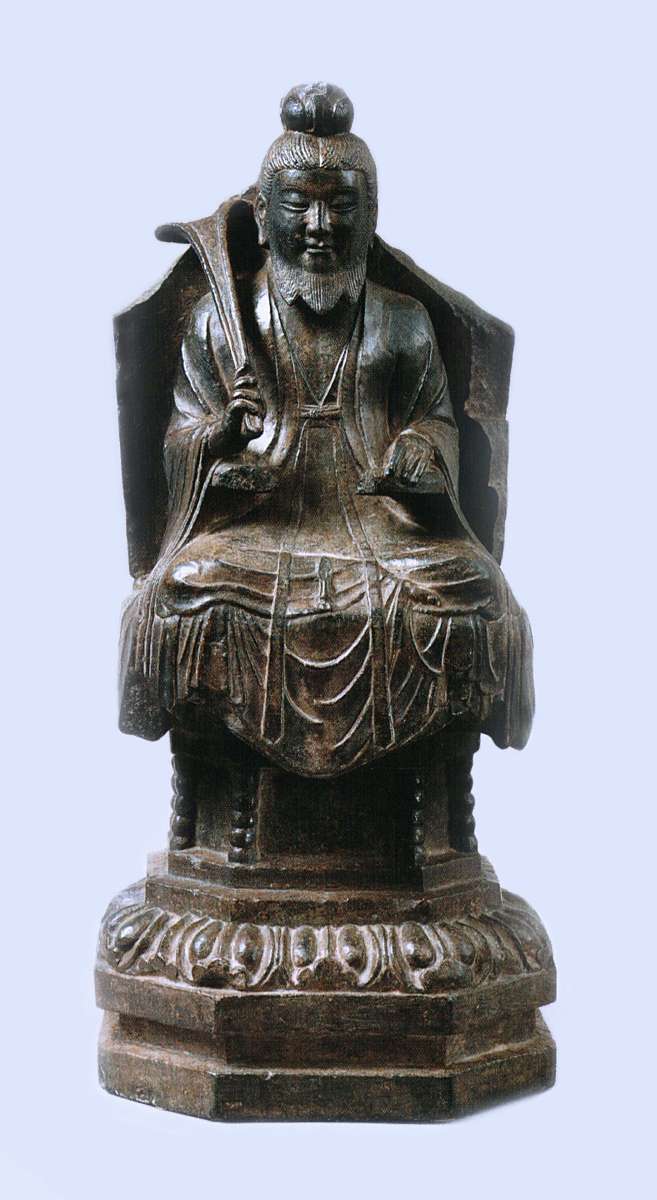
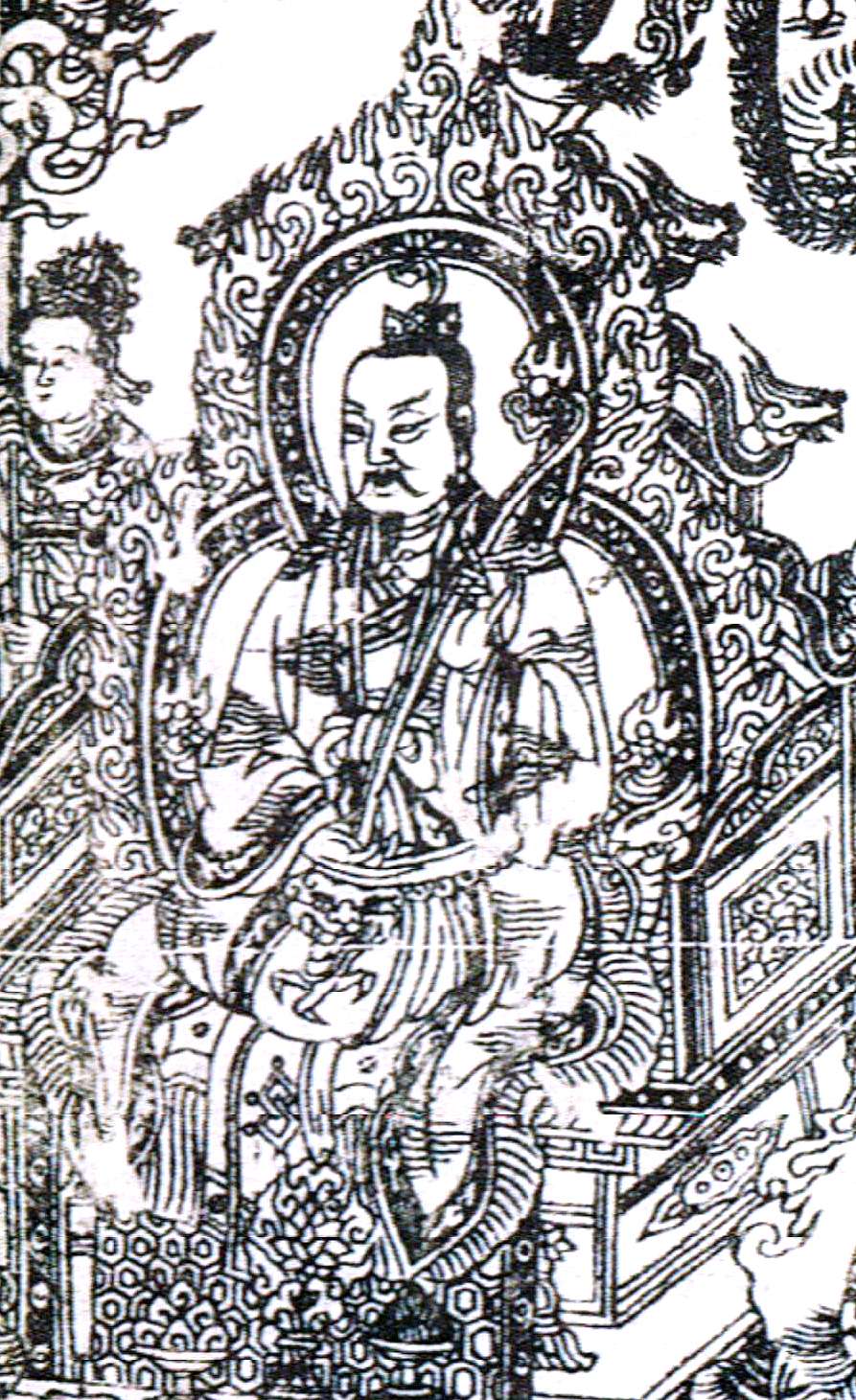
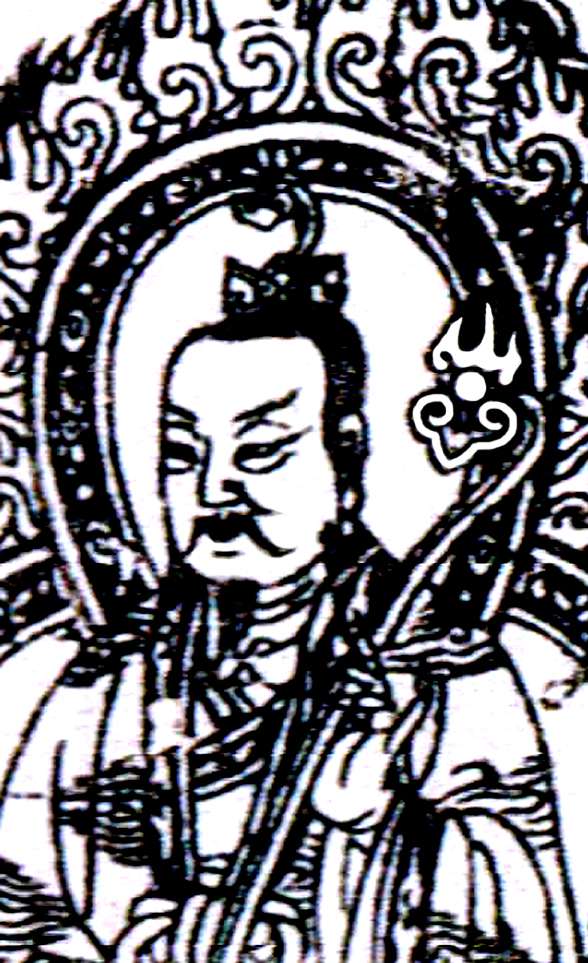
Daoism adopted the ruyi centuries prior to the Song Dynasty when the lingzhi mushroom was associated with the scepter. [28] It was one of the few ritual objects permitted Daoist monks living in medieval Chinese monasteries. [29] In fact, one early Tang Dynasty text states that it is among the items that “are essential for all Daoists, whether male or female, when they present offerings.” [30] Possibly taking a cue from Buddhist depictions of Manjusri, Daoists of the Tang began to depict some of their supreme deities with the scepter. For example, a late-7th or early-8th century statue of Laozi depicts him holding a straight tanbing-style ruyi (fig. 7). [31] After the lingzhi imagery was absorbed into the scepter, it became closely associated with the Celestial Worthy of Numinous Treasure (Lingbao Tianzun, 靈寶天尊), one of the Three Pure Ones (Sanqing, 三清), a trinity representing different aspects of the Dao (道). A 14th-century woodblock print depicts this deity holding a large mushroom ruyi—called by one scholar “his principle attribute”—while sitting on a heavenly throne surrounded by a sea of celestial beings (fig. 8). [32] The scepter was later associated with other Daoist deities during the Ming. [33] Therefore, the long association of the ruyi with Daoist immortals explains why Monkey would come to wield such an instrument with that name.

Fig. 7 – A late-7th  or early-8th century statue of Laozi holding a straight tanbing-style ruyi (larger version). Fig. 8 – A 14th-century woodblock print depicting the Celestial Worthy holding a linzhi ruyi (larger version). Fig. 9 – Detail of a Cintamani, or “wish-granting pearl” (larger version).

The Lowly Buddhist View 

Unlike their Daoist counterparts, Buddhists during the Tang looked upon the scepter as a somewhat base object. For example, although he listed it as a “lecture baton,” the monk Daoxuan (道璿, 702–760), an expert on monastic law, placed the ruyi in the same category as non-ritual items like satchels and spittoons. Furthermore, he described it as being one of the objects not among the “tools of the way.” [34] Sources from this time and the Song Dynasty equate the object with a simple backscratcher. [35] This shows that the ruyi lost any association that it may have had with wish-granting (as the term implies) upon entering China. So how did it regain its magic properties?

The Buddhist Cintamani

This probably happened because it was equated with the Buddhist Cintamani, or “wish-granting pearl” (fig. 9). [36] This is suggested by the Chinese translation of the Sanskrit term, Ruyi zhu (如意珠). [37] The association between the two was surely established by the Ming as Monkey’s staff has the magical ability to grow or shrink according to his wishes. [38] This is best exemplified by a poem appearing in Chapter seven of Journey to the West:

A spirit beam filling the supreme void—
That’s how the rod behaves accordingly.
It lengthens or shortens as one would wish;
Upright or prone, it grows or shrinks at will. [39]

The magic powers of the staff may be based on a weapon appearing in the earliest version of the novel, The Story of How Tripitaka of the Great Tang, Procures the Scriptures (Da Tang Sanzang qujing shihua, 大唐三藏取經詩話). In this later-13th century adaptation, our protagonist changes a ringed monk’s staff into a “gigantic yaksha whose head touched the sky and whose feet straddled the earth.” [40] This means that the Song and Ming Dynasty versions of the staff both have the ability to change their size and shape as Monkey wishes. I suggested in the second article that the initial description of the weapon in chapter one as a giant pillar of black iron is based on the famous Iron Pillar of Delhi, a religio-political Indian monument of the 4th century. A warrior wishing to wield such a pillar would naturally need to shrink it down. Therefore, the “wish-granting” ruyi concept was probably associated with the shape-changing abilities of the ringed monk’s staff and applied to monkey’s signature iron weapon.

Conclusion

The inscription on Monkey’s staff stands as a microcosm of Chinese literature, history, and religion. The weight harkens back to Yuan and Ming (13th c. to 17th c. CE) Military Romance literature in which great heroes are distinguished from normal humans by their ability to brandish extremely heavy weapons. Monkey’s ability to wield a staff weighing nearly nine tons elevates him above his human counterparts as a divine hero with herculean strength. The ruyi (如意) concept is much older and can be traced back to ancient India. The term is based on the Kalpavriksha, or “wish-granting” tree, of Hindu mythology. This element of Hindu culture was absorbed by Indian Buddhism and mixed with a separate tradition to become a symbol of religious debate and authority. Upon entering China during the Han Dynasty (206 BCE–220 CE), this branch was stylized into a tanbing (談柄), or “Discussion Stick,” which later became the emblem of the Bodhisattva Manjusri. It was simultaneously adopted by aristocrats and military commanders in subsequent dynasties as a sign of their secular power. The object attained its current S-shape and ornate head during the Song Dynasty (960–1279) when historical archaeologists happened upon ancient Chinese belt hooks and buckles from the Zhou and Han Dynasties (11th c. BCE–3rd c. CE) and confused them for such scepters.

There are three reason for the ruyi term being applied to Sun Wukong’s magic weapon. First, due to its historical association with military commanders, literati during the Song and Ming Dynasties came to look upon the object as an iron club used for self-defense. This would be perfect for protecting Monkey’s Buddhist master Xuanzang (玄奘) during their journey to India. Second, the head of the scepter was associated with the immortality-bestowing lingzhi mushroom (靈芝) during the Song Dynasty and became the emblem of the highest gods of Daoism, most notably the Celestial Worthy of Numinous Treasure (靈寶天尊). This makes the ruyi an excellent weapon for an immortal macaque possessed of Daoist magic. Third, the scepter was equated with the Buddhist Cintamani, or “wish-granting pearl”; this was associated with the magic, shape-changing abilities of a literary precursor of the weapon. Hence, the Ming version of Monkey’s pole gained the ability to magically shrink or grow according to his wishes. So, in the end, we see that both Monkey and his staff straddle the Buddhist and Daoist religions.


Updates

Update: 01/05/2015

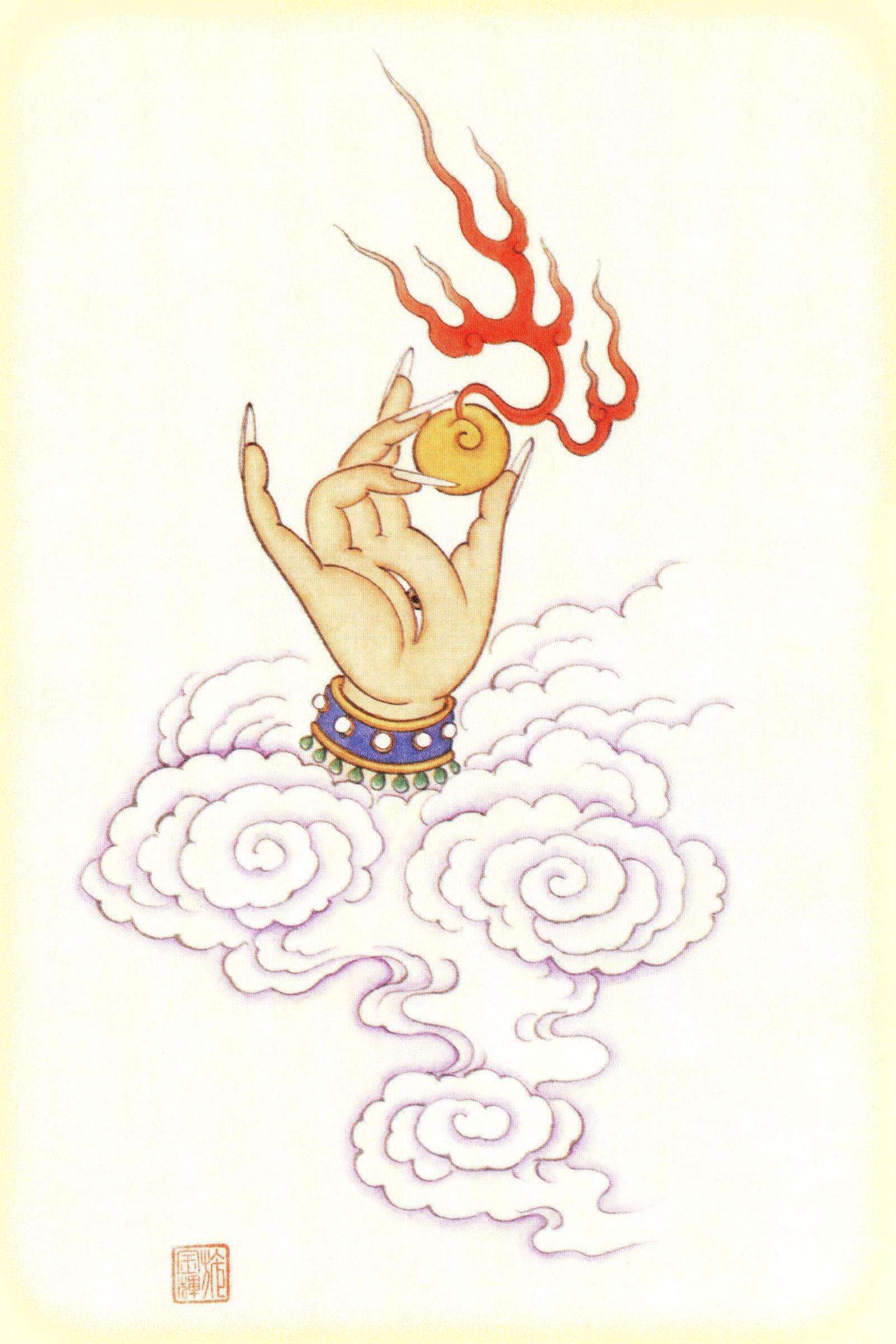
I suggested in the above entry that the ruyi may have been equated with the Buddhist cintamani, or “wish-granting pearl.” Well, I just noticed that the lingzhi-style scepter held by the Celestial Worthy from figure 8 appears to have a flaming pearl attached to it (fig. 9).

Fig. 9 – Enhanced version of the Celestial Worthy’s lingzhi ruyi scepter with a flaming pearl (larger version).

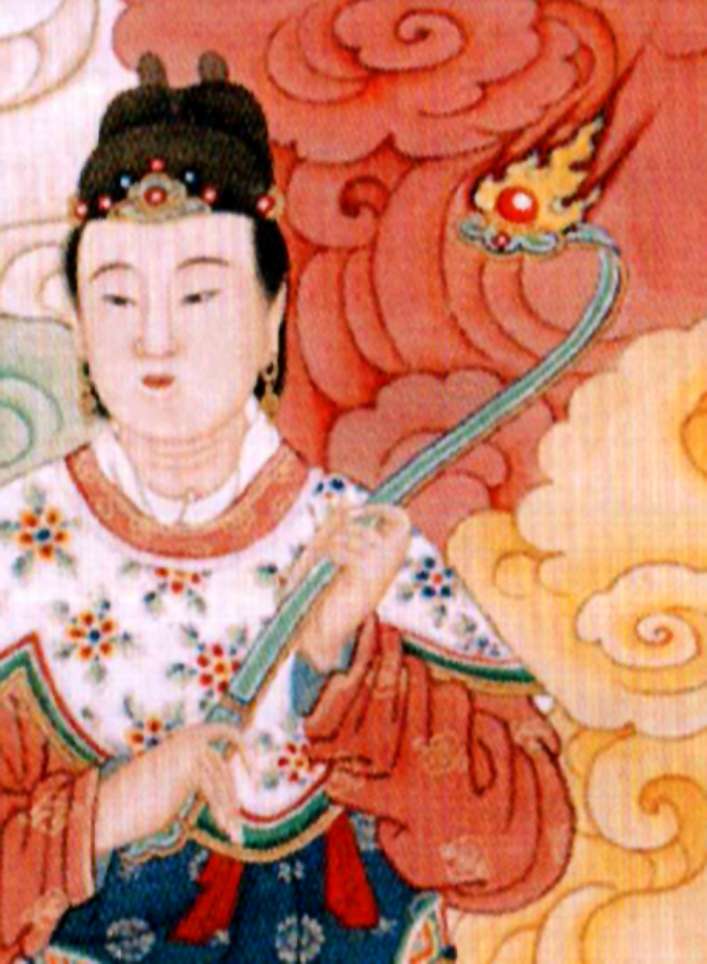
If it really is a Cintamani, this shows that the association between the two happened by at least the 14th century. This probably happened earlier considering that iconography takes time to become standardized. I’ve found at least one other Chinese painting featuring a flaming pearl ruyi. A Ming work titled The Lady of the Highest Primordial and the Empress of Earth (c. 1600) features an attendant of the second deity holding the object (fig. 10).

Fig. 10 – Detail of the attendant (larger version).


Update: 01-06-2015

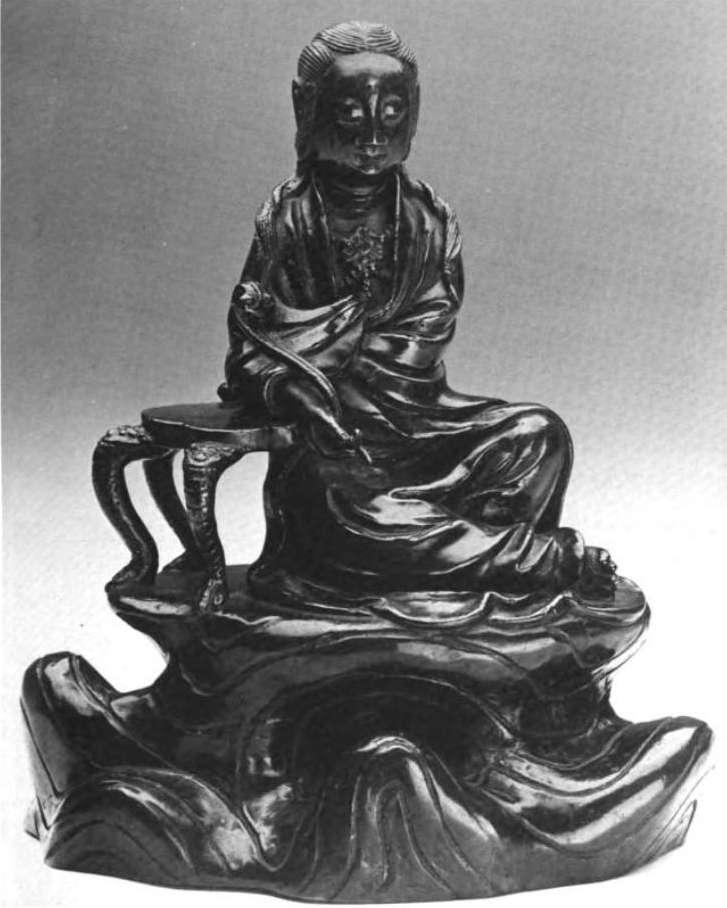
A prime example of the relationship between the ruyi and the cintamani comes in the form of a 16th-century statue of the Bodhisattva Guanyin (觀音). The deity is usually associated with the flaming pearl, but this statue depicts her holding a scepter (fig. 11). H.A. van Oort comments: “In the mind of the artist, the scepter could well have replaced the cintamani, the “wish-fulfilling jewel”; in that case the statue is a very free interpretation of the Ju-i Kuan-yin [Ruyi Guanyin, 如意觀音], or Cintamani Avalokitesvara, the Kuan-yin with the wish-fulfilling pearl.” [41]

Fig. 11 – Guanyin holding a ruyi scepter (larger version).


Update: 08-16-2020

I’ve written an article suggest the ruyi/lingzhi mushroom influenced the shape of Wukong’s curlicue-style headband.

Sun Wukong’s Curlicue-Style Headband


Update: 02-06-2021

I have written an article that discusses the magic powers of the staff. These include the ability to shrink and grow, control the ocean, astral project and entangle with Monkey’s spirit, multiply endlessly, pick locks, and transform into various objects. It also has sentience to a certain degree.

The Magic Powers of the Monkey King’s Iron Staff


Update: 07-03-21

I now believe the weight of Monkey’s staff is an embellishment of a heavy stone block lifted by the bandit Wu Song in the Water Margin (c. 1400).

The Weight of the Monkey King’s Staff: A Literary Origin

Notes:

[1] Wu Cheng’en and W.J.F. Jenner, Journey to the West (Vol. 1). [S.l.]: Foreign Languages Press, 2001), 56. Text altered slightly. (The text originally says, “As-You-Will,” but I have changed it to align with a source heavily sited in this paper.) Compare it with Anthony C. Yu’s translation: “The Compliant Golden-Hooped Rod” (Wu Cheng’en and Anthony C. Yu, The Journey to the West (Vol. 1) (Chicago, Ill: University of Chicago Press, 2012), 135). I prefer the former. Both translations use the word “pounds”; however, the Chinese version of the novel uses jin (斤), known in English as “catty.” Catty and pound are two different measures of weight, the former being heavier than the latter. Therefore, the text has been altered to show this. The catty during the Ming Dynasty when the novel was compiled equaled 590 grams (Mark Elvin, The Retreat of the Elephants: An Environmental History of China (New Haven (Conn.): Yale University P, 2004), 491 n. 133). This means 13,500 catties would equal roughly 17,560 lbs.

[2] Luo Guanzhong and Moss Roberts, Three Kingdoms: A Historical Novel (Berkeley: University of California Press, 1991), 27.

[3] Shi Naian, Guanzhong Luo, and Sidney Shapiro, Outlaws of the Marsh (Beijing: Foreign Languages Press, 1988), 94-95.

[4] Patricia Bjaaland Welch, Chinese Art: A Guide to Motifs and Visual Imagery (North Clarendon, VT: Tuttle Pub, 2008), 230.

[5] The Vimalakirti Sutra (c. 100) tells of how the Buddha chose Manjusri to call upon the malingering householder whom no other disciple wanted to visit due to his supernatural intellect. He and Vimalakirti debate Buddhist doctrine before a crowd of celestial onlookers until they realize that they are both equally versed in the dharma (Burton Watson, The Vimalakirti Sutra (New York: Columbia University Press, 1997)). For Manjusri’s association with the Ruyi scepter, see J. Leroy Davidson, “The Origin and Early Use of the Ju-i,” Artibus Asiae 13, no. 4 (1950): 240. The aforementioned sutra was not translated into Chinese until the 5th century, so this means the ruyi became associated with the deity rather quickly.

[6] Davidson, 241-242. Medieval Chinese dictionaries refer to the ruyi as a type of backscratcher, the idea being that it can reach the areas that “one wishes” (Ibid, 239; John Kieschnick, The Impact of Buddhism on Chinese Material Culture (Princeton: Princeton University Press, 2002), 142).

[7] Ibid, 245. See plate IV for examples of 8th-century ruyi scepters from Japan shaped like Bamboo stalks.

[8] Ibid, 246. Davidson cites a hard to find book that is long out of print. I located an archived scan of the publication online. See “A Manual of Buddhism, in Its Modern Development (1853).” Internet Archive. Accessed December 17, 2014. https://archive.org/details/manualofbudhism00hard. The story appears on page 255.

[9] Davidson, 246. Various Puranas state that such trees arose during the churning of the ocean of milk. The gods allowed humans to wish for whatever their hearts desired until they started asking for evil things. The trees were then transported to heaven beyond the reach of man (Roshen Dalal, Hinduism: An Alphabetical Guide (New Delhi: Penguin Books, 2010), 189).

[10] A day of religious observance in which the Buddhist lay community renews their commitment to the Eightfold Path. Buddhist priests are invited into homes to help with this process (Yijing, F. Max Müller, and Junjirō Takakusu, A Record of the Buddhist Religion As Practised in India and the Malay Archipelago (A.D. 671-695) (Oxford: Clarendon Press, 1896), 35 n. 1).

[11] Davidson, 246-247.

[12] John Kieschnick believes that the ruyi is a strictly Chinese invention (Kieschnick, 138-152). I, however, find Davidson’s arguments for an Indian origin more compelling.

[13] Joseph Edkins. “The Ju-i, or, Sceptre of Good fortune.” The East of Asia Magazine III (1904), 238. For a complete translation of the story, see John Minford and Joseph S. M. Lau, Classical Chinese Literature: From Antiquity to the Tang Dynasty (New York: Columbia University Press, 2000), 671-672.

[14] Edkins, 238.

[15] Ibid, 239.

[16] Ibid. See also Kieschnick, 144. Kieschnick refers to him by his temple name Gaozu. I have used his reign name to avoid confusion with other similarly named emperors from subsequent dynasties.

[17] Edkins, 239.

[18] Berthold Laufer, Jade: A Study in Chinese Archaeology and Religion (Chicago: Field Museum of Natural History, 1912), 336 n. 1. Text altered slightly. Laufer describes the ruyi as a blunt sword, but the available information makes the object sound more like a club.

[19] He writes: “The ruyi was used in ancient times to give directions or to protect oneself from the unexpected. It was for this reason that it was made of iron, and not on the basis of strictly aesthetic considerations…” (Kieschnick, 151).

[20] Davidson, 249. Text altered slightly.

[21] Ibid.

[22] R. Gordon Wasson and Joseph Needham both suggested that Zhi was actually based on Indian stories of Soma (Paul U. Unschuld, Medicine in China: A History of Ideas (Berkeley: University of California Press, 1985), 112.

[23] Sima Qian and Burton Watson, Records of the Grand Historian (Vol. 2) (Hong Kong: Columbia University Press, 1993), 14-15 and 45-46. Despite its association with mushrooms, some texts refer to it as a type of grass or herb (Wolfram Eberhard, A Dictionary of Chinese Symbols: Hidden Symbols in Chinese Life and Thought (London: Routledge & Kegan Paul, 1986), 173-174.

[24] Xiao Tong, Wen Xuan or Selections of Refined Literature (Vol. 3) (Princeton, N.J.: Princeton Univ. Press, 1996), 201.

[25] These are stone zhi (石芝), wood zhi (木芝), plant zhi (草芝), flesh zhi (肉芝), and mushroom zhi (菌芝) (Fabrizio Pregadio, The Encyclopedia of Taoism (Vol. 2) (London: Routledge, 2008), 1273).

[26] Ibid.

[27] Stephen Little and Shawn Eichman, Taoism and the Arts of China (Chicago: Art Institute of Chicago, 2000), 340.

[28] The association with the lingzhi, however, may have been as early as the Tang Dynasty (618–907). Yan Liben’s (閻立本, 600–673) “The Thirteen Emperors” painting features a monarch holding a straight tanbing-style ruyi with the head in the shape of a lingzhi. Although, the scalloped perimeter could denote a cloud. See “The Thirteen Emperors.” Digital Scrolling Paintings Project. Accessed December 23, 2014. http://scrolls.uchicago.edu/scroll/thirteen-emperors.

[29] Livia Kohn, The Daoist Monastic Manual: A Translation of the Fengdao Kejie (New York: Oxford University Press, 2004), 122.

[30] Ibid, 119.

[31] See image #39 in Little and Eichman, 183. Little suggests that this could instead be a depiction of the Celestial Worthy of Numinous Treasure (靈寶天尊) (Ibid, 187 cat. nos. 39-42 n. 9). On the contrary, Silvio A. Bedini mentions an incense burner of Laozi carrying a ruyi on his famous journey to the Western Paradise (Silvio A. Bedini, The Trail of Time: Time Measurement with Incense in East Asia (Cambridge: Cambridge Univ. Press, 1994), 113). This suggests that Laozi was indeed associated with the scepter.

[32] This illustrates a scene from an important Song Dynasty text in which the Celestial Worthy is said to reveal heavenly secrets to mankind (Little and Eichman, 237-238).

[33] See, for example, Cao Guojiu (曹國舅) (Welch, 259).

[34] Kieschnick, 148-149.

[35] Ibid, 1414-142 and 149-150.

[36] Erik Zürcher has suggested that the only way the lowly back scratcher could have become a symbol of lofty knowledge was via an association with the wish-granting pearl (Erik Zürcher, The Buddhist Conquest of China: The Spread and Adaptation of Buddhism in Early Medieval China (Leiden: Brill, 1997), 407 n. 59). It seems only natural that an affiliation between the scepter and the pearl would have sparked the idea that the former had magical properties.

[37] I’m not sure when the term was first translated into Chinese, but it appears in the Scripture on the Ten Wheels, a 6th-century sutra centered around the Bodhisattva Dizang (地藏, a.k.a., Ksitigarbha) (Ng Zhiru, The Making of a Savior Bodhisattva Dizang in Medieval China (Honolulu: University of Hawai’i Press, 2007), 29-30). This shows the association between the ruyi and the wish-granting pearl could be quite old. For more information on the Cintamani, see Alice Getty, The Gods of Northern Buddhism: Their History and Iconography (New York: Dover Publications, 1988), 186-187.

[38] Wu and Yu, 135.

[39] Ibid, 190.

[40] Victor H. Mair, The Columbia Anthology of Traditional Chinese Literature (New York: Columbia University Press, 1994), 1189. For the complete story, see pages 1181-1207.

[41] H. A. van Oort, The Iconography of Chinese Buddhism in Traditional China (Leiden: E.J. Brill, 1986), 22.

Bibliography:

“A Manual of Buddhism, in Its Modern Development (1853).” Internet Archive. Accessed December 17, 2014. https://archive.org/details/manualofbudhism00hard.

Bedini, Silvio A. The Trail of Time: Time Measurement with Incense in East Asia. Cambridge: Cambridge Univ. Press, 1994.

Dalal, Roshen. Hinduism: An Alphabetical Guide. New Delhi: Penguin Books, 2010.

Davidson, J. Leroy. “The Origin and Early Use of the Ju-i.” Artibus Asiae 13, no. 4 (1950), 239-49.

Eberhard, Wolfram. A Dictionary of Chinese Symbols: Hidden Symbols in Chinese Life and Thought. London: Routledge & Kegan Paul, 1986.

Edkins, Joseph. “The Ju-i, or, Sceptre of Good fortune.” The East of Asia Magazine III (1904), 238-240.

Elvin, Mark. The Retreat of the Elephants: An Environmental History of China. New Haven (Conn.): Yale University Press, 2004.

Getty, Alice. The Gods of Northern Buddhism: Their History and Iconography. New York: Dover Publications, 1988.

Kieschnick, John. The Impact of Buddhism on Chinese Material Culture. Princeton: Princeton University Press, 2002.

Kohn, Livia. The Daoist Monastic Manual: A Translation of the Fengdao Kejie. New York: Oxford University Press, 2004

Laufer,Berthold. Jade: A Study in Chinese Archaeology and Religion. Chicago: Field Museum of Natural History, 1912.

Little, Stephen, and Shawn Eichman. Taoism and the Arts of China. Chicago: Art Institute of Chicago, 2000.

Luo, Guanzhong, and Moss Roberts. Three Kingdoms: A Historical Novel. Berkeley: University of California Press, 1991.

Mair, Victor H. The Columbia Anthology of Traditional Chinese Literature. New York: Columbia University Press, 1994.

Minford, John, and Joseph S. M. Lau. Classical Chinese Literature: From Antiquity to the Tang Dynasty. New York: Columbia University Press, 2000.

Ng, Zhiru. The Making of a Savior Bodhisattva Dizang in Medieval China. Honolulu: University of Hawai’i Press, 2007.

Oort, H. A. van. The Iconography of Chinese Buddhism in Traditional China. Leiden: E.J. Brill, 1986.

Pregadio, Fabrizio. The Encyclopedia of Taoism (Vol. 2). London: Routledge, 2008.

Shi, Naian, Guanzhong Luo, and Sidney Shapiro. Outlaws of the Marsh. Beijing: Foreign Languages Press, 1988.

Sima, Qian, and Burton Watson. Records of the Grand Historian (Vol. 2). Hong Kong: Columbia University Press, 1993.

“The Thirteen Emperors.” Digital Scrolling Paintings Project. Accessed December 23, 2014. http://scrolls.uchicago.edu/scroll/thirteen-emperors.

Unschuld, Paul U. Medicine in China: A History of Ideas. Berkeley: University of California Press, 1985.

Watson, Burton. The Vimalakirti Sutra. New York: Columbia University Press, 1997.

Welch, Patricia Bjaaland. Chinese Art: A Guide to Motifs and Visual Imagery. North Clarendon, VT: Tuttle Pub, 2008.

Wu, Cheng’en, and Anthony C. Yu. The Journey to the West (Vol. 1). Chicago, Ill: University of Chicago Press, 2012.

Wu, Cheng’en, and W.J.F. Jenner. Journey to the West (Vol. 1). [S.l.]: Foreign Languages Press, 2001.

Xiao, Tong. Wen Xuan or Selections of Refined Literature (Vol. 3). Princeton, N.J.: Princeton Univ. Press, 1996.

Yijing, F. Max Müller, and Junjirō Takakusu. A Record of the Buddhist Religion As Practised in India and the Malay Archipelago (A.D. 671-695). Oxford: Clarendon Press, 1896.

Zürcher, Erik. The Buddhist Conquest of China: The Spread and Adaptation of Buddhism in Early Medieval China. Leiden: Brill, 1997.