From time to time I like to post a fun blog not directly related to (though sometimes informed by) my research. Past examples can be seen here and here. Regular articles will resume after this entry.
Back in 2010 I dreamed up an animation based around a modern adaptation of “In the Hall of the Mountain King” by the Finnish operatic metal band Apocalyptica. The original version of the song was composed by Edvard Grieg for Henrik Ibsen‘s play Peer Gynt in 1876. The play is based on an old Norwegian tale about a man named Per Gynt who travels the land rescuing maidens from the clutches of trolls. The music is used during the play to enhance the drama and action of a particular scene where Peer attempts to hide and then escape from the hall of the mountain king. This plot obviously shares many similarities with Journey to the West. Sun Wukong spends the majority of the novel rescuing Tripitaka from the mountain strongholds of various demon kings.
The animation would be completely silent to accommodate the music, the various notes acting as dialogue or sound effects. Below, I present the story with time stamps to indicate when the events are to take place. I recommend reading the material once, then listening to the song, and finally reading and listening in unison to better understand. You can possibly use the stopwatch on your phone and start it the same time as the music.
Apocalyptica’s arrangement of “In the Hall of the Mountain King”.
0:00 – 0:29 – The scene opens in a cave where a mountain demon is celebrating news that the Tang monk is headed to his territory. An imp runs in to inform him that Tripitaka has been spotted in the mountain with only two of his three disciples.
0:30 – 1:03 – The demon king leaves the cave and silently spies on them from afar as Tripitaka on his dragon-horse, Zhu Bajie and Sha Wujing walk down a path through the mountains. When it’s obvious that Wukong is off running errands for his master, the demon magically disguises himself as an elderly man or woman and waits for them, drawing them near.
The notes in this section sound like someone is sneaking around.
1:04 – 1:42 – He reveals his true form, grabs the monk, and orders his imps to attack Zhu Bajie and Sha Wujing. The two fight but are over powered by sheer numbers.
The change up from the sneaky notes is when he reveals his true self.
Each of the high-pitched notes here represent imps attacking the disciples in wave after wave, coming faster and faster until they are overwhelmed.
1:43 – 1:52 – The monk calls out Sun Wukong’s name. I imagine the words would come out as Chinese characters that drift through the air to Monkey’s ear. He forcefully turns his head towards the sound, his eyes flash with a fiery light.
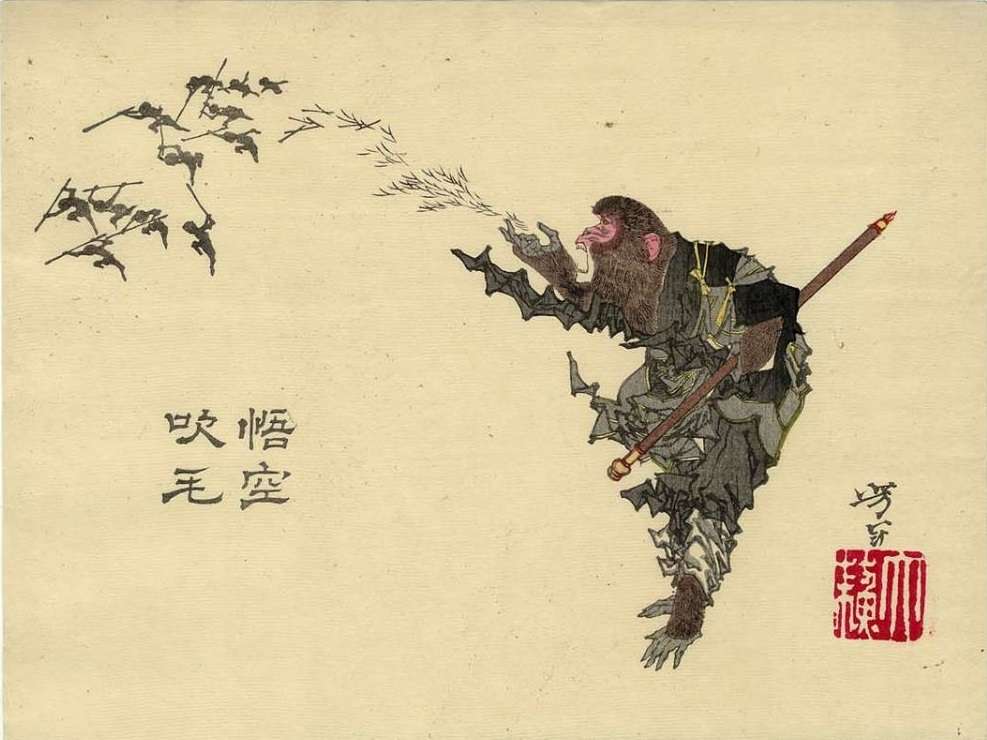
1:53 – 2:20 – Wukong lands in an explosion of multicolored clouds and light. He waves his staff in front of him, thus forcing the imps away from his brothers. He then pulls out magic hairs and blows on them, creating an army of monkeys to do battle with the imps. The monkeys do all manner of things to the imps while Wukong rolls around on the ground in laughter.
1:58 – Wukong creates the army of monkeys. Also, notice how a few seconds in the notes sound almost like monkeys.
2:21 – 2:26 – The imps run away in defeat. Monkey stands outside the cave screaming and hopping up and down while shaking his fist in order to entice the mountain demon outside.
2:23 – Double hop while shaking fist and screaming obscenities. The words come out as Chinese characters. They could be “coward” or something demeaning like that. The particular sound of “bwah bwah” in the song at this point is when he screams and hops.
2:26 – Second double hop, same.
2:27 – 2:31 – His trick works as the demon king pokes his head out of the doors and shakes his fist back at Wukong.
2:28 – First fist shake and screams obscenity. Same “bwah bwah” sound but with lower register.
2:31 – Second fist shake, same.
2:32 – 2:50 – The demon emerges with his armor and weapon ready to fight and the two begin their bout. The earth shakes, mountains crumble, forests tumble, and the gods shiver in the realm above.
2:51 – 3:08 – Both take to their clouds, the warriors circling each other, rising higher and higher into the heavens, leaving a double helix-like pattern in their wake.
3:09 – 3:12 – The demon makes one last attack with his weapon. Wukong disappears in a puff of smoke, only to reappear instantly in his 100,000-foot-tall cosmic form, breathing fire from a mouth full of tusk-like teeth, his eyes like the sun and moon. The demon realizes he is not Wukong’s match and flees in terror.
Monkey performs the cosmic transformation for his children (larger version). Original artist unknown. Found on this article.
3:13 – 3:16 – Wukong reverts to his original form and rockets towards earth with his staff held high.
3:17 – 3:21 – He lands a mortal blow to the demon and stands over his remains.
3:17 – The exact moment the demon is turned into hamburger.
3:22 – 3:24 – Wukong kicks open the double door of the mountain stronghold. The view would be from the inside out (i.e. it’s dark and then the doors are kicked inward, revealing the dark silhouette of Monkey holding his staff against a bright background).
The “boom” at the end is when he kicks in the doors.
After the song stops, the animation silently ends with them all continuing their journey to India. The entire animation would probably be around three minutes and forty seconds long. I would really love to work with an animator to make this a reality.
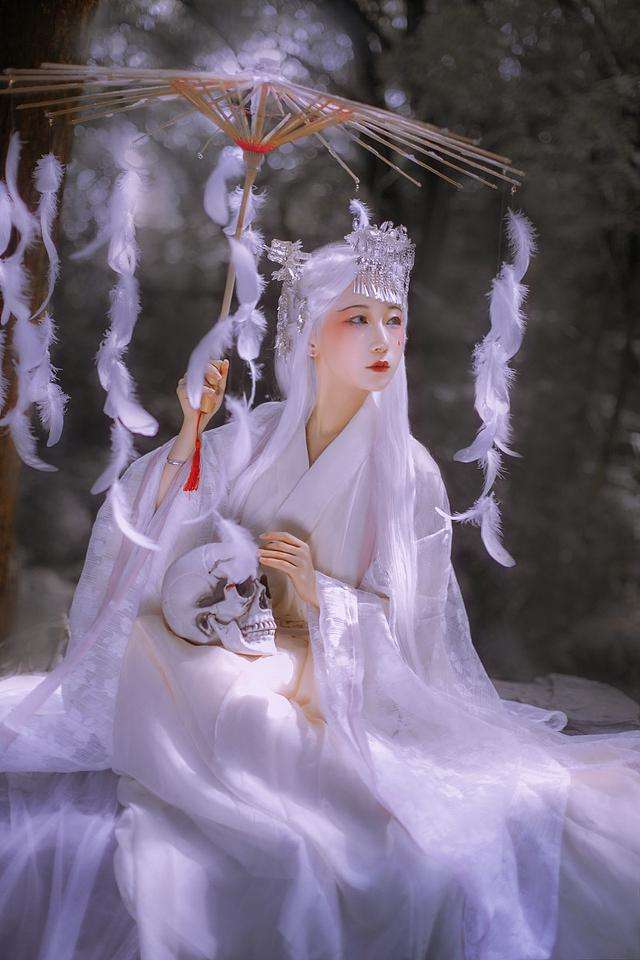
The twenty-seventh chapter of Journey to the West (Xiyouji, 西遊記, 1592) features a mountain spirit who resorts to magic disguises in an attempt to eat Tripitaka. Commonly referred to as the “White Bone Spirit” (Baigu jing, 白骨精), she is one of a family of ghouls active in White Tiger Mountain (Baihu ling, 白虎嶺) who have long told legends of the monk’s immortality-bestowing flesh (Wu & Yu, 2012, vol. 2, p. 17). She resorts to subterfuge because alone she is not powerful enough to contend with the holy man’s present disciples, Zhu Bajie and Sha Wujing.
This article will trace her origins and development, as well as highlight her appearance in one piece of popular media.
The spirit first disguises herself as a peerless beauty described as having “ice-white skin hid[ing] jade-like bones” (Wu & Yu, 2012, p. 18). She comes bearing a vegetarian meal, claiming it to be food intended for her pious husband toiling in the fields on the other side of the mountain. She instead decides to feed Tripitaka as this would allow her to keep her family’s vow of supporting monks. But before she can kidnap the monk, Sun Wukong returns from picking peaches for his master and seeing through the magic facade, seemingly kills the young girl with his magic staff. The monster, however, is able to escape in spirit at the last second using the “Magic of Releasing the Corpse” (Jieshi fa, 解屍法), [1] leaving behind a fake body in her place. The innocent-looking food is then revealed to be bewitched frogs, toads, and maggots. Despite this, Zhu Bajie convinces their master that Monkey is trying to conceal the murder with magic, leading to the monk using the Tight-Fillet spell as punishment.
She subsequently disguises herself as the girl’s elderly mother searching the mountain for her daughter. Sun again sees through the disguise and seemingly kills her with his staff. This again leads to his punishment with the Tight-Fillet spell. The White Bone Spirit’s last disguise is that of the elderly father looking for his wife and daughter. But this time Monkey calls on local deities to guard any possible escape routes, and this time, he succeeds in killing her. The spirit’s true form is revealed to be a “pile of flour-white skeletal bones” (yidui fen kulou, 一堆粉骷髏) with the name “Lady White Bone” (Baigu furen, 白骨夫人) engraved on her spine (fig. 1) (Wu & Yu, 2012, pp. 26).
The precursor of the White Bone Spirit can be traced to a demon appearing in chapter six of The Story of How Tripitaka of the Great Tang Procures the Scriptures (Da Tang Sanzang qujing shihua, 大唐三藏取經詩話, c. late-13th century), the earliest known printed edition of Journey to the West, which likely served as a prompt for ancient storytellers.
Chapter six: Passing Long Ditch and Great Serpent Peak (Guo changkeng dashe lingqu, 過長坑大蛇嶺處)
The pilgrims arrived at the valley of the fire-spitting White Tiger Spirit (Huolei ao baohu jing, 火類坳白虎精). Coming closer they encountered a great ditch. The four steep entrances were pitch-black and they heard a roar of thunder. They could not advance. The Dharma Master [Fashi, 法師, i.e. Tripitaka] held up his [magic] golden-ringed staff and, flourishing it toward the distant heavenly palace, yelled: “Devaraja! Help us in our afflictions!” Suddenly a shaft of light shot out from the staff five tricents long. It slashed through the long ditch and soon they were able to get across.
Next they came to Great Serpent Peak. There they saw a gigantic serpent like a dragon. It likewise was not harmful to humans. Then they crossed the pit of the fire-spitters. Down, down into the fiery pit they looked and saw a pile of dry bones over forty tricents long. The Dharma Master asked Monkey Pilgrim [Hou xingzhe, 猴行者]: “What are those white withered bones piled up there like snow on a mountain?” Monkey Pilgrim replied: “This is the place where the Heir Apparent, Ming Huang (‘Brightly August’), changed his bones.” [2] The Dharma Master, hearing this, joined his palms and bowed his head in reverence.
Next they suddenly came to a prairie fire which reached to the heavens. It sent off such a huge amount of smoke and sparks that the pilgrims could not proceed. The Dharma Master shone the light of his [magic] begging-bowl toward the fire and yelled: “Devaraja!” The fire died out immediately and the seven pilgrims crossed this pit. When they were halfway across, Monkey Pilgrim said: “Master, did you know this peak is inhabited by a white tiger spirit? It often appears as a vixen, demon, or goblin and even eats people.” The Master replied: “I didn’t know!” After a while they could see a spume of ominous-looking smoke rising behind the peak and from the cloud thus…fell a mixture of rain, snow, and sleet. In the cloudy mist there was a woman dressed all in white.
She wore a white bodice of gauze, a white gauze skirt with a white belt, and held in her hands a single white peony. [3] Her face was as pretty as a white lotus, her ten fingers like precious jades. Observing the form of the ogress, Monkey Pilgrim had his suspicions confirmed. “Master, don’t go any farther,” said Monkey Pilgrim. “It’s surely an ogress. Wait till I go up and ask who she is.” Monkey Pilgrim took one look at her and shouted in a loud voice: “What place are you from, demon? What shape is beneath your facade? If you are a sprite or goblin, why don’t you hurry back to your lair? If you are an ogress, hurriedly hid your traces. But, if you are the daughter of a human being, then tell me your name and surname. And be quick about it! If you procrastinate and don’t speak, I shall reduce you to dust and power!” Hearing the pilgrim’s ferocious tone of voice, the white-clad woman slowly advanced, smiled coyly, and inquired whither the master and his disciples were going. Monkey Pilgrim said: “Ask no more! We travel for the sake of the sentient beings of the Eastern Lands. And you must be none other than the White Tiger Spirit of the Fire-spitting Pit.”
Hearing this, the woman’s mouth gaped open and she screamed loudly, while at the same moment her skin burst open revealing claws, long fangs, a tail, and a feline head. She was fifteen feet long. In another instant the whole mountain was filled with white tigers. Monkey Pilgrim transformed his golden-ringed staff into a gigantic Yaksa whose head touched the sky and whose feet straddled the earth. In his hands he grasped a demon-subduing cudgel. His body was blue as indigo, his hair red as cinnabar; from his mouth a fiery gleam shot forth a hundred yards long. At the same time, the White Tiger Spirit advanced with a roar to do battle, but she was repulsed by the Monkey Pilgrim. After a short while, Monkey Pilgrim asked if the tiger spirit was ready to submit. She replied, “Never!” Monkey said: “If you will not submit, you will find an old monkey in your stomach!”
The tiger spirit heard what he said yet did not surrender right away. But no sooner had he yelled “Monkey!” than a monkey in the White Tiger Spirit’s stomach responded. The tiger spirit was forced to open her mouth and spit out the monkey. When it landed on the ground in front of her, it became twelve feet long with flashing eyes. The White Tiger Spirit spoke: “I still will not submit!” Monkey replied: “Then you will find another in your stomach!” Again, he caused the tiger spirit to open her mouth and spit out another monkey which landed in front of her. And again the tiger spirit said: “I still do not submit!” Monkey replied: “There are countless old monkeys in your stomach now, and even if you spit them out all day today until the next, all this month until the next, all this year until the next, all this life until the next, you will not be rid of them!” This made the tiger spirit angry. She was again afflicted by the Monkey when he transformed himself into a great stone in her stomach which gradually grew in size. Though she tried to spit it out, she couldn’t. Her stomach split asunder and blood poured from her seven orifices. [4] Monkey called upon the yaksa to slaughter the big White Tiger Spirit ruthlessly, and the yaksa pulverized its bones and obliterated its last vestiges.
The [Monkey Pilgrim], having withdrawn [his] magic, rested for a time before [the group] continued the journey. They left a poem:
The pit of fire-spitters and the White Tiger Spirit,
All that lot are vanquished, and peace and safety reign.
Now, the supernatural power of Monkey Pilgrim is displayed,
Protecting the monkish pilgrims across the great ditch (Wivell, 1994).
The ancient chapter has a number of details that naturally led to the development of the White Bone Spirit:
The demon is a White Tiger Spirit, hence the White Tiger Mountain mentioned in the novel.
The “piles” of the future emperor’s bones recall the “piles” of the White Bone Spirit’s bones (her true form) after she is killed by Wukong.
The White Tiger Spirit’s hunger for flesh and ability to take on any form (like “a vixen, demon, or goblin”) recalls the White Bone Spirit’s pursuit of Tripitaka and use of magic disguises.
The White Tiger Spirit’s initial disguise as a beautiful woman with a “white lotus” face and jade-like fingers recalls the White Bone Demon’s “ice-white skin” and “jade-like bones.”
4. Appearance in Popular Media
Here is the full length animated feature Sun Wukong Thrice Fights the White Bone Demon (Sun Wukong sanda Baigu jing, 孫悟空三打白骨精, 1985). It was produced twenty years after the highly popular Havoc in Heaven (Danao Tiangong, 大鬧天宮, 1965).
5. Updates
Update: 04-29-22
Shao (1997) writes: “Monkey kills the Cadaver demon three times as she manifests herself in three different forms in the symbolic sense of three cadavers which the Taoists hold accountable for voluptuary impulses” (p. 145). This makes the bone spirit an embodiment of the Three Corpses (Sanshi, 三尸).
Update: 01-31-23
I’ve used the word 髒 (zāng, “dirty”) for years now, but I never really paid attention to its components, 骨 (gǔ, “bone”) and 葬 (zàng, “bury”). It brings to mind taboos against being near or handling dead remains. This naturally reminds me of the White Bone Spirit.
Notes
1) This is related to an ancient Daoist concept called “Release by means of a corpse” (Shijie, 尸解). As far back as the Han Dynasty, immortals are described as leaving a fake corpse—sometimes a magically disguised object—behind while they ascended in secret to heaven (Kirkland, 2008).
2) This changing of bones most likely refers to some type of realized spiritual cultivation that resulted in a new, pure body for the future emperor.
3) The color white is associated with death in Chinese culture.
4) Sun Wukong defeats several monsters in Journey to the West by invading their stomach. See, for example, chapters 59, 75, and 82.
Sources
Kirkland, R. (2008). Shijie In F. Pregadio (Ed.), The Encyclopedia of Taoism (Vol. 2) (pp. 896-897). London [u.a.: Routledge].