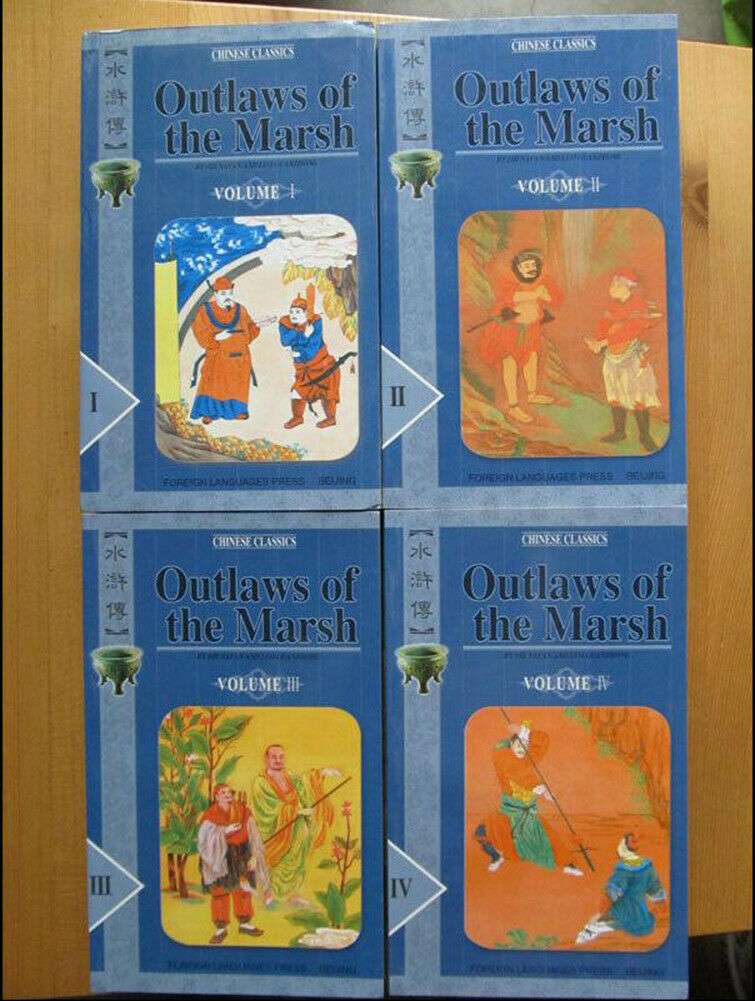
Archive #53 – PDFs of Outlaws of the Marsh (a.k.a. Water Margin) Foreign Language Press English Translation (Vols. 1-4)

Note: My blog is not monetized, so I am not making any money from this post. My hope is that the PDF will make this legendary story more accessible to a wider audience. If you enjoyed the digital version, please, please, please support the official release.

Here I present a PDF of the 100-chapter Foreign Language Press four-volume boxed set of Outlaws of the Marsh (a.k.a. Water Margin, Shuihu zhuan, 水滸傳, c. 1400; “WM” hereafter) translated by Sidney Shapiro. Credited to Shi Nai’an and Luo Guanzhong, this classic Chinese military romance follows 108 heavenly and earthly spirits-reborn-heroes who band together and use their great physical or mental strengths to rebel against the falling Song Dynasty (960–1279). Some of the surviving members later accept clemency from the government and work to fight the barbarian hordes invading China. Few survive to old age.

I’m archiving this book because it has a deep connection with Journey to the West (Xiyouji, 西遊記, 1592; “JTTW” hereafter). Here are a few examples. First, the name and number of Sun Wukong‘s “Multitude of Terrestrial Killers” (Disha shu地煞數; a.k.a. his “72 kinds of transformations,” qishier ban bianhua七十二般變化) and Zhu Bajie’s “Multitude of Celestial Rectifiers” (Tiangang shu天罡數; a.k.a. his “36 kinds of transformations,” sanshiliu ban bianhua三十六般變化) are similar to that of the spirits mentioned above. [1] In WM ch. 2, they are called the “Stars of the 36 Celestial Rectifiers and of the 72 Terrestrial Killers—a total of 108 Demon Lords” (三十六員天罡星,七十二座地煞星,共是一百單八個魔君) (Meulenbeld, 2019, p. 5; Shi & Luo, 1975/2021, vol. 1,  p. 16). [2] Second, see my previous article analyzing the parallels between the Monkey King and the bandit Wu Song (武松). See also the sister article over at the Journey to the West Library blog. And third, I’ve previously suggested that Sun’s ploy to rescue the beleaguered wife of Zhu Bajie in JTTW ch. 18 is based on an event from WM ch. 5. Both feature:

  • Young, beautiful daughters in unwanted relationships (Green Orchid vs the unnamed maiden).
  • Elderly fathers worried for their child (Mr. Gao vs Mr. Liu).
  • Evil spirit-turned-inhumanly strong, hot-tempered, heavy metal staff-wielding martial monks who come to their aid (Sun Wukong vs Lu Zhishen).
  • The monk takes the place of the woman in a darkened room.
  • The villain is beaten (Zhu Bajie vs Zhou Tong) (Wu & Yu, 2012, vol. 1, pp. 374-377; Shi & Luo, 1993/2001, pp. 109-113).

This PDF will complement the translations that I’ve previously archived. These include the JTTW story cycle (here and here), the four-volume 2000 Library of Chinese Classics Chinese-English bilingual edition of Creation of the Gods (Fengshen yanyi封神演義, c. 1620 CE), a fan translation of Journey to the South (Nanyouji南遊記, c. 1570s-1580s), and the four-volume 2001 Foreign Language Press boxed set of Three Kingdoms (Sanguo yanyi三國演義; lit: “Romance of the Three Kingdoms,” 14th century.).

Archive Link:

Click to access Outlaws-of-the-Marsh.pdf

Fig. 1 – The four covers of the boxed set edition (larger version). Image found here.

Notes:

1) Anthony C. Yu (Wu & Yu, 2012) translates these as the “Art of the Heavenly Ladle” and the “Art of the Earthly Multitude” (vol. 1, p. 122). I instead follow the translation used by Meulenbeld (2019). In regards to Tiangang (天罡), he explains: “In its exorcist manifestation, the Northern Dipper is known as gang 罡, which I translate here as ‘rectifier’ due to the ritual function it has in righting wrong” (Meulenbeld, 2019, p. 7). “Terrestrial Killers” is a direct translation of Disha (地煞).

2) Shapiro translates these as the “[t]hirty-six stars of Heavenly spirits and seventy two stars of Earthly Fiends, a total of one hundred and eight demons” (Shi & Luo, 2001, vol. 1, p. 16). Each of the 108 bandits is later associated with a particular star in WM ch. 71 (Shi & Luo, 2001, vol. 4, pp. 1499-1501; Shi & Luo, 1975/2021, vol. 3,  pp. 972-975).

Sources:

Meulenbeld, M. (2019). Vernacular “Fiction” and Celestial Script: A Daoist Manual for the Use of Water Margin. Religions10(9), 518. MDPI AG. Retrieved from http://dx.doi.org/10.3390/rel10090518.

Shi, N., & Luo, G. (2001). Outlaws of the Marsh (Vols. 1-4) (S. Shapiro, Trans.). Beijing: Foreign Languages Press. (Original work published 1993)

Shi, N., & Luo, G. (2021). Shuihu zhuan (shangzhongxia) [Tale of the Water Margin (Vols. 1-3)]. Beijing: Renmin wenxue chubanshe. (Original work published 1975)

Wu, C., & Yu, A. C. (2012). The Journey to the West (Vols. 1-4) (Rev. ed.). Chicago, Illinois: University of Chicago Press.

Archive #15 – Narrative Structure and the Problem of Chapter Nine in the “Hsi-Yu Chi”

Last updated: 04-03-2022

Readers may be surprised to learn that chapter nine of the current one hundred chapter edition of Journey to the West did not appear in the original version anonymously published by the Shidetang (世德堂) publishing house in 1592. Chapter nine of course tells the story of how Tripitaka‘s parents, his scholar-official father Chen Guangrui (陳光蕊) and mother Yin Wenjiao (殷溫嬌), meet (fig. 1); Guangrui’s murder and the pregnant Lady Yin’s kidnapping by a bandit; Tripitaka’s birth and Moses-like trip down a river (hence his nickname “River Float,” Jiang liu, 江流); his rescue, rearing, and initiation into the Buddhist order by the abbot of Gold Mountain; Lady Yin’s rescue and the bandit-turned-official’s arrest; and Tripitaka’s later reunion with his mother and father, the latter’s body having been preserved and brought back to life by heaven.

Some scholars, such as Glen Dudbridge, suggest the current ninth chapter is a forgery, having been written by one Zhu Dingchen (朱鼎臣) of Canton because it appears in his slightly later edited version of the novel titled The Chronicle of Deliverances in Tripitaka Tang’s Journey to the West (Tang Sanzang Xiyou shi ni zhuan, 唐三藏西游释尼傳, circa 1595). (See the 01-02-21 update for new information about Zhu’s version of the novel.) Other scholars posit there is internal textual evidence for a possible lost chapter and that the current ninth chapter was salvaged from these internal clues. 

Tripitaka's Parents

Fig. 1 – Tripitaka’s parents from the 1986 television show. 

Anthony Yu‘s (1975) paper “Narrative Structure and the Problem of Chapter Nine in the ‘Hsi-Yu Chi'” supplements previous analyses of said internal textual evidence. He demonstrates that references to the Chen Guangrui episode litter the book. For example, a poem in chapter twelve (ch. 11 of the original Shidetang version) reads:

Gold Cicada was his former divine name.
As heedless he was of the Buddha’s talk,
He had to suffer in this world of dust,
To fall in the net by being born a man.
He met misfortune as he came to Earth,
And evildoers even before his birth.
His father: Chen, a zhuangyuan [1] from Haizhou.
His mother’s sire: chief of this dynasty’s court.
Fated by his natal star to fall in the stream,
He followed tide and current, chased by mighty waves.
At Gold Mountain, the island, he had great luck,
For the abbot, Qian’an, raised him up.
He met his true mother at age eighteen,
And called on her father at the capital.
A great army was sent by Chief Kaishan
To stamp out at Hongzhou the vicious crew.
The zhuangyuan Guangrui escaped his doom:
Son rejoined sire—how worthy of praise!
They saw the emperor to receive his grace;
Their names resounded in Lingyan Tower.
Declining office, he chose a monk’s life
At Hongfu Temple to seek the true Way,
This old Buddha-child, nicknamed River Float,
With a religious name of Chen Xuanzang. [2]

靈通本諱號金蟬,只為無心聽佛講。
轉托塵凡苦受磨,降生世俗遭羅網。
投胎落地就逢兇,未出之前臨惡黨。
父是海州陳狀元,外公總管當朝長。
出身命犯落江星,順水隨波逐浪泱。
海島金山有大緣,遷安和尚將他養。
年方十八認親娘,特赴京都求外長。
總管開山調大軍,洪州剿寇誅兇黨。
狀元光蕊脫天羅,子父相逢堪賀獎。
復謁當今受主恩,凌煙閣上賢名響。
恩官不受願為僧,洪福沙門將道訪。
小字江流古佛兒,法名喚做陳玄奘。

Yu (1975) notes “this passage…which introduces Tripitaka to the reader, has, with the exception of one major discrepancy (i.e. the name of the monk who took in the river-borne orphan), all the crucial elements constitutive of the Chen Guangrui story” (p. 296).

After providing several more examples, he concedes external textural evidence for a lost chapter has yet to be discovered, but suggests the author-compiler of the Journey to the West was surely familiar with established Yuan-Ming dramas involving Tripitaka’s birth and life:

I think that the foregoing analysis, admittedly brief, is sufficient to show the significance, if not the indispensability, of the Chen Guangrui episode in the narrative, though as I have remarked earlier, these later allusions certainly cannot be construed as incontrovertible proofs for a “lost chapter.” The existence of such a chapter has to be established by further discovery of textual materials hitherto unknown, if such discovery is indeed still possible. It may be safely asserted, however, that the author of the hundred-chapter novel, Wu Cheng’en or whoever he might be, is thoroughly familiar with the tradition of the birth and adventures of the infant Xuanzang popularized in the dramas of Yuan and Ming China, and that he has consciously and skillfully exploited this tradition in his narrative (Yu, 1975, p. 306).

Yu (1975) goes on to counter Dudbridge’s criticism that the Chen Guangrui episode doesn’t progress the overall plot by saying it should, instead, be accepted as an “organizing principle”, one that explains the reason for the monk’s ordeals:

[T]he theme of the river and its attendant perils utilized by the author of the hundred-chapter novel reinforces the theme of Tripitaka’s this-worldly identity as the incarnation of the banished Gold Cicada. Both themes in turn support the threefold aetiology developed in the narrative for explicating the meaning of Tripitaka’s ordeals: as a form of chastisement for his preexistent transgression, as a test of endurance for the earthly pilgrim, and as an exemplum of the high cost of obtaining sacred writings from the West (p. 307).

Furthermore, he counters Dudbridge’s claim that the concept of a lost chapter would be stronger if the novel provided more than just passing references to background info of the central characters. In fact, the novel does provide lengthy info on our heroes. For example, Yu (1975) presents a very long poem from chapter nineteen detailing Zhu Bajie’s life, from his early Daoist training, achievement of immortality, and rise to heavenly rank to his drunken flirting with the moon goddess (fig. 2), banishment from heaven, and mistaken reincarnation on earth as a pig-man.

Zhu Bajie-Chang'e stamp

Fig. 2 – a Taiwanese stamp featuring Zhu Bajie and the moon goddess Chang’e.

In the end, Yu (1975) states Qing-era editors of the novel were justified in their suspicion of a lost chapter given the lack of detailed info about Tripitaka’s life, unlike the other pilgrims:

In the absence of chapter 9, Tripitaka is the only member of the pilgrimage, in fact, whose origins are presented in the manner which Dudbridge ascribes to the disciples: in allusion or indirectly, in moments of retrospect. The early editors of the Xiyouji, therefore, were not wholly unjustified in their protest that a theme of such significance as the Chen Guangrui story had not been more fully accounted for by antecedent narrative (p. 310).

Paper link:


Disclaimer:

This has been posted for educational purposes. No malicious copyright infringement is intended. Please support the official release.


Update: 01-02-21

Zhu Dingchen’s edition of Journey to the West actually predates the 1592 edition. This shows that the aforementioned internal clues in the 1592 edition are based on previous material.


Update: 12-01-21

I’ve archived a book that shows how Tripitaka’s exile from heaven is similar to ancient Greek and Egyptian beliefs.


Update: 04-03-22

I’ve posted an entry discussing the characterization of Tripitaka as a Confucian in the novel.

Notes:

1) A scholar rank. All quotes from Yu (1975) originally use Wade-Giles. I have updated them with Pinyin.

2) Yu, 1975, p. 296. See Wu & Yu, 2012, p. 275 in Yu’s updated translation of the novel.

Sources:

Wu, C., & Yu, A. C. (2012). The journey to the West: Vol. 1. Chicago, Illinois: University of Chicago Press.

Yu, A. (1975). Narrative Structure and the Problem of Chapter Nine in The “Hsi-Yu Chi”. The Journal of Asian Studies, 34(2), 295-311. doi:10.2307/2052750