Sun Wukong and Miao Folklore

Last updated: 04-26-21

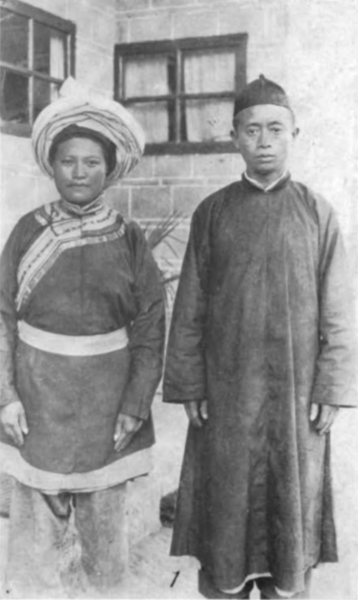
Sun Wukong appears in a body of Buddhist folklore passed on by the Miao ethnic group of Sichuan, also known as the “River Miao” (Chuan Miao, 川苗) or “Old Miao” (Miao: Hmong Bo) (fig. 1). The particular tale is quite different from the popular narrative appearing in Journey to the West (1592). For example, the unnamed monkey tends to a dragon king’s injury and later escorts a Tang dynasty emperor to India.

A Monkey Went Fishing, or Securing Buddhist Sacred Books (97)

The monkey changed into a fisherman and daily went fishing (with a line and hook). He hooked the dragon’s upper lip. When he pulled, the fishhook broke off in the dragon’s upper lip. The dragon’s lip therefore pained him every day. Then every day the dragon king called on his soldiers to go and get a doctor and heal it, but they could not find a doctor.

The monkey daily went to the sand bank to look for his fishhook. One day when he was looking for it two of the dragon king’s soldiers came and asked him, “What are you looking for?” He answered, “I am looking for medicine.” The two soldiers then said, “Old scholar, our old man’s upper lip pains him and he sent us to help him find a doctor. Can you heal him?” The monkey thought, “Probably he has been caught by my fishhook.” He then said, “I can heal it, but I must first look at the injury, then I will give the medicine.” Then the two soldiers invited him to come.

He said, “How can I go since there is so much water?” He had to go down into the water of the stream. The two men then said, “You may get under our fins and close your eyes, and do not open your eyes until we call you.” The monkey wanted to see the dragon, so he closed his two eyes. The two soldiers held him under their fins, and in a short time one of them called him, and he opened his eyes and looked.

When he opened his eyes he had already entered a fine palace. In a little while he heard the soldiers of the dragon king from both sides calling to the dragon king to come and have his wound looked at.

The monkey heard the inside gate resound, “Gu, ga.” He then saw the hands of a big man carrying the dragon king so that he could sit in the chair. Then they requested him to look at the wound. The monkey kowtowed just once to the dragon king and then looked. Then he took a pair of chop sticks and pushed aside the dragon king’s lips, and saw that the fishhook was hooked in the dragon king’s upper lip. Then he took the chopsticks and loosened the fishhook a little. He then asked the dragon king, “Is it any better?” The dragon king answered, “It is a little better.” Then the monkey sat down and rested a little. The dragon king said, “I am afraid that I will die from this illness.”

The monkey said, “You will not die from this sickness. You will certainly recover.” The dragon said, “If you are willing to heal me, I will give you whatever you want.” The monkey then used the chopsticks to push open the lips. Then he seized the fishhook with his chopsticks and with one jerk pulled out the fish book. The lip of the dragon king hurt no longer.

Then the dragon king called to his daughters to entertain the monkey fisherman. The monkey remained there several days. The dragon king was afraid that he [the monkey] was in a hurry and told his soldiers to give him some gold and silver. The monkey said, “I do not want gold and silver. I only want you to permit me to stay here a few days longer.” When the soldiers had reported this to the dragon king, he was glad to have him remain longer. He stayed several months.

One day he was visiting with the women in the palace. The monkey saw a yellow golden club. He then picked it up to play with. He struck with the golden club outside, and the club flew with him to the sea. Then he knew that this club was an ancient golden club. The dragon king did not pursue him.

The monkey lived until the Tang Dynasty, and the Tang Dynasty king wanted to go and get sacred books. But the king could not go himself because the demons and spooks were very numerous along the road. The Tang emperor then sent a messenger to call the monkey to him. The monkey said, “I cannot go. If anybody wants me to go, he must change likenesses with me, and then I will go.”

The Tang emperor himself returned, and for three years sought for a method. One day he came and said to the monkey, “Now I am able to change.” The monkey then requested the Tang emperor to change. The Tang emperor then changed into a big mountain, and the monkey went into the mountain. Then he was unable to come out again. The Tang emperor then said, “Now will you go with me?” The monkey then promised to go with him. Then the Tang emperor lifted aside the written character that had imprisoned him, and then the monkey came out. The monkey then went with the Tang emperor to the western horizon and brought back the sacred books. [79]

[Notes]

79) The Ch’uan Miao said that this is a story about a monkey of some repute, but they did not know his name. It is evidently the monkey god Sen Hou Tzu [Sun houzi, “the monkey Sun”] 孫猴子 or Sen Wu K’ung [Sun Wukong孫悟空 (Graham, 1954, p. 211).

I. Story influences

I suggest the first three-quarters of the Miao tale draws on the Asian variant of a widely known story cycle in which a fisherman is rewarded for releasing a magic fish (B375.1. Fish returned to the water: grateful, n.d.). This version sees the fisherman release a carp to later discover it was actually the transformed son of a dragon king. He is then rewarded with a magic treasure for his kindness. [1] This cycle is partially played out in another Miao legend in which a fisherman catches a fish, who turns out to be the daughter of the dragon king Ryuang Lan, and later marries her in human form (Graham, 1954, pp. 226-227). In our story, the monkey-turned-fisherman catches the dragon king and then frees him of the hook. He is subsequently rewarded with a prolonged stay in the dragon kingdom and thereafter retrieves the golden club, which is itself a magic treasure.

Miao couple (for Sun Wukong article) - small

Fig. 1 – A Miao couple (larger version). She is wearing traditional dress, while he wears that of the Chinese. From Graham, 1954, p. 125. Fig. 2 – Sun Wukong meets the dragon king Ao Guang (larger version). A screenshot from the classic Chinese animation Uproar in Heaven (1965).

Elements of the first three-quarters and all of the last quarter clearly borrow from Journey to the West. The monkey is presented as a shape-shifting immortal, for he changes into a fisherman and lives until the Tang dynasty. His aversion to water in the tale is a common trope throughout the novel, such as when Sun Wukong uses water-propelling magic or relies on others to fight water-based monsters. [2] The golden club is the Monkey King’s “As-you-will” gold-banded cudgel retrieved from the undersea dragon kingdom. This in turn identifies the dragon king as Ao Guang, the ruler of the Eastern Sea (fig. 2). The unnamed “Tang dynasty emperor”, Tang Taizong in Journey to the West, replaces the monk Tripitaka originally sent to retrieve holy scriptures. The monkey’s imprisonment inside the emperor-turned-mountain is based on Sun’s imprisonment under Five Elements Mountain in the novel, complete with a written amulet weighing the landmass down.

The monarch’s transformation into a mountain is particularly interesting to me, for I don’t recall ever reading any Asian folklore featuring such an event. I know of at least one instance of a hero in ancient European folklore being changed into a mountain as punishment (see fig. 5 in my article here). However, our tale presents the ruler’s transformation as a willing metamorphosis. The Miao consider mountains to be living beings, [3] having “heads, feet, hands, eyes, ears, hearts, breasts, veins, and arteries” (Graham, 1954, p. 9). Therefore, the mountain is a macrocosm of the human body, making the transformation one of degree and not kind. But this portion of the narrative remains a mystery to me as the original intended outcome was “switch[ing] likenesses.” I take this to mean that the monkey would look like the emperor and visa versa. Does this imply the primate was keen on usurping the throne and the monarch then used his transformation as a deterrent?

II. Monkey progenitors

The Monkey King’s inclusion in Miao folklore should come as no surprise since monkeys play an important role in their mythology. They believe humans are descended from a pair of monkeys who broke off their tails by accident and eventually evolved human features (Graham, 1954, p. 204). As explained in this article, having a monkey ancestor is a common belief among the various ethnic groups of Tibet and southwestern China. Sun Wukong also appears in the legends of the neighboring (and related) Qiang people of Sichuan.


Updated: 04-26-21

Author David Leffman was kind enough to ask his Miao friend of southeast Guizhou about this story. This is their response:

I feel personally that this story is maybe created recently by someone who want to find a reason to give better explanation of her embroidery. In our folk story we have monkey which is smart, used to play prank joke with human being Jiangyang. And Miao don’t have chronology, not even annals, never knew anything about Tang Dynasty which should be aliens for them. And in the history Miao lived away from Han Chinese, almost no contact except those who were called Shu Miao, the cooked ones in west Hunnan and some in east Guizhou, like Sheng Chongwen, the famous writer who grew up in Fenghuang ancient town. Then those Shu Miao may get some influence and confuse those Han Chinese culture as their own.

So it’s possible that the above story is a modern legend influenced by Chinese culture.

Notes

1) One version appears in the Complete Tale of Guanyin of the Southern Seas (Nanhai Guanyin quanzhuan, 南海觀音全傳), a 16th-century pious novelette detailing Guanyin’s former life as the Princess Miaoshan. After achieving enlightenment, Miaoshan/Guanyin looks to take on disciples. One is a dragon princess (longnu, 龍女) who bestows the Bodhisattva with a magic jewel for saving her brother, a dragon prince who had been caught by a fisherman while transformed into a carp (Idema, 2008, p. 31).

2) The water-propelling magic is first displayed in chapter three when Sun seeks a magic weapon from the underwater dragon kingdom (Wu & Yu, 2012, p. 133). An example of Monkey relying on others to fight a water-based monster happens in chapter 22 when he asks Zhu Bajie to battle Sha Wujing (Wu & Yu, 2012, p. 423).

3) According to Graham (1954), “The Ch’uan Miao regard all things as alive and sentient. The sun, moon, stars, mountains, rivers, rocks, trees, thunder, the echo, the rainbow, homes, fields, plains, recompense or karma, beds, marriage, swords, the harvest, the year…the ceremonial drum, and even the sound of the ceremonial drum are considered to be living things” (p. 9).

Sources

B375.1. Fish returned to the water: grateful (n.d.). S. Thompson. Motif-index of folk-literature. Retrieved from http://www.ruthenia.ru/folklore/thompson/index.htm.

Graham, D. C. (1954). Songs and stories of the Chʻuan Miao. Washington: Smithsonian Institution. Retrieved from https://babel.hathitrust.org/cgi/pt?id=inu.39000005872432;view=1up;seq=7

Idema, W. L. (2008). Personal salvation and filial piety: Two precious scroll narratives of Guanyin and her acolytes. Honolulu: University of Hawaii Press.

Wu, C., & Yu, A. C. (2012). The journey to the west: Vol. 1. Chicago, Ill: University of Chicago Press.

Sun Wukong and the Qiang Ethnic Group of China

Last updated: 08-02-2019

The Qiang (Ch: 羌; Qiangic: Rrmea) ethnic group have been mentioned in Chinese records as far back as the oracle bones of the Shang Dynasty (17th to 11th-century BCE). Originally inhabiting the northern reaches of China, these sheepherders and warriors were driven southwest over many centuries of conflict with neighboring ethnic groups, as well as the Chinese. Many Chinese dynasties attempted to assimilate them, but the Qiang have resisted up to the present. Today, they live in western Sichuan near the Tibetan border and are listed among the 56 recognized ethnic groups of China (Yu, 2004, pp. 155-156; Wang, 2002, pp. 133-136).

What’s interesting about the Qiang for the purposes of this blog is that both magic monkeys and heavenly stones, and even Sun Wukong himself, play a part in the people’s religious mythology.

Map of China showing location of Sichuan Province, home to Qiang ethnic group, some of whom worship Sun Wukong

Fig. 1 – A map of China showing the location of Sichuan province in red. Larger version available on wikicommons.

I. Monkeys and Qiang shamanism

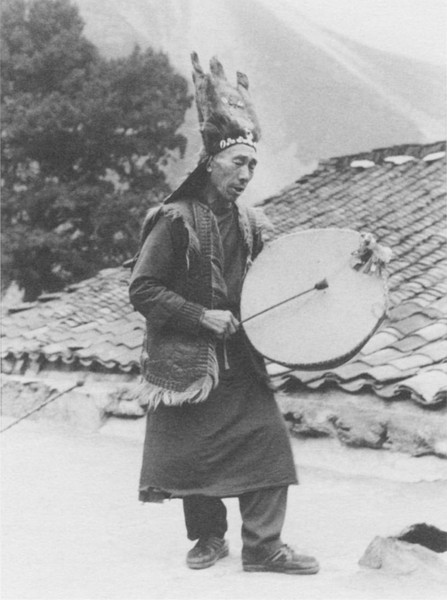
Shamans (Ch: Duan gong, 端公 or Wu, 巫j; Qiangic: Shüpi) are the heart of Qiang religious life. During special ceremonies, they wear three-peaked hats (fig. 2 and 3) made from the fur of golden monkeys (fig. 4), each peak respectively representing the deities of heaven, earth, and shamanism (more on the latter below). [1] These hats are especially worn during exorcisms because the monkeys are considered “the purest of animals, [which stand] in extreme contrast to the vilest of beings—the demons” (Oppitz, 2004, p. 13). There are several legends, with many variants, explaining the origins of the headdress. One version states:

[T]he Qiangs used to have a written language, and their patriarch recorded the scriptures he obtained from the gods and other important writings on human affairs on the bark of birch trees. One day when he took out the pieces of bark to be aired, a mountain sheep came and ate them all. With the help of a golden monkey the patriarch captured the guilty sheep and made its skin into a drum. When he beat on the drum he was able to recall the words written on the birch bark. To prevent future mishaps to these precious documents, he memorized them by heart (Yu, 2004, p. 160).

So in essence the hats are worn to commemorate the assistance of the golden monkey. Interestingly, another version replaces the patriarch and golden monkey with Tripitaka and Sun Wukong:

A long time ago, in the Tang period, there was a monk by the name of Tang Seng [唐僧, “Tang Monk”], who undertook a journey to the western skies in the company of a monkey named Sun Wukong, in order to collect sacred scriptures. On their way back, they encountered a sheep ghost who ate all the newly acquired scriptures. The monkey got very angry, killed the sheep ghost, and used its skin to fabricate a drum. Thereupon Tang Seng and the monkey met with the Eighteen Arhats … Listening to their teachings, Tang Seng picked up the sheep-skin drum and repeated all that he heard through their mouths. Since then all shamans use a drum when reciting their knowledge from memory (Oppitz, 2004, p. 23).

Qiang shaman hat and goldn monkey

Fig. 2 – The three-peaked golden monkey skin shaman hat. From the Sichuan University Museum. Larger version on wikipedia. Fig. 3 – A shaman wearing the headdress and playing the ritual sheep skin drum (larger version). Original photograph by Michael Oppitz. From Oppitz, 2004, p. 14. Fig. 4 – A golden monkey with child. Larger version on wikipedia.

The golden monkey is closely associated with the Qiang’s pantheistic worship of sacred white stones, each one representing the gods of heaven, sun, fire, mountains, rivers, and trees. [2] Yu (2004) provides another legend for the origins of the Shaman’s hat, describing how the monkey is the offspring of the sacred stone and noting parallels with the birth of Sun Wukong:

Another legend depicts the golden monkey as a Prometheus-like figure who stole fire from heaven. The first two attempts failed because the god of wind and the god of rain extinguished the fire, but the monkey succeeded the third time by concealing the fire in a white stone. It is worth noting that in this legend the golden monkey is closely related to the white stone. In the Qiang language, the first syllables in the names of the monkey’s mother and father mean respectively “stone” and “fire.” “This implies that fire is produced by stone and hidden inside the stone, and that the half-human, half-simian golden monkey was an offspring of the union between stone and fire”. The white stone and the golden monkey, as the source of fire and the messenger who brought it to the human world, became the totems of the Qiang people. To commemorate the recovery of the lost scriptures, wearing the monkey hat and playing the sheepskin drum also became an indispensable part of Sacrifice to the Mountain[, a Qiang ceremony]. However, the monkey legend is not particular to the Qiang people. The Yi minority people of northwestern Guizhou province have a nuo drama known as bianren xi (changing-into-people drama) based on a legend that people derived from monkeys. Actors wear monkey masks for this performance. There is also the famous monkey, Sun Wukong, who was born from a stone in the Han Chinese novel Xiyou ji (Journey to the West, 1592) by Wu Chengen (ca. 1506-1582). [3] The novel was first published in 1592, but the monkey lore included in it was of much earlier time (p. 160).

A celestial, stone-born monkey who steals from heaven certainly sounds like the Monkey King. As noted here, stories about Sun Wukong have been circulating in Asia for a millennia. So it seems only natural that the Qiang’s reverence for heavenly stones and monkeys would lead to some of them worshiping the beloved cultural figure.

Graham (1958) notes that Sun Wukong and Sha Wujing figure among the Chinese patron deities of the “red” shamans (p. 53). [4] What’s interesting is that the red shamans are said to speak a special demon language and use their skills to exorcise demons (p. 54). Therefore, their worship of the Monkey King should come as no surprise considering Sun Wukong is the exorcist par excellence.

As noted above, one of the peaks of the ritual headdress represents the patron deity of shamanism. Known among other names as the Abba mula (“father god”; Ch: Aba muna, 阿爸木纳), this is the title given to the shaman’s main focus of worship. For instance, Sun Wukong is the Abba mula of those who revere him. Most importantly, the chosen deity is further represented by a small bundle that the shaman carries with him and guards jealousy, as it is the source of his knowledge and power. Graham (1958) describes the sacred bundle’s importance, construction, and use:

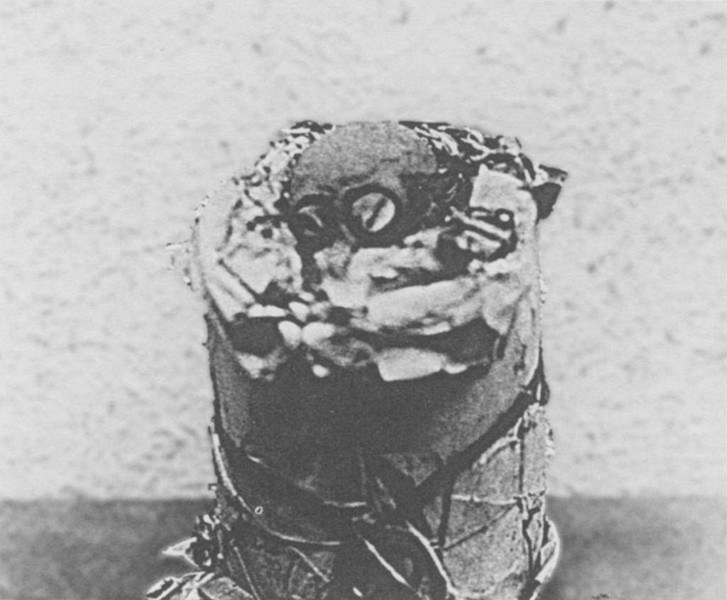
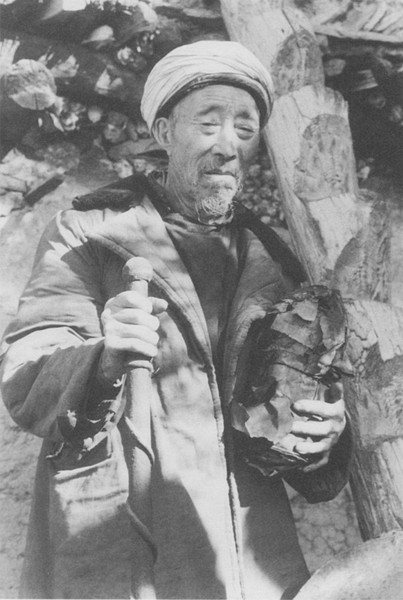
He is the patron or guardian deity and instructor of the Ch’iang priest, and without him the priest could do nothing. It consists of a skull of a golden-haired monkey wrapped in a round bundle of white paper. Its eyes are old cowry shells or large seeds. Inside are also dried pieces of a golden-haired monkey’s lungs, intestines, lips, and fingernails. It is so wrapped that the face of the skull is visible at one end, and the other end is closed [fig. 5 and 6]. After each ceremony in the sacred grove, [5] the priest wraps another sheet of white paper around it, so that it gradually increases in diameter. Some priests will not allow another person to touch his Abba Mula and only the priest worships this god (pp. 51-52).

I mention this because there are no doubt sacred bundles representing Sun Wukong, which are used under his supernatural guidance.

Qiang abba mula bundle and shaman holding one

Fig. 5 – The Abba mula bundle. Note the visible monkey skull with cowry shell eyes (larger version). Original photograph by Wolfgang Wenning. Fig. 6 – A Qiang shaman carry a bundle and sacred cane (larger version). Original photograph by Michael Oppitz. Both images are from Oppitz, 2004, p. 41.

Oppitz (2004) explains that stories alluding to Sun Wukong appear in Qiang pictorial divination books. Furthermore, he suggests that the ritual of wrapping the Abba mula bundle with additional paper represents the lost written knowledge saved by the Monkey King / golden monkey, which is now passed on orally.

In Qiang divination books the monkey features in various passages. In one book the picture of a monkey alludes to a story in which he destroys a heavenly palace; another book addresses a monkey’s trip to a western land, where he acquires written texts. In both cases the monkey Sun Wukong of popular literature and protagonist of the novel Xi yu ji, who escorts the Tang pilgrim Xuanzang, stands as the model. This character’s association with the acquisition of books and the role a golden-haired monkey plays in a Qiang myth as the inventor of the drum replacing the lost scriptures, suggests that the paper which is wrapped around the venerated monkey skull may also be interpreted as a hint to the conflict between scriptural versus oral tradition at the intersection of which the monkey stands as a mediator (p. 42).

II. Monkeys and the Qiang origin myth

Called “Mutsitsu and Tugantsu” (Ch: Mujiezhu yu Douanzhu, 木姐珠與斗安珠), the Qiang origin myth centers around the romance of Mutsitsu, the daughter of the supreme god Abamubi (or Mubita), and the earthbound monkey Tugantsu. The latter saves the goddess from a ferocious tiger when she visits the mortal world and both instantly fall in love. She brings him to the celestial realm, where Abamubi only agrees to their marriage if Tugantsu can successfully complete a series of impossible herculean tasks. These include falling the trees of ninety-nine mountains, burning the trees, and using the arable land to plant a crop of corn (other sources say grain); but each time Mutsitsu secretly enlists the aid of fellow gods to insure the tasks are completed on time. During the burning of the forest, Tugantsu’s fur is singed, revealing him to be a handsome man. In the end, the supreme god agrees to their marriage and Mutsitsu and Tugantsu become the progenitors of mankind. [6]

Academia Sinica (n.d.) comments that some Qiang communities who revere Chinese gods often equate Abamubi with the Jade Emperor of Daoism and Tugantsu with Sun Wukong. I find this especially fascinating as the Monkey King then becomes a sacred protoplast.

Tibetan origin myth painting - Monkey and Ogress - small

Fig. 7 – A modern painting showing the monkey and rock ogress of Tibetan myth (larger version). Original from Wikipedia.

In addition, Academia Sinica (n.d.) explains this “monkey transforming into human” motif (i.e. Tugantsu becoming a man) has similarities with Tibetan mythology, for the Qiang live in close proximity to the people of Tibet. This refers to the Tibetan origin myth in which the Bodhisattvas Avalokitesvara (the Indo-Tibetan variant of Guanyin) and Tara are respectively reborn on earth as a monkey and his wife, a rock ogress (fig. 7). (Again, the association between the monkey and rock reminds one of Sun Wukong.) The union produces six half-human half-monkey children, from which originate the six original tribes of Tibet. These children and their offspring eventually evolve human features (Stein, 1972, pp. 37 and 46).

III. Conclusion

The religious mythology of the Qiang ethnic group of China pays reverence to both heavenly monkeys and sacred stones. Examples include stories about a golden monkey born from a stone who both bestows fire on man and creates the sheepskin drum needed to recover lost scriptural knowledge. Qiang communities that revere Chinese deities often replace the golden monkey with Sun Wukong, no doubt due to his birth mirroring the former’s origins. The same holds true for the Qiang origin myth in which a goddess and monkey-turned-man become the progenitors of mankind. The Monkey King is sometimes equated with the father, transforming him from a literary character and cultural figure into a sacred protoplast. Interestingly, the monkey-rock and monkey-to-man motifs have connections to a wider myth cycle present in Tibet.

Some shamans (Qiangic: Shüpi) specializing in exorcism worship our hero as their patron deity, or Abba mula (“father god”). Such deities are given form as a bundled monkey skull successively wrapped in white paper. This sacred object is considered the source of the shaman’s power. It’s possible the wrapping paper references the lost scriptural knowledge that Sun Wukong/the golden monkey helped recover.

To my knowledge, most of what has been written about the Qiang, and by extension their connection with Sun Wukong, was collected by ethnographers during the 20th and 21st centuries. Considering the Qiang have no written language (hence the importance of oral knowledge), it’s impossible to say how far back this connection goes. But as noted in this article, the Monkey King has been worshiped by the Chinese since at least the 17th-century. So the Qiang reverence for Sun Wukong could also be centuries old.


Update: 04-19-2019

Sun Wukong also appears in the folklore of the neighboring (and related) Miao ethnic group. The Miao also believe man derives from monkeys.

Sun Wukong and Miao Folklore


Update: 08-02-2019

Rockhill (1891) provides a complete translation of the Tibetan monkey-ogress origin myth taken from the Mani Kambum (12th to 13th-century), a collection of Tibetan Buddhist texts centered around Avalokitesvara. [7] The translation is too long to transcribe here, so I have made a PDF of the relevant pages. It’s interesting to note that the Bodhisattva Hilumandju, the protagonist, is a monkey king with magic powers. 

Archive link

Click to access the-land-of-the-lamas-notes-of-a-journey-through-china-mongolia-and-tibet-1891-by-william-woodville-rockhill-rock-ogress-and-a-monkey-info-pages-extracted.pdf

Hilumandju and Hanumanji are quite similar, as noted by other writers (Chattopadhyaya & Chimpa, 2011, p. 152). The Tibetologist Per K. Sørensen notes “the idea of an ape-gestalt in this myth is directly associated with or inspired by the ape-king … and champion … Ha-lu ma-da = Hanümän, the resourceful figure and protagonist known from Välmlki’s Rämäyana, a tale of considerable popularity already in the dynastic period in Tibet” (Bsod-nams-rgyal-mtshan & Sørensen, 1994, p. 127, n. 329).

Additionally, the Chinese of Sichuan also have stories regarding primates fathering human children. A body of Han and Tang dynasty tales that heavily influenced the creation of Sun Wukong describes magic white apes (baiyuan, 白猿) kidnapping and impregnating young woman. One example appears in both Zhang Hua’s Encyclopedic Records of Things (Bowuzhi, 博物志, c. 290) and the Records of Spirits (Soushenji, 搜神記, c. 340):

In the high mountains of southwestern Shu [Sichuan and Tibet] there is an animal resembling the monkey. It is seven feet in height, it can imitate the ways of human beings and is able to run fast in pursuit of them. It is named Jia-guo 猳國 or Ma-hua 馬化; some call it Jue 貜. It watches out for young women travelling on the road and seizes and bears them away without anyone being aware of it. If travelers are due to pass in its vicinity they lead one another by a long robe, but even this fails to avert disaster. The beast is able to distinguish between the smell of men and women and can thus pick out the women and leave the men. Having abducted a man’s wife or daughter it makes her its own wife. Women that fail to bear its children can never return for the rest of their lives, and after ten years they come to resemble the beast in appearance, their minds become confused, and they no longer think of return. Those that bear sons return to their homes with the infants in their arms. The sons are all like men in appearance. If any refuse to rear them, the mothers die. So the women go in fear of the beast, and none dares refuse to bring up her son. Grown up, the sons are no different from men, and they all take the surname Yang 楊, which is why there are so many people by that name now in the south west of Shu: they are mostly descended from the Jia-guo or Ma-hua (Wu, 1987, pp. 91-92).

I find the last part fascinating because it states the inhabitants of the Sichuan-Tibet region were fathered by the ape. This recalls the Tibetan, Qiang, and Miao tales of humans descending from monkeys. It also suggests the aforementioned ethnic stories about a primate progenitor stretch back to the early part of the first millennium.

Notes:

1) Graham (1958) notes the headdress is one of eleven sacred implements of the Qiang shaman. He provides a detailed description of the hat’s significance.

This is made of a golden-haired monkey skin and is believed to be very efficacious, greatly adding to the dignity and potency of the priest and his ceremonies. The eyes and ears of the monkey are left on, and the tail is sewed on at the back. The eyes enable the hat to see and the ears to hear, and add to the efficiency of the hat. The tail also adds to its efficiency. The front of the hat is ornamented with old cowry shells arranged in ornamental designs, one or two polished white bones that are said to be the kneecaps of tigers, and sometimes with carved sea shells. These ornaments improve the looks of the hat and also add to its efficiency. Other ornaments believed to add efficiency when used are two cloth pennants, one or two small circular brass mirrors, and one or two small brass horse bells much like sleigh bells, on which the Chinese character wang 王 meaning king is carved. Near Wen-ch’uan the priests sometimes assist the magistrate in praying for rain and in turn are presented with a small, thin silver plaque to be worn on the hat, on which is stamped the Chinese word shang 賞, or “reward.” This plaque also adds dignity and efficiency (pp. 55-56).

2) The Qiang reverence for these stones is tied to the aforementioned conflict with neighboring tribes. For example, legend states the great heavenly ancestor of the Qiang sent them three white stones to aid in their battle with a neighboring tribe, transforming them into mountains from which weapons were made. Another legend claims these stones help the Qiang make fire (Yu, 2004, pp. 156-157). These white stones often appear on buildings (both temples and houses), walls, altars, and graves in Qiang society (Graham, 1958, p. 103).

3) The original paper reads, “…in the Han Chinese novel Xiyu ji (Journey to the West, 1982)…” I have corrected the typos.

4) The colors red, white, and black signify the class of magic (good vs. dark), though shamans often inhabit all three roles (Graham, 1958, p. 54).

5) Sacred groves are home to a village’s temple and white stone altar, where many rituals are performed at night and in the early morning (Graham, 1958, p. 64).

6) A Chinese version of the tale can be read here. This forum has scans of an illustrated bilingual book presenting a different version of the tale.

7) Another version of the tale appears in The Mirror Illuminating the Royal Genealogies (Rgyal rabs gsal ba’i me long, 14th-century). An annotated translation can be read in Bsod-nams-rgyal-mtshan & Sørensen, 1994, pp. 125-133.

Sources:

Academia Sinica. (n.d.). A Brief Introduction to the Qiang People – Religion. Retrieved from http://ethno.ihp.sinica.edu.tw/en/southwest/main_QI-04.html

Bsod-nams-rgyal-mtshan, & Sørensen, P. K. (1994). The mirror illuminating the royal genealogies: Tibetan buddhist historiography : an annotated translation of the XIVth century Tibetan chronicle: rGyal-rabs gsal-ba’i me-long. Wiesbaden: Harrassowitz.

Chattopadhyaya, A., & Chimpa. (2011). Atīśa and Tibet: Life and works of Dīpaṃkara Śrījñāna (alias Atīśa) in relation to the history and religion of Tibet, with Tibetan sources. Delhi: Motilal Banarsidass Publishers.

Graham, D. C. (1958). The customs and religion of the Ch’iang. Washington: Smithsonian Institution. Retrieved from https://repository.si.edu/bitstream/handle/10088/22946/SMC_135_Graham_1958_1_1-110.pdf?sequence=1&isAllowed=y

Oppitz, M. (2004). Ritual objects of the Qiang shamans. Res: Anthropology and aesthetics, 45, 10-46. Retrieved from https://www.journals.uchicago.edu/doi/pdfplus/10.1086/RESv45n1ms20167620

Rockhill, W. W. (1891). The land of the lamas: Notes of a journey through China, Mongolia and Tibet with maps and illustrations. New York: Century Co.

Stein, R. A. (1972). Tibetan civilization. Stanford, Calif: Stanford University Press.

Wang, M. (2002). Searching for Qiang culture in the first half of the twentieth century. Inner Asia, 4(1), 131-148. Retrieved from http://www.jstor.org/stable/23615428

Wu, H. (1987). The earliest pictorial representations of ape tales: An interdisciplinary study of early Chinese narrative art and literature. T’oung Pao LXXIII, pp. 86-112.

Yu, S. (2004). Sacrifice to the Mountain: A Ritual Performance of the Qiang Minority People in China. TDR 48(4), 155-166. Retrieved from http://www.jstor.org/stable/4488600

Sun Wukong’s Strength-Bestowing Ritual

Last updated: 05-15-2025

In chapter 88 of Journey to the West (Xiyouji, 西遊記, 1592), the pilgrims arrive in the lower Indian prefecture of Jade Flower District (Yuhua xian, 玉華縣), which strikes Tripitaka as a spitting image of the Tang Chinese capital of Chang’an. There, the disciples’ monstrous appearance rouses the local ruler’s three sons to action against what they think are demons come to harm their father. However, they soon learn Monkey, Pigsy, and Sandy are celestial warriors possessing magical versions of their mere earthly arms (two staves and a battle rake). The three princes are later accepted as disciples, the oldest wanting to learn Monkey’s techniques and the second and third oldest wanting to learn from Pigsy and Sandy in turn. But when they fail to lift the monks’ celestial weapons, Monkey performs an arcane ritual in which he bestows each prince with superhuman strength:

In a secluded room behind the Gauze-Drying Pavilion, Pilgrim traced out on the ground a diagram of the Big Dipper. Then he asked the three princes to prostrate themselves inside the diagram and, with eyes closed, exercise the utmost concentration. Behind them he himself recited in silence the true sayings of realized immortality and intoned the words of Dharani as he blew divine breaths into their visceral cavities. Their primordial spirits were thus restored to their original abodes. Then he transmitted secret oral formulas to them so that each of the princes received the strength of tens of thousands of men. [1] He next helped them to circulate and build up the fire phases, as if they themselves were carrying out the technique for shedding the mortal embryo and changing the bones. Only when the circulation of the vital force had gone through all the circuits of their bodies (modeled on planetary movements) did the young princes regain consciousness. When they jumped to their feet and gave their own faces a wipe, they felt more energetic than ever. Each of them, in fact, had become so sturdy in his bones and so strong in his ligaments that the eldest prince could handle the golden-hooped rod, the second prince could wield the nine-pronged muckrake, and the third prince could lift the fiend-routing staff (Wu & Yu, 2012, vol. 4, pp. 202-203).

行者才教三個王子都在暴紗亭後,靜室之間,畫了罡斗。教三人都俯伏在內,一個個瞑目寧神。這裡卻暗暗念動真言,誦動咒語,將仙氣吹入他三人心腹之中,把元神收歸本舍。傳與口訣,各授得萬千之膂力,運添了火候,卻像個脫胎換骨之法。運遍了子午周天,那三個小王子方才甦醒,一齊爬將起來,抹抹臉,精神抖擻,一個個骨壯筋強:大王子就拿得金箍棒,二王子就掄得九齒鈀,三王子就舉得降妖杖。

I. Explanation

1. “Pilgrim traced out on the ground a diagram of the Big Dipper.”

The Big Dipper (gang dou, 罡斗), also known as the Northern Dipper (beidou, 北斗), is a pattern of seven stars associated with the constellation Ursa Major (fig. 1). Daoism considers the pole star of this pattern to be the center of the cosmos through which emanates “primordial breath” (generative qi), which has long been deified as the great god Taiyi. The constellation is associated with a Daoist ritual known as Bugang (步綱/罡, “Walking the Guideline”) in which a practitioner paces the Big Dipper pattern with their feet on the ground. This ritual dance is synonymous with the much older shamanistic Yubu (禹步, “Paces of Yu”) used by ancient Sage Kings to conquer primordial chaos by pacing the stars and planets into motion, thereby directing the seasons and passage of time. The ritual involved pacing an inwardly spiraling circular pattern while dragging one foot behind the other in imitation of the limp adopted by Yu the Great after over-exerting himself quelling the fabled World Flood (fig. 2). Later Daoists viewed Yubu as a means of gaining immortality because the limping, three pace-style walking pattern symbolized the practitioner spanning the three realms of Earth, Man, and finally Heaven (this has an interesting Vedic correlation). [2] But, most importantly, by the Tang and Song dynasties, Bugang served the purpose of purifying the area before an altar, ensuring the liturgy to follow takes place in a consecrated space. In fact, some sources interchange the characters for Bugang with the homonyms 布剛, meaning “distributing strength,” which denotes the demonifugic properties of the dance (Andersen, 1989). Therefore, Monkey draws the Big Dipper talisman on the ground in order to create a sacred space free of any negative influences.

Fig. 1 – The location of the Big Dipper in relation to the Ursa Major constellation (larger version). Originally from this Futurism article. Fig. 2 – A diagram showing the inwardly spiraling pattern of Yubu (top) and the dipper pattern of Bugang (bottom) (larger version). Take note of the spiral’s limping, three pace-style walking pattern. Originally found on this wordpress article.  

2. “Then he himself recited in silence the true sayings of realized immortality and intoned the words of Dharani…”

The “true sayings” (zhenyan, 真言) is the Chinese term for Mantra, meaning “spell” or “magical formula.” A mantra is “a syllable or series of syllables that may or may not have semantic meaning, most often in a form of Sanskrit, the contemplation or recitation of which is thought to be efficacious” (Buswell & Lopez, 2014, p. 529). The most famous mantra is of course Om Mani Padme Hum, the very same six-syllable prayer that was used to weigh down the mountain holding Monkey prisoner for rebelling against heaven.

The “true sayings” is often used as an abbreviation for Dharani (tuoluoni/zongchi, 陀羅尼/總持), a Sanskrit term meaning “mnemonic device” (fig. 3). Like mantras, dharani are comprised of syllables, but these instead serve to remind practitioners of broader concepts, for example a single syllable representing the first letter of a much longer phrase. There exists four types of dharani said to be used by Bodhisattvas to achieve enlightenment: 1) those used for teaching interpretations of Buddhist law; 2) those used for understanding the exact meaning of important words; 3) those used for casting spells; and 4) those used for spiritual endurance in the face of suffering (Buswell & Lopez, 2014, pp. 241-242). The third type, which concerns us, falls under a category of sutra recitation called Paritta (minghu/minghu jing, 明護/明護經), which is Pali for “protection.” The historical Buddha is known to have delivered paritta verses, including those for “protection from evil spirits, the assurance of good fortune, exorcism, curing serious illness, and even safe childbirth” (Buswell & Lopez, 2014, p. 630).

In both cases zhenyan/mantra and dharani refer to magical formulas of sorts and were no doubt chosen because they gave the ritual an heir of arcane authenticity. Additionally, I suggest the use of dharani may have also been chosen to denote a spell of protection, as in Sun wanted to protect the princes during the transformation of their bodies.

(Note 06-15-19: Feng Dajian of Nankai University notified me via Twitter that he disagrees with Anthony C. Yu’s 2012 revised translation (cited above) associating the “True Sayings” with the Buddhist Dharani. This is because he feels the ritual is overtly Daoist, noting that the religion also has its own True Sayings.)

Fig. 3 – A Dharani print from the late Tang Dynasty. Original from Wikicommons.

3. “…as he blew divine breaths into their visceral cavities. Their primordial spirits were thus restored to their original abodes.”

Journey to the West translator Anthony C. Yu (Wu & Yu, 2012) notes this section “is an abbreviated or paraphrastic account, in fact, of the neidan (internal or physiological alchemy process)” (vol. 4, p. 396, n. 8). Monkey already went through this process in chapter two when he practiced a series of breathing and energy circulation exercises that resulted in his immortality. Therefore, he uses his own hard-won “divine breath” or “immortal energy” (xianqi, 仙氣) to fortify the princes’ bodies by drastically speeding up the years-long process of internal cultivation to only a matter of hours or minutes. Monkey’s breath bolsters their own energy, helping them to achieve “primordial spirits” (yuanshen, 元神), a term commonly associated with Buddhahood or enlightenment. In Daoism, the term is synonymous with the attainment of immortality via the formation of a “Sacred Embryo” (shengtai, 聖胎) (fig. 4), which is forged from spiritual energies over long years of self-cultivation (Darga, 2008). This suggests that, beyond super strength, the ritual also gives them some form of immortality.

Fig. 4 – The Sacred Embryo is sometimes depicted as a baby (or in this case a Buddha) on a practitioner’s stomach (larger version). Found on this blog.

4. “He next helped them to circulate and build up the fire phases…”

The fire phases (huohou, 火候) comprise the process of circulating spiritual energy throughout the body at prescribed times (fig. 5). Monica Esposito (2008) writes there are three phases in total, making up two distinct periods of activity and rest:

The first is a phase of “yangization” in which Yang augments and Yin decreases. This is described as a warlike or martial period, corresponding to the advancement of a light called Martial Fire (wuhuo 武火) or Yang Fire (yanghuo 陽火) that purifies by burning and eliminates defiled elements to release the Original Yang and increase it. At the cosmic level, the beginning of this phase is symbolized by the winter solstice (zi 子) and by the hexagram fu 復 ䷗ (Return, no. 24), which indicates the return of Yang. This is followed by a phase of balance, a time of rest called muyu ([沐浴] ablutions). At the cosmic level, this phase is symbolized by the spring and autumn equinoxes and by the hexagrams dazhuang 大壯 ䷡ (Great Strength, no. 34) and guan 觀 ䷓ (Contemplation, no. 20). The third stage is a phase of “yinization” in which Yin augments and Yang decreases. This period, called Civil Fire (wenhuo 文火) or Yin Fire (yinfu 陰符), corresponds to a decrease of the light. The adept achieves the alchemical work spontaneously and without any effort or voluntary intervention; water descends to moisten, fertilize, and temper fire. At the cosmic level, this phase is symbolized by the summer solstice (wu 午) and by the hexagram gou 姤 ䷫ (Encounter, no. 44) (p. 531).

Mastering the complicated chronological rhythm of this process is considered the best kept secret of internal alchemy (Esposito, 2008). Therefore, Monkey navigates this temporal maze for the princes, ensuring the spiritual energy that he has helped them cultivate ebbs and flows when prescribed. Once again we see Sun has sped up a lengthy process to only a few days, hours, or minutes.

Fig. 5 – A chart showing the fire phases, the 12 phases of the moon, and the corresponding hexagrams (larger version). From Kim, 2008, p. 528.

II. Similarities to Comic Book Heroes

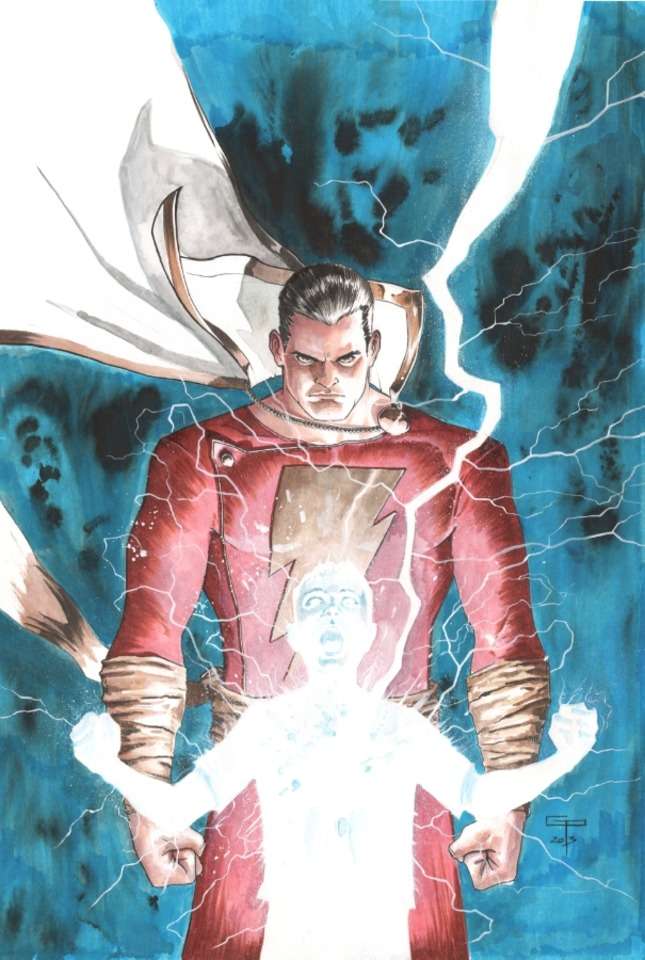
The princes in essence become the fantasy equivalent of today’s comic book superheroes. Gaining power from a divine being is similar to the concept of “Divine Empowerment” from DC Comics. A good example is Billy Batson, a.k.a. Captain Marvel (Ch: Jingqi duizhang, 驚奇隊長) (fig. 6), a child-turned-adult who receives super strength and other powers from a battery of Western gods and sages through the medium of a divine wizard.

4139607-160

Fig. 6 – The child Billy Batson transforming into the superhero Captain Marvel, also known as Shazam (larger version). Originally found on this Comic Vine article.

III. Conclusion

This fascinating strength-bestowing ritual draws on multiple aspects of Buddho-Daoist ceremony and internal alchemy. First, Sun chooses a secluded room where he traces a diagram of the Big Dipper on the floor in order to consecrate the space. Second, he recites magical spells likely intended to protect the princes during their bodily transformation. Third, Monkey uses his own divine breath to ignite their spiritual energy, manually fanning the flames to higher levels of spiritual attainment. Finally, he controls the ebb and flow of the resulting energy throughout their bodies according to a prescribed chronological rhythm. In all, Sun shortens a years-long process to only a few days, hours, or minutes. The princes come away from the ritual with superhuman strength and likely some form of divine longevity.

This whole process reminds me of the DC Comics character Billy Batson receiving divine powers through the medium of the Wizard Shazam to become Captain Marvel.


Update: 12-14-19

This is a past photomanipulation that depicts Monkey as the Wizard Shazam and the three Indian Princes as Captain Marvel. I used a golden age comic book image as the base (fig. 7).

Fig. 7 – The photomanipulation mixing Journey to the West and Captain Marvel (larger version). The original comic book image can be seen here.


Update: 07-17-22

I’ve posted an article that explores the abilities of Monkey’s immortal breath (used in the ritual above).

A Survey of Sun Wukong’s Magic “Immortal Breath” and Its Abilities


Update: 03-18-23

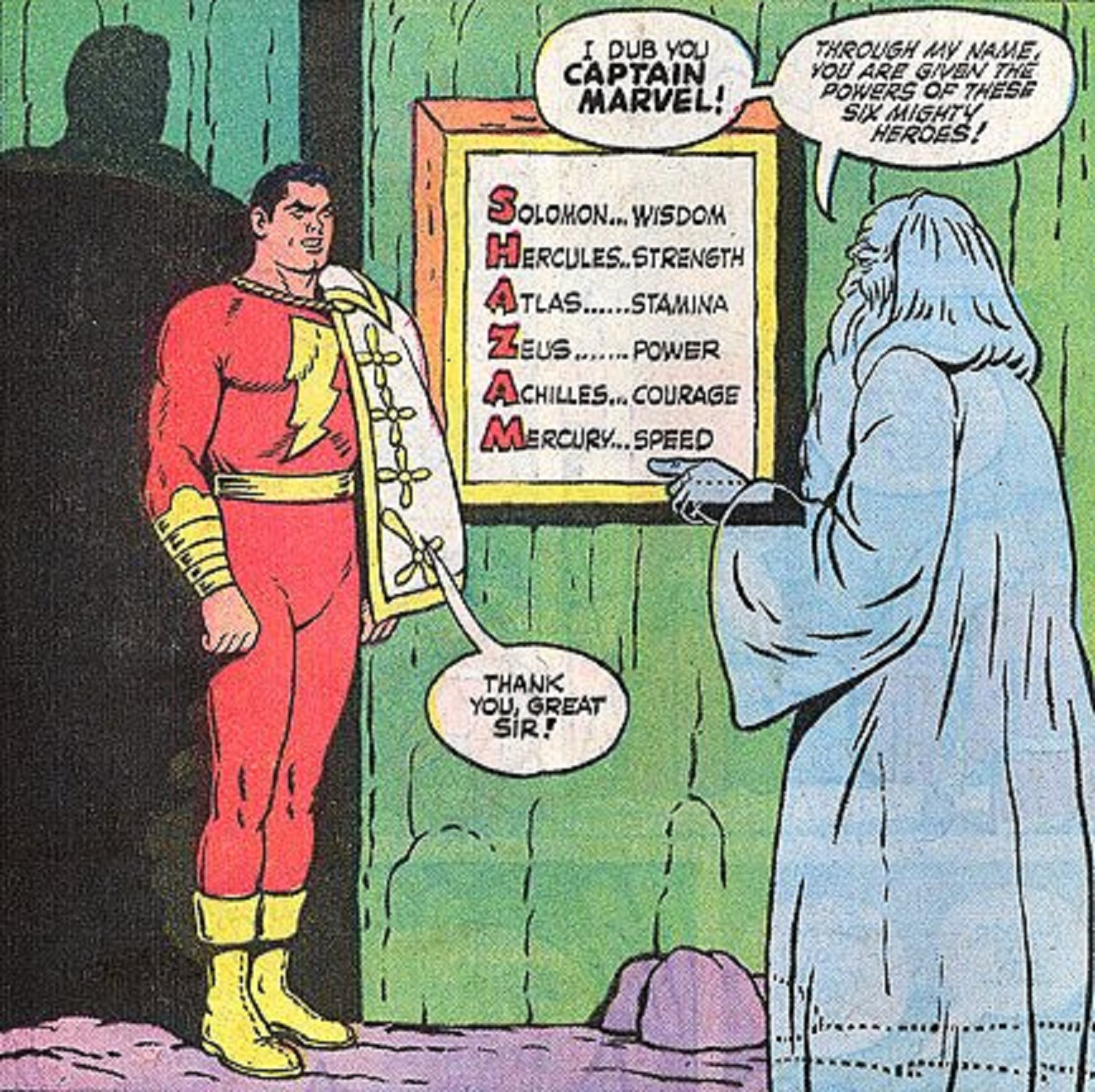
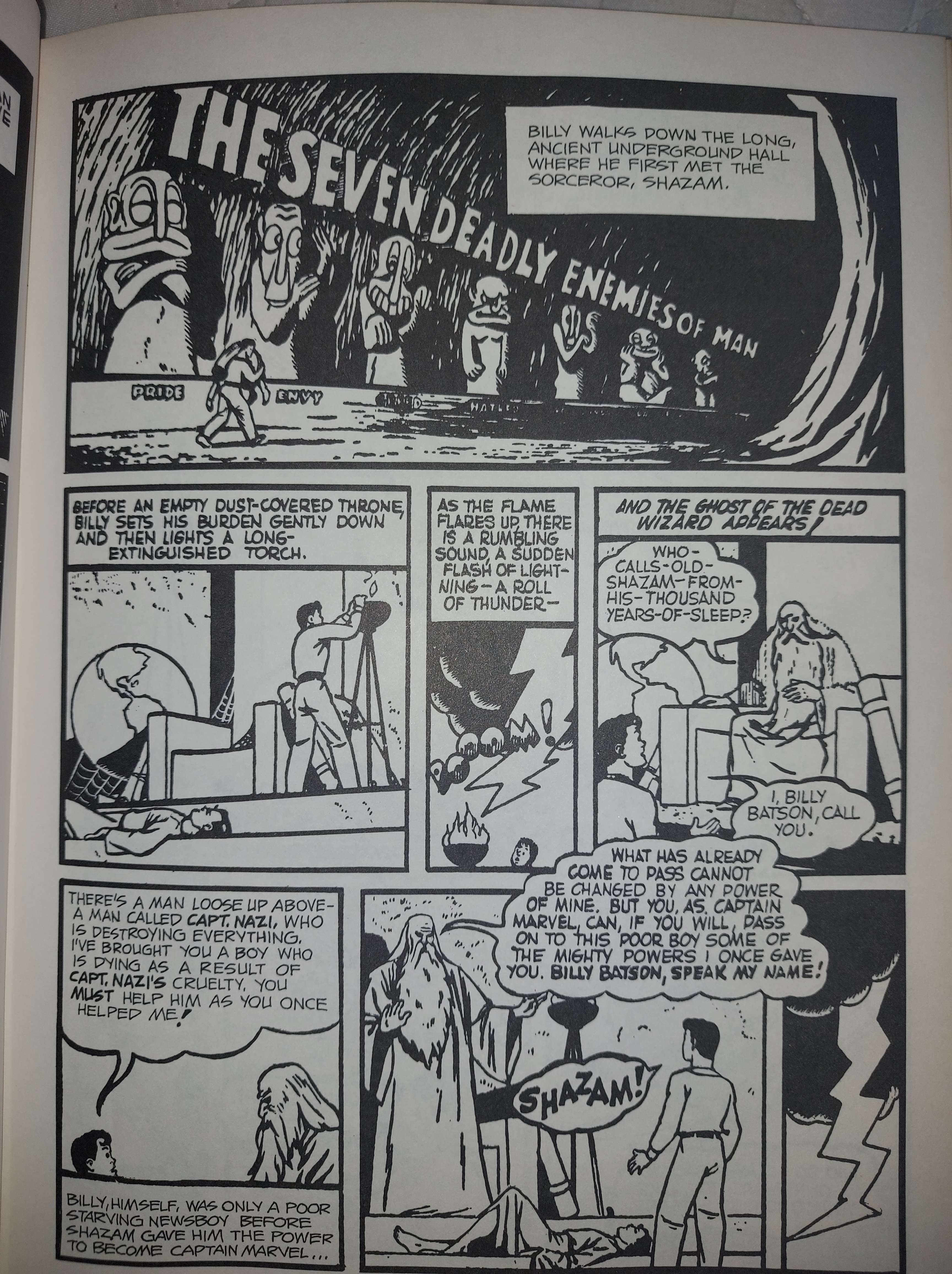
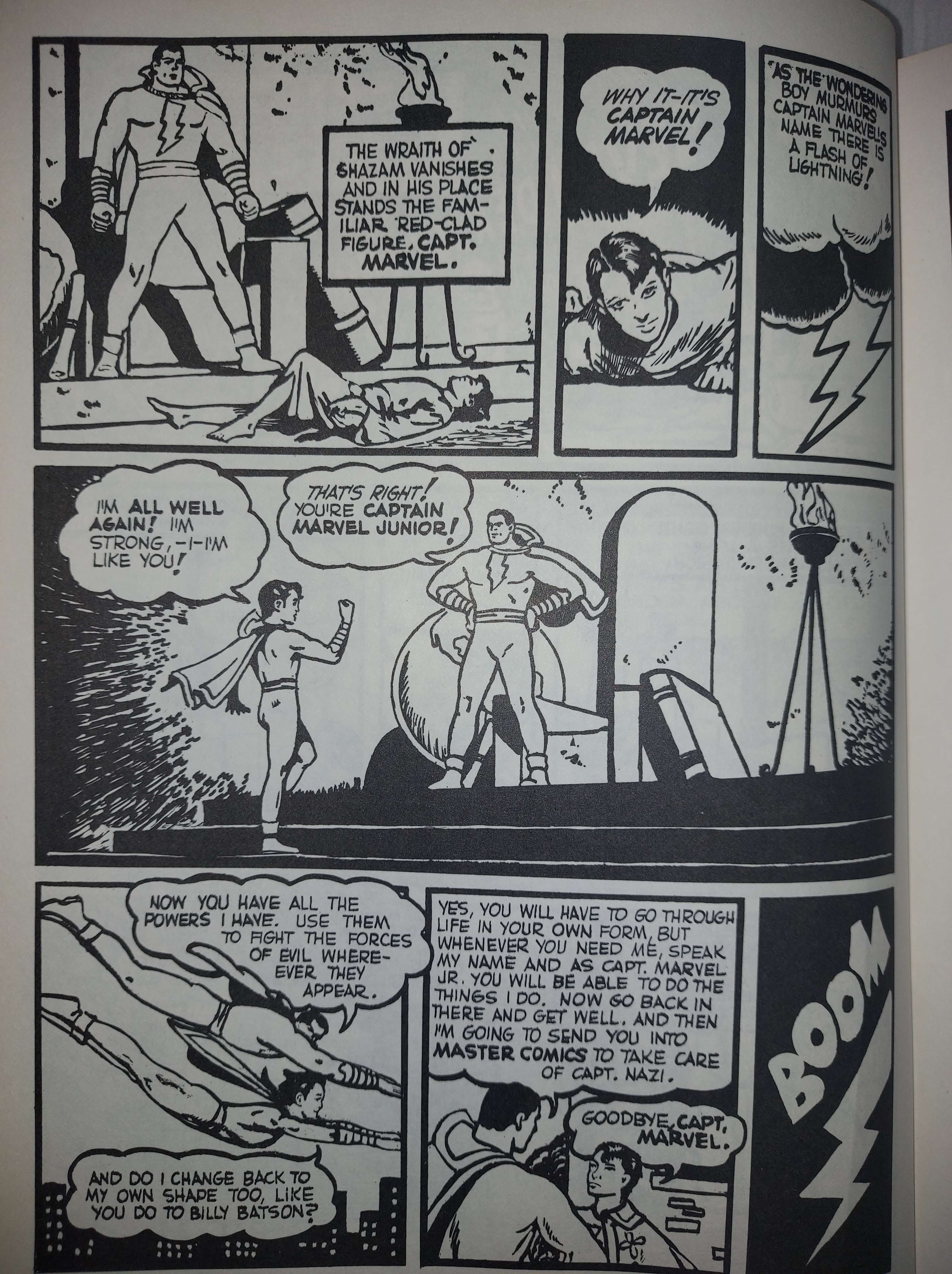
Above, I referenced Captain Marvel because he receives divine powers similar to the Indian Princes from Journey to the West. Well, the hero is also capable of sharing his abilities just like Sun Wukong! One issue has him save the life of a fatally injured boy by giving him some of his magic energy, thereby transforming him into a superhero. The boy is henceforth known as “Captain Marvel Jr.” (Ch: Xiao shengqi duizhang, 小神奇隊長) in his hero form (fig. 8-10) (Binder et. al., 1977, pp. 57-59).

Fig. 8 – Billy Batson (a.k.a. Captain Marvel) seeks help from Shazam to save the boy (larger version). Fig. 9 – Captain Marvel shares some of his power, thus saving the boy (larger version). Fig. 10 – The boy-turned-superhero vows to fight evil (larger version).


Update: 12-02-23

Someone recently asked me why the monstrous pilgrims would take human disciples in the first place. Well, this is the result of a sequence of events:

  • The young princes are amazed to see Sun, Zhu, and Sha display their martial arts skills while flying on divine clouds (fig. 11).
  • They tell their father, the sovereign prince, that they want to become their students, claiming it would allow them to protect their nation.
  • The monarch asks Tripitaka for permission, and he agrees.
  • The sovereign prince then personally requests that Sun, Zhu, and Sha tutor his sons in martial arts (Wu & Yu, 2012, pp. 197-199).

This seems straightforward enough, but there is an underlying answer that just dawned on me. Everyone agrees, and Monkey goes a step further by empowering the princes (fig. 12), as a way of kissing the ruler’s butt since he stamped the group’s travel rescript, a kind of passport needed to legally travel through various countries (Wu & Yu, 2012, p. 193). Without the stamp, the pilgrims wouldn’t have been able to continue their journey to the Buddha’s mountain.

The humorous implication here is that even celestials have to bow to earthly bureaucracy. 

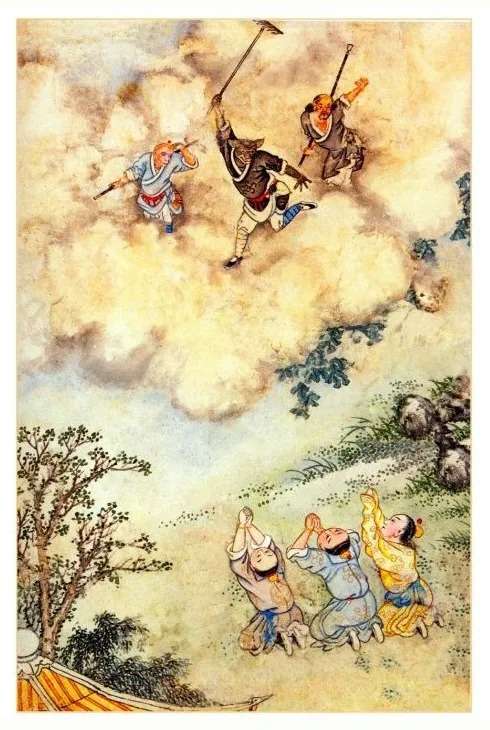
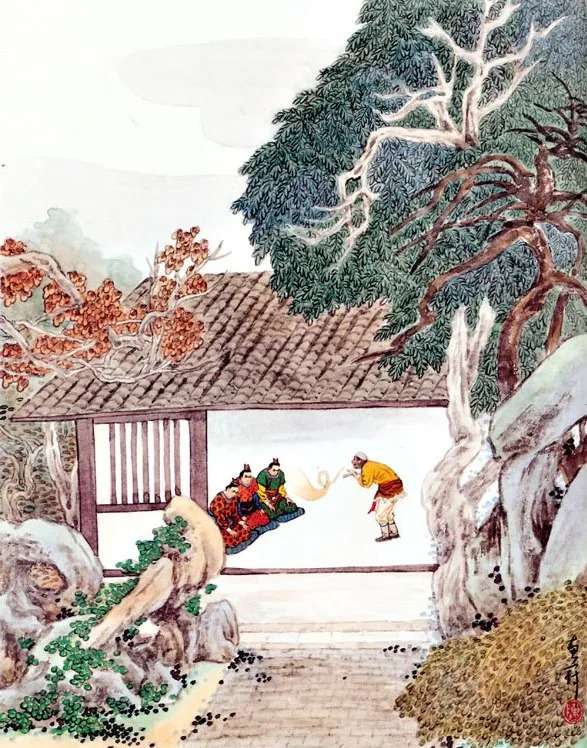
Fig. 11 – The princes drop to their knees as they watch the three monstrous pilgrims display their supernatural martial skills (larger version). Image from the Qing-Period Color-Illustrated Complete Edition of Journey to the West (清彩繪全本西遊記, 2008). Fig. 12 – Monkey empowers the princes with his divine breath (larger version). Image from Chen Huiguan’s Newly Illustrated and Complete Journey to the West (陈惠冠新绘全本西游记, 2001). Both images found here.

For future reference, this episode takes place towards the middle of ep. 23 of the 1986 JTTW TV show and the end of ep. 55 and the beginning of ep. 56 of the 2011 JTTW TV show. Both programs skip over the strength-bestowing ritual.


Update: 08-11-24

I have written a catalog of all of Sun Wukong’s abilities from all 100 chapters of JTTW. The strength-bestowing ritual appears on pages 193-194 (ch. 88, no. 3) of this PDF.

Archive #46 – A Catalog of the Monkey King’s Magic Powers and Skills


Update: 05-15-25

I forgot to mention above that although the princes can wield their teachers’ divine, multi-ton weapons after the ritual—an amazing feat for mortals to be sure—the weight is still too much for them to handle comfortably. This is why they request to make their own lighter replicas. Chapter 88 reads: 

When the old prince saw this [the princes wielding the divine weapons], he could not have been more pleased, and another vegetarian banquet was laid out to thank the master and his three disciples. Right before the banquet tables, however, they [the princes] began their instruction. The one studying the rod performed with the rod; the one studying the rake performed with the rake; and the one studying the staff performed with the staff. The princes thus succeeded in making a few turns and several movements, but they were, after all, mortals, and they found the goings rather strenuous. After exercising for a while, they began to pant heavily. Indeed, they could not last long, though their weapons might have the ability to undergo transformation. In their advances and retreats, their attacks and offenses, the princes simply could not attain the wonder of natural transformation. Later that day the banquet came to an end.

The next day the three princes came again to thank their masters and to say: “We thank the divine master for endowing us with strength in our arms. Though we are now able to hold the weapons of our masters, however, we find it difficult to wield and turn them. We propose, therefore, that artisans be asked to duplicate the three weapons. They will use your weapons as models but take some of the weight off. Would the masters grant us permission?” (Wu & Yu, 2012, vol. 4, p. 203)

老王見了,歡喜不勝。又排素宴,啟謝他師徒四眾。就在筵前各傳各授:學棍的演棍,學鈀的演鈀,學杖的演杖。雖然打幾個轉身,丟幾般解數,此等終是凡夫,有些著力:走一路,便喘氣噓噓,不能耐久。蓋他那兵器都有變化,其進退攻揚,隨消隨長,皆有自然之妙,此等終是凡夫,豈能以遽及也?當日收了筵宴。 

次日,三個王子又來稱謝道:「感蒙神師授賜了膂力,縱然掄得師的兵器,只是轉換艱難。意欲命匠依神師兵器式樣,減削斤兩,打造一般,未知師父肯容否?」

Pigsy takes the lead by granting their wish, but the three original weapons are unfortunately stolen by a fiend while in the custody of craftsmen (Wu & Yu, 2012, vol. 4, pp. 203-204). This eventually leads to a war with earthly and heavenly lion-spirits (see chapters 88 to 90).

After the day is saved, the replica weapons are completed. The end of chapter 90 reads:

In the meantime, the ironsmiths had finished forging the three weapons. As they kowtowed to Pilgrim [Monkey], they said, “Holy Father, our work is done.”

“What’s the weight of each of the weapons?” asked Pilgrim.

“The golden-hooped rod weighs a thousand catties,” replied one of the ironsmiths. “The nine-pronged rake and the fiend-routing staff both weigh eight hundred catties.” “All right,” said Pilgrim, and he asked the three princes to come out and pick up their weapons (based on Wu & Yu, 2012, vol. 4, pp. 229-230).

又見那鐵匠人等造成了三般兵器,對行者磕頭道:「爺爺,小的們工都完了。」問道:「各重多少斤兩?」鐵匠道:「金箍棒有千斤,九齒鈀與降妖杖各有八百斤。」行者道:「也罷。」叫請三位王子出來,各人執兵器。

One thousand catties (千斤) is 1,300.72 lbs or 590 kg, and 800 catties (八百斤) is 1,040.58 lbs or 472 kg.

This episode would be a great setup for a Game of Thrones-style Asian fantasy. The three princes could be plotting and scheming against each other in the hopes of one day gaining the throne from their aging father, the sovereign prince. Then a monkey wizard comes along and makes things worse by bestowing them with super strength and divine longevity. This would definitely lead to lots of drama between the brothers and their offspring. It would be a centuries-long battle royale between competing dynasties of superpowered beings!

Notes:

1) Although the original English translation reads “the strength of a thousand arms” (Wu & Yu, 2012, p. 202), the Chinese reads wanqian zhi luli (萬千之膂力), which means “the strength of tens of thousands (of men).” I have therefore adjusted the translation for more accuracy.

2) Andersen (2008) notes that the three paces are similar to those used by Vedic priests:

It would appear, in other words, that even in this early period the Paces of Yu constituted a close parallel to the three Strides Viṣṇu in early Vedic mythology, which are thought to have taken the god through the three levels of the cosmos (thereby establishing the universe), and which indeed, just like the Paces of Yu in Taoist ritual, are known to have been imitated by Vedic priests as they approached the altar—and in the same form as the Paces of Yu, that is, dragging one foot after the other (pp. 238-239).

Sources:

Andersen, P. (1989). The Practice of Bugang. Cahiers d’Extrême-Asie, 5. Numéro spécial Etudes taoïstes II / Special Issue on Taoist Studies II en l’honneur de Maxime Kaltenmark. pp. 15-53.

Andersen, P. (2008). Bugang. In F. Pregadio (Ed.), The Encyclopedia of Taoism (Vols. 1-2) (pp. 237-240). London [u.a.: Routledge].

Binder, O., Woolfolk, W., O’Neil, D., Parker, B., Maggin, E. S., & Bridwell, E. N. (1977). Shazam! From the Forties to the Seventies. New York: Harmony Books.

Buswell, R., & Lopez, D. (2014). The Princeton Dictionary of Buddhism. Princeton University Press.

Darga, M. (2008). Shengtai. In F. Pregadio (Ed.), The Encyclopedia of Taoism (Vols. 1-2) (pp. 883-884). London [u.a.: Routledge].

Esposito, M. (2008). Huohou: 2. Neidan. In F. Pregadio (Ed.), The Encyclopedia of Taoism (Vols. 1-2) (pp. 530-532). London [u.a.: Routledge].

Kim, D. (2008). Houhou: 1. Waidan. In F. Pregadio (Ed.), The Encyclopedia of Taoism (Vols. 1-2) (pp. 526-530). London [u.a.: Routledge].

Wu, C., & Yu, A. C. (2012). The Journey to the West (Vols. 1-4) (Rev. ed.). Chicago, Illinois: University of Chicago Press.

Story Idea: Master Subodhi’s Curriculum II – Immortal Warriors and Shaolin Monks – Some Fun Monkey King Fanfiction Speculation

From time to time I like to post a fun blog not directly related to (though informed by) my research. A past example can be seen here. Regular articles will resume after this entry.

Last Updated: 05-15-2022

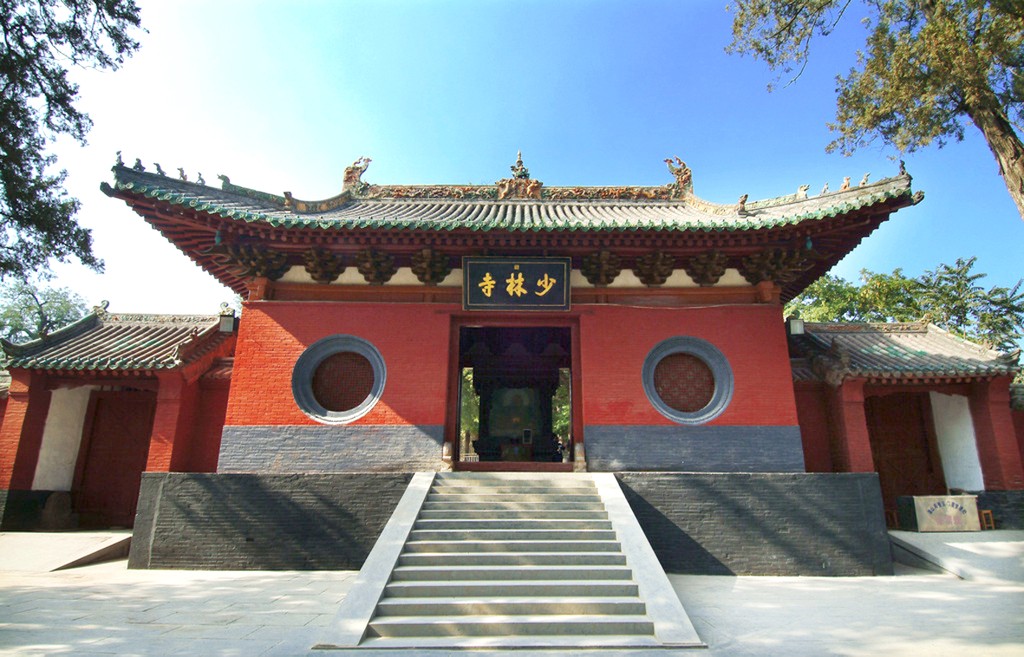
As noted in part one, the immortal sage Subodhi teaches Sun Wukong Chan (Zen) and Daoist philosophy; the secret of immortality; the 72 heavenly transformations; cloud-somersaulting; general Daoist magic; military arts like troop maneuvering, weapons, and boxing; and medicine. But why would a Daoist monk need to know how to wield weapons and fight in battle formations? In this piece I would like to speculate that the Sage’s school is a training ground for an immortal monastic army! I am by no means suggesting there is actual textual support for my conjecture. This is purely a fun exercise, fodder for fanfiction, if you will. I plan to supplement what we already know from the novel with historical information about monastic armies in China, particularly focusing on the warrior monks of the famed Shaolin monastery (Shaolinsi, 少林寺) (fig. 1).

Shaolin front gate

Fig. 1 – The front gate of Shaolin (larger version).

I. The Evolution of Shaolin’s Monastic Army: A Brief Survey

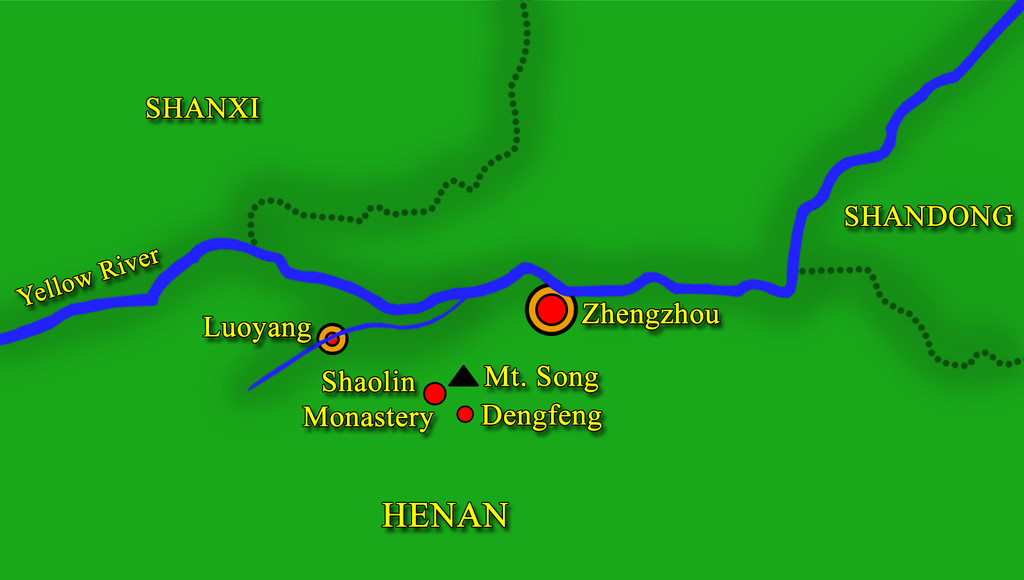
Founded in 496 during the Northern Wei Dynasty, the Shaolin monastery was built on Song Mountain, a mountain range located in Henan Province, China (fig. 2). It became the home of Chan Buddhism and a center for Buddhist learning, even attracting the likes of Xuanzang (on whom Tripitaka is based), whose request to move there in 645 was denied by the Tang Emperor Taizong (Shahar, 2008, p. 17). Despite being a school of higher religious learning, the monastery later came to be associated with elite warriors. The term “Warrior Monk” seems like an oxymoron considering Buddhism is generally considered a religion of peace. However, evidence suggests the monks may have first taken up arms to protect their property, for monasteries were often lavishly decorated and laden with treasures from rich donors, making them prime targets for bandits (Shahar, 2008, p. 18). For example, one of Shaolin’s worst bandit raids took place in 1356 when Red Turban rebels attacked, “peeling off the gold coating of the Buddha images and breaking the statues in search of hidden treasures”, eventually destroying part of the complex (Shahar, 2008, p. 85).

Fig. 2 – A map showing the location of Shaolin and the nearby town of Dengfeng in northern Henan (larger version). The ancient Sui and Tang capital of Luoyang is visible to the left, while the modern day capital of Zhengzhou is visible to the right. Henan shares a border with the provinces of Shanxi and Shandong to the north. Adapted from Shahar, 2008, p. 10. By the author.

The first documented case of Shaolin monks protecting their monastery took place in 610 when they repelled a bandit attack that saw many of their stupas burnt. Their combat experience would come in handy years later when, in 621, the monks aided Li Shimin, the future Emperor Taizong of the newly formed Tang Dynasty, by assaulting a stronghold and capturing the nephew of Wang Shichong, a former general of the defunct Sui Dynasty and the founder of a competing dynasty. Wang had captured valuable farmland belonging to Shaolin and established the stronghold there because it was located in a valley through which passed the strategically important route to the Sui capital of Luoyang. The monks’ intervention was not a display of loyalty to the fledgling Tang but solely a move to regain control of their property, a political gamble that paid off and benefited the monastery for centuries (Shahar, 2008, pp. 25-27). Three of the monks who took part in the battle were awarded titles by Li. One in particular was given the high military rank of Generalissimo (Da Jiangjun, 大將軍) (Shahar, 2008, p. 31). This wasn’t the last time Shaolin soldier monks came to the aid of the Chinese empire.

By the late Ming Dynasty Shaolin was famed far and wide for their mastery of the staff, their method appearing in various military encyclopedias. The interest in their martial prowess was likely spurred by news of their military victories during the 1550s against the Wokou (倭寇, “Dwarf/Japanese pirates”), a conglomeration of Japanese, Chinese, and Korean sea bandits who plagued China’s eastern and southeastern coasts (fig. 3). The Ming’s hereditary army was all but useless at this time, forcing local governments to rely more on prefectural level troops (xiang bing, 廂兵), including contingents of Buddhist warrior monks from different monasteries (Shahar, 2008, p. 68). Monks from Shaolin and sister temples were mobilized in the spring of 1553 and fought the pirates a total of four times through the autumn of 1555. Shahar (2008) explains:

The monks scored their biggest victory in the Wengjiagang battle. On July 21, 1553, 120 fighting monks defeated a group of pirates, chasing the survivors for ten days along the twenty-mile route southward to Wangjiazhuang (on the Jiaxing Prefecture coast). There, on July 31, the very last bandit was disposed of. All in all, more than a hundred pirates perished, whereas the monks suffered four casualties only. Indeed, the monks took pity on no one in this battle, one employing his iron staff to kill an escaping pirate’s wife (p. 69).

It’s interesting to note that the head priest who led the monastic army in their victory over the Wokou was himself from Shaolin and was documented to have single-handedly defeated eight armed monks from a neighboring temple who challenged his position (Shahar, 2008, pp. 69-70).

Wokou pirates vs ming

Fig. 3 – Detail from a Ming painting depicting soldiers fighting the Wokou (larger version). More information about the scroll can be seen here.

In a chapter titled “The Monastic Armies’ First Victory” (Seng bing shou jie ji, 僧兵首捷記, 1568), the geographer Zheng Ruoceng extolled Shaolin’s skill and called for their regular use, along with other holy warriors from sister temples, in combat:

In today’s martial arts, there is no one in the land who does not yield to Shaolin. Funiu [in Henan] should be ranked as second. The main reason [for Funiu’s excellence] is that its monks, seeking to protect themselves against the miners, studied at Shaolin. Third comes Wutai [in Shanxi]. The source of the Wutai tradition is the method of the “Yang Family Spear” (Yangjia qiang), which has been transmitted for generations in the Yang family. Together, these three [Buddhist centers] comprise hundreds of monasteries and countless monks. Our land is beset by bandits inside and barbarians outside. If the government issues an order for [these monks’] recruitment it will win every battle (Shahar, 2008, p. 70).

The warrior monks were just one type of disciple at Shaolin. For example, modern Shaolin has four types: 1) ordained monks; 2) ordained martial arts monks who often leave to open their own schools around the monastery or abroad; 3) non-ordained martial arts performers (a.k.a. “fake monks”); and 4) lay disciples. Only the first type strictly adheres to Buddhist dietary laws. The martial type are historically known for eating meat and drinking alcohol, associating the former with physical strength and fighting ability. During the Ming and Qing Dynasties, such monks lived in subsidiary shrines (fangtou, 房頭) away from the monastery proper or lived an itinerant lifestyle (Shahar, 2008, pp. 46-51). Therefore, the warrior monks who bloodied their hands during wartime and regularly ate meat lived away from the devout, vegetarian body within the main monastery. Their unruly nature was for the most part accepted because of the protection they provided.

II. Speculation

Now the fun begins! Here I would like to take what we know about the novel (part I) and the above information to speculate on the martial history of Subodhi’s school.

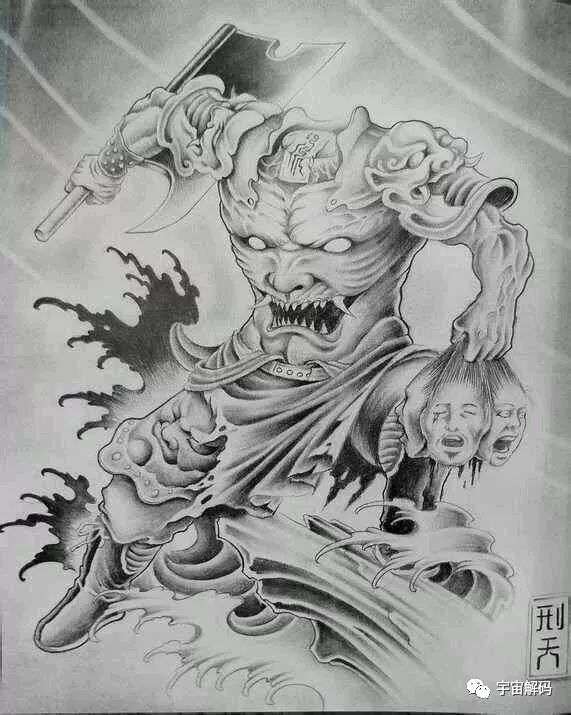
Like Shaolin, Subodhi’s school is located in the mountains and most likely houses great heavenly treasures, the likes of which might be sought after by demon kings. Conflict with these demons would naturally necessitate the immortal monks take up arms in defense of their school. Continued conflict would allow them to hone their skills until their services might be called upon by one of two celestial factions vying for control of heaven during times immemorial, much like Li Shimin’s struggle against Wang Shichong. Chinese mythology is full of numerous baddies threatening the primacy of heaven. One in particular is the headless deity Xingtian (刑天) (fig. 4) from the Classic of Mountains and Seas (c. 4th–1st century BCE):

Xingtian and the Supreme God Di came to this place and struggled against each other for ultimate power. The Supreme God cut off Xingtian’s head and buried him at Eternally Auspicious Mountain. Xiangtian’s nipples then transformed into eyes, and his navel became a mouth. He performs a dance with an ax and shield (Strassberg, 2002, p. 171).

Xingtian was originally a retainer of the Flame emperor, who lost his bid for power against the Yellow Emperor. Xingtian then continued his master’s war, even refusing to die after being beheaded (Strassberg, 2002, p. 171).

Xingtian

Fig. 4 – A modern depiction of Xingtian (larger version). Artist unknown.

The deity’s sustained, obsessive defiance, illustrated by his war dance, could serve as an ever present threat working in the shadows, waiting and plotting. Perhaps untold millennia after his first defeat Xingtian amasses a huge army that attacks the celestial realm via the Tianhe (天河, “Heavenly River), or the Milky Way, much like the Wokou attacked the Chinese coast by sea. The Yellow emperor then calls up Master Subodhi’s immortal warriors to help neutralize the threat, emerging victorious and winning the admiration of deities throughout the cosmos like their Shaolin counterparts.

So where does Sun Wukong fit in to this fanciful yarn? As an ordained-martial monk, Monkey would regularly train in weapons and fight in the monastic army, possibly rising through the ranks due to his supernatural talent and becoming a general who leads an assault against Xingtian’s forces. (Perhaps he would even have to defend his position against older, jealous immortals, much like the aforementioned Shaolin monk during the Ming.) Sun’s time in the monastic army would explain why, as noted in part I, the young immortal knows how to train his monkey children to march, go on patrol, follow orders directed by flags and battle drums, and advance and retreat. Only a person who studied military classics and had prior experience with leading troops would have such knowledge.

This in turn would explain why Subodhi expels Monkey and warns him to never reveal the sage had been his teacher. Sun Wukong is a powerful immortal and seasoned fighter with vast magical powers. Combine that with little impulse control and you’ve got the makings of a demon. Heaven discovering that Subodhi had trained the very demon who came to rebel against it would stain the sage’s name and the achievements of his school.

I would love to see someone use this information to write a prequel set during Sun Wukong’s time in Subodhi’s monastery.


Update: 09-18-21

Sun is originally expelled from Subodhi’s school for flaunting his newfound powers of transformation (Wu & Yu, 2012, vol. 1, pp. 123-124). But given Monkey’s ability to acquire amazing powers in just three short years, perhaps Subodhi fears his student’s potential for exponential spiritual growth. Whether this is because he sees a spark of malice in his disciple or he’s just plain jealous (the former seems more likely), Subodhi could just use the transformation as an excuse to halt his progression. But imagine Sun after another three years! I imagine high-level cosmic beings like the Buddha would be interested in keeping an eye on his progress.


Update: 05-15-22

I’ve posted an article that expands on the ideas from above.

Story Idea: The REAL Reason Sun Wukong is Expelled from Subodhi’s School

Sources

Shahar, M. (2008). The Shaolin Monastery: History, Religion, and the Chinese Martial Arts. Honolulu: University of Hawai’i Press.

Strassberg, Richard (2002). A Chinese Bestiary: Strange Creatures from the Guideways Through Mountains and Seas. University of California Press.

Wu, C., & Yu, A. C. (2012). The Journey to the West (Rev. ed.) (Vols. 1-4). Chicago: University of Chicago Press.

Monkey and the Summoners of Hell: The Story and Origins of the Heibai Wuchang

Last updated: 10-14-2022

One of the most famous episodes from Journey to the West happens in chapter three after Sun Wukong returns from the undersea palace with his magic staff and is chosen as lord of the 72 monster kings. Following a lavish banquet in his honor, the Monkey King falls asleep and his soul is dragged to the Chinese underworld by two spirits:

In his sleep the Handsome Monkey King saw two men approach with a summons with the three characters “Sun Wukong” written on it. They walked up to him and, without a word, tied him up with a rope and dragged him off. The soul of the Handsome Monkey King was reeling from side to side. They reached the edge of a city. The Monkey King was gradually coming to himself, when he lifted up his head and suddenly saw above the city an iron sign bearing in large letters the three words “Region of Darkness [You mingjie, 幽冥界].” The Handsome Monkey King at once became fully conscious. “The Region of Darkness is the abode of Yama, King of Death,” he said. “Why am I here?” “Your age in the World of Life has come to an end,” the two men said. “The two of us were given this summons to arrest you.” When the Monkey King heard this, he said, “I, old Monkey himself, have transcended the Three Regions and the Five Phases [1]; hence I am no longer under Yama’s jurisdiction. Why is he so confused that he wants to arrest me?” The two summoners paid scant attention. Yanking and pulling, they were determined to haul him inside. Growing angry, the Monkey King whipped out his treasure. One wave of it turned it into the thickness of a rice bowl; he raised his hand once, and the two summoners were reduced to hash (Wu & Yu, 2012, p. 139).

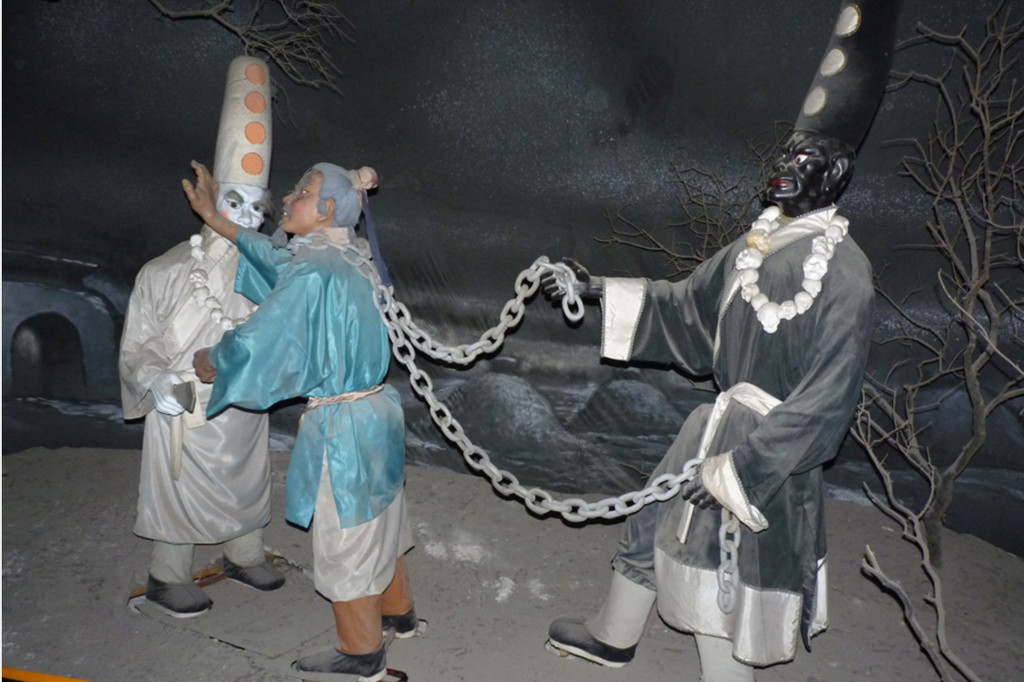
The two unnamed psychopomps are simply referred to in the story as “[those who] arrest the dead” (Gou siren, 勾死人). Modern media sometimes portrays these two wearing contrasting black and white uniforms with tall hats (fig. 1).

Heibai Wuchang summon Wukong - small

Fig. 1 – The summoners taking Sun Wukong’s soul in his sleep (larger version). From episode 7 of the Little Fox ESL Journey to the West series.

The Heibai Wuchang

The specific color-coded deities are known in China, Taiwan, and Southeast Asian countries like Malaysia and Singapore as the Heibai wuchang (黑白無常), or the “Black and White [spirits of] Impermanence.” Tan (2018) describes their mythic background and religious importance:

[A] good deal of importance attaches to the worship in Malaysia and Singapore of Heibai Wuchang … popularly known as Da Er Ye (大二爺, Eldest and Second Uncles). In charge of policing the netherworld and protecting humans from evil, they are believed to be two soldiers of the Tang dynasty, General Xie [謝] and General Fan [范]. The former was tall and was hanged by the enemy, while the latter was shorter and was drowned while fighting enemies. General Xie’s image is that of a tall person with a protruding long tongue; he’s wearing a white shirt, and his high hat has the characters yijian daji ([一見大吉] “big luck on seeing me”) or yijian shengcai ([一見生財] “getting wealth on seeing me”). General Fan’s image has a dark face, and his square hat bears the characters tianxia taiping [天下太平], or “peace in the world.” Also called Qiye (七爺) and Baye (八爺), the two generals are in charge of rewarding good people and punishing evil ones. General Xie is more popular among worshippers; frightening as he is, the Elder Uncle benefits from his association with blessing wealth (p. 58).

Chen (2014) provides a different background for the two, which is commonly told in the southern Chinese city of Fuzhou in Fujian province:

The Seventh Lord (七爺) and Eighth Lord (八爺) are frequently seen and are well-known in Taiwanese religious parades. These two deities were originally two brother-like friends in Fuzhou (福州). One was called Xie Bian (謝必安), and the other one was named Fan Wujiu (范無救; 范無咎). On a rainy day, they had an appointment to meet under the Nan Tai Bridge (南臺橋). Fan Wujiu was short with a dark complexion, but Xie Bian was tall with a light complexion. Fan Wujiu arrived at the meeting place earlier, waited there in spite of the heavy rain, and was drowned. Xie Bian tried to bring umbrellas for Fan Wujiu and was therefore late. When he arrived at the bridge, Fan Wujiu was already dead, so he decided to commit suicide because of his friendship and guilt. According to legends, the Heavenly Emperor (玉皇大帝) was touched by this pair of brother-like friends, and promoted their ghosts to supernatural officers from the underworld. The Seventh Lord is Bai Wuchang (白無常), and the Eighth Lord is Hei Wuchang (黑無常). Their mission is to bring dead people’s ghosts from the ordinary human world to the underworld at the moment of their deaths (p. 220).

Heibai wuchang statues - small

Fig. 2 – A depiction of the spirits taking a soul to the Chinese underworld (larger version). From the Haw Par Villa theme park in Singapore. Original picture from Baike.

Stevens (1997) goes into more detail about their function and veneration:

The pair are despatched on orders from the City God when the due date of a person’s death arrives, to seek out and identify the correct human through the local spiritual official, the Earth God [fig. 3]. They appear before the human and the Tall Demon [the white spirit] announces that the time has come. The Short Demon [the black spirit] binds the soul and drags it before the City God. The Short Demon carries the tablet of authority and the chains to arrest the soul whose due date of death has arrived [fig. 2].

The Tall Demon … receives considerable attention from devotees, often relatives of the very sick, and in a few temples he is provided with cigarettes which are to be seen continually burning having been forced in between his lips. More popularly, his mouth is smeared with a black substance to win his favour and bribe him to keep away. This used to be opium and is still said to be opium, though the substance appears to be more of a sweet sticky mess. In northern and central China, only the Tall Demon is found (p. 173).

tudi_gong_28129

Fig. 3 – A monumental statue of an Earth god in Taiwan (larger version).

Origins

The sources above provide two backgrounds for the spirits, historical generals or brother-like friends, all of whom died unnatural deaths. Both origins involve the tall, white figure being hanged, while the short, black figure was drowned. Both of these backgrounds have respective ties to religious beliefs of the Han (206 BCE – 220 CE) and Song (960-1279 CE) dynasties. It was common practice during the Han for generals, especially those slain by the enemy, to be deified as gods. This concept of deified mortals carried over into the Song Dynasty when tutelary gods were popular. Those deified were often pious or loyal people who died unnatural deaths. But most importantly, these individuals were deified by the very communities in which they lived, meaning they were worshiped as the protector of the specific locale and its people (Von Glahn, 2004, p. 164).

These tutelary cults find their origin in earth gods (tudishen, 土地神) worshiped as early as the Han. Just like people of the Song worshiped the worthy among their fallen community members, people of the Han worshiped the gods believed to inhabit the very earth on which their communities were established. Considering the dead were buried underground, these earth gods also served the function of “escort[ing] the deceased to the world of the afterlife” (Von Glahn, 2004, p. 165). Remember above that Stevens described the tall and short spirits relying on the local earth god to help locate the correct soul being summoned. Therefore, our spirits appear to be a combination of deified mortals (generals/worthy citizens) and earth gods who escorted the deceased to the afterlife. But there may be more to the story.

Wuchang (無常), or “impermanence”, is the Chinese term for the sanskrit Anitya. This is one of the “Three Marks” (Sk: Trilaksana) of existence in Buddhism, the other two being suffering (Duhkha) and non-self (Anatman) (Buswell & Lopez, 2014, pp. 47-48). The fact Wuchang is associated with these spirits suggests there is an added Buddhist influence. As I’ve written before, the Chinese underworld presented in Journey to the West is an amalgam of local Chinese and foreign Buddhist beliefs. In short, the Chinese Underworld consists of ten courts in which a soul is punished and sent on to the next until their karma is cleansed. The concept of purgatory and the Ten Kings or Judges of hell are products of 7th-century Chinese Buddhism. Prior to this, souls of the dead were kept en masse in a sort of Daoist city of the dead. So our two summoners were no doubt absorbed into this new Buddhist worldview. The spirits in effect could be viewed as personifications of Buddhist impermanence.

The contrasting black and white color scheme has at least two origins. One, it may have evolved from the belief that each performed duties at different times. Maspero (1981) writes, “The most famous of [the City God’s] subordinates are Master White (Bai laoye [白老爺]) and Master Black (Hei laoye [黑老爺]), who perceive everything that goes on within the constituency, the former during the day and the latter during the night” (p. 110). Two, it may draw from the dualistic nature of Chinese philosophy. Baptandier (2008) comments their color is a “personification of the yin and yang principles of life” (p. 146).

20180916_131548 - small

Fig. 4 – A wall mural depicting the Ba Jiajiang (Eight Generals), including General Xie (white) with the phrase “Big Luck” (daji, 大吉) on his hat (larger version) and to his left General Fan (black) with a square hat. Taken by the author in Taipei, Taiwan.

Influence

Both General Xie (the tall, white spirit) and General Fan (the short, black spirit) figure among the Ba Jiajiang (八家將), or “Eight Generals” (fig. 4). These spirit generals are considered protectors of the City God (as well as other popular folk deities) and destroyers of evil. They consist of our two spirits, two more underworld figures called Generals Gan (甘) and Liu (柳), as well as four other figures known as the Four Seasons (Siji, 四季). These generals are personified during festivals by temple parade dance troupes called Jiajiang (家將). Members paint their faces according to the prescribed wrathful iconography for each general (fig. 5) and perform all sorts of choreographed militaristic dances while wielding weapons (video 1). These performances serve to exorcize evil spirits.

National Akau Mazu’s Cup of Youth Ba-Jia-Jang and Guan-Jang-Shou Competition, Ci Feng Mazu Temple, Pingtung City, Taiwan

Fig. 5 – The facepaint of General Xie, the tall, white spirit. A larger version can be seen on this blog. Original picture by Rich J. Matheson.

The tradition originated in Fuzhou but later spread to Taiwan by the 1870s, making it a rather recent phenomenon (Sutton, 1996).

Video 1 – A Ba Jiajiang performance.


Update: 10-29-2018

Sutton (1996) explains the ceremonial procession of the Eight Generals is modeled after yamen officials making an arrest in dynastic China. In this case, the otherworldly generals would be sent to arrest evil spirits:

The performers seen on the march—excluding the Four Seasons—represent a process, though it is never ritually played out: arrest by yamen underlings. In principle the punishment bearer warns, the messengers search out, the stave bearers pursue, Erye and Daye [the Black and White Spirits] take into custody, and the justices at the rear interrogate and record (p. 215).

In video 1, the man dressed in civilian attire and carrying the strange, yoke-like device on his shoulders (visible at 00:26) is performing the part of the punishment bearer, which I take to mean a symbol of those previously arrested and used as warnings to the evil spirits being pursued.


Update: 10-14-22

I purchased some ritual items from Singapore previously used by tangki spirit-mediums of the Heibai wuchang. These include an old-school abacus for making arcane calculations, a soul-summoning placard, and a smoking pipe (fig. 6). I feel much cooler now that I have them. My seller-collector friend, from whom I purchased this set, told me that some of the beads are missing from the abacus because they were most likely given to believers as talismans.

Fig. 6 – The ritual items used by Singaporean tangki spirit-mediums of the Heibai wuchang (larger version).

Notes

1) The Three Realms are Heaven, Earth, and Hell, and the Five Phases are the elements of fire, water, earth, metal, and wood. The point being that he is beyond the control of the three realms and the effects of the elements because he has achieved immortality.

Sources

Baptandier, B. (2008). The lady of Linshui: A Chinese female cult. Stanford, Calif: Stanford University Press.
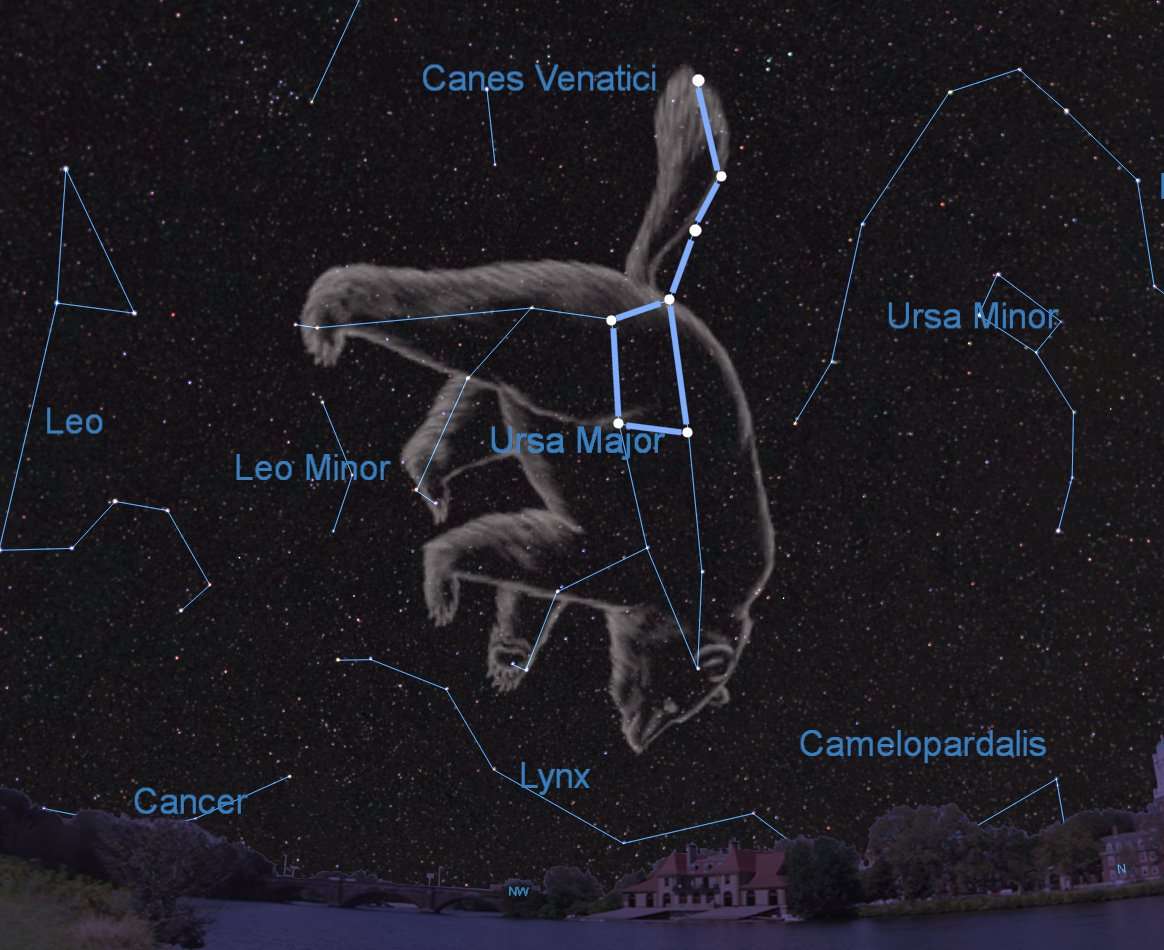
Chen, Y. (2014). Cinematic visualization of spiritual lesbianism in Monkia Treut’s Ghosted: countering essentialist concerns about Li Ang’s literary works In Y. Chen (Ed). New modern Chinese women and gender politics: The centennial of the end of the Qing Dynasty (pp. 210-222).

Maspero, H. (1981). Taoism and Chinese religion. Amherst: University of Massachusetts Press.

Buswell, R., & Lopez, D. (2014). The Princeton Dictionary of Buddhism. Princeton University Press.

Stevens, K. G. (1997). Chinese gods: the unseen world of spirits and demons. London: Collins & Brown.

Sutton, D. S. (1996). Transmission in Popular Religion: The Jiajiang Festival Troupe of Southern Taiwan in Later Imperial China in Shahar, M., & Weller, R. P. (Ed.) Unruly gods: Divinity and society in China (pp. 212-249). Honolulu: University of Hawaiʻi Press.
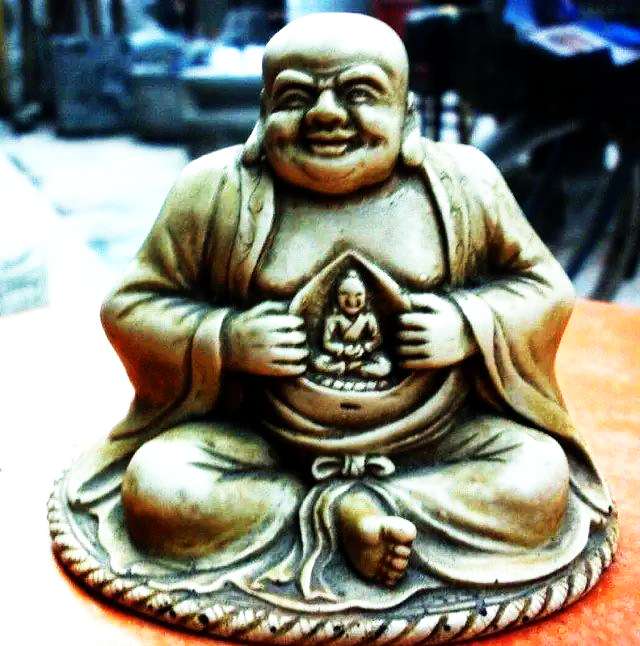
Tan, C. B. (2018). Chinese religion in Malaysia: Temples and communities. Leiden; Boston: Brill.

Von Glahn, R. (2004). The sinister way: The divine and the demonic in Chinese religious culture. Berkeley: University of California Press.
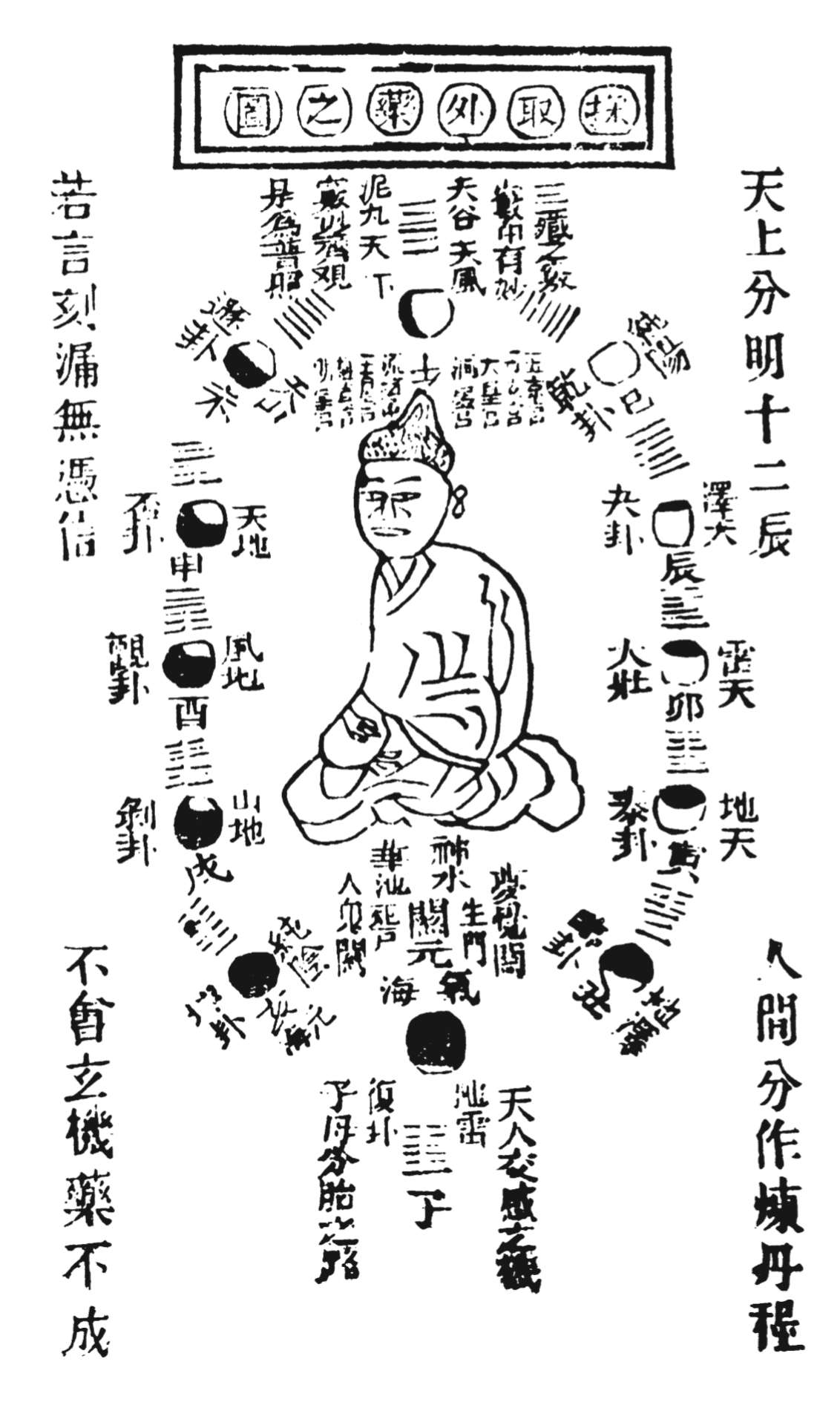
Wu, C., & Yu, A. C. (2012). The journey to the West: Volumes 1. Chicago, Illinois : University of Chicago Press.