This article is a greatly expanded version of this piece.
Last updated: 08-31-2025
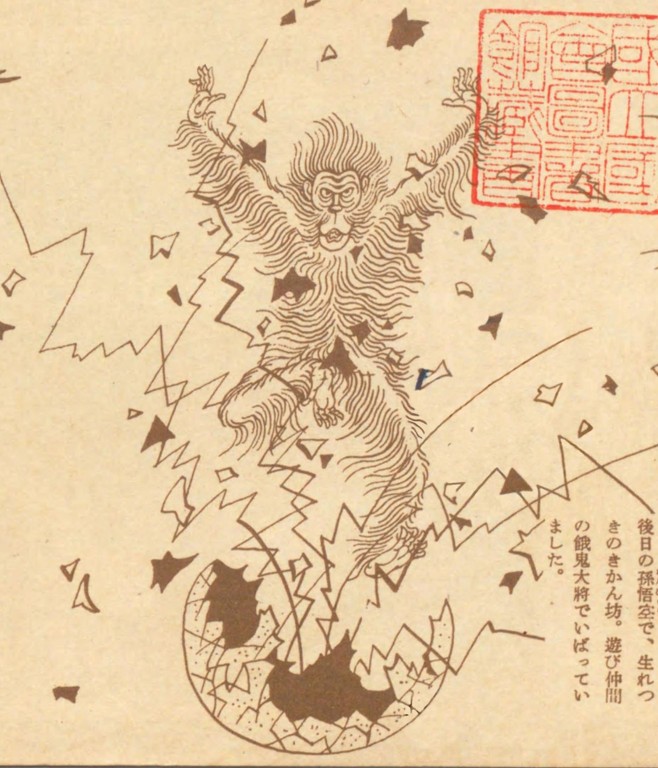
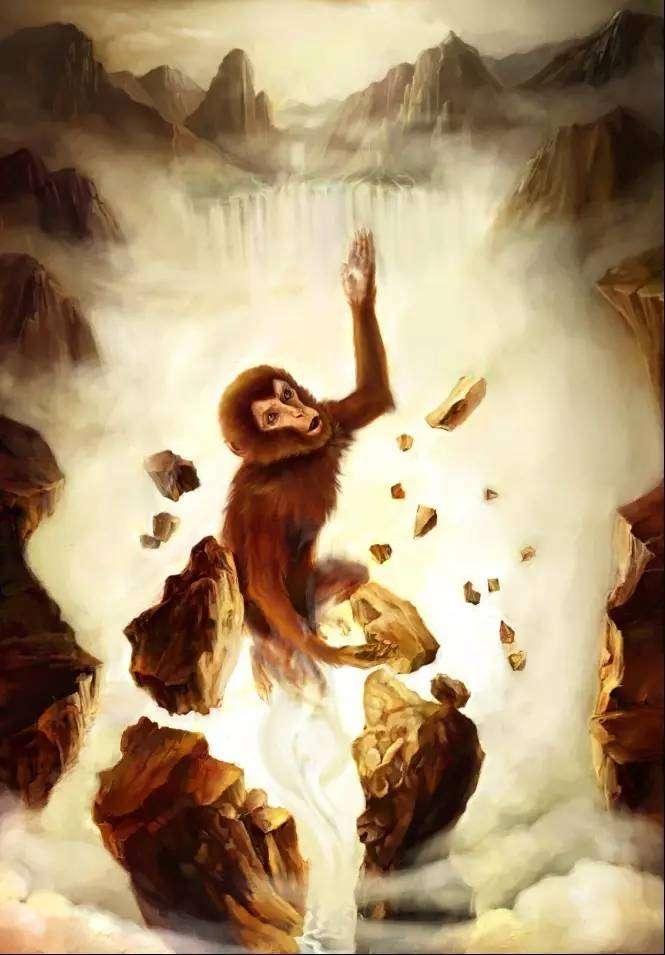
One of the many unique aspects of Sun Wukong‘s story cycle is his birth from stone (fig. 1). Chapter one of Journey to the West (Xiyouji, 西遊記, 1592 CE) describes how the 36-foot, 5-inch (11.09 m)-tall, 24-foot (7.31 m)-circumference rock issues forth a stone egg after absorbing celestial and terrestrial energies over countless eons:
Since the creation of the world, it [the stone] had been nourished for a long period by the seeds of Heaven and Earth and by the essences of the sun and the moon, until, quickened by divine inspiration, it became pregnant with a divine embryo [xianbao, 仙胞]. One day, it split open, giving birth to a stone egg [shiluan, 石卵] about the size of a playing ball [yuanqiu, 圓毬]. Exposed to the wind, it was transformed into a stone monkey endowed with fully developed features and limbs (Wu & Yu, 2012, p. 101).
蓋自開闢以來,每受天真地秀,日精月華,感之既久,遂有靈通之意。內育仙胞,一日迸裂,產一石卵,似圓毬樣大。因見風,化作一個石猴,五官俱備,四肢皆全。
The description of Wukong’s conception draws on ancient Chinese cosmological ideas regarding the gendered nature of the universe. Works of the Eastern Zhou and Han considered heaven masculine and described it as the father/husband/superior of the feminine earth, the mother/wife/inferior (Hinsch, 2011, pp. 157-158). As quoted above, the stone is “nourished…by the seeds of Heaven and Earth.” This line was likely influenced by philosophical works such as the Yijing (易經, late-9th century BCE) which states: “Heaven and Earth come together, and all things take shape and find form. Male and female mix their seed, and all creatures take shape and are born” (Wilhelm & Baynes, 1977, pp. 342-343).
Surprisingly, Wukong is not the only figure from world mythology born from stone. In fact, “Birth from rock” (T544.1) is a mythic category appearing in Stith Thompson’s Motif-Index of Folk-Literature. Eliade (1978) comments: “The theme recurs in the great civilizations of Central America (Inca, Maya), in the traditions of certain tribes of Southern American, among the Greeks, the Semites, in the Caucasus, and generally from Asia Minor right down to Oceania” (p. 43).
In this article, I will explore eight examples from Asian and Western myth, demonstrating how stone-born figures share certain parallels with Monkey. I will show that, with the exception of creator gods and savior figures, stone-born beings generally have one or more of the following in common: 1) they are the product of masculine heavenly forces and feminine earthly forces (anthropomorphic or otherwise); 2) they violate the natural order by challenging heaven (in one form or another); and 3) they are eventually defeated by the gods. The purpose of this preliminary survey is to better understand an ancient myth cycle that may have influenced the development of the Monkey King’s lore.

Fig. 1 – Monkey’s birth from stone by Zhang Moyi (larger version). Found on this article.
Table of Contents
1. Stone Births of Eastern Mythology – Other Examples
1.1. Yu the Great
Yu the Great (Dayu, 大禹), a demi-god, sage-king, and founder of the Xia Dynasty, is generally portrayed in his mythos as either violently erupting from the side or back of his mother or emerging (or being hewn with an ax) from the executed body of his father Gun (Cook & Luo, 2017, p. 98-101). However, a few sources briefly note his lithic birth. For example, the Han-era Huainanzi (淮南子, 2nd century BCE) simply states: “Yu was born from a stone” (Cook & Luo, 2017, p. 100). Lewis (2006) explains Yu’s stone birth is tied to ancient Chinese beliefs about the fertile, creative power of stone, as evidenced by the stone altar of the High Matchmaker (Gao mei, 高媒), which was historically prayed to for children by married couples, as well as legends of the mending of the sky with five magic stones by the primordial goddess Nuwa, the High Matchmaker’s mythic prototype. [1] This naturally has implications for the stone birth of Monkey.
Interestingly, the Jin-era Diwang Shiji (帝王世紀, 3rd century) states Yu’s mother was impregnated by swallowing magic seeds and a “divine pearl” (shenzhu, 神珠), a type of stone, and even locates his birth in a place called “Stone Knob” (Shiniu, 石紐) (Cook & Luo, 2017, p. 101). While the mother is not a stone, his birth is effected by one and happens in a place named stone. In this instance, the divine pearl is an encapsulation of the same masculine heavenly and feminine earthly forces that help create Wukong.
Yu is of course most famous in Chinese myth for his monumental effort in quelling the fabled world flood and then establishing the nine provinces of China (Birrell, 1999, pp. 81-83). Therefore, as a savior figure his mythos lacks the rebellious challenge against the gods and eventual defeat that marks several figures in this list. However, in a twist, his father Gun is known for violating the natural order by stealing God’s “self-renewing soil” in his quest to quell the flood. For this crime, he is executed (Birrell, 1999, pp. 79-81).
1.2. Qi of Xia
Yu’s son, Qi (啟) or Kai (開), both meaning “open” (fig. 2), [2] is said in an early-4th century source to have also been born from stone: [3]
When Yu was controlling the floodwaters and was making a passage through Mount Huanyuan, he changed into a bear. He spoke to the Tushan girl: “If you want to give me some food, when you hear the sound of a drumbeat, come to me.” But Yu leaped on a stone and by mistake drummed on it. The Tushan girl came forward, but when she saw Yu in the guise of a bear she was ashamed and fled. She reached the foothills of Mount Songgao, when she turned into a stone and gave birth to Qi. Yu said, “Give me back my son!” The stone then split open [4] on its north flank and Qi was born (Birrell, 1999, p. 123).
禹治洪水,通轘轅山,化為熊。謂塗山氏曰:『欲餉,聞鼓聲乃來。』禹跳石,誤中鼓, 塗山氏往,見禹方作熊,慚而去。至嵩高山下,化為石,方生啟。禹曰:『歸我子!』 石破北方而啟生。」(source – see p. 72, n. 20)
Lewis (2006) notes that early texts, such as the aforementioned Diwang Shiji, claim this daughter of the Tushan clan is named Nuwa (with variations on her given name), proving that Yu and the goddess were married in some traditions (p. 134). This then strengthens the association between marriage, procreation, and stones.
Birrell (1999) explains a text appearing in the Zhou to Han-era Guicang (歸藏) records that he tried to “steal” (qie, 竊) music from heaven, while the Shanhaijing (山海經) states he received it as a gift from the realm above (pp. 83-84). While not directly related to Qi’s stone birth story, this shows at least one tradition believed Qi followed in his grandfather’s footsteps by stealing from heaven and violating the natural order, much like Wukong steals immortal peaches and wine.

Fig. 2 – A woodblock print of Qi of Xia from a Ming-era version of the Shanhai jing (larger version). Plate XLIV from Strassberg, 2002, p. 168.
1.3. The Children of Hilumandju
One myth explains that the Tibetan people were the product of the union of a magic monkey and a rock-ogress (Tb: brag srin mo) (fig. 3). While evidence for this tale goes back to at least the 7th-century, [5] the best known version comes from the Mani Kambum (12th to 13th century; lit: “Collected Teachings on Mani”). As the story goes, the Buddha charges the Avalokitesvara Bodhisattva with converting the evil creatures of the “Land of Snow” (Tibet) to Buddhism. The latter sends his avatar, the Bodhisattva Hilumandju, a monkey king (and possible reference to Hanuman) with great spiritual powers, to meditate on a mountain top in Tibet. A rock-ogress comes upon his hermitage and attempts to seduce him by taking the form of a female monkey and then a human woman, but each time her advances are rejected due to his supernatural focus. As a result, the rock-ogress threatens to mate with an ogre and produce a race of demonic creatures that would devour the world, thereby heaping sins upon the monkey king if he does not take her as his wife. So after seeking council with his master, Hilumandju agrees to become her husband (I have archived the full story here):
“So be it (Laso),” he made answer. Then the monkey Bodhisattva, fearing lest the rock-ogress should destroy herself, departed in all haste for the Abode of Snow, and as soon as he arrived he took her unto him as his wife. When the space of nine months had elapsed she bore him six sons, who participated of the nature of the six classes of sentient creatures subject to birth and death. As their father was a monkey, so their bodies were covered with hair, and as their mother was a rock-ogress, so they had tails; their faces were reddish and they were most unsightly. From the mortal gods, one had gentleness and patience; from the mortal (lit., subject to birth and death) Asuras (lh’a-mayin), one of them derived angry passions and quarrelsomeness. One of them had in part great lusts, and love of worldly riches, which qualities he owed to mortal man. One of them owed to hell’s mortal fiends, hate, and anger, and great hardiness. One partook of the mortal Préta’s (yidag) characteristics in being deformed, from his cravings for food (lit., bad stomach), and his avariciousness. One partook of mortal brute beasts in not being able to distinguish right from wrong, and in having neither comprehension nor cleverness. When born they were ruddy-faced, had a taste for flesh and blood, and hair covered their heads and bodies, and, moreover, they knew how to speak (Rockhill, 1891, pp. 357-358). [6]
The resulting six offspring mate with monkeys and reproduce in the many hundreds, becoming more and more human with each new generation. When they eat all of their resources and begin to starve, Avalokitesvara gives Hilumandju grain and jewels for his descendants to grow and mine until they are fully human and ready to receive the Buddhist teachings (Rockhill, 1891, pp. 358-361).
The rock-ogress and her kind are portrayed as vicious, blood-thirsty creatures beyond Avalokitesvara’s ability to convert to Buddhism (Rockhill, 1891, p. 359). The rock-monkey children inherit not only their mother’s misshapen appearance but also many of her negative qualities, making them resistant to the teachings. So, in a way, they too violate the natural order.
I obviously can’t continue without commenting on this tale’s interesting parallels with Sun Wukong. Hilumandju is a monkey king who uses his magic powers in the service of Buddhism at the behest of the Bodhisattva Avalokitesvara. And like Wukong, Hilumandju’s children are the product of a masculine heavenly force and a feminine earthly force (the rock-ogress). Wukong is a monkey king who uses his magic powers in the service of Buddhism at the behest of the Bodhisattva Guanyin, the feminine form of Avalokitesvara.

Fig. 3 – A modern painting showing the monkey and rock ogress of Tibetan myth (larger version). Original from Wikipedia.
2. Stone Births in Western Mythology
Jong (1997) explains Western myths of stone-born figures “are usually connected with the Song of Ullikummi known from Hittite and Hurrian sources” (p. 292). He continues:
There are many more myths or complexes of myths which largely follow the same pattern: the cycle of Agdistis from Phrygia, the Nart-epics of the Ossetes, the Jewish myths of the monster Armillus and—for some aspects—the Georgian myth cycles of Amirani [fig. 4] (Jong, 1997, p. 292).

Fig. 4 – A chart showing the existence of the rock-born son trope from other cultures (larger version). From Jong, 1997, p. 293.
2.1. Ullikummi
The aforementioned Hurrian myth of the “Song of Ullikummi” (c. 1200 BCE) appears in an extant Hittite cuneiform text comprising three fragmented clay tablets. While named after the eponymous stone monster (fig. 5), the story follows the machinations of Kumarbi, a resentful former ruler of the gods, who wishes to usurp the throne from his son, the storm god Tesub. Kumarbi sets about doing this by bedding a massive stone in an effort to produce a being powerful enough to rout the gods. Upon its birth, the doting father gives the creature a name meaning “Destroy Kummiya” (Rutherford, 2020, p. 147), foreshadowing its intended fate to destroy Tesub’s home (I have archived papers reconstructing the story here and here):
Out of the [rock’s] body like a blade he sprang.
He shall go! Ullikummi be his name!
Up to Heaven to kingship he shall go,
and Kummiya, the dear town, he shall press down!
But the Storm-God he shall hit,
and like salt he shall pound him,
and like an ant with (his) foot he shall crush him!
But Tasmisu [7] like a …… reed he shall break off!
All the gods down from Heaven like birds he shall scatter,
and like empty vessels he shall break them! (Güterbock, 1951, p. 153).
Fearing that it may be killed by the gods before coming into full power, Kumarbi has the monster hidden in the underworld, where it is placed on the right shoulder of the Atlas-like god Upelluri. The creature quickly multiples in size, growing nine thousand leagues tall, eventually reaching heaven. When Ishtar fails to seduce the blind and deaf monster, the warrior god Astabi leads 70 deities into battle against the lithic menace only to be defeated and cast into the sea below. Tesub abandons the throne and, along with Tasmisu, seeks the aid of Ea, the god of wisdom and witchcraft, who travels to the underworld in search of the creature’s origins. Upon questioning Upelluri, who effortlessly carries the weight of the heavens, earth, and sea, Ea learns that a great weight, which turns out to be the monster, pains the titan’s right shoulder. In the end (of the third and final extant tablet), Ea calls for a tool originally used by the old gods to cleave heaven and earth and chisels Ullikummi free of Upelluri’s shoulder, thus breaking the monster’s base of power and leaving it vulnerable to attack by the gods. Güterbock (1951) suggests that there’s a missing fourth tablet that describes the monster’s ultimate defeat (p. 140). [8]
Like Monkey and the other figures listed above, Ullikummi is the product of a masculine heavenly force (Kumarbi) and a feminine earthly force (the stone). Although the assault on heaven is orchestrated by his father, Ullikummi’s challenge to the gods, like that of Monkey, violates the natural order. And his presumed defeat in the end also follows the story cycle of Wukong.
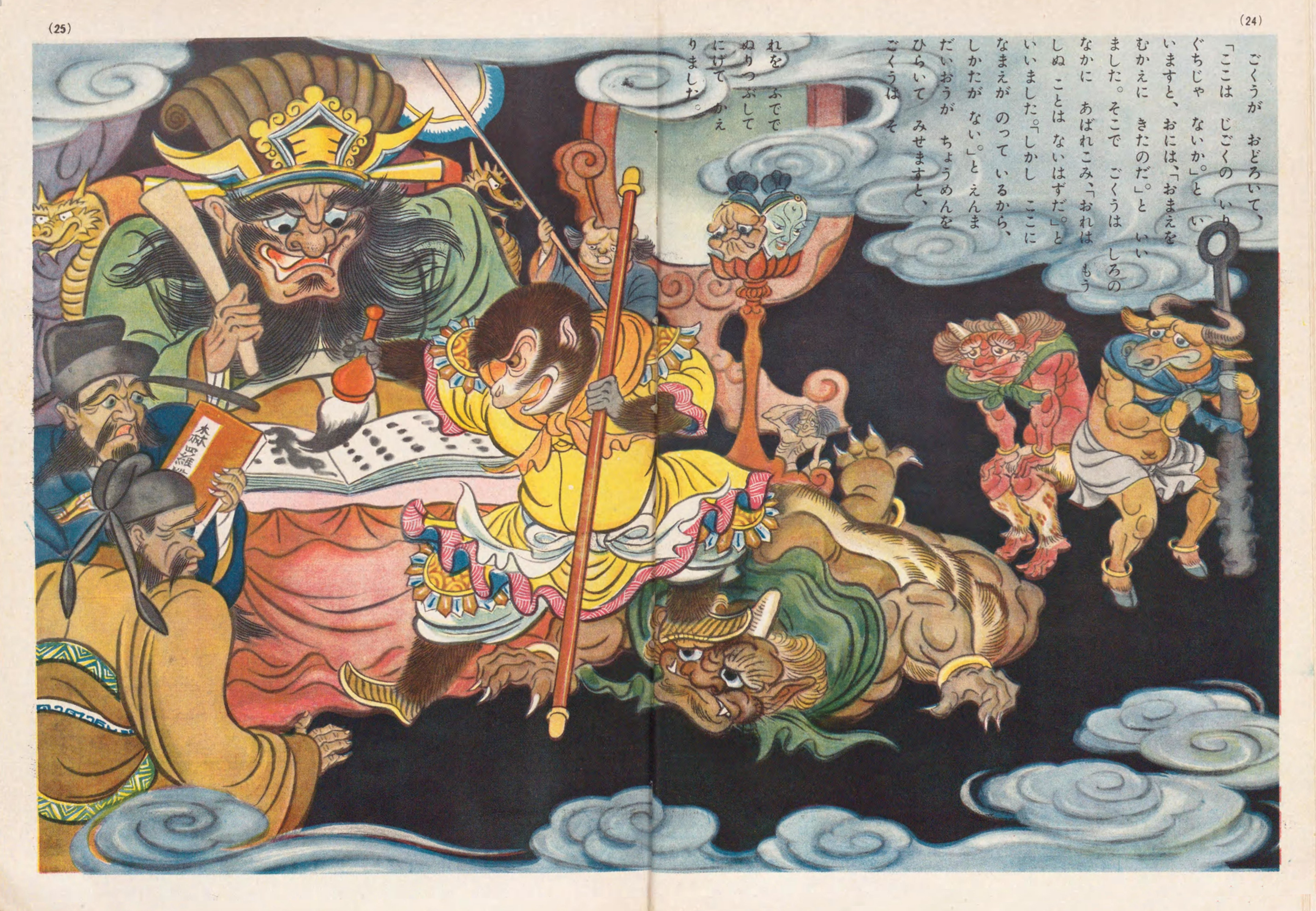
I’d like to add that Ullikummi battling Astabi’s force of 70 gods is similar to Sun fighting the 72 gods called up against him (Koss, 1981, p. 84). Also, King Tesub seeking aid from Ea, leading to Ullikummi’s defeat, is reminiscent of the Jade Emperor asking for the Buddha to intervene, leading to Wukong’s defeat.

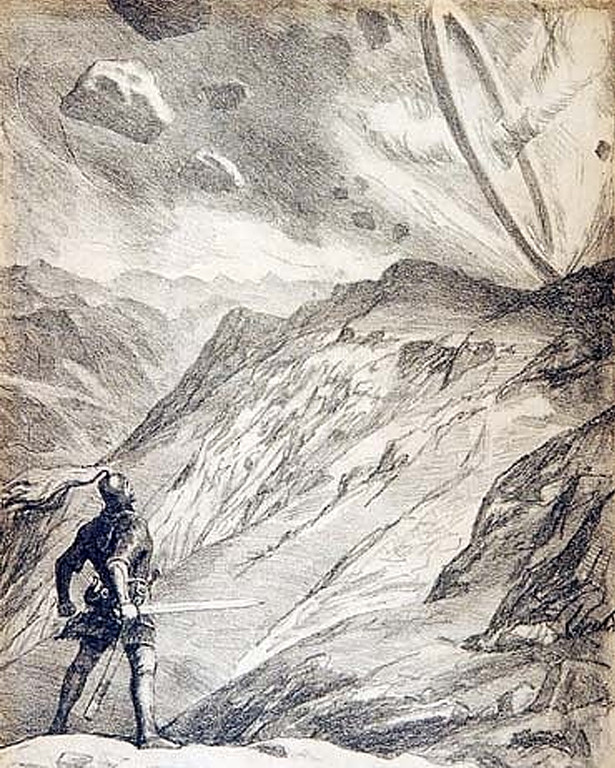
Fig. 5 – Ullikummi as a playable character from the online video game Final Fantasy XI (larger version).
2.2. Mithras
The Greco-Roman god of light, Mithras, [9] is perhaps the best known and studied of the stone-born deities in Western mythology. Researchers often refer to his birth stone using the Latin term Petra Genetrix, or the “Fecund rock.” Manfred Clauss notes that the symbolism of the rock is tied to the earth and the cosmic egg (I have archived the relevant chapter section here).
The multi-layered quality of Mithraic symbolism … reappears in the case of the rock: represented and understood not only as the kosmos but also as the earth, on many images it is encircled by a serpent, [fig. 6] a creature associated with the earth (Clauss & Gordon, 2001, p. 67).
[…]
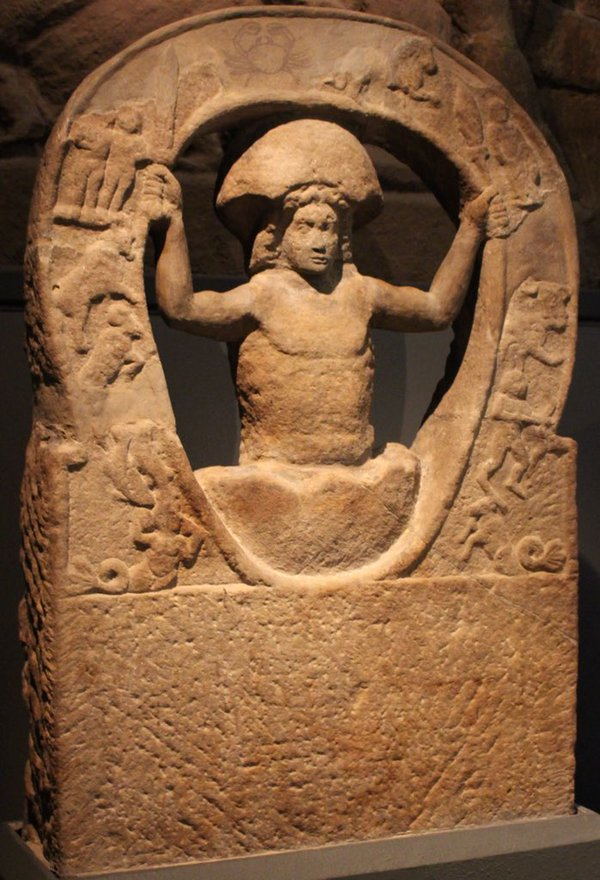
We can discern the influence of Orphic speculation in a Greek inscription from one of the numerous mithraea in Rome, on a statue-base dedicated Διi ‘Hλω Miθpa Φávητı, that is to Deus Sol Mithras Phanes. Phanes is the embodiment of unlimited light, an Orphic deity who emerged from the cosmic egg. There is also literary evidence for the syncretism of Mithras with Phanes. In this community, therefore, Mithras’ identification with the sun god grounded an allusion to the Orphic-Platonic ideas current among the intellectual élites. Mithras-Phanes is also known to us in iconographic form: a relief from Vercovicium (Housesteads) on Hadrian’s Wall shows Mithras emerging from the cosmic egg, [fig. 7] which is represented both as such and by the shape of the zodiacal ring (Clauss & Gordon, 2001, p. 70).
Mithras’ position as a solar deity and depiction emerging from a cosmic egg/stone establishes him as a self-born creator god. This is supported by another aspect of his holy narrative: the slaying of the bull. Stone reliefs depict him in a great struggle to pin the animal down and then strike it in the neck with a knife. Since the bull was symbolic of the moon (and thus death), its sacrifice is seen as the creation of life and the cosmos. This is represented by zodiac symbols—the path of the newly formed planets—on the god’s fluttering cloak and by grapes or ears of corn in place of the pooled blood on the ground (Clauss & Gordon, 2001, pp. 78-90). Therefore, like Yu the Great, Mithras’ feat distances him from the rebellion and defeat that mark other figures in this list.
Sun Wukong is similar to Mithras as he too struggles against bovine opponents, including Laozi’s buffalo in chapters 50 to 52 and the Bull Demon King in chapters 59 to 61. However, Monkey’s conception involves the mingling of masculine heavenly and feminine earthly forces, while Mithras is born of a virginal stone.

Fig. 6 – An example of Mithras’ serpent-wrapped birth rock from Austria. A larger version is available on Wikicommons; Fig. 7 – The deity emerging from a cosmic egg surrounded by the western Zodiac symbols (larger version). From the Homesteads Roman Fort along Hadrian’s Wall. Found on this article.
2.3. Diorphus
Mithras’ son, Diorphus, is said to have also been born from a stone. Pseudo-Plutarch (c. 3rd century) writes:
Near to this [the Araxes] river lies the mountain Diorphus, so called from Diorphus the son of the Earth, of whom this story is reported. Mithras desirous to have a son, yet hating woman-kind, lay with a stone, till he had heated it to that degree that the stone grew big, and at the prefixed time was delivered of a son, called Diorphus; who, growing up and contending with Mars for courage and stoutness, was by him slain, and by the providence of the Gods was transformed into the mountain which was called Diorphus by his name (Plutarch & Goodwin, 1874, p. 505).
Diorphus is similar to Monkey, Qi of Xia, and the children of Hilumandju as he is the product of a masculine heavenly force (Mithras) and a feminine earthly force (the stone). He and Qi share a further connection as they are both the sons of beings who were themselves born from stone. And much like Wukong, Diorphus violates the natural order by challenging the gods (in this case Mars) and is defeated, being transformed into a mountain after his death. While not exactly the same, the end result brings to mind Monkey’s imprisonment under Five Elements Mountain.
The tale of Diorphus’ conception follows the same tradition as the Story of Ullikummi where a god intends to sire a son with a stone and not a goddess, resulting in a powerful, rebellious offspring.
2.4. Agdistis
The god Agdistis is a monstrous, hermaphroditic being sired by Zeus. Their story is recorded by Arnobious of Sicca (died c. 330):
Within the confines of Phrygia, he says (Timotheus), there is a rock of unheard-of wildness in every respect, the name of which is Agdus, so named by the natives of that district. Stones taken from it, as Themis by her oracle had enjoined, Deucalion and Pyrrha threw upon the earth, [10] at that time emptied of men; from which this Great Mother, too, as she is called, was fashioned along with the others, and animated by the deity. Her, given over to rest and sleep on the very summit of the rock, Jupiter assailed with lewdest desires. But when, after long strife, he could not accomplish what he had proposed to himself, he, baffled, spent his lust on the stone. This the rock received, and with many groanings Acdestis (Agdistis) is born in the tenth month, being named from his mother rock. In him there had been resistless might, and a fierceness of disposition beyond control, a lust made furious, and derived from both sexes. He violently plundered and laid waste; he scattered destruction wherever the ferocity of his disposition had led him; he regarded not gods nor men, nor did he think anything more powerful than himself; he contemned earth, heaven, and the stars.
Now, when it had been often considered in the councils of the gods, by what means it might be possible either to weaken or to curb his audacity, Liber, the rest hanging back, takes upon himself this task. With the strongest wine he drugs a spring much resorted to by Acdestis where he had been wont to assuage the heat and burning thirst roused in him by sport and hunting. Hither runs Acdestis to drink when he felt the need; he gulps down the draught too greedily into his gaping veins. Overcome by what he is quite unaccustomed to, he is in consequence sent fast asleep. Liber is near the snare which he had set; over his foot he throws one end of a halter formed of hairs, woven together very skillfully; with the other end he lays hold of his privy members. When the fumes of the wine passed off, Acdestis starts up furiously, and his foot dragging the noose, by his own strength he robs himself of his sex; with the tearing asunder of these parts there is an immense flow of blood; both are carried off and swallowed up by the earth; from them there suddenly springs up, covered with fruit, a pomegranate tree … (Burkert, 1979, pp. 255-256)
Agdistis is similar to Monkey and the above figures as they are the product of a masculine heavenly force (Zeus) and a feminine earthly force (the stone). And like Wukong’s rebellion, the hermaphrodite’s raw, destructive nature threatens the primacy of heaven. As a result, both Agdistis and Monkey share a superiority complex, believing that they are mightier than the gods. The deities fear their power and, therefore, seek ways to tame them. Wukong is placated for a time with celestial posts before ultimately being imprisoned by the Buddha, while Agdistis is stripped of their manhood.
Agdistis’ conception also follows the tradition of Ullikummi and Diorphus. The end result of Zeus’s attempted rape of the stone/earth goddess is a powerful, rebellious offspring.
2.5. Armilus
The Book of Zerubbabel (7th century) describes Armilus, a Jewish anti-messiah figure, as the spawn of Satan and a world conqueror who will force all to worship his lithic mother. Knohl (2009) presents the section where Zerubbabel learns of Armilus from an angel:
This city is Nineveh, the city of bloodshed, which is the big Rome. And I have said to him: “When would be the end of these awful things?’ And he took me by my hand and brought me to the house of disgrace.
And he showed me there a marble stone in the shape of a very beautiful virgin. And he said to me: ‘What do you see, Zerubbabel?’ And I said: ‘I see a marble stone in the shape of a very beautiful woman.’
And he told me: “This stone is the wife of Belial [Satan], and when Belial sees her, he will lie with her and she will become pregnant and will bear him Armilus, and she will be the chief idolatry. And he (Armilus) will rule over the whole world and his dominion will be from one end of the earth to the other end of the earth. And he will make signs. He will worship strange gods, and will speak words against the Most High and no one will be able to stand against him. And all nations will go astray after him except for Israel.
And he Armilus will take his mother from the house of disgrace and all places and all nations will worship this stone and will make sacrifices and libations to it. And no one will be able to look upon her face because of her beauty. He is Arimolaus son of Satan, and he will become a King in Emmaus, the city of his father, and his fear will fall in all places (pp. 79-81). [11]
Another tradition explains Armilus will proclaim himself God and, having won the trust of Christians, lead a vast army to decimate Jews who stand against him. In the end, though, God or the Messiah will gather the scattered Israelites and defeat Armilus:
But as Armilus nevertheless insists upon being recognized as God by the Jews, and they cry out to him that he is Satan and not God, a bitter battle breaks out between Armilus with an immense heathen army on the one side, and Nehemiah with 30,000 Jewish heroes on the other. This unequal combat ends in the death of the “Ephraimite Messiah” and a million Jews. After an interval of forty-five days, … Michael will blow his trumpet; then the Messiah and Elijah will appear, gather the dispersed of Israel, and proceed to Jerusalem. Armilus, inflamed against the Jews, will march against the Messiah. But now God Himself will war against Armilus and his army and destroy them; or the Messiah, as one version has it, will slay Armilus by the breath of his mouth (Kohler & Ginzberg, 1906, p. 119).
Like Monkey and the above figures, Armilus is the product of a masculine heavenly force (Satan) and a feminine earthly force (the stone statue). He violates the natural order by proclaiming himself God and even fights against the All Mighty, much like Monkey proclaims himself the “Great Sage Equaling Heaven” and leads an army against heaven. Armilus’ defeat by God is also like Wukong’s subjugation by the Buddha, Diorphus’ death by Mars, and Ullikummi’s presumed besting by the gods.
Armilus’ conception also follows the tradition of Ullikummi, Diorphus, and Agdistis. Satan lays with the stone statue with the intent of creating a powerful, rebellious offspring.
2.6. Soslan
The hero Soslan, also known as Sozryko, appears in a body of legends associated with the Caucasian Nart Saga:
At the sight of the beautiful Satana [the mother of the Narts] washing clothes on the riverbank, a shepherd across the river poured out his semen on a stone from which, nine months later, the child Soslan came forth. When he had grown up, he demanded to be “tempered” in the milk of a she-wolf, a treatment destined to make him invulnerable. The divine smith Kurdalägon dropped him into a trough containing one hundred goatskins of milk, but since the trough was too short, Soslan had to bend his knees, which consequently were not tempered and thus remained vulnerable.
After a long existence devoted to war exploits, mostly miraculous, Soslan insulted the daughter of Balsäg, a kind of celestial spirit, who took his vengeance by discharging at Soslan a living steel wheel that he controlled. The hero was hit by the wheel on all parts of his body successively and threw it back without being injured until, on the advice of the treacherous Syrdon [a figure similar to Loki], the wheel hit him on the knees and smashed them to pieces. According to an eastern Circassian variant, Soslan indulged in a game during which the Narts, again at Syrdon’s instigation, threw a wheel made of serrated steel at him from the top of a hill. It hit the distracted Soslan in the knees (Honigsblum, 1993, p. 264).
Despite the slight difference, Soslan’s parentage still follows the same tradition as Ullikummi, Diorphus, Agdistis, and Armilus. His father is humanoid, while his mother is a stone. The change from deity to lowly human shows that, in this case, even mortal sperm was thought capable of magically fertilizing earth.

Fig. 8 – “Soslan vs Balsag Wheel” by Maharbek Tuganov (larger version).
3. Western Influences on Sun Wukong’s Story?
Monkey’s birth narrative was likely influenced by that of Yu the Great and his son Qi/Kai considering that our hero wields the sage-king’s cosmic ruler, the gold-banded cudgel, as a weapon. But since his stone birth and later rebellion mirror the tales above, might this suggest the author-compiler of Journey to the West was aware of the ancient myth cycle of a stone-born son who challenges heaven? Many of the cited Western myths show a clear affinity with the Song of Ullikummi. For example, Burkert (1979) notes six similarities between the myths of Agdistis and the stone titan: “(1) The initial situation: the big stone; (2) a god fertilizes the stone; (3) the stone gives birth to a child; (4) the child thus created is a rebel against the gods; (5) the gods gather and plan countermeasures; (6) the enemy of the gods is rendered harmless” (p. 257). Sound familiar? If this circa 12th-century BCE myth cycle spread west from Anatolia to Greece, could not a version of it have spread east and penetrated China by way of Persia and India? This need not have been the original Ullikummi story but an older protomyth or even a later variation. Of course this then raises the question: how would the author-compiler have learned about this story? Needless to say, much, much more research is needed to determine if such a dissemination took place. Similarities alone aren’t enough without some kind of textural, oral, or archaeological evidence. Perhaps in the future a scholar more qualified than myself will pursue this line of inquiry.
4. Monkey’s Stone Egg and Popular Culture
Sun Wukong’s stone birth is so well known that it is referenced in the world famous anime Dragon Ball Z (DBZ). The original Dragon Ball series presents the main character Son Goku, himself based on the Great Sage, as a good-natured little boy with bulletproof skin and a monkey tail. However, DBZ reveals him to be a Saiyan, a humanoid alien warrior, who was sent as an infant in a rocket ship (à la Superman) to destroy Earth. This vessel, known as an “Attack Ball” (Atakku Bōru, アタックボール), is spherical in shape and represents the stone from which Wukong is born (fig. 9). It is a fun little twist on the original lore.

Fig. 9 – Goku in the stone egg-like Attack Ball (larger version).
5. Conclusion
This brief survey demonstrates that stone is capable of giving birth to creator gods, protoplasts, savior figures, heroes, and even great monsters. But much like a human egg, a father is needed to fertilize it with sperm. Sun Wukong’s stone is nourished by the seeds of heaven. Qi of Xia was fathered by the demigod Yu the Great and born from a woman-turned-stone. The first Tibetans, born of a rock-ogress, are sired by the Bodhisattva Hilumandju. In almost all cases in Western mythology (with the exception of Soslan), the pater is a heavenly force, an anthropomorphic deity, who begets a son by impregnating a stone in place of a goddess or mortal woman. Examples include Kumarbi and the stone titan Ullikummi, Mithras and the foolhardy Diorphus, Zeus and the violent Agdistis, and Satan and the anti-Messiah Armilus. Misogyny aside, the myths discussed speak to some belief that a son born of stone would pose a threat to the gods. I suggest this tendency towards violating the natural order is a manifestation of their unnatural births.
The number of similarities between Monkey’s early story arc and the Song of Ullikummi might suggest a possible flow of influence from the near east. Both are born of stone, rebel against heaven, rout an army of 70-something gods, and are defeated by a supreme deity. I must stress, however, that these are just surface level affinities. They shouldn’t be accepted as concrete proof of influence until a deeper study providing actual historical evidence is conducted.
6. Updates
Updated: 01-27-21
I have found a full account of the mythical stone birth of the Nart hero Soslan. It is portrayed as volcanic in nature, with the birth stone growing as it is baked in an oven for nine months. And finally, the child is born glowing red hot, causing a god of blacksmiths to quench-harden him in water.
There were two brothers, the sons of Sajem. The elder was named Zartyzh, the younger Shawey.
One day Setenaya [Satana] was bathing by the river. On the water’s other side stood one of these brothers, the Nart herdsman Sajemuquo Zartyzh, also called Tezhidada, the “Eldest Ram.” From where he stood he was able to see Lady Setenaya. When that brother saw the beautiful temptress going back and forth, not standing still, strewing her clothes about, he could no longer control his passion. He was enchanted by her beauty and so let loose an arrow of manly fluid.
“Setenaya” It is coming to you.”
“So, let it come, but why did you do that?” said Setenaya.
“Hey, Setenaya! By day I tend the sheep. By night, when I come to you, the lance is always stuck in the ground in front of your house. so how would you have me do it?” said the shepherd.
Heavy steam arose as the bolt skimmed over the water, tracing a path until it reached Setenaya, but the bolt of lust just missed her and instead fell on a stone that was lying beside her on the riverbank. Setenaya picked up the stone, wrapped it in a warm cloth, brought it home, and placed it in the stove. Day by day the stone grew. It lay for nine months and nine days. During this time it grew in size and became very big. Lady Setenaya had her people bring the stone to Tlepsh‘s smithy. There she bade Tlepsh, the god of the forge, to break open the stone.
Tlepsh did as she had bidden him. From inside the stone emerged a baby boy, glowing as bright as fire. The baby fell on the front part of Setenaya’s dress and burned through it until he fell to the ground. Tlepsh seized him with his blacksmith’s tongs, and holding him by the thighs plunged him into the water for the grindstone seven times, thus cooling the baby. Then once again Tlepsh picked up the little child with his metal tongs by his thighs and hardened him seven times, so that the child’s skin became a little bit more flexible. The child became like a human being, but his skin remained tough, like tempered steel. Tlepsh named the baby Sawseruquo [Soslan] and gave him back to Setenaya.
On his thighs, where Tlepsh had held him with the tongs, Sawseruquo’s skin remained soft like human skin, and because his thighs had been squeezed, he was bowlegged (Colarusso, 2015, pp. 52-53).
This story has obvious parallels with the Greek story of Achilles, a mighty warrior with a vulnerable spot on his feet. Interestingly, a character from the Iliad (8th-century BCE) suggests that, due to his unwillingness to help his comrades in battle, Achilles’ parents were not the human couple commonly associated with him but the very sea and a rock cliff. Alepidou (2020) convincingly argues that these are references to the ancient Hurro-Hittite “Story of Hedammu” and the “Story of Ullikummi.” Hedammu, the offspring of Kumarbi and a sea goddess, was a massive sea creature that plagued the earth and sea. As noted above, Kumarbi’s subsequent offspring, Ullikummi, is a stone giant who attacked heaven. The stone titan is defeated when he is chiseled free from his base of power on the shoulder of an underworld god. This weakness of the lower extremities likely influenced that of Achilles and Soslan.
Update: 02-26-22
I was originally thinking about writing a sequel to this piece in which I list mythic characters trapped under mountains. Here’s the list I have so far:
- Sun Wukong (various Journey to the West iterations) – Mt. Huaguo by Guanyin or Five Elements Mountain by the Buddha
- 108 stars (Water Margin) – Imprisoned in an earth prison under a stone slab by a Daoist master. Jing Wang (1992) suggests the stone slab was likely influenced by the Taishan stone (泰山石).
- Goddess Yaoji (Precious Scroll of Erlang) – Mt. Tai by the Jade Emperor
- Goddess Sanshengmu (Precious Lotus Lamp) – Mt. Hua by Erlang
- Wuzhiqi (Extensive Records of the Taiping Reign) – Turtle Mountain by Yu the Great
- Ravana (Ramayana) – Mt. Kailash by Shiva
- Typhon (Dionysiaca/various) – Sicily/ Mt. Etna by Zeus
- Enceladus (Apollodorus/various) – Sicily by Athena or Mt. Etna by Zeus
- Polybotes (Apollodorus/various) – Kos/Nisyros by Poseidon
But if I choose the broader term “earth prisons,” I can include other mythic baddies like Lucifer and Loki, as well as the Titans in Tartarus!
Update: 08-31-25
It has occurred to me since writing the main article that my suggestion that Monkey was influenced by Ullikummi could just be a coincidence. As shown by this Yuan-Ming zaju play, the concept of a rebellious Great Sage feuding with and being punished by heaven predates the 1592 JTTW. And Monkey’s stone birth is unique to the standard edition, meaning that the rebellion and lithic nativity are separate elements added to his later mythos—i.e. they are not part of Wukong’s early story cycle.
Notes:
1) See chapter four, especially the sections “The Mythology of Nü Gua and the Flood” and “Yu, Marriage, and the Body.”
2) Strassberg (2002) explains that the variant Kai (開) was used during the Han to avoid conflicting with Emperor Jing’s personal name, Liu Qi (劉啟) (p. 169). Whether Qi or Kai is used, both names reference the story of the stone splitting open to give birth to Yu’s son. See also note four below.
3) Birrell (1999) writes:
It is said by the Tang classical scholar and commentator Yan Shigu (A.D. 581-645) to be a reference he located in a text from Huainanzi, compiled circa 139 B.C. That text, however, does not appear in the extant editions of Huainanzi. The only reference the latter makes to the Yu/Qi myth is: “Yu was born of a stone.” Embroidered versions of the metamorphosis of the Tushan girl into stone begin to appear in the writings of Han commentators such as Gao You (third century A.D.), and Ying Shao (second century A.D.). The fourth-century commentator of The Classic of Mountains and Seas, Guo Pu, however, specifies that the mother of Qi (Kai) metamorphosed into stone and gave birth to Qi on the mountain. Thus the tradition of Qi’s miraculous birth is confirmed by at least the early fourth century A.D. and probably derives from an earlier tradition (p. 122).
I changed the Wade-Giles to Pinyin.
4) The stone “splitting open” is related to stories of sage-kings erupting from the backs or sides of their mothers, splitting them open in the process (Cook & Luo, 2017, pp. 97-100). See also note two above.
5) Sørensen notes that the myth was depicted in a mural from the famous Jokhang Temple, which was built in the 7th-century (Bsod-nams-rgyal-mtshan & Sørensen, 1994, p. 582).
6) Another version of the tale appears in The Mirror Illuminating the Royal Genealogies (Tb: Rgyal rabs gsal ba’i me long, 14th century). An annotated translation can be read in Bsod-nams-rgyal-mtshan & Sørensen, 1994, pp. 125-133.
7) The vizier and brother of Tesub.
8) Güterbock (1951), pp. 138-140 gives a summary of the tale. The paper also translates the first half of the fragmented epic. Güterbock (1952) translates the other half. Both papers are archived above.
9) I am indebted to Jose Loayza for bringing the stone birth of Mithras to my attention. This resulted in the rest of the Western figures in this article.
10) This references another myth in which, following the great flood, mankind is repopulated by Deucalion and Pyrrha casting the “bones” (stones) of the “great mother” (Gaia) over their shoulders. Thus thrown, the stones soften and take on human shape. See for example Ovid’s Metamorphosis (Ovid & More (n.d.)).
11) Knohl (2009) suggests that Armilus’ story is a veiled attack against Augustus Caesar: 1) who is said to have been sired by the god Apollo under the guise of a dragon, the Jewish symbol for Satan; 2) who founded the Greek city of Nicopolis, which brings to mind the biblical Emmaus Nicopolis; 3) and who helped spread the cult of the goddess Roma, a statue of a beautiful woman (pp. 81-83). So, Satan impregnating the stone statue to produce Armilus likely refers to the myth of Apollo siring Augustus.
Sources:
Alepidou, A. (2020). Near Eastern Echoes in Iliad 16.33–35, Yearbook of Ancient Greek Epic Online, 4(1), 1-26. doi: https://doi.org/10.1163/24688487-00401001
Birrell, A. (1999). Chinese Mythology: An introduction. Baltimore: The Johns Hopkins University Press.
Bsod-nams-rgyal-mtshan, & Sørensen, P. K. (1994). The Mirror Illuminating the Royal Genealogies: Tibetan Buddhist Historiography: An Annotated Translation of the XIVth Century Tibetan Chronicle: rGyal-rabs gsal-ba’i me-long. Wiesbaden: Harrassowitz.
Burkert, W. (1979). Von Ullikummi zum Kaukasus. Die Felsengeburt des Unholds. Würzb. Jahrbb. 5, 252-261. Retrieved from https://journals.ub.uni-heidelberg.de/index.php/wja/article/view/25702/19416
Clauss, M., & Gordon, R. (2001). The Roman Cult of Mithras: The god and his mysteries. New York: Routledge.
Colarusso, J. (2015). Nart Sagas from the Caucasus: Myths and Legends from the Circassians, Abazas, Abkhaz and Ubykhs. Princeton: Princeton University Press.
Cook, C. A., & Luo, X. (2017). Birth in Ancient China: A study of metaphor and cultural identity in pre-imperial China. Albany: State University of New York Press
Eliade, M. (1978). The Forge and the Crucible (3rd ed.). Chicago: University of Chicago Press.
Güterbock, H. (1951). The Song of Ullikummi Revised Text of the Hittite Version of a Hurrian Myth. Journal of Cuneiform Studies,5(4), 135-161. doi:10.2307/1359008
Güterbock, H. (1952). The Song of Ullikummi Revised Text of the Hittite Version of a Hurrian Myth (Continued). Journal of Cuneiform Studies, 6(1), 8-42. doi:10.2307/1359160
Hinsch, B. (2011). Women in Early Imperial China. Lanham, Md: Rowman & Littlefield Publishers.
Honigsblum, G. (1993). The Religion and Myths of the Ossets. In Y. Bonnefoy (Ed.). American, African, and Old European mythologies (pp. 262-265). Chicago: University of Chicago Press.
Jong, A. (1997). Traditions of the Magi: Zoroastrianism in Greek and Latin literature. Leiden; New York: Brill.
Knohl, I. (2009). Messiahs and Resurrection in ‘The Gabriel Revelation’. Israel: Bloomsbury Publishing.
Kohler, K., & Ginzberg, L. (1906). Armilus. In The Jewish Encyclopedia (vol. 2, pp. 118-120). United Kingdom: Funk & Wagnalls. Retrieved from http://www.jewishencyclopedia.com/articles/1789-armilus
Koss, N. (1981). The Xiyou ji in Its Formative Stages: The Late Ming Editions (Vols. 1 and 2). (Doctoral dissertation). Available from ProQuest Dissertations and Theses database. (UMI No. 8112445)
Lewis, M. E. (2006). The Flood Myths of Early China. Albany: State University of New York Press.
Ovid, & More, B. (n.d.). Metamorphoses, lines 348-415. Retrieved June 6, 2020, from http://www.perseus.tufts.edu/hopper/text?doc=Perseus:text:1999.02.0028:book=1:card=348
Plutarch, & Goodwin, W. W. (1874). Plutarch’s Morals: Translated from Greek by Several Hands. United States: Little, Brown. Retrieved from http://www.perseus.tufts.edu/hopper/text?doc=Perseus:text:2008.01.0400:chapter=23&highlight=mithras
Rockhill, W. W. (1891). The Land of the Lamas: Notes of a Journey Through China, Mongolia and Tibet with maps and Illustrations. New York: Century Co.
Rutherford, I. (2020). Hittite Texts and Greek Religion: Contact, Interaction, and Comparison. United Kingdom: OUP Oxford.
Wilhelm, H., & Baynes, C. F. (1977). I Ching or Book of Changes (3rd ed.). Princeton University Press.
Wu, C., & Yu, A. (2012). The Journey to the West (Vol. 1) (Rev. ed.). Chicago: University of Chicago Press.




_1.jpg)

#/media/File:Kagamibuta_netsuke_front.jpg)


.jpeg)

.jpg)