Type the phrase “到此一遊/游” (daoci yi you) into an online Chinese dictionary and chances are the results will say it’s a type of vandalism meaning “…was here,” as in “so-and-so was here.” This phrase is often used as a form of graffiti by Chinese tourists wanting to record their visit to a particular site. The most famous modern example that comes to mind happened in 2013 when a Chinese teenager defaced a carving in Egypt’s 3,500-year-old Luxor Temple with the phrase “Ding Jinhao was here” (Ding Jinhao daoci yi you, 丁锦昊到此一游) (fig. 1) (Wong, 2013).

Fig. 1 – The “Ding Jinhao was here” graffiti on the face of a Luxor Temple relief (larger version). Screenshot from a CBS news report.
Table of Contents
1. The Phrase in JTTW
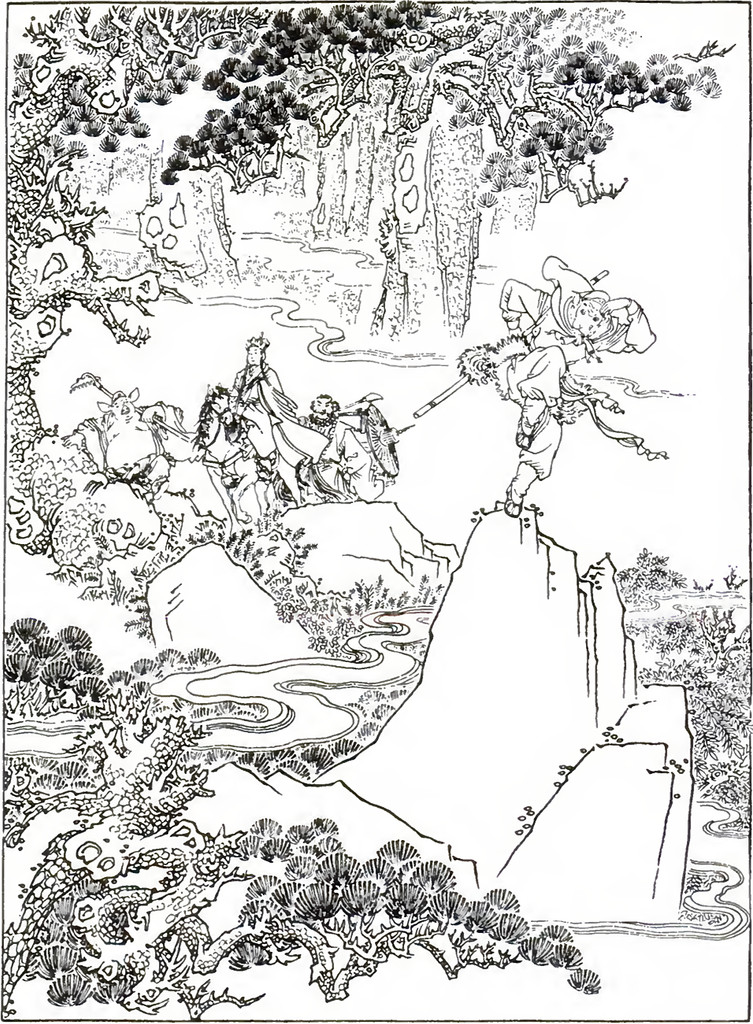
This same phrase appears in the seventh chapter of Journey to the West (Xiyouji, 西遊記, 1592). After Sun Wukong escapes from Laozi’s eight trigrams furnace, the immortal causes such an uproar that the Buddha is forced to intervene. The latter makes a wager that if Monkey can jump out of his hand, the Tathagata will make him the new Emperor of Heaven. Sun accepts and leaps from the Enlightened One’s palm:
As the Great Sage advanced, he suddenly saw five flesh-pink pillars supporting a mass of green air. “This must be the end of the road,” he said. “When I go back presently, Tathagata [the Buddha] will be my witness and I shall certainly take up residence in the Palace of Divine Mists.” But he thought to himself, “Wait a moment! I’d better leave some kind of memento if I’m going to negotiate with Tathagata.” He plucked a hair and blew a mouthful of magic breath onto it, crying, “Change!” It changed into a writing brush with extra thick hair soaked in heavy ink. One the middle pillar he then wrote in large letters the following line: “The Great Sage, Equal to Heaven, has made a tour of this place” [Qitian Dasheng, daoci yi you, 齊天大聖,到此一遊; fig. 2] (emphasis added). When he had finished writing, he retrieved his hair, and with a total lack of respect he left a bubbling pool of monkey urine at the base of the first pillar (Wu & Yu, 2012, pp. 194-195).
Anyone whose read the story will know that the pillars are in fact the Buddha’s fingers, implying that Monkey never left because the former had exercised his great spiritual powers. Sun, therefore, loses the bet and is crushed under Five Elements Mountain as punishment for his rebellion.

Fig. 2 – Sun tags the pillar (Buddha’s finger) with the phrase “The Great Sage Equaling Heaven was here” (larger version). From the Japanese children’s book Son Goku (1939).
2. Is JTTW the Source?
The quoted translation by Anthony C. Yu (Wu & Yu, 2012) can be rendered simply as “The Great Sage was here.” This is a perfect example of Monkey’s brash, ego-driven personality, not unlike the type of tourist who’d think it appropriate to defile an ancient monument with their name. A few online sources (example) suggest that Journey to the West is the origin of the “…was here” phrase. However, knowing that the novel has so many historical influences, I’m of the opinion that this literary element certainly reflects an already extant real world concept from the Ming (or earlier). But the novel no doubt helped make the phrase more popular in the public eye.
Can you imagine how many people copied this phrase after the novel was published in 1592?
Sources:
Wong, H. (2013, May 29). Netizen outrage after Chinese tourist defaces Egyptian temple. CNN. Retrieved September 6, 2018, from http://edition.cnn.com/travel/article/china-egypt/index.html
Wu, C., & Yu, A. C. (2012). The Journey to the West (Vols. 1-4) (Rev. ed.). Chicago, Illinois: University of Chicago Press.