Last updated: 10-14-2022
One of the most famous episodes from Journey to the West happens in chapter three after Sun Wukong returns from the undersea palace with his magic staff and is chosen as lord of the 72 monster kings. Following a lavish banquet in his honor, the Monkey King falls asleep and his soul is dragged to the Chinese underworld by two spirits:
In his sleep the Handsome Monkey King saw two men approach with a summons with the three characters “Sun Wukong” written on it. They walked up to him and, without a word, tied him up with a rope and dragged him off. The soul of the Handsome Monkey King was reeling from side to side. They reached the edge of a city. The Monkey King was gradually coming to himself, when he lifted up his head and suddenly saw above the city an iron sign bearing in large letters the three words “Region of Darkness [You mingjie, 幽冥界].” The Handsome Monkey King at once became fully conscious. “The Region of Darkness is the abode of Yama, King of Death,” he said. “Why am I here?” “Your age in the World of Life has come to an end,” the two men said. “The two of us were given this summons to arrest you.” When the Monkey King heard this, he said, “I, old Monkey himself, have transcended the Three Regions and the Five Phases [1]; hence I am no longer under Yama’s jurisdiction. Why is he so confused that he wants to arrest me?” The two summoners paid scant attention. Yanking and pulling, they were determined to haul him inside. Growing angry, the Monkey King whipped out his treasure. One wave of it turned it into the thickness of a rice bowl; he raised his hand once, and the two summoners were reduced to hash (Wu & Yu, 2012, p. 139).
The two unnamed psychopomps are simply referred to in the story as “[those who] arrest the dead” (Gou siren, 勾死人). Modern media sometimes portrays these two wearing contrasting black and white uniforms with tall hats (fig. 1).

Fig. 1 – The summoners taking Sun Wukong’s soul in his sleep (larger version). From episode 7 of the Little Fox ESL Journey to the West series.
The Heibai Wuchang
The specific color-coded deities are known in China, Taiwan, and Southeast Asian countries like Malaysia and Singapore as the Heibai wuchang (黑白無常), or the “Black and White [spirits of] Impermanence.” Tan (2018) describes their mythic background and religious importance:
[A] good deal of importance attaches to the worship in Malaysia and Singapore of Heibai Wuchang … popularly known as Da Er Ye (大二爺, Eldest and Second Uncles). In charge of policing the netherworld and protecting humans from evil, they are believed to be two soldiers of the Tang dynasty, General Xie [謝] and General Fan [范]. The former was tall and was hanged by the enemy, while the latter was shorter and was drowned while fighting enemies. General Xie’s image is that of a tall person with a protruding long tongue; he’s wearing a white shirt, and his high hat has the characters yijian daji ([一見大吉] “big luck on seeing me”) or yijian shengcai ([一見生財] “getting wealth on seeing me”). General Fan’s image has a dark face, and his square hat bears the characters tianxia taiping [天下太平], or “peace in the world.” Also called Qiye (七爺) and Baye (八爺), the two generals are in charge of rewarding good people and punishing evil ones. General Xie is more popular among worshippers; frightening as he is, the Elder Uncle benefits from his association with blessing wealth (p. 58).
Chen (2014) provides a different background for the two, which is commonly told in the southern Chinese city of Fuzhou in Fujian province:
The Seventh Lord (七爺) and Eighth Lord (八爺) are frequently seen and are well-known in Taiwanese religious parades. These two deities were originally two brother-like friends in Fuzhou (福州). One was called Xie Bian (謝必安), and the other one was named Fan Wujiu (范無救; 范無咎). On a rainy day, they had an appointment to meet under the Nan Tai Bridge (南臺橋). Fan Wujiu was short with a dark complexion, but Xie Bian was tall with a light complexion. Fan Wujiu arrived at the meeting place earlier, waited there in spite of the heavy rain, and was drowned. Xie Bian tried to bring umbrellas for Fan Wujiu and was therefore late. When he arrived at the bridge, Fan Wujiu was already dead, so he decided to commit suicide because of his friendship and guilt. According to legends, the Heavenly Emperor (玉皇大帝) was touched by this pair of brother-like friends, and promoted their ghosts to supernatural officers from the underworld. The Seventh Lord is Bai Wuchang (白無常), and the Eighth Lord is Hei Wuchang (黑無常). Their mission is to bring dead people’s ghosts from the ordinary human world to the underworld at the moment of their deaths (p. 220).

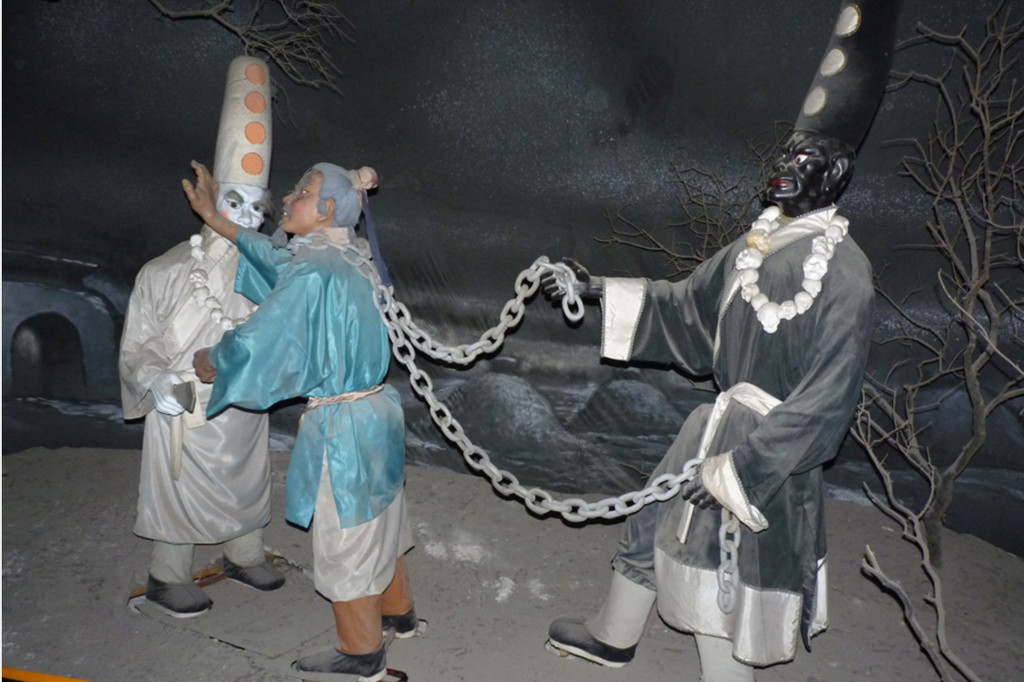
Fig. 2 – A depiction of the spirits taking a soul to the Chinese underworld (larger version). From the Haw Par Villa theme park in Singapore. Original picture from Baike.
Stevens (1997) goes into more detail about their function and veneration:
The pair are despatched on orders from the City God when the due date of a person’s death arrives, to seek out and identify the correct human through the local spiritual official, the Earth God [fig. 3]. They appear before the human and the Tall Demon [the white spirit] announces that the time has come. The Short Demon [the black spirit] binds the soul and drags it before the City God. The Short Demon carries the tablet of authority and the chains to arrest the soul whose due date of death has arrived [fig. 2].
The Tall Demon … receives considerable attention from devotees, often relatives of the very sick, and in a few temples he is provided with cigarettes which are to be seen continually burning having been forced in between his lips. More popularly, his mouth is smeared with a black substance to win his favour and bribe him to keep away. This used to be opium and is still said to be opium, though the substance appears to be more of a sweet sticky mess. In northern and central China, only the Tall Demon is found (p. 173).

Fig. 3 – A monumental statue of an Earth god in Taiwan (larger version).
Origins
The sources above provide two backgrounds for the spirits, historical generals or brother-like friends, all of whom died unnatural deaths. Both origins involve the tall, white figure being hanged, while the short, black figure was drowned. Both of these backgrounds have respective ties to religious beliefs of the Han (206 BCE – 220 CE) and Song (960-1279 CE) dynasties. It was common practice during the Han for generals, especially those slain by the enemy, to be deified as gods. This concept of deified mortals carried over into the Song Dynasty when tutelary gods were popular. Those deified were often pious or loyal people who died unnatural deaths. But most importantly, these individuals were deified by the very communities in which they lived, meaning they were worshiped as the protector of the specific locale and its people (Von Glahn, 2004, p. 164).
These tutelary cults find their origin in earth gods (tudishen, 土地神) worshiped as early as the Han. Just like people of the Song worshiped the worthy among their fallen community members, people of the Han worshiped the gods believed to inhabit the very earth on which their communities were established. Considering the dead were buried underground, these earth gods also served the function of “escort[ing] the deceased to the world of the afterlife” (Von Glahn, 2004, p. 165). Remember above that Stevens described the tall and short spirits relying on the local earth god to help locate the correct soul being summoned. Therefore, our spirits appear to be a combination of deified mortals (generals/worthy citizens) and earth gods who escorted the deceased to the afterlife. But there may be more to the story.
Wuchang (無常), or “impermanence”, is the Chinese term for the sanskrit Anitya. This is one of the “Three Marks” (Sk: Trilaksana) of existence in Buddhism, the other two being suffering (Duhkha) and non-self (Anatman) (Buswell & Lopez, 2014, pp. 47-48). The fact Wuchang is associated with these spirits suggests there is an added Buddhist influence. As I’ve written before, the Chinese underworld presented in Journey to the West is an amalgam of local Chinese and foreign Buddhist beliefs. In short, the Chinese Underworld consists of ten courts in which a soul is punished and sent on to the next until their karma is cleansed. The concept of purgatory and the Ten Kings or Judges of hell are products of 7th-century Chinese Buddhism. Prior to this, souls of the dead were kept en masse in a sort of Daoist city of the dead. So our two summoners were no doubt absorbed into this new Buddhist worldview. The spirits in effect could be viewed as personifications of Buddhist impermanence.
The contrasting black and white color scheme has at least two origins. One, it may have evolved from the belief that each performed duties at different times. Maspero (1981) writes, “The most famous of [the City God’s] subordinates are Master White (Bai laoye [白老爺]) and Master Black (Hei laoye [黑老爺]), who perceive everything that goes on within the constituency, the former during the day and the latter during the night” (p. 110). Two, it may draw from the dualistic nature of Chinese philosophy. Baptandier (2008) comments their color is a “personification of the yin and yang principles of life” (p. 146).

Fig. 4 – A wall mural depicting the Ba Jiajiang (Eight Generals), including General Xie (white) with the phrase “Big Luck” (daji, 大吉) on his hat (larger version) and to his left General Fan (black) with a square hat. Taken by the author in Taipei, Taiwan.
Influence
Both General Xie (the tall, white spirit) and General Fan (the short, black spirit) figure among the Ba Jiajiang (八家將), or “Eight Generals” (fig. 4). These spirit generals are considered protectors of the City God (as well as other popular folk deities) and destroyers of evil. They consist of our two spirits, two more underworld figures called Generals Gan (甘) and Liu (柳), as well as four other figures known as the Four Seasons (Siji, 四季). These generals are personified during festivals by temple parade dance troupes called Jiajiang (家將). Members paint their faces according to the prescribed wrathful iconography for each general (fig. 5) and perform all sorts of choreographed militaristic dances while wielding weapons (video 1). These performances serve to exorcize evil spirits.

Fig. 5 – The facepaint of General Xie, the tall, white spirit. A larger version can be seen on this blog. Original picture by Rich J. Matheson.
The tradition originated in Fuzhou but later spread to Taiwan by the 1870s, making it a rather recent phenomenon (Sutton, 1996).
Video 1 – A Ba Jiajiang performance.
Update: 10-29-2018
Sutton (1996) explains the ceremonial procession of the Eight Generals is modeled after yamen officials making an arrest in dynastic China. In this case, the otherworldly generals would be sent to arrest evil spirits:
The performers seen on the march—excluding the Four Seasons—represent a process, though it is never ritually played out: arrest by yamen underlings. In principle the punishment bearer warns, the messengers search out, the stave bearers pursue, Erye and Daye [the Black and White Spirits] take into custody, and the justices at the rear interrogate and record (p. 215).
In video 1, the man dressed in civilian attire and carrying the strange, yoke-like device on his shoulders (visible at 00:26) is performing the part of the punishment bearer, which I take to mean a symbol of those previously arrested and used as warnings to the evil spirits being pursued.
Update: 10-14-22
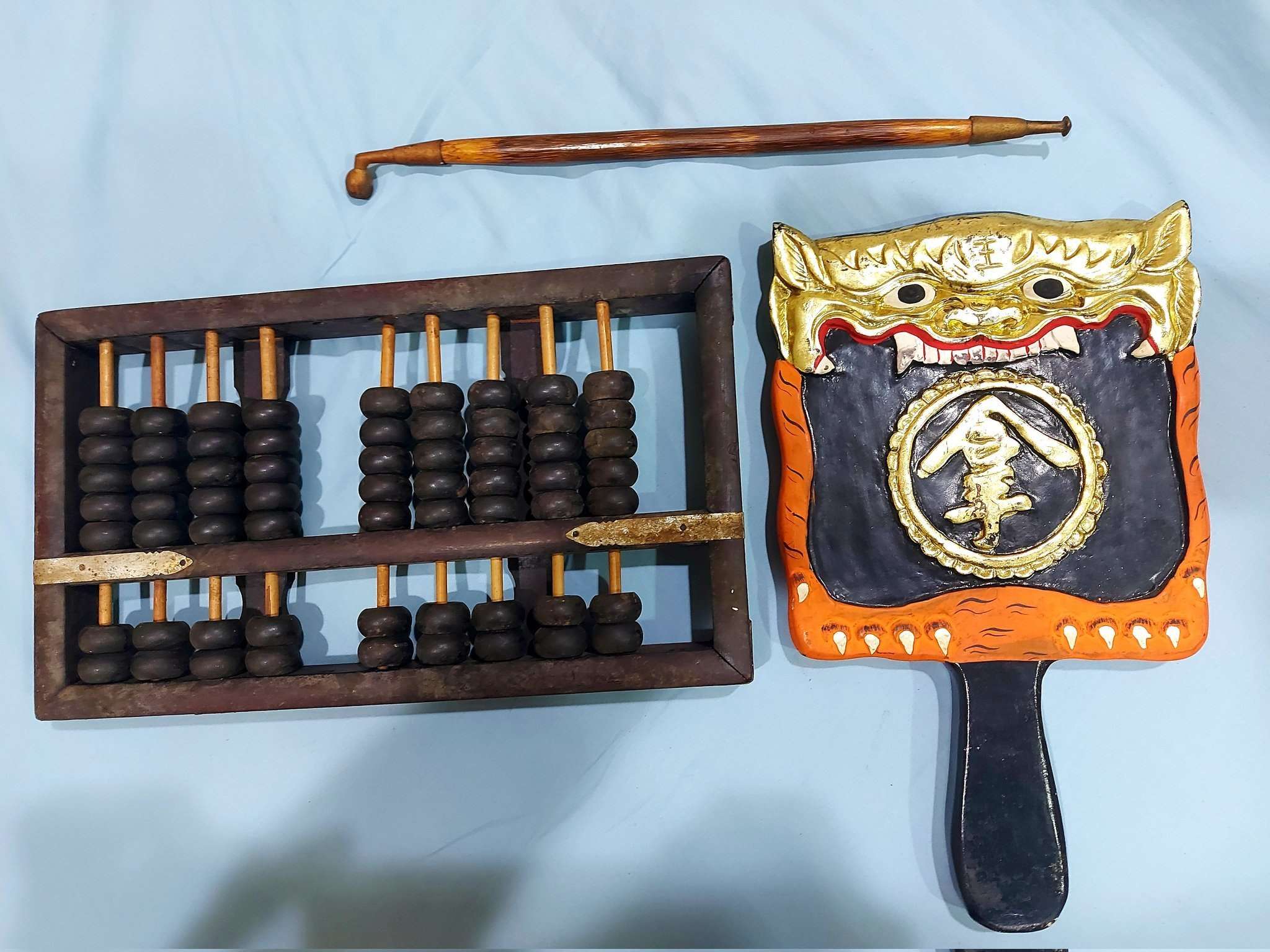
I purchased some ritual items from Singapore previously used by tangki spirit-mediums of the Heibai wuchang. These include an old-school abacus for making arcane calculations, a soul-summoning placard, and a smoking pipe (fig. 6). I feel much cooler now that I have them. My seller-collector friend, from whom I purchased this set, told me that some of the beads are missing from the abacus because they were most likely given to believers as talismans.

Fig. 6 – The ritual items used by Singaporean tangki spirit-mediums of the Heibai wuchang (larger version).
Notes
1) The Three Realms are Heaven, Earth, and Hell, and the Five Phases are the elements of fire, water, earth, metal, and wood. The point being that he is beyond the control of the three realms and the effects of the elements because he has achieved immortality.
Sources
Baptandier, B. (2008). The lady of Linshui: A Chinese female cult. Stanford, Calif: Stanford University Press.
Chen, Y. (2014). Cinematic visualization of spiritual lesbianism in Monkia Treut’s Ghosted: countering essentialist concerns about Li Ang’s literary works In Y. Chen (Ed). New modern Chinese women and gender politics: The centennial of the end of the Qing Dynasty (pp. 210-222).
Maspero, H. (1981). Taoism and Chinese religion. Amherst: University of Massachusetts Press.
Buswell, R., & Lopez, D. (2014). The Princeton Dictionary of Buddhism. Princeton University Press.
Stevens, K. G. (1997). Chinese gods: the unseen world of spirits and demons. London: Collins & Brown.
Sutton, D. S. (1996). Transmission in Popular Religion: The Jiajiang Festival Troupe of Southern Taiwan in Later Imperial China in Shahar, M., & Weller, R. P. (Ed.) Unruly gods: Divinity and society in China (pp. 212-249). Honolulu: University of Hawaiʻi Press.
Tan, C. B. (2018). Chinese religion in Malaysia: Temples and communities. Leiden; Boston: Brill.
Von Glahn, R. (2004). The sinister way: The divine and the demonic in Chinese religious culture. Berkeley: University of California Press.
Wu, C., & Yu, A. C. (2012). The journey to the West: Volumes 1. Chicago, Illinois : University of Chicago Press.