Last updated: 10-26-2024
Someone on reddit recently asked why Sun Wukong was able to live just shy of 400 years before even attaining immortality. I thought this was a good question, so I decided to split off related material from an old piece that I never finished and make a quick article. The short answer is tied to Daoist concepts of fate, and the long answer ultimately explains why Monkey strikes his name from the ledger of life and death in hell.
I. Info from the novel
Here, I would like to quote two early sections from Journey to the West (Xiyouji, 西遊記, 1592) that refer to Sun Wukong’s age. The first appears in chapter one after he becomes monarch of the primates:
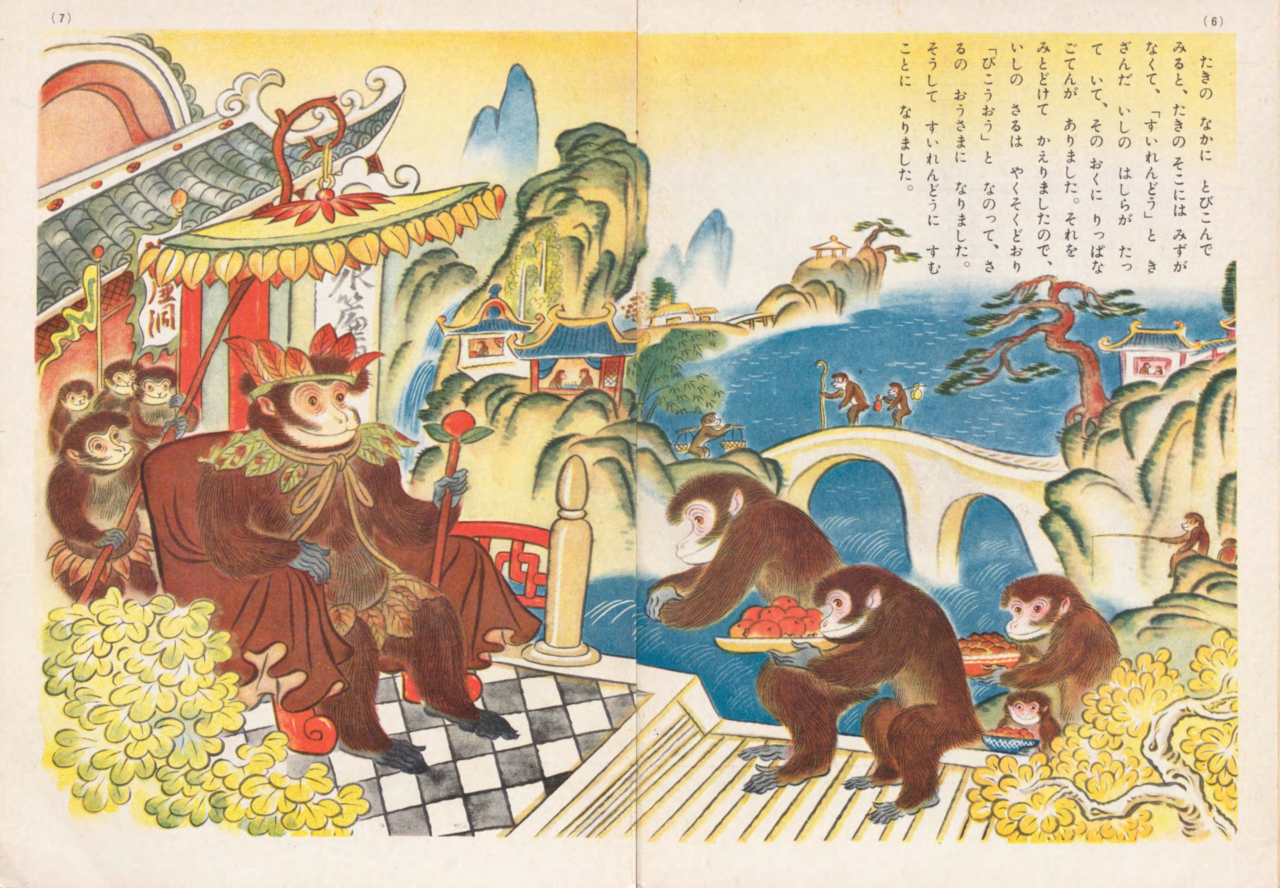
The Handsome Monkey King thus led a flock of gibbons, macaques, and horse-monkeys, some of whom were appointed by him as his ministers, aides, and envoys. They toured the Flower-Fruit Mountain in the morning, and they lived in the Water-Curtain Cave by night. Living in concord and sympathy, they did not mingle with bird or beast but enjoyed their independence in perfect happiness. For such were their activities:
In the spring they gathered flowers for food and drink.
In the summer they went in quest of fruits for sustenance.
In the autumn they amassed taros and chestnuts to ward off time.
In the winter they searched for yellow-sperms to live out the year.The Handsome Monkey King had enjoyed this insouciant existence for three to five hundred years (emphasis added) when one day, while feasting with the rest of the monkeys, he suddenly grew sad and shed a few tears (based on Wu & Yu, 2012, p. 106).
美猴王領一群猿猴、獼猴、馬猴等,分派了君臣佐使。朝遊花果山,暮宿水簾洞,合契同情,不入飛鳥之叢,不從走獸之類,獨自為王,不勝歡樂。是以:
And the second appears in chapter three after Monkey is dragged to hell. He bullies underworld officials into giving him his ledger of life and death, in which he learns his exact age and fate:
You see, though this monkey resembled a human being [i.e. his body], he was not listed under the names of men; though he resembled the short-haired creatures [i.e. his fur], he did not dwell in their kingdoms; though he resembled other animals, he was not subject to the unicorn; and though he resembled flying creatures [i.e. his beak-like, protruding face], he was not governed by the phoenix. He had, therefore, a separate ledger, which Wukong examined himself. Under the heading “Soul1350” he found the name Sun Wukong recorded, with the description: “Heaven-born Stone Monkey. Age: three hundred and forty-two years. A good end” (emphasis added) (Wu & Yu, 2012, p. 140).
So why then was he able to live so long?
I. Religious background
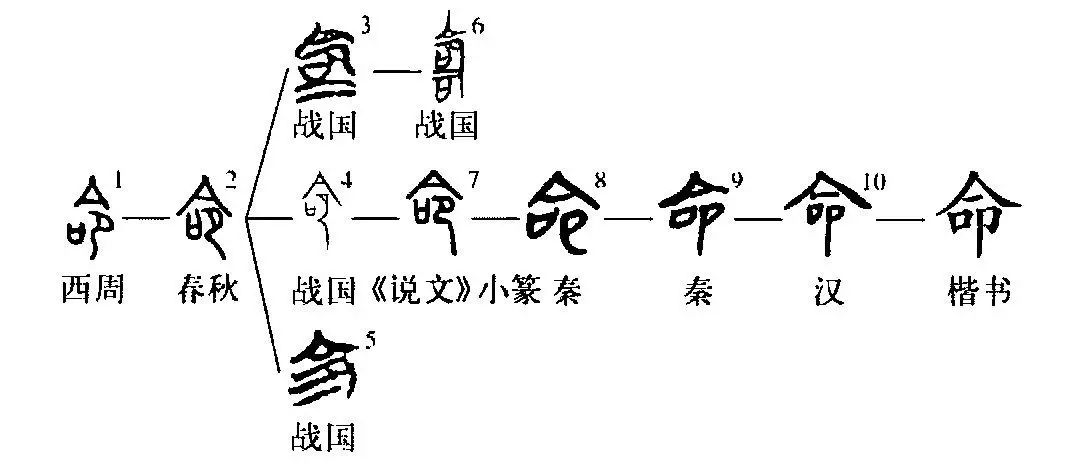
The answer lies in the concept of “pre-allotted lifespans” (ming, 命; a.k.a. “fate”) (fig. 1), which can be traced to weft texts [1] and Grand Purity (Taiqing, 太清) scriptures of the Han dynasty (3rd-c. BCE to 3rd-c. CE). According to 1st to 3rd-century CE commentators, a person’s lifespan and good or bad fortune in life were determined according to whatever combination of “heavenly pneumas” (tianqi, 天氣) and “astral essences” (xingjing, 星精) that they were born under, meaning one’s fate was not handpicked by heaven (Campany, 2005, pp. 131-134). This allotted lifespan was not set in stone, however, for it was subject to subtractions and additions based on one’s bad or good deeds. The deity in charge of this tally system was called the “Director of Allotted Life Spans” (Siming, 司命), and, unlike the underworld officials who provided Monkey with his ledger, he was said to reside in heaven where he regularly received reports on individual human sins by the tutelary Stove god (Zaoshen, 竈神) on the first, fifteenth, and last day of every month. Additionally, he received reports from the three corpses/worms (sanshi, 三尸) inhabiting a person’s body. [2] The more a person sinned, the more points (time) was subtracted, anywhere from almost a year for major offences to just three days for minor offences. Doing good deeds or cheating the system were the only ways to live out the entirety of the allotted lifespan (Campany & Ge, 2002, pp. 47-52).

Evolution of the character ming (命) (larger version). Image found here.
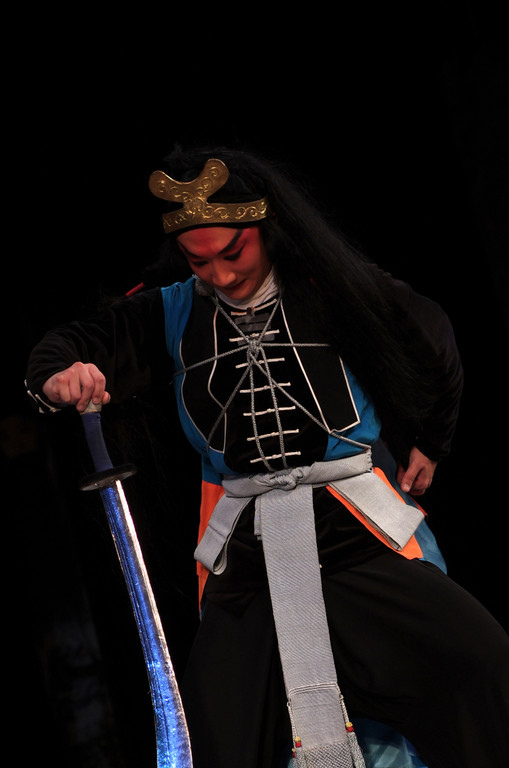
Ways of “living off the books” included magically disguising clothing or a sword as a body (fig. 2), ritually bribing the gods of life and death with a golden statue to be used as a substitute body, or inserting a fake death certificate into the coffin of a recently deceased grandfather. These methods essentially tricked heaven into thinking that the person had died (Campany, 2005, pp. 134-138; Campany & Ge, 2002, pp. 60). The use of longevity-bestowing elixirs was considered the only true way of breaking free of the allotted lifespan and achieving immortality. Interestingly, the Han-era Scripture on the Elixirs of the Nine Tripods (Jiuding danjing, 九鼎丹經) describes how taking a fired concoction of cinnabar, vinegar, and lacquer for a thousand days straight would result in the “Director of Allotted Life Spans expung[ing] your name from the registers of death, so that you will end only when Heaven and Earth do” (Campany & Ge, 2002, pp. 52).

Fig. 2 – A type of Chinese jian (劍) sword that might be magically disguised to look like a decoy body (larger version). Image found here.
Therefore, we can see that Wukong’s allotted lifespan was 342 years and his birth fell under fortunate cosmic circumstances, for he was born onto an island paradise, served as the king of monkeys, and was destined to have a “good end” (shan zhong, 善終). Monkey had already achieved immortality via Daoist practices prior to being dragged to hell, so he had no need for cheating the system in order to live out the rest of his allotted lifespan. Nor did he need to take an elixir. He was simply so powerful that he could strike his name from the ledgers by force, thereby freeing himself from heaven’s control.
As for the significance of 342, Irwen Wong over at the Journey to the West Library blog has pointed out to me that the numbers add up to nine (3+4+2 = 9), which is an important digit in religious numerology. However, he also suggests that 342 could just be a random number chosen by the author-compiler.
Update: 10-15-24
I was reminded that the max level in the hit video game Black Myth: Wukong (2024) is 342, an obvious reference to Monkey’s lifespan.
Update: 10-26-24
Someone on reddit disagreed with me regarding allotted lifespans. Instead, they suggested that Sun Wukong somehow naturally performs the Daoist breathing exercises that would eventually lead to his immortality, as in he lengthened his life via cultivation practices just like Monkey deduces the 270-year-old Buddhist abbot, “Elder of the Golden Pool” (Jinchi changlao, 金池長老), did in chapter 17 (Wu & Yu, 2012, vol. 1, p. 356). But this explanation ignores two elements from the novel. One, as mentioned above, the Great Sage’s allotted lifespan of 342 years is clearly recorded in the ledgers of life and death. This is beyond dispute. And two, the book presents cultivated longevity as a crime against heaven. For example, when Sun achieves immortality, the Patriarch Subodhi gives him a warning:
“What you have learned,” said the Patriarch, “is no ordinary magic: you have stolen the creative powers of Heaven and Earth and invaded the dark mysteries of the sun and moon. Your success in perfecting the elixir is something that the gods and the demons cannot countenance. Though your appearance will be preserved and your age lengthened, [heaven will send the three calamities to destroy you]” (Wu & Yu, 2012, vol. 1, p. 121).
The aforementioned calamities are elemental attacks of divine lightening, fire, and wind that are respectively sent every 500 years to kill cultivators for defying their fated age and attaining immortality (Wu & Yu, 2012, vol. 1, pp. 121-122).
This negative view of immortality also extends to the cultivation practices that produce it. Campany (1985) explains that demons are evil in the novel because they try to bypass the natural cosmic hierarchy by using spiritual practices to encapsulate the universe within themselves, while the pilgrims follow the “correct” path by submitting to Buddhism and building Buddhist merit in place of the selfish quest for immortality (pp. 112-113). This is perfectly summed up by the Great Sage’s story trajectory. He was considered a monster until he reformed and became Tripitaka’s disciple.
Having said that, I would like to return to the Golden Pool Elder. It’s important to remember that he learned his life-prolonging techniques from a nearby spirit, and that he was, as Monkey puts it, also a member of the fiend’s “monster’s gang” (yaojing jiedang, 妖精結黨) (Wu & Yu, 2012, vol. 1, p. 356). And when you take into account his willingness to set his own monastery on fire just to murder Tripitaka and attain the monk’s heaven-sent robe (Wu & Yu, 2012, vol. 1, p. 340), the abbot is just as much of a devil as those he congregated with. Therefore, his cultivation falls into the same category as demons, making him an ill-suited example to use.
Notes:
1) The term “Weft texts” draws on a weaving analogy to refer to side texts that compliment or complete existing material.
2) The ancient Chinese believed that the body was inhabited by upwards of ten souls, namely three hun (魂) and seven po (魄) souls. In addition, the body was inhabited by three demonic parasites, the three corpses/worms (sanshi, 三尸), who wanted nothing more than to be rid of their mortal confinement so they’d be free to wander and eat sacrificial offerings left for ghosts. Therefore, they would report the sins of their human vessel to heaven in order to hasten their demise (Campany & Ge, 2002, p. 49, for example).
Monkey’s own three corpses/worms are referenced in chapter 32 when a demon magically calls forth a mountain that crushes our hero:
Exerting his spirit even more, he [the monster] recited another spell and sent up the Tai Mountain to press down on Pilgrim’s head. With this magic of the Tai Mountain Pressing the Head, the Great Sage was overpowered as his strength ebbed and his tendons turned numb; the weight was so great that the spirits of the Three Worms inside his body exploded and blood spouted from his seven apertures [i.e. his eyes, ears, nostrils, and mouth] (Wu & Yu, 2012, vol. 2, pp. 108-109).
又整性情,把真言念動,將一座泰山遣在空中,劈頭壓住行者。那大聖力軟觔麻,遭逢他這泰山下頂之法,只壓得三尸神咋,七竅噴紅。
Sources:
Campany, R. F. (1985). Demons, Gods, and Pilgrims: The Demonology of the Hsi-yu Chi. Chinese Literature: Essays, Articles, Reviews (CLEAR), 7(1/2), 95-115. doi:10.2307/495195
Campany, R. F., & Ge, H. (2002). To Live as Long as Heaven and Earth: A Translation and Study of Ge Hong’s Traditions of Divine Transcendents. Berkeley: University of California Press.
Campany, R. F. (2005). Living off the Books: Fifty Ways to Dodge Ming in Early Medieval China. In C. Lupke (Ed.), The Magnitude of Ming: Command, Allotment, and Fate in Chinese Culture (pp. 129-150), University of Hawaii Press.
Wu, C., & Yu, A. C. (2012). The Journey to the West (Vols. 1-4) (Rev. ed.). Chicago, Illinois: University of Chicago Press.