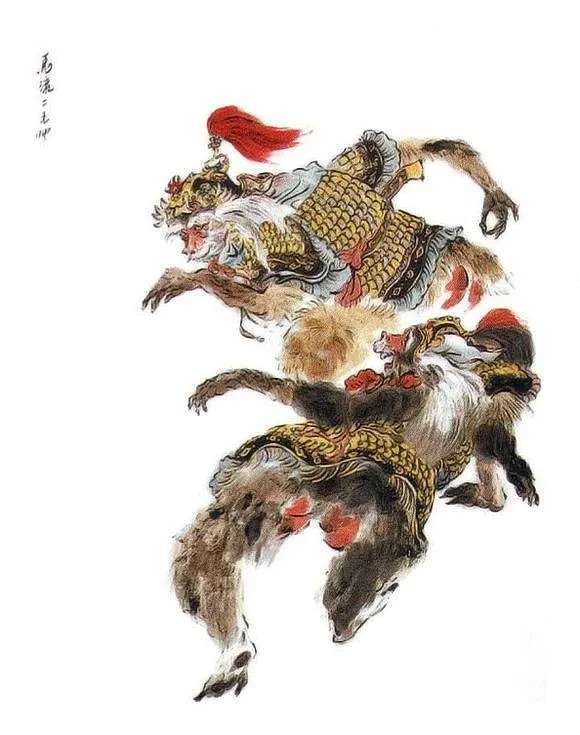
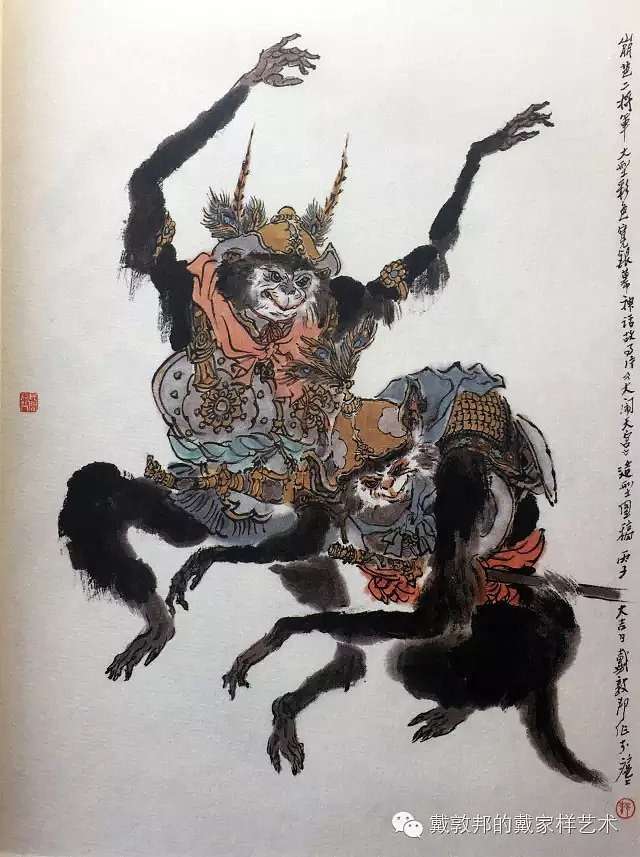
The Monkey King’s “Four Mighty Commanders” (Si Jianjiang, 四健將) (figs. 1 & 2) are minor characters appearing in chapters one, three to six, and 28 of Journey to the West (Xiyouji, 西遊記, 1592). They are presented as two elderly gibbons and two elderly horse-monkeys (i.e. macaques) who serve their monarch as advisors and makeshift tutors on spiritual and military matters. In fact, one of them is responsible for setting Wukong on his path towards immortality. They are later given high military rank and charged with training and governing Wukong’s monkey army. An outside observer may question the commanders’ ability to lead troops in battle since they are defeated in nearly every single skirmish. But it should be remembered that, while technically immortal, they can still be killed and only have access to mere earthly weapons. Yet, they choose to face celestial soldiers who wield divine weapons and have millennia of combat experience. This speaks to their great bravery.
Here, I have gathered all references to these characters that I know of. I’ve also included a section on the possible homophonic origins of their names, as well as a section describing their immortality.
This article was prompted by a question put to me on tumblr. Searching the site for “beng ba” and “ma liu” results in a number of posts with fan art and fiction, so this survey has merit. Hopefully it will benefit fans of the novel and/or those who wish to insert these characters into their fan media.
Note: I have changed some of Yu’s (Wu & Yu, 2012) translations of primate names for more accuracy. Also, any bold text from this point forward is my emphasis.
[The Stone Monkey becomes the king of the primates through a test of bravery: leaping through a waterfall and discovering a long-forgotten immortal’s cave.]
The Handsome Monkey King thus led a flock of gibbons [yuanhou, 猿猴], macaques [mihou, 獼猴], and horse-monkeys [mahou, 馬猴], some of whom were appointed by him as his officers and ministers (based on Wu & Yu, 2012, vol. 1, p. 106).
From among the ranks a long-armed gibbon [tongbei yuanhou, 通背猿猴; lit: “(arms)-through-the back-gibbon”] [1] suddenly leaped forth and cried aloud, “If the Great King is so farsighted, it may well indicate the sprouting of his religious inclination. There are, among the five major divisions of all living creatures, only three species that are not subject to Yama, King of the Underworld.” The Monkey King said, “Do you know who they are?” The monkey said, “They are the Buddhas, the immortals, and the holy sages; these three alone can avoid the Wheel of Transmigration as well as the process of birth and destruction, and live as long as Heaven and Earth, the mountains and the streams.” “Where do they live?” asked the Monkey King. The monkey said, “They do not live beyond the world of the Jambudvipa, for they dwell within ancient caves on immortal mountains.” When the Monkey King heard this, he was filled with delight, saying, “Tomorrow I shall take leave of you all and go down the mountain. Even if I have to wander with the clouds to the comers of the sea or journey to the distant edges of Heaven, I intend to find these three kinds of people. I will learn from them how to be young forever and escape the calamity inflicted by King Yama” (based on Wu & Yu, 2012, vol. 1, p. 107).
[After returning from abroad, the Monkey King wishes to train his children in how to defend themselves with weapons since they had previously been plagued by the Demon King of Havoc.]
As they were speaking, four older monkeys [si ge laohou, 四個老猴] came forward, two horse-monkeys with red buttocks [chikao mahou, 赤尻馬猴] and two long-armed gibbons. Coming to the front, they said, “Great King, to be furnished with sharp-edged weapons is a very simple matter.” “How is it simple?” asked Wukong. The four monkeys replied, “East of our mountain, across two hundred miles of water, is the boundary of the Aolai Country. In that country there is a king who has numberless men and soldiers in his city, and there are bound to be all kinds of gold, silver, copper, and iron works there. If the great king goes there, he can either buy weapons or have them made” (based on Wu & Yu, 2012, vol. 1, p. 131).
[Wukong frets over not having a divine weapon that fits his taste.]
The four elder monkeys came forward and memorialized, “The great king is a divine sage, and therefore it is not fit for him to use an earthly weapon. We do not know, however, whether the great king is able to take a journey through water?” “Since I have known the Way,” said Wukong, “I have the ability of seventy-two transformations. The cloud somersault has unlimited power. I am familiar with the magic of body concealment and the magic of displacement. I can find my way to Heaven or I can enter the Earth. I can walk past the sun and the moon without casting a shadow, and I can penetrate stone and metal without hindrance. Water cannot drown me, nor fire burn me. Is there any place I can’t go to?” “It’s a good thing that the great king possesses such powers,” said the four monkeys, “for the water below this sheet iron bridge of ours flows directly into the Dragon Palace of the Eastern Ocean. If you are willing to go down there, Great King, you will find the old Dragon King, from whom you may request some kind of weapon. Won’t that be to your liking?” Hearing this, Wukong said with delight, “Let me make the trip!” (Wu & Yu, 2012, vol. 1, p. 133).
The Monkey King made the four old monkeys mighty commanders of his troops by appointing the two horse-monkeys with red buttocks as marshals Ma and Liu [Ma, Liu er yuanshuai, 馬、流二元帥], and the two long-armed gibbon as generals Beng and Ba [Beng, Ba er jiangjun, 崩、芭二將軍]. The four mighty commanders [si jianjiang, 四健將], moreover, were entrusted with all matters concerning fortification, pitching camps, reward, and punishment (based on Wu & Yu, 2012, vol. 1, p. 138).
[The Monkey King becomes sworn brothers with six other animal demon kings.]
One day, the four mighty commanders had been told to prepare a great banquet in their own cave, and the six kings were invited to the feast. They killed cows and slaughtered horses; they sacrificed to Heaven and Earth. The various imps were ordered to dance and sing, and they all drank until they were thoroughly drunk. After sending the six kings off, Wukong also rewarded the leaders great and small with gifts. Reclining in the shade of pine trees near the sheet iron bridge, he fell asleep in a moment. The four mighty commanders led the crowd to form a protective circle around him, not daring to raise their voices (based on Wu & Yu, 2012, vol. 1, p. 139).
[Wukong’s soul is taken to the underworld because he is fated to die at 342 year old. However, he inks out his name, as well as those of all other monkeys, from the ledgers of hell and then fights his way out of the world of darkness.]
While our Monkey King was fighting his way out of the city, he was suddenly caught in a clump of grass and stumbled. Waking up with a start, he realized that it was all a dream. As he was stretching himself, he heard the four mighty commanders and the various monkeys crying with a loud voice, “Great King! How much wine did you imbibe? You’ve slept all night long. Aren’t you awake yet?” “Sleeping is nothing to get excited about,” said Wukong, “but I dreamed that two men came to arrest me, and I didn’t perceive their intention until they brought me to the outskirts of the Region of Darkness. Showing my power, I protested right up to the Palace of Darkness and argued with the Ten Kings. I went through our ledger of births and deaths and crossed out all our names. Those fellows have no hold over us now.” The various monkeys all kowtowed to express their gratitude. From that time onward there were many mountain monkeys who did not grow old, for their names were not registered in the Underworld. When the Handsome Monkey King finished his account of what had happened, the four mighty commanders reported the story to the demon kings of various caves, who all came to tender their congratulations (Wu & Yu, 2012, vol. 1, p. 141).
[Monkey is invited to heaven to be the keeper of the heavenly horses. This is a plan to keep his unruly adventures in check.]
He then called the four mighty commanders together for this admonition: “Be diligent in teaching and drilling the young ones. Let me go up to Heaven to take a look and to see whether I can have you all brought up there too to live with me.” The four mighty commanders indicated their obedience (Wu & Yu, 2012, vol. 1, p. 144).
[He leaves heaven in rebellion when he learns that his post is the lowest in the celestial bureaucracy.]
ln a moment, he lowered the direction of his cloud and returned to the Flower-Fruit Mountain. The four mighty commanders were seen drilling troops with the Monster Kings of various caves. “Little ones,” this Monkey King cried in a loud voice, “old Monkey has returned!” (Wu & Yu, 2012, vol. 1, p. 150).
“Make me a banner immediately,” he ordered the four mighty commanders, “and inscribe on it in large letters, ‘The Great Sage, Equal to Heaven.’ Erect a pole to hang it on” (Wu & Yu, 2012, vol. 1, p. 151).
[He is granted the empty title of “Great Sage Equaling Heaven” and charged with guarding the immortal peach groves. However, he eats most of the ripe fruit, and then he wrecks a long-awaited banquet just because he isn’t invited. He finally flees to earth.]
Lowering the direction of his cloud, he returned to the Flower-Fruit Mountain. There he was greeted by flashing banners and shining spears, for the four mighty commanders and the monster kings of seventy-two caves were engaging in a military exercise. “Little ones,” the Great Sage called out loudly, “I have returned!” The monsters dropped their weapons and knelt down, saying, “Great Sage! What laxity of mind! You left us for so long, and did not even once visit us to see how we were doing.” “It’s not that long!” said the Great Sage. “It’s not that long!” They walked as they talked, and went deep inside the cave dwelling. After sweeping the place clean and preparing a place for him to rest, and after kowtowing and doing homage, the four mighty commanders said, “The Great Sage has been living for over a century in Heaven. May we ask what appointment he actually received?”
“I recall that it’s been but half a year,” said the Great Sage, laughing. “How can you talk of a century?” “One day in Heaven,” said the commanders, “is equal to one year on Earth” (Wu & Yu, 2012, vol. 1, p. 166).
The various monsters were delighted by these words, and they prepared a banquet of fruits and wine to welcome him. A stone bowl was filled with coconut wine and presented to the Great Sage, who took a mouthful and then exclaimed with a grimace, “It tastes awful! Just awful!” “The Great Sage,” said Beng and Ba, the two commanders, “has grown accustomed to tasting divine wine and food in Heaven. Small wonder that coconut wine now seems hardly delectable. But the proverb says, “Tasty or not, it’s water from home!” (Wu & Yu, 2012, vol. 1, p. 167).
[Heaven calls up forces to end his hijinks. The first to challenge him are the Nine Luminaries, anthropomorphic deities of the planets, moon, and sun.]
Hastily the little monsters reported inside, “Great Sage, disaster! Disaster! Outside there are nine savage deities who claim that they are sent from the Region Above to subdue the Great Sage.” Our Great Sage was just sharing the Heavenly wine with the four mighty commanders and the monster kings of seventy-two caves. Hearing this announcement, he said in a most nonchalant manner,
“If you have wine today, get drunk today; Mind not the troubles in front of your door!”
Hardly had he finished speaking when still another flock of imps arrived to report, “Father, those nine savage gods have broken down the door, and are about to fight their way in!”
These reckless, witless gods!” said the Great Sage angrily. “They really have no manners! I was not about to quarrel with them. Why are they abusing me to my face?” He gave the order for the One-Horn Demon King to lead the monster kings of seventy-two caves to battle, adding that old Monkey and the four mighty commanders would follow in the rear. The Demon King swiftly led his troops of ogres to go out to fight, but they were ambushed by the Nine Luminaries and pinned down right at the head of the sheet iron bridge (Wu & Yu, 2012, vol. 1, pp. 170-171).
[The Monkey King singlehandedly defeats the Nine Luminaries.]
Devaraja Li then ordered the Four Great Devarajas and the Twenty-Eight Constellations to go out together to do battle. Without displaying the slightest panic, the Great Sage also ordered the One-Horn Demon King, the monster kings of seventy-two caves, and the four mighty commanders to range themselves in battle formation in front of the cave (Wu & Yu, 2012, vol. 1, p. 171).
Beginning with the battle formation at dawn, they fought until the sun sank down behind the western hills. The One-Horn Demon King and the monster kings of seventy-two caves were all taken captive by the forces of Heaven. Those who escaped were the four mighty commanders and the troop of monkeys, who hid themselves deep inside the Water-Curtain Cave. With his single rod, the Great Sage withstood in midair the Four Great Devarajas, Li the Pagoda Bearer, and Prince Nata, and battled with them for a long time. When he saw that evening was approaching, the Great Sage plucked a handful of hairs, threw them into his mouth, and chewed them to pieces. He spat them out, crying, “Change!” They changed at once into many thousands of Great Sages, each employing a golden-hooped rod! They beat back Prince Nata and defeated the Five Devarajas.
In triumph the Great Sage collected back his hairs and hurried back to his cave. Soon, at the head of the sheet iron bridge, he was met by the four mighty commanders leading the rest of the monkeys. As they kowtowed to receive him they cried three times, sobbing aloud, and then they laughed three times, hee-heeing and ho-hoing. The Great Sage said, “Why do you all laugh and cry when you see me?” “When we fought with the Deva Kings this morning,” said the four mighty commanders, “the monster kings of seventy-two caves and the One-Horn Demon King were all taken captive by the gods. We were the only ones who managed to escape alive, and that is why we cried. Now we see that the Great Sage has returned unharmed and triumphant, and so we laugh as well.”
“Victory and defeat,” said the Great Sage, “are the common experiences of a soldier. The ancient proverb says,
You may kill ten thousand of your enemies, But you will lose three thousand of your allies!
Moreover, those chieftains who have been captured are tigers and leopards, wolves and insects, badgers and foxes, and the like. Not a single member of our own kind has been hurt. Why then should we be disconsolate? Although our adversaries have been beaten back by my magic of body division, they are still encamped at the foot of our mountain. Let us be most vigilant, therefore, in our defense. Have a good meal, rest well, and conserve your energy. When morning comes, watch me perform a great magic and capture some of these generals from Heaven, so that our comrades may be avenged.” The four mighty commanders drank a few bowls of coconut wine with the host of monkeys and went to sleep peacefully. We shall speak no more of them (Wu & Yu, 2012, vol. 1, pp. 172-173).
The Immortal Master fought the Great Sage for more than three hundred rounds, but the result still could not be determined. The Immortal Master, therefore, summoned all his magical powers; with a shake, he made his body a hundred thousand feet tall. Holding with both hands the divine lance of three points and two blades like the peaks that cap the Hua Mountain, this green-faced, saber-toothed figure with scarlet hair aimed a violent blow at the head of the Great Sage. But the Great Sage also exerted his magical power and changed himself into a figure having the features and height of Erlang. He wielded a compliant golden-hooped rod that resembled the Heaven-supporting pillar on top of Mount Kunlun to oppose the god Erlang. This vision so terrified the marshals, Ma and Liu, that they could no longer wave the flags, and so appalled the generals, Beng and Ba, that they could use neither scimitar nor sword. On the side of Erlang, the Brothers Kang, Zhang, Yao, Li, Guo Shen, and Zhi Jian gave the order to the plant-headed deities to let loose the falcons and dogs and to advance upon those monkeys in front of the Water-Curtain Cave with mounted arrows and drawn bows. The charge, alas,
Dispersed the four mighty commanders of monkey imps And captured two or three thousand numinous fiends!
Those monkeys dropped their spears and abandoned their armor, forsook their swords, and threw away their lances. They scattered in all directions running, screaming, scuttling up the mountain, or scrambling back to the cave. It was as if a cat at night had stolen upon resting birds: they darted up as stars to fill the sky. The Brothers thus gained a complete victory, of which we shall speak no further (Wu & Yu, 2012, vol. 1, pp. 181-182).
[Monkey returns to the Mountain of Flowers and Fruit after being kicked out of the pilgrimage. He discovers that the remainder of his children are plagued by human hunters that eat or force them to perform tricks.]
When the Great Sage heard these words, he became terribly angry. “Who is in charge in the cave now?” he asked. “We still have Ma and Liu, the two marshals,” said the little fiends, “[B]eng and Ba, the two generals, they are in charge.” “Report to them at once,” said the Great Sage, “and say that I’ve returned.” Those little fiends dashed inside the cave and cried, “Father Great Sage has come home!” When Ma, Liu, [B]eng, and Ba heard the report, they rushed out of the door to kowtow and to receive him inside the cave. The Great Sage took a seat in the middle as the various fiends all lined up before him to pay homage. “Father Great Sage,” they said, “we heard recently that you had regained your life so that you could protect the Tang Monk on his journey to the Western Heaven to acquire scriptures. Why are you not heading toward the West? Why do you come back to this mountain?”
“Little ones,” said the Great Sage, “you have no idea that the Tang Monk is wholly ignorant of who is worthy and who is foolish. For his sake, I caught fiends and overcame demons throughout the journey, using all my abilities. Several times I slew a monster, but, accusing me of doing evil and violence, he disowned me as his disciple and banished me back here. He even wrote me a formal letter of banishment as proof that he would never want to use me again.” Clapping their hands and roaring with laughter, the monkeys said, “Lucky! Lucky! What do you want to be a monk for? Come home and you can lead us to have a few years’ fun. Quick! Let’s bring out the coconut wine for the reception of Father.” “Let’s not drink wine just yet,” said the Great Sage. “Let me ask you, how often do those hunters come to our mountain?” “Great Sage,” said Ma and Liu, “there’s no telling of time. They are here every day to make trouble.” The Great Sage asked, “Why aren’t they here today?” Ma and Liu replied, “Just wait and you’ll see them come” (Wu & Yu, 2012, vol. 2, pp. 31-32).
This Chinese article suggests a naturalistic explanation for these odd-sounding names:
Beng-Ba [崩芭] should be a homophone of “bengba” [蹦巴], that is, bengda [蹦躂], which means that the monkey jumps up and down all day without a moment’s peace. Therefore, it became an alternative name for monkeys. Ma-Liu [馬流] is a homophone for “maliu” [麻溜], which means the monkey moves with speed and agility.
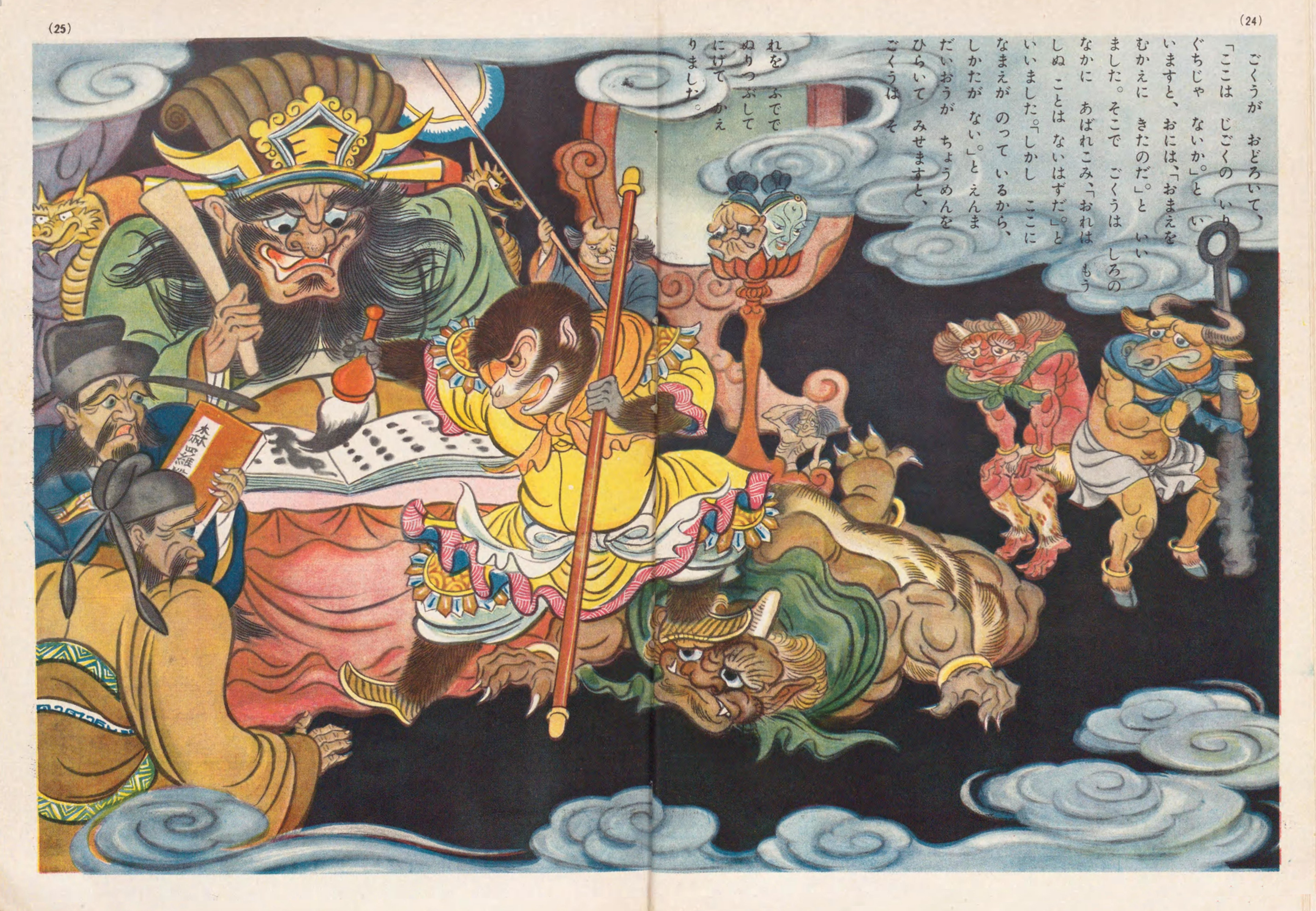
I mentioned in the introduction that the Four Mighty Commanders are technically immortal. This is the result of Wukong inking out the names of all monkeys from the ledgers of hell in chapter three (fig. 2). Wukong explains:
I went through our ledger of births and deaths [shengsi buzi, 生死簿子] and crossed out all our names. Those fellows have no hold over us now.” The various monkeys all kowtowed to express their gratitude. From that time onward there were many mountain monkeys [shanhou, 山猴] who did not grow old, for their names were not registered in the Underworld (Wu & Yu, 2012, vol. 1, p. 141).
Their divine longevity is exhibited when they reappear in chapter 28, sometime after Wukong is released from his 600-plus year imprisonment under Five Elements Mountain. And this same chapter also reveals that they are still capable of dying if fatally wounded. The rank and file monkeys lament their fate at the hands of human hunters:
Those of us who were shot by arrows, pierced by spears, or clubbed to death they took away for food to be served with rice. The dead monkeys would be skinned and boned, cooked with sauce and steamed with vinegar, fried with oil, and sauteed with salt (Wu & Yu, 2012, vol. 2, p. 31).
Fig. 2 – Monkey striking the names from the ledger (larger version). From the Japanese children’s book Son Goku (1939).
4. Updates
Update: 04-30-26
I forgot to mention that Commanders Beng, Ba, Ma, and Liu appear in folk religion statuary. “Nick” Thng Fu Jie, the serving Monkey King tangki (spirit-medium) at Singapore’s Palace of Treasured Virtue (Baode gong, 寶德宮) commissioned the Sect Arts of Singapore and Malaysia (Xima zongyi, 新马宗艺) idol shop to carve 72 statues in honor of the Great Sage’s 2025 religious festival (16th day of the 2nd lunar month). The commanders appear in idols 12 to 15 (fig. 3-6).
They also appear in this video by “Angela” Hakka Moi, a friend of the blog. She briefly interviews tangki Nick.
Note:
1) This term refers to the belief that the long, agile arms of the gibbon were somehow connected (i.e. tongbi, 通臂), passing through the back (i.e. tongbei, 通背) (Gulik, 1967, p. 92-93).