

Last updated: 01-05-2025
This is the first of three articles where I will present info about the disciples’ lives prior to the main events of Journey to the West (Xiyouji, 西遊記, 1592; “JTTW” hereafter). This piece will focus on the White Dragon Horse (Bai longma, 白龍馬). The next two will focus on Zhu Bajie (here) and Sha Wujing. These are meant to compliment my previous essay on Sun Wukong.
This particular article is based on a question put to me by a reader in late-January 2023:
I was wondering about Ao Lie’s* punishment. I know that he burned a pearl from the Jade Emperor (I think?), but I’m not exactly clear as to why he did that. Was it on accident or in anger, or is there a reason given?
* Ao Lie (敖烈) is a modern name for the dragon that comes from a live action TV show called Journey to the West Afterstory (Xiyouji houzhuan, 西游记后传, 2000). [1] JTTW chapter 15 actually calls him Yulong san taizi (玉龍三太子), or “Third Prince Jade Dragon.”
What follows is a formatted and expanded version of my reply. [2]
I. Explanation
The Jade Dragon briefly describes the details of his crime to the Bodhisattva Guanyin in JTTW chapter eight:
Because I inadvertently set fire to the palace and burned some of the pearls therein, my father the king [Ao Run] memorialized to the Court of Heaven and charged me with grave disobedience. The Jade Emperor hung me in the sky and gave me three hundred lashes, and I shall be executed in a few days. I beg the Bodhisattva to save me (Wu & Yu, 2012, vol. 1, p. 213).
However, despite Yu’s (Wu & Yu, 2012) translation, the original Chinese doesn’t include a word meaning “inadvertently.” In fact, zonghuo (縱火) means “to set fire” or “arson,” meaning that the Third Prince did it on purpose—for whatever selfish reasons. Unfortunately, the novel doesn’t go into anymore detail.
II. Possible origin
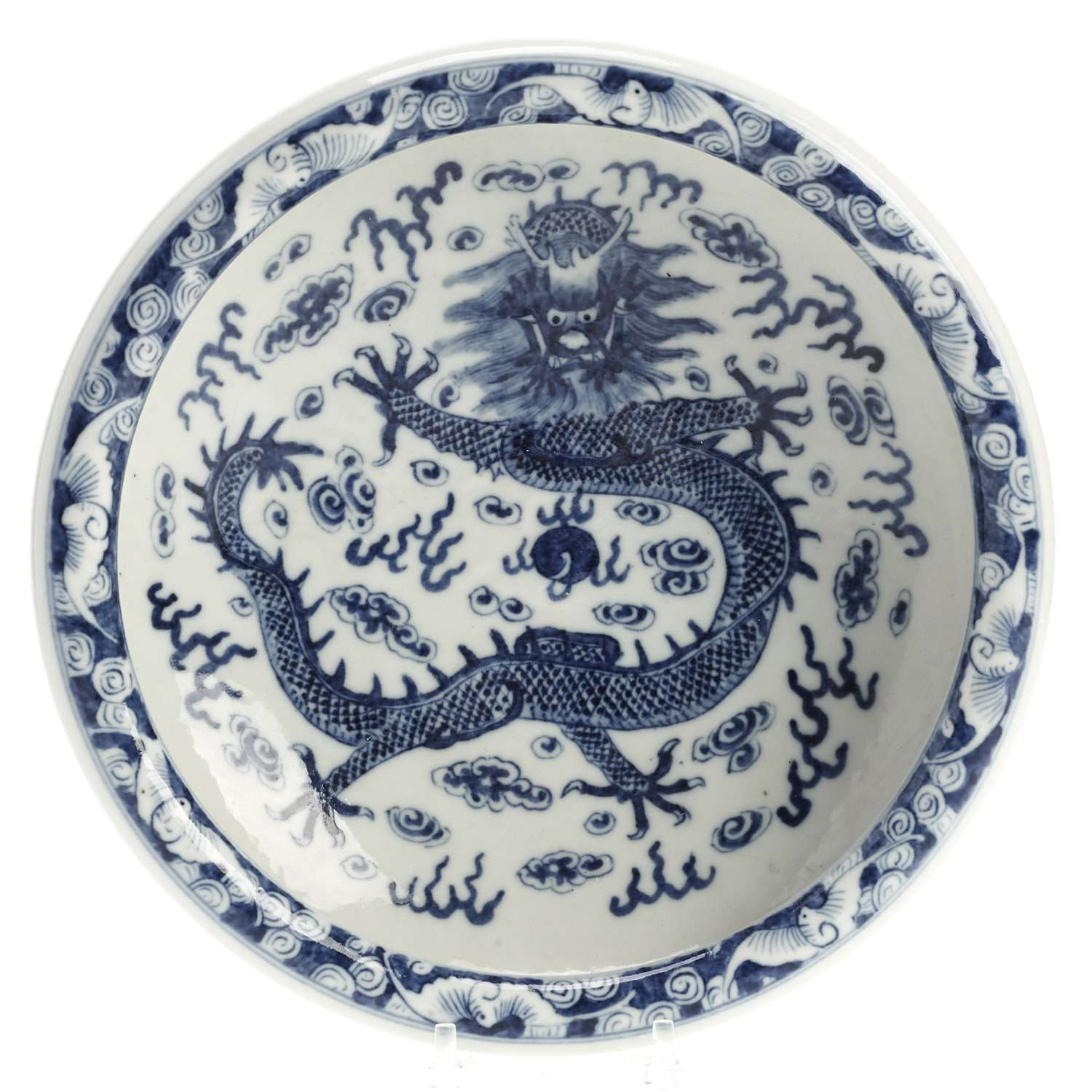
I suggest that this episode is intended to explain the “dragon chasing a jewel” (ganzhu longwen, 趕珠龍紋) motif in Chinese art. The jewel is shown emitting flames, and the dragon looks as if it’s frozen in the heavens, just like the Jade Dragon Prince was (fig. 1).


Fig. 1 – A Qing-era plate showing the dragon chasing a flaming jewel motif (larger version). Image found here. I like to think the title of this piece is “SHIT SHIT SHIT SHIT!!!! MY DAD’S GONNA KILL MEEE!!!!”
III. Significance
The pearl-burning incident is important because it directly leads to Jade Dragon joining the pilgrimage to India. After being rescued by Guanyin, he’s recruited and sent to wait for the Tang Monk “in a deep mountain stream” (shenjian zhi zhong, 深澗之中), and he official joins the quest in chapter 15 following a brief confrontation with Monkey at the specifically named Eagle Grief Stream (Yingchou jian, 鷹愁澗) (Wu & Yu, 2012, vol. 1, pp. 214 and 327-328).
Here’s the scene where he is transformed into a horse:
The Bodhisattva went up to the little dragon and plucked off the shining pearls hanging around his neck. She then dipped her willow branch into the sweet dew in her vase and sprinkled it all over his body; blowing a mouthful of magic breath on him, she cried, “Change!” The dragon at once changed into a horse with hair of exactly the same color and quality as that of the horse he had swallowed (Wu & Yu, 2012, vol. 1, p. 328).
菩薩上前,把那小龍的項下明珠摘了,將楊柳枝蘸出甘露,往他身上拂了一拂,吹口仙氣,喝聲叫:「變!」那龍即變做他原來的馬匹毛片。
Update: 01-04-25
It just dawned on me that Jade Dragon’s portrayal as a mischief-causing third prince mirrors the early life of Third Prince Nezha (San taizi Nezha, 三太子哪吒; Nezha san taizi, 哪吒三太子), whose devilry leads to him battling and killing the dragon Third Prince Ao Bing (San taizi Ao Bing, 三太子敖丙) in Investiture of the Gods (Fengshen yanyi, 封神演義, c. 1620) chapter twelve (Gu, 2000).
Update: 01-05-25
Friend of the blog Ryin-Silverfish tells me that the Third Dragon Prince is also associated with fire in the early-Ming JTTW Zaju play that predates the standard 1592 edition of the novel. He appears in “Act Seven: Mucha Sells a Horse” (Diqi chu Mucha shouma, 第七出 木叉售馬) as the “Third Prince Fire Dragon” (Huolong san taizi, 火龍三太子), who is sentenced to death for not delivering the full amount of rain to a given area as ordered by the heavenly court. And after being pardoned, he is transformed into a horse just like his novel counterpart.
Note:
1) Thank you to the good folks over at the JTTW Discord for connecting the name to a TV show, and thank you to reader innerdreamily6dcc2c3a93 for giving me the specific name.
2) I actually added this material as a January 2023 update to a previous article, but I decided to split it off into this new post.
Source:
Gu, Z. (2000). Creation of the Gods (Vols. 1-4). Beijing: New World Press.
Wu, C., & Yu, A. C. (2012). The Journey to the West (Vols. 1-4). Chicago, Illinois: University of Chicago Press.